Low lying excitations in ¹⁵⁰Pm
Pith reviewed 2026-06-25 21:17 UTC · model grok-4.3
The pith
The odd-odd nucleus 150Pm has a 1- ground state, a 2- state near 50 keV, and a low-lying 6- isomer.
A machine-rendered reading of the paper's core claim, the machinery that carries it, and where it could break.
Core claim
The present work indicates 1- ground state, a 2- state close to the ground state (~50 keV) and a low lying 6- isomeric state in this odd-odd nucleus along with emerging band structures developed with two quasiparticle configurations.
What carries the argument
Gamma-gamma coincidence spectroscopy combined with relative excitation functions at different beam energies and limited angular distribution data, interpreted through shell model calculations.
If this is right
- Confirms 1- as the ground state spin-parity for 150Pm.
- Places a 2- state approximately 50 keV above the ground state.
- Identifies a low-lying 6- isomeric state.
- Reveals band structures arising from two-quasiparticle configurations.
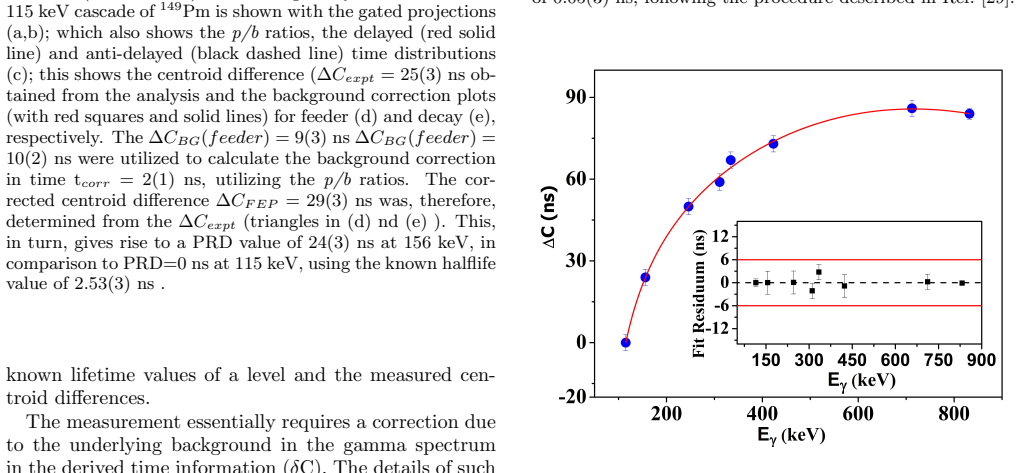
- Provides lifetime estimates for two excited levels using generalized centroid difference analysis.
Where Pith is reading between the lines
- The observed pattern of states may appear in other odd-odd nuclei in the same mass region.
- These levels could affect beta-decay properties or reaction rates involving 150Pm.
- Further coincidence data with better statistics could confirm or refine the band structures.
Load-bearing premise
The tentative spin-parity assignments to the low-lying states rely on limited angular distribution data and supporting information.
What would settle it
A precise measurement of the ground-state spin or the energy and spin of the proposed isomer that contradicts the 1-, 2-, or 6- assignments would falsify the claims.
Figures






read the original abstract
The low lying excitations in odd-odd $^{150}$Pm have been studied through proton induced reaction with an array of five Compton suppressed Clover HPGe and one segmented planar Ge detectors. The relative excitation functions for the observed $\gamma$ rays have been studied using singles data at two beam energies of 8~MeV and 9~MeV. 16 new $\gamma$ rays and 15 new levels have been placed in the level scheme of $^{150}$Pm based on $\gamma-\gamma$ coincidence data. The relative intensities for the observed $\gamma$ rays have been determined using total and gated projections. Tentative spin-parity assignments were made to few low lying excitations of $^{150}$Pm, using limited angular distribution data and other information. Lifetimes were estimated for two excited levels in this nucleus using using generalized centroid difference analysis, applied in the nanosecond range, with Ge detectors. Large basis shell model and projected shell model calculation were performed to interpret the experimentally observed levels. The present work indicates 1$^-$ ground state, a 2$^-$ state close to the ground state ($\sim$50~keV) and a low lying 6$^-$ isomeric state in this odd-odd nucleus along with emerging band structures developed with two quasiparticle configurations.
Editorial analysis
A structured set of objections, weighed in public.
Referee Report
Summary. The paper reports an experimental study of low-lying excitations in odd-odd 150Pm via proton-induced reactions at 8 and 9 MeV using five Compton-suppressed Clover HPGe detectors and one segmented planar Ge detector. From γ-γ coincidence data, 16 new γ rays and 15 new levels are placed in the level scheme. Relative intensities are determined from total and gated projections, and relative excitation functions are examined. Tentative J^π assignments are made to a few low-lying states (including a 1− ground state, a 2− state near 50 keV, and a 6− isomeric state) using limited angular distribution data and other information. Lifetimes of two levels are estimated via generalized centroid difference analysis in the nanosecond range. Results are compared to large-basis shell-model and projected shell-model calculations to interpret two-quasiparticle configurations and emerging band structures.
Significance. If the tentative assignments hold, the work supplies new experimental constraints on the structure of 150Pm, a nucleus with sparse prior data on low-lying states. The addition of 15 levels, lifetime estimates, and model comparisons helps map two-quasiparticle excitations in this odd-odd system. The experimental methods (coincidence spectroscopy, intensity measurements, and ns-range lifetime analysis with Ge detectors) are standard and the assignments are explicitly labeled tentative, reducing circularity risk with the calculations.
major comments (1)
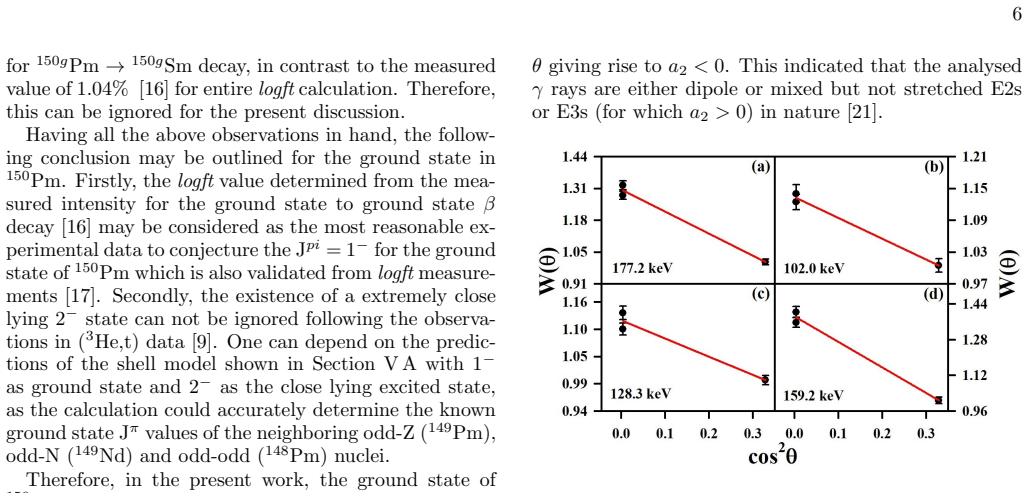
- [Abstract] Abstract: The headline indications of a 1− ground state, ~50 keV 2− state, and low-lying 6− isomer are load-bearing for the claimed configurations and band structures, yet rest on tentative assignments from 'limited angular distribution data and other information'. A dedicated subsection or figure presenting the angular-distribution coefficients (A2, A4), fit quality, and alternative J^π possibilities is required to assess whether these assignments can be considered reliable enough to support the stated conclusions.
minor comments (3)
- [Abstract] Abstract: Typo 'using using generalized centroid difference analysis' should be corrected.
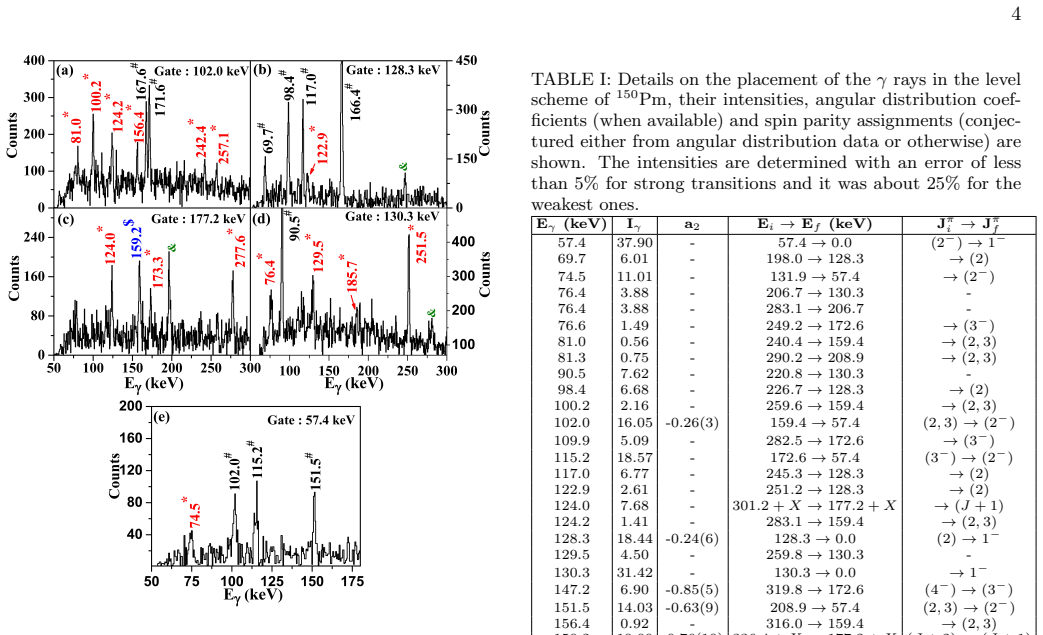
- The manuscript should include the complete level scheme, representative coincidence spectra, and a table of new γ-ray energies, intensities, and placements to allow independent verification of the 16 new transitions and 15 new levels.
- Uncertainties on relative intensities, excitation-function ratios, and lifetime values are not mentioned in the abstract; these should be reported explicitly with the data.
Simulated Author's Rebuttal
We thank the referee for the careful review and for recognizing the significance of the new experimental constraints on 150Pm. We address the single major comment below.
read point-by-point responses
-
Referee: [Abstract] Abstract: The headline indications of a 1− ground state, ~50 keV 2− state, and low-lying 6− isomer are load-bearing for the claimed configurations and band structures, yet rest on tentative assignments from 'limited angular distribution data and other information'. A dedicated subsection or figure presenting the angular-distribution coefficients (A2, A4), fit quality, and alternative J^π possibilities is required to assess whether these assignments can be considered reliable enough to support the stated conclusions.
Authors: We agree that the angular-distribution analysis supporting the tentative J^π assignments requires more explicit documentation. Although the manuscript already qualifies these assignments as tentative and notes the limited nature of the data, we will add a dedicated subsection (with an accompanying table or figure) that reports the measured A2 and A4 coefficients, the quality of the Legendre-polynomial fits, and the alternative J^π values that were considered and rejected on the basis of the available information. This addition will be placed in the Results section and will allow readers to evaluate the assignments independently. The revision will be incorporated in the next version of the manuscript. revision: yes
Circularity Check
No significant circularity; experimental placements and tentative assignments derive directly from coincidence and angular data, with models used only for post-hoc interpretation.
full rationale
The paper reports new γ-γ coincidence placements, relative intensities, excitation functions, and limited angular distributions from proton-induced reactions. Tentative J^π values and the indicated 1^-, 2^-, and 6^- states follow from those measurements plus 'other information,' without any parameter fitting to the new data that would render subsequent model comparisons circular. Shell-model and projected-shell-model calculations are invoked solely to interpret the observed levels after the experimental scheme is constructed; no self-citation chain, self-definitional loop, or fitted-input-called-prediction pattern appears in the derivation. The central claims therefore remain externally falsifiable against the raw coincidence and angular data.
Axiom & Free-Parameter Ledger
Reference graph
Works this paper leans on
-
[1]
This was determined through the measurement of intensity ofβdecay of 150gPm to 150gSm
Ground state The spin-parity of 1 − was conjectured, for the ground state of 150Pm, by Hoshi et al., [16] from the measure- ment oflogftvalues. This was determined through the measurement of intensity ofβdecay of 150gPm to 150gSm. This is the only measurement of this particular ground state to ground state beta decay intensity which resulted in the assign...
-
[2]
However, the determination of multipo- larity for the 57.4 keV transition has not been possible from any conventional method
57.4 keV excited state This 57.4 keV state is found to be the first excited state in 150Pm. However, the determination of multipo- larity for the 57.4 keV transition has not been possible from any conventional method. In the present work, J π of this level is conjectured to be 2 − following the predic- tion of shell model which has successfully reproduced...
-
[3]
In order to realize this measurement, the 90 ◦ de- tectors were divided into two halves, thereby, generating data at two different angles of 86.5 ◦ and 93.5 ◦
Other excited levels The spin assignment for few excited levels of 150Pm were attempted from a limited angular distribution anal- ysis. In order to realize this measurement, the 90 ◦ de- tectors were divided into two halves, thereby, generating data at two different angles of 86.5 ◦ and 93.5 ◦. This could be done due to the known opening angle of the Clov...
-
[4]
Verification of calculation The calculated low-lying level schemes of the neigh- bouring nuclei 149Pm, 149Nd, and 148Pm are compared with the experimental data [30, 42] in Fig. 12. The par- ticle restrictions adopted for these nuclei are summarized in Table III. For all three benchmark nuclei, the ground state is cor- rectly reproduced and the overall pat...
-
[5]
Levels in 150Pm The present shell-model calculation predicts a 1 − ground state for 150Pm and a closely lying 2 − state at 31 keV, consistent with the experimental ground-state assignment of Hoshiet al.[16]. In addition, a low-lying 6− state is predicted at 7 keV, which is not inconsistent with the systematics of isomeric states in this region [7], althou...
1929
-
[6]
The first excited band originates from 1ν1πconfiguration withK=−2 and quasiparticle energy of 1.87 MeV
This band is crossed at spin I=7 by another two- quasiparticle band having a different intrinsic configura- tion of (−3,1ν1π,2.20). The first excited band originates from 1ν1πconfiguration withK=−2 and quasiparticle energy of 1.87 MeV. As is evident from Fig. 14, the second excited band depicts crossings with several other configu- rations consisting of (...
1913
-
[7]
Evaluated Nuclear Structure Data(ENSDF): https://nndc.bnl.gov/ ensdf
-
[8]
Iachello,Phys
F. Iachello,Phys. Rev. Lett.87, 052502 (2001)
2001
-
[9]
R. F. Casten and N. V. Zamfir,Phys. Rev. Lett.87, 052503 (2001)
2001
-
[10]
Kr¨ ucken et al.,Phys
R. Kr¨ ucken et al.,Phys. Rev. Lett.88, 232501 (2002)
2002
-
[11]
Barea, C
J. Barea, C. E. Alonso and J. M. Ares,Phys. Rev. C83, 024307(2011)
2011
-
[12]
Rev.96, 1549 (1954)
Vera Kistiakowsky FischerPhys. Rev.96, 1549 (1954)
1954
-
[13]
A. Saha T. Bhattacharjee, D. Banerjee, Deepak Pandit, P. Das, Soumik Bhattacharya, R. Guin, S. K. Das, S. R. Banerjee,Eur. Phys. J. A56, 189 (2020). 19
2020
-
[14]
K. T. Lesko, E. B. Norman, R. -M. Larimer, J. C. Bacelar and E. M. BeckPhys. Rev. C39, 619 (1989)
1989
-
[15]
C. J. Guess et al.,Phys. Rev. C83, 064318 (2011)
2011
-
[16]
Banerjee A
D. Banerjee A. Saha, T. Bhattacharjee, R. Guin, S. K. Das, P. Das, Deepak Pandit, A. Mukherjee, A. Chowd- hury, Soumik Bhattacharya, S. Das Gupta, S. Bhat- tacharyya, P. Mukhopadhyay and S. R. BanerjeePhys. Rev. C91, 024617 (2015)
2015
-
[18]
Bucurescu et al.,Phys
D. Bucurescu et al.,Phys. Rev. C85, 017304 (2012)
2012
-
[19]
S. Das, S. Samanta, R. Banik, R. Bhattacharjee, K. Basu, R. Raut, S. S. Ghugre, A. K. Sinha, S. Bhattacharya, S. Imran et al.,Nucl. Instrum. Methods Phys. Res. Sect. A 893, 138 (2018)
2018
-
[20]
R. K. Bhowmik (private communication)
-
[21]
Lebeda et al.,Nucl
O. Lebeda et al.,Nucl. Phys. A929, 129 (2014)
2014
-
[22]
Hoshi, M
M. Hoshi, M. Fujiwara and Y. Yoshizawa,J. Phys. Soc. Japan42, 1098 (1977)
1977
-
[23]
Barrette, M
J. Barrette, M. Barrette, S. Monaro, S. Santhanam, and S. Markiza,Can. J. Phys.48, 1161 (1970)
1970
-
[24]
Kib´ edi, T
T. Kib´ edi, T. W. Burrows, M. B. Trzhaskovskaya, P. M. Davidson, C. W. Nestor, Jr.,Nucl. Instrum. Meth- ods Phys. Res., Sect. A589, 202 (2008)
2008
-
[25]
Saha et al.,Nucl
A. Saha et al.,Nucl. Phys. A9761 (2018)
2018
-
[26]
Basak et al.,Phys
S. Basak et al.,Phys. Rev. C111, 034319 (2025)
2025
-
[27]
Podolyak, C
Z. Podolyak, C. M. Shand, E. Wilson, B. A. Brown, H. Grawe, C. J. Chiara, S. Zhu, B. Fornal, and R. V. F. Janssens,J. Phys. Conf. Ser.580, 012010 (2015)
2015
-
[28]
E. S. Macias, W. D. Ruther, D. C. Camp and R. G. LanierComp. Phys. Comm11, 75 (1976)
1976
-
[29]
Kortelahti, A
M. Kortelahti, A. Pakkanen, M. Piiparinen, E. Ham- mar` en, T. Komppa, and R. Komu,Nucl. Phys. A332, 422 (1979)
1979
-
[30]
Mordechai, A
S. Mordechai, A. A. Jaffe, D. Nir and M. Paul,Nucl. Phys. A208, 410 (1973)
1973
-
[31]
Kumar et al.,Phys
D. Kumar et al.,Phys. Rev. C106, 034306 (2022)
2022
-
[32]
Basak, S
S. Basak, S. S. Alam, D. Kumar, A. Saha, T. Bhattachar- jee,Phys. Rev. C104, 024320 (2021)
2021
-
[33]
S. K. Tandel et al.,Phys. Lett. B750225 (2015)
2015
-
[34]
Khamos Yadav et al.,Phys. Rev. C105, 034307 (2022)
2022
-
[35]
J. M. R´ egis et al.,Nucl. Instr. & Meth. A823, 72 (2016)
2016
-
[36]
Data Sheets185, 2 (2022)
Balraj Singh and Jun ChenNucl. Data Sheets185, 2 (2022)
2022
-
[37]
S. K. Basu and A. A. Sonzogni, Nucl. Data Sheets114, 435 (2013)
2013
-
[38]
Palit et al.,Nucl
R. Palit et al.,Nucl. Instrum. Methods Phys. Res. Sect. A680, 90 (2012)
2012
-
[39]
J. -M. R´ egis, A. Esmaylzadeh, J. Jolie, V. Karayonchev, L. Knafla, U. K¨oster, Y. H. Kim, and E. Strub,Nucl. Instrum. Methods Phys. Res. A955, 163258 (2020)
2020
-
[40]
Kumar et al.,Phys
D. Kumar et al.,Phys. Rev. C109, 024302 (2024)
2024
-
[41]
S. S. Alam et al.,Phys. Rev. C99, 014306 (2019)
2019
-
[42]
M¨oller, A
P. M¨oller, A. J. Sierka, T. Ichikawa, H. Sagawa,Atom. Data and Nucl. Data Tables,109-110, 1 (2016)
2016
-
[43]
B. A. Brown, W. D. M. Rae , Nucl. Data Sheets120 (2014) 115
2014
-
[44]
B. A. Brown, N. J. Stone, J. R. Stone, I. S. Towner, and M. Hjorth-Jensen,Phys. Rev. C71, 044317 (2005)
2005
-
[45]
Shergur et al.,Phys
J. Shergur et al.,Phys. Rev. C72, 024305 (2005)
2005
-
[46]
Somen Chanda et al.,Phys. Rev. C,79, 054332 (2009)
2009
-
[47]
Somen Chanda et al.,Nucl. Phys. A,775, 153 (2006)
2006
-
[48]
Nica NDS 117,Nucl
N. Nica NDS 117,Nucl. Data Sheets117, 1 (2014)
2014
-
[49]
Nomura,Phys
K. Nomura,Phys. Rev. C105, 044301 (2022)
2022
-
[50]
Hara and Y
K. Hara and Y. Sun, Int. J. Mod. Phys. E4, 637 (1995)
1995
-
[51]
Nilsson et al., Nucl
S.G. Nilsson et al., Nucl. Phys. A131, 1 (1969)
1969
-
[52]
Dieterich et al., Nucl
W. Dieterich et al., Nucl. Phys. A253, 429 (1975)
1975
-
[53]
M¨oller and J
P. M¨oller and J. Nix, At. Data Nucl. Data Tables59, 185 (1995)
1995
-
[54]
L.-J. Wang, Y. Sun, and S. K. Ghorui, Phys. Rev. C97, 044302 (2018)
2018
-
[55]
Velazquez, J
V. Velazquez, J. G. Hirsch, Y. Sun et al., Nuclear Physics A653, 355 (1999)
1999
-
[56]
Sun and D
Y. Sun and D. H. Feng, Phys. Rep.264, 375 (1996)
1996
-
[57]
Castel and I
B. Castel and I. S. Towner, Modern Theories of Nuclear Moments (Clarendon, Oxford, 1990)
1990
-
[58]
Sun and K
Y. Sun and K. Hara, Comput. Phys. Commun.104, 245 (1997)
1997
-
[59]
M. A. Jones et al., Nucl. Phys. A609, 201 (1996)
1996
-
[60]
W. J. Vermeer et al.,Phys. Rev. C42,4 (1990)
1990
-
[61]
Budick, I
B. Budick, I. Maleh and R. Marrus,Phys. Rev. B135 1281 (1964)
1964
-
[62]
D. G. Burke and I. G. Nowikow,Nucl. Phys. A756, 308 (2005)
2005
-
[63]
C. J. Gallagher, and S. A. Moszkowski,Phys. Rev.111 1282 (1958)
1958
-
[64]
Newby, Jr.,Phys
Neal D. Newby, Jr.,Phys. Rev.125,2063 (1962)
2063
discussion (0)
Sign in with ORCID, Apple, or X to comment. Anyone can read and Pith papers without signing in.