REVIEW 3 major objections 5 minor 193 references
Wave turbulence, thermalization and multimode locking in optical fibers
T0 review · 3 major / 5 minor · reviewed 2026-08-15 · deepseek-v4-flash
Pith's one-line read Beam self-cleaning in multimode fibers is wave thermalization, and weak disorder accelerates it.
desk verdict Thorough and honest review of wave turbulence in multimode fibers; the disorder-acceleration scaling is a reproduced result with a regime caveat the authors themselves flag, so treat the abstract's 'explains' with a grain of salt. read the letter →
The pith
A machine-rendered reading of the paper's core claim, the machinery that carries it, and where it could break.
The reading
What carries the argument
The load-bearing object is the discrete wave-turbulence kinetic equation for the averaged modal powers $n_p(z)$, obtained from the modal NLS equation by closing the moment hierarchy with the Gaussian factorization that disorder-induced random phases justify. In the parabolic GRIN potential the mode spectrum is equally spaced, $\beta_p=\beta_0(p_x+p_y+1)$, so four-wave resonances are discrete and only exact ones, $\Delta\omega_{lmnp}=0$, contribute; the disorder term supplies the damping rate $8\Delta\beta$ that replaces the Dirac resonance condition with a finite bandwidth. The equation conserves power and energy, obeys an $H$-theorem for $S=\sum_p \log n_p$, and relaxes to the RJ distribution, with the thermalization length $L^{\rm disor}_{\rm kin}\sim \Delta\beta L_{\rm nl}^2/\bar S^2_{lmnp}$ controlling the rate. In the strong-disorder case the same closing procedure yields a kinetic equation whose collision term gives RJ thermalization and whose linear term drives power equipartition, so their competition fixes whether condensation or equipartition wins.
What would settle it
Measure, in a GRIN fiber with controllable distributed stress or index fluctuations, the propagation length at which the fundamental-mode fraction reaches half its Rayleigh-Jeans equilibrium value for several disorder strengths at fixed injected power and energy; if the central claim is wrong, the measured thermalization length will not scale inversely with the disorder parameter $\Delta\beta$ and will not converge to the same RJ endpoint. A second check: in a strongly disordered fiber with $L^{\rm RJ}_{\rm kin}\ll L^{\rm eq}_{\rm kin}$, observe the modal populations as a function of length; the transient condensate predicted by the kinetic equation should rise and then decay to equipartition, and its absence would falsify the strong-disorder kinetic closure.
Extended reading notes
Core claim
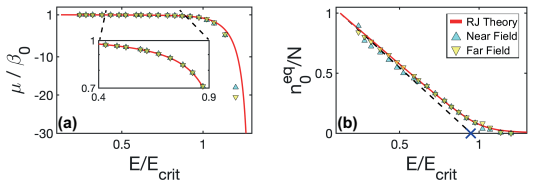
On the paper's own terms, the central claim is that the nonequilibrium evolution of a speckle beam in a GRIN multimode fiber is described by a discrete wave-turbulence kinetic equation whose equilibrium is the Rayleigh-Jeans law $n_p^{\rm eq}=T/(\beta_p-\mu)$, where $\beta_p$ is the propagation constant of mode $p$. Beam self-cleaning is the corresponding condensation: most power accumulates in the fundamental mode while higher-order modes keep a small population required by energy conservation. The new quantitative result is that weak, mode-decorrelated disorder introduces an effective dissipation $\Delta\beta$ that broadens the four-wave resonances; in the discrete regime only exact resonances survive, and the thermalization length obeys $L^{\rm disor}_{\rm kin}/L^{\rm ord}_{\rm kin}\sim \Delta\beta/\beta_0$, so disorder speeds up thermalization without changing the final RJ state. For strong disorder, the kinetic equation predicts that, although the long-distance equilibrium is power equipartition, a transient RJ condensation can still occur when the RJ thermalization length is shorter than the disorder-induced equipartition length. These predictions are validated by parameter-free comparisons with NLS simulations and by experiments on entropy growth, RJ condensation, negative temperatures, and modal phase-locking.
Load-bearing premise
The load-bearing premise is that refractive-index disorder acts much more strongly than the Kerr nonlinearity, so the modal phases are thoroughly randomized and the mode statistics factorize like Gaussian variables; the paper itself notes that in real beam-cleaning fibers the disorder and nonlinear lengths are comparable, so the quantitative acceleration scaling is derived in a regime experiments only partially satisfy.
Editorial extensions
If this is right
- If the central claim is right, the output mode distribution of a self-cleaned beam is fixed by the injected power and kinetic energy alone, so fiber output profiles can be predicted from input statistics without solving the full nonlinear wave equation.
- Weak disorder accelerates the approach to that equilibrium, implying that small fabrication imperfections or bending noise make beam cleaning easier to observe in short fibers; the final cleaned state, however, is not changed by the disorder.
- In the strong-disorder regime, transient condensation can appear before equipartition, so experiments on stressed fibers should see a rise followed by a decay of the fundamental-mode population before the beam settles to a uniform mode distribution.
- Because the kinetic theory conserves power and energy, higher-order modes are never fully emptied, so a cleaned beam is expected to carry a measurable residual population in higher-order modes rather than a pure single-mode output.
- The measured entropy growth during thermalization, including the two-beam calorimetry results, follows from the same $H$-theorem, giving a direct experimental handle on the optical temperature and chemical potential.
Reading between the lines
- A testable extension suggested by the rate scaling: in fibers with engineered disorder strength, measuring the propagation length needed to reach a fixed fraction of the equilibrium condensate should show $L_{\rm kin}\propto 1/\Delta\beta$ at fixed power and energy, a clean way to isolate the disorder contribution from nonlinearity.
- If disorder only sets the rate, the same RJ endpoint should be reachable in fibers of very different imperfection levels; that invites comparing step-index and GRIN fibers at matched mode counts to test whether the absence of beam cleaning in step-index fibers comes from the quasi-degenerate resonance structure rather than from a different equilibrium.
- The modal phase-locking that accompanies the amplitude thermalization suggests that the true attracting state may be a phase-coherent condensate dressed by a thermal tail; a statistical theory retaining phase information could predict the observed locked phases from the same conserved quantities, extending the current incoherent description.
- Because strong disorder can produce a transient condensate that later decays, single-shot measurements along the fiber might reveal a non-monotonic fundamental-mode population; time-averaged output measurements would miss this unless the transient length is resolved.
Signed reviews
Editorial analysis
A structured set of objections, weighed in public.
Referee Report
Summary. This review-style paper argues that beam self-cleaning (BSC) in graded-index multimode fibers can be understood as classical wave thermalization toward the Rayleigh-Jeans equilibrium, and that refractive-index disorder changes only the rate of this thermalization, not the final state. The authors derive wave-turbulence kinetic equations for both weak polarization-type disorder and strong random mode coupling, obtaining closed kinetic equations (Eqs. 21, 26, 37) whose stationary solutions are the RJ distribution or the equipartition distribution depending on the regime. The central quantitative claim is Eq. (30), namely that weak disorder accelerates thermalization and condensation by the factor L_disorder_kin / L_ord_kin ~ Δβ/β0. The kinetic equations are validated against numerical simulations of the NLS equation without adjustable parameters (Figs. 3, 4, 7-10), and the experimental part reviews recent measurements of entropy growth, RJ condensation, negative-temperature equilibria, and modal phase-locking. The paper concludes that the observed phase-locking accompanying BSC is outside the current statistical-mechanics description and motivates future extensions.
Significance. If the central kinetic-theory result holds as stated, this paper provides a parameter-free, first-principles description of thermalization rates in disordered multimode fibers, which would be a substantial step beyond the equilibrium thermodynamic theories of Refs. [11,13-15]. The appendices contain self-contained derivations of the discrete kinetic equations, and the NLS-to-kinetic-equation comparisons in Figs. 3, 4, 8-10 are quantitative and do not use adjustable parameters. The review also usefully collects recent experiments on entropy growth, calorimetry, and negative-temperature equilibria that support the equilibrium part of the statistical-mechanics picture, while honestly highlighting the phase-locking phenomenon that lies beyond the incoherent-wave assumption. The main weakness is that the central quantitative claim, Eq. (30), is derived in the disorder-dominated regime Ld << Lnl, whereas the paper itself concedes that BSC experiments operate near Ld ~ Lnl; the numerical support for Eq. (30) covers only idealized disorder models, not experimentally characterized GRIN fibers.
major comments (3)
- [Sec. 2.3.6, Eq. (30), and Sec. 2.5] Equation (30) is the central quantitative claim of the paper, but it is derived from the discrete kinetic equation (26) under the disorder-dominated hypothesis Ld << Lnl stated in Eq. (9). In Sec. 2.5 the authors explicitly write that in beam-cleaning experiments the impact of weak polarization disorder is expected to be of the same order as nonlinear effects and that for Ld ≥ Lnl the system enters a mixed coherent-incoherent regime that the kinetic equation does not describe. Since the abstract states that weak disorder accelerates thermalization in a practical experimental setting, the paper needs either a quantitative argument that the Ld/Lnl ratio in the actual BSC experiments is small enough for Eq. (30) to apply, or a clear reformulation of the claim as a model prediction that remains to be tested experimentally in the BSC regime.
- [Sec. 2.3.9, Figs. 3 and 7] The numerical validation of Eq. (30) is performed only for the mode-decorrelated model and for the partially mode-correlated model, and the latter is explicitly called an artificial model in Sec. 2.3.9. No experimentally measured disorder correlation statistics, values of lβ, or values of Ld for real GRIN fibers are provided. The claim that disorder accelerates thermalization in the experimental setting of BSC therefore rests on model disorder statistics rather than on measured fiber imperfections; this should be stated explicitly when the scaling is promoted in the abstract and conclusions.
- [Sec. 2.3.10, Eq. (33)] The discussion of dispersion-relation corrections shows that the acceleration scaling can be weakened or modified when the perturbation b0 is comparable to Δβ. Since typical beam-cleaning parameters give b0/β0 ~ 5×10^-4 to 5×10^-3 and no experimental estimate of Δβ for real GRIN fibers is given, the paper does not establish that the condition Δβ >> b0 required for Eq. (30) holds in the experiments it discusses. This is a load-bearing caveat for the quantitative validity of the central claim and should be moved from the end of Sec. 2.3 into the statement of Eq. (30).
minor comments (5)
- [Sec. 1] There is a typo in the introduction: the text reads "back in 1978 by by Lin et al."; the duplicated "by" should be removed.
- [Eq. (20)] The notation for the continuous extension is unclear: the text defines κ = β0(px,py) and then writes β̃_k = κx + κy + β0, which mixes discrete indices and continuous variables; please define k and β̃_k unambiguously.
- [Eq. (26)] The sentence defining M_lmnp(n) contains a garbled parenthetical "with ’ nm’ for ’ nm(z)’"; the definition should be written in standard notation with all mode indices explicitly time-dependent.
- [References [41,43]] The reference titles contain typographical errors: "Wave Trubulence" appears in [41] and "Physics of Wave Trubulence" in [43]; these should be corrected.
- [Sec. 3.4, Eq. (47)] The minimization problem in Eq. (47) would be easier to follow if the functional ε were explicitly defined as a function of the modal phases and if the constraint that the total power is fixed were written out.
Circularity Check
No significant circularity: the kinetic equations and the disorder-acceleration scaling are derived from the stated NLS model, and the RJ equilibrium is obtained as the stationary solution of those equations rather than imposed as an input.
full rationale
The central derivation chain is self-contained. The modal NLS model with disorder is stated in Eqs. (3)-(7); the Furutsu-Novikov theorem and Gaussian closure are used in Appendix A to obtain the forced-damped fourth-order moment equations (13)-(16), and the discrete kinetic equation (26) follows by keeping only exact resonances. The Rayleigh-Jeans distribution (29) is not inserted as an ansatz: it is identified as the stationary solution of the kinetic equation, which conserves power and energy and satisfies the entropy-growth theorem (27). The disorder-acceleration scaling, Eq. (30), follows algebraically from the 1/Δβ coefficient of the collision term in Eq. (26) together with the no-disorder scaling Lord_kin from Ref. [11]; it is not a fitted parameter, and the paper supports it with parameter-free NLS simulations in Figs. 3 and 7. Heavy self-citation is present, but the cited prior works contain the derivations and direct NLS simulations being reviewed, so the citations are independent evidence rather than circular support. The admitted limitation that BSC experiments operate at Ld ~ Lnl rather than Ld << Lnl, and the statement that the partially mode-correlated disorder model is 'artificial', are domain-of-validity caveats for the quantitative claim, not circularity: they do not make the derived prediction equivalent to its inputs. The phase-locking discussion in Sec. 3.4 is presented as a separate phenomenological minimization with explicitly acknowledged limited predictive capability, and it does not feed back into the kinetic-theory derivation. No step was found in which a prediction reduces by construction to a fitted parameter or to a self-citation chain.
Assumptions & free parameters
free parameters (3)
- Effective disorder strength Δβ =
2.6, 10.5, 42 m^-1 (Figs 3, 7); 2.6 m^-1 (Fig. 5)
- Disorder correlation length lβ =
30 cm, 1.88 cm, 0.47 cm (Fig. 3); 0.019 m (Fig. 4); 30 cm (Fig. 5)
- Disorder spatial shape parameters bx, by =
bx=0.4, by=0.5 in Figs 8-9; bx=0.4, by=0.3 in Fig. 10
assumptions (7)
- domain assumption Gaussian moment theorem closure for fourth-order moments (random phases imply factorizability)
- domain assumption Weakly nonlinear regime Llin << Lnl
- domain assumption Disorder dominates nonlinearity Ld << Lnl
- domain assumption Conservation of power N and kinetic energy E, negligible losses
- ad hoc to paper Phenomenological polarization disorder as Hermitian matrices with Ornstein-Uhlenbeck statistics
- ad hoc to paper Partially mode-correlated disorder model (degenerate modes share noise, distinct groups decorrelated)
- domain assumption Strong disorder regime: Llin << Ldis and Llin << lβ
Cite this review
Pith. "Pith review of Wave turbulence, thermalization and multimode locking in optical fibers." pith.science (2026). https://pith.science/paper/D4LZVCSV
@misc{pith2026250511299,
  author       = {Pith},
  title        = {Pith review of: Wave turbulence, thermalization and multimode locking in optical fibers},
  year         = {2026},
  howpublished = {\url{https://pith.science/paper/D4LZVCSV}},
  note         = {Machine review of arXiv:2505.11299}
}
read the original abstract
We present a comprehensive overview of recent advances in theory and experiments on complex light propagation phenomena in nonlinear multimode fibers. On the basis of the wave turbulence theory, we derive kinetic equations describing the out-of-equilibrium process of optical thermalization toward the Rayleigh-Jeans (RJ) equilibrium distribution. Our theory explains the effect of beam self-cleaning (BSC) in graded-index (GRIN) fibers, whereby a speckled beam transforms into a bell-shaped beam at the fiber output. We theoretically explore the role of random refractive index fluctuations along the fiber, and show how these imperfections can assist the observation of BSC in a practical experimental setting. This conclusion is supported by the derivation of wave turbulence kinetic equations that account for the presence of a time-dependent disorder (random mode coupling). The kinetic theory reveals that a weak disorder accelerates the rate of RJ thermalization and condensation. On the other hand, although strong disorder is expected to suppress wave condensation, the kinetic equation reveals that an out-of-equilibrium process of condensation and RJ thermalization can still occur. The kinetic equations are validated by numerical simulations of the nonlinear Schrodinger equation. We outline a series of recent experiments, which permit to confirm the statistical mechanics approach for describing beam propagation and thermalization. For example, we highlight the demonstration of entropy growth, and point out that there are inherent limits to peak-power scaling in multimode fiber lasers. We conclude by pointing out the experimental observation that BSC is accompanied by an effect of modal phase-locking. From the one hand this explains the observed preservation of the spatial coherence of the beam, but also it points to the need of extending current descriptions in future research.
Figures


Figures from the paper (16 more)




Reference graph
Works this paper leans on
-
[1]
Agrawal,
G. P. "Agrawal, "Fiber-optic communication systems", "John Wiley & Sons", "2012"
2012
-
[2]
C. Lin, V. Nguyen, W. French, Wideband near-ir continuum (0.7–2.1µm) generatedinlow-lossopticalfibres,ElectronicsLetters14(25)(1978)822– 823
1978
-
[3]
Cristiani, C
I. Cristiani, C. Lacava, G. Rademacher, B. J. Puttnam, R. S. Luìs, C. An- tonelli,A.Mecozzi,M.Shtaif,D.Cozzolino,D.Bacco,etal.,Roadmapon multimode photonics, Journal of Optics 24 (8) (2022) 083001. 77
2022
-
[4]
P. Horak, F. Poletti, Multimode Nonlinear Fibre Optics: Theory and Applications, Recent Progress in Optical Fiber Research (Jan. 2012). doi:10.5772/27489. URL https://www.intechopen.com/books/ recent-progress-in-optical-fiber-research/ multimode-nonlinear-fibre-optics-theory-and-applications
-
[5]
L. G. Wright, D. N. Christodoulides, F. W. Wise, Controllable spatiotem- poral nonlinear effects in multimode fibres, Nat. Photonics (2015) 1–5
2015
-
[6]
L. G. Wright, S. Wabnitz, D. N. Christodoulides, F. W. Wise, Ultrabroad- band dispersive radiation by spatiotemporal oscillation of multimode waves, Phys. Rev. Lett. 115 (2015) 223902
2015
-
[7]
Hasegawa, Self-confinement of multimode optical pulse in a glass fiber, Opt
A. Hasegawa, Self-confinement of multimode optical pulse in a glass fiber, Opt. Lett. 5 (1980) 416–417
1980
-
[8]
Longhi, Modulation instability and space-time dynamics in nonlinear parabolic-index optical fibers, Opt
S. Longhi, Modulation instability and space-time dynamics in nonlinear parabolic-index optical fibers, Opt. Lett. 28 (2003) 2363–2365
2003
Show all 193 references
-
[9]
W.H.Renninger,F.W.Wise,Opticalsolitonsingraded-indexmultimode fibres, Nat. Commun. 4 (2012) 1719
2012
-
[11]
Aschieri, J
P. Aschieri, J. Garnier, C. Michel, V. Doya, A. Picozzi, Condensation and thermalization of classsical optical waves in a waveguide, Physical Review A 83 (3) (2011) 033838
2011
-
[12]
Baudin, A
K. Baudin, A. Fusaro, K. Krupa, J. Garnier, S. Rica, G. Millot, A. Picozzi, Classical rayleigh-jeans condensation of light waves: Observation and thermodynamiccharacterization,Phys.Rev.Lett.125(2020)244101. doi: 10.1103/PhysRevLett.125.244101. URL https://link.aps.org/doi/10.1...
2020 doi
-
[13]
F. O. Wu, A. U. Hassan, D. N. Christodoulides, Thermodynamic theory of highly multimoded nonlinear optical systems, Nature Photonics 13 (2019) 776–782. doi:10.1038/s41566-019-0501-8. URL http://dx.doi.org/10.1038/s41566-019-0501-8
2019 doi
-
[14]
Parto, F
M. Parto, F. O. Wu, P. S. Jung, K. Makris, D. N. Christodoulides, Ther- modynamic conditions governing the optical temperature and chemical potential in nonlinear highly multimoded photonic systems, Opt. Lett. 44 (16) (2019) 3936–3939.doi:10.1364/OL.44.003936. URL https://opg....
2019 doi
-
[15]
K. G. Makris, F. O. Wu, P. S. Jung, D. N. Christodoulides, Statistical mechanics of weakly nonlinear optical multimode gases, Optics letters 45 (7) (2020) 1651–1654
2020
-
[16]
L. G. Wright, F. O. Wu, D. N. Christodoulides, F. W. Wise, Physics of highlymultimodenonlinearopticalsystems,NaturePhysics18(9)(2022) 1018–1030
2022
-
[17]
N. K. Efremidis, D. N. Christodoulides, Fundamental entropic processes inthetheoryofopticalthermodynamics, Phys.Rev.A103(2021)043517. doi:10.1103/PhysRevA.103.043517. URL https://link.aps.org/doi/10.1103/PhysRevA.103.043517
2021 doi
-
[18]
M. A. Selim, G. G. Pyrialakos, F. O. Wu, Z. Musslimani, K. G. Makris, M. Khajavikhan, D. Christodoulides, Thermalization of the ablowitz- ladik lattice in the presence of non-integrable perturbations, Opt. Lett. 48 (8) (2023) 2206–2209.doi:10.1364/OL.489165. URL https://opg.op...
2023 doi
-
[19]
G. G. Pyrialakos, H. Ren, P. S. Jung, M. Khajavikhan, D. N. Christodoulides, Thermalization dynamics of nonlinear non-hermitian optical lattices, Phys. Rev. Lett. 128 (2022) 213901. doi:10.1103/ PhysRevLett.128.213901. URL https://link.aps.org/doi/10.1103/PhysRevLett.128.213901
2022 doi
-
[20]
F. O. Wu, P. S. Jung, M. Parto, M. Khajavikhan, D. N. Christodoulides, Thermodynamicopticalpressuresintight-bindingnonlinearmultimode photonic systems, Communications Physics 3 (2020) 216
2020
-
[21]
Efremidis, D
N. Efremidis, D. Christodoulides, Thermodynamic optical pressures in tight-binding nonlinear multimode photonic systems, Communications Physics 5 (2022) 286
2022
-
[22]
H. Ren, G. G. Pyrialakos, F. O. Wu, P. S. Jung, N. K. Efremidis, M. Kha- javikhan, D. N. Christodoulides, Nature of optical thermodynamic pres- sure exerted in highly multimoded nonlinear systems, Phys. Rev. Lett. 131 (2023) 193802.doi:10.1103/PhysRevLett.131.193802. URL https...
2023 doi
-
[23]
N.K.Efremidis,D.N.Christodoulides,Statisticalmechanicsandpressure of composite multimoded weakly nonlinear optical systems, Opt. Lett. 49 (10) (2024) 2777–2780.doi:10.1364/OL.511787. URL https://opg.optica.org/ol/abstract.cfm?URI=ol-49-10-2777
2024 doi
-
[24]
H. Ren, G. G. Pyrialakos, F. O. Wu, N. K. Efremidis, M. Khajavikhan, D. N. Christodoulides, Dalton’s law of partial optical thermodynamic pressures in highly multimoded nonlinear photonic systems, Opt. Lett. 49 (7) (2024) 1802–1805.doi:10.1364/OL.517715. URL https://opg.optica...
2024 doi
-
[25]
Garnier, A
J. Garnier, A. Fusaro, K. Baudin, C. Michel, K. Krupa, G. Millot, A. Picozzi, Wave condensation with weak disorder versus beam self- cleaning in multimode fibers, Phys. Rev. A 100 (2019) 053835. doi: 10.1103/PhysRevA.100.053835. URL https://link.aps.org/doi/10.1103/PhysRevA.100.053835
2019 doi
-
[26]
Podivilov, F
E. Podivilov, F. Mangini, O. Sidelnikov, M. Ferraro, M. Gervaziev, D. Kharenko, M. Zitelli, M. Fedoruk, S. Babin, S. Wabnitz, Thermal- izationoforbitalangularmomentumbeamsinmultimodeopticalfibers, Physical Review Letters 128 (24) (2022) 243901
2022
-
[27]
F.O.Wu,Q.Zhong,H.Ren,P.S.Jung,K.G.Makris,D.N.Christodoulides, Thermalization of light’s orbital angular momentum in nonlinear multi- modewaveguidesystems,PhysicalReviewLetters128(12)(2022)123901
2022
-
[28]
Rasmussen, T
K. Rasmussen, T. Cretegny, P. G. Kevrekidis, N. Gronbech-Jensen, Statis- tical mechanics of a discrete nonlinear system, Phys. Rev. Lett. 84 (2000) 3740
2000
-
[29]
Jordan, C
R. Jordan, C. Josserand, Self-organization in nonlinear wave turbulence, Phys. Rev. E 61 (2000) 1527
2000
-
[30]
Jordan, B
R. Jordan, B. Turkington, C. L. Zirbel, A mean-field statistical theory for the nonlinear Schrödinger equation, Physica D 137 (2000) 353
2000
-
[31]
R.Rumpf, A.C.Newell, Coherentstructuresandentropyinconstrained, modulationallyunstable,nonintegrablesystems,Phys.Rev.Lett.87(2001) 054102
2001
-
[32]
Rumpf, A
R. Rumpf, A. C. Newell, Localization and coherence in nonintegrable systems, Physica D 184 (2003) 162
2003
-
[33]
Rumpf, Simple statistical explanation for the localization of energy in nonlinear lattices with two conserved quantities, Phys
B. Rumpf, Simple statistical explanation for the localization of energy in nonlinear lattices with two conserved quantities, Phys. Rev. E 69 (2004) 016618
2004
-
[34]
Leuzzi, C
L. Leuzzi, C. Conti, V. Folli, L. Angelani, , G. Ruocco, Phase diagram and complexity of mode-locked lasers: From order to disorder, Phys. Rev. Lett. 102 (2009) 083901
2009
-
[35]
C.Conti, L.Leuzzi, Complexityofwavesinnonlineardisorderedmedia, Phys. Rev. B 83 (2011) 134204
2011
-
[36]
6 (2015) 6058
N.Ghofraniha,I.Viola,F.DiMaria,G.Barbarella,G.Gigli,L.L.,C.Conti, Experimental evidence of replica symmetry breaking in random lasers, Nature Commun. 6 (2015) 6058
2015
-
[37]
Pierangeli, A
D. Pierangeli, A. Tavani, F. Di Mei, A. Agranat, C. Conti, E. DelRe, Ob- servation of replica symmetry breaking in disordered nonlinear wave propagation, Nature Commun. 8 (2017) 1501. 80
2017
-
[38]
Baudin, J
K. Baudin, J. Garnier, A. Fusaro, N. Berti, C. Michel, K. Krupa, G. Millot, A. Picozzi, Observation of light thermalization to negative-temperature rayleigh-jeans equilibrium states in multimode optical fibers, Phys. Rev. Lett. 130 (2023) 063801.doi:10.1103/PhysRevLett.130.063...
2023 doi
-
[39]
A. L. M. Muniz, F. O. Wu, P. S. Jung, M. Khajavikhan, D. N. Christodoulides, U. Peschel, Observation of photon-photon thermody- namic processes under negative optical temperature conditions, Science 379 (6636) (2023) 1019–1023. arXiv:https://www.science.org/doi/ pdf/10.1126/sc...
2023 doi
-
[40]
V. E. Zakharov, V. S. L’vov, G. Falkovich, Kolmogorov Spectra of Turbu- lence I, Springer; Berlin, 1992
1992
-
[41]
Nazarenko, Wave Trubulence, Lecture Notes in Physics 825, Springer, 2011
S. Nazarenko, Wave Trubulence, Lecture Notes in Physics 825, Springer, 2011
2011
-
[42]
A. C. Newell, R. Rumpf, Wave turbulence, Annual Review of Fluid Me- chanics 43 (2011) 59–78
2011
-
[43]
S.Galtier,PhysicsofWaveTrubulence,CambridgeUniversityPress,2022
2022
-
[44]
A. Eloy, O. Boughdad, M. Albert, P.-E. Larré, F. Mortessagne, M. Bellec, C. Michel, Experimental observation of turbulent coherent structures in a superfluid of light, Europhysics Letters 134 (2021) 26001
2021
-
[45]
Baker-Rasooli, W
M. Baker-Rasooli, W. Liu, T. Aladjidi, A. Bramati, Q. Glorieux, Turbulent dynamics in a two-dimensional paraxial fluid of light, Phys. Rev. A 108 (2023) 063512. doi:10.1103/PhysRevA.108.063512. URL https://link.aps.org/doi/10.1103/PhysRevA.108.063512
2023 doi
-
[46]
Hammani, B
K. Hammani, B. Kibler, C. Finot, A. Picozzi, Emergence of rogue waves from optical turbulence, Phys. Lett. A 374 (2010) 3585
2010
-
[47]
B.Kibler,K.Hammani,C.Finot,A.Picozzi,Roguewaves,rationalsolitons and wave turbulence theory, Phys. Lett. A 375 (2011) 3149
2011
-
[48]
Onorato, S
M. Onorato, S. Residori, U. Bortolozzo, A. Montina, F. Arecchi, Rogue waves and their generating mechanisms in different physical contexts, Physics Reports (2013)
2013
-
[49]
Dudley, G
J. Dudley, G. Genty, A. Mussot, A. Chabchoub, F. Dias, Rogue waves and analogies in optics and oceanography, Nature Reviews Physics 1 (2019) 675
2019
-
[50]
Barviau, B
B. Barviau, B. Kibler, A. Kudlinski, A. Mussot, G. Millot, A. Picozzi, Experimental signature of optical wave thermalization through super- continuum generation in photonic crystal fiber, Opt. Express 17 (2009) 7392. 81
2009
-
[51]
Barviau, B
B. Barviau, B. Kibler, A. Picozzi, Wave turbulence description of super- continuumgeneration: influenceofself-steepeningandhigher-orderdis- persion, Opt. Express 79 (2009) 063840
2009
-
[52]
B.Kibler,C.Michel,A.Kudlinski,B.Barviau,G.Millot,A.Picozzi,Emer- genceofspectralincoherentsolitonsthroughsupercontinuumgeneration in a photonic crystal fiber, Phys. Rev. E 84 (2011) 066605
2011
-
[53]
Barviau, J
B. Barviau, J. Garnier, G. Xu, B. Kibler, G. Millot, A. Picozzi, Truncated thermalizationofincoherentopticalwavesthroughsupercontinuumgen- erationinphotoniccrystalfibers,PhysicalReviewA87(3)(2013)035803
2013
-
[54]
F. Meng, C. Lapre, C. Billet, T. Sylvestre, J.-M. Merolla, C. Finot, S. K. Turitsyn, G. Genty, J. Dudley, Intracavity incoherent supercontinuum dynamics and rogue waves in a broadband dissipative soliton laser, Nat Commun 12 (2021) 5567
2021
-
[55]
Congy, G
T. Congy, G. A. El, G. Roberti, A. Tovbis, S. Randoux, P. Suret, Statistics of extreme events in integrable turbulence, Phys. Rev. Lett. 132 (2024) 207201. doi:10.1103/PhysRevLett.132.207201. URL https://link.aps.org/doi/10.1103/PhysRevLett.132.207201
2024 doi
-
[56]
Suret, S
P. Suret, S. Randoux, A. Gelash, D. Agafontsev, B. Doyon, G. El, Soliton gas: Theory, numerics, and experiments, Phys. Rev. E 109 (2024) 061001. doi:10.1103/PhysRevE.109.061001. URL https://link.aps.org/doi/10.1103/PhysRevE.109.061001
2024 doi
-
[57]
C.Connaughton,C.Josserand,A.Picozzi,Y.Pomeau,S.Rica,Condensa- tion of classical nonlinear waves, Phys. Rev. Lett. 95 (2005) 263901
2005
-
[58]
C. Sun, S. Jia, C. Barsi, S. Rica, A. Picozzi, J. Fleischer, Observation of the kinetic condensation of classical waves, Nature Physics 8 (2012) 470
2012
-
[59]
Bortolozzo, J
U. Bortolozzo, J. Laurie, S. Nazarenko, S. Residori, Optical wave turbu- lence and the condensation of light, J. Opt. Soc. Am. B 26 (2009) 2280
2009
-
[60]
Laurie, U
J. Laurie, U. Bortolozzo, S. Nazarenko, S. Residori, One-dimensional op- tical wave turbulence: Experiment and theory, Phys. Rep. 514 (2012) 121
2012
-
[61]
Chiocchetta, P
A. Chiocchetta, P. Larré, I. Carusotto, Thermalization and bose-einstein condensationofquantumlightinbulknonlinearmedia,ReviewsofMod- ern Physics 115 (2016) 24002
2016
-
[62]
Pitois, S
S. Pitois, S. Lagrange, H. R. Jauslin, A. Picozzi, Velocity locking of inco- herent nonlinear wave packets, Phys. Rev. Lett. 97 (2006) 033902
2006
-
[63]
P.Suret,S.Randoux,H.Jauslin,A.Picozzi,Anomalousthermalizationof nonlinear wave systems, Phys. Rev. Lett. 104 (2010) 054101. 82
2010
-
[64]
Šantić, A
N. Šantić, A. Fusaro, S. Salem, J. Garnier, A. Picozzi, R. Kaiser, Nonequi- librium precondensation of classical waves in two dimensions prop- agating through atomic vapors, Phys. Rev. Lett. 120 (2018) 055301. doi:10.1103/PhysRevLett.120.055301. URL https://link.aps.org/doi/10...
2018 doi
-
[65]
Kurnosov, L
A. Kurnosov, L. J. Fernández-Alcázar, A. Ramos, B. Shapiro, T. Kottos, Optical kinetic theory of nonlinear multimode photonic networks, Phys. Rev. Lett. 132 (2024) 193802.doi:10.1103/PhysRevLett.132.193802. URL https://link.aps.org/doi/10.1103/PhysRevLett.132.193802
2024 doi
-
[66]
M. Lian, Y. Geng, Y.-J. Chen, Y. Chen, J.-T. Lü, Coupled thermal and powertransportofopticalwaveguidearrays: Photonicwiedemann-franz law and rectification effect, Phys. Rev. Lett. 133 (2024) 116303.doi:10. 1103/PhysRevLett.133.116303. URL https://link.aps.org/doi/10.1103/PhysR...
2024 doi
-
[67]
Michel, M
C. Michel, M. Haelterman, P. Suret, S. Randoux, R. Kaiser, A. Picozzi, Thermalization and condensation in an incoherently pumped passive optical cavity, Phys. Rev. A 84 (2011) 033848
2011
-
[68]
Turitsyna, S
E. Turitsyna, S. Smirnov, S. Sugavanam, N. Tarasov, X. Shu, S. Babin, E.Podivilov,D.Churkin,G.Falkovich,S.Turitsyn,Thelaminar-turbulent transition in a fibre laser, Nature Photonics 7 (10) (2013) 783–786
2013
-
[69]
Turitsyna, G
E. Turitsyna, G. Falkovich, V. Mezentsev, S. Turitsyn, Optical turbulence andspectralcondensateinlong-fiberlasers,Phys.Rev.A80(2009)031804
2009
-
[70]
Turitsyna, G
E. Turitsyna, G. Falkovich, A. El-Taher, X. Shu, P. Harper, S. Turitsyn, Optical turbulence and spectral condensate in long fibre lasers, Proc. R. Soc. A 468 (2012) 2145
2012
-
[71]
Churkin, I
D. Churkin, I. Kolokolov, E. Podivilov, I. D. Vatnik, M. A. Nikulin, S. S. Vergeles, I. S. Terekhov, V. V. Lebedev, G. Falkovich, S. A. Babin, S. K. Turitsyn, Wave kinetics of random fibre lasers, Nature Communications 6 (2015) 6214
2015
-
[72]
Picozzi, J
A. Picozzi, J. Garnier, T. Hansson, P. Suret, S. Randoux, G. Millot, D.Christodoulides,Opticalwaveturbulence: Towardsaunifiednonequi- librium thermodynamic formulation of statistical nonlinear optics, Physics Reports 542 (1) (2014) 1–132, optical wave turbulence: Towards a uni...
2014 doi
-
[73]
S. K. Turitsyn, S. A. Babin, E. G. Turitsyna, G. E. Falkovich, E. Podivilov, D. Churkin, Optical wave turbulence, Eds. V. Shira and S. Nazarenko, Wave Turbulence, World Scientific Series on Nonlinear Science Series A: Volume 83, 2013. 83
2013
-
[74]
V. N. Tsytovich, Nonlinear effects in plasma, Plenum; New-York, 1970
1970
-
[75]
K.Hasselmann,Onthenon-linearenergytransferinagravity-wavespec- trum. part 1. general theory, J. Fluid Mech. 12 (1962) 481–500
1962
-
[76]
K.Hasselmann,Onthenon-linearenergytransferinagravity-wavespec- trum. part 2. conservation theorems; wave-particle analogy; irreversibil- ity, J. Fluid Mech. 15 (1963) 273–281
1963
-
[77]
Dyachenko, A
S. Dyachenko, A. C. Newell, A. Pushkarev, V. E. Zakharov, Optical tur- bulence: weak turbulence, condensates and collapsing filaments in the nonlinear Schrödinger equation, Physica D 57 (1992) 96
1992
-
[78]
Zakharov, F
V. Zakharov, F. Dias, A. Pushkarev, One-dimensional wave turbulence, Phys. Rep. 398 (2004) 1
2004
-
[79]
D. J. Benney, P. G. Saffman, Nonlinear interactions of random waves in dispersive medium, Proc. R. Soc. London Ser. A 289 (1966) 301
1966
-
[80]
Newell, The closure problem in a system of random gravity waves, Rev
A. Newell, The closure problem in a system of random gravity waves, Rev. of Geophys. 6 (1968) 1
1968
-
[81]
D. J. Benney, A. Newell, Random wave closure, Stud. Appl. Math. 48 (1969) 29
1969
-
[82]
A.C.Newell,S.Nazarenko,L.Biven,Waveturbulenceandintermittency, Physica D 152-153 (2001) 520–550
2001
-
[83]
Huang, Statistical Mechanics, Wiley, 1963
K. Huang, Statistical Mechanics, Wiley, 1963
1963
-
[85]
Krupa, A
K. Krupa, A. Tonello, B. M. Shalaby, M. Fabert, A. Barthélémy, G. Millot, S. Wabnitz, V. Couderc, Spatial beam self-cleaning in multimode fibres, Nat. Photonics 11 (2017) 234–241
2017
-
[86]
41 (16) (2016) 3675–3678.doi:10.1364/OL.41.003675
Z.Liu,L.G.Wright,D.N.Christodoulides,F.W.Wise,Kerrself-cleaning offemtosecond-pulsedbeamsingraded-indexmultimodefiber,Opt.Lett. 41 (16) (2016) 3675–3678.doi:10.1364/OL.41.003675
2016 doi
-
[87]
L. G. Wright, Z. Liu, D. A. Nolan, M.-J. Li, D. N. Christodoulides, F. W. Wise, Self-organized instability in graded-index multimode fibres, Nat. Photonics 10 (2016) 771–776
2016
-
[88]
Ferraro, F
M. Ferraro, F. Mangini, M. Zitelli, S. Wabnitz, On spatial beam self- cleaning from the perspective of optical wave thermalization in multi- mode graded-index fibers, Advances in Physics: X 8 (1) (2023).doi: 10.1080/23746149.2023.2228018. 84
2023
-
[89]
Teğin, B
U. Teğin, B. Rahmani, E. Kakkava, D. Psaltis, C. Moser, Single-mode output by controlling the spatiotemporal nonlinearities in mode-locked femtosecond multimode fiber lasers, Advanced Photonics 2 (5) (2020) 056005–056005
2020
-
[90]
Ferraro, L
N.O.Moussa,T.Mansuryan,C.-H.Hage,M.Fabert,K.Krupa,A.Tonello, M. Ferraro, L. Leggio, M. Zitelli, F. Mangini, et al., Spatiotemporal beam self-cleaning for high-resolution nonlinear fluorescence imaging with multimode fiber, Scientific Reports 11 (1) (2021) 18240
2021
-
[91]
Wehbi, T
S. Wehbi, T. Mansuryan, K. Krupa, M. Fabert, A. Tonello, M. Zitelli, M. Ferraro, F. Mangini, Y. Sun, S. Vergnole, et al., Continuous spatial self-cleaning in grin multimode fiber for self-referenced multiplex cars imaging, Optics Express 30 (10) (2022) 16104–16114
2022
-
[92]
Hansson, A
T. Hansson, A. Tonello, T. Mansuryan, F. Mangini, M. Zitelli, M. Ferraro, A. Niang, R. Crescenzi, S. Wabnitz, V. Couderc, Nonlinear beam self- imaging and self-focusing dynamics in a GRIN multimode optical fiber: theory and experiments, Optics Express 28 (16) (2020) 24005.arXi...
2020 arXiv
-
[93]
Leventoux, G
Y. Leventoux, G. Granger, K. Krupa, A. Tonello, G. Millot, M. Ferraro, F.Mangini,M.Zitelli,S.Wabnitz,S.Février,V.Couderc,3dtime-domain beam mapping for studying nonlinear dynamics in multimode optical fibers, Optics Letters 46 (1) (2020) 66–69
2020
-
[94]
O. S. Sidelnikov, E. V. Podivilov, M. P. Fedoruk, S. Wabnitz, Random mode coupling assists kerr beam self-cleaning in a graded-index multimode optical fiber, Optical Fiber Technology 53 (2019) 101994. doi:https://doi.org/10.1016/j.yofte.2019.101994. URL https://www.sciencedire...
2019
-
[95]
Degueldre, J
H. Degueldre, J. Metzger, T. Geisel, F. R., Random focusing of tsunami waves, Nature Physics 259 (2016) 12
2016
-
[96]
P.Caramazza,O.Moran,R.Murray-Smith,D.Faccio,Transmissionofnat- ural scene images through a multimode fibre, Nature Communications 2029 (2019) 10
2019
-
[97]
Cherroret, T
N. Cherroret, T. Karpiuk, B. Grémaud, C. Miniatura, Thermalization of matter waves in speckle potentials, Phys. Rev. A 92 (2015) 063614. doi:10.1103/PhysRevA.92.063614. URL https://link.aps.org/doi/10.1103/PhysRevA.92.063614
2015 doi
-
[98]
Cherroret, T
N. Cherroret, T. Scoquart, D. Delande, Coherent multiple scat- tering of out-of-equilibrium interacting bose gases, Annals of Physics 435 (2021) 168543, special Issue on Localisation 2020. doi:https://doi.org/10.1016/j.aop.2021.168543. 85 URL https://www.sciencedirect.com/scie...
2021
-
[99]
Z. Wang, W. Fu, Y. Zhang, H. Zhao, Wave-turbulence origin of the in- stability of anderson localization against many-body interactions, Phys. Rev. Lett. 124 (2020) 186401.doi:10.1103/PhysRevLett.124.186401. URL https://link.aps.org/doi/10.1103/PhysRevLett.124.186401
2020 doi
-
[100]
doi:10.3390/e21090823
S.Nazarenko,A.Soffer,M.-B.Tran,Onthewaveturbulencetheoryforthe nonlinear schrödinger equation with random potentials, Entropy 21 (9) (2019). doi:10.3390/e21090823. URL https://www.mdpi.com/1099-4300/21/9/823
2019 doi
-
[101]
Ramos, C
A. Ramos, C. Shi, L. Fernández-Alcázar, D. Christodoulides, T. Kottos, Theory of localization-hindered thermalization in nonlinear multimode photonics, Communications Physics 6 (2023) 189
2023
-
[102]
G. G. Pyrialakos, F. O. Wu, P. S. Jung, H. Ren, K. G. Makris, Z. H. Musslimani, M. Khajavikhan, T. Kottos, D. Christodoulides, Slow- down of thermalization and the emergence of prethermal dynam- ics in disordered optical lattices, Phys. Rev. Res. 6 (2024) 013072. doi:10.1103/P...
2024 doi
-
[103]
Fusaro, J
A. Fusaro, J. Garnier, K. Krupa, G. Millot, A. Picozzi, Dramatic accelera- tion of wave condensation mediated by disorder in multimode fibers, Phys. Rev. Lett. 122 (2019) 123902. doi:10.1103/PhysRevLett.122. 123902. URL https://link.aps.org/doi/10.1103/PhysRevLett.122.123902
2019 doi
-
[104]
129 (2022) 063901.doi:10.1103/PhysRevLett.129.063901
N.Berti,K.Baudin,A.Fusaro,G.Millot,A.Picozzi,J.Garnier,Interplayof thermalization and strong disorder: Wave turbulence theory, numerical simulations,andexperimentsinmultimodeopticalfibers,Phys.Rev.Lett. 129 (2022) 063901.doi:10.1103/PhysRevLett.129.063901. URL https://link.aps...
2022 doi
-
[105]
Pariente, V
G. Pariente, V. Gallet, A. Borot, O. Gobert, F. Quéré, Space-time charac- terizationofultra-intensefemtosecondlaserbeams,Nat.Photonics10(8) (2016) 547–553. doi:10.1038/nphoton.2016.140
2016 doi
-
[106]
M. D. Gervaziev, I. Zhdanov, D. S. Kharenko, V. A. Gonta, V. M. Volosi, E. V. Podivilov, S. A. Babin, S. Wabnitz, Mode decomposition of multimode optical fiber beams by phase-only spatial light modulator, Laser Phys. Lett. 18 (1) (2021) 015101.doi:10.1088/1612-202X/abcf27. URL...
2021 doi
-
[107]
Pourbeyram, P
H. Pourbeyram, P. Sidorenko, F. O. Wu, N. Bender, L. Wright, D. N. Christodoulides, F. Wise, Direct observations of thermalization to a rayleigh–jeans distribution in multimode optical fibres, Nature Physics 18 (6) (2022) 685–690
2022
-
[108]
Mangini, M
F. Mangini, M. Gervaziev, M. Ferraro, D. S. Kharenko, M. Zitelli, Y. Sun, V. Couderc, E. V. Podivilov, S. A. Babin, S. Wabnitz, Statistical mechanics ofbeamself-cleaningingrinmultimodeopticalfibers,Opt.Express30(7) (2022) 10850–10865. doi:10.1364/OE.449187. URL https://opg.opt...
2022 doi
-
[109]
Mangini, M
F. Mangini, M. Ferraro, W. A. Gemechu, Y. Sun, M. Gervaziev, D. Kharenko, S. Babin, V. Couderc, S. Wabnitz, On the maximization of entropy in the process of thermalization of highly multimode nonlinear beams, Optics Letters 49 (12) (2024) 3340–3343
2024
-
[110]
Ferraro, F
M. Ferraro, F. Mangini, F. Wu, M. Zitelli, D. Christodoulides, S. Wab- nitz, Calorimetry of photon gases in nonlinear multimode optical fibers, Physical Review X 14 (2) (2024) 021020
2024
-
[111]
Mangini, M
F. Mangini, M. Ferraro, Y. Sun, M. Gervaziev, P. Parra-Rivas, D. S. Kharenko, V. Couderc, S. Wabnitz, Modal phase-locking in multimode nonlinear optical fibers, Optics Letters 48 (14) (2023) 3677–3680
2023
-
[112]
E. V. Podivilov, F. Mangini, O. S. Sidelnikov, M. Ferraro, M. Ger- vaziev, D. S. Kharenko, M. Zitelli, M. P. Fedoruk, S. A. Babin, S. Wab- nitz, Thermalization of Orbital Angular Momentum Beams in Multi- mode Optical Fibers, Phys. Rev. Lett. 128 (24) (2022) 243901. doi: 10.110...
2022 doi
-
[113]
J. C. Maxwell, Ii. on the dynamical theory of gases, Proceedings of the Royal Society of London 15 (1867) 167–171.doi:10.1098/rspl.1866. 0039
-
[114]
Mecozzi, C
A. Mecozzi, C. Antonelli, M. Shtaif, Coupled manakov equations in multimode fibers with strongly coupled groups of modes, Opt. Express 20 (21) (2012) 23436–23441.doi:10.1364/OE.20.023436. URL http://www.opticsexpress.org/abstract.cfm?URI= oe-20-21-23436
2012 doi
-
[115]
Mecozzi, C
A. Mecozzi, C. Antonelli, M. Shtaif, Nonlinear propagation in multi- mode fibers in the strong coupling regime, Opt. Express 20 (11) (2012) 11673–11678. doi:10.1364/OE.20.011673. URL https://opg.optica.org/oe/abstract.cfm?URI= oe-20-11-11673 87
2012 doi
-
[116]
Mumtaz, R.-J
S. Mumtaz, R.-J. Essiambre, G. P. Agrawal, Nonlinear Propagation in Multimode and Multicore Fibers: Generalization of the Manakov Equa- tions, Journal of Lightwave Technology 31 (3) (2013) 398–406. doi: 10.1109/JLT.2012.2231401
2013
-
[117]
Xiao, R.-J
Y. Xiao, R.-J. Essiambre, M. Desgroseilliers, A. M. Tulino, R. Ryf, S. Mumtaz, G. P. Agrawal, Theory of intermodal four-wave mixing with random linear mode coupling in few-mode fibers, Opt. Express 22 (26) (2014) 32039–32059. doi:10.1364/OE.22.032039. URL http://www.opticsexpr...
2014 doi
-
[118]
Lightwave Tech
K.Ho,J.Kahn,Linearpropagationeffectsinmode-divisionmultiplexing systems, J. Lightwave Tech. 32 (2014) 4
2014
-
[119]
I.Kaminow,T.Li,A.Willner,OpticalFiberTelecommunications,Systems and Networks, Sixth Ed., Elsevier, 2013
2013
-
[120]
G. P. Agrawal, Physics and Engineering of Graded-Index Media, Cam- bridgeUniversityPress,Cambridge,2023. doi:10.1017/9781009282086. URL https://www.cambridge.org/core/books/ physics-and-engineering-of-gradedindex-media/ 328D1D61DEB81F78CC7AAD69658A4904
2023 doi
-
[121]
S. A. Babin, A. G. Kuznetsov, O. S. Sidelnikov, A. A. Wolf, I. N. Nemov, S. I. Kablukov, E. V. Podivilov, M. P. Fedoruk, S. Wabnitz, Spatio-spectral beam control in multimode diode-pumped Raman fibre lasers via intracavity filtering and Kerr cleaning, Sci. Rep. 11 (1) (2021) 2...
2021 doi
-
[122]
D. S. Kharenko, M. D. Gervaziev, A. G. Kuznetsov, E. V. Podivilov, S. Wabnitz, S. A. Babin, Mode-resolved analysis of pump and Stokes beams in LD-pumped GRIN fiber Raman lasers, Opt. Lett. 47 (5) (2022) 1222–1225. doi:10.1364/OL.449119. URL https://www.osapublishing.org/ol/abs...
2022 doi
-
[123]
Biasi, O
A. Biasi, O. Evnin, B. A. Malomed, Fermi-pasta-ulam phenomena and persistentbreathersintheharmonictrap,Phys.Rev.E104(2021)034210. doi:10.1103/PhysRevE.104.034210. URL https://link.aps.org/doi/10.1103/PhysRevE.104.034210
2021 doi
-
[124]
A.Biasi,O.Evnin,B.A.Malomed,Obstructiontoergodicityinnonlinear schrödinger equations with resonant potentials, Phys. Rev. E 108 (2023) 034204. doi:10.1103/PhysRevE.108.034204. URL https://link.aps.org/doi/10.1103/PhysRevE.108.034204 88
2023 doi
-
[125]
V. E. Zakharov, A. O. Korotkevich, A. N. Pushkarev, A. I. Dyachenko, Mesoscopic wave turbulence, JETP Letters 82 (8) (2005) 487–491.doi: 10.1134/1.2150867
2005 doi
-
[126]
Kartashova, S
E. Kartashova, S. Nazarenko, O. Rudenko, Resonant interactions of non- linear water waves in a finite basin, Phys. Rev. E 78 (2008) 016304. doi:10.1103/PhysRevE.78.016304. URL https://link.aps.org/doi/10.1103/PhysRevE.78.016304
2008 doi
-
[127]
doi:10.1209/0295-5075/87/44001
E.Kartashova,Discretewaveturbulence,EurophysicsLetters87(4)(2009) 44001. doi:10.1209/0295-5075/87/44001. URL https://dx.doi.org/10.1209/0295-5075/87/44001
2009 doi
-
[128]
V. S. L’vov, S. Nazarenko, Discrete and mesoscopic regimes of finite-size waveturbulence,Phys.Rev.E82(2010)056322. doi:10.1103/PhysRevE. 82.056322. URL https://link.aps.org/doi/10.1103/PhysRevE.82.056322
2010 doi
-
[129]
Hassaini, N
R. Hassaini, N. Mordant, Confinement effects on gravity-capillary wave turbulence, Phys. Rev. Fluids 3 (2018) 094805. doi:10.1103/ PhysRevFluids.3.094805. URL https://link.aps.org/doi/10.1103/PhysRevFluids.3.094805
2018 doi
-
[130]
Chibbaro, G
S. Chibbaro, G. Dematteis, C. Josserand, L. Rondoni, Wave-turbulence theoryoffour-wavenonlinearinteractions,Phys.Rev.E96(2017)021101. doi:10.1103/PhysRevE.96.021101. URL https://link.aps.org/doi/10.1103/PhysRevE.96.021101
2017 doi
-
[131]
Chibbaro, G
S. Chibbaro, G. Dematteis, L. Rondoni, 4-wave dynamics in kinetic wave turbulence, Physica D: Nonlinear Phenomena 362 (2018) 24–59. doi:https://doi.org/10.1016/j.physd.2017.09.001. URL https://www.sciencedirect.com/science/article/pii/ S0167278917301847
2018 doi
-
[132]
Kuksin, A
S. Kuksin, A. Maiocchi, The effective equation method, Eds. E. Tobisch, New Approaches to Nonlinear Waves, Springer, New York, 2015
2015
-
[133]
During, A
G. During, A. Picozzi, S. Rica, Breakdown of weak-turbulence and non- linear wave condensation, Physica D 238 (2009) 1524
2009
-
[134]
doi:https://doi.org/10.1016/S0167-2789(03)00239-2
Y.Lvov,S.Nazarenko,R.West,Waveturbulenceinbose–einsteinconden- sates, Physica D: Nonlinear Phenomena 184 (1) (2003) 333–351, complex- ityandNonlinearityinPhysicalSystems–ASpecialIssuetoHonorAlan Newell. doi:https://doi.org/10.1016/S0167-2789(03)00239-2. URL https://www.science...
2003 doi
-
[135]
Baudin, A
K. Baudin, A. Fusaro, J. Garnier, N. Berti, K. Krupa, I. Carusotto, S. Rica, G. Millot, A.Picozzi, Energy andwave-action flowsunderlying rayleigh- jeansthermalizationofopticalwavespropagatinginamultimodefiber(a), 89 Europhysics Letters 134 (1) (2021) 14001.doi:10.1209/0295-507...
2021 doi
-
[136]
E. V. Podivilov, D. S. Kharenko, V. A. Gonta, K. Krupa, O. S. Sidelnikov, S. Turitsyn, M. P. Fedoruk, S. A. Babin, S. Wabnitz, Hydrodynamic 2D TurbulenceandSpatialBeamCondensationinMultimodeOpticalFibers, Phys.Rev.Lett.122(10)(2019)103902. arXiv:1811.10239, doi:10.1103/ PhysRe...
2019 arXiv
-
[137]
Zakharov, Weak turbulence in media with a decay spectrum, Journal of Applied Mechanics and Technical Physics 6 (1965) 22
V. Zakharov, Weak turbulence in media with a decay spectrum, Journal of Applied Mechanics and Technical Physics 6 (1965) 22
1965
-
[138]
Zakharov, On the weak turbulence spectrum in plasma without mag- netic field, Sov
V. Zakharov, On the weak turbulence spectrum in plasma without mag- netic field, Sov. Phys. JETP 24 (1967) 455
1967
-
[139]
Kolmogorov, The local structure of turbulence in incompressible vis- cous fluid for very large reynolds numbers, Doklady Akademiia Nauk SSSR 30 (1941) 301
A. Kolmogorov, The local structure of turbulence in incompressible vis- cous fluid for very large reynolds numbers, Doklady Akademiia Nauk SSSR 30 (1941) 301
1941
-
[140]
Y. Zhu, B. Semisalov, G. Krstulovic, S. Nazarenko, Self-similar evolution of wave turbulence in gross-pitaevskii system, Phys. Rev. E 108 (2023) 064207. doi:10.1103/PhysRevE.108.064207. URL https://link.aps.org/doi/10.1103/PhysRevE.108.064207
2023 doi
-
[141]
K.Baudin,J.Garnier,A.Fusaro,C.Michel,K.Krupa,G.Millot,A.Picozzi, Rayleigh–jeans thermalization vs beam cleaning in multimode optical fibers, Optics Communications 545 (2023) 129716
2023
-
[142]
Xiong, C
W. Xiong, C. Hsu, Y. e. a. Bromberg, Complete polarization control in multimodefiberswithpolarizationandmodecoupling,LightSciAppl7 (2018) 54
2018
-
[143]
M. B. Shemirani, W. Mao, R. A. Panicker, J. M. Kahn, Principal modes in graded-index multimode fiber in presence of spatial- and polarization- mode coupling, Journal of Lightwave Technology 27 (10) (2009) 1248–
2009
-
[144]
X. Shen, J. M. Kahn, M. A. Horowitz, Compensation for multimode fiber dispersion by adaptive optics, Opt. Lett. 30 (22) (2005) 2985–2987.doi: 10.1364/OL.30.002985. URL https://opg.optica.org/ol/abstract.cfm?URI=ol-30-22-2985
2005 doi
-
[145]
Fouque, J
J.-P. Fouque, J. Garnier, G. Papanicolaou, K. Sø lna, Wave Propagation and Time Reversal in Randomly Layered Media, Springer, 2007. 90
2007
-
[146]
P.Haldar,S.Mu,B.Georgeot,J.Gong,C.Miniatura,G.Lemarié,Rayleigh- jeansprethermalizationandwavecondensationinanonlineardisordered floquet system, EPL 144 (2024) 63001
2024
-
[147]
Krupa, G
K. Krupa, G. G. Castañeda, A. Tonello, A. Niang, D. S. Kharenko, M. Fabert, V. Couderc, G. Millot, U. Minoni, D. Modotto, S. Wab- nitz, Nonlinear polarization dynamics of Kerr beam self-cleaning in a graded-index multimode optical fiber, Opt. Lett. 44 (1) (2019) 171–174. doi:1...
2019 doi
-
[148]
Xiong, P
W. Xiong, P. Ambichl, Y. Bromberg, B. Redding, S. Rotter, H. Cao, Spa- tiotemporal control of light transmission through a multimode fiber with strong mode coupling, Phys. Rev. Lett. 117 (2016) 053901.doi: 10.1103/PhysRevLett.117.053901. URL https://link.aps.org/doi/10.1103/Ph...
2016 doi
-
[149]
Zitelli, V
M. Zitelli, V. Couderc, M. Ferraro, F. Mangini, P. Parra-Rivas, Y. Sun, S. Wabnitz, Spatiotemporal mode decomposition of ultrashort pulses in linear and nonlinear graded-index multimode fibers, Photon. Res. 11 (5) (2023) 750–756. doi:10.1364/PRJ.484271. URL https://opg.optica....
2023 doi
-
[150]
Olshansky, Mode coupling effects in graded-index optical fibers, Ap- plied Optics 14 (1975) 935
R. Olshansky, Mode coupling effects in graded-index optical fibers, Ap- plied Optics 14 (1975) 935
1975
-
[151]
Marcuse, Theory of dielectric optical waveguides, Academic Press, New York, 1974
D. Marcuse, Theory of dielectric optical waveguides, Academic Press, New York, 1974
1974
-
[152]
J.Garnier,Intensityfluctuationsinrandomwaveguides,Commun.Math. Sci. 18 (2020) 947
2020
-
[153]
G. P. Agrawal, Nonlinear Fiber Optics, sixth Edition, Elsevier, 2019. doi:10.1016/B978-0-12-397023-7.00001-2 . URL https://linkinghub.elsevier.com/retrieve/pii/ B9780123970237000012
2019 doi
-
[154]
Ferraro, F
M. Ferraro, F. Mangini, M. Zitelli, A. Tonello, A. De Luca, V. Couderc, S. Wabnitz, Femtosecond nonlinear losses in multimode optical fibers, Photonics Research 9 (12) (2021) 2443–2453
2021
-
[155]
Gervaziev, I
M. Gervaziev, I. Zhdanov, D. Kharenko, V. Gonta, V. Volosi, E. Podivilov, S. Babin, S. Wabnitz, Mode decomposition of multimode optical fiber beamsbyphase-onlyspatiallightmodulator,LaserPhysicsLetters18(1) (2020) 015101
2020
-
[156]
Mangini, M
F. Mangini, M. Ferraro, A. Tonello, V. Couderc, S. Wabnitz, High- temperature wave thermalization spoils beam self-cleaning in nonlinear multimode grin fibers, Optics Letters 48 (18) (2023) 4741–4744. 91
2023
-
[157]
Ferraro, F
M. Ferraro, F. Mangini, M. Zitelli, R. Jauberteau, Y. Sun, P. Parra-Rivas, K. Krupa, A. Tonello, V. Couderc, S. Wabnitz, Spatial beam cleaning in multimode grin fibers: Polarization effects, IEEE Photonics Journal (2023)
2023
-
[158]
M.Ferraro,F.Mangini,Y.Leventoux,A.Tonello,M.Zitelli,T.Mansuryan, Y. Sun, S. Fevrier, K. Krupa, D. Kharenko, et al., Multimode optical fiber beam-by-beam cleanup, Journal of Lightwave Technology 41 (10) (2023) 3164–3174
2023
-
[159]
G. Steinmeyer, Generalized thermodynamics of optical multimode sys- tems and the breach of the second law of thermodynamics, in: 2023 Conference on Lasers and Electro-Optics Europe & European Quantum Electronics Conference (CLEO/Europe-EQEC), IEEE, 2023, pp. 1–1
2023
-
[160]
Zanaglia, J
L. Zanaglia, J. Garnier, S. Rica, R. Kaiser, S. Wabnitz, C. Michel, V. Doya, A. Picozzi, Bridging rayleigh-jeans and bose-einstein condensation of a guidedfluidof lightwithpositiveand negativetemperatures, Phys.Rev. A 110 (2024) 063530.doi:10.1103/PhysRevA.110.063530. URL http...
2024 doi
-
[161]
M. J. Davis, S. A. Morgan, K. Burnett, Simulations of bose fields at finite temperature, Phys. Rev. Lett. 87 (2001) 160402. doi:10.1103/ PhysRevLett.87.160402. URL https://link.aps.org/doi/10.1103/PhysRevLett.87.160402
2001 doi
-
[162]
P. B. Blakie, M. J. Davis, Projected gross-pitaevskii equation for harmon- ically confined bose gases at finite temperature, Phys. Rev. A 72 (2005) 063608. doi:10.1103/PhysRevA.72.063608. URL https://link.aps.org/doi/10.1103/PhysRevA.72.063608
2005 doi
-
[163]
Onsager, Statistical hydrodynamics, Il Nuovo Cimento 6 (1949) 279
L. Onsager, Statistical hydrodynamics, Il Nuovo Cimento 6 (1949) 279
1949
-
[164]
Ramsey, Thermodynamics and statistical mechanics at negative abso- lute temperatures, Physical Review 103 (1956) 20
N. Ramsey, Thermodynamics and statistical mechanics at negative abso- lute temperatures, Physical Review 103 (1956) 20
1956
-
[165]
Baldovin, S
M. Baldovin, S. Iubini, R. Livi, A. Vulpiani, Statistical mechanics of systems with negative temperature, Physics Reports 923 (2021) 1–50, statistical mechanics of systems with negative temperature. doi:https://doi.org/10.1016/j.physrep.2021.03.007. URL https://www.sciencedire...
2021 doi
-
[166]
Onorato, Y
M. Onorato, Y. Lvov, G. Dematteis, S. Chibbaro, Wave turbulence and thermalization in one-dimensional chains, Physics Reports 1040 (2023) 1–36, wave Turbulence and thermalization in one-dimensional chains. doi:https://doi.org/10.1016/j.physrep.2023.09.006. URL https://www.scie...
2023 doi
-
[167]
arXiv:https://www.science.org/ doi/pdf/10.1126/science.1227831, doi:10.1126/science.1227831
S.Braun,J.P.Ronzheimer,M.Schreiber,S.S.Hodgman,T.Rom,I.Bloch, U.Schneider,Negativeabsolutetemperatureformotionaldegreesoffree- dom,Science339(6115)(2013)52–55. arXiv:https://www.science.org/ doi/pdf/10.1126/science.1227831, doi:10.1126/science.1227831. URL https://www.science....
2013 doi
-
[168]
Gauthier, M
G. Gauthier, M. T. Reeves, X. Yu, A. S. Bradley, M. A. Baker, T. A. Bell, H. Rubinsztein-Dunlop, M. J. Davis, T. W. Neely, Giant vortex clusters in a two-dimensional quantum fluid, Science 364 (6447) (2019) 1264–
2019
-
[169]
S. P. Johnstone, A. J. Groszek, P. T. Starkey, C. J. Billington, T. P. Simula, K. Helmerson, Evolution of large-scale flow from turbulence in a two- dimensional superfluid, Science 364 (6447) (2019) 1267–1271. arXiv: https://www.science.org/doi/pdf/10.1126/science.aat5793, doi...
2019 doi
-
[170]
Fienup, Phase retrieval algorithms: a comparison, Applied Optics 21 (1982) 2758
J. Fienup, Phase retrieval algorithms: a comparison, Applied Optics 21 (1982) 2758
1982
-
[171]
Shechtman, Y
Y. Shechtman, Y. C. Eldar, O. Cohen, H. N. Chapman, J. Miao, M. Segev, Phase retrieval with application to optical imaging: A contemporary overview, IEEE Signal Processing Magazine 32 (3) (2015) 87–109.doi: 10.1109/MSP.2014.2352673
2015
-
[172]
Fabert, M
M. Fabert, M. Săpânt,an, K. Krupa, A. Tonello, Y. Leventoux, S. Février, T. Mansuryan, A. Niang, B. Wetzel, G. Millot, et al., Coherent combining of self-cleaned multimode beams, Scientific reports 10 (1) (2020) 20481
2020
-
[173]
Guasoni, J
M. Guasoni, J. Garnier, B. Rumpf, D. Sugny, J. Fatome, F. Amrani, G. Millot, A. Picozzi, Incoherent fermi-pasta-ulam recurrences and un- constrainedthermalizationmediatedbystrongphasecorrelations, Phys. Rev. X 7 (2017) 011025.doi:10.1103/PhysRevX.7.011025. URL https://link.aps...
2017 doi
-
[174]
G. G. Pyrialakos, M. S. Kirsch, R. M. Altenkirch, J. Beck, H. Ren, M. A. Selim, P. S. Jung, M. Khajavikhan, A.Szameit, M. Heinrich, et al., Optical condensation of light via joule-thomson expansion, in: CLEO: Funda- mental Science, Optica Publishing Group, 2024, pp. FTu3R–3
2024
-
[175]
Bogoliubov, On the theory of superfluidity, J
N. Bogoliubov, On the theory of superfluidity, J. Phys. (USSR) 11 (1947) 23
1947
-
[176]
Q.Fontaine,T.Bienaimé,S.Pigeon,E.Giacobino,A.Bramati,Q.Glorieux, Observation of the bogoliubov dispersion in a fluid of light, Phys. Rev. Lett. 121 (2018) 183604.doi:10.1103/PhysRevLett.121.183604. URL https://link.aps.org/doi/10.1103/PhysRevLett.121.183604 93
2018 doi
-
[178]
I.Carusotto,Superfluidlightinbulknonlinearmedia,Proceedingsofthe Royal Society A 470 (2014) 2169
2014
-
[179]
Michel, O
C. Michel, O. Boughdad, M. Albert, P.-E. Larré, M. Bellec, Superfluid motion and drag-force cancellation in a fluid of light, Nature Communi- cations 9 (2018) 2108
2018
-
[180]
M. C. Braidotti, R. Prizia, C. Maitland, F. Marino, A. Prain, I. Starshynov, N. Westerberg, E. M. Wright, D. Faccio, Measurement of penrose su- perradiance in a photon superfluid, Phys. Rev. Lett. 128 (2022) 013901. doi:10.1103/PhysRevLett.128.013901. URL https://link.aps.org/...
2022 doi
-
[181]
G. Situ, J. Fleischer, Dynamics of the berezinskii-kosterlitz-thouless tran- sition in a photon fluid, Nature Photonics 14 (2020) 517
2020
-
[182]
Rumpf, A
B. Rumpf, A. C. Newell, V. E. Zakharov, Turbulent transfer of energy by radiating pulses, Phys. Rev. Lett. 103 (2009) 074502
2009
-
[183]
Krupa, A
K. Krupa, A. Tonello, V. Couderc, A. Barthélémy, G. Millot, D. Mod- otto,S.Wabnitz,Spatiotemporallight-beamcompressionfromnonlinear mode coupling, Phys. Rev. A 97 (2018) 043836.doi:10.1103/PhysRevA. 97.043836
2018 doi
-
[184]
Labaz, P
M. Labaz, P. Sidorenko, Spatial–spectral complexity in kerr beam self- cleaning, Optics Letters 49 (11) (2024) 2902–2905
2024
-
[185]
PC1334803
G.Genty,J.Li,J.Ruelle,J.M.Dudley,Real-timefull-fieldspatialmeasure- mentofmultimodefibersinthenonlinearregime,in: Real-timeMeasure- ments, Rogue Phenomena, and Single-Shot Applications X, SPIE, 2025, p. PC1334803
2025
-
[186]
L. G. Wright, S. Wabnitz, D. N. Christodoulides, F. W. Wise, Ultrabroad- band dispersive radiation by spatiotemporal oscillation of multimode waves, Phys. Rev. Lett. 115 (2015) 223902.doi:10.1103/PhysRevLett. 115.223902
2015 doi
-
[187]
O.V.Shtyrina,M.P.Fedoruk,Y.S.Kivshar,S.K.Turitsyn,Coexistenceof collapseandstablespatiotemporalsolitonsinmultimodefibers,Physical Review A 97 (1 2018).doi:10.1103/PhysRevA.97.013841
2018 doi
-
[188]
Mas Arabí, A
C. Mas Arabí, A. Kudlinski, A. Mussot, M. Conforti, Geometric paramet- ric instability in periodically modulated graded-index multimode fibers, Phys. Rev. A 97 (2018) 023803.doi:10.1103/PhysRevA.97.023803. URL https://link.aps.org/doi/10.1103/PhysRevA.97.023803 94
2018 doi
-
[189]
M. A. Eftekhar, L. G. Wright, M. S. Mills, M. Kolesik, R. A. Correa, F. W. Wise, D. N. Christodoulides, Versatile supercontinuum generation in parabolic multimode optical fibers, Opt. Express 25 (8) (2017) 9078–9087. doi:10.1364/OE.25.009078
2017 doi
-
[190]
Krupa, C
K. Krupa, C. Louot, V. Couderc, M. Fabert, R. Guenard, B. M. Shalaby, A.Tonello,D.Pagnoux,P.Leproux,A.Bendahmane,R.Dupiol,G.Millot, S. Wabnitz, Spatiotemporal characterization of supercontinuum extend- ingfromthevisibletothemid-infraredinamultimodegraded-indexopti- calfiber,Op...
2016 doi
-
[191]
G. L. Galmiche, Z. S. Eznaveh, M. A. Eftekhar, J. A. Lopez, L. G. Wright, F.Wise,D.Christodoulides,R.A.Correa,Visiblesupercontinuumgener- ation in a graded index multimode fiber pumped at 1064 nm, Opt. Lett. 41 (11) (2016) 2553–2556.doi:10.1364/OL.41.002553
2016 doi
-
[192]
G.Xu,J.Garnier,B.Rumpf,A.Fusaro,P.Suret,S.Randoux,A.Kudlinski, G.Millot,A.Picozzi,Originsofspectralbroadeningofincoherentwaves: Catastrophic process of coherence degradation, Phys. Rev. A 96 (2017) 023817. doi:10.1103/PhysRevA.96.023817. URL https://link.aps.org/doi/10.1103/Ph...
2017 doi
-
[193]
K. V.V., L. Vazquez, Nonlinear Random Waves, Singapore, 1994
1994
-
[194]
Gradstein, I
I. Gradstein, I. Ryzhik, Tables of Integrals, Sums, Series, and Products, Academic Press, New York, 1980. 95
1980
-
[1261]
doi:10.1109/JLT.2008.2005066
2008
-
[1267]
aat5718, doi:10.1126/science.aat5718
arXiv:https://www.science.org/doi/pdf/10.1126/science. aat5718, doi:10.1126/science.aat5718. URL https://www.science.org/doi/abs/10.1126/science.aat5718
Reviewed August 15, 2026 · model on record in the stance chip above.
Discussion (0). Continue with ORCID to comment.