Bargmann Zeros as a Diagnostic of the Tunneling Transition in Double-Well Quantum Systems
Pith reviewed 2026-06-29 21:12 UTC · model grok-4.3
The pith
Bargmann zeros of double-well eigenstates condense onto the imaginary axis as tunneling begins.
A machine-rendered reading of the paper's core claim, the machinery that carries it, and where it could break.
Core claim
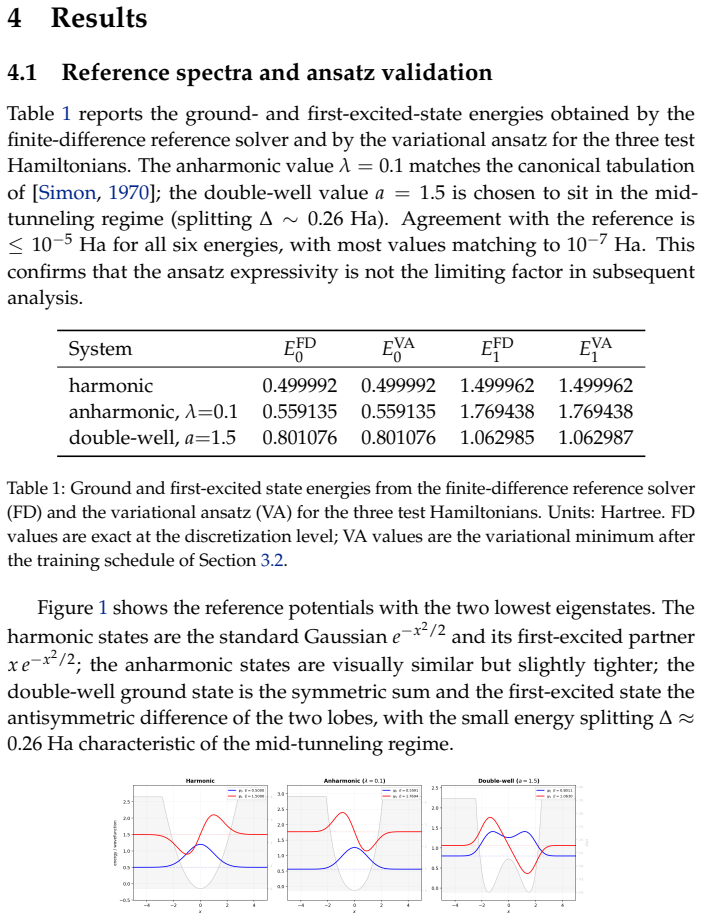
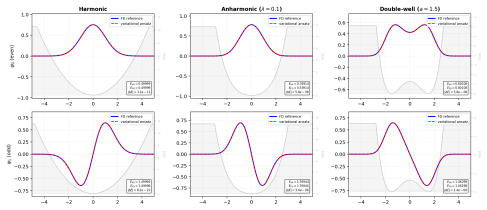
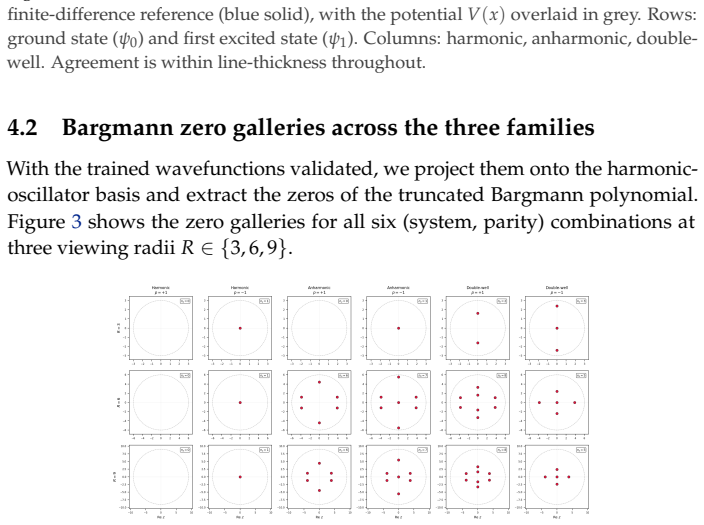
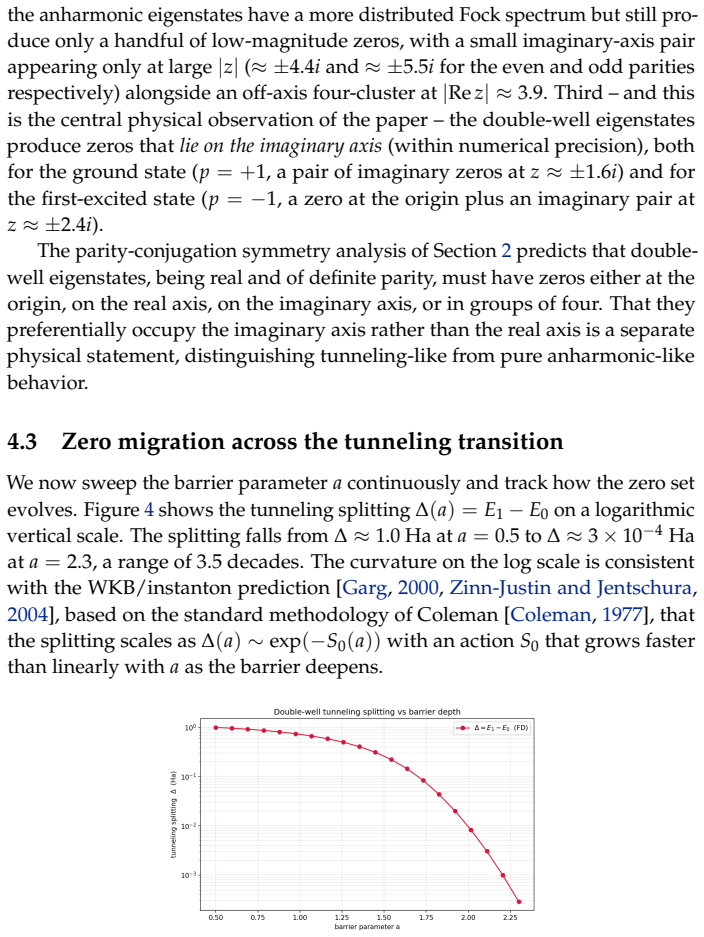
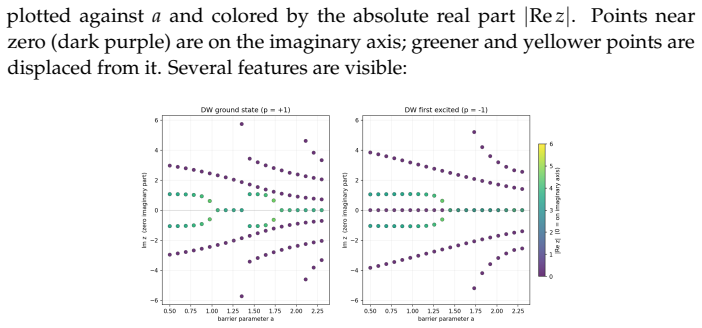
The complex zeros of the Bargmann-represented wavefunction provide a compact, purely analytic diagnostic for the tunneling regime of one-dimensional double-well Hamiltonians. For double-well eigenstates the zeros condense onto the imaginary axis, traced to a sign-alternation pattern in the Fock-coefficient spectrum characteristic of bimodally localized wavefunctions. A parameter sweep shows this migration concurrent with the exponential collapse of the tunneling splitting.
What carries the argument
The Bargmann representation of the wavefunction as a polynomial in the complex plane, with its zeros located by numerical root-finding after projection onto the harmonic-oscillator basis.
If this is right
- The position of the zeros serves as a signature distinguishing tunneling from non-tunneling regimes in double-well systems.
- The condensation tracks the barrier parameter a and the associated drop in energy splitting Delta(a).
- The diagnostic extends the use of zero images from random polynomials to actual physical eigenstates obtained variationally.
- Sign alternation in Fock coefficients is the mechanism linking localization to zero locations.
Where Pith is reading between the lines
- One could test whether similar zero condensation appears in other localized states, such as those in periodic potentials.
- This approach might provide an alternative to traditional methods for detecting tunneling in experimental spectra or simulations.
- Analytic approximations to the zero locations could be derived for the deep tunneling limit.
Load-bearing premise
The variational wavefunctions from the symbolic envelope plus correction network reproduce the true eigenstates closely enough that their Bargmann projections and zero sets match those of the exact states.
What would settle it
Direct numerical solution of the Schrödinger equation for double-well eigenstates at a barrier where tunneling splitting is minimal, followed by exact Bargmann projection and root finding, would falsify the claim if the zeros fail to condense on the imaginary axis.
Figures
read the original abstract
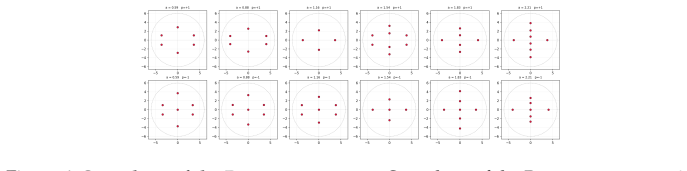
Complex zeros of wavefunctions represented as entire functions in Bargmann--Fock space encode structural information about the underlying quantum state. Prior work employed zero galleries of randomly generated polynomial superpositions of Fock states as visual fingerprints suitable for classification. Here we examine whether Bargmann zeros of physically realized eigenstates of one-dimensional anharmonic and double-well Hamiltonians carry a recognizable signature of the tunneling transition in the symmetric double well. Ground and first-excited eigenstates are obtained from a variational ansatz consisting of a physically motivated symbolic envelope multiplied by a small flexible correction network, trained by Rayleigh--Ritz minimization of the finite-difference Hamiltonian expectation value and validated to reproduce energies to within $\sim 10^{-5}\,\mathrm{Ha}$. The resulting wavefunctions are projected onto the harmonic-oscillator basis and the complex zeros of the truncated Bargmann polynomial are located by numerical root-finding. For harmonic and quartic-anharmonic potentials the zeros show no preferred orientation. For double-well eigenstates, by contrast, the zeros condense onto the imaginary axis. A sweep of the barrier parameter $a$ from $0.5$ to $2.3$ reveals a continuous migration of zeros toward the imaginary axis, concurrent with the exponential collapse of the tunneling splitting $\Delta(a) = E_1 - E_0$ over $3.5$ decades. This condensation is traced to a sign-alternation pattern in the Fock-coefficient spectrum that is characteristic of bimodally localized wavefunctions. The complex zero set of the Bargmann-represented wavefunction thereby provides a compact, purely analytic diagnostic for the tunneling regime of one-dimensional double-well Hamiltonians, extending the random-polynomial zero-image framework to physical eigenstates.
Editorial analysis
A structured set of objections, weighed in public.
Referee Report
Summary. The paper claims that the complex zeros of Bargmann-represented variational eigenstates of 1D double-well Hamiltonians condense onto the imaginary axis (unlike harmonic or quartic-anharmonic cases), providing a compact analytic diagnostic of the tunneling regime; this is demonstrated via a symbolic-envelope-plus-correction-network variational ansatz trained by Rayleigh-Ritz, projected to the HO basis, with zeros located by root-finding, and shown to migrate continuously with barrier parameter a concurrent with exponential collapse of the tunneling splitting Δ(a).
Significance. If the reported zero condensation is shown to be robust to the variational representation, the work usefully extends the random-polynomial zero-image framework to physical eigenstates and supplies a visually compact signature tied to the sign-alternation pattern in Fock coefficients of bimodally localized states.
major comments (2)
- [Abstract] Abstract (variational validation paragraph): the reported energy accuracy of ~10^{-5} Ha is obtained solely from Rayleigh-Ritz minimization; because Bargmann zeros are roots of a polynomial whose coefficients are the HO projections, and because such roots are exponentially sensitive to coefficient perturbations, an energy error sufficient for spectroscopy does not guarantee that the located zeros faithfully reflect the true eigenstates rather than truncation or ansatz artifacts. No L2 wavefunction error, coefficient-wise residuals, or high-n Fock amplitude convergence is reported.
- [Abstract] Abstract (projection and root-finding paragraph): the central diagnostic claim requires that the truncated Bargmann polynomial zeros are stable under basis enlargement and that the sign-alternation pattern is not an artifact of the finite correction network; without explicit tests of zero migration under increased HO cutoff or network width, the condensation onto the imaginary axis remains vulnerable to the skeptic concern that energy minimization alone does not control the high-order coefficients that dominate root locations.
Simulated Author's Rebuttal
We thank the referee for the careful reading and for highlighting the distinction between energy accuracy and fidelity of the Bargmann zeros. The points raised are substantive and we will strengthen the manuscript by adding the requested validation diagnostics. We address each major comment below.
read point-by-point responses
-
Referee: [Abstract] Abstract (variational validation paragraph): the reported energy accuracy of ~10^{-5} Ha is obtained solely from Rayleigh-Ritz minimization; because Bargmann zeros are roots of a polynomial whose coefficients are the HO projections, and because such roots are exponentially sensitive to coefficient perturbations, an energy error sufficient for spectroscopy does not guarantee that the located zeros faithfully reflect the true eigenstates rather than truncation or ansatz artifacts. No L2 wavefunction error, coefficient-wise residuals, or high-n Fock amplitude convergence is reported.
Authors: We agree that an energy error of order 10^{-5} Ha does not by itself certify the accuracy of the high-order Fock coefficients that control zero locations. In the revised manuscript we will add three explicit diagnostics: (i) the L2 norm difference between the variational wavefunction and a reference solution obtained by dense-grid finite-difference diagonalization, (ii) the maximum absolute residual in the HO coefficients up to the truncation cutoff, and (iii) convergence of the tail amplitudes (n > 30) as the correction-network width is increased. These quantities will be reported for representative values of the barrier parameter a. revision: yes
-
Referee: [Abstract] Abstract (projection and root-finding paragraph): the central diagnostic claim requires that the truncated Bargmann polynomial zeros are stable under basis enlargement and that the sign-alternation pattern is not an artifact of the finite correction network; without explicit tests of zero migration under increased HO cutoff or network width, the condensation onto the imaginary axis remains vulnerable to the skeptic concern that energy minimization alone does not control the high-order coefficients that dominate root locations.
Authors: We concur that stability under basis enlargement must be demonstrated. The revision will include new panels showing the imaginary-axis condensation for HO cutoffs ranging from N=20 to N=60 and for correction networks of increasing width. We will also overlay the zero trajectories versus a for these enlarged bases, confirming that once the cutoff exceeds the support of the significant Fock amplitudes the condensation pattern and its correlation with the exponential collapse of Δ(a) remain unchanged. revision: yes
Circularity Check
Numerical observation of zero patterns from variational wavefunctions; no definitional or self-citation reduction
full rationale
The paper obtains eigenstates via a standard Rayleigh-Ritz variational procedure on a hybrid symbolic+network ansatz, projects the resulting coefficients onto the harmonic-oscillator basis, constructs the truncated Bargmann polynomial, and locates its zeros by numerical root-finding. The reported condensation onto the imaginary axis is presented as an observed pattern that correlates with the tunneling splitting; it is not obtained by algebraic rearrangement of the input equations, by renaming a fitted parameter as a prediction, or by invoking a uniqueness theorem from prior self-work. The validation is performed on energy error alone, but this is an accuracy question rather than a circularity question. No load-bearing self-citation chain or ansatz-smuggling step appears in the supplied text. The derivation chain therefore remains self-contained against external numerical benchmarks.
Axiom & Free-Parameter Ledger
axioms (2)
- standard math Rayleigh-Ritz variational principle yields accurate approximations to low-lying eigenstates when the ansatz is flexible enough
- standard math Truncation of the Bargmann representation to a finite harmonic-oscillator basis produces a polynomial whose complex zeros can be located by standard root-finding
Reference graph
Works this paper leans on
-
[1]
Giuseppe Carleo and Matthias Troyer
doi:10.1002/cpa.3160140303. Giuseppe Carleo and Matthias Troyer. Solving the quantum many-body problem with artificial neural networks.Science, 355(6325):602–606,
-
[2]
Solving the Quantum Many-Body Problem with Artificial Neural Networks
doi:10.1126/science.aag2302. arXiv:1606.02318. Sacha Cerf, Clara Wassner, Jack Davis, Francesco Arzani, and Ulysse Chabaud. 19 εMean|∆E|(Ha) Std (Ha)|z 0|mean Std(z-drift) 0.005 2.70×10 −7 6.66×10 −8 1.6143 3.60×10 −4 0.01 2.04×10 −7 4.93×10 −8 1.6143 2.77×10 −4 0.015 1.65×10 −7 3.08×10 −8 1.6143 2.88×10 −4 0.02 1.55×10 −7 3.45×10 −8 1.6143 2.84×10 −4 0.0...
work page internal anchor Pith review Pith/arXiv arXiv doi:10.1126/science.aag2302
-
[3]
doi:10.48550/arXiv.2507.23468. Sidney Coleman. Fate of the false vacuum: Semiclassical theory.Physical Review D, 15(10):2929–2936,
-
[4]
doi:10.1103/PhysRevD.15.2929. Anupam Garg. Tunnel splittings for one-dimensional potential wells revis- ited.American Journal of Physics, 68(5):430–437,
-
[5]
Tunnel splittings for one dimensional potential wells revisited
doi:10.1119/1.19458. arXiv:cond-mat/0003115. Roy J. Glauber. Coherent and incoherent states of the radiation field.Physical Review, 131(6):2766–2788,
work page internal anchor Pith review Pith/arXiv arXiv doi:10.1119/1.19458
-
[6]
doi:10.1103/PhysRev.131.2766. Charles R. Harris, K. Jarrod Millman, Stéfan J. van der Walt, Ralf Gommers, Pauli Virtanen, David Cournapeau, Eric Wieser, Julian Taylor, Sebastian Berg, Nathaniel J. Smith, Robert Kern, Matti Picus, Stephan Hoyer, Marten H. van Kerkwijk, Matthew Brett, Allan Haldane, Jaime Fernández del Río, Mark Wiebe, Pearu Peterson, Pierr...
-
[7]
Nature , volume = 585, number = 7825, pages =
doi:10.1038/s41586-020-2649-2. Jan Hermann, Zeno Schätzle, and Frank Noé. Deep-neural-network solution of the electronic Schrödinger equation.Nature Chemistry, 12(10):891–897,
-
[8]
doi:10.1038/s41557-020-0544-y. arXiv:1909.08423. Kôdi Husimi. Some formal properties of the density matrix.Pro- ceedings of the Physico-Mathematical Society of Japan, 22(4):264–314,
-
[9]
Maciej Janowicz and Andrzej Zembrzuski
doi:10.11429/ppmsj1919.22.4_264. Maciej Janowicz and Andrzej Zembrzuski. Guessing quantum states from images of their zeros in the complex plane.Machine Graphics & Vision, 31(3/4): 147–159,
-
[10]
doi:10.22630/MGV .2022.31.3.8. Diederik P . Kingma and Jimmy Ba. Adam: A method for stochastic optimiza- tion. In3rd International Conference on Learning Representations (ICLR),
-
[11]
Adam: A Method for Stochastic Optimization
doi:10.48550/arXiv.1412.6980. arXiv:1412.6980. John R. Klauder and Bo-Sture Skagerstam.Coherent States: Applications in Physics and Mathematical Physics. World Scientific, Singapore,
work page internal anchor Pith review Pith/arXiv arXiv doi:10.48550/arxiv.1412.6980
-
[12]
doi:10.1142/0096. P . Leboeuf and A. Voros. Chaos-revealing multiplicative representation of quantum eigenstates.Journal of Physics A: Mathematical and General, 23(10): 1765–1774,
-
[13]
doi:10.1088/0305-4470/23/10/017. Adam Paszke, Sam Gross, Francisco Massa, Adam Lerer, James Bradbury, Gregory Chanan, Trevor Killeen, Zeming Lin, Natalia Gimelshein, Luca Antiga, Alban Desmaison, Andreas Köpf, Edward Yang, Zach DeVito, Mar- tin Raison, Alykhan Tejani, Sasank Chilamkurthy, Benoit Steiner, Lu Fang, Junjie Bai, and Soumith Chintala. PyTorch:...
-
[14]
PyTorch: An Imperative Style, High-Performance Deep Learning Library
doi:10.48550/arXiv.1912.01703. arXiv:1912.01703. A. M. Perelomov. Coherent states for arbitrary Lie group.Communications in Mathematical Physics, 26(3):222–236,
work page internal anchor Pith review Pith/arXiv arXiv doi:10.48550/arxiv.1912.01703 1912
-
[15]
doi:10.1007/BF01645091. David Pfau, James S. Spencer, Alexander G. de G. Matthews, and W. M. C. Foulkes. Ab initio solution of the many-electron Schrödinger equation with deep neural networks.Physical Review Research, 2(3):033429,
-
[16]
doi:10.1103/PhysRevResearch.2.033429. arXiv:1909.02487. Barry Simon. Coupling constant analyticity for the anharmonic oscillator.Annals of Physics, 58(1):76–136,
-
[17]
21 Pauli Virtanen, Ralf Gommers, Travis E
doi:10.1016/0003-4916(70)90240-X. 21 Pauli Virtanen, Ralf Gommers, Travis E. Oliphant, Matt Haberland, Tyler Reddy, David Cournapeau, Evgeni Burovski, Pearu Peterson, Warren Weckesser, Jonathan Bright, Stéfan J. van der Walt, Matthew Brett, Joshua Wilson, K. Jar- rod Millman, Nikolay Mayorov, Andrew R. J. Nelson, Eric Jones, Robert Kern, Eric Larson, C J ...
-
[18]
doi:10.1038/s41592-019-0686-2. Jean Zinn-Justin and Ulrich D. Jentschura. Multi-instantons and exact results II: Specific cases, higher-order effects, and numerical calculations.Annals of Physics, 313(2):269–325,
-
[19]
doi:10.1016/j.aop.2004.04.003. arXiv:quant- ph/0501137. 22
discussion (0)
Sign in with ORCID, Apple, or X to comment. Anyone can read and Pith papers without signing in.