Bitwise Triangular Coordinates for Central Products of Quaternion Groups: Floretion Base Vectors, Digitwise S3-Actions, and Centralizer Tiles
Pith reviewed 2026-05-21 07:44 UTC · model grok-4.3
The pith
A bitwise coordinate model unifies Boolean multiplication, triangular tilings, and centralizers for central products of n copies of Q8.
A machine-rendered reading of the paper's core claim, the machinery that carries it, and where it could break.
Core claim
The coordinate model identifies positive basis elements with words in {1,2,4,7} corresponding to i, j, k, e, forming the signed basis group Fn as the central product of n copies of Q8. This allows Boolean multiplication, recursive triangular tilings, digitwise S3-actions, and centralizer tile sets to be expressed in a single language. A local XNOR/AND rule gives table-free digitwise multiplication, and the centroid map to the triangular tiling is equivariant under the digitwise S3-action and the dihedral action. Odd digit permutations reverse multiplication order. For every non-unit basis word, the centralizer has cardinality 4^n and its positive tile set occupies exactly one half of the ord
What carries the argument
The centroid map from the signed basis group Fn to a recursive triangular tiling, which carries the unification of digitwise group operations with geometric symmetries and is equivariant under both the digitwise S3-action and the dihedral action on the triangle.
If this is right
- Multiplication of any two basis words reduces to independent per-digit XNOR and AND operations.
- Centralizers of all non-unit elements have exact cardinality 4^n inside the signed group.
- The positive subset of each such centralizer occupies exactly half the positions in the corresponding order-n tiling.
- Permutations of digits that are odd reverse the order of multiplication and yield commutation criteria for elements symmetric about triangular axes.
Where Pith is reading between the lines
- The table-free multiplication rule could be implemented directly in hardware or low-level code for large n without storing group tables.
- The recursive triangular tiling offers a geometric visualization of centralizer structure that might extend to other central products or extraspecial groups.
- Equivariance under S3 and dihedral actions suggests the possibility of symmetry-reduced algorithms for enumerating or factoring elements in these groups.
Load-bearing premise
The positive basis elements as words in the alphabet {1,2,4,7} generate the central product of n copies of Q8 and the centroid map to the recursive triangular tiling is equivariant under both the digitwise S3-action and the dihedral action on the triangle.
What would settle it
Finding even one non-unit basis word whose centralizer in the signed group has size different from 4^n or whose positive elements occupy a proportion other than one half of the order-n tiling would falsify the central claim.
Figures

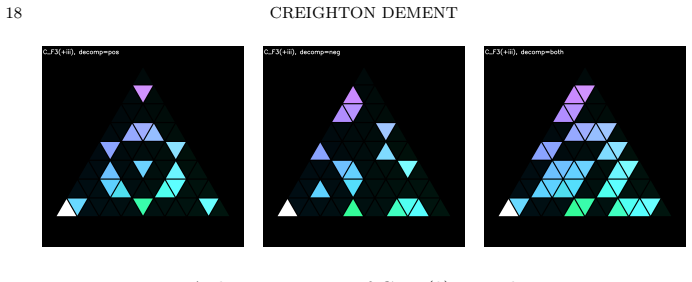
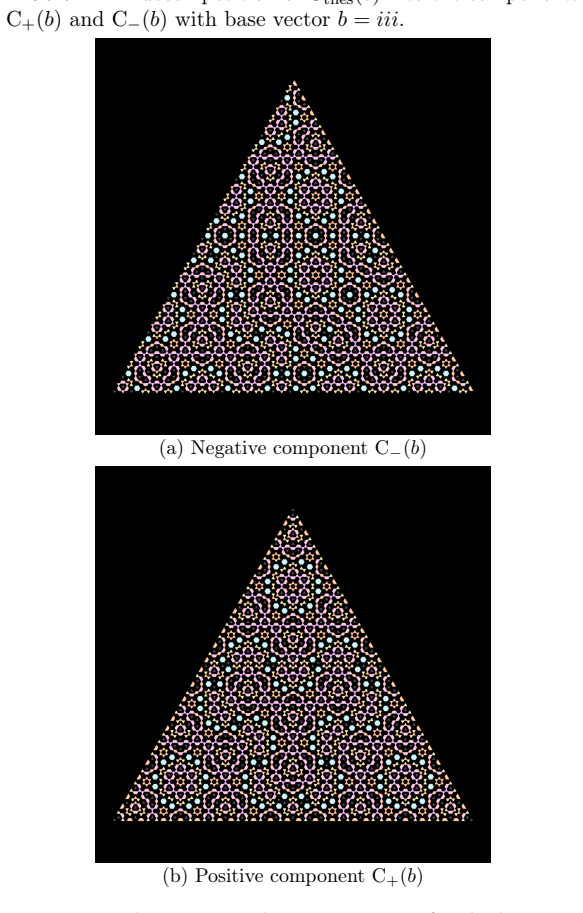
read the original abstract
This note studies a concrete bitwise and triangular coordinate model for the central product of n copies of the quaternion group Q8. The positive basis elements are words of length n in the alphabet {1, 2, 4, 7}, identified with i, j, k, and the identity element e. The signed basis group Fn is the corresponding central product of n copies of Q8, and the real algebra generated by the basis words is H^{\otimes n}. The contribution is the coordinate model: in this basis, Boolean multiplication, recursive triangular tilings, digitwise S3-actions, reflection anti-automorphisms, parity cancellation, and centralizer tile sets can be expressed in a single language. A local XNOR/AND rule recovers quaternionic basis multiplication and gives a table-free digitwise multiplication rule in every order. The associated centroid map to a recursive triangular tiling is equivariant for the digitwise S3-action and the dihedral action on the triangle. Odd digit permutations reverse multiplication order, yielding ordinary or twisted commutation criteria for products of elements symmetric about triangular axes. Synchronized cyclic changes of selected noncentral digits give equilateral triangles of centroids. Finally, for every non-unit basis word, the centralizer in the signed group has cardinality 4^n and its positive tile set occupies exactly one half of the order-n tiling.
Editorial analysis
A structured set of objections, weighed in public.
Referee Report
Summary. The manuscript introduces a bitwise and triangular coordinate model for the central product of n copies of the quaternion group Q8. Positive basis elements are words of length n in the alphabet {1,2,4,7} identified with the standard basis {e,i,j,k} of Q8. The signed basis group Fn is the corresponding central product, generating the algebra H^{⊗n}. The central contribution is a unified coordinate language in which Boolean multiplication, recursive triangular tilings, digitwise S3-actions, reflection anti-automorphisms, and centralizer tile sets are expressed together. A local XNOR/AND rule yields table-free digitwise multiplication; the centroid map to the recursive triangular tiling is equivariant under the digitwise S3-action and the dihedral action on the triangle; odd digit permutations reverse multiplication order; and for every non-unit basis word the centralizer in Fn has cardinality 4^n with its positive tile set occupying exactly half the order-n tiling.
Significance. If the equivariance, cardinality, and half-tile claims hold as direct consequences of the chosen alphabet and centroid map, the work supplies a parameter-free, definition-driven framework that unifies Boolean operations with geometric tilings for quaternion central products. Credit is due for the explicit local multiplication rule, the absence of fitted parameters or ad-hoc axioms, and the concrete, falsifiable statements on centralizer sizes and tile occupancies. Such a model could support computational enumeration and combinatorial studies in non-commutative algebra.
minor comments (3)
- [Abstract] Abstract, paragraph 2: the identification of the alphabet {1,2,4,7} with {e,i,j,k} is stated but an explicit one-line table or first-order example would make the subsequent XNOR/AND rule immediately verifiable without consulting external quaternion conventions.
- The title refers to 'Floretion Base Vectors' yet the abstract and summary do not define or relate the term to the basis words; a single sentence of clarification in the introduction would remove potential reader confusion.
- [Abstract] The claim that 'odd digit permutations reverse multiplication order' is asserted without a short worked example for n=2; adding one would illustrate the ordinary versus twisted commutation criteria mentioned later in the abstract.
Simulated Author's Rebuttal
We thank the referee for the positive summary of our work on bitwise triangular coordinates for central products of quaternion groups and for recommending minor revision. The recognition of the parameter-free framework, the local XNOR/AND multiplication rule, and the concrete claims on centralizer cardinalities and tile occupancies is appreciated. No specific major comments appear in the report.
Circularity Check
No significant circularity; properties follow directly from definitional construction
full rationale
The paper defines a bitwise coordinate system on words over the alphabet {1,2,4,7} for the central product of n copies of Q8, together with an associated centroid map to recursive triangular tilings. All stated results—the local XNOR/AND multiplication rule, digitwise S3-equivariance, centralizer cardinality 4^n for non-units, and the positive tile set occupying half the tiling—are presented as immediate consequences of these definitions and the induced actions. No step reduces a claimed prediction or theorem to a fitted parameter, a self-citation chain, or an ansatz smuggled from prior work; the derivation is self-contained and consists of explicit verification within the constructed model.
Axiom & Free-Parameter Ledger
axioms (1)
- domain assumption The alphabet {1,2,4,7} is identified with the generators i, j, k and the identity e of Q8, and words of length n generate the central product of n copies.
Lean theorems connected to this paper
-
IndisputableMonolith/Foundation/AlexanderDuality.leanalexander_duality_circle_linking unclear?
unclearRelation between the paper passage and the cited Recognition theorem.
The positive basis elements are words of length n in the alphabet {1,2,4,7}... Fn is the central product of n copies of Q8... the centroid map to a recursive triangular tiling is equivariant for the digitwise S3-action and the dihedral action on the triangle... for every non-unit basis word b, the centralizer in the signed group has cardinality 4^n and its positive tile set occupies exactly one half of the order-n tiling.
What do these tags mean?
- matches
- The paper's claim is directly supported by a theorem in the formal canon.
- supports
- The theorem supports part of the paper's argument, but the paper may add assumptions or extra steps.
- extends
- The paper goes beyond the formal theorem; the theorem is a base layer rather than the whole result.
- uses
- The paper appears to rely on the theorem as machinery.
- contradicts
- The paper's claim conflicts with a theorem or certificate in the canon.
- unclear
- Pith found a possible connection, but the passage is too broad, indirect, or ambiguous to say the theorem truly supports the claim.
discussion (0)
Sign in with ORCID, Apple, or X to comment. Anyone can read and Pith papers without signing in.