A Solar-System Window for Hidden Stellar Companions
Pith reviewed 2026-06-25 22:42 UTC · model grok-4.3
The pith
A hidden-brane companion at 300-2000 AU could overlap the minimum mass for a QCD-scaled hidden-sector star.
A machine-rendered reading of the paper's core claim, the machinery that carries it, and where it could break.
Core claim
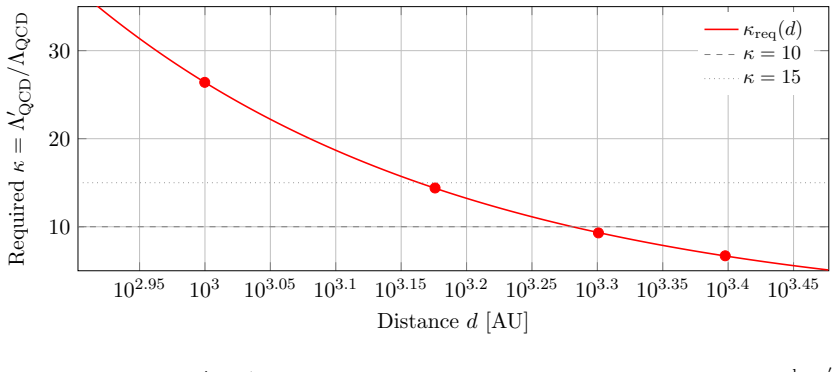
Using an illustrative ephemeris tidal envelope calibrated to Planet-Nine-like constraints, the allowed parameter space for a hidden-brane companion includes Earth to sub-Saturn masses at 300-1000 AU, rising to Jovian mass near 2000 AU. In a QCD-scaled hidden sector with confinement scale ten times ordinary QCD, the minimum hidden stellar mass overlaps the upper part of this window, offering a benchmark for a genuine hidden-sector star that is bright in dark photons, electromagnetically dark to us, and visible only through gravity.
What carries the argument
The phenomenological mass-distance map from an illustrative ephemeris tidal envelope calibrated to Planet-Nine-like constraints.
If this is right
- A smooth dark matter halo cannot supply such an object, as the local density yields only a sub-Pluto mass within 1000 AU.
- Any nearby hidden-brane companion must therefore be a structured, gravitationally bound object.
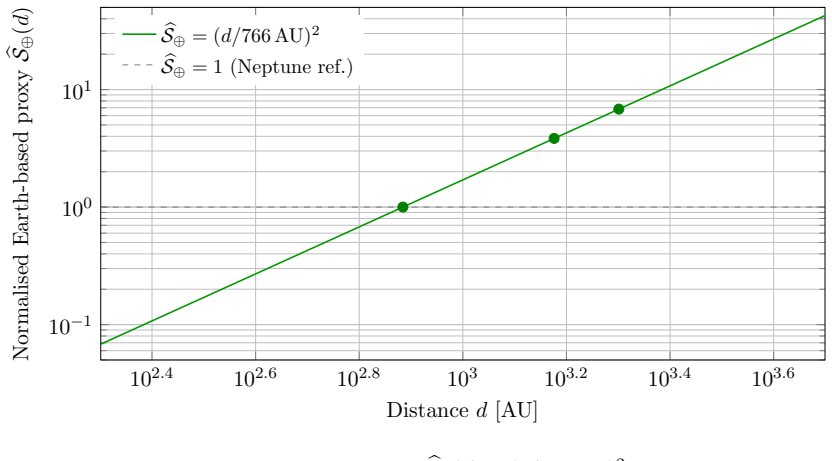
- The Earth-based source-strength proxy for brane-to-brane channels grows as the square of the companion distance.
- The largest received source scale therefore comes from the most massive companion still allowed, not the nearest one.
- A probe sent to the companion's gravitational projection would reduce the ordinary source-receiver separation by two to three orders of magnitude.
Where Pith is reading between the lines
- The same mass-distance window could be applied to other solar-system anomalies or to searches for dark companions around other stars.
- If the hidden-sector star exists, its dark-photon luminosity might be accessible to future precision gravity or fifth-force experiments once the distance is reduced by a probe.
- The quadratic growth of the source-strength proxy implies that more distant but heavier allowed companions are favored targets for brane-to-brane signal searches.
- The construction shows how solar-system dynamics can set concrete targets for hidden-sector model building without requiring new dynamical simulations.
Load-bearing premise
The illustrative ephemeris tidal envelope calibrated to Planet-Nine-like constraints accurately bounds the allowed masses and distances for a hidden-brane companion.
What would settle it
A direct dynamical search that either detects or rules out gravitational perturbations from an Earth-to-Jovian mass object at 300-2000 AU would test whether the allowed window exists; independently, a lattice calculation or effective-theory estimate of the minimum stable mass in the ten-times-QCD hidden sector would test whether that mass falls inside the window.
Figures

read the original abstract
Could the closest stellar or substellar object to the Sun be not an ordinary star at parsec distance, but a hidden-brane companion at hundreds or thousands of astronomical units? We do not perform a new Solar-System dynamics analysis; instead we construct a phenomenological mass-distance map using an illustrative ephemeris tidal envelope calibrated to Planet-Nine-like constraints. A smooth dark matter halo cannot supply such an object: the local density contains only a sub-Pluto mass within 1000 AU. A nearby hidden-brane companion must therefore be a structured, gravitationally bound object rather than a typical halo draw. The illustrative envelope still allows Earth to sub-Saturn masses at 300-1000 AU, rising to Jovian mass near 2000 AU. In a simple QCD-scaled hidden sector with a confinement scale about ten times larger than ordinary QCD, the minimum hidden stellar mass overlaps the upper part of this window, providing a benchmark for a genuine hidden-sector star: bright in dark photons, electromagnetically dark to us, and visible only through gravity. We also derive an Earth-based source-strength proxy for brane-to-brane channels and show that, along the ephemeris envelope, it grows as the square of the companion distance: the largest received source scale comes from the most massive companion still allowed, not the nearest one. A probe sent to the companion's gravitational projection would reduce the ordinary source-receiver separation by two to three orders of magnitude relative to Earth-based operation. This is not a detection forecast; the excitation of KK modes, the compact-direction brane-to-brane transfer factor, and the detector response remain model-dependent.
Editorial analysis
A structured set of objections, weighed in public.
Referee Report
Summary. The manuscript constructs a phenomenological mass-distance map for a possible hidden-brane stellar or substellar companion at 300-2000 AU using an illustrative ephemeris tidal envelope calibrated to Planet-Nine-like constraints. It argues that a smooth dark-matter halo cannot supply such an object, shows that the minimum mass of a QCD-scaled hidden-sector star (confinement scale ~10 imes QCD) overlaps the upper end of this window, derives an Earth-based source-strength proxy for brane-to-brane channels that grows as the square of distance along the envelope, and notes that a probe would reduce source-receiver separation by 2-3 orders of magnitude, while explicitly disclaiming new dynamics analysis or a detection forecast.
Significance. If the illustrative envelope is accepted, the work supplies a concrete benchmark for hidden-sector stars that are electromagnetically dark yet gravitationally detectable and bright in dark photons. The explicit disclaimers regarding the absence of new Solar-System dynamics and the model-dependent nature of KK-mode excitation and detector response are strengths in transparency. The result remains conditional on the chosen phenomenological calibration and the single free parameter (confinement scale factor), limiting its immediate predictive power.
major comments (3)
- [Abstract] Abstract: the reported scaling in which the Earth-based source-strength proxy 'grows as the square of the companion distance' is obtained by construction along the chosen ephemeris envelope; because the envelope itself is a phenomenological fit calibrated to Planet-Nine-like constraints, the scaling and the conclusion that the largest received source scale comes from the most massive (rather than nearest) companion lack independent dynamical grounding.
- [Abstract] Abstract: the claimed overlap between the minimum hidden stellar mass and the upper part of the mass-distance window (Earth to sub-Saturn at 300-1000 AU, Jovian near 2000 AU) rests entirely on the illustrative tidal envelope; the manuscript states it performs no new Solar-System dynamics analysis, so the robustness of the overlap under plausible variations in the Planet-Nine calibration or tighter tidal bounds is not quantified.
- [Abstract] Abstract: the assertion that a smooth dark-matter halo supplies only a sub-Pluto mass within 1000 AU and therefore cannot furnish the companion assumes the hidden-brane object obeys the same tidal envelope as an ordinary perturber; additional justification is needed for why brane-specific gravitational or compact-direction effects would not alter the allowed mass-distance region.
minor comments (2)
- The abstract and text repeatedly use 'illustrative' and 'phenomenological' qualifiers; a short dedicated paragraph early in the manuscript summarizing the precise functional form and calibration data of the envelope would improve readability.
- The free parameter (confinement scale factor) is introduced without a numerical range or sensitivity plot; adding a brief exploration of how the overlap changes for factors of 5-20 would strengthen the benchmark claim.
Simulated Author's Rebuttal
We thank the referee for the thoughtful and detailed report. The manuscript is deliberately phenomenological and makes no claim to new dynamical modeling; we address each major comment below and have revised the abstract and discussion for greater clarity on the illustrative nature of the envelope.
read point-by-point responses
-
Referee: [Abstract] Abstract: the reported scaling in which the Earth-based source-strength proxy 'grows as the square of the companion distance' is obtained by construction along the chosen ephemeris envelope; because the envelope itself is a phenomenological fit calibrated to Planet-Nine-like constraints, the scaling and the conclusion that the largest received source scale comes from the most massive (rather than nearest) companion lack independent dynamical grounding.
Authors: We agree that the quadratic scaling is obtained by construction once the envelope is adopted. The text already states that no new Solar-System dynamics analysis is performed and that the envelope is illustrative. The purpose is to show the implication of that envelope for the source-strength proxy. We have revised the abstract to state explicitly that the scaling holds within the chosen phenomenological calibration and does not rest on independent dynamical derivation. revision: partial
-
Referee: [Abstract] Abstract: the claimed overlap between the minimum hidden stellar mass and the upper part of the mass-distance window (Earth to sub-Saturn at 300-1000 AU, Jovian near 2000 AU) rests entirely on the illustrative tidal envelope; the manuscript states it performs no new Solar-System dynamics analysis, so the robustness of the overlap under plausible variations in the Planet-Nine calibration or tighter tidal bounds is not quantified.
Authors: The overlap is presented strictly as an illustration under the adopted calibration; the manuscript already notes the absence of new dynamics work. Quantifying robustness against variations in the Planet-Nine constraints would require dedicated N-body simulations outside the present scope. We have added language in the abstract and concluding section underscoring that the window and overlap are conditional on the illustrative envelope and the single free parameter (confinement scale). revision: partial
-
Referee: [Abstract] Abstract: the assertion that a smooth dark-matter halo supplies only a sub-Pluto mass within 1000 AU and therefore cannot furnish the companion assumes the hidden-brane object obeys the same tidal envelope as an ordinary perturber; additional justification is needed for why brane-specific gravitational or compact-direction effects would not alter the allowed mass-distance region.
Authors: The tidal envelope is a phenomenological bound on gravitational perturbations to the visible Solar System. Because the hidden-brane companion would source the same Newtonian gravity in the visible sector (independent of the compact-direction structure), the same mass-distance constraint applies. Compact-direction effects are confined to the hidden sector and do not modify the long-range gravitational tidal field felt by visible planets. We have inserted a brief clarifying sentence in the relevant paragraph to make this assumption explicit. revision: yes
Circularity Check
Phenomenological envelope is explicitly illustrative; proxy scaling follows from envelope definition but is not presented as independent prediction
specific steps
-
fitted input called prediction
[Abstract]
"We also derive an Earth-based source-strength proxy for brane-to-brane channels and show that, along the ephemeris envelope, it grows as the square of the companion distance: the largest received source scale comes from the most massive companion still allowed, not the nearest one."
The ephemeris envelope is constructed as a phenomenological calibration to Planet-Nine-like constraints; the reported quadratic growth of the proxy is therefore a mathematical property of the input envelope's mass-distance parametrization rather than an independent result from the hidden-sector model.
full rationale
The paper states it performs no new Solar-System dynamics analysis and instead constructs a phenomenological mass-distance map from an illustrative ephemeris tidal envelope calibrated to Planet-Nine-like constraints. The source-strength proxy scaling is shown along this envelope. Because the envelope is an input calibration rather than a derived result, the quadratic growth is a direct algebraic consequence of the chosen mass-distance relation. This is a minor instance of fitted-input behavior but does not render the central hidden-sector overlap claim circular, as the overlap is a comparison against the stated window and the paper does not claim the envelope or scaling as a first-principles prediction. No self-citation chains or ansatz smuggling are evident in the provided text. The derivation remains self-contained as an illustrative benchmark exercise.
Axiom & Free-Parameter Ledger
free parameters (1)
- confinement scale factor =
about ten times larger than ordinary QCD
axioms (2)
- domain assumption A smooth dark matter halo cannot supply a structured object of the required mass within 1000 AU
- domain assumption Planet-Nine-like constraints provide a valid tidal envelope for bounding companion masses
invented entities (2)
-
hidden-brane companion
no independent evidence
-
dark photons
no independent evidence
Reference graph
Works this paper leans on
-
[1]
Gaia Collaboration, T. Prusti et al., “The Gaia mission,” Astron. Astrophys.595(2016) A1, arXiv:1609.04153 [astro-ph.IM]
Pith/arXiv arXiv 2016
-
[2]
E. L. Wright et al., “The Wide-field Infrared Survey Explorer (WISE): Mission Descrip- tion and Initial On-orbit Performance,” Astron. J.140(2010) 1868, arXiv:1008.0031 [astro-ph.IM]
Pith/arXiv arXiv 2010
-
[3]
The Two Micron All Sky Survey (2MASS),
M. F. Skrutskie et al., “The Two Micron All Sky Survey (2MASS),” Astron. J.131 (2006) 1163–1183
2006
-
[4]
K. Batygin, F. C. Adams, M. E. Brown and J. C. Becker, “The Planet Nine hypothesis,” Phys. Rept.805, 1 (2019), arXiv:1902.10103 [astro-ph.EP]
Pith/arXiv arXiv 2019
-
[5]
What If Planet 9 Is a Primordial Black Hole?,
J. Scholtz and J. Unwin, “What If Planet 9 Is a Primordial Black Hole?,” Phys. Rev. Lett.125(2020) 051103, arXiv:1909.11090 [hep-ph]
arXiv 2020
-
[6]
Searching for a Black Hole in the Outer Solar System,
E. Witten, “Searching for a Black Hole in the Outer Solar System,” arXiv:2004.14192 [astro-ph.EP]
arXiv 2004
-
[7]
Searching for Black Holes in the Outer Solar System with LSST,
A. Siraj and A. Loeb, “Searching for Black Holes in the Outer Solar System with LSST,” Astrophys. J. Lett.898(2020) no.1, L4 doi:10.3847/2041-8213/aba119 [arXiv:2005.12280 [astro-ph.HE]]
-
[8]
Calling the Brane Next Door: The Kaluza-Klein Tower as a Gravitational Information Channel,
K. Benakli, “Calling the Brane Next Door: The Kaluza-Klein Tower as a Gravitational Information Channel,” [arXiv:2606.09969 [hep-th]]
-
[9]
The Local Dark Matter Density,
J. I. Read, “The Local Dark Matter Density,” J. Phys. G41(2014) 063101, arXiv:1404.1938 [astro-ph.GA]
Pith/arXiv arXiv 2014
-
[10]
Dark matter local density determination: recent ob- servations and future prospects,
P. F. de Salas and A. Widmark, “Dark matter local density determination: recent ob- servations and future prospects,” Rept. Prog. Phys.84(2021) 104901, arXiv:2012.11477 [astro-ph.GA]. 23
arXiv 2021
-
[11]
On the local dark matter density,
J. Bovy and S. Tremaine, “On the local dark matter density,” Astrophys. J.756, 89 (2012), arXiv:1205.4033 [astro-ph.GA]
Pith/arXiv arXiv 2012
-
[12]
Limits on the Macho Content of the Galactic Halo from the EROS-2 Survey of the Magellanic Clouds,
P. Tisserand et al., “Limits on the Macho Content of the Galactic Halo from the EROS-2 Survey of the Magellanic Clouds,” Astron. Astrophys.469(2007) 387–404, arXiv:astro- ph/0607207
arXiv 2007
-
[13]
L. Wyrzykowski et al., “The OGLE View of Microlensing towards the Magellanic Clouds. IV. OGLE-III SMC Data and Final Conclusions on MACHOs,” Mon. Not. Roy. Astron. Soc.416(2011) 2949–2961, arXiv:1106.2925 [astro-ph.GA]
Pith/arXiv arXiv 2011
-
[14]
Constraints on Primordial Black Holes,
B. Carr, K. Kohri, Y. Sendouda and J. Yokoyama, “Constraints on Primordial Black Holes,” Rept. Prog. Phys.84(2021) 116902, arXiv:2002.12778 [astro-ph.CO]
Pith/arXiv arXiv 2021
-
[15]
Primordial Black Holes as a dark matter candidate,
A. M. Green and B. J. Kavanagh, “Primordial Black Holes as a dark matter candidate,” J. Phys. G48(2021) 043001, arXiv:2007.10722 [astro-ph.CO]
Pith/arXiv arXiv 2021
-
[16]
A. M. Green, “Microlensing and dynamical constraints on primordial black hole dark mat- ter with an extended mass function,” Phys. Rev. D94, 063530 (2016), arXiv:1609.01143 [astro-ph.CO]
Pith/arXiv arXiv 2016
-
[17]
Primordial black hole constraints for extended mass functions,
B. Carr, M. Raidal, T. Tenkanen, V. Vaskonen and H. Veerm¨ ae, “Primordial black hole constraints for extended mass functions,” Phys. Rev. D96, 023514 (2017), arXiv:1705.05567 [astro-ph.CO]
Pith/arXiv arXiv 2017
-
[18]
New constraints on the location of P9 obtained with the INPOP19a planetary ephemeris,
A. Fienga, A. Di Ruscio, L. Bernus, P. Deram, D. Durante, L. Iess and J. Laskar, “New constraints on the location of P9 obtained with the INPOP19a planetary ephemeris,” Astron. Astrophys.640(2020) A6
2020
-
[19]
Observational Constraints on Planet Nine: Cassini Range Observations,
M. J. Holman and M. J. Payne, “Observational Constraints on Planet Nine: Cassini Range Observations,” Astron. J.152(2016) 94, arXiv:1604.03180 [astro-ph.EP]
Pith/arXiv arXiv 2016
-
[20]
The influence of the Galactic tidal field on the Oort comet cloud,
J. Heisler and S. Tremaine, “The influence of the Galactic tidal field on the Oort comet cloud,” Icarus65(1986) 13–26
1986
-
[21]
The formation and extent of the Solar System comet cloud,
M. Duncan, T. Quinn and S. Tremaine, “The formation and extent of the Solar System comet cloud,” Astron. J.94(1987) 1330–1338
1987
-
[22]
Oort cloud formation and dynamics,
L. Dones, P. R. Weissman, H. F. Levison and M. J. Duncan, “Oort cloud formation and dynamics,” inComets II, eds. M. C. Festou, H. U. Keller and H. A. Weaver, University of Arizona Press, Tucson (2004), pp. 153–174
2004
-
[23]
J. Fan, A. Katz, L. Randall and M. Reece, “Double-Disk Dark Matter,” Phys. Dark Univ.2, 139 (2013), arXiv:1303.1521 [astro-ph.CO]
Pith/arXiv arXiv 2013
-
[24]
Gravitational probes of dark matter physics,
M. R. Buckley and A. H. G. Peter, “Gravitational probes of dark matter physics,” Phys. Rept.761(2018) 1–60, arXiv:1712.06615 [astro-ph.CO]
Pith/arXiv arXiv 2018
-
[25]
M. Cirelli, A. Strumia and J. Zupan, “Dark Matter,” SciPost Phys. Rev.1(2026), arXiv:2406.01705 [hep-ph]
Pith/arXiv arXiv 2026
-
[26]
TwoU(1)’s and Epsilon Charge Shifts,
B. Holdom, “TwoU(1)’s and Epsilon Charge Shifts,” Phys. Lett. B166(1986) 196–198
1986
-
[27]
D. E. Kaplan, M. A. Luty and K. M. Zurek, “Asymmetric Dark Matter,” Phys. Rev. D 79(2009) 115016, arXiv:0901.4117 [hep-ph]. 24
Pith/arXiv arXiv 2009
-
[28]
Review of asymmetric dark matter,
K. Petraki and R. R. Volkas, “Review of asymmetric dark matter,” Int. J. Mod. Phys. A 28(2013) 1330028, arXiv:1305.4939 [hep-ph]
Pith/arXiv arXiv 2013
-
[29]
F.-Y. Cyr-Racine, K. Sigurdson, J. Zavala, T. Bringmann, M. Vogelsberger and C. Pfrom- mer, “ETHOS—An Effective Theory of Structure Formation: From dark particle physics to the matter distribution of the Universe,” Phys. Rev. D93(2016) 123527, arXiv:1512.05344 [astro-ph.CO]
Pith/arXiv arXiv 2016
-
[30]
The theory of brown dwarfs and extrasolar giant planets,
A. Burrows, W. B. Hubbard, J. I. Lunine and J. Liebert, “The theory of brown dwarfs and extrasolar giant planets,” Rev. Mod. Phys.73(2001) 719–765, arXiv:astro-ph/0103383. 25
Pith/arXiv arXiv 2001
discussion (0)
Sign in with ORCID, Apple, or X to comment. Anyone can read and Pith papers without signing in.