The contact temperature of arbitrary quantum states
Pith reviewed 2026-07-01 04:53 UTC · model grok-4.3
The pith
A simple thermometer model assigns a unique contact temperature to any finite-dimensional quantum state.
A machine-rendered reading of the paper's core claim, the machinery that carries it, and where it could break.
Core claim
The paper establishes that there exists a simple model of a universal thermometer with the property that, when prepared in a Gibbs equilibrium state at inverse temperature β and coupled to a system in any state, the heat flow vanishes for a unique β. This unique value is the contact temperature β_op of the system state, and the thermometer works for arbitrary states of finite dimensional quantum systems.
What carries the argument
The simple fixed universal thermometer model that exhibits vanishing heat current at exactly one inverse temperature for any system state.
If this is right
- Every state of a finite-dimensional quantum system is assigned a unique contact temperature.
- The contact temperature is determined solely by the system state and the fixed thermometer model.
- The same thermometer model applies uniformly to all possible system states.
- The definition of contact temperature relies only on the existence of a β where heat current vanishes.
Where Pith is reading between the lines
- The contact temperature may coincide with the usual thermodynamic temperature when the system itself is in a Gibbs state.
- This operational approach could extend to comparing effective temperatures between different non-equilibrium quantum processes.
- Explicit constructions of the thermometer Hamiltonian would allow numerical checks of the uniqueness property for small systems.
Load-bearing premise
A fixed thermometer model exists such that the heat current with any system state vanishes at precisely one inverse temperature.
What would settle it
Finding a finite-dimensional quantum state for which the heat current as a function of β has either no zero or more than one zero when coupled to the proposed thermometer model.
Figures
read the original abstract
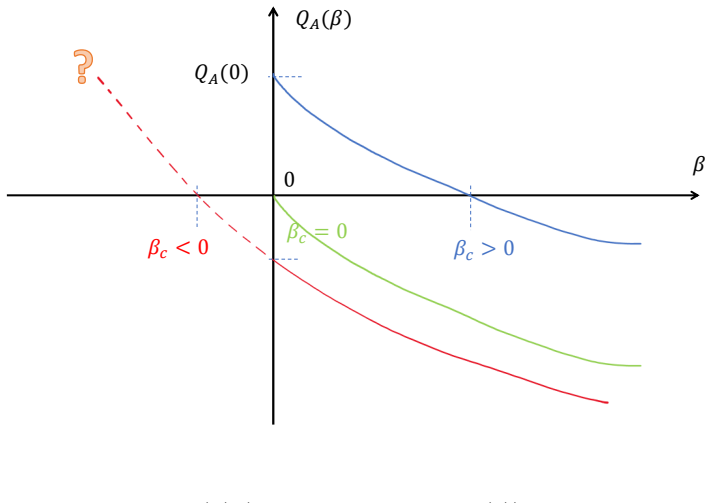
An intuitive scheme to assign a temperature to an arbitrary state of a quantum system is to investigate the heat flow resulting from the coupling to a thermometer. We introduce a simple model of a universal thermometer with the following property. When it is prepared in a Gibbs equilibrium state at inverse temperature $\beta\in\mathbb R$ and brought into thermal contact with a system in any state, the heat flow between the system and thermometer vanishes for a unique value of $\beta$. We call this value the contact temperature $\beta_{\rm op}\in\mathbb R$ of the system state. The thermometer is universal in that it yields a unique contact temperature for arbitrary states of finite dimensional quantum systems.
Editorial analysis
A structured set of objections, weighed in public.
Referee Report
Summary. The manuscript introduces a simple, explicit model of a universal thermometer for finite-dimensional quantum systems. The thermometer is prepared in a Gibbs state at inverse temperature β and coupled to an arbitrary system state; the heat current between them vanishes at a unique value β_op, which the authors define as the contact temperature of the system state. The central claim is that this model yields a unique β_op ∈ ℝ for every state of any finite-dimensional system.
Significance. If the explicit construction is correct, the result supplies a physically motivated, operationally defined temperature for arbitrary (including non-equilibrium) quantum states. This is potentially useful in quantum thermodynamics. The paper ships an explicit Hamiltonian and coupling together with a proof that the zero-current condition is single-valued, which strengthens the claim.
minor comments (3)
- §3, after Eq. (7): the heat-current expression is written in the interaction picture but the subsequent uniqueness proof assumes the interaction Hamiltonian is time-independent; a brief remark clarifying the frame would avoid confusion.
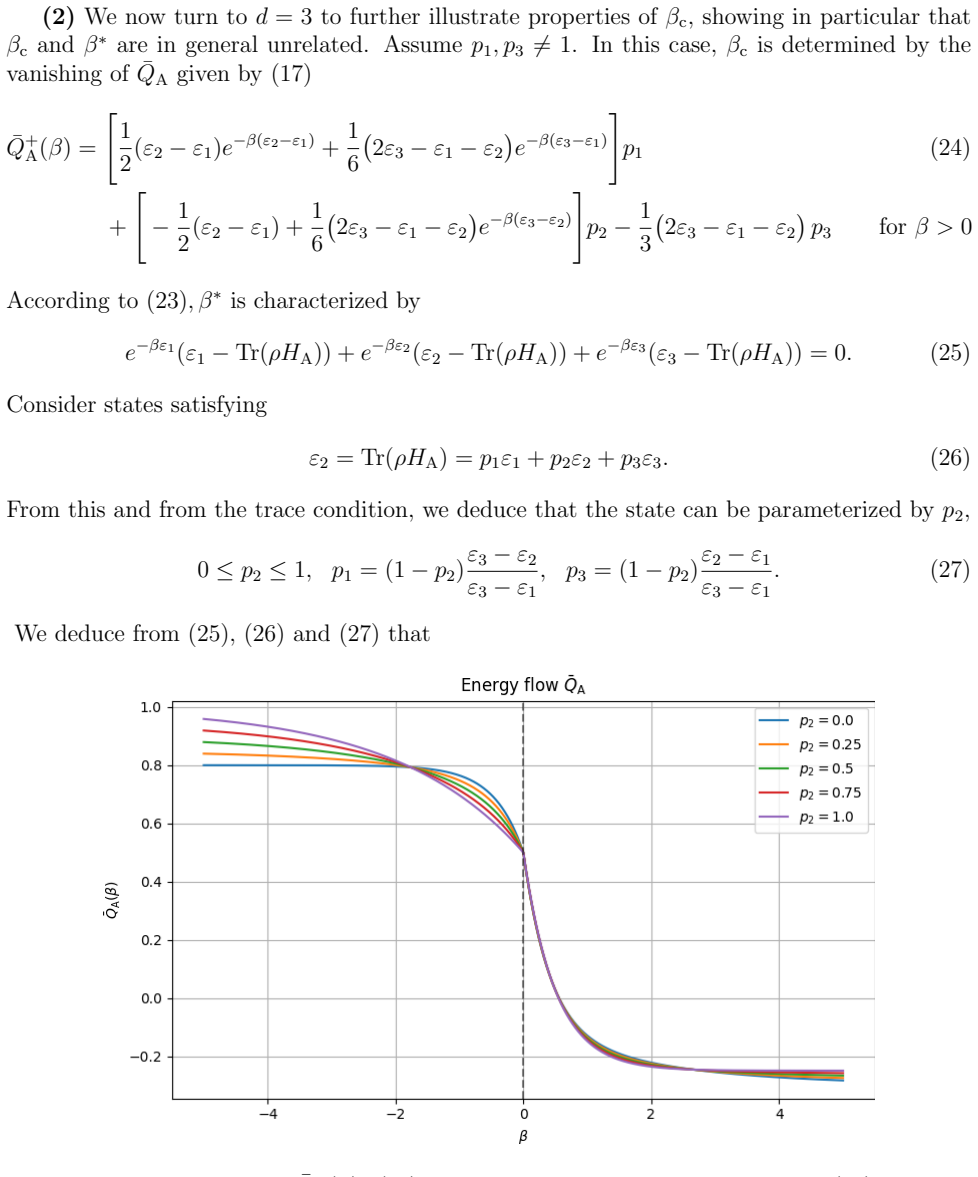
- Fig. 2 caption: the plotted quantity is labeled 'heat flow' but the axis is actually the steady-state current; relabel for consistency with the text definition in §2.
- Reference list: the citation to the original contact-temperature literature (e.g., the 1970s works on phenomenological contact temperature) is missing; add one or two foundational references.
Simulated Author's Rebuttal
We thank the referee for their positive assessment of the manuscript, recognition of the explicit construction and proof of uniqueness, and recommendation for minor revision. No specific major comments were provided in the report.
Circularity Check
No significant circularity detected
full rationale
The paper introduces an explicit simple thermometer model and defines the contact temperature directly as the unique β at which heat flow vanishes upon coupling to an arbitrary system state. The central claim is the construction and verification of a model possessing this uniqueness property for all finite-dimensional states, which is presented as a direct property of the introduced Hamiltonian and coupling without reduction to prior fitted parameters, self-citations, or redefinitions of inputs as outputs. The derivation is therefore self-contained.
Axiom & Free-Parameter Ledger
axioms (1)
- domain assumption For any finite-dimensional system state there exists a unique β such that heat flow vanishes when coupled to the thermometer prepared in its Gibbs state at that β.
invented entities (1)
-
Universal thermometer model
no independent evidence
Reference graph
Works this paper leans on
-
[1]
S. Alipour, F. Benatti, M. Afsary, F. Bakhshinezhad, M. Ramezani, T. Ala-Nissila, A.T. Rezakhani:Temperature in nonequilibrium quantum systems, arXiv:2105.11915
-
[2]
Brunner, N
N. Brunner, N. Linden, S. Popescu, P. Skrzypczyk:Virtual qubits, virtual temperatures, and the foundations of thermodynamics, Phys. Rev. E85, 051117 (2012)
2012
-
[3]
Carlen:Trace inequalities and quantum entropy: an introductory course, Entropy and the Quantum, Contemporary Mathematics,529, 73-140 (2010)
E. Carlen:Trace inequalities and quantum entropy: an introductory course, Entropy and the Quantum, Contemporary Mathematics,529, 73-140 (2010)
2010
-
[4]
Casas-V´ azquez, D
J. Casas-V´ azquez, D. Jou:Temperature in non-equilibrium states: a review of open prob- lems and current proposals, Rep. Prog. Phys.661937-2023 (2003)
2023
-
[5]
Dieudonn´ e:Foundations of Modern Analysis, Pure and Applied Mathematics, Vol
J. Dieudonn´ e:Foundations of Modern Analysis, Pure and Applied Mathematics, Vol. 10. Academic Press, New York, 1969 31
1969
-
[6]
Evans, R
D.E. Evans, R. Høegh-Krohn:Spectral Properties of Positive Maps on C*-Algebras, Journal of the London Mathematical Society, vols. s2-17, p. 345-355, (1978)
1978
-
[7]
Holevo:Quantum Systems, channels, Information, a mathematical introduction, De Gruyter, 2012
A. Holevo:Quantum Systems, channels, Information, a mathematical introduction, De Gruyter, 2012
2012
- [8]
-
[9]
Koukoulekidis, R
N. Koukoulekidis, R. Alexander, T. Hebdigel, D. Jennings:The geometry of passivity for quantum systems and a novel elementary derivation of the Gibbs state, Quantum5, 411 (2021)
2021
-
[10]
Kraus:States, Effects and Operations: Fundamental Notions of Quantum Theory, Lecture Notes in Physics190, Springer Verlag (1983)
K. Kraus:States, Effects and Operations: Fundamental Notions of Quantum Theory, Lecture Notes in Physics190, Springer Verlag (1983)
1983
-
[11]
Lindblad:Completely positive maps and entropy inequalities, Comm
G. Lindblad:Completely positive maps and entropy inequalities, Comm. Math. Phys.,40, 147–151 (1975)
1975
-
[12]
Lostaglio:An introductory review of the resource theory approach to thermodynamics, Rep
M. Lostaglio:An introductory review of the resource theory approach to thermodynamics, Rep. Prog. Phys.82, 114001, (2019)
2019
-
[13]
Lostaglio, A.M
M. Lostaglio, A.M. Alhambra, C. Perry:Elementary Thermal Operations,Quantum,2, 52, (2018)
2018
-
[14]
Lipka-Bartosik, M
P. Lipka-Bartosik, M. Perarnau-Llobet, N. Brunner:Operational Definition of the Tem- perature of a Quantum State, Phys. Rev. Lett.,130, 040401 (2023)
2023
-
[15]
Merkli, A
M. Merkli, A. Neira:Lectures on open quantum systems, Can. J. Phys.104, 1-13 (2026)
2026
-
[16]
M¨ uller-Hermes, D
A. M¨ uller-Hermes, D. Reeb:Monotonicity of the Quantum Relative Entropy Under Positive Maps,Ann. Henri Poincar´ e,18, 1777–1788 (2017)
2017
-
[17]
Muschik:Empirical foundation and axiomatic treatment of non-equilibrium tempera- ture, Arch
W. Muschik:Empirical foundation and axiomatic treatment of non-equilibrium tempera- ture, Arch. Ration. Mech. Anal.66379-401 (1977)
1977
-
[18]
Norris:Markov chains, Cambridge University Press (1997)
J.R. Norris:Markov chains, Cambridge University Press (1997)
1997
-
[19]
Schrader:Perron-Frobenius theory for positive maps on trace ideals, Fields Inst
R. Schrader:Perron-Frobenius theory for positive maps on trace ideals, Fields Inst. Com- mun.,30, 107–182 (2006)
2006
-
[20]
Uhlmann:Relative entropy and the Wigner-Yanase-Dyson-Lieb concavity in an inter- polation theory, Commun
A. Uhlmann:Relative entropy and the Wigner-Yanase-Dyson-Lieb concavity in an inter- polation theory, Commun. Math. Phys.54, 21–32 (1977) 32
1977
discussion (0)
Sign in with ORCID, Apple, or X to comment. Anyone can read and Pith papers without signing in.