Hall effect in multi-leg bosonic ladders
Pith reviewed 2026-06-29 09:39 UTC · model grok-4.3
The pith
For weak magnetic fields in interacting bosonic N-leg ladders, the Hall resistance equals the derivative of the logarithm of the charge stiffness with respect to density.
A machine-rendered reading of the paper's core claim, the machinery that carries it, and where it could break.
Core claim
Using bosonization, the ground state Hall response of interacting bosonic N-leg ladders threaded by a flux is analyzed in a perturbative expansion in the band curvature. For small magnetic field the Hall resistance is proportional to the derivative of the logarithm of the charge stiffness with respect to density, generalizing the two-leg case. At low temperature, corrections to the Hall resistance are exponentially small in the Meissner phase.
What carries the argument
Bosonization of the multi-leg ladder Hamiltonian with a perturbative expansion in band curvature that retains all interactions.
Load-bearing premise
The perturbative expansion in band curvature remains valid for the N-leg ladder while fully retaining interactions through bosonization.
What would settle it
Measure Hall resistance at small flux in a bosonic ladder and compare it directly to the density derivative of the logarithm of the measured charge stiffness; systematic mismatch would falsify the claimed proportionality.
Figures
read the original abstract
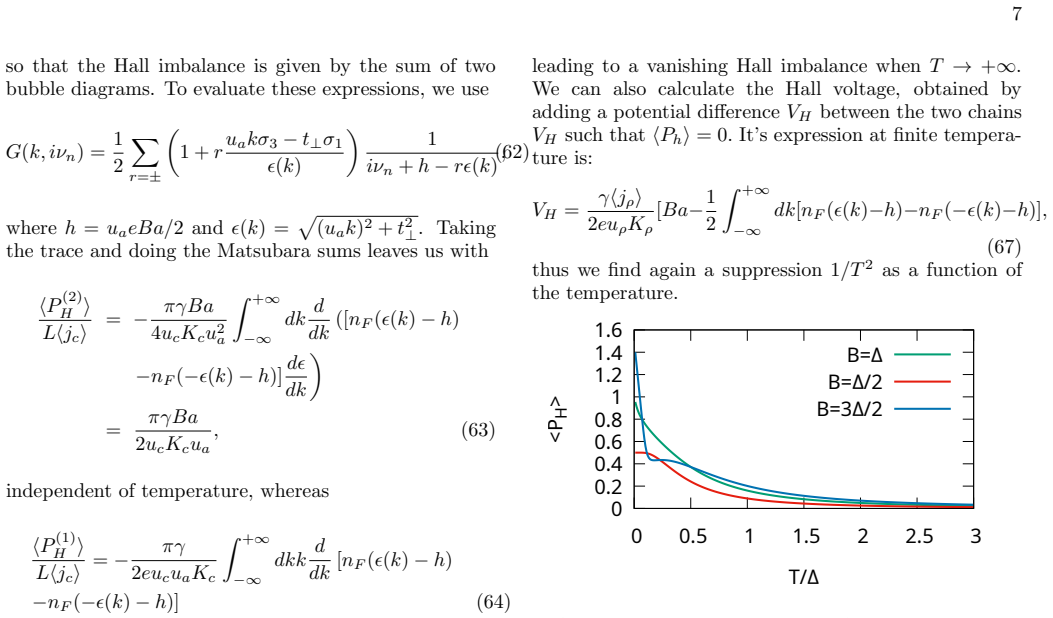
We use bosonization to analyze the ground state Hall response of interacting bosonic N-leg ladders threaded by a flux. We derive an explicit expression of the Hall imbalance in a perturbative expansion in the band curvature, retaining fully the interactions. For small magnetic field the Hall resistance is proportional to the derivative of the logarithm of the charge stiffness with respect to density, generalizing the result obtained in the two leg case. We also consider the effect of temperature, and establish that at low temperature, corrections to the Hall resistance are exponentially small in the Meissner phase.
Editorial analysis
A structured set of objections, weighed in public.
Referee Report
Summary. The manuscript uses bosonization to analyze the ground-state Hall response of interacting bosonic N-leg ladders threaded by flux. It derives an explicit expression for the Hall imbalance in a perturbative expansion in band curvature while retaining interactions fully. For small magnetic field, the Hall resistance is proportional to the derivative of the logarithm of the charge stiffness with respect to density, generalizing the two-leg result. Temperature effects are also considered, with corrections shown to be exponentially small in the Meissner phase at low T.
Significance. If the derivation is controlled, the result supplies a direct, parameter-free link between Hall resistance and charge stiffness for general N, extending the two-leg case in a manner potentially useful for quantum gas experiments. Retaining full interactions in the expansion and providing the temperature analysis are strengths if the power counting is rigorous.
major comments (1)
- [Abstract] Abstract: The central claim that the Hall resistance equals d(log D)/dn to leading order in band curvature for arbitrary N requires that the curvature perturbation commutes with the retained interactions. For N>2 the flux induces inter-mode scattering vertices in the multi-mode bosonized theory; no power-counting argument is supplied showing these vertices remain higher order than the curvature term. This is load-bearing for the generalization.
minor comments (1)
- The abstract refers to 'an explicit expression' without displaying the formula; placing the leading-order result in the abstract or introduction would aid readability.
Simulated Author's Rebuttal
We thank the referee for their careful reading and constructive feedback. We address the major comment below.
read point-by-point responses
-
Referee: [Abstract] Abstract: The central claim that the Hall resistance equals d(log D)/dn to leading order in band curvature for arbitrary N requires that the curvature perturbation commutes with the retained interactions. For N>2 the flux induces inter-mode scattering vertices in the multi-mode bosonized theory; no power-counting argument is supplied showing these vertices remain higher order than the curvature term. This is load-bearing for the generalization.
Authors: We thank the referee for highlighting this important point on the controlled nature of the expansion for N>2. The flux is incorporated into the hopping amplitudes prior to bosonization, which does generate inter-mode scattering vertices in the multi-mode theory. We agree that an explicit power-counting argument establishing that these vertices remain higher order in the band-curvature parameter (relative to the retained interactions) was not supplied in the manuscript. We will add a dedicated paragraph in the revised manuscript that computes the scaling dimensions of the flux-induced operators and demonstrates their suppression in the perturbative expansion used for the Hall imbalance. revision: yes
Circularity Check
Bosonization derivation self-contained; no reduction to inputs or self-citation chains
full rationale
The paper performs a perturbative expansion in band curvature within the bosonized multi-leg ladder model while retaining interactions fully, yielding the stated proportionality for Hall resistance as an output of the calculation. No quoted equations reduce the central result to a fitted parameter renamed as prediction, a self-definitional loop, or a load-bearing self-citation whose content is unverified. The generalization from the two-leg case is presented as an extension of the same method rather than an imported uniqueness theorem. The derivation chain remains independent of its inputs.
Axiom & Free-Parameter Ledger
axioms (1)
- domain assumption Bosonization is applicable to the interacting bosonic N-leg ladder system
Reference graph
Works this paper leans on
-
[1]
or in terms of a generalized hypergeometric function. In particular, we have Q1(n,0,0, N−1) = 2n+ 1−N 1−N .(25) For a givenN, we define normalized polynomialsq j(n) by qj(n) = vuut2j+ 1 N jY l=1 N−l N+l Qj(n−1,0,0, N−1),(26) so that NX n=1 qj(n)qk(n) =δ jk .(27) This allows us to rewrite ϕn(x) = N−1X j=0 qj(n)φj(x),(28) θn(x) = N−1X j=0 qj(n)ϑj(x),(29) Πn...
-
[2]
Operator products expansions give contri- butions∝cos(θ n+1 +θn−1−2θ n) of scaling dimension 3/(2K) that depend only on the fieldsϑ j withj≥2
and beyond a threshold in flux a vortex-like phase is obtained. Operator products expansions give contri- butions∝cos(θ n+1 +θn−1−2θ n) of scaling dimension 3/(2K) that depend only on the fieldsϑ j withj≥2. ForK >3/4, these contributions are relevant. Using twice Eq. (18.22.19), we can expressθ n+1 +θ n−1 −2θ n in terms of the Hahn polynomialsQ j(n−1,2,2,...
-
[3]
It seems reasonable that a similar behavior is obtained withN >3 coupled chains
+O(e −∆/T ) in the Meissner phase and in the limit of small temperature, and⟨P H ⟩ ≃ ⟨P H ⟩(T= 0) +O(T 2) in the Vortex phase, while⟨P H ⟩ ∼T −2 at high tem- perature. It seems reasonable that a similar behavior is obtained withN >3 coupled chains. V. CONCLUSION We have analyzed an N-leg bosonic ladder in the ground state and in the presence of flux, and ...
-
[4]
2 3 + 1 6 coshy βuaeBa 2 2 + (βt⊥) 2 sinhy y +O(β 4) = Ba 2
could help clarifying that issue. Finally, let us stress that our results provide a bosonic multileg ladder per- spective on Hall responses, establishing a bridge to the recent experimental observations[52, 54]. ACKNOWLEDGMENTS This research was supported in part by the Swiss Na- tional Science Foundation under grant 200020-219400. E. O. and R. C. acknowl...
-
[5]
E. H. Hall, On a new action of the magnet on electric currents, Am. J. Math.2, 287 (1879)
-
[6]
von Klitzing, G
K. von Klitzing, G. Dorda, and M. Pepper, No Title, Physical Review Letters45, 494 (1980)
1980
-
[7]
K. v. Klitzing, G. Dorda, and M. Pepper, New method for high-accuracy determination of the fine-structure con- stant based on quantized hall resistance, Phys. Rev. Lett. 45, 494 (1980-08). 10
1980
-
[8]
Ripka and K
P. Ripka and K. Z` avˇ eta, Magnetic sensors: Principles and applications, inHandbook of Magnetic Materials, Handbook of Magnetic Materials, Vol. 18, edited by K. Buschow (Elsevier, 2009) Chap. 3, p. 347
2009
-
[9]
D. J. Thouless, M. Kohmoto, M. P. Nightingale, and M. den Nijs, Quantized hall conductance in a two- dimensional periodic potential, Phys. Rev. Lett.49, 405 (1982)
1982
-
[10]
J. E. Avron and R. Seiler, Quantization of the hall con- ductance for general, multiparticle schr¨ odinger hamilto- nians, Phys. Rev. Lett.54, 259 (1985-01)
1985
-
[11]
Q. Niu, D. J. Thouless, and Y.-S. Wu, Quantized hall conductance as a topological invariant, Phys. Rev. B31, 3372 (1985-03)
1985
-
[12]
Xiao, M.-C
D. Xiao, M.-C. Chang, and Q. Niu, Berry phase effects on electronic properties, Rev. Mod. Phys.82, 1959 (2010)
1959
-
[13]
Tsuji, The thermoelectric, galvanomagnetic and ther- momagnetic effects of monovalent metals
M. Tsuji, The thermoelectric, galvanomagnetic and ther- momagnetic effects of monovalent metals. iii. the galvano- magnetic and thermomagnetic effects for anisotropic me- dia, Journal of the Physical Society of Japan13, 979 (1958)
1958
-
[14]
Ong, Geometric interpretation of the weak-field hall conductivity in two-dimensional metals with arbitrary fermi surface, Physical Review B43, 193 (1991)
N. Ong, Geometric interpretation of the weak-field hall conductivity in two-dimensional metals with arbitrary fermi surface, Physical Review B43, 193 (1991)
1991
-
[15]
Le´ on, C
G. Le´ on, C. Berthod, and T. Giamarchi, Hall effect in strongly correlated low-dimensional systems, Physical Review B75, 195123 (2007)
2007
-
[16]
Zotos, F
X. Zotos, F. Naef, M. Long, and P. Prelovˇ sek, Reactive hall response, Phys. Rev. Lett.85, 377 (2000)
2000
-
[17]
Auerbach, Hall number of strongly correlated metals, Phys
A. Auerbach, Hall number of strongly correlated metals, Phys. Rev. Lett.121, 066601 (2018)
2018
-
[18]
B. S. Shastry, B. I. Shraiman, and R. R. Singh, Physical Review Letters70, 2004 (1993)
2004
-
[19]
Fazio and H
R. Fazio and H. van der Zant, Physics Reports355, 235 (2001)
2001
-
[20]
Dalibard, F
J. Dalibard, F. Gerbier, G. Juzeli¯ unas, and P. ¨Ohberg, Colloquium: Artificial gauge potentials for neutral atoms, Rev. Mod. Phys.83, 1523 (2011)
2011
-
[21]
Galitski and I
V. Galitski and I. Spielman, Spin–orbit coupling in quan- tum gases, Nature (London)494, 49 (2013)
2013
-
[22]
Mancini, G
M. Mancini, G. Pagano, G. Cappellini, L. Livi, M. Rider, J. Catani, C. Sias, P. Zoller, M. Inguscio, M. Dalmonte, and L. Fallani, Observation of chiral edge states with neutral fermions in synthetic Hall ribbons, Science349, 1510 (2015)
2015
-
[23]
Introduction to the physics of artificial gauge fields
J. Dalibard, Introduction to the physics of artificial gauge fields, inQuantum Matter at Ultralow Tempera- tures, edited by M. Inguscio, W. Ketterle, S. Stringari, and G. Roati (IOS Press, Amsterdam, 2016) p. 1, arXiv:1504.05520 [cond-mat]
work page internal anchor Pith review Pith/arXiv arXiv 2016
-
[24]
Goldman, J
N. Goldman, J. Budich, and P. Zoller, Topological quan- tum matter with ultracold gases in optical lattices, Nat. Phys.12, 639 (2016)
2016
-
[25]
B. K. Stuhl, H.-I. Lu, L. M. Aycock, D. Genkina, and I. B. Spielman, Visualizing edge states with an atomic bose gas in the quantum hall regime, Science349, 1514 (2015)
2015
-
[26]
T. Zhou, G. Cappellini, D. Tusi, L. Franchi, T. Beller, G. Masini, J. Parravicini, C. Repellin, S. Greschner, M. Inguscio,et al., Strongly interacting lattice fermions with coherent state manipulation: from universal hall response to hall voltage measurement, inBose-Einstein Condensation 2023 Report of Contributions(Universit¨ at Hamburg, 2023) pp. 8–8
2023
-
[27]
A. Impertro, S. Huh, S. Karch, J. F. Wienand, I. Bloch, and M. Aidelsburger, Strongly interacting Meissner phases in large bosonic flux ladders, Nature Physics , 1 (2025), arXiv:2412.09481 [cond-mat]
-
[28]
F. D. M. Haldane, Physical Review Letters47, 1840 (1981)
1981
-
[29]
K. B. Efetov and A. I. Larkin, Sov. Phys. JETP42, 390 (1975)
1975
-
[30]
M. A. Cazalilla, R. Citro, T. Giamarchi, E. Orignac, and M. Rigol, One dimensional bosons: From condensed mat- ter systems to ultracold gases, Rev. Mod. Phys.83, 1405 (2011)
2011
-
[31]
S. R. White, Physical Review Letters69, 2863 (1992)
1992
-
[32]
K. A. Hallberg, adv. Phys.55, 477 (2006)
2006
-
[33]
Schollw¨ ock, The density-matrix renormalization group in the age of matrix product states, Annals of Physics 326, 96 (2011)
U. Schollw¨ ock, The density-matrix renormalization group in the age of matrix product states, Annals of Physics 326, 96 (2011)
2011
-
[34]
Kardar, Josephson-junction ladders and quantum fluctuations, Physical Review B33, 3125 (1986)
M. Kardar, Josephson-junction ladders and quantum fluctuations, Physical Review B33, 3125 (1986)
1986
-
[35]
E. Orignac and T. Giamarchi, Meissner effect in a bosonic ladder, Physical Review B64, 144515 (2001), cond- mat/0011497
-
[36]
Tokuno and A
A. Tokuno and A. Georges, Ground states of a bose- hubbard ladder in an artificial magnetic field: field- theoretical approach, New J. Phys.16, 073005 (2014)
2014
-
[37]
Uchino, Analytical approach to a bosonic ladder sub- ject to a magnetic field, Phys
S. Uchino, Analytical approach to a bosonic ladder sub- ject to a magnetic field, Phys. Rev. A93, 053629 (2016)
2016
-
[38]
Cha and J.-G
M.-C. Cha and J.-G. Shin, Two peaks in the momen- tum distribution of bosons in a weakly frustrated two-leg optical ladder, Physical Review A83, 055602 (2011)
2011
-
[39]
Piraud, Z
M. Piraud, Z. Cai, I. P. McCulloch, and U. Schollw¨ ock, Quantum magnetism of bosons with synthetic gauge fields in one-dimensional optical lattices: a density- matrix renormalization group study, Phys. Rev. A89, 063618 (2014)
2014
-
[40]
Piraud, F
M. Piraud, F. Heidrich-Meisner, I. P. McCulloch, S. Greschner, T. Vekua, and U. Schollw¨ ock, Vortex and meissner phases of strongly interacting bosons on a two- leg ladder, Physical Review B91, 140406 (2015)
2015
-
[41]
Piraud, F
M. Piraud, F. Heidrich-Meisner, I. P. McCulloch, S. Greschner, T. Vekua, and U. Schollw¨ ock, Vortex and meissner phases of strongly interacting bosons on a two- leg ladder, Phys. Rev. B91, 140406(R) (2015)
2015
-
[42]
Di Dio, S
M. Di Dio, S. De Palo, E. Orignac, R. Citro, and M.-L. Chiofalo, Persisting meissner state and incommensurate phases of hard-core boson ladders in a flux, Phys. Rev. B92, 060506 (2015)
2015
-
[43]
Greschner, M
S. Greschner, M. Piraud, F. Heidrich-Meisner, I. McCul- loch, U. Schollw¨ ock, and T. Vekua, Spontaneous increase of magnetic flux and chiral-current reversal in bosonic ladders: Swimming against the tide, Phys. Rev. Lett. 115, 190402 (2015)
2015
-
[44]
Natu, Bosons with long range interactions on two-leg ladders in artificial magnetic fields stefan s
S. Natu, Bosons with long range interactions on two-leg ladders in artificial magnetic fields stefan s. natu, Phys. Rev. A92, 053623 (2015)
2015
-
[45]
Greschner, M
S. Greschner, M. Piraud, F. Heidrich-Meisner, I. P. Mc- Culloch, U. Schollw¨ ock, and T. Vekua, Symmetry-broken states in a system of interacting bosons on a two-leg lad- der with a uniform abelian gauge field, Phys. Rev. A94, 063628 (2016-12)
2016
-
[46]
Greschner and T
S. Greschner and T. Vekua, Vortex-hole duality: A uni- fied picture of weak- and strong-coupling regimes of bosonic ladders with flux, Phys. Rev. Lett.119, 073401 11 (2017-08)
2017
-
[47]
Orignac, R
E. Orignac, R. Citro, M. Di Dio, and S. De Palo, Vortex lattice melting in a boson ladder in an artificial gauge field, Phys. Rev. B96, 014518 (2017-07)
2017
-
[48]
Citro, S
R. Citro, S. De Palo, M. Di Dio, and E. Orignac, Quan- tum phase transitions of a two-leg bosonic ladder in an ar- tificial gauge field, Physical Review B97, 174523 (2018)
2018
-
[49]
Maeda, C
Y. Maeda, C. Hotta, and M. Oshikawa, Universal tem- perature dependence of the magnetization of gapped spin chains, Physical Review Letters99, 057205 (2007)
2007
-
[50]
Finite-temperature properties of interacting bosons on a two-leg flux ladder
M. Buser, F. Heidrich-Meisner, and U. Schollw¨ ock, Finite-temperature properties of interacting bosons on a two-leg flux ladder, Physical Review A99, 053601 (2019), arXiv: 1901.07083
work page internal anchor Pith review Pith/arXiv arXiv 2019
-
[51]
Petrescu, M
A. Petrescu, M. Piraud, I. McCulloch, G. Roux, and K. L. Hur, Bulletin of the APS March Meeting 2016 , BAPS.2016.MAR.R50.9 (2016)
2016
-
[52]
M. C. Strinati, E. Cornfeld, D. Rossini, S. Barbarino, M. Dalmonte, R. Fazio, E. Sela, and L. Mazza, Laughlin- like states in bosonic and fermionic atomic synthetic lad- ders, Physical Review X7, 021033 (2017)
2017
-
[53]
M. C. Strinati, S. Sahoo, K. Shtengel, and E. Sela, Pre- topological fractional excitations in the two-leg flux lad- der, Physical Review B99, 245101 (2019)
2019
-
[54]
Universal Hall Response in Synthetic Dimensions
S. Greschner, M. Filippone, and T. Giamarchi, Uni- versal Hall Response in Synthetic Dimensions, Physi- cal Review Letters122, 083402 (2019), arXiv:1809.10927 [cond-mat]
work page internal anchor Pith review Pith/arXiv arXiv 2019
-
[55]
Buser, S
M. Buser, S. Greschner, U. Schollw¨ ock, and T. Gia- marchi, Probing the hall voltage in synthetic quantum systems, Phys. Rev. Lett.126, 030501 (2021)
2021
-
[56]
T.-W. Zhou, G. Cappellini, D. Tusi, L. Franchi, J. Par- ravicini, C. Repellin, S. Greschner, M. Inguscio, T. Gia- marchi, M. Filippone,et al., Observation of universal hall response in strongly interacting fermions, Science381, 10.1126/science.add1969 (2023), arXiv:2205.13567
- [57]
-
[58]
T.-W. Zhou, T. Beller, G. Masini, J. Parravicini, G. Cap- pellini, C. Repellin, T. Giamarchi, J. Catani, M. Filip- pone, and L. Fallani, Measuring Hall voltage and Hall resistance in an atom-based quantum simulator, Nature Communications16, 10247 (2025), arXiv:2411.09744 [cond-mat]
-
[59]
Giamarchi,Quantum Physics in One Dimension, In- ternational series of monographs on physics, Vol
T. Giamarchi,Quantum Physics in One Dimension, In- ternational series of monographs on physics, Vol. 121 (Oxford University Press, Oxford, 2004)
2004
-
[60]
Schick, Flux Quantization in a One-Dimensional Model, Phys
M. Schick, Flux Quantization in a One-Dimensional Model, Phys. Rev.166, 404 (1968)
1968
-
[61]
F. D. M. Haldane, J. Phys. C14, 2585 (1981)
1981
-
[62]
Hall effect and inter-chain magneto-optical properties of coupled Luttinger liquids
A. Lopatin, A. Georges, and T. Giamarchi, Hall effect and inter-chain magneto-optical properties of coupled luttinger liquids, Physical Review B63, 75109 (2001), cond-mat/0008066
work page internal anchor Pith review Pith/arXiv arXiv 2001
-
[63]
Kohn, Physical Review133, A171 (1964)
W. Kohn, Physical Review133, A171 (1964)
1964
-
[64]
Characterising transport in a quantum gas by measuring Drude weights
P. Sch¨ uttelkopf, M. Tajik, N. Bazhan, F. Cataldini, S.- C. Ji, J. Schmiedmayer, and F. Møller, Characterising transport in a quantum gas by measuring Drude weights, arXiv:2406.17569 [cond-mat] (2024)
work page internal anchor Pith review Pith/arXiv arXiv 2024
-
[65]
Donohue and T
P. Donohue and T. Giamarchi, Mott-superfluid transi- tion in bosonic ladders, Physical Review B63, 180508(R) (2001)
2001
-
[66]
Cr´ epin, N
F. Cr´ epin, N. Laflorencie, G. Roux, and P. Simon, Phase diagram of hard-core bosons on clean and disordered two- leg ladders: Mott insulator˘luttinger liquid˘bose glass, Phys. Rev. B84, 054517 (2011-08)
2011
-
[67]
Kolley, M
F. Kolley, M. Piraud, I. McCulloch, U. Schollw¨ ock, and F. Heidrich-Meisner, Strongly interacting bosons on a three-leg ladder in the presence of a homogeneous flux, New J. Phys.17, 092001 (2015)
2015
-
[68]
Citro, E
R. Citro, E. Orignac, N. Andrei, C. Itoi, and S. Qin, Effective theory of magnetization plateaus in a three- leg ladder with periodic boundary conditions, Journal of Physics: Condensed Matter12, 3041 (2000)
2000
-
[69]
I. Bouchoule, R. Citro, T. Duty, T. Giamarchi, R. G. Hulet, M. Klanjsek, E. Orignac, and B. Weber, A glance to luttinger liquid and its platforms, Nature Review Physics7, 565 (2025), arXiv:2501.12097
-
[70]
G. I. Japaridze and A. A. Nersesyan, ?, Journal of Exper- imental and Theoretical Physics Letters27, 334 (1978)
1978
-
[71]
V. L. Pokrovsky and A. L. Talapov, No Title, Physical Review Letters42, 65 (1979)
1979
-
[72]
K. A. Matveev, Equilibration of a one-dimensional quan- tum liquid, Journal of Experimental and Theoretical Physics117, 508 (2013), arXiv:1304.6012 [cond-mat]
work page internal anchor Pith review Pith/arXiv arXiv 2013
-
[73]
Zotos, F
X. Zotos, F. Naef, M. Long, and P. Prelovˇ sek, Drude Weight, Integrable Systems and the Reactive Hall Con- stant, inOpen Problems in Strongly Correlated Electron Systems, NATO Science Series II: Mathematics, Physics and Chemistry, Vol. 15, edited by J. Bonˇ ca, P. Prelovˇ sek, A. Ramˇ sak, and S. Sarkar (Springer Netherlands, Dor- drecht, 2001) p. 273
2001
-
[74]
A. Auerbach and S. Bhattacharyya, Quantum Transport Theory of Strongly Correlated Matter, Physics Reports 1091, 1 (2024), arXiv:2406.02677 [cond-mat]
-
[75]
H. J. Schulz, Physical Review B22, 5274 (1980)
1980
-
[76]
Bateman Manuscript Proyect, Higher transcendental functions (McGraw-Hill Book Company Inc., New York, 1953)
1953
-
[77]
Olver, D
F. Olver, D. Lozier, R. Boisvert, and C. Clark, eds.,NIST handbook of mathematical functions(Cambridge Univer- sity Press, Cambridge, UK, 2010)
2010
-
[78]
B. S. Shastry, B. I. Shraiman, and R. R. Singh, Faraday rotation and the hall constant in strongly correlated fermi systems, Physical review letters70, 2004 (1993)
2004
-
[79]
E. H. Lieb and W. Liniger, Physical Review130, 1605 (1963)
1963
-
[80]
Amico and V
L. Amico and V. Korepin, Universality of the one- dimensional bose gas with delta interaction, Annalen der Physik314, 496 (2004)
2004
discussion (0)
Sign in with ORCID, Apple, or X to comment. Anyone can read and Pith papers without signing in.