REVIEW 3 major objections 5 minor 40 references
Fine-Grained HDR Image Quality Assessment From Noticeably Distorted to Very High Fidelity
T0 review · 3 major / 5 minor · reviewed 2026-08-07 · deepseek-v4-flash
Pith's one-line read This paper introduces AIC-HDR2025, the first fine-grained HDR image quality dataset with JND-scaled subjective scores, and shows that the JPEG AIC-3 methodology yields 95% confidence intervals averaging 0.27 JND at 1 JND.
desk verdict A genuinely useful public HDR dataset with careful subjective data collection, but the '0.27 JND precision' claim is conditional on an unvalidated parametric model imported from AIC-3. read the letter →
The pith
A machine-rendered reading of the paper's core claim, the machinery that carries it, and where it could break.
The reading
What carries the argument
The central mechanism is the unified functional scale reconstruction: for each codec and source, perceived distortion $d$ as a function of bitrate $r$ is modeled by an exponential rate-distortion function $d(r) = \alpha e^{-\beta r}$, and the boosted triplet condition is linked to the plain condition by a quadratic boosting transform $h(d) = \gamma_1 d + \gamma_2 d^2$. The parameters $\alpha, \beta, \gamma_1, \gamma_2$ are estimated jointly from plain (PTC) and boosted (BTC) triplet responses using a Thurstonian Case V model and maximum likelihood, with confidence intervals computed by bootstrapping the cleaned response data 1,000 times. This machinery converts raw triplet choices into fractional JND scores and underlies the reported 0.27 CI width and the metric correlations.
What would settle it
Re-analyze the same triplet response data using a nonparametric ordinal scaling method (e.g., a Thurstone model without the exponential RD and quadratic boosting constraints) and compare the resulting JND estimates to the paper's parametric curves; if the nonparametric values fall outside the reported 95% confidence intervals, the parametric assumption is falsified. A complementary test would be to collect plain and boosted triplet responses at intermediate bitrate points not used in fitting and check whether the exponential $d(r)=\alpha e^{-\beta r}$ curve accurately predicts those new JND values.
Extended reading notes
Core claim
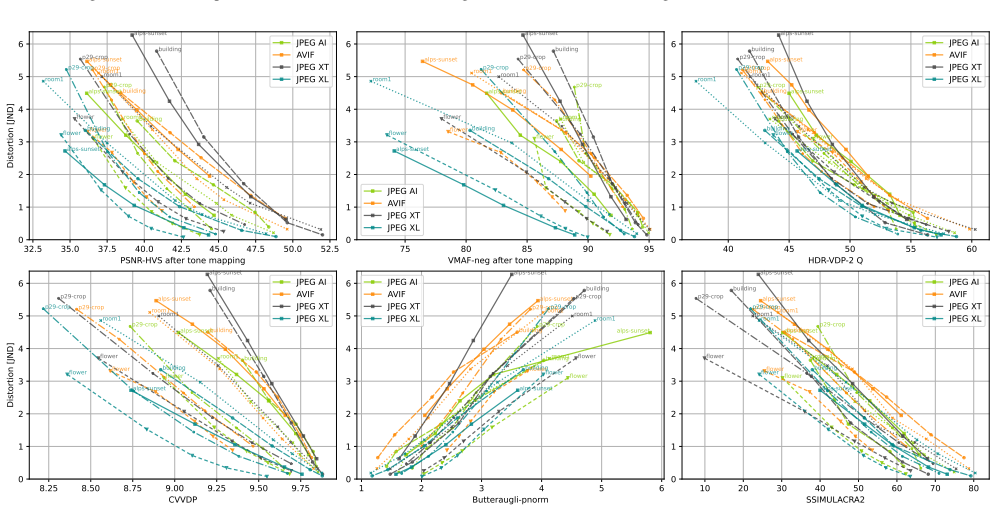
The central claim is that the JPEG AIC-3 test methodology, when applied to HDR content, enables precise, fine-grained quality estimation in just noticeable difference (JND) units, with 95% confidence intervals averaging a width of 0.27 at 1 JND. The paper demonstrates this by constructing AIC-HDR2025, the first HDR dataset covering the high-fidelity range from visible distortions to below the visually lossless threshold, using five sources, four codecs, and five compression levels each. From the collected plain and boosted triplet responses, the paper reconstructs per-codec rate-distortion curves in JND units and reports that HDR-VDP-2 outperforms all other tested metrics in predicting these subjective JND scores.
Load-bearing premise
The JND scores rest on a parametric model that assumes perceived distortion decays exponentially with bitrate and that the boosted viewing condition magnifies distortion through a fixed quadratic function; if either functional form does not faithfully represent human perception, the JND values, confidence intervals, and metric rankings inherit that bias.
Editorial extensions
If this is right
- The released AIC-HDR2025 dataset provides a public benchmark for evaluating HDR codecs in the high-fidelity, near-visually-lossless range, where traditional MOS scales are too coarse.
- HDR-VDP-2, with a PLCC of 0.936 and SRCC of -0.946, can serve as a reliable proxy for subjective JND scores in HDR codec tuning and bitrate allocation, at least within the codecs and content tested.
- The narrow confidence intervals (average 0.27 JND at 1 JND) indicate that the AIC-3 methodology can resolve very small perceptual differences, opening the door for finer-grained quality assessment of other HDR content.
- Conventional SDR-oriented metrics (e.g., SSIM, VMAF) perform better on tone-mapped HDR images, suggesting that tone mapping remains a practical preprocessing step when HDR-specific metrics are unavailable.
- Per-codec and per-source correlations are generally higher than overall correlations, meaning intra-codec quality prediction is easier than cross-codec generalization, an important distinction for practical bitrate control.
Reading between the lines
- A model-free or nonparametric ordinal scaling of the same triplet responses could test the validity of the assumed exponential rate-distortion and quadratic boosting shapes; if the nonparametric JND values deviate systematically, the parametric assumption is the likely culprit.
- The dataset could be used to train or fine-tune a learned HDR quality metric, since its JND-scaled labels provide a continuous, perceptually uniform target rather than coarse MOS categories.
- Because one lab used a different HDR display (Sony BVM-HX310) than the other three (MacBook Pro XDR), the paper's future cross-lab comparison may reveal display-dependent JND shifts; if so, the 0.27 CI width might be an underestimate for mixed-display deployments.
- The average 0.27 JND CI at 1 JND could serve as a baseline precision figure for future HDR datasets, enabling direct comparisons of methodology precision across SDR and HDR studies.
Editorial analysis
A structured set of objections, weighed in public.
Referee Report
Summary. The paper presents AIC-HDR2025, a fine-grained HDR image quality assessment dataset built from five HDR source images, four codecs (JPEG XL, JPEG AI, AVIF, JPEG XT), and five compression levels per source and codec, yielding 100 compressed images. Subjective quality was measured with the JPEG AIC-3 methodology using plain and boosted triplet comparisons, collecting 34,560 responses from 151 participants across four controlled laboratories. The authors reconstruct a perceived distortion scale in JND units using a parametric model with an exponential rate-distortion function and a quadratic boosting transform, report an average 95% confidence interval width of 0.27 JND at the 1 JND point, and benchmark a range of objective IQA metrics, finding that HDR-VDP-2 correlates best with the reconstructed JND values. The dataset is publicly released along with encoder recipes.
Significance. The dataset is a genuine and potentially valuable asset for the HDR IQA community: it covers the high-fidelity range near the visually lossless threshold, uses carefully calibrated displays and controlled laboratory conditions, includes multiple codecs and content types, and provides a broad benchmark of objective metrics, including several recently proposed HDR-aware models. The subjective data collection is more careful than in most existing HDR datasets, and the public release of the dataset and encoding recipes supports reproducibility. However, the headline claim of precise quality estimation hinges on the untested parametric model used to convert triplet responses into JND values; the reported 0.27-JND confidence interval and the metric correlations in Table II inherit the assumptions of that model. If the authors add validation of the assumed functional forms or appropriately qualify the precision claim, this dataset could become a standard reference for evaluating codecs and metrics in the high-fidelity HDR regime.
major comments (3)
- [Section V-B and Fig. 2] The JND scale is reconstructed using the assumed functional forms d(r)=αe^{-βr} and h(d)=γ1d+γ2d^2, imported from references [19] and [20], with four parameters estimated per source-codec combination. No goodness-of-fit, residual analysis, or independent validation of these shapes against the new HDR data is reported. Since only five bitrate levels are available per source-codec, the four-parameter model has no degrees of freedom with which to reveal its own misspecification. The bootstrap confidence interval of average width 0.27 at 1 JND therefore quantifies sampling variability only under the assumed model; any systematic error in the exponential or quadratic forms propagates directly into the claimed precision and into the metric correlations in Table II. I recommend adding an independent anchor, for example staircase measurements of a few JND points, or comparing the assumed model with a more flexible alternative using hold-out or cross-validation, and reporting how the 0.27 width and the correlations change.
- [Section V-B and Table I] The treatment of 'not sure' responses, split half and half between 'left' and 'right', is an untested assumption that materially affects the likelihood. Table I shows that 'not sure' rates are large for the smallest distortion differences, reaching 31.6% for BTC and 35.9% for PTC at distortion level difference 1. The authors should provide a sensitivity analysis, for example excluding 'not sure' responses or modeling them as a separate response category, to demonstrate that the reconstructed JND scales and the 0.27 confidence interval are robust to this modeling choice.
- [Section V-B] The model assumes that the only difference between the plain and boosted triplet tasks is a monotone quadratic transform h(d) of the same underlying distortion d(r). However, BTC and PTC differ in several task-relevant ways: zoom factor (2x in BTC), flicker at 10 Hz (BTC), viewing distance (1.5 times stimulus height for BTC versus 3.1 for PTC), and display region (full display versus central 2K region). These differences may engage different perceptual mechanisms, and it is not obvious that a single per-codec quadratic function can absorb all of them. The authors should justify or relax this assumption, for instance by fitting separate d(r) functions for each task and reporting the discrepancy, or by testing whether the quadratic transform adequately fits the observed response patterns for both tasks.
minor comments (5)
- [Abstract and Section IV-A] The dataset name is inconsistently written as AIC-HDR2025 in the abstract and title and HDR-AIC2025 in Section IV-A; please unify.
- [Abstract and Section I] 'A VIF' appears with a space in several places; this should be 'AVIF' for consistency with the rest of the text.
- [Section III-C] The procedure for manually selecting target bitrates is described only by 'based on visual inspection'; since the dataset is meant to cover a JND range, a more operational description of the selection criterion would help users understand the intended distortion levels.
- [Section IV-A] The fraction of cross-codec triplets is reported as 16.7%, below the 20% recommended by the JPEG AIC-3 standard [19]; a sentence explaining the impact of this deviation, or justifying it, would be useful.
- [Section V-B] When stating that 'a total of 16 parameters of type α, β, γ1, γ2 were estimated', it would be clearer to note explicitly that this is per source image, yielding 80 parameters across the five sources.
Circularity Check
JND scale relies on an unvalidated exponential-RD/quadratic-boosting ansatz imported from the authors' own AIC-3 references, and the 0.27 CI precision claim is computed by refitting that same model to bootstrap resamples.
-
ansatz smuggled in via citation
[Section V-B (Unified functional scale reconstruction)]
"The first is an exponential rate-distortion (RD) function d(r) = αe^{−βr}, that maps bitrate r to perceived distortion d in JND units corresponding to the plain triplet comparison task. The second function nonlinearly maps these distortions d(r) to the perceived distortion corresponding to the boosted triplet comparison task by means of a quadratic boosting transform, h(d)=γ1d+γ2d²."
These functional forms are adopted from the JPEG AIC-3 modeling process [19] and procedure [20], which are authored or co-authored by many of the present authors (Jenadeleh, Saupe, Sneyers, Ascenso, Ebrahimi, Mohammadi). No goodness-of-fit check or independent validation of the exponential and quadratic shapes is reported on the new HDR data. Since the reconstructed JND scores are defined by these fitted functions, the central scale inherits an unverified ansatz through a self-citation rather than being derived from first principles or tested against an external anchor.
-
fitted input called prediction
[Section V-B and Abstract]
"The results confirm that AIC-3 enables precise HDR quality estimation, with 95% confidence intervals averaging a width of 0.27 at 1 JND. These CIs were computed by bootstrapping the cleansed dataset 1,000 times: for each iteration, triplet questions were resampled with replacement, RD curves were reconstructed, and distortion values were evaluated at 100 equally spaced bitrates."
The headline precision claim is obtained by refitting the same exponential/quadratic model to bootstrap resamples of the same triplet data. The 0.27 CI therefore measures only sampling variability conditional on the assumed functional forms and the fitted parameters; it does not bound model misspecification error. Presenting this as 'the results confirm' that AIC-3 enables precise estimation is a fitted output (the model's own uncertainty) being used as independent confirmation of the model's precision.
full rationale
The paper's main empirical contribution — 34,560 collected triplet ratings and public dataset — is independent and not circular; metric correlations in Table II compare external objective models against subjectively grounded scores. However, the JND scale itself is constructed from a parametric model (exponential RD plus quadratic boosting) imported from the authors' own AIC-3 references without goodness-of-fit validation, and the claimed 0.27 CI precision is a bootstrap of that same fitted model. These are real but partial circularities: the model assumptions and precision claim are not independently established, while the underlying human-response data provide substantial independent content. Hence score 4 rather than 0 or 6. No uniqueness theorem or forced-choice reduction is involved; the circularity is limited to the model-form import and self-confirmed precision.
Assumptions & free parameters
free parameters (4)
- alpha (exponential scale) per source and codec =
MLE estimate, not reported in paper
- beta (exponential rate) per source and codec =
MLE estimate, not reported in paper
- gamma1 (linear boosting coefficient) per source and codec =
MLE estimate, not reported in paper
- gamma2 (quadratic boosting coefficient) per source and codec =
MLE estimate, not reported in paper
assumptions (5)
- domain assumption Thurstone Case V model: response probabilities are determined by the difference of perceptual scale values through a normal (probit) link.
- ad hoc to paper Exponential rate-distortion form d(r)=alpha*e^(-beta*r) for plain triplet distortion as a function of bitrate.
- ad hoc to paper Quadratic boosting transform h(d)=gamma1*d+gamma2*d^2 mapping plain distortion to boosted distortion.
- ad hoc to paper 'Not sure' responses are split half-half between left and right.
- domain assumption Batch exclusion criterion: batches with accuracy and consistency below 0.7 are invalid.
Cite this review
Pith. "Pith review of Fine-Grained HDR Image Quality Assessment From Noticeably Distorted to Very High Fidelity." pith.science (2026). https://pith.science/paper/DBUCV75J
@misc{pith2026250612505,
  author       = {Pith},
  title        = {Pith review of: Fine-Grained HDR Image Quality Assessment From Noticeably Distorted to Very High Fidelity},
  year         = {2026},
  howpublished = {\url{https://pith.science/paper/DBUCV75J}},
  note         = {Machine review of arXiv:2506.12505}
}
read the original abstract
High dynamic range (HDR) and wide color gamut (WCG) technologies significantly improve color reproduction compared to standard dynamic range (SDR) and standard color gamuts, resulting in more accurate, richer, and more immersive images. However, HDR increases data demands, posing challenges for bandwidth efficiency and compression techniques. Advances in compression and display technologies require more precise image quality assessment, particularly in the high-fidelity range where perceptual differences are subtle. To address this gap, we introduce AIC-HDR2025, the first such HDR dataset, comprising 100 test images generated from five HDR sources, each compressed using four codecs at five compression levels. It covers the high-fidelity range, from visible distortions to compression levels below the visually lossless threshold. A subjective study was conducted using the JPEG AIC-3 test methodology, combining plain and boosted triplet comparisons. In total, 34,560 ratings were collected from 151 participants across four fully controlled labs. The results confirm that AIC-3 enables precise HDR quality estimation, with 95\% confidence intervals averaging a width of 0.27 at 1 JND. In addition, several recently proposed objective metrics were evaluated based on their correlation with subjective ratings. The dataset is publicly available.
Figures


Reference graph
Works this paper leans on
-
[19]
ISO/IEC CD 29170-3, “Information technology — advanced image coding and evaluation — Part 3: Subjective quality assessment of high- fidelity images,” 2025
work page 2025
-
[20]
Fine-grained subjective visual quality assessment for high-fidelity com- pressed images,
Michela Testolina, Mohsen Jenadeleh, Shima Mohammadi, Shaolin Su, Jo˜ao Ascenso, Touradj Ebrahimi, Jon Sneyers, and Dietmar Saupe, “Fine-grained subjective visual quality assessment for high-fidelity com- pressed images,” in2025 Data Compression Conference (DCC), 2025, pp. 123–132
work page 2025
-
[1]
Parameter values for the HDTV standards for production and international programme exchange,
Recommendation ITU-R BT.709-6, “Parameter values for the HDTV standards for production and international programme exchange,” 2015, https://www.itu.int/rec/r-rec-bt.709
work page 2015
-
[2]
Recommendation ITU-R BT.2020-2, “Parameter values for ultra-high definition television systems for production and international programme exchange,” 2015, https://www.itu.int/rec/R-REC-BT.2020-2-201510-I/ en
work page 2020
-
[3]
ST 2084:2014 – high dynamic range electro-optical transfer function of mastering reference displays,
SMPTE, “ST 2084:2014 – high dynamic range electro-optical transfer function of mastering reference displays,” SMPTE Standard, 2014
work page 2014
-
[4]
Recommendation ITU-R BT.2100-3, “Image parameter values for high dynamic range television for use in production and interna- tional programme exchange,” 2025, https://www.itu.int/rec/R-REC-BT. 2100-3-202502-I/en
work page 2025
-
[5]
Perceptual design for high dynamic range systems,
T Kunkel, S Daly, S Miller, and J Froehlich, “Perceptual design for high dynamic range systems,” inHigh Dynamic Range Video, pp. 391–430. Elsevier, 2016
work page 2016
-
[6]
A study of subjective and objective quality assessment of HDR videos,
Zaixi Shang, Joshua P Ebenezer, Abhinau K Venkataramanan, Yongjun Wu, Hai Wei, Sriram Sethuraman, and Alan C Bovik, “A study of subjective and objective quality assessment of HDR videos,”IEEE Transactions on Image Processing, vol. 33, pp. 42–57, 2023
work page 2023
Show all 40 references
-
[7]
JPEG XL next-generation image compres- sion architecture and coding tools,
Jyrki Alakuijala, Ruud Van Asseldonk, Sami Boukortt, Martin Bruse, Iulia-Maria Coms,a, et al., “JPEG XL next-generation image compres- sion architecture and coding tools,” inApplications of Digital Image Processing XLII, 2019, vol. 11137, pp. 112–124
2019
-
[8]
An evaluation of the next- generation image coding standard A VIF,
Nabajeet Barman and Maria G Martini, “An evaluation of the next- generation image coding standard A VIF,” in12th International Confer- ence on Quality of Multimedia Experience (QoMEX), 2020, pp. 1–4
2020
-
[9]
Overview and evaluation of the JPEG XT HDR image compression standard,
Alessandro Artusi, Rafał K Mantiuk, Thomas Richter, Philippe Hanhart, Pavel Korshunov, Massimiliano Agostinelli, Arkady Ten, and Touradj Ebrahimi, “Overview and evaluation of the JPEG XT HDR image compression standard,”Journal of Real-Time Image Processing, vol. 16, pp. 413–428, 2019
2019
-
[10]
JPEG AI: the first international standard for image coding based on an end-to-end learning-based approach,
Elena Alshina, Jo ˜ao Ascenso, and Touradj Ebrahimi, “JPEG AI: the first international standard for image coding based on an end-to-end learning-based approach,”IEEE MultiMedia, vol. 31, no. 4, pp. 60–69, 2024
2024
-
[11]
Subjective video quality assessment methods for multimedia applications,
Recommendation ITU-T P.910, “Subjective video quality assessment methods for multimedia applications,” 2008, https://www.itu.int/rec/ t-rec-p.910/en
2008
-
[12]
Methodologies for the subjective assessment of the quality of television images,
Recommendation ITU-R BT.500-15, “Methodologies for the subjective assessment of the quality of television images,” 2023, https://www.itu. int/rec/R-REC-BT.500
2023
-
[13]
Tone mapping-based high-dynamic-range image compression: Study of optimization criterion and perceptual quality,
Manish Narwaria, Myl `ene P. Da Silva, Patrick Le Callet, and R ´emi Pepion, “Tone mapping-based high-dynamic-range image compression: Study of optimization criterion and perceptual quality,”Optical Engi- neering, vol. 52, no. 10, 2013
2013
-
[14]
Com- paring subjective and objective quality assessment of hdr images com- pressed with jpeg-xt,
Claire Mantel, Stefan Catalin Ferchiu, and Søren Forchhammer, “Com- paring subjective and objective quality assessment of hdr images com- pressed with jpeg-xt,” in2014 IEEE 16th International Workshop on Multimedia Signal Processing (MMSP). IEEE, 2014, pp. 1–6
2014
-
[15]
Subjective quality assessment database of HDR images compressed with JPEG XT,
Pavel Korshunov, Philippe Hanhart, Thomas Richter, Alessandro Artusi, Rafał Mantiuk, and Touradj Ebrahimi, “Subjective quality assessment database of HDR images compressed with JPEG XT,” in2015 Seventh International Workshop on Quality of Multimedia Experience (QoMEX). IEEE, 2...
2015
-
[16]
Consolidated dataset and metrics for high- dynamic-range image quality,
Aliaksei Mikhailiuk, Mar ´ıa P ´erez-Ortiz, Dingcheng Yue, Wilson Suen, and Rafał K Mantiuk, “Consolidated dataset and metrics for high- dynamic-range image quality,”IEEE Transactions on Multimedia, vol. 24, pp. 2125–2138, 2021
2021
-
[17]
HDRC: A subjective quality assessment database for compressed high dynamic range image,
Yue Liu, Zhangkai Ni, Peilin Chen, Shiqi Wang, and Sam Kwong, “HDRC: A subjective quality assessment database for compressed high dynamic range image,”International Journal of Machine Learning and Cybernetics, vol. 15, no. 10, pp. 4373–4388, 2024
2024
-
[18]
Information technology — Advanced image coding and evaluation — Part 2: Evaluation procedure for nearly lossless coding,
ISO/IEC 29170-2:2015, “Information technology — Advanced image coding and evaluation — Part 2: Evaluation procedure for nearly lossless coding,” 2015
2015
-
[21]
Subjec- tive image quality assessment with boosted triplet comparisons,
Hui Men, Hanhe Lin, Mohsen Jenadeleh, and Dietmar Saupe, “Subjec- tive image quality assessment with boosted triplet comparisons,”IEEE Access, vol. 9, pp. 138939–138975, 2021
2021
-
[22]
High dynamic range television for production and international programme exchange,
Report ITU-R BT.2390, “High dynamic range television for production and international programme exchange,” 2020, https://www.itu.int/pub/R-REP-BT.2390/
2020
-
[23]
High dynamic range explained,
Eric Chan, “High dynamic range explained,” Adobe Blog, 2023, https: //blog.adobe.com/en/publish/2023/10/10/hdr-explained
2023
-
[24]
Relaxed forced choice improves performance of visual quality assessment methods,
Mohsen Jenadeleh, Johannes Zagermann, Harald Reiterer, Ulf-Dietrich Reips, Raouf Hamzaoui, and Dietmar Saupe, “Relaxed forced choice improves performance of visual quality assessment methods,” in15th In- ternational Conference on Quality of Multimedia Experience (QoMEX), 2023,...
2023
-
[25]
The present state of ultra-high definition television,
Report ITU-R BT.2246-8, “The present state of ultra-high definition television,” 2023, https://www.itu.int/pub/R-REP-BT.2246/
2023
-
[26]
Comparing correlated correlation coefficients.,
Xiao-Li Meng, Robert Rosenthal, and Donald B Rubin, “Comparing correlated correlation coefficients.,”Psychological Bulletin, vol. 111, no. 1, pp. 172, 1992
1992
-
[27]
ColorVideoVDP: A visual difference predictor for image, video and display distortions,
Rafal K Mantiuk, Param Hanji, Maliha Ashraf, Yuta Asano, and Alexan- dre Chapiro, “ColorVideoVDP: A visual difference predictor for image, video and display distortions,”ACM Transactions on Graphics (TOG), vol. 43, no. 4, pp. 1–20, 2024
2024
-
[28]
HDR-VDP-2.2: A calibrated method for objective quality prediction of high-dynamic range and standard images,
Manish Narwaria, Rafal K Mantiuk, Mattheiu Perreira Da Silva, and Patrick Le Callet, “HDR-VDP-2.2: A calibrated method for objective quality prediction of high-dynamic range and standard images,”Journal of Electronic Imaging, vol. 24, no. 1, pp. 010501–010501, 2015
2015
-
[29]
HDR-VDP-3: A multi-metric for predicting image differences, quality and contrast dis- tortions in high dynamic range and regular content,
Rafał K. Mantiuk, Dounia Hammou, and Param Hanji, “HDR-VDP-3: A multi-metric for predicting image differences, quality and contrast dis- tortions in high dynamic range and regular content,”arXiv:2304.13625, 2023
2023 arXiv
-
[30]
Image quality assessment: from error visibility to structural similarity,
Zhou Wang, A.C. Bovik, H.R. Sheikh, and E.P. Simoncelli, “Image quality assessment: from error visibility to structural similarity,”IEEE Transactions on Image Processing, vol. 13, no. 4, pp. 600–612, 2004
2004
-
[31]
Multiscale structural similarity for image quality assessment,
Zhou Wang, Eero P Simoncelli, and Alan C Bovik, “Multiscale structural similarity for image quality assessment,” inThe Thirty-Seventh Asilomar Conference on Signals, Systems & Computers, 2003. IEEE, 2003, vol. 2, pp. 1398–1402
2003
-
[32]
On between-coefficient contrast masking of DCT basis functions,
Nikolay Ponomarenko, Flavia Silvestri, Karen Egiazarian, Marco Carli, Jaakko Astola, and Vladimir Lukin, “On between-coefficient contrast masking of DCT basis functions,” inProceedings of the Third Interna- tional Workshop on Video Processing and Quality Metrics. Scottsdale US...
2007
-
[33]
Information content weighting for perceptual image quality assessment,
Zhou Wang and Qiang Li, “Information content weighting for perceptual image quality assessment,”IEEE Transactions on Image Processing, vol. 20, no. 5, pp. 1185–1198, 2010
2010
-
[34]
Toward a practical perceptual video qual- ity metric,
Zhi Li, Anne Aaron, Ioannis Katsavounidis, Anush Moorthy, and Megha Manohara, “Toward a practical perceptual video qual- ity metric,” Netflix TechBlog, 2016, https://netflixtechblog.com/ toward-a-practical-perceptual-video-quality-metric-653f208b9652
2016
-
[35]
Toward a better quality metric for the video community,
Zhi Li, Kyle Swanson, Christos Bampis, Luk ´aˇs Krasula, and Anne Aaron, “Toward a better quality metric for the video community,” Netflix TechBlog, 2020, https://netflixtechblog.com/ toward-a-better-quality-metric-for-the-video-community-7ed94e752a30
2020
-
[36]
High dynamic range image quality assessment based on frequency disparity,
Yue Liu, Zhangkai Ni, Shiqi Wang, Hanli Wang, and Sam Kwong, “High dynamic range image quality assessment based on frequency disparity,” IEEE Transactions on Circuits and Systems for Video Technology, vol. 33, no. 8, pp. 4435–4440, 2023
2023
-
[37]
PU21: A novel perceptually uniform encoding for adapting existing quality metrics for HDR,
Rafał K. Mantiuk and Maryam Azimi, “PU21: A novel perceptually uniform encoding for adapting existing quality metrics for HDR,” in 2021 Picture Coding Symposium (PCS), 2021, pp. 1–5
2021
-
[38]
Butteraugli, a tool for measuring perceived differences between images,
Jyrki Alakuijala, “Butteraugli, a tool for measuring perceived differences between images,” 2016-2025, Original version: https://github.com/ google/butteraugli; current version: https://github.com/libjxl/libjxl/blob/ main/lib/jxl/butteraugli/butteraugli.cc
2016
-
[39]
Detecting the psychovisual impact of com- pression related artifacts using SSIMULACRA,
Jon Sneyers, “Detecting the psychovisual impact of com- pression related artifacts using SSIMULACRA,” Cloudinary blog, 2017, https://cloudinary.com/blog/detecting the psychovisual impact of compression related artifacts using ssimulacra
2017
-
[40]
SSIMULACRA 2 - Structural SIMilarity Unveiling Local And Compression Related Artifacts,
Jon Sneyers, “SSIMULACRA 2 - Structural SIMilarity Unveiling Local And Compression Related Artifacts,” 2023, https://github.com/ cloudinary/ssimulacra2
2023
Reviewed August 7, 2026 · model on record in the stance chip above.
Discussion (0). Continue with ORCID to comment.