REVIEW 4 major objections 5 minor 27 references
SAGP: Semantic Affordance-Guided Grasp Planning via Coarse-Zone VLM Reasoning
T0 review · 4 major / 5 minor · reviewed 2026-08-03 · deepseek-v4-flash
Pith's one-line read SAGP claims that zero-shot VLM ratings of coarse object zones can re-rank geometric grasps toward functionally appropriate regions—handles, not rims—with no training and no loss in physical success.
desk verdict Coarse-zone VLM re-ranking is a sensible idea, but the paper's headline numbers are unverifiable and its main appropriateness metric is circular; treat the technique as promising and the quantitative claims as unproven. read the letter →
The pith
A machine-rendered reading of the paper's core claim, the machinery that carries it, and where it could break.
The reading
What carries the argument
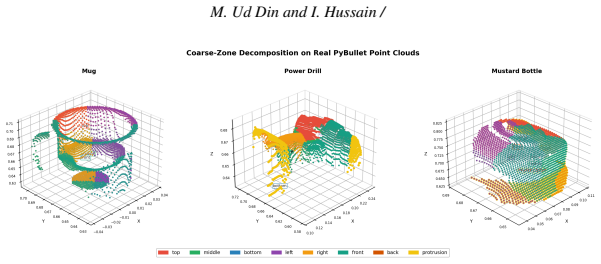
The load-bearing mechanism is the coarse-zone abstraction layer. It maps raw point clouds to eight labeled zones using PCA-based vertical alignment (equal thirds: top, middle, bottom; lateral: left/right/front/back) plus DBSCAN clustering of centroid-outlier points as protrusions. Each grasp candidate is assigned to a zone by its contact midpoint, and a pre-trained VLM's zero-shot ratings of those zones—mapped to numeric values—re-rank the candidates. The layer does the work of translating a VLM's reliable word-level spatial knowledge (handle, rim, blade) into a form a geometric planner can optimize, while deliberately keeping the VLM away from precise coordinate prediction.
What would settle it
Replace the VLM's self-declared preferred zone with human-labeled functional regions on the same 14 objects and recompute preferred-zone accuracy; if the score drops substantially below the reported >60%, the claimed functional gain is an artifact of self-scoring. A complementary test is to run the pipeline on objects rotated far from the VLM's typical view and check whether zone ratings and grasp outcomes diverge from the cached-query setting.
Extended reading notes
Core claim
The central discovery is that a coarse-zone abstraction is the right interface between VLM semantics and geometric grasp planning. PCA divides the point cloud into vertical thirds and lateral regions, DBSCAN marks protrusions such as handles, and a pre-trained VLM rates each zone on a good/acceptable/bad/dangerous scale. These ratings, fused with geometric, reachability, and task-alignment scores, re-rank antipodal grasps, preserving the geometry-only baseline's high physical success while preferring functionally correct regions.
Load-bearing premise
The load-bearing premise is that a coarse zone computed by PCA vertical thirds and DBSCAN protrusion clustering is a stable proxy for the functional region a task needs, and that the pre-trained VLM's zone ratings are a valid ground truth for that appropriateness; if a tilted object misaligns the PCA or the VLM mislabels a handle as 'bad', the re-ranking will confidently prefer the wrong grasp, and the reported metrics will not reveal it because preferred-zone accuracy and Ta
Editorial extensions
If this is right
- Functional grasping becomes possible on previously unseen objects: any object a VLM can recognize and whose protrusions survive clustering gets task-appropriate grasp re-ranking without annotations.
- The semantic layer can be attached to any underlying antipodal grasp generator; only the re-ranking stage changes, so existing planners gain functionality at small engineering cost.
- On near-symmetric objects where all zones are rated about equally, the method degrades gracefully to the geometry-only baseline rather than hurting physical success.
- On very small objects, strongly symmetric objects, or objects in atypical orientations, the paper expects zone detection or VLM ratings to degrade; a deployed system would need a fallback or a re-query strategy.
Reading between the lines
- The paper's preferred-zone metric is partly self-confirming: the VLM defines the preferred zone and the experiment then measures how often the grasp lands in it. Testing zone preferences against independent human labels or downstream task outcomes would reveal whether the VLM's choices are truly functional or merely consistent.
- Because the VLM query is cached per (object, task), the reported comparisons ignore per-instance semantic variation; a stronger stress test would re-query the VLM on every trial, including translated or slightly rotated versions, to measure how stable the zone preferences are under pose noise.
- The same zone abstraction could be reused beyond grasp planning—for example, to bias exploration during in-hand manipulation or to define finger targets for multi-fingered hands—since the zones carry localizable functional meaning that a planner can consume.
Editorial analysis
A structured set of objections, weighed in public.
Referee Report
Summary. The paper proposes SAGP, a training-free pipeline that connects VLM semantic reasoning to geometric grasp planning through a coarse-zone abstraction. The method decomposes an object point cloud into zones (top/middle/bottom, protrusions) using PCA alignment and DBSCAN clustering, asks a pretrained VLM (Qwen-VL) to rate each zone's grasp suitability on a four-level scale, and re-ranks antipodal grasp candidates using a weighted sum of geometric, reachability, affordance, avoidance, and task-alignment scores (Eq. 7). The experiments in PyBullet with a Franka Panda on 14 YCB objects are claimed to preserve the geometry-only baseline's grasp success rate above 90% while substantially improving functional appropriateness, e.g. preferred-zone accuracy above 60%, especially on asymmetric handle-bearing objects.
Significance. If the empirical claims were independently grounded, SAGP would be a useful practical contribution: it avoids category-specific part segmentation and VLM direct pose prediction by restricting VLM reasoning to coarse semantic zones, which is a sensible division of labor given VLMs' known spatial-hallucination limitations. The structured JSON prompting, the caching scheme for reproducibility, the comparison against a VLM-Direct baseline, and the explicit discussion of failure modes are strengths. However, the current evaluation does not establish the central claim. Task 2 success and preferred-zone accuracy are defined through the same VLM preferences that SAGP optimizes, so the reported 'functional appropriateness' gain may reflect self-consistency rather than task-relevant correctness. Moreover, Section 5.1 contains no numeric results table, per-object breakdown, error bars, or significance tests, making the magnitude and even direction of the effect impossible to verify. The core idea is original and worth further development, but the evidence presented is not yet commensurate with the strength of the conclusions.
major comments (4)
- [§4.3, §4.4, §3.5] Circular evaluation of functional appropriateness. Section 4.3 defines Task 2 success as 'the grasp must occur within the VLM-preferred zone', and Section 4.4 defines preferred-zone accuracy (PZA) as the fraction of successful grasps falling within that same VLM-preferred zone. Section 3.5's scoring function (Eq. 7) uses the same VLM's zone ratings in S_afford (Eq. 8) and the same VLM's preferred direction in S_task, so SAGP is explicitly re-ranking candidates toward the metric on which it is evaluated. The geometry-only baseline is not an independent ground truth; it is merely indifferent to VLM preferences. Under this protocol, a method that blindly implements VLM preferences would score high on Task 2 and PZA regardless of whether those preferences correspond to functionally appropriate grasps. The manuscript therefore 'substantially improving functional appropriateness' is not suppor
- [§5.1] The quantitative results are not actually reported. The section makes only qualitative claims: 'grasp success rates above 90%', 'preferred-zone accuracy exceeds 60%', and 'orientation preservation improves correspondingly'. There is no table or figure reporting GSR, PZA, AC, OP, or MPT for SAGP, Geometry-Only, and VLM-Direct, per object or aggregate. There are no error bars, standard deviations, or statistical tests across the 20 trials per (object, task). As a result, the claimed 'substantial improvement' cannot be quantified, checked, or compared across baselines. The paper needs a complete results table (and ideally per-category asymmetric/near-symmetric breakdown) with uncertainties and significance testing. Without these numbers, neither the reader nor the authors can verify the core claim.
- [§3.3–§3.5, Eq. (5)] Internal inconsistency in zone definitions and assignment. Section 3.3 declares the zone vocabulary Z = {top, middle, bottom, left, right, front, back, protrusion}. However, Eq. (5) assigns a grasp candidate only to 'protrusion' or, otherwise, to one of top/middle/bottom. The left/right/front/back labels are never assigned to any candidate, so the VLM's ratings of those zones cannot enter S_afford or S_avoid, and any 'preferred zone' named among the lateral labels would make Task 2/PZA impossible to satisfy. The paper's abstract and discussion refer to 'lateral sides' as part of the coarse-zone abstraction, but this component is not implemented as described. The authors should either use the lateral-zone labels in Eq. (5), or remove them from the zone vocabulary and revise the claims about lateral-side reasoning.
- [§3.5] The fusion weights α, β, γ, δ, ε are said to be 'selected on a small held-out tuning subset', but no details are given: how large is the subset, which objects/tasks, what selection criterion, and how sensitive are the results to the chosen weights? Since the entire semantic re-ranking effect is mediated by Eq. (7), the usefulness of SAGP depends on this weight vector. Without a sensitivity analysis or a clearly motivated selection procedure, it is hard to know whether the reported advantages are robust or an artifact of tuning. Please provide the tuning protocol and a sensitivity study (e.g., varying each weight or reporting results for a few representative weight sets).
minor comments (5)
- [§3.3] Typo and notation: 'The SAGP performs' should be 'SAGP performs'. In Eq. (5), 'midpoint(g)∈protrusion' is ambiguous; better to write 'midpoint(g)∈P_protrusion' where P_protrusion is the set of points labelled as protrusion.
- [§4.4] The caching scheme caches VLM responses at the (object, task) level even though each trial uses a random yaw. The authors state they 'verified this assumption by re-querying the VLM under three additional viewpoints for a representative subset' but do not specify the subset, the viewpoints, or the stability criterion. Please give details so this reproducibility claim can be assessed.
- [§5.1] The phrase 'With the simulator now correctly configured' reads as if it refers to an earlier revision or debugging process; please remove or replace it with a neutral description of the simulation configuration.
- [References] Reference [14] contains a typographical spacing error: 'V oxPoser' should be 'VoxPoser'.
- [§5.2] Figure 3 caption says 'three successful grasps (two execution instances each)', which is six images, but the text says 'subfigs 2-7 show three successful grasps'. Consider clarifying whether each grasp is shown twice or whether there are three distinct grasps with two snapshots each.
Circularity Check
The functional-appropriateness metrics are defined by the same VLM that SAGP uses to rank grasps, so the reported improvement may be self-consistent by construction.
-
self definitional
[Sections 3.4-3.5 (Eq. 7-8) and Sections 4.3-4.4 (Task 2, PZA)]
"The VLM also identifies a preferred-zone set Zpref, an avoid-zone set Zavoid, an approach direction, a grasp style, and orientation constraints. ... The zone-affordance term applies the VLM rating of the candidate's zone: Safford(g) = φ(r_z(g)). ... Task 2: Functional grasp. In addition to Task 1, the grasp must occur within the VLM-preferred zone, and the object orientation must be preserved within 15◦. ... preferred-zone accuracy (PZA), the fraction of successful grasps falling within the VLM-preferred zone."
The SAGP score in Eq. 7 includes Safford(g) = φ(r_z(g)) from Eq. 8, i.e. the same Qwen-VL zone rating that defines Zpref, plus Stask from the VLM-declared approach/orientation constraints. The paper's headline evidence for improved 'functional appropriateness' is Task 2 success and PZA, both defined as 'within the VLM-preferred zone' by that same VLM. Therefore re-ranking with Eq. 7 directly optimizes the metric used in evaluation; PZA > 60% largely measures self-consistency with the annotator, not agreement with an independent functional ground truth. GSR is an independent physical check, so the circularity is partial, giving a score of 6.
full rationale
The geometric success rate is independently and appropriately measured in PyBullet, so SAGP's claim of preserving >90% GSR is not circular. The circularity concerns the second, central claim of 'substantially improving functional appropriateness.' That claim rests on Task 2 and PZA, which are defined by the VLM-preferred zone. The same VLM's zone ratings are directly inserted into the scoring function (Eq. 8) and its declared task constraints into Stask. Thus the re-ranked policy is evaluated with the very labels it consumes: a grasp is 'functionally appropriate' iff it falls where the VLM said to grasp. The paper offers no human-labeled or physically grounded validation of the VLM ratings (e.g., for mug, drill, scissors), and Section 5.3 only notes symmetric-object collapse, so the asymmetry improvement is not independently confirmed. No other circularity patterns (self-citation chains, imported uniqueness theorems, ansatz-by-citation) appear: the self-citations [18], [19], [25] are not load-bearing. Overall, the physical component is sound and independent, but the semantic-appropriateness evaluation is partially circular.
Assumptions & free parameters
free parameters (3)
- fusion weights α,β,γ,δ,ε =
0.3, 0.1, 0.3, 0.2, 0.1
- protrusion detection thresholds =
1.5× median distance, DBSCAN eps=0.01 m, Nmin=10, min cluster=20
- task-alignment and filtering tolerances =
approach within 30°, orientation within 15°, gripper width 0.005–0.08 m, IK margin 0.5
assumptions (6)
- domain assumption Zero-shot VLM categorical ratings over coarse zones are a valid and sufficiently reliable proxy for task-appropriate grasping.
- domain assumption PCA-based vertical-axis selection and equal-third partitioning yield zones that align with functional regions across arbitrary object poses.
- domain assumption VLM zone ratings are robust to viewpoint and pose perturbations so responses can be cached at the (object, task) level.
- domain assumption Ground-truth segmentation of the target object is available in simulation and real-world SAM substitution will not change results.
- domain assumption PyBullet dynamics faithfully capture grasp success and orientation preservation for the Franka Panda.
- domain assumption Antipodal sampling covers all relevant grasp candidates; semantic re-ranking cannot recover candidates absent from the geometric set.
Cite this review
Pith. "Pith review of SAGP: Semantic Affordance-Guided Grasp Planning via Coarse-Zone VLM Reasoning." pith.science (2026). https://pith.science/paper/DEQSMBWL
@misc{pith2026260729374,
  author       = {Pith},
  title        = {Pith review of: SAGP: Semantic Affordance-Guided Grasp Planning via Coarse-Zone VLM Reasoning},
  year         = {2026},
  howpublished = {\url{https://pith.science/paper/DEQSMBWL}},
  note         = {Machine review of arXiv:2607.29374}
}
read the original abstract
Geometry-based grasp planners ensure physically valid grasps but ignore functional semantics, often generating grasps that are antipodal and collision-free yet practically inappropriate, for example, gripping a mug by its rim, a knife by the blade, or a bottle near its cap. These inconsistencies cause the downstream task to fail even when traditional grasp metrics are met. Existing vision-language model (VLM) approaches either depend on fine-grained, category-specific part segmentation or attempt to directly infer grasp poses, with the latter prone to spatial hallucinations. As a result, no practical, training-free framework has yet been proposed that robustly links high-level semantic reasoning to geometric grasp planning. We introduce Semantic Affordance-Guided Grasp Planning (SAGP), a training-free pipeline built on a coarse-zone abstraction layer. The method first partitions the object point cloud into spatial regions (top, middle, bottom, lateral sides, and protrusions) by applying PCA-based alignment followed by distance-driven DBSCAN clustering, entirely bypassing learned segmentation. A pre-trained VLM then assesses the grasp quality of each region through a structured zero-shot query, and the resulting zone-wise scores are fused with geometric, reachability, and task-alignment signals to re-rank antipodal grasp candidates. Experiments on YCB objects in PyBullet with a Franka Panda robot show that SAGP preserves the high success rate of geometry-only planning while substantially improving the functional appropriateness of selected grasps, particularly on asymmetric, handle-bearing objects where geometry alone is uninformative. The introduced coarse-zone abstraction offers an effective, training-free bridge between VLM-based reasoning and geometric grasp planning, without the need for fine-grained part segmentation.
Figures


Reference graph
Works this paper leans on
-
[1]
Robotic grasping and contact: a review
Bicchi A, Kumar V . Robotic grasping and contact: a review. In: Proc. IEEE Int. Conf. on Robotics and Automation (ICRA); 2000. p. 348-353
2000
-
[2]
GraspIt!: a versatile simulator for robotic grasping
Miller AT, Allen PK. GraspIt!: a versatile simulator for robotic grasping. IEEE Robot Autom Mag. 2004;11(4):110-122
2004
-
[3]
Grasp pose detection in point clouds
ten Pas A, Gualtieri M, Saenko K, Platt R. Grasp pose detection in point clouds. Int J Robot Res. 2017;36(13-14):1455-1473
2017
-
[4]
Dex-Net 2.0: deep learning to plan robust grasps with synthetic point clouds and analytic grasp metrics
Mahler J, Liang J, Niyaz S, Laskey M, Doan R, Liu X, et al. Dex-Net 2.0: deep learning to plan robust grasps with synthetic point clouds and analytic grasp metrics. In: Proc. Robotics: Science and Systems (RSS); 2017. M. Ud Din and I. Hussain /
2017
-
[5]
Contact-GraspNet: efficient 6-DoF grasp generation in cluttered scenes
Sundermeyer M, Mousavian A, Triebel R, Fox D. Contact-GraspNet: efficient 6-DoF grasp generation in cluttered scenes. In: Proc. IEEE Int. Conf. on Robotics and Automation (ICRA); 2021. p. 13438-13444
2021
-
[6]
AnyGrasp: robust and efficient grasp perception in spatial and temporal domains
Fang HS, Wang C, Fang H, Gou M, Liu J, Yan H, et al. AnyGrasp: robust and efficient grasp perception in spatial and temporal domains. IEEE Trans Robot. 2023;39(5):3929-3945
2023
-
[7]
A human-inspired real-time grasp force selec- tion policy based on load-grip force coupling
Stachowsky M, Vale J, Abdullah HA, Moussa M. A human-inspired real-time grasp force selec- tion policy based on load-grip force coupling. Int J Mech Eng Robot Res. 2015;4(4):336-342, doi: 10.18178/ijmerr.4.4.336-342
-
[8]
GPT-4V(ision) for robotics: multimodal task planning from human demonstration
Wake N, Kanehira A, Sasabuchi K, Takamatsu J, Ikeuchi K. GPT-4V(ision) for robotics: multimodal task planning from human demonstration. arXiv:2311.12015. 2023
arXiv 2023
Show all 27 references
-
[9]
Same object, different grasps: data and semantic knowledge for task-oriented grasping
Murali A, Liu W, Marino K, Chernova S, Gupta A. Same object, different grasps: data and semantic knowledge for task-oriented grasping. In: Proc. Conf. on Robot Learning (CoRL); 2020
2020
-
[10]
Learning grasp affordance densities
Detry R, Kraft D, Kroemer O, Bodenhagen L, Peters J, Kr ¨uger N, et al. Learning grasp affordance densities. Paladyn J Behav Robot. 2011;2(1):1-17
2011
-
[11]
GraspGPT: leveraging semantic knowledge from a large language model for task-oriented grasping
Tang C, Huang D, Ge W, Liu W, Zhang H. GraspGPT: leveraging semantic knowledge from a large language model for task-oriented grasping. IEEE Robot Autom Lett. 2023;8(11):7551-7558
2023
-
[12]
SemGrasp: semantic grasp generation via language aligned dis- cretization
Li K, Wang J, Yang L, Lu C, Dai B. SemGrasp: semantic grasp generation via language aligned dis- cretization. In: Proc. European Conf. on Computer Vision (ECCV); 2024
2024
-
[13]
Do as I can, not as I say: grounding language in robotic affordances
Ahn M, et al. Do as I can, not as I say: grounding language in robotic affordances. In: Proc. Conf. on Robot Learning (CoRL); 2022
2022
-
[14]
V oxPoser: composable 3D value maps for robotic manipulation with language models
Huang W, Wang C, Zhang R, Li Y , Wu J, Fei-Fei L. V oxPoser: composable 3D value maps for robotic manipulation with language models. In: Proc. Conf. on Robot Learning (CoRL); 2023
2023
-
[15]
CLIPort: what and where pathways for robotic manipulation
Shridhar M, Manuelli L, Fox D. CLIPort: what and where pathways for robotic manipulation. In: Proc. Conf. on Robot Learning (CoRL), PMLR vol. 164; 2021. p. 894-906
2021
-
[16]
RT-2: vision-language-action models transfer web knowledge to robotic control
Brohan A, et al. RT-2: vision-language-action models transfer web knowledge to robotic control. arXiv:2307.15818. 2023
2023 arXiv
-
[17]
Code as policies: language model programs for embodied control
Liang J, Huang W, Xia F, Xu P, Hausman K, Ichter B, et al. Code as policies: language model programs for embodied control. In: Proc. IEEE Int. Conf. on Robotics and Automation (ICRA); 2023. p. 9493- 9500
2023
-
[18]
Lang2Manip: a tool for LLM-based symbolic-to-geometric planning for manipulation
Ud Din M, Rosell J, Akram W, Hussain I. Lang2Manip: a tool for LLM-based symbolic-to-geometric planning for manipulation. In: Proc. 12th Int. Conf. on Automation, Robotics and Applications (ICARA); 2026. p. 568-574
2026
-
[19]
Planning grasping motions for humanoid robots
Rosell J, Su ´arez R, Garc ´ıa N, Ud Din M. Planning grasping motions for humanoid robots. Int J Hu- manoid Robot. 2019;16(6):1950041, doi: 10.1142/S0219843619500415
2019 doi
-
[20]
LAN-grasp: using large language models for semantic object grasping
Mirjalili R, Krawez M, Blei Y , Silenzi S, Walter F, Burgard W. LAN-grasp: using large language models for semantic object grasping. arXiv:2310.05239. 2023
2023
-
[21]
Open3D: a modern library for 3D data processing
Zhou QY , Park J, Koltun V . Open3D: a modern library for 3D data processing. arXiv:1801.09847. 2018
2018 arXiv
-
[22]
A density-based algorithm for discovering clusters in large spatial databases with noise
Ester M, Kriegel HP, Sander J, Xu X. A density-based algorithm for discovering clusters in large spatial databases with noise. In: Proc. 2nd Int. Conf. on Knowledge Discovery and Data Mining (KDD); 1996. p. 226-231
1996
-
[23]
Qwen-VL: a versatile vision-language model for understanding, localization, text reading, and beyond
Bai J, et al. Qwen-VL: a versatile vision-language model for understanding, localization, text reading, and beyond. arXiv:2308.12966. 2023
2023 arXiv
-
[24]
PyBullet, a Python module for physics simulation for games, robotics and machine learning.http://pybullet.org; 2016-2021
Coumans E, Bai Y . PyBullet, a Python module for physics simulation for games, robotics and machine learning.http://pybullet.org; 2016-2021
2016
-
[25]
Physics-based motion planning: evaluation criteria and benchmark- ing
Muhayyuddin, Akbari A, Rosell J. Physics-based motion planning: evaluation criteria and benchmark- ing. In: Robot 2015: Second Iberian Robotics Conf. Advances in Intelligent Systems and Computing, vol. 417. Springer; 2015. p. 43-55, doi: 10.1007/978-3-319-27146-0 4
2015 doi
-
[26]
The YCB object and model set: towards common benchmarks for manipulation research
Calli B, Singh A, Walsman A, Srinivasa S, Abbeel P, Dollar AM. The YCB object and model set: towards common benchmarks for manipulation research. In: Proc. Int. Conf. on Advanced Robotics (ICAR)
-
[27]
Segment anything
Kirillov A, Mintun E, Ravi N, Mao H, Rolland C, Gustafson L, et al. Segment anything. In: Proc. IEEE/CVF Int. Conf. on Computer Vision (ICCV); 2023. p. 4015-4026
2023
Reviewed August 3, 2026 · model on record in the stance chip above.
Discussion (0). Continue with ORCID to comment.