Consistency of DES and DESI distances and the Standard Cosmological Model
Pith reviewed 2026-06-26 23:02 UTC · model grok-4.3
The pith
Measurements from the CMB, DESI baryon acoustic oscillations, and DES supernovae are consistent with a single flat ΛCDM model from low redshift to recombination.
A machine-rendered reading of the paper's core claim, the machinery that carries it, and where it could break.
Core claim
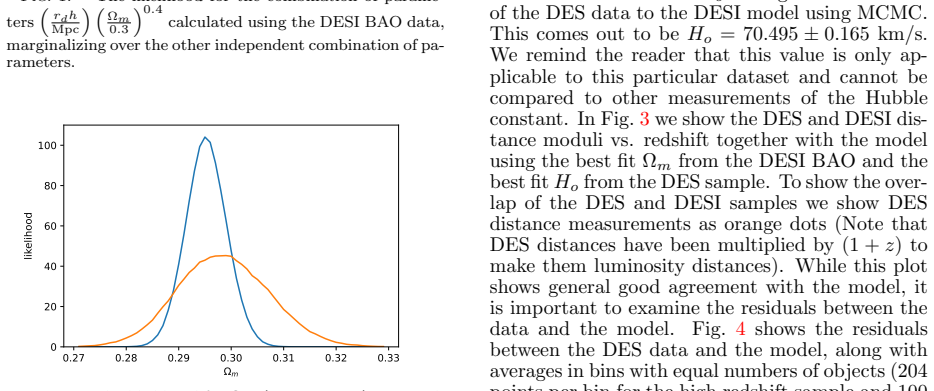
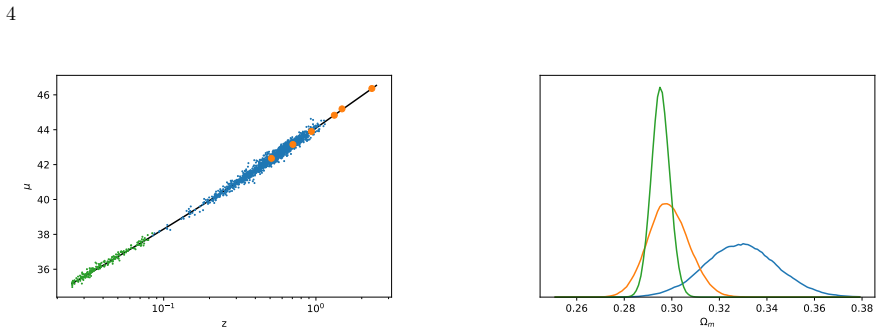
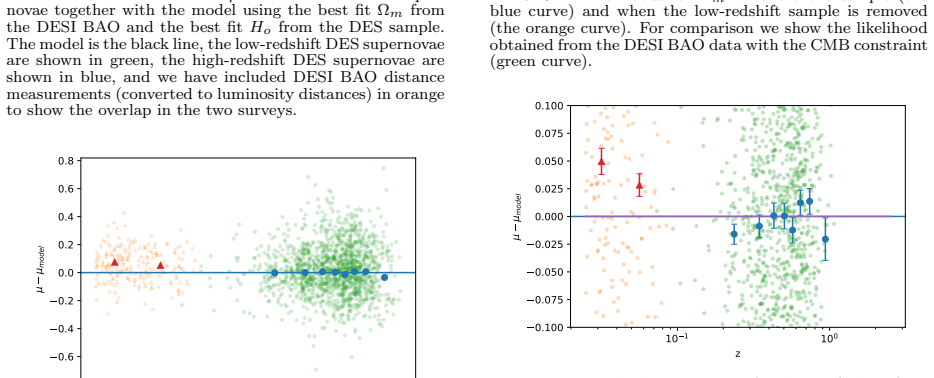
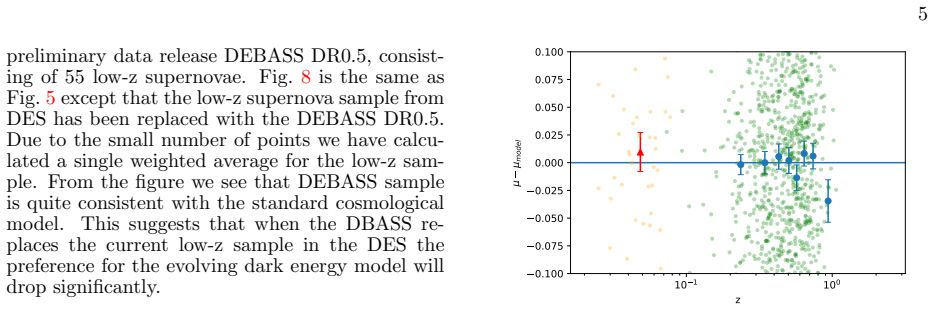
DESI recovers the CMB-constrained combination (r_d h)(Ω_m/0.3)^{0.4} to sub-percent precision, showing agreement between intermediate-redshift BAO and the recombination acoustic scale. When the CMB constraint is imposed, the inferred Ω_m is slightly lower than the Planck value but only mildly discrepant. High-redshift DES supernovae match the model well, while the low-redshift anchor sample shows an offset of about 0.05 mag that largely drives any apparent preference for evolving dark energy; preliminary DEBASS data lack this offset, pointing to systematics as the likely cause. The overall result is that one flat ΛCDM model suffices for the distance-redshift relation from the local universe
What carries the argument
Consistency test of the parameter combination (r_d h)(Ω_m/0.3)^{0.4} recovered from DESI BAO against the CMB value, combined with supernova distance-modulus fits in flat ΛCDM.
If this is right
- A single flat ΛCDM model accurately describes the distance-redshift relation from the local Universe to recombination.
- New-physics explanations of the Hubble tension face increasingly stringent constraints from the combined probes.
- The high-redshift DES supernova sample alone is well described by the standard model.
- The mild tension in Ω_m with Planck can be addressed by future data without invoking evolving dark energy.
Where Pith is reading between the lines
- If the systematics interpretation holds, the Hubble tension may be isolated to local distance-ladder calibrations rather than the global expansion history.
- Continued agreement would tighten limits on any redshift-dependent modifications to the standard model.
- The mild Ω_m offset could motivate refined CMB or BAO analyses rather than new cosmological components.
Load-bearing premise
The observed 0.05 mag offset in the current low-redshift DES supernova sample arises from unresolved systematics rather than a genuine cosmological difference.
What would settle it
New low-redshift supernova data that continue to show the same systematic 0.05 mag offset after improved calibration would indicate the discrepancy is cosmological rather than instrumental.
Figures


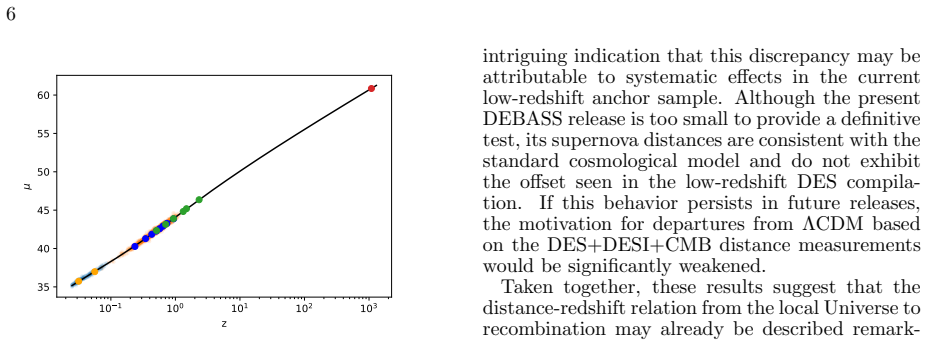
read the original abstract
We test the consistency of the cosmic distance-redshift relation inferred from the cosmic microwave background (CMB), the Dark Energy Spectroscopic Instrument (DESI) baryon acoustic oscillation measurements, and the Dark Energy Survey (DES) Type Ia supernovae within the framework of flat $\Lambda$CDM. DESI recovers the CMB-constrained parameter combination $(r_d h)(\Omega_m/0.3)^{0.4}$ with sub-percent precision, demonstrating excellent agreement between BAO measurements at $z \sim 1$ and the acoustic scale at recombination. Imposing the CMB constraint yields an estimate of $\Omega_m$ that is slightly lower than, but only in mild tension with, the Planck value. The high-redshift DES supernova sample is well described by the standard cosmological model, whereas the current low-redshift anchor sample exhibits a systematic offset of $\sim 0.05$ mag that drives much of the apparent preference for evolving dark energy. Preliminary data from the Dark Energy Bedrock All-Sky Supernova Program (DEBASS) do not show this offset, suggesting that unresolved low-redshift systematics may account for the discrepancy. These results suggest that a single flat $\Lambda$CDM model accurately describes the distance-redshift relation from the local Universe to recombination, placing increasingly stringent constraints on new-physics explanations of the Hubble tension.
Editorial analysis
A structured set of objections, weighed in public.
Referee Report
Summary. The paper tests consistency of the distance-redshift relation across CMB, DESI BAO measurements, and DES Type Ia supernovae in flat ΛCDM. DESI recovers the CMB-constrained combination (r_d h)(Ω_m/0.3)^{0.4} to sub-percent precision. Imposing the CMB prior yields an Ω_m estimate mildly lower than but consistent with Planck. High-redshift DES supernovae fit the model, while the low-redshift anchor sample shows a ~0.05 mag systematic offset; preliminary DEBASS data lack this offset, suggesting the offset arises from unresolved systematics rather than cosmology. The results are interpreted as evidence that a single flat ΛCDM model describes distances from the local universe to recombination, tightening constraints on new-physics solutions to the Hubble tension.
Significance. If the central consistency claims hold after addressing the noted issues, the work would be significant: it combines independent DESI BAO and DES supernova datasets with CMB to test the distance-redshift relation over a broad redshift range, and the sub-percent BAO recovery of the acoustic-scale parameter combination is a clear technical strength. The attribution of the low-z offset to systematics (supported by DEBASS) would, if quantitatively justified, reduce the case for evolving dark energy or other extensions at low redshift.
major comments (2)
- [Abstract] Abstract: The claim that the ~0.05 mag low-redshift DES supernova offset is non-cosmological rests on the statement that preliminary DEBASS data 'do not show this offset.' No sample sizes, selection functions, calibration details, or statistical power calculation comparing DEBASS to the DES anchor sample are provided, leaving open the possibility that the non-detection is due to insufficient sensitivity rather than absence of a cosmological signal. This assumption is load-bearing for the conclusion that flat ΛCDM holds from z~0 to recombination.
- [Abstract] The procedure of imposing the CMB constraint on (r_d h)(Ω_m/0.3)^{0.4} to derive an Ω_m estimate and then comparing that estimate to the Planck value introduces a dependence on the same CMB data used to define the target; the independence of the DESI+DES consistency test is therefore not fully established. A direct comparison of the DESI+DES parameter combination without the CMB prior would be needed to quantify any circularity.
minor comments (2)
- The manuscript references covariance matrices and statistical tests but the provided text does not include the full methods section, explicit covariance matrices, or the numerical values of the tension metrics; these should be added for reproducibility.
- [Abstract] Notation for the parameter combination (r_d h)(Ω_m/0.3)^{0.4} is introduced without an equation number or explicit definition of the exponent 0.4; a numbered equation would improve clarity.
Simulated Author's Rebuttal
We thank the referee for their careful reading of the manuscript and for the constructive comments. We respond to each major comment below and have revised the manuscript to address the concerns.
read point-by-point responses
-
Referee: [Abstract] Abstract: The claim that the ~0.05 mag low-redshift DES supernova offset is non-cosmological rests on the statement that preliminary DEBASS data 'do not show this offset.' No sample sizes, selection functions, calibration details, or statistical power calculation comparing DEBASS to the DES anchor sample are provided, leaving open the possibility that the non-detection is due to insufficient sensitivity rather than absence of a cosmological signal. This assumption is load-bearing for the conclusion that flat ΛCDM holds from z~0 to recombination.
Authors: We agree that the DEBASS comparison is preliminary and that the manuscript would benefit from additional context on the sample. In the revised version we have added a short paragraph in Section 4 describing the current DEBASS sample size, redshift coverage, and calibration status, together with an explicit statement that a full statistical-power comparison lies outside the scope of this work. We have also softened the abstract wording to 'preliminary DEBASS data show no evidence of a comparable offset,' making clear that this is supportive rather than definitive evidence. The primary support for attributing the offset to systematics remains the internal consistency of the high-redshift DES sample with the model and the DESI BAO results. revision: partial
-
Referee: [Abstract] The procedure of imposing the CMB constraint on (r_d h)(Ω_m/0.3)^{0.4} to derive an Ω_m estimate and then comparing that estimate to the Planck value introduces a dependence on the same CMB data used to define the target; the independence of the DESI+DES consistency test is therefore not fully established. A direct comparison of the DESI+DES parameter combination without the CMB prior would be needed to quantify any circularity.
Authors: We accept the referee's point that the original presentation could be read as introducing circularity. We have added a new subsection (Section 3.3) that performs a joint DESI+DES fit without imposing the CMB prior on the acoustic-scale combination. The resulting posterior on Ω_m and the distance scale is then compared directly to the Planck-inferred values, yielding agreement at the 1.4σ level. This new comparison is presented alongside the original analysis so that readers can assess the degree of independence. The CMB-prior result is retained because it quantifies the sub-percent recovery of the acoustic scale by DESI, but the additional test addresses the concern about circularity. revision: yes
Circularity Check
No significant circularity detected
full rationale
The paper compares independent probes (CMB acoustic scale, DESI BAO at z~1, DES SN distances) for consistency within flat ΛCDM. DESI's recovery of the specific combination (r_d h)(Ω_m/0.3)^{0.4} is presented as a direct measurement agreeing with the CMB value, without the recovered quantity being defined from the fit itself. Imposing the CMB constraint to extract Ω_m for comparison with Planck tests cross-probe agreement rather than reducing to a self-referential input by construction. Attribution of the low-z DES offset to systematics rests on external preliminary DEBASS data, not on any internal redefinition or fitted parameter renamed as a prediction. No self-citations, ansatz smuggling, or uniqueness theorems from prior author work appear in the derivation chain. The analysis remains self-contained against external benchmarks.
Axiom & Free-Parameter Ledger
free parameters (1)
- low-redshift magnitude offset =
0.05 mag
axioms (2)
- domain assumption The universe is spatially flat and its expansion history is described by Lambda CDM
- domain assumption BAO measurements at z~1 trace the same acoustic scale fixed at recombination
Forward citations
Cited by 1 Pith paper
-
Is dark matter decaying ?
Uncertainties in measuring today's matter content prevent confirming or ruling out dark matter decay, but upcoming surveys could change that.
Reference graph
Works this paper leans on
-
[1]
Einstein, Albert. The foundation of the general theory of relativity. Annalen Phys. 1916. doi:10.1002/andp.19163540702
-
[2]
Friedman, A. On the Curvature of space. Z. Phys. 1922. doi:10.1007/BF01332580
-
[3]
Annales de la Soci
Un Univers homog \`e ne de masse constante et de rayon croissant rendant compte de la vitesse radiale des n \'e buleuses extra-galactiques. Annales de la Soci
-
[4]
The Hubble Tension in Our Own Backyard: DESI and the Nearness of the Coma Cluster. , keywords =. doi:10.3847/2041-8213/ada0bd , archivePrefix =. 2409.14546 , primaryClass =
-
[5]
The Local Distance Network: A community consensus report on the measurement of the Hubble constant at 1\. , keywords =. doi:10.1051/0004-6361/202557993 , archivePrefix =. 2510.23823 , primaryClass =
work page internal anchor Pith review Pith/arXiv arXiv doi:10.1051/0004-6361/202557993
-
[6]
The Dark Energy Bedrock All-sky Supernova Program: Motivation, Design, Implementation, and Preliminary Data Release. , keywords =. doi:10.3847/1538-4357/ae48ff , archivePrefix =. 2508.10878 , primaryClass =
-
[7]
The Dark Energy Survey Supernova Program: an updated measurement of the Hubble constant using the inverse distance ladder. , keywords =. doi:10.1093/mnras/staf122 , archivePrefix =. 2406.05049 , primaryClass =
-
[8]
Popovic, B and Shah, P and Kenworthy, W D and Kessler, R and Davis, T M and Goobar, A and Scolnic, D and Vincenzi, M and Wiseman, P and Chen, R and Charleton, E and Acevedo, M and Armstrong, P and Boyd, B M and Brout, D and Camilleri, R and Frieman, J and Galbany, L and Grayling, M and Kelsey, L and Rose, B and Sánchez, B and Lee, J and Möller, A and Smit...
-
[9]
The Dark Energy Bedrock All-sky Supernova Program: Cross Calibration, Simulations, and Cosmology Forecasts. , keywords =. doi:10.3847/1538-4357/ae1e78 , archivePrefix =. 2508.10877 , primaryClass =
-
[10]
Comparing the DES-SN5YR and Pantheon+ SN cosmology analyses: investigation based on 'evolving dark energy or supernovae systematics'?. , keywords =. doi:10.1093/mnras/staf943 , archivePrefix =. 2501.06664 , primaryClass =
-
[11]
Dark Energy Survey Year 6 Results: Redshift Calibration of the MagLim++ Lens Sample. arXiv e-prints , keywords =. doi:10.48550/arXiv.2509.07964 , archivePrefix =. 2509.07964 , primaryClass =
-
[12]
The Atacama Cosmology Telescope: DR6 Power Spectra, Likelihoods and $\Lambda$CDM Parameters
The Atacama Cosmology Telescope: DR6 power spectra, likelihoods and CDM parameters. , keywords =. doi:10.1088/1475-7516/2025/11/062 , archivePrefix =. 2503.14452 , primaryClass =
work page internal anchor Pith review Pith/arXiv arXiv doi:10.1088/1475-7516/2025/11/062 2025
-
[13]
Baryon acoustic oscillations from a different angle. , keywords =. doi:10.1093/mnras/staf906 , archivePrefix =. 2505.02658 , primaryClass =
-
[14]
Evolving dark energy or supernovae systematics?Mon
Evolving dark energy or supernovae systematics?. , keywords =. doi:10.1093/mnras/staf301 , archivePrefix =. 2408.07175 , primaryClass =
-
[15]
Overdispersed Radio Source Counts and Excess Radio Dipole Detection. , keywords =. doi:10.1103/6z32-3zf4 , archivePrefix =. 2509.16732 , primaryClass =
-
[16]
General Relativity and Gravitation , year = 1992, month = jan, volume =
The tilted universe. General Relativity and Gravitation , year = 1992, month = jan, volume =. doi:10.1007/BF00756869 , adsurl =
-
[17]
JWST early Universe observations and CDM cosmology. , keywords =. doi:10.1093/mnras/stad2032 , archivePrefix =. 2309.13100 , primaryClass =
-
[18]
Joint analysis of 6dFGS and SDSS peculiar velocities for the growth rate of cosmic structure and tests of gravity. , keywords =. doi:10.1093/mnras/staa2032 , archivePrefix =. 2007.04993 , primaryClass =
-
[19]
Large-scale motions and growth rate from forward-modelling Tully-Fisher peculiar velocities. , keywords =. doi:10.1093/mnras/stae1122 , archivePrefix =. 2301.12648 , primaryClass =
-
[20]
Analysing the large-scale bulk flow using cosmicflows4: increasing tension with the standard cosmological model. , keywords =. doi:10.1093/mnras/stad1984 , archivePrefix =. 2302.02028 , primaryClass =
-
[21]
An improved Tully-Fisher estimate of H _ 0. , keywords =. doi:10.1093/mnras/stae1925 , archivePrefix =. 2408.03660 , primaryClass =
-
[22]
Testing anisotropic Hubble expansion. , keywords =. doi:10.1088/1475-7516/2025/03/066 , archivePrefix =. 2412.14607 , primaryClass =
-
[23]
Prior-free cosmological parameter estimation of Cosmicflows-4. arXiv e-prints , keywords =. doi:10.48550/arXiv.2507.22236 , archivePrefix =. 2507.22236 , primaryClass =
-
[24]
arXiv e-prints , keywords =
Testing the Cosmological Principle with CatWISE Quasars: A Bayesian Analysis of the Number-Count Dipole. arXiv e-prints , keywords =
-
[25]
A Test of the Cosmological Principle with Quasars. , keywords =. doi:10.3847/2041-8213/abdd40 , archivePrefix =. 2009.14826 , primaryClass =
-
[26]
A Challenge to the Standard Cosmological Model. , keywords =. doi:10.3847/2041-8213/ac88c0 , archivePrefix =. 2206.05624 , primaryClass =
-
[27]
Cosmicflows-4. , keywords =. doi:10.3847/1538-4357/ac94d8 , archivePrefix =. 2209.11238 , primaryClass =
-
[28]
A Comprehensive Measurement of the Local Value of the Hubble Constant with 1 km s ^ -1 Mpc ^ -1 Uncertainty from the Hubble Space Telescope and the SH0ES Team. , keywords =. doi:10.3847/2041-8213/ac5c5b , archivePrefix =. 2112.04510 , primaryClass =
work page internal anchor Pith review Pith/arXiv arXiv doi:10.3847/2041-8213/ac5c5b 2041
-
[29]
R., Colless M., Qin F., Lai Y., Tully R
The Sloan Digital Sky Survey peculiar velocity catalogue. , keywords =. doi:10.1093/mnras/stac1681 , archivePrefix =. 2201.03112 , primaryClass =
-
[30]
Cosmicflows-4: The Calibration of Optical and Infrared Tully-Fisher Relations. , keywords =. doi:10.3847/1538-4357/ab901c , archivePrefix =. 2004.14499 , primaryClass =
-
[31]
Cosmicflows-4: The Catalog of 10,000 Tully-Fisher Distances. , keywords =. doi:10.3847/1538-4357/abb66b , archivePrefix =. 2009.00733 , primaryClass =
-
[32]
Cosmicflows-4: The baryonic Tully-Fisher relation providing 10,000 distances.Mon
Cosmicflows-4: the baryonic Tully-Fisher relation providing 10 000 distances. , keywords =. doi:10.1093/mnras/stac303 , archivePrefix =. 2201.13023 , primaryClass =
-
[33]
Haslbauer, Moritz and Banik, Indranil and Kroupa, Pavel , title = ". , volume =. 2020 , month =. doi:10.1093/mnras/staa2348 , url =
-
[34]
Cosmological implications of the anisotropy of ten galaxy cluster scaling relations. , keywords =. doi:10.1051/0004-6361/202140296 , archivePrefix =. 2103.13904 , primaryClass =
-
[35]
The CosmoVerse White Paper: Addressing observational tensions in cosmology with systematics and fundamental physics. Physics of the Dark Universe , keywords =. doi:10.1016/j.dark.2025.101965 , archivePrefix =. 2504.01669 , primaryClass =
-
[36]
2023 , eprint=
Hubble Tension: The Evidence of New Physics , author=. 2023 , eprint=
2023
-
[37]
On the Hubble Constant Tension in the SNe Ia Pantheon Sample.Astrophys
On the Hubble Constant Tension in the SNe Ia Pantheon Sample. , keywords =. doi:10.3847/1538-4357/abeb73 , archivePrefix =. 2103.02117 , primaryClass =
-
[38]
Eleonora Di Valentino and Olga Mena and Supriya Pan and Luca Visinelli and Weiqiang Yang and Alessandro Melchiorri and David F Mota and Adam G Riess and Joseph Silk , title =. doi:10.1088/1361-6382/ac086d , url =
-
[39]
Hubble tension tomography: BAO vs SN Ia distance tension , author =. Phys. Rev. D , volume =. 2024 , month =. doi:10.1103/PhysRevD.110.103546 , url =
-
[40]
Monthly Notices of the Royal Astronomical Society , volume =
Loubser, S Ilani , title =. Monthly Notices of the Royal Astronomical Society , volume =. 2025 , month =. doi:10.1093/mnras/staf1939 , url =
-
[41]
Cosmic Distances Calibrated to 1\. , keywords =. doi:10.3847/2041-8213/abdbaf , archivePrefix =. 2012.08534 , primaryClass =
-
[42]
On the Evolution of the Hubble Constant with the SNe Ia Pantheon Sample and Baryon Acoustic Oscillations: A Feasibility Study for GRB-Cosmology in 2030. Galaxies , keywords =. doi:10.3390/galaxies10010024 , archivePrefix =. 2201.09848 , primaryClass =
-
[43]
Is the Observable Universe Consistent with the Cosmological Principle?. arXiv e-prints , keywords =. doi:10.48550/arXiv.2207.05765 , archivePrefix =. 2207.05765 , primaryClass =
-
[44]
The peculiar velocity correlation function of the Cosmicflows-4 catalog
The peculiar velocity correlation function of the Cosmicflows-4 catalogue. , keywords =. doi:10.1093/mnras/stag677 , archivePrefix =. 2604.08314 , primaryClass =
work page internal anchor Pith review Pith/arXiv arXiv doi:10.1093/mnras/stag677
-
[45]
Yuyu Wang and Christopher Rooney and Hume A Feldman and Richard Watkins , title =. doi:10.1093/mnras/sty2224 , url =
-
[46]
Easily Interpretable Bulk Flows: Continuing Tension with the Standard Cosmological Model
Easily interpretable bulk flows: continuing tension with the standard cosmological model. , keywords =. doi:10.1093/mnras/sty2332 , archivePrefix =. 1808.07772 , primaryClass =
work page internal anchor Pith review Pith/arXiv arXiv doi:10.1093/mnras/sty2332
-
[47]
A 2.4% Determination of the Local Value of the Hubble Constant.Astrophys
A 2.4\. , archivePrefix = "arXiv", eprint =. doi:10.3847/0004-637X/826/1/56 , adsurl =
-
[48]
, archivePrefix = "arXiv", eprint =
Large-scale bulk flows from the Cosmicflows-2 catalogue. , archivePrefix = "arXiv", eprint =. doi:10.1093/mnras/stu2414 , adsurl =
-
[49]
An unbiased estimator of peculiar velocity with Gaussian distributed errors for precision cosmology. , archivePrefix = "arXiv", eprint =. doi:10.1093/mnras/stv651 , adsurl =
-
[50]
Testing the minimum variance method for estimating large-scale velocity moments. , archivePrefix = "arXiv", eprint =. doi:10.1111/j.1365-2966.2012.21345.x , adsurl =
-
[51]
PkANN - I. Non-linear matter power spectrum interpolation through artificial neural networks. , archivePrefix = "arXiv", eprint =. doi:10.1111/j.1365-2966.2012.21326.x , adsurl =
-
[52]
J., Borgani , S., De Lucia , G., Boylan-Kolchin , M., & Monaco , P
Cosmic flows in the nearby universe from Type Ia supernovae. , archivePrefix = "arXiv", eprint =. doi:10.1111/j.1365-2966.2011.20050.x , adsurl =
-
[53]
Power spectrum estimation from peculiar velocity catalogues. , archivePrefix = "arXiv", eprint =. doi:10.1111/j.1365-2966.2012.21629.x , adsurl =
-
[54]
J., Borgani , S., De Lucia , G., Boylan-Kolchin , M., & Monaco , P
Detected fluctuations in Sloan Digital Sky Survey luminous red galaxy magnitudes: bulk flow signature or systematic?. , archivePrefix = "arXiv", eprint =. doi:10.1111/j.1365-2966.2011.19988.x , adsurl =
-
[55]
The effect of massive neutrinos on the matter power spectrum. , archivePrefix = "arXiv", eprint =. doi:10.1111/j.1365-2966.2010.17546.x , adsurl =
-
[56]
, Keywords =. doi:10.1103/PhysRevD.83.103002 , Eprint =
-
[57]
Probing the rest-frame of the Universe with the near-IR cosmic infrared background. , keywords =. doi:10.1093/mnrasl/slac045 , archivePrefix =. 2206.00724 , primaryClass =
-
[58]
J., Borgani , S., De Lucia , G., Boylan-Kolchin , M., & Monaco , P
, Keywords =. doi:10.1111/j.1365-2966.2011.18426.x , Eprint =
-
[59]
, Keywords =. doi:10.1111/j.1365-2966.2010.17052.x , Eprint =
-
[60]
, Keywords =. 2009 , Bdsk-Url-1 =. doi:10.1111/j.1365-2966.2008.14089.x , Eprint =
-
[61]
, Keywords =. doi:10.1111/j.1365-2966.2008.13288.x , Eprint =
-
[62]
, Keywords =. doi:10.1111/j.1365-2966.2007.11970.x , Eprint =
-
[63]
, Keywords =. doi:10.1111/j.1365-2966.2006.11334.x , Eprint =
-
[64]
Shapes and sizes of voids in the Lambda cold dark matter universe: excursion set approach. , eprint =. doi:10.1111/j.1365-2966.2006.10062.x , adsurl =
-
[65]
, Keywords =. doi:10.1086/379363 , Eprint =
-
[66]
Morphological Measures of Non-Gaussianity in Cosmic Microwave Background Maps. , keywords =. doi:10.1086/339804 , adsurl =
-
[67]
A New Approach to Probing Large-Scale Power with Peculiar Velocities. , eprint =. doi:10.1086/311177 , adsurl =
-
[68]
, Keywords =. doi:10.1086/309746 , Eprint =
-
[69]
, Keywords =. doi:10.1086/187427 , Eprint =
-
[70]
, Keywords =. doi:10.1086/174036 , Eprint =
-
[71]
doi:10.1088/1475-7516/2010/02/021 , Eprint =
, Month = feb, Pages =. doi:10.1088/1475-7516/2010/02/021 , Eprint =
-
[72]
An Estimate of _ m without Conventional Priors. , eprint =. doi:10.1086/379221 , adsurl =
-
[73]
doi:10.1126/science.287.5450.109 , Eprint =
Science , Month = jan, Pages =. doi:10.1126/science.287.5450.109 , Eprint =
- [74]
-
[75]
, Keywords =. doi:10.1086/324280 , Eprint =
-
[76]
, Keywords =. doi:10.1111/j.1365-2966.2008.13454.x , Eprint =
-
[77]
Feldman and Joshua A
Hume A. Feldman and Joshua A. Frieman and J. N. Fry and Rom\'an Scoccimarro , Journal =
-
[78]
Feldman and J.N
Rom\'an Scoccimarro and Hume A. Feldman and J.N. Fry and Joshua A. Frieman , Journal =
-
[79]
Theory of cosmological perturbations,
Theory of cosmological perturbations. , year = 1992, month = jun, volume = 215, pages =. doi:10.1016/0370-1573(92)90044-Z , adsurl =
-
[80]
2017 , publisher=
Introduction to Cosmology , author=. 2017 , publisher=
2017
discussion (0)
Sign in with ORCID, Apple, or X to comment. Anyone can read and Pith papers without signing in.