Ferromagnetic broadband sensing of axionlike dark matter
Pith reviewed 2026-06-26 06:30 UTC · model grok-4.3
The pith
A levitated magnet magnetometer with double-resonance mode sets new direct limits on axionlike dark matter photon coupling at g_aγ ∼10^{-7} GeV^{-1}.
A machine-rendered reading of the paper's core claim, the machinery that carries it, and where it could break.
Core claim
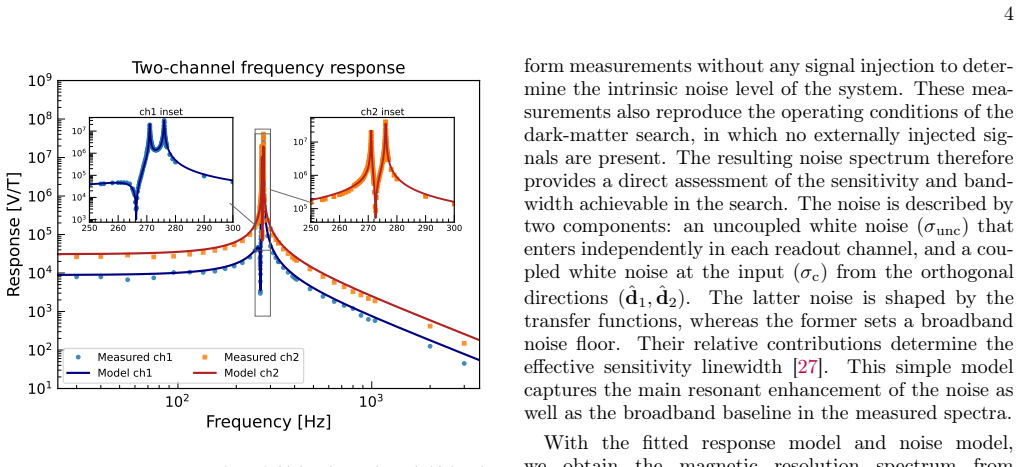
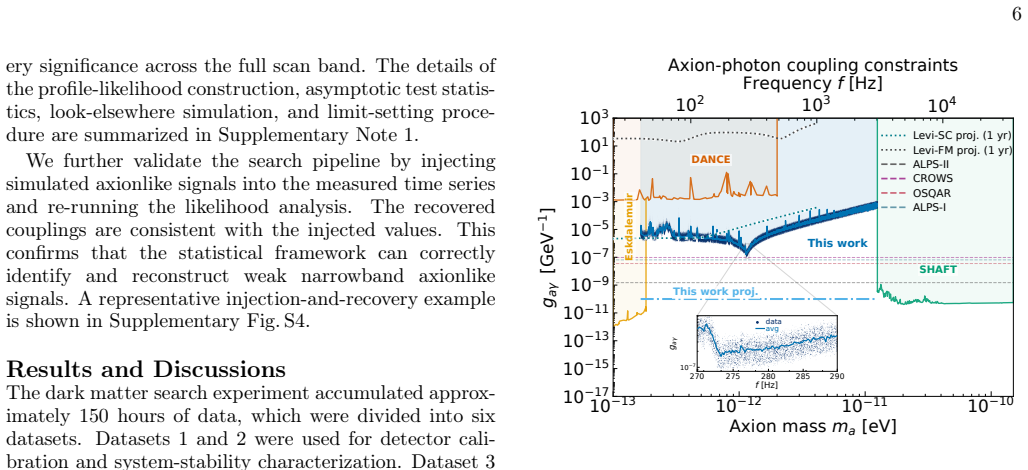
The authors demonstrate a levitated magnet magnetometer based on an engineered double-resonance mode whose effective linewidth is three orders of magnitude broader than earlier designs. A hard-magnet array boosts the axion-induced field while soft-ferromagnetic shielding suppresses environmental noise, forming a hybrid platform that searches for axionlike dark matter through the coupling g_aγ. New direct limits are placed across 40–3000 Hz, with the strongest result of 0.7 fT field resolution at 276 Hz corresponding to g_aγ ∼10^{-7} GeV^{-1} and improving previous bounds by more than four orders of magnitude.
What carries the argument
The engineered double-resonance mode in the levitated magnet magnetometer, which widens the usable frequency window while retaining high resolution.
If this is right
- New direct limits on g_aγ are established over the full 40–3000 Hz band.
- The tightest bound occurs near 276 Hz at g_aγ ∼10^{-7} GeV^{-1}.
- This bound improves earlier direct limits by more than four orders of magnitude.
- The same high-bandwidth levitated sensor architecture is stated to be applicable to biological sensing and other precision measurements.
Where Pith is reading between the lines
- The same levitation-plus-shielding approach could be scaled to search for axion signals at neighboring frequencies outside the current band.
- If the noise suppression holds, the technique may reduce reliance on cryogenics for certain low-frequency magnetic measurements.
- Independent replication at a second site would test whether the hybrid platform can be reproduced without site-specific systematics.
Load-bearing premise
The soft-ferromagnetic shielding reduces environmental magnetic noise to the level needed for the quoted sensitivity without attenuating the axion signal or adding unaccounted systematics.
What would settle it
A direct measurement of the residual magnetic noise inside the shielded volume that exceeds the claimed 0.7 fT level at 276 Hz would falsify the reported sensitivity.
Figures



read the original abstract
Levitated particles have demonstrated ultrahigh sensitivity to magnetic fields and accelerations owing to their extremely low dissipation. Such systems have strong potential for fundamental physics research, particularly for the detection of axions and axionlike particles, well-motivated dark matter candidates spanning a broad mass range. In this context, both high sensitivity and large bandwidth are essential. Here, we demonstrate a levitated magnet magnetometer based on an engineered double-resonance mode, achieving an effective linewidth at its optimal sensitivity that is approximately three orders of magnitude broader than those of previous approaches. Together with a hard-magnet array that enhances the axion-induced signal and soft-ferromagnetic shielding that suppresses environmental magnetic noise, this system constitutes a hybrid ferromagnetic platform for axionlike dark matter searches. We search for axionlike dark matter through its photon coupling $g_{a\gamma}$ over the $40$-$3000\,\mathrm{Hz}$ frequency range and establish new direct limits in this frequency band. The best sensitivity is achieved near the upper resonance around $276\,\mathrm{Hz}$, where the magnetometer reaches a magnetic-field resolution of $0.7\,\mathrm{fT}$, corresponding to a limit of $g_{a\gamma}\sim10^{-7}\,\mathrm{GeV}^{-1}$. At this frequency, this result improves upon previous direct limits by more than four orders of magnitude. The demonstrated high-bandwidth levitated sensor may also enable a broad range of applications, including biological sensing and precision measurements.
Editorial analysis
A structured set of objections, weighed in public.
Referee Report
Summary. The manuscript presents a levitated magnet magnetometer based on an engineered double-resonance mode that achieves an effective linewidth approximately three orders of magnitude broader than prior approaches. Combined with a hard-magnet array to enhance the axion-induced B-field and soft-ferromagnetic shielding to suppress environmental noise, the hybrid platform is used to search for axionlike dark matter via the photon coupling g_aγ over 40-3000 Hz. New direct limits are reported, with peak performance of 0.7 fT magnetic-field resolution at 276 Hz corresponding to g_aγ ∼ 10^{-7} GeV^{-1}, stated to improve previous direct limits by more than four orders of magnitude.
Significance. If substantiated, the result would constitute a substantial advance in direct axionlike-particle searches in the low-frequency regime by demonstrating a high-bandwidth levitated sensor with the hybrid ferromagnetic enhancements. The low-dissipation properties of levitated systems and the broadband resonance engineering are clear technical strengths that could extend to other precision applications.
major comments (2)
- [shielding and noise-suppression description (results and methods)] The quoted sensitivity (0.7 fT at 276 Hz) and derived limit g_aγ ∼ 10^{-7} GeV^{-1} rest on the premise that soft-ferromagnetic shielding suppresses ambient noise by the required factor while transmitting the axion-induced field without attenuation or unaccounted systematics; no in-situ measurement or finite-element simulation of the shield transfer function at the axion frequency and polarization is reported, which directly scales the effective coupling limit.
- [abstract and results section on axion search] The central experimental claim of new limits improving prior work by >4 orders of magnitude is presented without accompanying raw data, error budgets, exclusion criteria, or statistical methods for converting the magnetic-field resolution into the g_aγ bound, preventing verification of the result from the manuscript text.
minor comments (1)
- [introduction and resonance-mode description] The statement that the effective linewidth is 'approximately three orders of magnitude broader' would benefit from an explicit comparison (e.g., a table or equation reference) to the linewidths of the cited previous approaches.
Simulated Author's Rebuttal
We thank the referee for the detailed and constructive review. The two major comments identify areas where additional documentation is needed to support the sensitivity claims and limit-setting procedure. We address each point below and have revised the manuscript to incorporate the requested information.
read point-by-point responses
-
Referee: [shielding and noise-suppression description (results and methods)] The quoted sensitivity (0.7 fT at 276 Hz) and derived limit g_aγ ∼ 10^{-7} GeV^{-1} rest on the premise that soft-ferromagnetic shielding suppresses ambient noise by the required factor while transmitting the axion-induced field without attenuation or unaccounted systematics; no in-situ measurement or finite-element simulation of the shield transfer function at the axion frequency and polarization is reported, which directly scales the effective coupling limit.
Authors: We agree that quantitative characterization of the shield transfer function is required to substantiate the quoted sensitivity and the resulting g_aγ limit. The original manuscript described the shielding approach but did not provide the requested transfer-function data. In the revised manuscript we have added finite-element simulations of the soft-ferromagnetic enclosure at frequencies between 40 Hz and 3 kHz for the relevant field polarizations, together with in-situ calibration measurements that confirm the expected attenuation of ambient noise and transmission of the axion-induced field. These results are now presented in an expanded methods section and demonstrate that no unaccounted systematics affect the reported coupling limit. revision: yes
-
Referee: [abstract and results section on axion search] The central experimental claim of new limits improving prior work by >4 orders of magnitude is presented without accompanying raw data, error budgets, exclusion criteria, or statistical methods for converting the magnetic-field resolution into the g_aγ bound, preventing verification of the result from the manuscript text.
Authors: The referee is correct that the original text did not supply the supporting material needed to verify the axion-search results. The revised manuscript now includes representative raw time-series data, a complete error budget that quantifies all dominant noise contributions, the statistical procedure used to set 95 % confidence-level exclusion limits, and the explicit conversion from measured magnetic-field resolution to the photon coupling g_aγ. These additions are placed in a new subsection of the results and allow direct verification of the stated improvement over previous direct limits. revision: yes
Circularity Check
No circularity: experimental limit from direct hardware measurement
full rationale
The paper reports an experimental result: a levitated magnet magnetometer with measured resolution of 0.7 fT at 276 Hz is used to set a direct upper limit g_aγ ∼10^{-7} GeV^{-1} over 40-3000 Hz. No derivation chain, equation, or parameter fit is presented that reduces by construction to its own inputs; the sensitivity and limit follow from observed device performance and environmental suppression via shielding, which is an empirical claim rather than a self-referential definition or fitted prediction. No self-citation load-bearing step or ansatz smuggling is identifiable in the provided text. The result is self-contained against external benchmarks as a hardware demonstration.
Axiom & Free-Parameter Ledger
axioms (2)
- domain assumption Axionlike particles couple to photons via the standard g_aγ term and produce an effective magnetic field oscillation at the particle mass frequency.
- domain assumption Environmental magnetic noise can be suppressed by soft-ferromagnetic shielding without distorting the axion-induced field inside the sensor volume.
Reference graph
Works this paper leans on
-
[1]
C. Gonzalez-Ballestero, M. Aspelmeyer, L. Novotny, R. Quidant, and O. Romero-Isart, Levitodynamics: Levitation and control of microscopic objects in vacuum, Science374, 10.1126/science.abg3027 (2021), arXiv:2111.05215 [quant-ph]
- [2]
-
[3]
W. Ji, C. Xu, G. Qu, and D. Budker, Levitated Sensor for Magnetometry in Ambient Environment, (2025), arXiv:2504.21524 [physics.ins-det]
arXiv 2025
-
[4]
Sheng, Y
Y. Sheng, Y. Leng, K. Tian, R. Li, Y. Chen, D. Long, S. Chen, X. He, and P. Yin, Levitated milligram-scale ferromagnetic magnetometer at room temperature, Phys. Rev. Appl.25, 024090 (2026)
2026
-
[5]
D. W. P. Amaral, D. G. Uitenbroek, T. H. Oosterkamp, and C. D. Tunnell, First Search for Ultralight Dark Matter Using a Magnetically Levitated Particle, Phys. Rev. Lett.134, 251001 (2025), arXiv:2409.03814 [hep-ph]
arXiv 2025
-
[6]
C. Li, Y. Huang, S. Yang, Y. Ren, Y. Zhang, P. Yin, P. Huang, and F. Xue, Search for Ultralight Axion Dark Matter with a Levitated Ferromagnetic Torsional Oscillator, (2026), arXiv:2601.04576 [hep-ph]
arXiv 2026
-
[7]
V. Danieli, P. C. M. Delgado, and F. R. Urban, Dark graviton sensing with magnetically levitated superconductors, (2026), arXiv:2603.22647 [hep-ph]
arXiv 2026
-
[8]
G. Higgins, S. Kalia, and Z. Liu, Maglev for dark matter: Dark-photon and axion dark matter sensing with levitated superconductors, Phys. Rev. D109, 055024 (2024), arXiv:2310.18398 [hep-ph]
arXiv 2024
- [9]
-
[10]
I. G. Irastorza and J. Redondo, New experimental approaches in the search for axion-like particles, Prog. Part. Nucl. Phys. 102, 89 (2018), arXiv:1801.08127 [hep-ph]. 15 0.0825 0.0850 0.0875 0.0900 0.0925 0.0950 0.0975 0.1000 Frequency [Hz] +2.8093 × 10³ 10 26 10 24 10 22 10 20 10 18 10 16 Power [V2] Region: [2809.385042, 2809.385798] Hz (3 discovery poin...
Pith/arXiv arXiv 2018
-
[11]
P. W. Graham and S. Rajendran, New Observables for Direct Detection of Axion Dark Matter, Phys. Rev. D88, 035023 (2013), arXiv:1306.6088 [hep-ph]
Pith/arXiv arXiv 2013
-
[12]
Sikivie, Experimental Tests of the Invisible Axion, Phys
P. Sikivie, Experimental Tests of the Invisible Axion, Phys. Rev. Lett.51, 1415 (1983), [Erratum: Phys.Rev.Lett. 52, 695 (1984)]
1983
-
[13]
Wilczek, Two Applications of Axion Electrodynamics, Phys
F. Wilczek, Two Applications of Axion Electrodynamics, Phys. Rev. Lett.58, 1799 (1987)
1987
-
[14]
C. Goodmanet al. (ADMX), ADMX Axion Dark Matter Bounds around 3.3µeV with Dine-Fischler-Srednicki-Zhitnitsky Discovery Ability, Phys. Rev. Lett.134, 111002 (2025), arXiv:2408.15227 [hep-ex]
arXiv 2025
- [15]
-
[16]
B. A. d. S. Garciaet al. (MADMAX), First Search for Axion Dark Matter with a MADMAX Prototype, Phys. Rev. Lett. 135, 041001 (2025), arXiv:2409.11777 [hep-ex]
arXiv 2025
-
[17]
L. Brouwer et al. (DMRadio), Proposal for a definitive search for GUT-scale QCD axions, Phys. Rev. D106, 112003 (2022), arXiv:2203.11246 [hep-ex]
arXiv 2022
-
[18]
J. L. Ouelletet al., First Results from ABRACADABRA-10 cm: A Search for Sub-µeV Axion Dark Matter, Phys. Rev. Lett.122, 121802 (2019), arXiv:1810.12257 [hep-ex]
Pith/arXiv arXiv 2019
-
[19]
C. P. Salemiet al., Search for Low-Mass Axion Dark Matter with ABRACADABRA-10 cm, Phys. Rev. Lett.127, 081801 (2021), arXiv:2102.06722 [hep-ex]
arXiv 2021
-
[20]
L. Brouweret al. (DMRadio), Projected sensitivity of DMRadio-m3: A search for the QCD axion below 1µeV, Phys. Rev. D106, 103008 (2022), arXiv:2204.13781 [hep-ex]
arXiv 2022
-
[21]
A. V. Gramolin, D. Aybas, D. Johnson, J. Adam, and A. O. Sushkov, Search for axion-like dark matter with ferromagnets, Nature Phys.17, 79 (2021), arXiv:2003.03348 [hep-ex]
arXiv 2021
-
[22]
I. A. Sulaiet al., Hunt for magnetic signatures of hidden-photon and axion dark matter in the wilderness, Phys. Rev. D 108, 096026 (2023), arXiv:2306.11575 [hep-ph]
arXiv 2023
- [23]
-
[24]
A. Nishizawa, A. Taruya, and Y. Himemoto, Axion dark matter search from terrestrial magnetic fields at extremely low frequencies, (2025), arXiv:2504.07559 [hep-ph]
arXiv 2025
- [25]
-
[26]
Weiet al., Dark matter search with a resonantly-coupled hybrid spin system, Rept
K. Weiet al., Dark matter search with a resonantly-coupled hybrid spin system, Rept. Prog. Phys.88, 057801 (2025), arXiv:2306.08039 [hep-ph]
arXiv 2025
-
[27]
Xuet al., Constraining ultralight dark matter through an accelerated resonant search, Commun
Z. Xuet al., Constraining ultralight dark matter through an accelerated resonant search, Commun. Phys.7, 226 (2024), arXiv:2309.16600 [hep-ph]
arXiv 2024
-
[28]
J. Lee, M. Lisanti, W. A. Terrano, and M. Romalis, Laboratory Constraints on the Neutron-Spin Coupling of feV-Scale Axions, Phys. Rev. X13, 011050 (2023), arXiv:2209.03289 [hep-ph]
arXiv 2023
-
[29]
D. F. Jackson Kimball, D. Budker, T. E. Chupp, A. A. Geraci, S. Kolkowitz, J. T. Singh, and A. O. Sushkov, Probing fundamental physics with spin-based quantum sensors, Phys. Rev. A108, 010101 (2023)
2023
-
[30]
Conget al., Spin-dependent exotic interactions, Rev
L. Conget al., Spin-dependent exotic interactions, Rev. Mod. Phys.97, 025005 (2025), arXiv:2408.15691 [hep-ph]
arXiv 2025
-
[31]
D. Budker and M. V. Romalis, Optical Magnetometry, Nature Phys.3, 227 (2007), arXiv:physics/0611246
Pith/arXiv arXiv 2007
-
[32]
J.-P. Dou, F. Lu, X.-W. Shang, H. Tang, and X.-M. Jin, Regeneration of spin wave in moving atoms, npj Quantum Inf. 12, 24 (2026), arXiv:2408.04950 [quant-ph]
arXiv 2026
-
[33]
S. Chaudhuri, K. Irwin, P. W. Graham, and J. Mardon, Optimal Impedance Matching and Quantum Limits of Electro- magnetic Axion and Hidden-Photon Dark Matter Searches, (2018), arXiv:1803.01627 [hep-ph]
arXiv 2018
-
[34]
D. Aybaset al., Cavity, Lumped Circuit, and Spin-Based Detection of Axion Dark Matter: Differences and Similarities, Universe12, 106 (2026), arXiv:2602.06726 [hep-ph]
Pith/arXiv arXiv 2026
-
[35]
A. V. Gramolin, A. Wickenbrock, D. Aybas, H. Bekker, D. Budker, G. P. Centers, N. L. Figueroa, D. F. J. Kimball, and A. O. Sushkov, Spectral signatures of axionlike dark matter, Phys. Rev. D105, 035029 (2022), arXiv:2107.11948 [hep-ph]
arXiv 2022
-
[36]
R. Catena and P. Ullio, A novel determination of the local dark matter density, JCAP08, 004, arXiv:0907.0018 [astro- ph.CO]
-
[37]
Y. Kahn, B. R. Safdi, and J. Thaler, Broadband and Resonant Approaches to Axion Dark Matter Detection, Phys. Rev. Lett.117, 141801 (2016), arXiv:1602.01086 [hep-ph]
Pith/arXiv arXiv 2016
-
[38]
P. Sikivie, N. Sullivan, and D. B. Tanner, Proposal for Axion Dark Matter Detection Using an LC Circuit, Phys. Rev. Lett.112, 131301 (2014), arXiv:1310.8545 [hep-ph]
Pith/arXiv arXiv 2014
-
[39]
6.4, COMSOL AB, Stockholm, Sweden (2025)
COMSOL AB,COMSOL Multiphysics v. 6.4, COMSOL AB, Stockholm, Sweden (2025)
2025
-
[40]
G. Cowan, K. Cranmer, E. Gross, and O. Vitells, Asymptotic formulae for likelihood-based tests of new physics, Eur. Phys. J. C71, 1554 (2011), [Erratum: Eur.Phys.J.C 73, 2501 (2013)], arXiv:1007.1727 [physics.data-an]
Pith/arXiv arXiv 2011
-
[41]
O’Hare, cajohare/axionlimits: Axionlimits,https://cajohare.github.io/AxionLimits/(2020)
C. O’Hare, cajohare/axionlimits: Axionlimits,https://cajohare.github.io/AxionLimits/(2020)
2020
-
[42]
M. Betz, F. Caspers, M. Gasior, M. Thumm, and S. W. Rieger, First results of the CERN Resonant Weakly Interacting sub-eV Particle Search (CROWS), Phys. Rev. D88, 075014 (2013), arXiv:1310.8098 [physics.ins-det]
Pith/arXiv arXiv 2013
-
[43]
R. Ballou et al., Latest Results of the OSQAR Photon Regeneration Experiment for Axion-Like Particle Search, in 10th Patras Workshop on Axions, WIMPs and WISPs (2014) pp. 125–130, arXiv:1410.2566 [hep-ex]
Pith/arXiv arXiv 2014
-
[44]
Ehretetal., New ALPS Results on Hidden-Sector Lightweights, Phys
K. Ehretetal., New ALPS Results on Hidden-Sector Lightweights, Phys. Lett. B689, 149 (2010), arXiv:1004.1313 [hep-ex]
Pith/arXiv arXiv 2010
-
[45]
D. C. Brothertonet al. (ALPS II), Any Light Particle Searches with ALPS II: first science results, (2025), arXiv:2512.14110 [hep-ex]
Pith/arXiv arXiv 2025
-
[46]
C. A. Thomson, B. T. McAllister, M. Goryachev, E. N. Ivanov, and M. E. Tobar, Upconversion Loop Oscillator Axion Detection Experiment: A Precision Frequency Interferometric Axion Dark Matter Search with a Cylindrical Microwave Cavity, Phys. Rev. Lett.126, 081803 (2021), [Erratum: Phys.Rev.Lett. 127, 019901 (2021)], arXiv:1912.07751 [hep-ex]
arXiv 2021
-
[47]
D. Martynov and H. Miao, Quantum-enhanced interferometry for axion searches, Phys. Rev. D101, 095034 (2020), arXiv:1911.00429 [physics.ins-det]
arXiv 2020
-
[48]
Pizzella, S
V. Pizzella, S. Della Penna, C. DelGratta, and G. Luca Romani, TOPICAL REVIEW: SQUID systems for biomagnetic imaging, Superconductor Science Technology14, R79 (2001)
2001
-
[49]
V. K. Shah and R. T. Wakai, A Compact, High Performance Atomic Magnetometer for Biomedical Applications, Phys. Med. Biol.58, 8153 (2013), arXiv:1307.2357 [physics.ins-det]
Pith/arXiv arXiv 2013
-
[50]
J. Bovy, D. W. Hogg, and H.-W. Rix, Galactic masers and the Milky Way circular velocity, Astrophys. J.704, 1704 (2009), arXiv:0907.5423 [astro-ph.GA]
Pith/arXiv arXiv 2009
discussion (0)
Sign in with ORCID, Apple, or X to comment. Anyone can read and Pith papers without signing in.