Correlation is magic in electronic structure Hamiltonians
Pith reviewed 2026-07-01 05:25 UTC · model grok-4.3
The pith
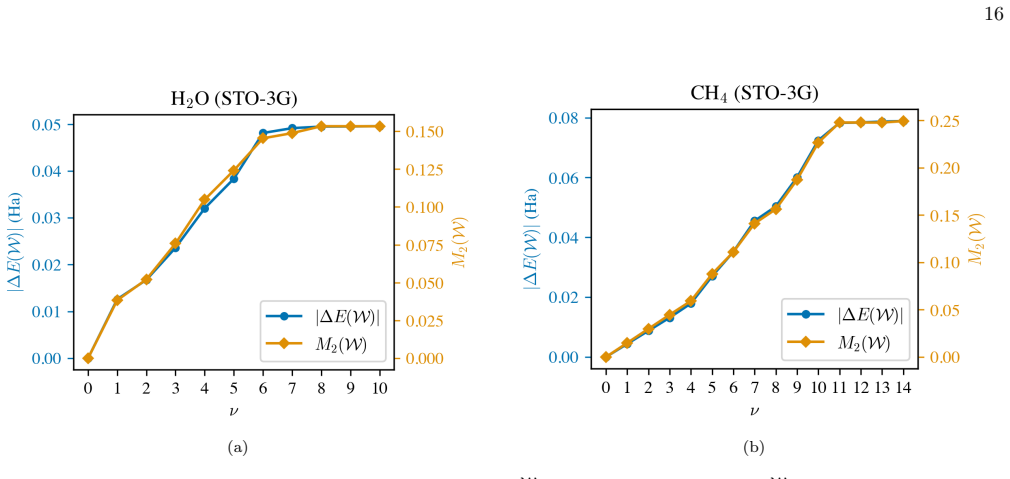
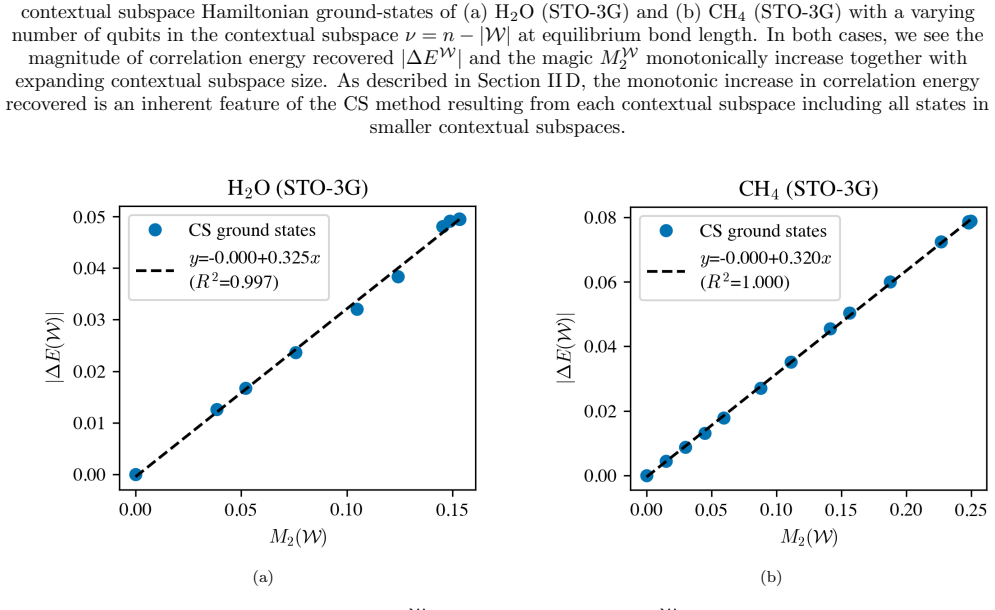
Correlation energy recovered by approximate ground states is proportional to their magic as measured by 2-stabilizer Renyi entropy.
A machine-rendered reading of the paper's core claim, the machinery that carries it, and where it could break.
Core claim
For weakly- and moderately-correlated electronic structure Hamiltonians, the correlation is directly represented by 2-SRE, and thus by the magic. We prove that the correlation energy recovered by the CS ground states is proportional to the magic present in the approximate ground state. The 2-SRE of post-Hartree-Fock ground states is proportional to the correlation energy they recover, and the CS method can be used to monotonically vary the magic of approximate CS ground states.
What carries the argument
The 2-stabilizer Renyi entropy (2-SRE) as a measure of magic, connected to Hartree-Fock overlap and correlation energy through the contextual subspace construction.
If this is right
- The correlation energy recovered by CS ground states is proportional to the magic in the approximate ground state.
- The 2-SRE of post-Hartree-Fock ground states scales directly with the correlation energy recovered.
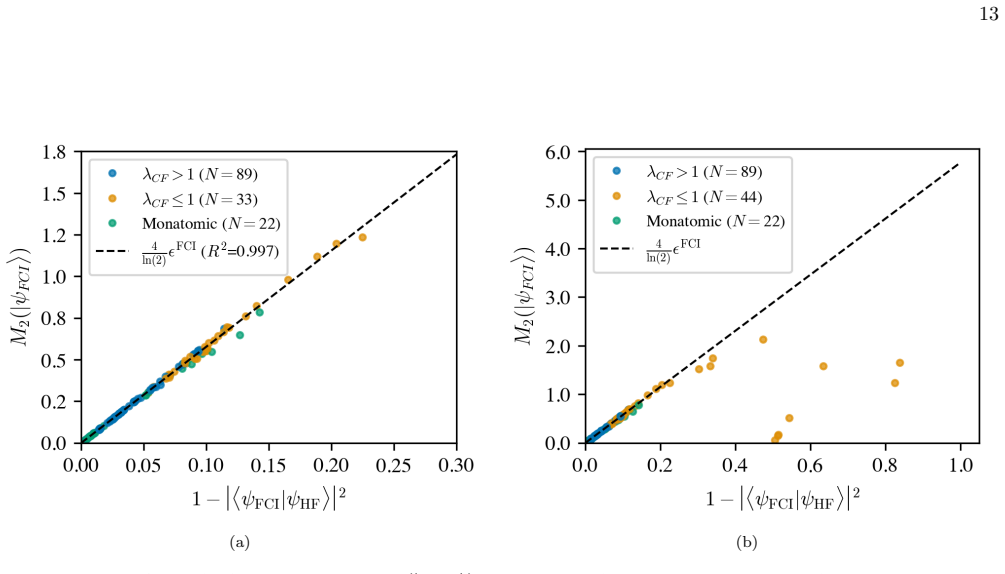
- Linear relationships between 2-SRE, correlation energy, and Hartree-Fock weight hold across the dataset of 190 molecules.
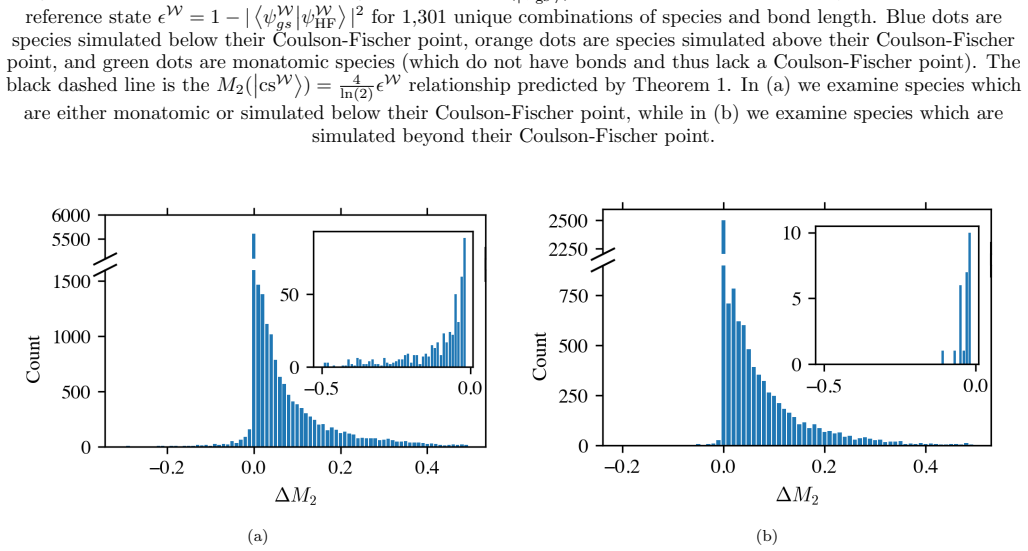
- The contextual subspace method allows monotonic variation of magic while controlling correlation recovery.
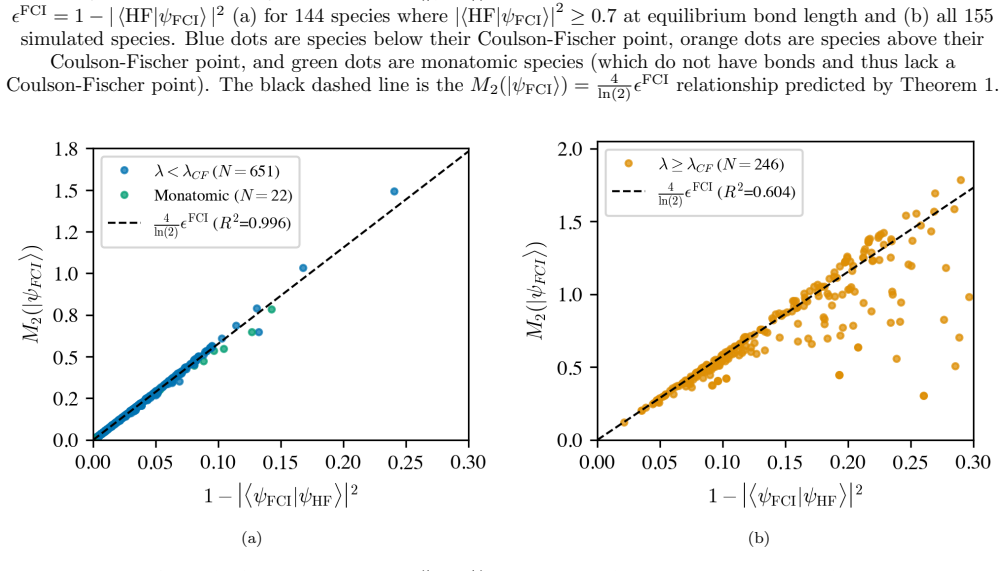
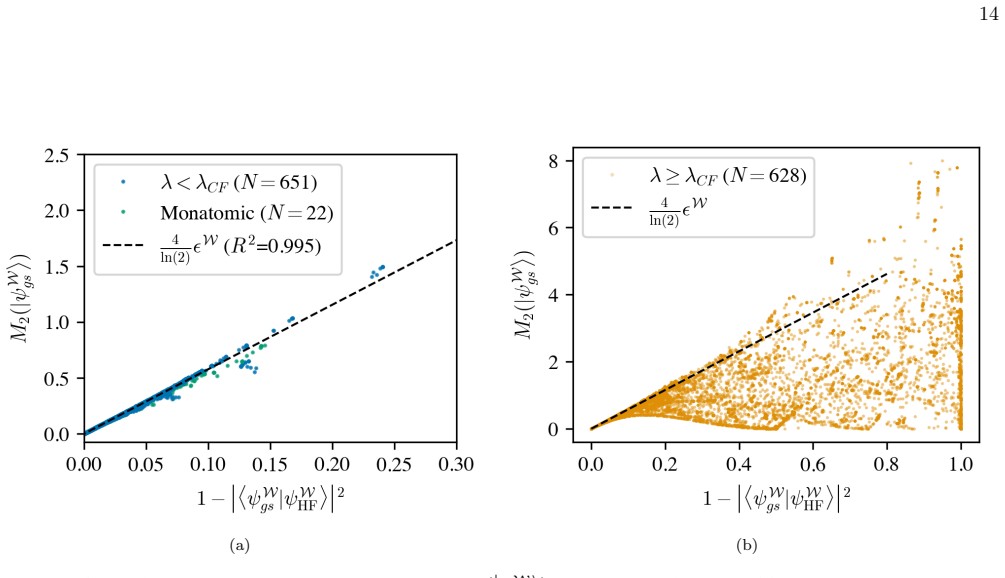
- The linear relationships break down beyond the Coulson-Fischer point where Hartree-Fock fails.
Where Pith is reading between the lines
- Magic could act as a practical proxy for estimating how much correlation a variational state will capture without full energy evaluation.
- Quantum algorithms for chemistry might prioritize ansatze that increase 2-SRE to access more correlation at given resources.
- The observed breakdown suggests 2-SRE loses its direct link to correlation in regimes where multiple reference states are needed.
Load-bearing premise
The perturbative link between 2-SRE and Hartree-Fock overlap continues to hold when the true ground state deviates from the Hartree-Fock reference.
What would settle it
A calculation on a moderately correlated molecule at bond lengths before the Coulson-Fischer point where the recovered correlation energy does not increase linearly with the 2-SRE of the approximate ground state.
Figures



read the original abstract
The gate and qubit requirements of quantum computations of electronic structure have been extensively studied. However, the quantum resources present in electronic ground states, as measured by entanglement and magic, remain less well understood. We study the relationship between correlation in electronic structure Hamiltonians and magic as measured by the 2-stabilizer Renyi entropy (2-SRE). Perturbative calculations show that the 2-SRE of a given state is proportional to its overlap with a reference stabilizer state. In the context of quantum chemistry, this links the magic of electronic structure ground states to their Hartree-Fock weight, an established measure of electronic correlation. We then show that the 2-SRE of post-Hartree-Fock ground states is proportional to the correlation energy they recover. We explore this connection through the contextual subspace (CS) method. We present a theoretical framework showing that the CS method can be used to monotonically vary the magic of approximate CS ground states, and we prove that the correlation energy recovered by the CS ground states is proportional to the magic present in the approximate ground state. We present simulation results using 190 molecular species under Jordan-Wigner encoding at a range of bond lengths. The linear relationships between magic and correlation are robust across the Hamiltonians in our dataset, but break down at bond lengths beyond the Coulson-Fischer point, where Hartree-Fock fails to capture key physical features of the true ground state wavefunction. By establishing linear relationships for both correlation energy and Hartree-Fock reference weight with the 2-SRE, we conclude that for weakly- and moderately-correlated electronic structure Hamiltonians, the correlation is directly represented by 2-SRE, and thus by the magic.
Editorial analysis
A structured set of objections, weighed in public.
Referee Report
Summary. The manuscript claims that for weakly- and moderately-correlated electronic structure Hamiltonians, correlation is directly represented by 2-SRE (hence magic). Perturbative calculations establish that 2-SRE is proportional to overlap with a Hartree-Fock reference stabilizer state, linking magic to an established correlation measure. The authors then prove that post-Hartree-Fock ground states have 2-SRE proportional to recovered correlation energy. Using the contextual subspace (CS) method, they provide a framework to monotonically vary magic in approximate CS ground states and prove that the correlation energy recovered by these states is proportional to the magic present. Numerical simulations on 190 molecular species under Jordan-Wigner encoding show robust linear relationships that hold until bond lengths exceed the Coulson-Fischer point.
Significance. If the central claims hold, the work establishes a concrete link between electronic correlation and quantum magic via 2-SRE, with potential implications for resource estimation in quantum chemistry algorithms. Strengths include the large numerical dataset (190 species) and the explicit proof for the CS proportionality. The regime limitation past the Coulson-Fischer point is already noted by the authors.
major comments (3)
- [theoretical framework for CS method] Theoretical framework for CS method: the proof that CS ground-state correlation energy is proportional to the magic in the approximate ground state appears to follow from the construction of the contextual subspace, which is explicitly designed to control magic. The manuscript must clarify whether this proportionality is independent of the perturbative 2-SRE-HF-overlap link or is tautological by design of the subspace selection.
- [perturbative calculations] Perturbative calculations section: the claimed proportionality between 2-SRE and overlap with the HF reference stabilizer is used to anchor the subsequent CS result, yet the paper itself reports breakdown beyond the Coulson-Fischer point where HF ceases to be a good reference. No quantitative bound is supplied on the range of validity inside the 'moderately correlated' window, leaving the central scaling claim regime-limited without a clear demarcation.
- [simulation results] Simulation results on 190 species: while linear relationships between magic, HF weight, and correlation energy are reported as robust, the breakdown at longer bond lengths indicates the scaling does not hold universally. The manuscript should report how many of the 190 Hamiltonians lie inside the valid regime, together with explicit fit statistics (R² or equivalent) rather than qualitative statements of robustness.
minor comments (2)
- Notation for 2-SRE and its relation to magic should be defined once at first use and used consistently.
- Figures displaying linear fits should include quantitative measures of fit quality (e.g., R² values) to allow readers to assess the strength of the reported proportionality.
Simulated Author's Rebuttal
We thank the referee for their careful reading of our manuscript and for the constructive comments. Below we respond point-by-point to the major comments, indicating the revisions we will make.
read point-by-point responses
-
Referee: [theoretical framework for CS method] Theoretical framework for CS method: the proof that CS ground-state correlation energy is proportional to the magic in the approximate ground state appears to follow from the construction of the contextual subspace, which is explicitly designed to control magic. The manuscript must clarify whether this proportionality is independent of the perturbative 2-SRE-HF-overlap link or is tautological by design of the subspace selection.
Authors: The proportionality result for the contextual subspace (CS) method is derived independently from the perturbative calculations. It follows from the way the contextual subspace is constructed by selecting terms that introduce non-stabilizer (magic) components, and the definition of the approximate ground state as the lowest energy state in that subspace. The perturbative link provides context for interpreting the result in terms of correlation but is not used in the proof. We will revise the manuscript to explicitly clarify this independence and avoid any potential misinterpretation of tautology. revision: yes
-
Referee: [perturbative calculations] Perturbative calculations section: the claimed proportionality between 2-SRE and overlap with the HF reference stabilizer is used to anchor the subsequent CS result, yet the paper itself reports breakdown beyond the Coulson-Fischer point where HF ceases to be a good reference. No quantitative bound is supplied on the range of validity inside the 'moderately correlated' window, leaving the central scaling claim regime-limited without a clear demarcation.
Authors: We note that the manuscript already identifies the breakdown of the scaling beyond the Coulson-Fischer point. We agree that a more quantitative demarcation of the 'moderately correlated' regime would be beneficial. In the revision, we will provide additional analysis, such as the range of HF overlaps or correlation energies where the linear scaling holds with high fidelity, to better bound the validity of the central claim. revision: yes
-
Referee: [simulation results] Simulation results on 190 species: while linear relationships between magic, HF weight, and correlation energy are reported as robust, the breakdown at longer bond lengths indicates the scaling does not hold universally. The manuscript should report how many of the 190 Hamiltonians lie inside the valid regime, together with explicit fit statistics (R² or equivalent) rather than qualitative statements of robustness.
Authors: The referee raises a valid point about quantifying the robustness. We will update the simulation results section to specify the number of the 190 molecular Hamiltonians that remain within the regime where Hartree-Fock is valid (i.e., prior to the Coulson-Fischer point), and we will include explicit fit statistics such as R² values for the reported linear relationships. revision: yes
Circularity Check
No significant circularity; derivations presented as independent
full rationale
The paper's chain begins with perturbative calculations establishing 2-SRE proportionality to stabilizer overlap (linking to HF weight), followed by a separate theoretical framework for the contextual subspace method that demonstrates monotonic magic variation and a claimed proof of correlation-energy proportionality. These steps are described as distinct results rather than reductions of outputs to inputs by definition or construction. No self-citations, fitted parameters renamed as predictions, or ansatzes smuggled via prior work appear in the provided text. The explicit acknowledgment of breakdown beyond the Coulson-Fischer point further indicates the claims are not tautological. The central proportionality is presented as a derived result, not forced by the subspace construction itself.
Axiom & Free-Parameter Ledger
axioms (2)
- domain assumption The 2-stabilizer Renyi entropy of a state is proportional to its overlap with a reference stabilizer state under perturbative expansion.
- domain assumption The contextual subspace method can be used to monotonically vary the magic of approximate ground states while preserving the proportionality to recovered correlation energy.
Reference graph
Works this paper leans on
-
[1]
9 Lemma 1Let|ψ⟩be a generaln-qubit quantum state
Magic monotonicity of the CS projectors In this section, we show the monotonic relation be- tween the size of a Hilbert space governed by the con- textual subspace method and theα-SRE of a particular state projected into that Hilbert space forα≥2 by using the results found in [25]. 9 Lemma 1Let|ψ⟩be a generaln-qubit quantum state. If the unitary partition...
-
[2]
Succinctly, the magicM 2( csW ) decreases with in- creasing|W|:M 2( csW ′ E )≤M 2( csW ) for|W| ≤ |W ′|
Magic monotonicity of the CS ground-states In this section, we use Lemma 1 and Corollary 1 to show that the ground states{ csW }n−1 W=1 of the con- textual subspace Hamiltonians{H W cs }n−1 W=1 have magic 10 which monotonically decreases with decreasing system size. Succinctly, the magicM 2( csW ) decreases with in- creasing|W|:M 2( csW ′ E )≤M 2( csW ) f...
-
[3]
greedy search
More information on the Hamiltonian generation process can be found in Appendix D. B. Numerical simulation methodology To reduce computational complexity, initial qubit ta- pering was performed on all Hamiltonians as described in Section II D [83, 84]. For simplicity we will refer to the qubit count after initial tapering as the total number of qubitsNreq...
2025
-
[4]
For a set of Pauli operatorsJto be non-contextual, commutation must be transitive onJ
Non-contextual Pauli structure The following definitions and structures are all defined in [85] and [47], and are presented here as a reference for the reader. For a set of Pauli operatorsJto be non-contextual, commutation must be transitive onJ. Commutation being an equivalence relation means that for all Pauli operatorsA, B, C∈ J, if [A, B] = 0, and [B,...
-
[5]
Unitary Partitioning Operator and Induced Magic The use of the unitary partitioning technique makes the rotation operatorU W non-Clifford and increases the number of terms in the Hamiltonian by a factor of O(|Hfull|(n2 −1)) [46]. Additionally, the rotation from unitary partitioning (let us call the rotation operator for unitary partitioningR) induces magi...
-
[6]
Faithfulness:M α(|ψ⟩) = 0 iff|ψ⟩ ∈STAB, other- wiseM α(|ψ⟩)>0
-
[7]
Stability under free operations (invariance un- der Clifford transformations):C∈ C(H) : Mα(C|ψ⟩) =M α(|ψ⟩)
-
[8]
Furthermore, theα-SRE has been shown to be a mono- tone of non-stabilizerness forα≥2 [24, 25, 71]
Additivity:M α(|ψ⟩ ⊗ |ϕ⟩) =M α(|ψ⟩) +M α(|ϕ⟩). Furthermore, theα-SRE has been shown to be a mono- tone of non-stabilizerness forα≥2 [24, 25, 71]. A magic monotone is a real-valued functionMfor alln∈Nqubit systems such that 1.M(ψ) = 0 iffψis a pure stabilizer state, 2.∀pair (ψ, ε), whereε∈ Fis a free stabilizer proto- colε(|ψ⟩ ⟨ψ|) =|ϕ⟩ ⟨ϕ|it holds that M(...
-
[9]
We look at the projector form of the entropy as well as an extension of SRE to the mixed state case
Expanding SRE to mixed states Extending SRE to mixed states, we expand on 2-SRE in equation (3). We look at the projector form of the entropy as well as an extension of SRE to the mixed state case. We have that the projector form of 2-SRE is given by M2(|ψ⟩) =−log 2n tr(Q|ψ⟩ ⟨ψ| N 4) (C2) Q:= 2 −2n X P∈P (n) P N 4,(C3) forP (n) defined as the group of all...
-
[10]
Lewars,Computational Chemistry: Introduction to the Theory and Applications of Molecular and Quantum Mechanics(Springer, 2003)
E. Lewars,Computational Chemistry: Introduction to the Theory and Applications of Molecular and Quantum Mechanics(Springer, 2003)
2003
-
[11]
Szabo and N
A. Szabo and N. S. Ostlund,Modern Quantum Chem- istry: Introduction to Advanced Electronic Structure Theory(Macmillan, 2012)
2012
-
[12]
Helgaker, P
T. Helgaker, P. Jorgensen, and J. Olsen,Molecular Electronic-Structure Theory(John Wiley & Sons, 2013)
2013
-
[13]
L¨ owdin, Quantum theory of many-particle sys- tems
P.-O. L¨ owdin, Quantum theory of many-particle sys- tems. III. Extension of the Hartree-Fock scheme to in- clude degenerate systems and correlation effects, Phys. Rev.97, 1509 (1954)
1954
-
[14]
L¨ owdin, The historical development of the elec- tron correlation problem, Int
P.-O. L¨ owdin, The historical development of the elec- tron correlation problem, Int. J. Quantum Chem.55, 77 (1995)
1995
-
[15]
Aspuru-Guzik, A
A. Aspuru-Guzik, A. D. Dutoi, P. J. Love, and M. Head- Gordon, Simulated quantum computation of molecular energies, Science309, 1704 (2005)
2005
-
[16]
B. P. Lanyon, J. D. Whitfield, G. G. Gillett, M. E. Goggin, M. P. Almeida, I. Kassal, J. D. Biamonte, M. Mohseni, B. J. Powell, M. Barbieri, A. Aspuru- Guzik, and A. G. White, Towards quantum chemistry on a quantum computer, Nat. Chem.2, 106 (2010)
2010
-
[17]
J. D. Whitfield, J. Biamonte, and A. Aspuru-Guzik, Simulation of electronic structure Hamiltonians using quantum computers, Mol. Phys.109, 735 (2011)
2011
-
[18]
Kassal, J
I. Kassal, J. D. Whitfield, A. Perdomo-Ortiz, M.-H. Yung, and A. Aspuru-Guzik, Simulating chemistry us- ing quantum computers, Annu. Rev. Phys. Chem.62, 185 (2011)
2011
-
[19]
McArdle, S
S. McArdle, S. Endo, A. Aspuru-Guzik, S. C. Benjamin, and X. Yuan, Quantum computational chemistry, Rev. Mod. Phys.92, 015003 (2020)
2020
-
[20]
Schleich and A
P. Schleich and A. Aspuru-Guzik, Cracking chemistry with quantum simulations, Science390, 1002 (2025)
2025
-
[21]
S. Lee, J. Lee, H. Zhai, Y. Tong, A. M. Dalzell, A. Ku- mar, P. Helms, J. Gray, Z.-H. Cui, W. Liu,et al., Eval- uating the evidence for exponential quantum advantage in ground-state quantum chemistry, Nat. Commun.14, 1952 (2023)
1952
-
[22]
Bauer, S
B. Bauer, S. Bravyi, M. Motta, and G. K.-L. Chan, Quantum algorithms for quantum chemistry and quan- 26 tum materials science, Chem. Rev.120, 12685 (2020)
2020
-
[23]
J. Chen and G. K.-L. Chan, A framework for robust quantum speedups in practical correlated electronic structure and dynamics, arXiv:2508.15765
-
[24]
Schr¨ odinger, Discussion of probability relations be- tween separated systems, inMathematical Proceedings of the Cambridge Philosophical Society, Vol
E. Schr¨ odinger, Discussion of probability relations be- tween separated systems, inMathematical Proceedings of the Cambridge Philosophical Society, Vol. 31 (Cam- bridge University Press, 1935) pp. 555–563
1935
-
[25]
M. A. Nielsen and I. L. Chuang,Quantum Computa- tion and Quantum Information(Cambridge University Press, 2010)
2010
-
[26]
Bravyi and D
S. Bravyi and D. Gosset, Improved classical simulation of quantum circuits dominated by Clifford gates, Phys. Rev. Lett.116, 250501 (2016)
2016
-
[27]
Bravyi, D
S. Bravyi, D. Browne, P. Calpin, E. Campbell, D. Gos- set, and M. Howard, Simulation of quantum circuits by low-rank stabilizer decompositions, Quantum3, 181 (2019)
2019
-
[28]
Howard, J
M. Howard, J. Wallman, V. Veitch, and J. Emerson, Contextuality supplies the ‘magic’ for quantum compu- tation, Nature510, 351 (2014)
2014
-
[29]
Bermejo-Vega, N
J. Bermejo-Vega, N. Delfosse, D. E. Browne, C. Okay, and R. Raussendorf, Contextuality as a resource for models of quantum computation with qubits, Phys. Rev. Lett.119, 120505 (2017)
2017
-
[30]
R. W. Spekkens, Negativity and contextuality are equiv- alent notions of nonclassicality, Phys. Rev. Lett.101, 020401 (2008)
2008
-
[31]
Kocia and P
L. Kocia and P. Love, Discrete Wigner formalism for qubits and noncontextuality of Clifford gates on qubit stabilizer states, Phys. Rev. A96, 062134 (2017)
2017
-
[32]
Veitch, S
V. Veitch, S. A. H. Mousavian, D. Gottesman, and J. Emerson, The resource theory of stabilizer quantum computation, New J. Phys.16, 013009 (2014)
2014
-
[33]
Leone, S
L. Leone, S. F. E. Oliviero, and A. Hamma, Stabilizer R´ enyi entropy, Phys. Rev. Lett.128, 050402 (2022)
2022
-
[34]
Leone and L
L. Leone and L. Bittel, Stabilizer entropies are mono- tones for magic-state resource theory, Phys. Rev. A110, L040403 (2024)
2024
-
[35]
Bittel and L
L. Bittel and L. Leone, Operational interpretation of the stabilizer entropy, Quantum10, 2069 (2026)
2069
-
[36]
T. Haug, L. Aolita, and M. Kim, Probing quantum com- plexity via universal saturation of stabilizer entropies, Quantum9, 1801 (2025)
2025
-
[37]
S. F. E. Oliviero, L. Leone, A. Hamma, and S. Lloyd, Measuring magic on a quantum processor, npj Quantum Inf.8, 148 (2022)
2022
-
[38]
Beverland, E
M. Beverland, E. Campbell, M. Howard, and V. Kli- uchnikov, Lower bounds on the non-Clifford resources for quantum computations, Quantum Sci. Technol.5, 035009 (2020)
2020
-
[39]
C. D. White, C. Cao, and B. Swingle, Conformal field theories are magical, Phys. Rev. B103, 075145 (2021)
2021
-
[40]
C. E. P. Robin and M. J. Savage, Quantum complexity fluctuations from nuclear and hypernuclear forces, Phys. Rev. C112, 044004 (2025)
2025
-
[41]
Chernyshev, C
I. Chernyshev, C. E. P. Robin, and M. J. Savage, Quan- tum magic and computational complexity in the neu- trino sector, Phys. Rev. Research7, 023228 (2025)
2025
-
[42]
P. R. N. Falc˜ ao, P. S. Tarabunga, M. Frau, E. Tirrito, J. Zakrzewski, and M. Dalmonte, Nonstabilizerness in U(1) lattice gauge theory, Phys. Rev. B111, L081102 (2025)
2025
-
[43]
C. Cao, G. Cheng, A. Hamma, L. Leone, W. Munizzi, and S. F. Oliviero, Gravitational backreaction is magi- cal, PRX Quantum6, 040375 (2025)
2025
-
[44]
C. D. White and M. J. White, Magic states of top quarks, Phys. Rev. D110, 116016 (2024)
2024
-
[45]
J. Gargalionis, N. Moynihan, S. Trifinopoulos, E. N. V. Wallace, C. D. White, and M. J. White, Spin versus Magic: Lessons from Gluon and Graviton Scattering, arXiv:2508.14967
- [46]
-
[47]
P. S. Tarabunga, E. Tirrito, T. Chanda, and M. Dal- monte, Many-body magic via Pauli-Markov chains– from criticality to gauge theories, PRX Quantum4, 040317 (2023)
2023
-
[48]
S. F. Oliviero, L. Leone, and A. Hamma, Magic-state resource theory for the ground state of the transverse- field Ising model, Phys. Rev. A106, 042426 (2022)
2022
-
[49]
Turkeshi, A
X. Turkeshi, A. Dymarsky, and P. Sierant, Pauli spec- trum and nonstabilizerness of typical quantum many- body states, Phys. Rev. B111, 054301 (2025)
2025
-
[50]
CMS Collaboration,Observation of magic states of top quark pairs produced in proton-proton collisions at√s= 13 TeV, CMS Physics Analysis Summary CMS-PAS- TOP-25-001 (CERN, 2025)
2025
-
[51]
X. Xu, L. Soriano-Agueda, X. L´ opez, E. Ramos- Cordoba, and E. Matito, All-purpose measure of elec- tron correlation for multireference diagnostics, J. Chem. Theory Comput.20, 721 (2023)
2023
-
[52]
T. J. Lee and P. R. Taylor, A diagnostic for determin- ing the quality of single-reference electron correlation methods, Int. J. Quantum Chem.36, 199 (1989)
1989
-
[53]
Izs´ ak, A
R. Izs´ ak, A. V. Ivanov, N. S. Blunt, N. Holzmann, and F. Neese, Measuring electron correlation: The impact of symmetry and orbital transformations, J. Chem. Theory Comput.19, 2703 (2023)
2023
-
[54]
W. M. Kirby, A. Tranter, and P. J. Love, Contextual subspace variational quantum eigensolver, Quantum5, 456 (2021)
2021
-
[55]
Ralli, T
A. Ralli, T. Weaving, A. Tranter, W. M. Kirby, P. J. Love, and P. V. Coveney, Unitary partitioning and the contextual subspace variational quantum eigensolver, Phys. Rev. Research5, 013095 (2023)
2023
-
[56]
Weaving, A
T. Weaving, A. Ralli, W. M. Kirby, A. Tranter, P. J. Love, and P. V. Coveney, A stabilizer framework for the contextual subspace variational quantum eigensolver and the noncontextual projection ansatz, J. Chem. The- ory Comput.19, 808 (2023)
2023
-
[57]
C. A. Coulson and I. Fischer, XXXIV. Notes on the molecular orbital treatment of the hydrogen molecule, Philos. Mag.40, 386 (1949)
1949
-
[58]
H. Gao, S. Imamura, A. Kasagi, and E. Yoshida, Dis- tributed implementation of full configuration interac- tion for one trillion determinants, J. Chem. Theory Comput.20, 1185 (2024)
2024
-
[59]
D. R. Hartree, The wave mechanics of an atom with a non-Coulomb central field. Part II. Some results and dis- cussion, inMathematical Proceedings of the Cambridge Philosophical Society, Vol. 24 (Cambridge University Press, 1928) pp. 111–132
1928
-
[60]
Fock, N¨ aherungsmethode zur L¨ osung des quanten- mechanischen Mehrk¨ orperproblems, Z
V. Fock, N¨ aherungsmethode zur L¨ osung des quanten- mechanischen Mehrk¨ orperproblems, Z. f¨ ur Physik61, 126 (1930)
1930
-
[61]
C. C. J. Roothaan, New developments in molecular or- 27 bital theory, Rev. Mod. Phys.23, 69 (1951)
1951
-
[62]
G. G. Hall, The molecular orbital theory of chemical valency VIII. A method of calculating ionization poten- tials, Proc. R. Soc. Lond. A205, 541 (1951)
1951
-
[63]
P. A. Limacher, P. W. Ayers, P. A. Johnson, S. De Baerdemacker, D. Van Neck, and P. Bultinck, A new mean-field method suitable for strongly corre- lated electrons: Computationally facile antisymmetric products of nonorthogonal geminals, J. Chem. Theory Comput.9, 1394 (2013)
2013
-
[64]
J. A. Pople, Nobel Lecture: Quantum chemical models, Rev. Mod. Phys.71, 1267 (1999)
1999
-
[65]
Kohanoff,Electronic Structure Calculations for Solids and Molecules: Theory and Computational methods (Cambridge University Press, 2006)
J. Kohanoff,Electronic Structure Calculations for Solids and Molecules: Theory and Computational methods (Cambridge University Press, 2006)
2006
-
[66]
Esquivel, S
R. Esquivel, S. L´ opez-Rosa, and J. Dehesa, Correlation energy as a measure of non-locality: Quantum entan- glement of helium-like systems, Europhys. Lett.111, 40009 (2015)
2015
-
[67]
Wang and S
H. Wang and S. Kais, Quantum entanglement and elec- tron correlation in molecular systems, Israel J. Chem. 47, 59 (2007)
2007
-
[68]
J. S. Bell, On the Einstein Podolsky Rosen paradox, Physics Physique Fizika1, 195 (1964)
1964
-
[69]
Einstein, B
A. Einstein, B. Podolsky, and N. Rosen, Can quantum- mechanical description of physical reality be considered complete?, Phys. Rev.47, 777 (1935)
1935
-
[70]
Bohr, Can quantum-mechanical description of phys- ical reality be considered complete?, Phys
N. Bohr, Can quantum-mechanical description of phys- ical reality be considered complete?, Phys. Rev.48, 696 (1935)
1935
-
[71]
Gottesman and I
D. Gottesman and I. L. Chuang, Demonstrating the viability of universal quantum computation using tele- portation and single-qubit operations, Nature402, 390 (1999)
1999
-
[72]
M. F. Pusey, J. Barrett, and T. Rudolph, On the reality of the quantum state, Nature Phys.8, 475 (2012)
2012
-
[73]
N. D. Mermin, Hidden variables and the two theorems of John Bell, Rev. Mod. Phys.65, 803 (1993)
1993
-
[74]
H. Kwon, K. C. Tan, T. Volkoff, and H. Jeong, Nonclas- sicality as a quantifiable resource for quantum metrol- ogy, Phys. Rev. Lett.122, 040503 (2019)
2019
-
[75]
Gokhale, O
P. Gokhale, O. Angiuli, Y. Ding, K. Gui, T. Tomesh, M. Suchara, M. Martonosi, and F. T. Chong,O(N 3) measurement cost for variational quantum eigensolver on molecular Hamiltonians, IEEE Trans. Quantum Eng. 1, 1 (2020)
2020
-
[76]
C. H. Bennett, G. Brassard, C. Cr´ epeau, R. Jozsa, A. Peres, and W. K. Wootters, Teleporting an unknown quantum state via dual classical and Einstein-Podolsky- Rosen channels, Phys. Rev. Lett.70, 1895 (1993)
1993
-
[77]
Kenfack and K
A. Kenfack and K. ˙Zyczkowski, Negativity of the Wigner function as an indicator of non-classicality, J. Opt. B: Quantum Semiclassical Opt.6, 396 (2004)
2004
-
[78]
Kochen and E
S. Kochen and E. Specker, The problem of hidden vari- ables in quantum mechanics, J. Math. Mech.17, 59 (1967)
1967
-
[79]
N. D. Mermin, Simple unified form for the major no- hidden-variables theorems, Phys. Rev. Lett.65, 3373 (1990)
1990
-
[80]
Haug and L
T. Haug and L. Piroli, Stabilizer entropies and nonsta- bilizerness monotones, Quantum7, 1092 (2023)
2023
discussion (0)
Sign in with ORCID, Apple, or X to comment. Anyone can read and Pith papers without signing in.