REVIEW 3 major objections 6 minor 87 references
On-device Content-based Recommendation with Single-shot Embedding Pruning: A Cooperative Game Perspective
T0 review · 3 major / 6 minor · reviewed 2026-08-12 · deepseek-v4-flash
Pith's one-line read Shaver is a single-shot embedding pruning method that gives every embedding parameter a Shapley value as a fair attribution score, so one well-trained recommender model can be compressed to any parameter budget without retraining.
desk verdict Shaver is a credible single-shot embedding pruner for CTR models, with a theorem that genuinely buys a complexity reduction; just know the theorem and the algorithm only work when every field activates exactly one feature per row, and the paper doesn't say that loudly. read the letter →
The pith
A machine-rendered reading of the paper's core claim, the machinery that carries it, and where it could break.
The reading
What carries the argument
The load-bearing mechanism is the corresponding-player identity (Definition 4.2 and Theorem 4.3): for a data instance in which feature $i$ of field $j$ is the sole activated feature, the Shapley value of embedding parameter $(i,c)$ under the parameter-level value function equals the Shapley value of field-slot player $(j,c)$ under the field-level value function. This identity is what collapses the combinatorial game over $nd$ parameters to one over $md$ field slots, making the Monte Carlo estimation in Algorithm 1 tractable. Two auxiliary mechanisms support the result: the local-value formulation of Eq. (10), which turns global Shapley values into averages over per-instance permutations, and the field-aware codebook of Eqs. (14)-(15), which imputes pruned parameters with per-field weighted-average embeddings rather than zeros.
What would settle it
Take a small CTR model with a field whose instances can activate two features simultaneously, enumerate all parameter subsets to compute exact Shapley values, and compare them with Shaver's field-level estimates on the same data; any material gap in the attribution of an active parameter would falsify Theorem 4.3's equality. A simpler check is whether the method's validation AUC degrades sharply when a multi-hot field is included in an otherwise one-hot dataset.
Extended reading notes
Core claim
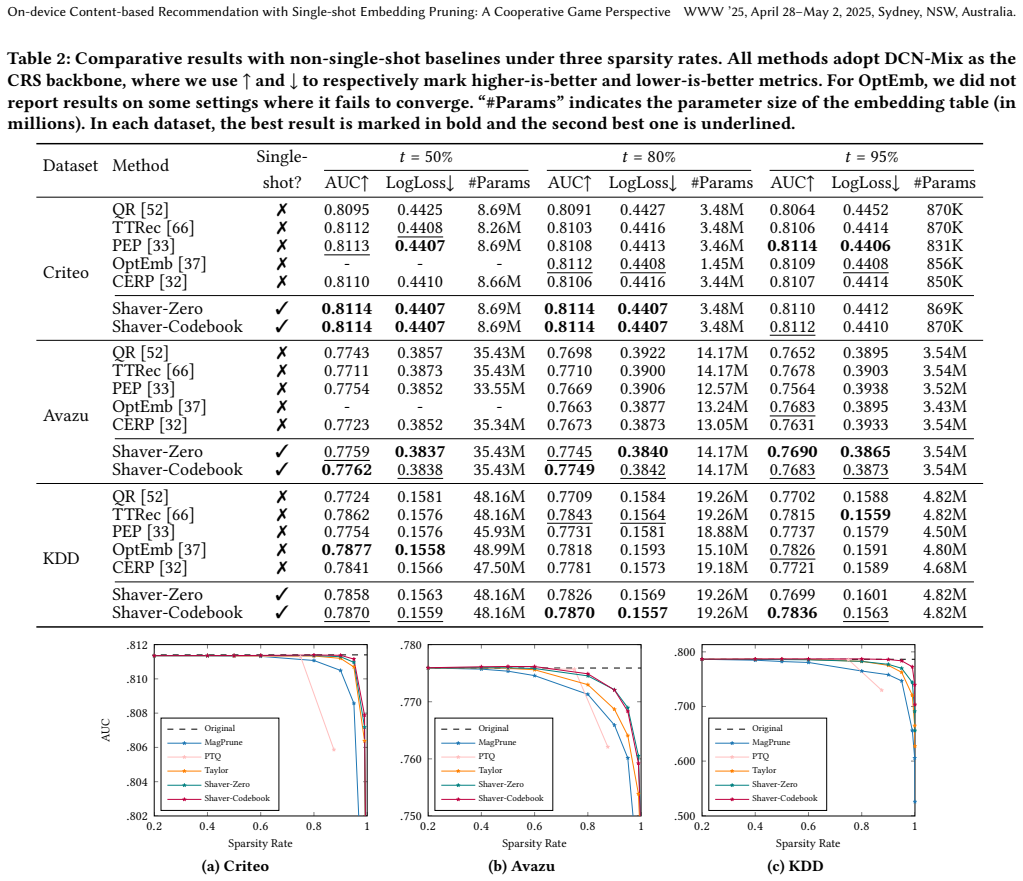
On the paper's own terms, the central discovery is that Shapley-value attribution, previously considered too expensive for parameter-level pruning in recommender systems, can be computed efficiently for embedding tables because of the one-hot structure of categorical CTR data. Definition 4.2 pairs each activated embedding parameter $(i,c)$ with a field-level player $(j,c)$, and Theorem 4.3 proves their Shapley values are equal for that instance. Consequently, estimating attribution over the $n$ features reduces to estimating it over the $m$ fields, and Algorithm 1 accumulates unbiased Monte Carlo estimates in $O(md|D|)$ forward passes. The pruned model replaces low-scoring entries with per-field codebook values that solve in closed form, giving a single-shot compressor that the experiments show matches or beats trained-from-scratch baselines on Criteo, Avazu, and KDD across sparsity rates from 20% to 99.9%.
Load-bearing premise
The method's efficiency rests on a single one-hot premise: every field activates exactly one feature per instance, so an inactive embedding parameter is a null player and the field-level game exactly mirrors the parameter-level game.
Editorial extensions
If this is right
- A trained CTR model can be shipped once and specialized to any device memory budget by ranking parameters and truncating, with no per-budget retraining or mask search.
- The $O(md|D|)$ cost means attribution can be recomputed on-device or in streaming and federated settings whenever the model or data distribution shifts.
- Because the codebook stores only $md$ values, replacing zero-padding adds negligible storage while preserving more of the dot-product and element-wise feature interactions that CTR models rely on.
- The method extends beyond the three reported datasets to any categorical CTR model whose input is a concatenation of one-hot field encodings, including DeepFM and DCN-v2 backbones.
- Combining Shaver's scores with post-pruning fine-tuning yields further gains in several settings, though the paper notes occasional degradation from validation-set leakage.
Reading between the lines
- Our inference: the one-hot assumption in Eq. (1) is the hinge. If a deployment uses multi-hot fields, user-defined dense features, or feature crosses, the corresponding-player equality no longer holds exactly; a fallback would be to split multi-hot fields into per-feature singleton games or treat the active set as a coalition, at extra cost.
- Our inference: the codebook's tendency to spend less budget on high-frequency features (Figure 4) suggests a principled pruning policy could be derived from feature frequency and field interactions, not just raw attribution magnitude.
- Our inference: Shaver's attribution scores are computed from a trained model, so the method should transfer to other interaction-heavy architectures such as factorization machines and cross networks; a natural test is whether attribution scores computed on DeepFM also prune a DCN-v2 model effectively.
- Our inference: because estimation only needs forward passes, the same scoring procedure could be applied periodically in a streaming setting to adapt an embedding table to drift, something the paper motivates but does not evaluate.
Signed reviews
Editorial analysis
A structured set of objections, weighed in public.
Referee Report
Summary. The paper introduces Shaver, a single-shot embedding-pruning method for content-based recommender systems (CTR models). Shaver assigns each embedding parameter a Shapley value as an attribution score, so that a trained model can be pruned to any parameter budget without retraining. To make Shapley computation tractable, the paper proves Theorem 4.3, which reduces the complexity from O(nd|D|) to O(md|D|) under the assumption that each feature field has exactly one activated feature per instance. The paper also proposes a field-aware codebook to replace zero-padding for pruned parameters, with a closed-form solution. Experiments on Criteo, Avazu, and KDD with DeepFM and DCN-Mix backbones compare Shaver with non-single-shot and single-shot baselines, and an on-device benchmark is reported.
Significance. If the theoretical reduction and the empirical claims hold, Shaver would be a useful contribution: it targets a practical single-shot pruning setting, provides a nontrivial complexity reduction, ships code, and includes a synthetic-data verification that the estimated Shapley values are close to exact ones. The experiments cover three large-scale datasets, two backbones, many sparsity levels, and an edge-device deployment benchmark, which is a real strength. However, the central efficiency theorem depends on a single-activation-per-field assumption that is not stated as a limitation, and the experimental sections report no variance across seeds. Both issues bound the significance of the work as written.
major comments (3)
- [§4.3, Definition 4.2, Appendix A] Theorem 4.3 and its proof are internally sound only when every feature field activates exactly one feature per instance, as encoded in Eq. (1). Under multi-hot fields—e.g., movie genres or user interest tags—the 'corresponding player' of Definition 4.2 is not unique, the map g in Eq. (16) is no longer single-valued, Algorithm 1 line 9 is ambiguous, and the counting argument behind the O(md|D|) complexity claim collapses. Multi-hot categorical features are routine in content-based recommendation, so this is a load-bearing restriction on the paper's central claim. The authors should either state this assumption as a clear scope limitation or extend the method and theorem to multi-hot fields (for instance, by decomposing fields into per-feature subgames).
- [§5.2–5.4, Tables 2 and 3, Figure 2] No error bars, confidence intervals, or multiple-seed results are reported anywhere. Many of the claimed advantages are based on AUC differences of 0.0001–0.001, which are within the range where seed-to-seed variation matters. Since the headline contribution is 'competitive performance' across budgets, single-run results are not sufficient to support the comparison. Please report means and standard deviations over at least three seeds, or explicitly state that only one seed was used and discuss the implications.
- [§4.4, Eq. (14), Appendix A] Equation (14) defines the optimal codebook with respect to a uniformly sampled pruned set Q of size B, but in the actual pruning procedure Q is the set of parameters with the lowest Shapley values. Consequently, the closed-form solution in Eq. (15) is optimal for a different distribution over pruning masks than the one actually used. The paper calls C* 'optimal' and attributes performance gains to it, so this mismatch is a gap between the derivation and the deployed algorithm. Either derive the codebook for the actual selection rule or explicitly present it as a heuristic approximation.
minor comments (6)
- [§4.2, Eq. (10)] The notation R(x,y) is used both for a random permutation and as a paired sample; this is confusing because R was previously an ordered set. Please rename one of them.
- [§4.2, text after Eq. (10)] There is a typo: 'with a quality, decent-sizedD' should read 'with a quality, decent-sized D'.
- [§4.3, first paragraph] The word 'Shapely' in 'efficient Shapely value computation' is misspelled; it should be 'Shapley'.
- [Table 1 and Appendix C.2] The dataset preprocessing description does not state whether any field in Criteo, Avazu, or KDD is multi-hot. Since the theorem assumes single activation per field, please make explicit whether the preprocessed datasets satisfy this condition.
- [Figure 4] The x-axis label 'Frequency Bins' is not self-explanatory; please clarify whether bins are equal-frequency or equal-width, and whether the three bins contain equal numbers of features.
- [§5.4, closing paragraph] The phrase 'can cause data leakage' is inaccurate if 'leakage' refers to test-set contamination: Shapley values are computed from training and validation data, and the test set is held out. Please rephrase to describe the selection effect on fine-tuning more precisely.
Circularity Check
No significant circularity: Shaver's Shapley-value derivation is proven from stated one-hot assumptions, and its results are evaluated on held-out test data.
full rationale
Shaver's derivation chain is self-contained. The Shapley-value definition (Eqs. 5-8), the local/global decomposition (Eqs. 9-10), and Theorem 4.3 form a mathematical argument with explicitly stated assumptions: single activation per feature field (Eq. 1) and the corresponding-player mapping in Definition 4.2. Theorem 4.3 is proved in Appendix A via explicit binomial and Chu-Vandermonde identities rather than assumed, and the O(md|D|) complexity claim follows from that proof together with Algorithm 1, which updates exactly the activated parameter's Shapley accumulator. The codebook is a closed-form minimizer of a stated expected-distance objective (Eqs. 14-15), using feature frequencies without encoding the target test results. The only self-citations ([7], [55], and related on-device recommendation works) are contextual or provide public data splits and preprocessing; no load-bearing claim rests on an unverified self-cited theorem. The validation-set usage for attribution scores is explicitly disclosed in Section 5.4 as a potential source of data leakage during fine-tuning, but this is analogous to model selection on validation data and does not make the test-set evaluation circular. The multi-hot field limitation raised by a skeptical reading is a domain/assumption risk: if a field activates multiple features, the corresponding-player map in Definition 4.2 is not unique and Theorem 4.3's premise fails. That is a correctness/robustness concern about the stated assumptions, not a circularity, because the paper's own equations do not presuppose the theorem's conclusion.
Assumptions & free parameters
assumptions (3)
- domain assumption Each categorical feature field contributes exactly one active feature per data instance, so all other features in the field are inactive for that instance.
- domain assumption Pruning can be modeled as replacing a parameter with a placeholder value, and the loss difference under this replacement is a meaningful attribution signal.
- standard math The Chu-Vandermonde identity and the linearity of Shapley values over data samples justify the closed-form solution and unbiasedness claims.
invented entities (1)
-
Field-aware codebook C in R^{m x d}
independent evidence
Cite this review
Pith. "Pith review of On-device Content-based Recommendation with Single-shot Embedding Pruning: A Cooperative Game Perspective." pith.science (2026). https://pith.science/paper/DI6NZIOC
@misc{pith2026241113052,
  author       = {Pith},
  title        = {Pith review of: On-device Content-based Recommendation with Single-shot Embedding Pruning: A Cooperative Game Perspective},
  year         = {2026},
  howpublished = {\url{https://pith.science/paper/DI6NZIOC}},
  note         = {Machine review of arXiv:2411.13052}
}
read the original abstract
Content-based Recommender Systems (CRSs) play a crucial role in shaping user experiences in e-commerce, online advertising, and personalized recommendations. However, due to the vast amount of categorical features, the embedding tables used in CRS models pose a significant storage bottleneck for real-world deployment, especially on resource-constrained devices. To address this problem, various embedding pruning methods have been proposed, but most existing ones require expensive retraining steps for each target parameter budget, leading to enormous computation costs. In reality, this computation cost is a major hurdle in real-world applications with diverse storage requirements, such as federated learning and streaming settings. In this paper, we propose Shapley Value-guided Embedding Reduction (Shaver) as our response. With Shaver, we view the problem from a cooperative game perspective, and quantify each embedding parameter's contribution with Shapley values to facilitate contribution-based parameter pruning. To address the inherently high computation costs of Shapley values, we propose an efficient and unbiased method to estimate Shapley values of a CRS's embedding parameters. Moreover, in the pruning stage, we put forward a field-aware codebook to mitigate the information loss in the traditional zero-out treatment. Through extensive experiments on three real-world datasets, Shaver has demonstrated competitive performance with lightweight recommendation models across various parameter budgets. The source code is available at https://github.com/chenxing1999/shaver
Figures


Figures from the paper (2 more)


Reference graph
Works this paper leans on
-
[1]
Yi Wang Aden. 2012. KDD Cup 2012, Track 2. https://kaggle.com/competitions/ kddcup2012-track2
2012
-
[2]
Marco Ancona, Cengiz Öztireli, and Markus Gross. 2020. Shapley value as principled metric for structured network pruning.arXiv preprint arXiv:2006.01795 (2020)
work page Pith review arXiv 2020
-
[3]
Omer Ben-Porat and Moshe Tennenholtz. 2018. A game-theoretic approach to recommendation systems with strategic content providers. NeuRIPS (2018)
2018
-
[4]
Han Cai, Chuang Gan, Tianzhe Wang, Zhekai Zhang, and Song Han. 2020. Once- for-all: Train one network and specialize it for efficient deployment.ICLR (2020)
2020
-
[5]
Javier Castro, Daniel Gómez, and Juan Tejada. 2009. Polynomial calculation of the Shapley value based on sampling. Computers & operations research (2009)
2009
-
[6]
Hugh Chen, Ian C Covert, Scott M Lundberg, and Su-In Lee. 2023. Algorithms to estimate Shapley value feature attributions. Nature Machine Intelligence 5, 6 (2023), 590–601
2023
-
[7]
Tong Chen, Hongzhi Yin, Yujia Zheng, Zi Huang, Yang Wang, and Meng Wang
-
[8]
Yizhou Chen, Guangda Huzhang, Anxiang Zeng, Qingtao Yu, Hui Sun, Heng-Yi Li, Jingyi Li, Yabo Ni, Han Yu, and Zhiming Zhou. 2023. Clustered Embedding Learning for Recommender Systems. In WWW
work page 2023
Show all 87 references
-
[9]
Chi, and Derek Zhiyuan Cheng
Benjamin Coleman, Wang-Cheng Kang, Matthew Fahrbach, Ruoxi Wang, Lichan Hong, Ed H. Chi, and Derek Zhiyuan Cheng. 2023. Unified Embedding: Battle- tested feature representations for web-scale ML systems. In NeuRIPS
2023
-
[10]
Ian Covert, Chanwoo Kim, Su-In Lee, James Zou, and Tatsunori Hashimoto. 2024. Stochastic Amortization: A Unified Approach to Accelerate Feature and Data Attribution. arXiv preprint arXiv:2401.15866 (2024)
2024 arXiv
-
[11]
Ian Covert and Su-In Lee. 2021. Improving kernelshap: Practical shapley value estimation via linear regression. Artificial Intelligence and Statistics (2021)
2021
-
[12]
Ian Covert, Scott M Lundberg, and Su-In Lee. 2020. Understanding global feature contributions with additive importance measures. NeuRIPS (2020)
2020
-
[13]
Yunfei Fang, Caihong Mu, and Yi Liu. 2023. AutoShape: Automatic Design of Click-Through Rate Prediction Models Using Shapley Value. In Pacific Rim International Conference on Artificial Intelligence
2023
-
[14]
Amirata Ghorbani and James Zou. 2020. Neuron Shapley: discovering the re- sponsible neurons. In NeuRIPS
2020
-
[15]
Xudong Gong et al . 2022. Real-time short video recommendation on mobile devices. In CIKM. 3103–3112
2022
-
[16]
Hui Guan, Andrey Malevich, Jiyan Yang, Jongsoo Park, and Hector Yuen
-
[17]
Jiyang Guan, Zhuozhuo Tu, Ran He, and Dacheng Tao. 2022. Few-shot backdoor defense using shapley estimation. In CVPR
2022
-
[18]
Huifeng Guo, Ruiming Tang, Yunming Ye, Zhenguo Li, and Xiuqiang He. 2017. DeepFM: A Factorization-Machine based Neural Network for CTR Prediction. In IJCAI, Carles Sierra (Ed.). 1725–1731
2017
-
[19]
Jialiang Han, Yun Ma, Qiaozhu Mei, and Xuanzhe Liu. 2021. Deeprec: On-device deep learning for privacy-preserving sequential recommendation in mobile com- merce. In WWW. 900–911
2021
-
[20]
Song Han, Huizi Mao, and William J. Dally. 2016. Deep Compression: Compress- ing Deep Neural Network with Pruning, Trained Quantization and Huffman Coding. In ICLR, Yoshua Bengio and Yann LeCun (Eds.)
2016
-
[21]
Xiangnan He, Lizi Liao, Hanwang Zhang, Liqiang Nie, Xia Hu, and Tat-Seng Chua. 2017. Neural collaborative filtering. In WWW. 173–182
2017
-
[22]
Olivier Chapelle Jean-Baptiste Tien, joycenv. 2014. Display Advertising Challenge. https://kaggle.com/competitions/criteo-display-ad-challenge
2014
-
[23]
Neil Jethani, Mukund Sudarshan, Ian Connick Covert, Su-In Lee, and Rajesh Ranganath. 2021. FastSHAP: Real-time shapley value estimation. In ICLR
2021
-
[24]
Joglekar, Cong Li, Jay K
Manas R. Joglekar, Cong Li, Jay K. Adams, Pranav Khaitan, and Quoc V. Le. 2019. Neural Input Search for Large Scale Recommendation Models. SIGKDD (2019). https://api.semanticscholar.org/CorpusID:195874115
2019
-
[25]
Wang-Cheng Kang et al. 2021. Learning to Embed Categorical Features without Embedding Tables for Recommendation. In SIGKDD. 840–850
2021
-
[26]
Shuming Kong, Weiyu Cheng, Yanyan Shen, and Linpeng Huang. 2022. Autosrh: An embedding dimensionality search framework for tabular data prediction.IEEE Transactions on Knowledge and Data Engineering 35, 7 (2022), 6673–6686
2022
-
[27]
2023.{AdaEmbed}: Adaptive Embedding for{Large-Scale} Rec- ommendation Models
Fan Lai et al. 2023.{AdaEmbed}: Adaptive Embedding for{Large-Scale} Rec- ommendation Models. In OSDI
2023
-
[28]
Namhoon Lee, Thalaiyasingam Ajanthan, and Philip Torr. 2018. SNIP: Single-shot network pruning based on connection sensitivity. In ICLR
2018
-
[29]
Shiwei Li et al. 2023. Adaptive Low-Precision Training for Embeddings in Click- through Rate Prediction. In AAAI
2023
-
[30]
Shiwei Li et al . 2024. Embedding Compression in Recommender Systems: A Survey. ACM Comput. Surv. (jan 2024)
2024
-
[31]
Xurong Liang, Tong Chen, Lizhen Cui, Yang Wang, Meng Wang, and Hongzhi Yin. 2024. Lightweight Embeddings for Graph Collaborative Filtering. In SIGIR. 1296–1306
2024
-
[32]
Xurong Liang, Tong Chen, Quoc Viet Hung Nguyen, Jianxin Li, and Hongzhi Yin
-
[33]
Siyi Liu, Chen Gao, Yihong Chen, Depeng Jin, and Yong Li. 2021. Learnable Embedding Sizes for Recommender Systems. In ICLR. https://openreview.net/ forum?id=vQzcqQWIS0q
2021
-
[34]
Zirui Liu, Hailin Zhang, Boxuan Chen, Zihan Jiang, Yikai Zhao, Yangyu Tao, Tong Yang, and Bin Cui. 2025. CAFE+: Towards Compact, Adaptive, and Fast Embedding for Large-scale Online Recommendation Models. ACM Transactions on Information Systems (2025)
2025
-
[35]
Scott M Lundberg, Gabriel Erion, Hugh Chen, Alex DeGrave, Jordan M Prutkin, Bala Nair, Ronit Katz, Jonathan Himmelfarb, Nisha Bansal, and Su-In Lee. 2020. From local explanations to global understanding with explainable AI for trees. Nature machine intelligence (2020)
2020
-
[36]
Scott M Lundberg and Su-In Lee. 2017. A unified approach to interpreting model predictions. NeuRIPS (2017)
2017
-
[37]
Fuyuan Lyu et al . 2022. OptEmbed: Learning Optimal Embedding Table for Click-through Rate Prediction. In CIKM. 1399–1409
2022
-
[38]
Matteo Marcuzzo, Alessandro Zangari, Andrea Albarelli, and Andrea Gasparetto
-
[39]
Lorenzo Minto and Moritz Haller. 2021. Using Federated Learning to Improve Brave’s On-Device Recommendations While Protecting Your Privacy. (2021). https://brave.com/blog/federated-learning/
2021
-
[40]
Pavlo Molchanov, Stephen Tyree, Tero Karras, Timo Aila, and Jan Kautz. 2017. Pruning Convolutional Neural Networks for Resource Efficient Inference. In ICLR
2017
-
[41]
Dheevatsa Mudigere et al . 2022. Software-Hardware Co-Design for Fast and Scalable Training of Deep Learning Recommendation Models. In Proceedings of the 49th Annual International Symposium on Computer Architecture . 993–1011
2022
-
[42]
Markus Nagel, Marios Fournarakis, Rana Ali Amjad, Yelysei Bondarenko, Mart Van Baalen, and Tijmen Blankevoort. 2021. A white paper on neural network quantization. arXiv preprint arXiv:2106.08295 (2021)
2021 arXiv
-
[43]
Niketan Pansare et al. 2022. Learning compressed embeddings for on-device inference. Proceedings of Machine Learning and Systems 4 (2022), 382–397
2022
-
[44]
Liang Qu, Yonghong Ye, Ningzhi Tang, Lixin Zhang, Yuhui Shi, and Hongzhi Yin
-
[45]
Yunke Qu, Tong Chen, Quoc Viet Hung Nguyen, and Hongzhi Yin. 2024. Budgeted Embedding Table For Recommender Systems. In WSDM (WSDM ’24) . 557–566
2024
-
[46]
Yunke Qu, Tong Chen, Xiangyu Zhao, Lizhen Cui, Kai Zheng, and Hongzhi Yin
-
[47]
Yunke Qu, Liang Qu, Tong Chen, Xiangyu Zhao, Jianxin Li, and Hongzhi Yin
-
[48]
Yunke Qu, Liang Qu, Tong Chen, Xiangyu Zhao, Quoc Viet Hung Nguyen, and Hongzhi Yin. 2024. Scalable Dynamic Embedding Size Search for Streaming Recommendation. arXiv preprint arXiv:2407.15411 (2024)
2024
-
[49]
In SIGIR
Single-shot Embedding Dimension Search in Recommender System. In SIGIR. 513–522
-
[50]
Alvin E Roth. 1988. The Shapley value: essays in honor of Lloyd S. Shapley . Cam- bridge University Press
1988
-
[51]
Benedek Rozemberczki and Rik Sarkar. 2021. The Shapley Value of Classifiers in Ensemble Games. In CIKM. 1558–1567
2021
-
[52]
In SIGIR
Continuous Input Embedding Size Search For Recommender Systems. In SIGIR. 708–717
-
[53]
Statista. 2024. Online advertising revenue in the United States from 2000 to
2024
-
[54]
Will Cukierski Steve Wang. 2014. The Avazu Dataset. https://kaggle.com/ competitions/avazu-ctr-prediction
2014
-
[55]
Hung Vinh Tran, Tong Chen, Quoc Viet Hung Nguyen, Zi Huang, Lizhen Cui, and Hongzhi Yin. 2024. A Thorough Performance Benchmarking on Lightweight Embedding-based Recommender Systems. arXiv preprint arXiv:2406.17335 (2024)
2024 arXiv
-
[56]
Steffen Rendle. 2010. Factorization Machines. In ICDM. 995–1000. https://doi. org/10.1109/ICDM.2010.127
2010 doi
-
[57]
Ruoxi Wang et al. 2021. Dcn v2: Improved deep & cross network and practical lessons for web-scale learning to rank systems. In WWW. 1785–1797
2021
-
[58]
Shuyao Wang, Yongduo Sui, Jiancan Wu, Zhi Zheng, and Hui Xiong. 2024. Dy- namic Sparse Learning: A Novel Paradigm for Efficient Recommendation. In WSDM. 740–749
2024
-
[59]
Hao-Jun Michael Shi, Dheevatsa Mudigere, Maxim Naumov, and Jiyan Yang
-
[60]
Xin Xia, Hongzhi Yin, Junliang Yu, Qinyong Wang, Guandong Xu, and Quoc Viet Hung Nguyen. 2022. On-device next-item recommendation with self- supervised knowledge distillation. In SIGIR
2022
-
[61]
Xin Xia, Junliang Yu, Qinyong Wang, Chaoqun Yang, Nguyen Quoc Viet Hung, and Hongzhi Yin. 2023. Efficient on-device session-based recommendation. TOIS (2023)
2023
-
[62]
https://www.statista.com/statistics/183816/us-online-advertising- revenue-since-2000/
(2024). https://www.statista.com/statistics/183816/us-online-advertising- revenue-since-2000/
2024
-
[63]
Zhiqiang Xu, Dong Li, Weijie Zhao, Xing Shen, Tianbo Huang, Xiaoyun Li, and Ping Li. 2021. Agile and accurate CTR prediction model training for massive- scale online advertising systems. In Proceedings of the International Conference on Management of Data (SIGMOD)
2021
-
[64]
Bencheng Yan, Pengjie Wang, Kai Zhang, Wei Lin, Kuang-Chih Lee, Jian Xu, and Bo Zheng. 2021. Learning Effective and Efficient Embedding via an Adaptively- Masked Twins-based Layer. In CIKM
2021
-
[65]
Qinyong Wang, Hongzhi Yin, Tong Chen, Zi Huang, Hao Wang, Yanchang Zhao, and Nguyen Quoc Viet Hung. 2020. Next point-of-interest recommendation on resource-constrained mobile devices. In WWW
2020
-
[66]
Chunxing Yin, Bilge Acun, Xing Liu, and Carole-Jean Wu. 2021. TT-Rec: Ten- sor Train Compression for Deep Learning Recommendation Models. ArXiv abs/2101.11714 (2021). https://api.semanticscholar.org/CorpusID:231719841
2021 arXiv
-
[67]
Hongzhi Yin, Tong Chen, Liang Qu, and Bin Cui. 2024. On-Device Recommender Systems: A Tutorial on The New-Generation Recommendation Paradigm. In Companion Proceedings of the ACM on Web Conference 2024 . 1280–1283
2024
-
[68]
Yejing Wang, Zhaocheng Du, Xiangyu Zhao, Bo Chen, Huifeng Guo, Ruiming Tang, and Zhenhua Dong. 2023. Single-shot feature selection for multi-task recommendations. In SIGIR. 341–351. WWW ’25, April 28–May 2, 2025, Sydney, NSW, Australia. Tran et al. Figure 5: A graphic explanat...
2023
-
[69]
Jiahui Yu, Linjie Yang, Ning Xu, Jianchao Yang, and Thomas Huang. 2019. Slimmable neural networks. ICLR (2019)
2019
-
[70]
Hailin Zhang et al. 2023. Experimental Analysis of Large-scale Learnable Vector Storage Compression. arXiv:2311.15578 [cs.LG]
2023 arXiv
-
[71]
Xin Xia, Junliang Yu, Guandong Xu, and Hongzhi Yin. 2023. Towards communication-efficient model updating for on-device session-based recom- mendation. In CIKM. 2795–2804
2023
-
[72]
Xiangyu Zhao et al. 2021. AutoDim: Field-aware Embedding Dimension Searchin Recommender Systems. In WWW. 3015–3022
2021
-
[73]
Xiangyu Zhaok et al. 2021. AutoEmb: Automated Embedding Dimensionality Search in Streaming Recommendations. In ICDM. 896–905
2021
-
[74]
Jie Amy Yang, Jianyu Huang, Jongsoo Park, Ping Tak Peter Tang, and An- drew Tulloch. 2020. Mixed-precision embedding using a cache. arXiv preprint arXiv:2010.11305 (2020)
2020 arXiv
-
[75]
Jieming Zhu et al. 2022. BARS: Towards Open Benchmarking for Recommender Systems. In SIGIR. 2912–2923
2022
-
[76]
Jieming Zhu, Jinyang Liu, Shuai Yang, Qi Zhang, and Xiuqiang He. 2021. Open benchmarking for click-through rate prediction. In CIKM. 2759–2769. A Proofs Theorem 4.3. Assume player(𝑖,𝑐) in𝑣(·) is corresponding with player(𝑗,𝑐) in𝑢(·) w.r.t. data instance (x,𝑦). Then, denote the...
2021
-
[77]
Hongzhi Yin, Liang Qu, Tong Chen, Wei Yuan, Ruiqi Zheng, Jing Long, Xin Xia, Yuhui Shi, and Chengqi Zhang. 2024. On-Device Recommender Systems: A Comprehensive Survey. arXiv preprint arXiv:2401.11441 (2024)
2024 arXiv
-
[80]
Hailin Zhang, Zirui Liu, Boxuan Chen, Yikai Zhao, Tong Zhao, Tong Yang, and Bin Cui. 2024. CAFE: Towards Compact, Adaptive, and Fast Embedding for Large-scale Recommendation Models. Proceedings of the ACM on Management of Data (2024)
2024
-
[83]
Ruiqi Zheng, Liang Qu, Tong Chen, Kai Zheng, Yuhui Shi, and Hongzhi Yin
-
[84]
TKDE (2024)
Personalized Elastic Embedding Learning for On-Device Recommendation. TKDE (2024)
2024
-
[87]
(26) By applying Cauchy–Bunyakovsky–Schwarz inequality to the above equation, we receive the required Eq. 24. B Further Details of Shaver B.1 Pseudo code The pseudo code is shown in Algorithm 1. For each data point, we first sample a random orderR for set of players in 𝑢(·) (l...
2025
-
[2019]
arXiv preprint arXiv:1911.02079 (2019)
Post-training 4-bit quantization on embedding tables. arXiv preprint arXiv:1911.02079 (2019)
2019 arXiv
-
[2020]
Compositional Embeddings Using Complementary Partitions for Memory- Efficient Recommendation Systems. In KDD. 165–175
-
[2021]
In SIGKDD
Learning Elastic Embeddings for Customizing On-Device Recommenders. In SIGKDD. 138–147
-
[2022]
IEEE Access 10 (2022), 86578–86623
Recommendation systems: An insight into current development and future research challenges. IEEE Access 10 (2022), 86578–86623
2022
-
[2023]
arXiv:2309.03518 [cs.IR]
Learning Compact Compositional Embeddings via Regularized Pruning for Recommendation. arXiv:2309.03518 [cs.IR]
-
[2024]
arXiv preprint arXiv:2411.12205 (2024)
Sparser Training for On-Device Recommendation Systems. arXiv preprint arXiv:2411.12205 (2024)
2024 arXiv
Reviewed August 12, 2026 · model on record in the stance chip above.
Discussion (0). Continue with ORCID to comment.