REVIEW 4 major objections 5 minor 2 cited by
Multi-Way Representation Alignment
T0 review · 4 major / 5 minor · reviewed 2026-08-03 · deepseek-v4-flash
Pith's one-line read This paper proposes that aligning three or more representation spaces through a shared 'universe' with a post-hoc consensus correction — its GCPA method — simultaneously preserves internal geometry and improves any-to-any retrieval beyond p
desk verdict GCPA is a practical, honestly evaluated method for aligning M≥3 representation spaces, but its retrieval gains partly just confirm that optimizing cosine agreement improves cosine-agreement metrics, and the consensus assumption is only tested in strong-correspondence settings. read the letter →
The pith
A machine-rendered reading of the paper's core claim, the machinery that carries it, and where it could break.
The reading
What carries the argument
The consensus direction c_i = norm((1/M) sum_m û_{m,i}) — the normalized average of the M unit directions a matched sample takes in the GPA universe — together with the shared residual map T_theta (a small MLP) trained to minimize distance to c_i under a trust-region penalty on angular drift. The formal workhorse is Proposition 3.2, which equates average consensus agreement with the norm of the mean direction and shows it monotonically controls total pairwise agreement.
What would settle it
Take a set of, say, three models with deliberately corrupted training correspondences for one model (as in the paper's edge-map experiment) and measure GCPA versus GPA retrieval as anchors are removed one by one. If GCPA's accuracy drops below GPA's whenever the consensus is built from fewer than two clean models, that would demonstrate the correction depends on consensus quality rather than on the geometry scaffold itself.
Extended reading notes
Core claim
GCPA is the claim: first construct a Generalized Procrustes Analysis universe — orthogonal maps into a common reference that preserve each model's internal distances and angles — then train one small shared MLP in universe coordinates to nudge each sample direction toward the multi-model consensus direction c_i, with a trust penalty that caps how far it may deviate from the trusted GPA geometry. The paper proves an identity (Proposition 3.2): for a fixed sample, raising each view's cosine similarity to the consensus direction monotonically raises the sum of pairwise cosine similarities between all views, so the correction directly targets retrieval agreement. The result is a universe that re
Load-bearing premise
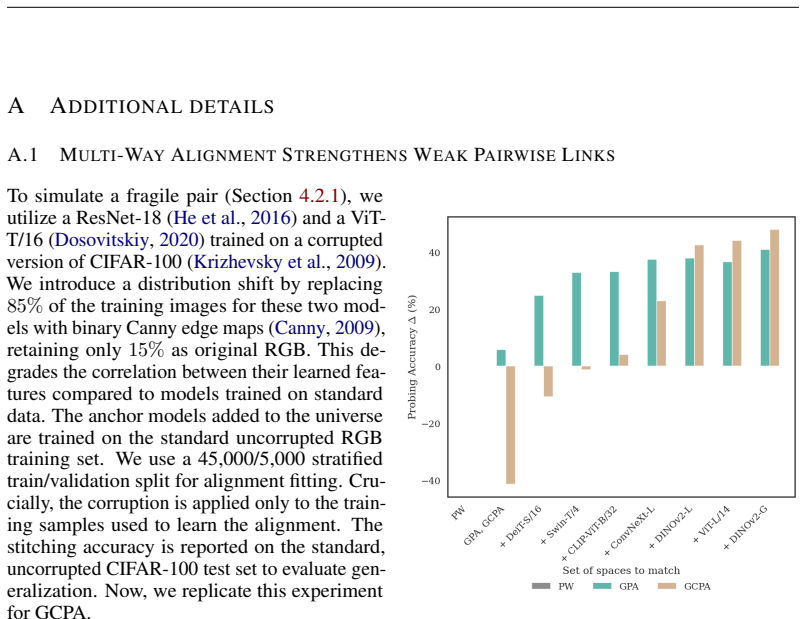
The load-bearing premise is that the per-sample consensus direction — the normalized average of all models' directions in the universe — points at the semantically correct alignment target; the paper's own Figure 8 shows that when few or corrupted models support that consensus, GCPA's correction can reinforce the mismatch and fall behind plain GPA.
Editorial extensions
If this is right
- Translating between any two models via the universe is path-independent: composing through the shared reference always gives the same map as a direct one, which pairwise pipelines cannot guarantee.
- Adding a new model costs one fitted map into the fixed universe rather than M−1 new pairwise maps, with little loss in cross-model accuracy versus full refitting.
- Retrieval in the corrected universe beats both strict isometries and agreement-maximizing GCCA across multilingual, cross-camera, and cross-modal benchmarks.
- A shared universe also stabilizes weak pairwise links: a poorly-corresponding pair becomes stitched more accurately when routed through a universe of healthy anchor models.
- The trust-region correction creates a tunable geometry/agreement trade-off for practitioners.
Reading between the lines
- The consensus-correction module is a plug-in: the same T_theta could be applied on top of any base alignment, not just GPA, so the idea likely transfers to non-orthogonal or functional universe constructions.
- The identity behind GCPA suggests a broader principle: for unit vectors, maximizing average agreement with the mean direction is equivalent to maximizing pairwise sum-of-cosines, so any method that targets consensus implicitly optimizes pairwise agreement — a testable design rule for future multi-view objectives.
- The failure mode shown in Figure 8 — GCPA underperforming when correspondences are weak — implies the method's benefit is conditional on consensus quality; a practical recipe would be to gate the correction by an estimate of consensus confidence per sample.
- One extension worth testing: applying the correction per-sample with different trust thresholds based on agreement level could improve robustness to noisy correspondences beyond the fixed (τ, λ) used here.
Editorial analysis
A structured set of objections, weighed in public.
Referee Report
Summary. The paper addresses the alignment of M≥3 neural representation spaces by constructing a shared universe. It adapts Generalized Procrustes Analysis (GPA) to produce an orthogonal universe, argues that strict isometry is suboptimal for retrieval relative to agreement-maximizing methods such as GCCA, and proposes Geometry-Corrected Procrustes Alignment (GCPA), which starts from a GPA scaffold and applies a shared nonlinear correction toward per-sample consensus directions. Experiments cover multilingual retrieval, cross-camera person re-identification, multimodal retrieval, clustering, and probing/stitching, reporting that GCPA improves retrieval over pairwise alignment, GPA, and GCCA while retaining a reusable reference space.
Significance. If the reported results hold, GCPA is a practically useful multi-way alignment method: it reduces the number of learned maps from O(M^2) to O(M), supports incremental model addition, and improves retrieval in several benchmarks. The paper ships a public implementation, and its formal statements (Proposition 3.2, Theorem B.1) are concrete and checkable. However, the central empirical claim is weakened by the fact that the GCPA objective directly optimizes the cosine-agreement metric used for evaluation, by the absence of error bars/significance tests on the headline retrieval tables, and by the paper's own Figure 8 showing that GCPA can underperform GPA under weak correspondences. These issues make the 'consistently improves' claim currently conditional rather than established.
major comments (4)
- [§4.4, Table 2 and Figure 4] Retrieval results are reported as point estimates without error bars, confidence intervals, or significance tests. Several gains are small (e.g., Table 2: GCPA vs GCCA at M=3 is 0.637 vs 0.628; at M=10 it is 0.503 vs 0.487). Without multiple seeds or paired statistical tests, 'consistently improves' is not supported. Please add variability estimates and, where possible, paired tests across language subsets or cross-validation folds.
- [§3.4, Eq. (5), Eq. (8), Proposition 3.2] The GCPA objective maximizes cosine similarity to the consensus direction c_i, and Proposition 3.2 proves this monotonically increases pairwise cosine similarity, which is exactly the retrieval evaluation metric. Moreover, c_i in Eq. (5) averages over all M models including the model being corrected, so the objective contains a self-contribution: each model is pulled toward a target that partly consists of its own vector. This self-referential bias should be quantified or removed by, e.g., computing a leave-one-out consensus c_i^{(m)} excluding model m during training, and reporting whether retrieval gains persist. As stated, the improvement of GCPA over GPA on cosine-based retrieval is close to a consequence of the training objective rather than an independent validation of the method.
- [Appendix A.1, Figure 8; Abstract and §5] The abstract and conclusions claim GCPA 'consistently improves any-to-any retrieval,' but Figure 8 shows that on edge-heavy CIFAR-100, GCPA can underperform GPA when the universe is small or the anchor models are weak. The paper frames this as expected behavior, but it directly contradicts the unqualified 'consistent' claim. Please revise the claim to state the conditions under which GCPA helps, and ideally add a retrieval experiment with corrupted or biased anchors to show how retrieval performance degrades in the regime identified by Figure 8.
- [Appendix E, Eq. (14)] GCPA applies a shared nonlinear corrector Tθ before mapping back to a target space, and the paper acknowledges that 'strict orthogonal cycle consistency need not hold after correction.' This undermines the 'shared universe' framing: the corrected coordinates are no longer a common coordinate system in the usual sense, because the composition of maps through the universe is path-dependent. The contribution claims a 'practical shared reference space'; please clarify what invariant property is retained after the nonlinear correction, and report whether any-to-any translation consistency is measurably affected.
minor comments (5)
- [Notation throughout] The use of 'Ω' and 'U' is sometimes inconsistent (e.g., Eq. (1) uses X n Ω_{m←n} while the text refers to maps in different orders). Please standardize notation for maps and spaces.
- [§3.3, Proposition 3.1] Proposition 3.1 is stated without a complete, self-contained formulation; it refers to Theorem B.1 and the 'retrieval gap' is described only informally. Consider stating the precise optimization and what 'suboptimal' means formally.
- [§4.5, Figure 5] The bar chart reports mean changes but no variance or number of trials per condition. Adding per-triad values or error bars would help judge robustness.
- [Appendix A.3] For Market-1501, there are no cross-camera image-level correspondences, yet the alignment uses identity-level correspondences. Please explain how the matched rows for GPA/GCPA are constructed from different images of the same identity, since this is nonstandard.
- [References] The reference to 'Cannistraci et al.' is incomplete (no year, title, or venue). Please complete it or remove.
Circularity Check
No significant circularity: GCPA's gains are empirical and held-out; the consensus identity is a true algebraic lemma, not a self-smuggled prediction.
full rationale
The claimed derivation chain is not circular. GPA (Eq. 3) and GCPA (Eq. 8) are constructive algorithms; the consensus direction (Eq. 5) is defined from the aligned unit vectors, and Proposition 3.2 is a correct algebraic identity (proved in Appendix B) showing that maximizing agreement to the consensus increases pairwise cosine agreement. This identity is tautological in the sense that the consensus is the normalized sum of the vectors, but it is used only to motivate the objective, not as evidence for the empirical retrieval results. The retrieval improvements are measured on held-out test splits after fitting alignment parameters on the training split (Section 4.1), and GCPA is compared against GCCA, a strong independent baseline that also optimizes agreement; outperforming GCCA is therefore not forced by the GCPA training objective. The paper's own Fig. 8 and Appendix A.1 disclose a genuine limitation — under weak/corrupted correspondences the consensus correction can reinforce mismatch — which qualifies the 'consistently improves' claim but is a correctness/robustness caveat, not circularity. Self-citations to earlier representation-alignment work are background references and are not used as load-bearing uniqueness theorems or as substitutes for the experiments. Hence no circular step; score 0.
Assumptions & free parameters
free parameters (4)
- trust tolerance τ =
not specified; described as a fixed conservative value, swept in Appendix C
- trust penalty weight λ =
not specified; fixed across benchmarks, swept in Appendix C
- shared MLP Tθ parameters =
trained on the training split with the GCPA objective (Eq. 13)
- PCA common dimension d =
not specified
assumptions (6)
- domain assumption Matched sample correspondence is available across all M spaces during alignment fitting.
- domain assumption All representations are standardized within each space before alignment.
- domain assumption Cosine similarity in the aligned space is the appropriate retrieval metric.
- ad hoc to paper The per-sample average of unit-normalized matched directions is a semantically meaningful consensus target.
- domain assumption Orthogonal maps preserve internal geometry and this is desirable for stitching/probing.
- standard math Rayleigh–Ritz/Ky Fan variational characterization of extremal eigenvalues.
Cite this review
Pith. "Pith review of Multi-Way Representation Alignment." pith.science (2026). https://pith.science/paper/DIJ4S5Q7
@misc{pith2026260206205,
  author       = {Pith},
  title        = {Pith review of: Multi-Way Representation Alignment},
  year         = {2026},
  howpublished = {\url{https://pith.science/paper/DIJ4S5Q7}},
  note         = {Machine review of arXiv:2602.06205}
}
abstract
The Platonic Representation Hypothesis suggests that independently trained neural networks converge to increasingly similar latent spaces. However, current strategies for mapping these representations are inherently pairwise, scaling quadratically with the number of models and failing to yield a consistent global reference. In this paper, we study the alignment of $M \ge 3$ models. We first adapt Generalized Procrustes Analysis (GPA) to construct a shared orthogonal universe that preserves the internal geometry essential for tasks like model stitching. We then show that strict isometric alignment is suboptimal for retrieval, where agreement-maximizing methods like Canonical Correlation Analysis (CCA) typically prevail. To bridge this gap, we finally propose Geometry-Corrected Procrustes Alignment (GCPA), which establishes a robust GPA-based universe followed by a post-hoc correction for directional mismatch. Extensive experiments demonstrate that GCPA consistently improves any-to-any retrieval while retaining a practical shared reference space.
Figures


Figures from the paper (8 more)




Forward citations
Cited by 2 Pith papers
-
One Adapter Pair per Model: A Universal Activation Interface for Language Models
A frozen shared activation bus with one encoder-decoder adapter per model lets probes, a single SAE, and a carrier NLA be reused across compatible language models.
-
CertBind from Multimodal Connectivity to Certifiable Retrieval Decisions
CertBind provides four interlocking certificates that let deployed multimodal connector routes preserve native retrieval, recover flagged routes through failure-diverse paths, and abstain when a top-k answer cannot be...
Reference graph
Works this paper leans on
-
[2]
3 Jacob Devlin, Ming-Wei Chang, Kenton Lee, and Kristina Toutanova
URL http://arxiv.org/abs/ 2509.24734. 3 Jacob Devlin, Ming-Wei Chang, Kenton Lee, and Kristina Toutanova. Bert: Pre-training of deep bidirectional transformers for language understanding. InProceedings of the 2019 conference of the North American chapter of the association for computational linguistics: human language technologies, volume 1 (long and shor...
arXiv 2019
-
[5]
3 Fabian Gröger, Shuo Wen, Huyen Le, and Maria Brbi´c
URL https://proceedings.mlr.press/v89/grave19a.html. 3 Fabian Gröger, Shuo Wen, Huyen Le, and Maria Brbi´c. With limited data for multimodal alignment, let the structure guide you.arXiv preprint arXiv:2506.16895,
-
[6]
Deep multimodal semantic embeddings for speech and images
3 David Harwath and James Glass. Deep multimodal semantic embeddings for speech and images. In 2015 IEEE workshop on automatic speech recognition and understanding (ASRU), pp. 237–244. IEEE,
2015
-
[7]
URLhttps://arxiv.org/abs/2505.12540. 3 Jon R Kettenring. Canonical analysis of several sets of variables.Biometrika, 58(3):433–451,
-
[9]
Towards universal backward-compatible representation learning.arXiv preprint arXiv:2203.01583,
3 Binjie Zhang, Yixiao Ge, Yantao Shen, Shupeng Su, Fanzi Wu, Chun Yuan, Xuyuan Xu, Yexin Wang, and Ying Shan. Towards universal backward-compatible representation learning.arXiv preprint arXiv:2203.01583,
-
[2019]
An image is worth 16x16 words: Transformers for image recognition at scale
9 Alexey Dosovitskiy. An image is worth 16x16 words: Transformers for image recognition at scale. arXiv preprint arXiv:2010.11929,
arXiv 2010
-
[2020]
We introduce a distribution shift by replacing 85% of the training images for these two mod- els with binary Canny edge maps (Canny, 2009), retaining only 15% as original RGB
trained on a corrupted version of CIFAR-100 (Krizhevsky et al., 2009). We introduce a distribution shift by replacing 85% of the training images for these two mod- els with binary Canny edge maps (Canny, 2009), retaining only 15% as original RGB. This de- grades the correlation between their learned fea- tures compared to models trained on standard data. ...
2009
-
[2021]
3 Yisong Yue, Been Kim, et al. Escaping platos cave: Jam for aligning independently trained vision and language models.arXiv preprint arXiv:2507.01201,
Show all 10 references
-
[2025]
2 Irene Cannistraci, Luca Moschella, Marco Fumero, Valentino Maiorca, and Emanuele Rodolà
URLhttps://arxiv.org/abs/2505.17101. 2 Irene Cannistraci, Luca Moschella, Marco Fumero, Valentino Maiorca, and Emanuele Rodolà. From bricks to bridges: Product of invariances to enhance latent space communication. InThe Twelfth International Conference on Learning Representati...
-
[6542]
URL https://doi.org/10.1093/pnasnexus/ pgac039
doi: 10.1093/pnasnexus/pgac039. URL https://doi.org/10.1093/pnasnexus/ pgac039. 2 John C Gower. Generalized procrustes analysis.Psychometrika, 40(1):33–51,
Reviewed August 3, 2026 · model on record in the stance chip above.
Discussion (0). Continue with ORCID to comment.