REVIEW 2 major objections 5 minor 3 cited by
Deformable Beta Splatting
T0 review · 2 major / 5 minor · reviewed 2026-08-10 · deepseek-v4-flash
Pith's one-line read Deformable Beta Splatting claims that swapping Gaussian kernels and spherical-harmonic colors for deformable Beta kernels and Spherical Beta colors yields state-of-the-art radiance-field quality with 45% of the parameters and 1.5x faster…
desk verdict Solid, reproducible splatting improvement with Beta kernels and Spherical Beta color; the theoretical claims about 3D consistency and exact MCMC are overreaching and need revision. read the letter →
The pith
A machine-rendered reading of the paper's core claim, the machinery that carries it, and where it could break.
The reading
What carries the argument
The load-bearing object is the deformable Beta kernel $B(x;b)=(1-x)^{4e^b}$, evaluated at $r^2$ where $r$ is the Mahalanobis distance from a pixel to a projected ellipsoidal primitive's center. Bounded support and the learnable exponent $b$ give each primitive a choice between Gaussian-like smoothness, flat-top solid shapes, and sharp peaks; the paper justifies the kernel's multi-view consistency through an inverse Abel transform, which turns any well-behaved radial 2D kernel into a radial 3D kernel with the same projection. The second mechanism is the Spherical Beta color model, which replaces spherical-harmonic coefficients with a small set of Beta lobes $B(1-\hat{R}_m\cdot\hat{V}; b_m)$, each with a reflection direction and color, so diffuse and specular terms are separate parameters. The third is the kernel-agnostic MCMC densification proof, which uses a Taylor and binomial approximation to show that dividing a small opacity $o$ among $N$ clones preserves the original rendered contribution up to $O(o^2)$, independent of the kernel shape.
What would settle it
Render one large, strongly anisotropic Beta ellipsoid with a high $b$ value from several camera angles, and compare its projected alpha footprint with the numerically integrated 3D opacity that the inverse Abel transform would prescribe; if the footprints disagree for non-radial shapes, the kernel-consistency claim fails. A second check: train with the opacity regularizer turned off and verify whether clone-based densification still preserves the rendered distribution, as the small-opacity assumption requires.
Extended reading notes
Core claim
The paper's central claim is that both expressive bottlenecks of 3D Gaussian Splatting—the fixed smooth Gaussian kernel and low-order spherical-harmonic color—can be replaced by deformable Beta variants without sacrificing real-time rendering. The Beta kernel $B(x;b)=(1-x)^{4e^b}$ is bounded on $[0,1]$, starts Gaussian-like at $b=0$, and its single shape parameter adapts to flat surfaces, sharp edges, and high-frequency texture. Spherical Beta encodes view-dependent color by summing bounded Beta lobes over reflection directions, separating a diffuse base color from specular highlights with parameters that grow linearly rather than quadratically. On the optimization side, the paper proves that opacity regularization alone makes MCMC densification distribution-preserving for any splatting kernel, since cloning $N$ copies of a primitive with small opacity $o$ and opacity $o/N$ leaves the composited distribution unchanged to $O(o^2)$. The reported consequence is better PSNR, SSIM, and LPIPS than implicit and explicit baselines on four standard benchmarks, with roughly 45% of the parameter count of vanilla 3DGS and 1.5x the frame rate of the MCMC-based Gaussian baseline.
Load-bearing premise
The weakest load-bearing premise is that the inverse Abel transform justifies the Beta kernel as a multi-view-consistent 3D splat for the anisotropic ellipsoidal primitives actually rendered, even though the proof in the appendix covers only radially symmetric kernels.
Editorial extensions
If this is right
- If DBS is right, radiance-field rendering can exceed the quality of Gaussian-based baselines while using about 45% of the parameters and rendering at 1.5x the frame rate of the MCMC-based Gaussian approach.
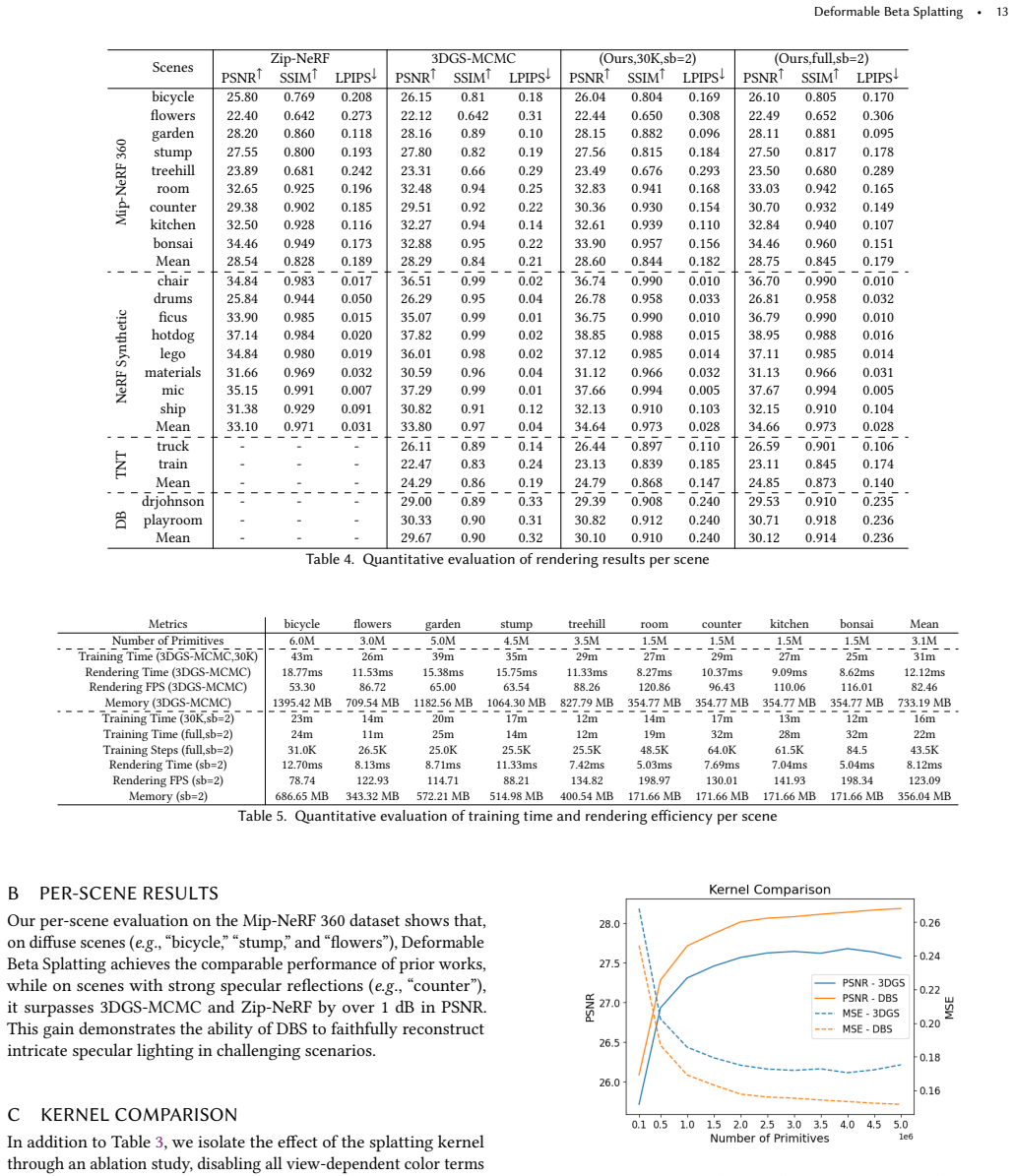
- The kernel ablation shows the Beta kernel alone, with all view-dependent color disabled, beats the Gaussian kernel at every primitive budget from 0.1M to 5M, so the geometry representation itself carries part of the gain.
- Spherical Beta with two lobes beats degree-3 spherical harmonics for view-dependent color while using roughly 31% of the color parameters, and it stores diffuse and specular components separately.
- The densification proof implies that any splatting kernel, not just Beta, can use opacity-only MCMC densification as long as the opacity regularizer keeps per-primitive opacity small.
- After training, primitives can be split into geometry and texture layers by their $b$ values and into diffuse and specular maps by their color terms, giving decomposition without retraining.
Reading between the lines
- Beyond the paper, the kernel-agnostic MCMC result suggests that other splatting kernels, such as linear, half-Gaussian, or convex primitives, could adopt the same opacity-only densification without re-deriving scale adjustments.
- The Beta kernel's bounded support points toward a principled replacement for the hard cut-off artifacts of unbounded Gaussian splats; a testable extension is beta-shaped falloff in level-of-detail and anti-aliasing filters.
- Because Spherical Beta separates diffuse base color from specular lobes, it may enable relighting and material editing directly on a trained radiance field, an application the paper does not develop.
- If the anisotropic inverse-Abel gap is closed, the same construction would license any bounded radial 2D kernel as a multi-view-consistent 3D splat, making the kernel design space much larger than the Beta family.
Editorial analysis
A structured set of objections, weighed in public.
Referee Report
Summary. The paper introduces Deformable Beta Splatting (DBS), a 3D Gaussian Splatting variant that replaces Gaussian kernels with bounded, deformable Beta kernels, replaces low-order Spherical Harmonics with a Spherical Beta color model, and adapts MCMC-based densification to be kernel-agnostic via opacity regularization. The authors claim improved visual quality on standard radiance-field benchmarks with roughly half the storage and about 1.5x faster rendering than 3DGS-MCMC. The manuscript includes a derivation of the Beta kernel, an inverse Abel argument for multi-view consistency, a first-order proof of kernel-agnostic densification, extensive experiments, ablations, compression studies, and per-scene efficiency tables.
Significance. If the claims hold, DBS is a practically valuable contribution: it attacks two known limitations of 3DGS at once (fixed smooth kernels and expensive view-dependent color), and it replaces Gaussian-specific densification heuristics with a simpler opacity-regularized rule. The paper is unusually complete on the systems side: CUDA implementation details, per-scene tables, hyperparameters, compression experiments, and a public project page are provided. The empirical results are internally consistent and the reported gains over 3DGS-MCMC are substantial and plausible. The main weakness is theoretical: the multi-view-consistency proof in Appendix A is derived for radial kernels, while the implemented primitive is an anisotropic ellipsoid, and the extension is assumed rather than shown. This gap is fixable but currently leaves the paper's central geometric justification incomplete.
major comments (2)
- [Appendix A and Section 3.2 (Eqs. 5-6)] The inverse Abel construction in Appendix A, Eqs. (A.20)-(A.24), establishes a multi-view-consistent 3D counterpart only for a radial 2D kernel K(r) projected along the z-axis. The actual rendering equations, Eqs. (5)-(6), evaluate B(r_i^2; b_i) with r_i^2 = (x - mu_i')^T Sigma_i'^{-1} (x - mu_i'), where Sigma_i' is the projected covariance of an oriented, scaled 3D ellipsoid. The manuscript does not show that the line integral of the affinely transformed 3D kernel equals B(r_i^2) with the projected covariance; for a general anisotropic ellipsoid this is not implied by the radial Abel computation. An affine change of variables would likely produce such a profile up to an x-independent scale that can be absorbed into the unnormalized opacity in Eq. (6), so the gap appears fixable, but as written the claim in Section 3.1 that the Beta Kernel is a valid multi-view-consistent 3D splat is not established for the implemented primitive.
- [Section 3.4 and Appendix D (Eqs. 11-15)] The proof in Appendix D shows that a single densification event with N copies is distribution-preserving only to first order in opacity, with an O(o^2) error term. The introduction and Section 3.4 state that the result holds 'regardless of the number of densifications.' Because each densification event introduces an O(o^2) error and subsequent optimization changes the distribution, the multi-event statement requires either a telescoping error argument or a qualification. This does not invalidate the empirical protocol, but it makes the theoretical claim stronger than the provided proof.
minor comments (5)
- [Section 3.1, Eq. (3) and surrounding text] The stated integral equality that motivates c=4 is numerically false: for b=0 the left-hand side is ∫_0^1 (1-x)^4 dx = 0.2, while the right-hand side ∫_0^1 e^{-9x^2} dx is approximately 0.295. The value c=4 should be rederived, or the claim rephrased; with c=4, (1-x)^4 is not a close approximation of e^{-9x^2} over [0,1].
- [Section 3.3 and Introduction] The parameter-count comparison to SH degree 3 should be stated precisely. With M=2 Spherical Beta lobes, the per-primitive count is 3 + 2*(3+3+1) = 17, versus 3*(3+1)^2 = 48 for SH degree 3, a ratio of about 35%, not the stated 31%; with M=1 the ratio is about 21%. Please specify the configuration used for the '31%' claim.
- [Abstract and Table 2] The abstract's '45% of the parameters' does not align with Table 2's storage ratio (356.04 MB vs 733.19 MB, about 49%) or with the per-primitive parameter ratio for sb=2 (about 49%). The 45% figure appears to match Table 3's memory comparison on Tanks&Temples and Deep Blending; please clarify whether the claim refers to parameter count or storage and to which configuration.
- [Figure 2 caption] The caption states that b=0 is 'almost identical to Gaussian (domain scaled by 3 sigma)', but the comparison is not quantified. Given the integral mismatch in Section 3.1, please specify the exact Gaussian (variance and support scaling) used for the comparison.
- [Appendix D and Introduction] The proof of kernel-agnostic densification considers one clone event with N copies; the phrase 'regardless of the number of densifications' in the introduction should be qualified as noted in Major Comment 2, or a multi-event error analysis should be supplied.
Circularity Check
No significant circularity: benchmark claims are measured, the MCMC proof is conditional and self-contained, and the only self-citation (AtomGS) is not load-bearing; the Abel-to-anisotropic-ellipsoid gap is a rigor concern, not a circular reduction.
full rationale
The paper's central claims are not circular. The SOTA quality, 45% parameter, and 1.5x speedup statements are measurements against external baselines (Tables 1-2, 4-5); no fitted parameter is relabeled as a prediction. The Beta kernel is constructed analytically from the Beta density (Eqs. 1-3), with c=4 chosen to approximate a Gaussian at b=0, and all kernel/color/opacity parameters are optimized against the photometric loss (Eq. 10), so no quantity is defined in terms of the benchmark it is claimed to predict. The kernel-agnostic MCMC argument is a conditional theorem: it imports the opacity-transfer relation from external prior work (Eq. 11) and proves distribution preservation to first order via Taylor and binomial expansions (Eqs. 12-15 and D.35-D.39) under the small-opacity regime, which is enforced by the opacity regularizer and whose weight is selected by ablation (Table 6), not by assuming the conclusion. There is one non-load-bearing self-citation (AtomGS in the related-work survey), which does not support any core derivation. A real rigor gap exists but is not circularity: Appendix A constructs a multi-view-consistent 3D counterpart only for radially symmetric 2D kernels, whereas rendering (Eqs. 5-6) evaluates the kernel on the anisotropic projected covariance of an oriented ellipsoid, so the anisotropic extension is an unproven assumption rather than a derived consequence. Spherical Beta (Eq. 8) is algebraically Phong's specular term because B(1-R·V;b)=(R·V)^b, but Phong is explicitly credited, making this a novelty-attribution concern rather than a circular reduction.
Assumptions & free parameters
free parameters (6)
- Kernel initialization constant c =
4
- Opacity regularization weight lambda_o =
0.01
- Scale regularization weight lambda_Sigma =
0.01
- SSIM loss weight lambda_SSIM =
0.2
- Number of Spherical Beta lobes sb =
2
- Noise beta parameter b' =
ln(25) ≈ 3.219
assumptions (4)
- standard math Inverse Abel transform gives a valid 3D kernel for a prescribed 2D radial kernel
- ad hoc to paper Anisotropic multi-view consistency of the Beta ellipsoid
- domain assumption Small-opacity regime (o around 0.1)
- domain assumption Alpha-compositing model over sorted primitives
invented entities (2)
-
Deformable Beta Kernel B(r^2;b)=(1-r^2)^{4e^b}
-
Spherical Beta color model
Cite this review
Pith. "Pith review of Deformable Beta Splatting." pith.science (2026). https://pith.science/paper/DLILJKP7
@misc{pith2026250118630,
  author       = {Pith},
  title        = {Pith review of: Deformable Beta Splatting},
  year         = {2026},
  howpublished = {\url{https://pith.science/paper/DLILJKP7}},
  note         = {Machine review of arXiv:2501.18630}
}
read the original abstract
3D Gaussian Splatting (3DGS) has advanced radiance field reconstruction by enabling real-time rendering. However, its reliance on Gaussian kernels for geometry and low-order Spherical Harmonics (SH) for color encoding limits its ability to capture complex geometries and diverse colors. We introduce Deformable Beta Splatting (DBS), a deformable and compact approach that enhances both geometry and color representation. DBS replaces Gaussian kernels with deformable Beta Kernels, which offer bounded support and adaptive frequency control to capture fine geometric details with higher fidelity while achieving better memory efficiency. In addition, we extended the Beta Kernel to color encoding, which facilitates improved representation of diffuse and specular components, yielding superior results compared to SH-based methods. Furthermore, Unlike prior densification techniques that depend on Gaussian properties, we mathematically prove that adjusting regularized opacity alone ensures distribution-preserved Markov chain Monte Carlo (MCMC), independent of the splatting kernel type. Experimental results demonstrate that DBS achieves state-of-the-art visual quality while utilizing only 45% of the parameters and rendering 1.5x faster than 3DGS-MCMC, highlighting the superior performance of DBS for real-time radiance field rendering. Interactive demonstrations and source code are available on our project website: https://rongliu-leo.github.io/beta-splatting/.
Figures


Figures from the paper (5 more)



Forward citations
Cited by 3 Pith papers
-
ContraGS: Codebook-Condensed and Trainable Gaussian Splatting for Fast, Memory-Efficient Reconstruction
ContraGS trains 3D Gaussian Splatting directly on codebook-compressed representations, cutting peak model memory ~3.5x with small quality loss.
-
Triangle Splatting for Real-Time Radiance Field Rendering
A triangle-soup representation with a compact normalized window function is optimized end-to-end and beats Gaussian and convex splatting baselines on LPIPS while rendering at real-time rates.
-
Surf-NeRF: Surface Regularised Neural Radiance Fields
Surf-NeRF shows that surface-light-field regularisation plus a permutohedral lattice encoding makes NeRF geometry more accurate and separates diffuse from specular appearance.
Reference graph
Works this paper leans on
-
[4]
3D Gaussian Splatting for Real-Time Radiance Field Rendering. arXiv:2308.04079 [cs.GR] https://arxiv.org/abs/2308.04079 Shakiba Kheradmand, Daniel Rebain, Gopal Sharma, Weiwei Sun, Jeff Tseng, Hossam Isack, Abhishek Kar, Andrea Tagliasacchi, and Kwang Moo Yi. 2024. 3D Gaussian Splatting as Markov Chain Monte Carlo. arXiv:2404.09591 [cs.CV] https://arxiv. ...
arXiv 2017
-
[2021]
In Proceedings of the IEEE/CVF international conference on computer vision
Fastnerf: High-fidelity neural rendering at 200fps. In Proceedings of the IEEE/CVF international conference on computer vision . 14346–14355. Zhiyang Guo, Wengang Zhou, Li Li, Min Wang, and Houqiang Li. 2024. Motion- aware 3D Gaussian Splatting for Efficient Dynamic Scene Reconstruction. arXiv:2403.11447 [cs.CV] https://arxiv.org/abs/2403.11447 Antoine Gu...
arXiv 2024
-
[2023]
LucidDreamer: Domain-free Generation of 3D Gaussian Splatting Scenes. arXiv:2311.13384 [cs.CV] https://arxiv.org/abs/2311.13384 Pinxuan Dai, Jiamin Xu, Wenxiang Xie, Xinguo Liu, Huamin Wang, and Wei- wei Xu. 2024. High-quality Surface Reconstruction using Gaussian Surfels. arXiv:2404.17774 [cs.CV] https://arxiv.org/abs/2404.17774 Linus Franke, Laura Fink,...
arXiv 2024
-
[2024]
3D Convex Splatting: Radiance Field Rendering with 3D Smooth Convexes. arXiv:2411.14974 [cs.CV] https://arxiv.org/abs/2411.14974 Binbin Huang, Zehao Yu, Anpei Chen, Andreas Geiger, and Shenghua Gao. 2024. 2D Gaussian Splatting for Geometrically Accurate Radiance Fields. In Special Interest Group on Computer Graphics and Interactive Techniques Conference C...
arXiv 2024
Reviewed August 10, 2026 · model on record in the stance chip above.
Discussion (0). Continue with ORCID to comment.