REVIEW 3 major objections 4 minor
Gravitational Enstrophy: Local Geometric Origin and Inverse-Cascade Constraints
T0 review · 3 major / 4 minor · reviewed 2026-08-05 · deepseek-v4-flash
Pith's one-line read General relativity has a conserved curvature measure—magnetic Weyl enstrophy—that forces nonlinear wave energy toward lower frequencies.
desk verdict Candid, clean derivation of a magnetic Weyl balance law, but the advertised near-extremal inverse cascade is not established: Eq. (27) admits that the fastest channel breaks the conserved quantity, leaving only a one-sided constraint that does not force lower-frequency transfer. read the letter →
The pith
A machine-rendered reading of the paper's core claim, the machinery that carries it, and where it could break.
The reading
What carries the argument
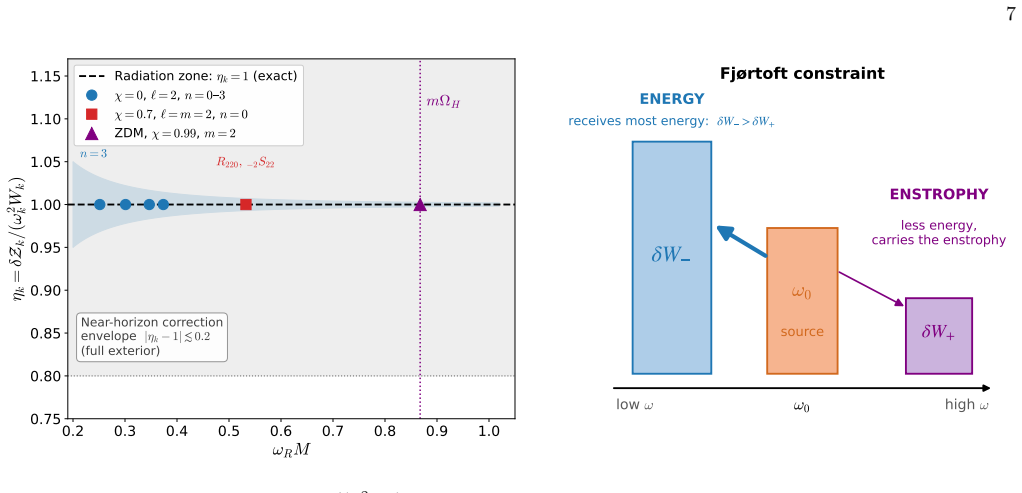
The supporting object is B_ab = ⋆C_acbd u^c u^d, the magnetic (frame-dragging) part of the Weyl tensor as seen by an observer u^a; its integrated square Z is the enstrophy. Three mechanisms carry the argument: the two-derivative relation between metric amplitude and radiative curvature, which fixes η_k = δZ_k/(ω_k²W_k) = 1; the ZAMO-frame cancellations—symmetric-times-antisymmetric vorticity contraction vanishes pointwise, and δE²=δB² makes curl exchange a harmless transfer between sectors; and the Fjørtoft algebra of two conserved positive moments with weights 1 and ω², which in Theorem 1 forces lower-frequency-dominant redistribution. Conditions (C1)–(C4) delimit when the balance law is co
What would settle it
Measure p from a second-order Teukolsky or fully nonlinear evolution at χ ≈ 0.99: if p ≤ 0, the integrated acceleration source diverges and Z is not conserved. Independently, in a global AdS pure-gravity run with multi-mode data, track ⟨ω²⟩ = Z/W: a drift on the nonlinear timescale shows the resonant interactions do not conserve Z, so the constraint does not bind there.
Extended reading notes
Core claim
Central claim: the magnetic part of the Weyl tensor—the frame-dragging sector of spacetime curvature—is the gravitational analogue of fluid vorticity, and its integrated square is an approximately conserved second moment for radiative perturbations. In the radiation zone of type D vacuums, δZ_k/W_k = ω_k² mode by mode, with near-horizon corrections O(√(1−χ)) for zero-damping modes. In the ZAMO frame the Bianchi evolution has vanishing vorticity coupling and cancelling curl exchange; remaining terms are controlled, so dδZ/dt = O(ε³). With energy conservation this yields a gravitational Fjørtoft theorem: more energy flows to lower frequencies than to higher. Active regimes are near-extremal Ke
Load-bearing premise
The load-bearing premise is that near the horizon, in the zero-angular-momentum frame, the radiative curvature falls off faster than the redshift factor (|δB|² ∼ α^(2p) with p > 0); the paper states this exponent is not fixed by background geometry and must be verified numerically.
Editorial extensions
If this is right
- In near-extremal Kerr, the constraint predicts nonlinear transfer piles energy near ω ≈ mΩ_H, an observable spectral excess over linear quasinormal-mode predictions.
- In reflecting AdS, energy and enstrophy are both conserved to O(ε³) for transverse radiative modes, giving a closed vacuum laboratory for the inverse cascade.
- Generic Kerr ringdown remains cascade-suppressed because τ_damp ≲ τ_nl; there, Z is a diagnostic of the spectral direction, not a dynamical driver.
- In the fluid/gravity correspondence, the bulk magnetic Weyl enstrophy maps to boundary fluid enstrophy with coefficient (2624π⁵/189)T⁵, so the ratio R_holo = 1 diagnoses the hydrodynamic regime in holographic turbulence.
- The (W, Z) pair is one of several conserved two-moment pairs; the scalar AdS instability conserves (E, N) instead, so its direct cascade does not contradict the Fjørtoft logic.
Reading between the lines
- Inference: if the near-horizon fall-off exponent is confirmed positive, the enstrophy balance becomes a hard conservation law on the cascade timescale, and high-signal near-extremal ringdowns should show excess power near ω ≈ mΩ_H—a clean separation from linear quasinormal-mode templates.
- Inference: the same two-moment algebra may work for other positive quadratic Weyl functionals, such as the electric enstrophy or the Bel–Robinson super-energy; the paper chooses B² as the cleanest representative, but the proof structure suggests a family of conserved moments.
- Inference: whether a third conserved quantity exists in the resonant mode-coupling of near-extremal Kerr would decide between recurrent cascades and monotone attraction to ω = mΩ_H; this can be settled by computing the sign and magnitude of the second-order Teukolsky coupling coefficients.
Editorial analysis
A structured set of objections, weighed in public.
Referee Report
Summary. The paper proposes the magnetic Weyl functional Z = ∫ B_ab B^ab √γ d^3x as a gravitational analogue of fluid enstrophy. For linear radiative perturbations of Petrov type D backgrounds (Kerr, Kerr–AdS), it argues that the modal spectral ratio δZ_k/W_k equals ω_k^2 (Proposition 1); that the local Bianchi balance law for δZ reduces, in the ZAMO frame, to an approximate conservation law dδZ/dt = O(ε^3) under conditions (C1)–(C4); and that the pair (W, Z) then yields a gravitational Fjørtoft theorem forcing preferential transfer toward lower frequencies. The paper applies this to near-extremal Kerr, Kerr–AdS and horizonless AdS, and gives a fluid/gravity map between the bulk magnetic Weyl norm and boundary fluid enstrophy.
Significance. If the approximate conservation law held as stated, this would be an important addition to gravitational perturbation theory: it identifies a curvature-level second moment that organizes spectral transfer in a way analogous to 2D turbulence, and it gives explicit falsifiable targets (spectral excess near ω = mΩ_H; R_holo = 1 in holographic turbulence). The paper's algebraic machinery is largely transparent and is a genuine strength: the pointwise cancellation of the ZAMO vorticity coupling (Sec. IV A), the self-adjoint curl integration by parts (Appendix A 3), the shear decoupling statement (Prop. 2), the explicit numerical checks (Tables III and V), and the closed-form fluid/gravity coefficient Eq. (52) are useful concrete results. The kinematic Fjørtoft theorem itself (Theorem 1) is standard and clean. However, the dynamical premise needed to apply it in the advertised regimes is not established: the fastest near-extremal nonlinearity violates Z conservation, and the near-horizon acceleration convergence rests on an unverified falloff exponent. The headline physical claim is therefore stronger than the paper's own equations support.
major comments (3)
- [Sec. V C and Sec. VI C] The equality-form Fjørtoft constraint is not available in the advertised near-extremal regime. Eq. (27) shows that each resonant three-wave interaction changes Z by 3ω1ω2ω3 δn3, i.e. an O(1) change relative to the modal enstrophy, while the paper's own nonlinearity analysis (Eq. (28), Sec. VI C, Fig. 2) identifies the three-wave channel as the fastest near-extremal transfer, τ_nl^{-1} ∼ v ε ω_R, and Table V confirms the triads are kinematically open. Thus ΔZ/Z ∼ O(1) over one nonlinear time, not the O(ε^3) remainder asserted in Eq. (14); premise (20) fails precisely where the cascade is claimed active. What survives is the one-sided Corollary 2, which rules out a purely direct cascade but does not force preferential lower-frequency transfer; the direction is set by coupling coefficients that the paper defers. This limitation must be moved into the abstract and main theorem, or the three-
- [Appendix E 7] Condition (C3) depends on convergence of the ZAMO acceleration source. Equation (E38) gives a_hatr |δB|^2 sqrt(g_rr) ∼ α^{2p−2}, so the horizon integral converges only if p > 0, where p is the near-horizon falloff exponent |δB|^2 ∼ α^{2p}. The paper explicitly states that p is not fixed by the background geometry and defers its verification to future numerics (Sec. VIII B). Since the same appendix notes that a perturbation regular in a horizon-penetrating frame can have p ≤ 0 in the singular ZAMO frame, the conservation law is conditional on an unverified input. The abstract and Sec. VI C present the near-extremal constraint as operative; they should either carry the explicit p > 0 condition as a stated assumption or provide numerical evidence for physical ZDMs.
- [Sec. III, Prop. 1, Remark 3(i)] The central ratio η_k = 1 is definitional. With W_k defined in Eq. (6) as (1/(2ω_k^2)) ∫ |Ψ4|^2 and δZ_k defined as (1/2)∫ |Ψ4|^2, the cancellation δZ_k/(ω_k^2 W_k) = 1 is built into the definitions; no dynamics enters. Remark 3(i) concedes this, and the genuine content is the gauge/frame reduction δB^2 = 1/2 |Ψ4|^2 and the mode-independence of the ratio. The abstract and introduction, however, present η_k = 1 as a demonstrated physical result ('we show that η_k = 1'), which overstates the status. The paper should be rephrased so that the spectral weighting appears as a normalization/definitional identity plus a frame-reduction statement, not as an independent dynamical prediction.
minor comments (4)
- [Abstract] Typo: 'constraintt implyging' should read 'constraint implying'.
- [Fig. 1] The caption notation 'n = 3 R220, −2S22' is unexplained; please define the spheroidal harmonic and overtone labels.
- [Sec. VIII C] The observational signatures are speculative and depend on Conjecture 1, which the paper itself identifies as unproven. Consider labeling this subsection explicitly as conditional on the conjecture.
- [Sec. V C] The sentence 'This change is the secular content of the O(ε^3) remainder' is potentially confusing: Eq. (27) shows the change is not O(ε^3) relative to Z but O(1) per transfer event. Clarify the distinction between field-order counting and relative change of the conserved moment.
Circularity Check
The exact spectral ratio η_k = 1 is a normalization identity: Eq. (6) defines W_k and δZ_k from the same |Ψ_4|^2 integral, so the ω^2 weighting that drives the Fjørtoft theorem is put in by construction. The independent content is the approximate conservation of δZ, which is conditional and not circular.
-
self definitional
[Sec. III B, Eq. (6)–(7), Proposition 1; Remark 3(i)]
"W_k[D] = 1/(2ω_k^2) ∫_D |Ψ_4^(1)|^2 √γ d^3x, δZ_k[D] = ∫_D δB_ab^(k)δB^ab_(k) √γ d^3x ... η_k ≡ δZ_k[D]/(ω_k^2 W_k[D]) = 1. (Remark 3(i)): 'With the Isaacson normalization W_k ≡ ω_k^{-2} ∫ δB_ab δB^ab √γ d^3x, the radiation-zone equality η_k = 1 is an identity between two functionals built from the same curvature density.'"
Proposition 1's exact equality is not derived from independent definitions of energy and enstrophy: W_k and δZ_k are both defined from the same ∫|Ψ_4|^2 integral, with W_k carrying a 1/ω_k^2 factor chosen so that the ratio equals 1 identically. The paper's own Remark 3(i) concedes this. The subsequent spectral weighting Z ≈ Σ_k ω_k^2 W_k in Eq. (17), and hence the two-moment algebra of Theorem 1, inherits this constructed ratio. What is not circular is the separate dynamical claim that δZ is approximately conserved on τ_nl (Eq. (14) under C1–C4); that claim rests on the Bianchi-identity balance and on unverified conditions such as the near-horizon falloff exponent p>0, not on the normalization of W_k. So the circularity is partial: the 'prediction' of ω_k^2 spectral weighting is a normaliz
full rationale
The central circular step is confined to the spectral-weighting result. Proposition 1 defines the Isaacson energy in Eq. (6) as (1/2ω_k^2)∫|Ψ_4|^2√γ d^3x and the magnetic Weyl enstrophy as ∫δB^2√γ d^3x = (1/2)∫|Ψ_4|^2√γ d^3x in the transverse radiative sector; substituting these definitions makes η_k = δZ_k/(ω_k^2 W_k) = 1 an algebraic identity. The paper explicitly acknowledges this in Remark 3(i), calling the equality 'an identity between two functionals built from the same curvature density.' The gravitational Fjørtoft theorem then uses only this constructed ratio, together with approximate conservation of W and Z, so the advertised lower-frequency bias is, at the level of the weighting, a definitional input rather than a derived prediction. I do not score the approximate-conservation claim as circular: it is derived from the Bianchi identities, with vorticity cancellation, curl-exchange cancellation, and explicit smallness conditions (C1)–(C4), and it is openly conditional on the near-horizon falloff exponent p>0 (Appendix E7). That condition is unverified but not circular. Likewise, the self-citations to [3], [5], and [42] for ZDM lifetimes, nonlinear transfer rates, and numerical evidence are external, code-reproduced or independently checkable results, so they do not constitute load-bearing circular self-citation under the review rules. The skeptical objection that resonant three-wave interactions change Z at order unity (Eq. (27)) is a dynamical-failure argument against the equality-form constraint in near-extremal Kerr, not a circularity argument; the paper itself concedes that only the one-sided Corollary 2 survives in that regime. That reduces the scope of the claim but does not change the circularity score. Overall, because the paper's flagship spectral weighting and the consequent Fjørtoft biasing reduce to a normalization choice, while the genuinely independent conservation mechanism remains conditional and noncircular, the appropriate score is 6: partial circularity by construction.
Assumptions & free parameters
free parameters (2)
- Three-wave coupling coefficient v =
v ~ 1.5
- Near-horizon radiative curvature falloff exponent p =
unspecified (assumed > 0)
assumptions (5)
- standard math Goldberg-Sachs theorem: on Petrov type D vacuum backgrounds, the transverse radiative perturbation is carried by Psi_4 (and Psi_0) in Kinnersley gauge.
- domain assumption ZAMO congruence in stationary axisymmetric spacetimes is hypersurface-orthogonal, so vorticity and expansion vanish (Frobenius theorem).
- domain assumption Mode-by-mode equality delta E^2 = delta B^2 in the transverse radiative sector, with cross-mode terms vanishing by time averaging over beat times.
- domain assumption Nonlinear transfer time tau_nl ~ 1/(epsilon^2 omega_R) and coupling coefficients of order unity.
- ad hoc to paper Near-horizon ZAMO-frame radiative curvature falls as |delta B|^2 ~ alpha^{2p} with p > 0.
invented entities (1)
-
Gravitational enstrophy Z (magnetic Weyl functional)
independent evidence
Cite this review
Pith. "Pith review of Gravitational Enstrophy: Local Geometric Origin and Inverse-Cascade Constraints." pith.science (2026). https://pith.science/paper/DMQ6FUJ5
@misc{pith2026260803697,
  author       = {Pith},
  title        = {Pith review of: Gravitational Enstrophy: Local Geometric Origin and Inverse-Cascade Constraints},
  year         = {2026},
  howpublished = {\url{https://pith.science/paper/DMQ6FUJ5}},
  note         = {Machine review of arXiv:2608.03697}
}
abstract
Two-dimensional fluids conserve energy and enstrophy, driving inverse energy cascades via Fj\o rtoft's argument. We show General Relativity admits an analogous structure: for linear radiative perturbations of Petrov type D backgrounds (Kerr, Kerr--AdS), the gravitational-wave energy $W = \sum_k W_k$ and magnetic Weyl enstrophy $\mathcal{Z} = \int B_{ab} B^{ab} \sqrt{\gamma} \, d^3x \approx \sum_k \omega_k^2 W_k$ are approximately conserved in the zero-angular momentum frame, where vorticity coupling vanishes identically and curl exchange cancels mode-by-mode. This yields a gravitational Fj\o rtoft constraint implying nonlinear energy transfer proceeds preferentially toward lower frequencies. The constraint is dynamically active in near-extremal Kerr ($\tau_{\text{damp}} \gg \tau_{\text{nl}}$) and confined geometries (AdS), but suppressed in generic ringdown. In AdS, $\mathcal{Z}$ maps holographically to the boundary fluid enstrophy.
Figures


Reviewed August 5, 2026 · model on record in the stance chip above.
Discussion (0). Sign in to comment.