Three Advanced Lectures on Inflation
Pith reviewed 2026-06-28 00:00 UTC · model grok-4.3
The pith
Lecture notes present an advanced treatment of primordial inflation theory together with linear and nonlinear perturbation theory in slow-roll and quasi-de Sitter spacetimes.
A machine-rendered reading of the paper's core claim, the machinery that carries it, and where it could break.
Core claim
The lectures establish the standard framework for primordial inflation by first introducing its theoretical foundations and then deriving the linear and nonlinear perturbations that arise in slow-roll and quasi-de Sitter backgrounds, thereby providing the tools needed to compute observable signatures from inflationary models.
What carries the argument
Slow-roll inflation in quasi-de Sitter spacetime, which supplies the background dynamics and the setting in which linear and nonlinear cosmological perturbations are computed.
If this is right
- The linear perturbation results allow direct computation of the primordial power spectrum and its tilt.
- The nonlinear treatment provides the machinery to calculate non-Gaussian statistics such as the bispectrum.
- Both levels of perturbation theory connect the inflationary epoch to late-time observables in the cosmic microwave background and large-scale structure.
- The quasi-de Sitter background description covers the leading corrections to exact de Sitter expansion during inflation.
Where Pith is reading between the lines
- The notes could serve as a reference for deriving higher-order correlation functions beyond the bispectrum.
- Extensions might incorporate quantum gravity corrections to the perturbation equations while retaining the slow-roll framework.
- The material supplies a natural starting point for comparing different inflationary models against current observational bounds.
Load-bearing premise
The reader already possesses working knowledge of general relativity, quantum field theory on curved spacetime, and basic cosmological perturbation theory.
What would settle it
A derivation in the notes that yields a result differing from a standard, independently verified calculation in the literature on inflationary perturbations.
Figures
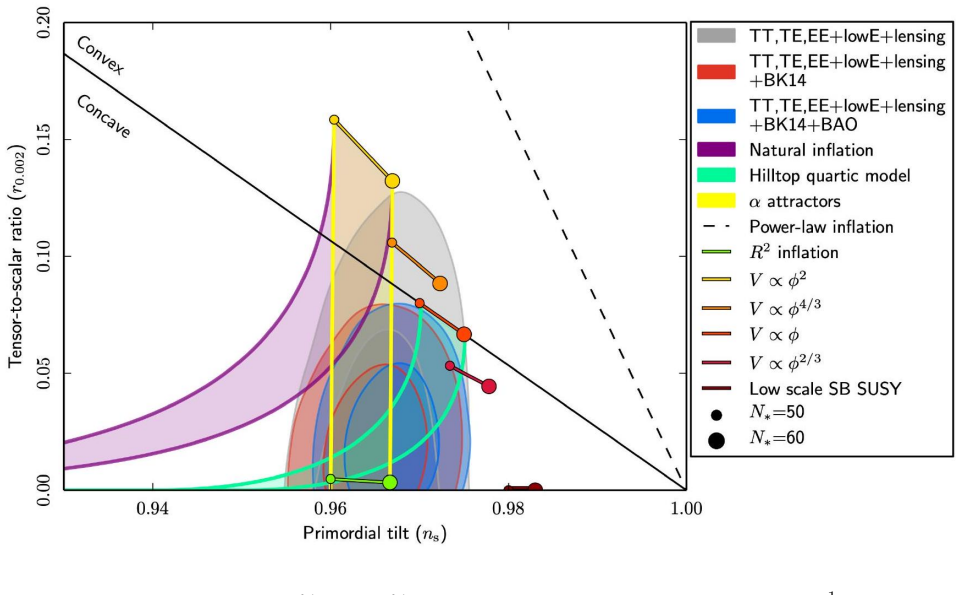
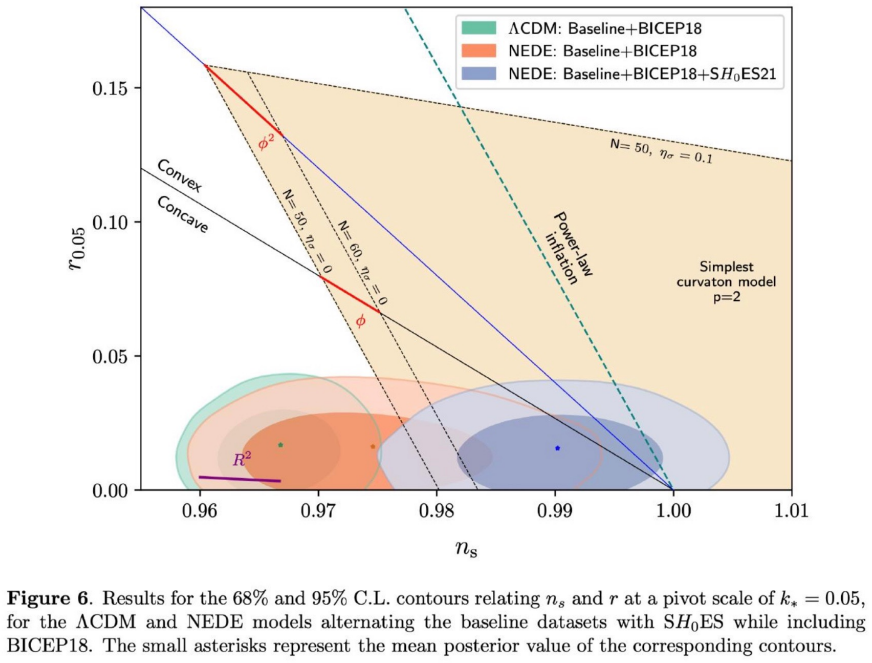

read the original abstract
Lecture notes on inflation. The lectures are three double lectures, held for the first time at the Nordita Winter School 2024 - Particle Physics and Cosmology, covering an advanced introduction to the theory of primordial inflation, as well as the linear and non-linear perturbation theory of slow-roll inflation/quasi-de Sitter spacetimes.
Editorial analysis
A structured set of objections, weighed in public.
Referee Report
Summary. The manuscript consists of lecture notes from three double lectures delivered at the Nordita Winter School 2024, providing an advanced introduction to the theory of primordial inflation together with the linear and non-linear perturbation theory of slow-roll inflation and quasi-de Sitter spacetimes.
Significance. The notes summarize established material in cosmology for readers already familiar with general relativity, quantum field theory on curved spacetime, and basic cosmological perturbation theory. As a pedagogical resource they may be useful for advanced students, but they introduce no new results, derivations, or predictions, so their significance for the research literature is limited to exposition of prior work.
major comments (1)
- The manuscript advances no original central claim, derivation, or result; it is a summary of prior literature on inflation and perturbation theory. Consequently there are no load-bearing technical elements whose soundness can be assessed in the usual way for a research article.
Simulated Author's Rebuttal
We thank the referee for reviewing our manuscript. The work consists of lecture notes from the Nordita Winter School 2024 and is intended as a pedagogical resource rather than an original research article. We respond to the major comment below.
read point-by-point responses
-
Referee: The manuscript advances no original central claim, derivation, or result; it is a summary of prior literature on inflation and perturbation theory. Consequently there are no load-bearing technical elements whose soundness can be assessed in the usual way for a research article.
Authors: We agree that the manuscript presents no new scientific claims, derivations, or predictions, as it comprises lecture notes summarizing established results in primordial inflation and linear/non-linear perturbation theory in slow-roll and quasi-de Sitter backgrounds. The purpose is to provide a coherent, advanced-level exposition for readers already familiar with general relativity, quantum field theory on curved spacetime, and basic cosmological perturbation theory. Such pedagogical materials are common in the literature and can offer value through structured presentation and selection of topics, even without novel content. We do not claim the notes as original research. revision: no
Circularity Check
No significant circularity: lecture notes summarize prior literature
full rationale
This is a set of lecture notes presenting an advanced introduction to established topics in primordial inflation and linear/non-linear perturbation theory. No original central claim, derivation chain, or new result is advanced. The notes presuppose working knowledge of GR, QFT on curved spacetime, and basic cosmological perturbation theory, but contain no self-contained predictions, fitted parameters, or uniqueness theorems that reduce to the paper's own inputs. All content is drawn from prior literature, eliminating any risk of circular reasoning in new results. Score 0 is the appropriate finding per the rules for self-contained summaries against external benchmarks.
Axiom & Free-Parameter Ledger
Reference graph
Works this paper leans on
-
[1]
D. J. Fixsen. The Temperature of the Cosmic Microwave Background.Astrophys. J., 707:916–920, 2009.arXiv:0911.1955,doi:10.1088/0004-637X/707/2/916
work page internal anchor Pith review Pith/arXiv arXiv doi:10.1088/0004-637x/707/2/916 2009
-
[2]
Alan H. Guth. The Inflationary Universe: A Possible Solution to the Horizon and Flatness Problems.Phys. Rev. D, 23:347–356, 1981.doi:10.1103/PhysRevD.23.347
-
[3]
Pre-Big-Bang in String Cosmology
M. Gasperini and G. Veneziano. Pre - big bang in string cosmology.Astropart. Phys., 1:317–339, 1993.arXiv:hep-th/9211021,doi:10.1016/0927-6505(93)90017-8
work page internal anchor Pith review Pith/arXiv arXiv doi:10.1016/0927-6505(93)90017-8 1993
-
[4]
The Ekpyrotic Universe: Colliding Branes and the Origin of the Hot Big Bang
Justin Khoury, Burt A. Ovrut, Paul J. Steinhardt, and Neil Turok. The Ekpyrotic universe: Colliding branes and the origin of the hot big bang.Phys. Rev. D, 64:123522, 2001.arXiv: hep-th/0103239,doi:10.1103/PhysRevD.64.123522
work page internal anchor Pith review Pith/arXiv arXiv doi:10.1103/physrevd.64.123522 2001
-
[5]
Arvind Borde, Alan H. Guth, and Alexander Vilenkin. Inflationary space-times are incom- pletein past directions.Phys. Rev. Lett., 90:151301, 2003.arXiv:gr-qc/0110012,doi:10.1103/ PhysRevLett.90.151301
Pith/arXiv arXiv 2003
-
[6]
Andrei D. Linde. Chaotic Inflation.Phys. Lett. B, 129:177–181, 1983.doi:10.1016/ 0370-2693(83)90837-7
1983
-
[7]
Monodromy in the CMB: Gravity Waves and String Inflation
Eva Silverstein and Alexander Westphal. Monodromy in the CMB: Gravity Waves and String Inflation.Phys. Rev. D, 78:106003, 2008.arXiv:0803.3085,doi:10.1103/PhysRevD.78.106003
work page internal anchor Pith review Pith/arXiv arXiv doi:10.1103/physrevd.78.106003 2008
-
[8]
Gravity Waves and Linear Inflation from Axion Monodromy
Liam McAllister, Eva Silverstein, and Alexander Westphal. Gravity Waves and Linear In- flation from Axion Monodromy.Phys. Rev. D, 82:046003, 2010.arXiv:0808.0706,doi: 10.1103/PhysRevD.82.046003
work page internal anchor Pith review Pith/arXiv arXiv doi:10.1103/physrevd.82.046003 2010
-
[9]
A Natural Framework for Chaotic Inflation
Nemanja Kaloper and Lorenzo Sorbo. A Natural Framework for Chaotic Inflation.Phys. Rev. Lett., 102:121301, 2009.arXiv:0811.1989,doi:10.1103/PhysRevLett.102.121301
work page internal anchor Pith review Pith/arXiv arXiv doi:10.1103/physrevlett.102.121301 2009
-
[10]
Andrei D. Linde. A New Inflationary Universe Scenario: A Possible Solution of the Horizon, Flatness, Homogeneity, Isotropy and Primordial Monopole Problems.Phys. Lett. B, 108:389–393, 1982.doi:10.1016/0370-2693(82)91219-9
-
[11]
Andreas Albrecht and Paul J. Steinhardt. Cosmology for Grand Unified Theories with Radiatively Induced Symmetry Breaking.Phys. Rev. Lett., 48:1220–1223, 1982.doi:10.1103/PhysRevLett. 48.1220
-
[12]
Lotfi Boubekeur and David. H. Lyth. Hilltop inflation.JCAP, 07:010, 2005.arXiv:hep-ph/ 0502047,doi:10.1088/1475-7516/2005/07/010
-
[13]
Andrei D. Linde. Hybrid inflation.Phys. Rev. D, 49:748–754, 1994.arXiv:astro-ph/9307002, doi:10.1103/PhysRevD.49.748
work page internal anchor Pith review Pith/arXiv arXiv doi:10.1103/physrevd.49.748 1994
-
[14]
Kari Enqvist and Martin S. Sloth. Adiabatic CMB perturbations in pre - big bang string cosmol- ogy.Nucl. Phys. B, 626:395–409, 2002.arXiv:hep-ph/0109214,doi:10.1016/S0550-3213(02) 00043-3. 50
work page internal anchor Pith review Pith/arXiv arXiv doi:10.1016/s0550-3213(02 2002
-
[15]
Generating the curvature perturbation without an inflaton
David H. Lyth and David Wands. Generating the curvature perturbation without an inflaton. Phys. Lett. B, 524:5–14, 2002.arXiv:hep-ph/0110002,doi:10.1016/S0370-2693(01)01366-1
work page internal anchor Pith review Pith/arXiv arXiv doi:10.1016/s0370-2693(01)01366-1 2002
-
[16]
Effects of Cosmological Moduli Fields on Cosmic Microwave Background
Takeo Moroi and Tomo Takahashi. Effects of cosmological moduli fields on cosmic microwave background.Phys. Lett. B, 522:215–221, 2001. [Erratum: Phys.Lett.B 539, 303–303 (2002)]. arXiv:hep-ph/0110096,doi:10.1016/S0370-2693(01)01295-3
work page internal anchor Pith review Pith/arXiv arXiv doi:10.1016/s0370-2693(01)01295-3 2001
-
[17]
Evgeny I. Buchbinder, Justin Khoury, and Burt A. Ovrut. New Ekpyrotic cosmology.Phys. Rev. D, 76:123503, 2007.arXiv:hep-th/0702154,doi:10.1103/PhysRevD.76.123503
work page internal anchor Pith review Pith/arXiv arXiv doi:10.1103/physrevd.76.123503 2007
-
[18]
Inflationary cosmology
Andrei Linde. Inflationary cosmology. Presentation at the Cosmology, Strings, and Phenomenol- ogy Conference, Oscar Klein Auditorium, AlbaNova University Center, Stockholm, June 18, 2007,
2007
-
[19]
Available at:https://indico.fysik.su.se/event/89/contributions/10762/ attachments/4437/5152/Andrei_Linde.pdf
Slides. Available at:https://indico.fysik.su.se/event/89/contributions/10762/ attachments/4437/5152/Andrei_Linde.pdf
-
[20]
Inflationary trispectrum from graviton exchange
David Seery, Martin S. Sloth, and Filippo Vernizzi. Inflationary trispectrum from graviton ex- change.JCAP, 03:018, 2009.arXiv:0811.3934,doi:10.1088/1475-7516/2009/03/018
work page internal anchor Pith review Pith/arXiv arXiv doi:10.1088/1475-7516/2009/03/018 2009
-
[21]
Semiclassical relations and IR effects in de Sitter and slow-roll space-times
StevenB.GiddingsandMartinS.Sloth. SemiclassicalrelationsandIReffectsindeSitterandslow- roll space-times.JCAP, 01:023, 2011.arXiv:1005.1056,doi:10.1088/1475-7516/2011/01/023
work page internal anchor Pith review Pith/arXiv arXiv doi:10.1088/1475-7516/2011/01/023 2011
-
[22]
Steven B. Giddings and Martin S. Sloth. Cosmological observables, IR growth of fluctuations, and scale-dependent anisotropies.Phys. Rev. D, 84:063528, 2011.arXiv:1104.0002,doi:10.1103/ PhysRevD.84.063528
Pith/arXiv arXiv 2011
-
[23]
Steven B. Giddings and Martin S. Sloth. Fluctuating geometries, q-observables, and infrared growth in inflationary spacetimes.Phys. Rev. D, 86:083538, 2012.arXiv:1109.1000,doi:10. 1103/PhysRevD.86.083538
Pith/arXiv arXiv 2012
-
[24]
Viatcheslav F. Mukhanov, H. A. Feldman, and Robert H. Brandenberger. Theory of cosmological perturbations. Part 1. Classical perturbations. Part 2. Quantum theory of perturbations. Part 3. Extensions.Phys. Rept., 215:203–333, 1992.doi:10.1016/0370-1573(92)90044-Z
-
[25]
de Sitter limit of inflation and nonlinear perturbation theory
Philip R. Jarnhus and Martin S. Sloth. de Sitter limit of inflation and nonlinear perturbation theory.JCAP, 02:013, 2008.arXiv:0709.2708,doi:10.1088/1475-7516/2008/02/013
work page internal anchor Pith review Pith/arXiv arXiv doi:10.1088/1475-7516/2008/02/013 2008
-
[26]
A New Type of Isotropic Cosmological Models Without Singularity
Alexei A. Starobinsky. A New Type of Isotropic Cosmological Models Without Singularity.Phys. Lett. B, 91:99–102, 1980.doi:10.1016/0370-2693(80)90670-X
-
[27]
Planck 2018 results. X. Constraints on inflation
Y. Akrami et al. Planck 2018 results. X. Constraints on inflation.Astron. Astrophys., 641:A10, 2020.arXiv:1807.06211,doi:10.1051/0004-6361/201833887
work page internal anchor Pith review Pith/arXiv arXiv doi:10.1051/0004-6361/201833887 2018
-
[28]
Florian Niedermann and Martin S. Sloth. New early dark energy.Phys. Rev. D, 103(4):L041303, 2021.arXiv:1910.10739,doi:10.1103/PhysRevD.103.L041303
-
[29]
Florian Niedermann and Martin S. Sloth. Resolving the Hubble tension with new early dark energy.Phys. Rev. D, 102(6):063527, 2020.arXiv:2006.06686,doi:10.1103/PhysRevD.102. 063527
-
[30]
Cruz, Florian Niedermann, and Martin S
Juan S. Cruz, Florian Niedermann, and Martin S. Sloth. A grounded perspective on new early dark energy using ACT, SPT, and BICEP/Keck.JCAP, 02:041, 2023.arXiv:2209.02708,doi: 10.1088/1475-7516/2023/02/041. 51
-
[31]
Non-Gaussian features of primordial fluctuations in single field inflationary models
Juan Martin Maldacena. Non-Gaussian features of primordial fluctuations in single field inflation- ary models.JHEP, 05:013, 2003.arXiv:astro-ph/0210603,doi:10.1088/1126-6708/2003/05/ 013
work page internal anchor Pith review Pith/arXiv arXiv doi:10.1088/1126-6708/2003/05/ 2003
-
[32]
Cosmological diagrammatic rules
Steven B. Giddings and Martin S. Sloth. Cosmological diagrammatic rules.JCAP, 07:015, 2010. arXiv:1005.3287,doi:10.1088/1475-7516/2010/07/015
work page internal anchor Pith review Pith/arXiv arXiv doi:10.1088/1475-7516/2010/07/015 2010
-
[33]
The Inflationary Trispectrum for Models with Large Non-Gaussianities.Phys
Xingang Chen, Min-xin Huang, and Gary Shiu. The Inflationary Trispectrum for Models with Large Non-Gaussianities.Phys. Rev. D, 74:121301, 2006.arXiv:hep-th/0610235,doi:10.1103/ PhysRevD.74.121301
Pith/arXiv arXiv 2006
-
[34]
Mixed Inflaton and Spectator Field Models after Planck
Kari Enqvist and Tomo Takahashi. Mixed Inflaton and Spectator Field Models after Planck. JCAP, 10:034, 2013.arXiv:1306.5958,doi:10.1088/1475-7516/2013/10/034
work page internal anchor Pith review Pith/arXiv arXiv doi:10.1088/1475-7516/2013/10/034 2013
-
[35]
On Non-Gaussianity in the Curvaton Scenario
N. Bartolo, S. Matarrese, and A. Riotto. On nonGaussianity in the curvaton scenario.Phys. Rev. D, 69:043503, 2004.arXiv:hep-ph/0309033,doi:10.1103/PhysRevD.69.043503
work page internal anchor Pith review Pith/arXiv arXiv doi:10.1103/physrevd.69.043503 2004
-
[36]
David Seery, James E. Lidsey, and Martin S. Sloth. The inflationary trispectrum.JCAP, 01:027, 2007.arXiv:astro-ph/0610210,doi:10.1088/1475-7516/2007/01/027
work page internal anchor Pith review Pith/arXiv arXiv doi:10.1088/1475-7516/2007/01/027 2007
-
[37]
Princeton University Press, 2018.arXiv:1703.05448
Andrew Strominger.Lectures on the Infrared Structure of Gravity and Gauge Theory. Princeton University Press, 2018.arXiv:1703.05448
Pith/arXiv arXiv 2018
-
[38]
Stephen W. Hawking, Malcolm J. Perry, and Andrew Strominger. Soft Hair on Black Holes.Phys. Rev. Lett., 116(23):231301, 2016.arXiv:1601.00921,doi:10.1103/PhysRevLett.116.231301
work page internal anchor Pith review Pith/arXiv arXiv doi:10.1103/physrevlett.116.231301 2016
-
[39]
Asymptotic Symmetries in de Sitter and Inflationary Spacetimes
Ricardo Z. Ferreira, McCullen Sandora, and Martin S. Sloth. Asymptotic Symmetries in de Sitter and Inflationary Spacetimes.JCAP, 04:033, 2017.arXiv:1609.06318,doi:10.1088/1475-7516/ 2017/04/033
work page internal anchor Pith review Pith/arXiv arXiv doi:10.1088/1475-7516/ 2017
-
[40]
Martin S. Sloth. Soft gravitons as Goldstone modes of spontaneously broken asymptotic sym- metries in de Sitter spacetimes.Phys. Rev. D, 112(2):L021501, 2025.arXiv:2502.03520, doi:10.1103/bsjy-4tj8
-
[41]
Patient Observers and Non-perturbative Infrared Dynamics in Inflation
Ricardo Z. Ferreira, McCullen Sandora, and Martin S. Sloth. Patient Observers and Non- perturbative Infrared Dynamics in Inflation.JCAP, 02:055, 2018.arXiv:1703.10162,doi: 10.1088/1475-7516/2018/02/055
work page internal anchor Pith review Pith/arXiv arXiv doi:10.1088/1475-7516/2018/02/055 2018
-
[42]
Is Patience a Virtue? Cosmic Censorship of Infrared Effects in de Sitter
Ricardo Z. Ferreira, McCullen Sandora, and Martin S. Sloth. Is Patience a Virtue? Cosmic Censorship of Infrared Effects in de Sitter.Int. J. Mod. Phys. D, 26(12):1743019, 2017.arXiv: 1705.06380,doi:10.1142/S0218271817430192
work page internal anchor Pith review Pith/arXiv arXiv doi:10.1142/s0218271817430192 2017
-
[43]
Enrico Pajer. Building a Boostless Bootstrap for the Bispectrum.JCAP, 01:023, 2021.arXiv: 2010.12818,doi:10.1088/1475-7516/2021/01/023
-
[44]
Pimentel, Charlotte Sleight, and Massimo Taronna
Daniel Baumann, Daniel Green, Austin Joyce, Enrico Pajer, Guilherme L. Pimentel, Charlotte Sleight, and Massimo Taronna. Snowmass White Paper: The Cosmological Bootstrap.SciPost Phys. Comm. Rep., 2024:1, 2024.arXiv:2203.08121,doi:10.21468/SciPostPhysCommRep.1
-
[45]
Nima Arkani-Hamed, Daniel Baumann, Hayden Lee, and Guilherme L. Pimentel. The Cosmolog- ical Bootstrap: Inflationary Correlators from Symmetries and Singularities.JHEP, 04:105, 2020. arXiv:1811.00024,doi:10.1007/JHEP04(2020)105. 52
-
[46]
The SAGEX review on scattering amplitudes chapter 11: soft theorems and celestial amplitudes.J
Tristan McLoughlin, Andrea Puhm, and Ana-Maria Raclariu. The SAGEX review on scattering amplitudes chapter 11: soft theorems and celestial amplitudes.J. Phys. A, 55(44):443012, 2022. arXiv:2203.13022,doi:10.1088/1751-8121/ac9a40
-
[47]
Asymptotic Symmetries and Charges in De Sitter Space.Class
Dionysios Anninos, Gim Seng Ng, and Andrew Strominger. Asymptotic Symmetries and Charges in De Sitter Space.Class. Quant. Grav., 28:175019, 2011.arXiv:1009.4730,doi:10.1088/ 0264-9381/28/17/175019. 53
Pith/arXiv arXiv 2011
discussion (0)
Sign in with ORCID, Apple, or X to comment. Anyone can read and Pith papers without signing in.