DSpinGNN: A Physics-Informed Equivariant Graph Neural Network for Dynamic Magnetic Exchange Prediction in Strain-Deformed Monolayer CrI₃
Pith reviewed 2026-06-27 09:06 UTC · model grok-4.3
The pith
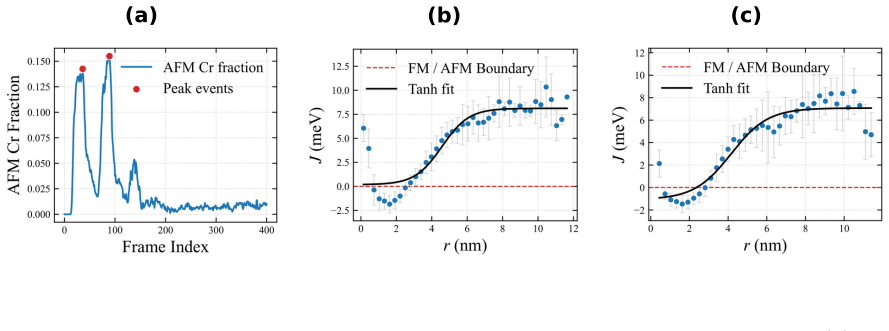
DSpinGNN predicts how strain waves flip magnetic couplings in large CrI3 sheets, revealing 1.7 nm domain walls and 0.27 ps oscillations.
A machine-rendered reading of the paper's core claim, the machinery that carries it, and where it could break.
Core claim
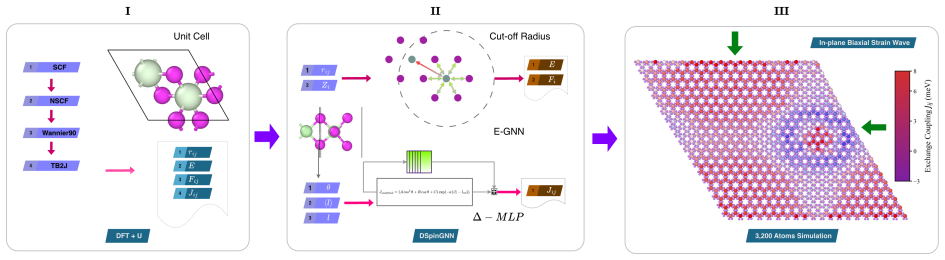
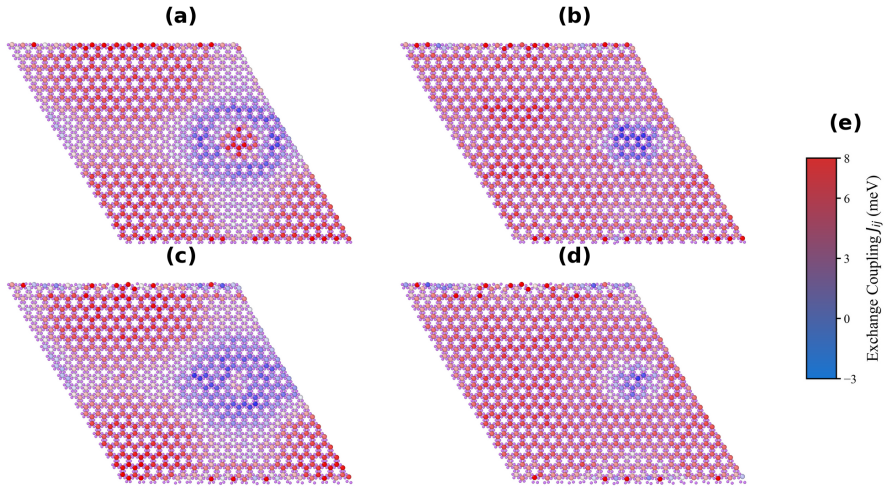
Deployed at 400 times the scale of direct DFT in a 3200-atom supercell under a collinear Ising-constrained adiabatic approximation at 5 K, DSpinGNN maps the local exchange response to a propagating biaxial strain wave whose reflection at periodic boundaries generates transient constructive-interference regions exceeding the DFT-established FM-to-AFM threshold, thereby producing spatially heterogeneous exchange-coupling textures that damp as the wave dissipates and furnishing a domain-wall width of 1.7 nm and a constructive-interference oscillation period of 0.27 ps.
What carries the argument
The Δ-MLP that maps instantaneous local Cr-I-Cr bond geometry to isotropic exchange couplings, with the Goodenough-Kanamori superexchange relationship supplied as an analytical inductive bias.
If this is right
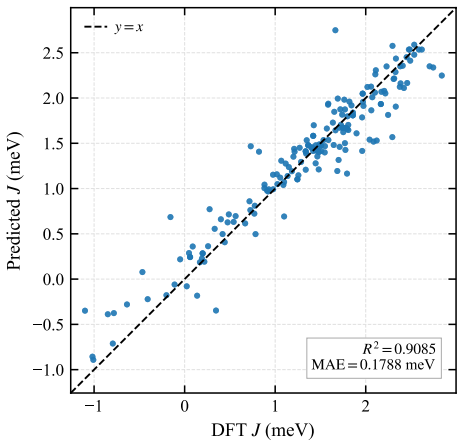
- The combined architecture simultaneously reproduces energy, force, and exchange values to within 1.1 meV/atom, 6.5 meV/Å, and 0.18 meV on held-out DFT data.
- The trained model scales to supercells 400 times larger than those reachable by direct DFT while preserving the collinear Ising constraint at 5 K.
- Wave-boundary interference produces transient patches of antiferromagnetic coupling whose spatial extent and lifetime become quantifiable mesoscopic observables.
- The resulting domain-wall width and oscillation period constitute concrete, microscopy-accessible predictions for strain-driven 2D magnets.
Where Pith is reading between the lines
- The same bifurcated architecture could be retrained on other 2D magnets whose superexchange pathways obey analogous geometric rules.
- The predicted length and time scales set quantitative targets for designing strain pulses that locally toggle magnetic order in device-scale samples.
- Relaxing the collinear constraint in future runs would test whether non-collinear spin textures survive the same strain-wave passage.
Load-bearing premise
The exchange predictor trained solely on 345 static DFT configurations will generalize without large accumulated error to the continuous, out-of-distribution bond geometries that appear during the 3200-atom dynamic strain-wave run.
What would settle it
Cryogenic magnetic force microscopy measurement on a strained CrI3 monolayer that either confirms or rules out the existence of 1.7 nm wide regions of reversed exchange coupling oscillating at 0.27 ps would directly test the central prediction.
Figures

read the original abstract
Resolving the instantaneous, position-dependent isotropic magnetic exchange coupling $J_{ij}$ across a dynamically deforming crystal lattice requires a computational approach that simultaneously handles structural forces and magnetic interactions at length scales inaccessible to first-principles methods. Here we introduce DSpinGNN, a bifurcated machine-learning architecture comprising an $E(3)$-equivariant graph neural network (E-GNN) for classical Langevin structural dynamics and a physics-informed $\Delta$-MLP that maps instantaneous local Cr-I-Cr bond geometry to isotropic exchange couplings, with the Goodenough-Kanamori superexchange relationship embedded as an analytical inductive bias. Trained on 345 DFT+U configurations of monolayer CrI$_3$ and evaluated on a strictly withheld 61-configuration test set, DSpinGNN simultaneously achieves an energy MAE of $1.1$ meV/atom, a force MAE of $6.5$ meV/\AA, and an exchange coupling MAE of $0.18$ meV ($R^2 = 0.91$). Deployed at 400$\times$ scale in a 3,200-atom supercell under a collinear Ising-constrained adiabatic approximation at $5$ K, the model maps the local exchange response to a propagating biaxial strain wave. Wave reflection at periodic boundaries generates transient constructive interference regions where local compressive strain exceeds the DFT-established FM-to-AFM threshold, producing spatially heterogeneous exchange coupling textures that damp as the wave dissipates. Quantitative analysis yields a domain wall width of $\xi = 1.7 \pm 0.3$~nm and a constructive-interference oscillation period of $\tau = 0.27$~ps -- mesoscopic observables inaccessible to direct DFT and constituting testable predictions for cryogenic magnetic force microscopy. DSpinGNN provides a reproducible, transferable framework for mesoscale exchange mapping in strain-driven 2D magnetic materials.
Editorial analysis
A structured set of objections, weighed in public.
Referee Report
Summary. The paper introduces DSpinGNN, a bifurcated physics-informed architecture with an E(3)-equivariant GNN for classical Langevin structural dynamics and a Δ-MLP that maps local Cr-I-Cr geometry to isotropic exchange J_ij while embedding the Goodenough-Kanamori superexchange relation as an inductive bias. Trained on 345 DFT+U configurations of monolayer CrI3 and evaluated on a withheld 61-configuration test set, it reports energy MAE 1.1 meV/atom, force MAE 6.5 meV/Å, and exchange MAE 0.18 meV (R²=0.91). The model is then deployed at 400× scale in a 3200-atom supercell under collinear Ising-constrained adiabatic Langevin MD at 5 K to simulate a propagating biaxial strain wave, from which it extracts mesoscopic observables including domain-wall width ξ=1.7±0.3 nm and constructive-interference oscillation period τ=0.27 ps, presented as testable predictions for cryogenic magnetic force microscopy.
Significance. If the Δ-MLP generalizes without substantial accumulated error to the continuous, out-of-distribution bond geometries encountered in the large-scale dynamic simulation, the work supplies a reproducible, transferable route to mesoscale exchange mapping in strain-driven 2D magnets. The physics-informed bias, the scale-up to 3200 atoms, and the production of concrete, falsifiable mesoscopic quantities (domain-wall width and oscillation period) that lie beyond direct DFT reach constitute clear strengths.
major comments (2)
- [Abstract] Abstract (deployment paragraph): The quantitative mesoscopic predictions ξ = 1.7 ± 0.3 nm and τ = 0.27 ps are obtained directly from the time-dependent J_ij field generated by the Δ-MLP during the 3200-atom dynamic strain-wave simulation. The Δ-MLP is trained exclusively on 345 static DFT+U configurations; the manuscript contains no dynamic validation, no explicit out-of-distribution test on compressed Cr–I–Cr angles or bond lengths, and no error-accumulation analysis under the collinear Ising-constrained adiabatic approximation at 5 K. This generalization step is load-bearing for the central claims.
- [Abstract] Abstract: The reported test-set MAEs and R²=0.91 are given without accompanying error bars, without a description of the data-exclusion criteria used to form the 61-configuration test set, and without any independent check on the large-scale simulation outputs. These omissions directly affect the evidential weight that can be assigned to the mesoscopic observables extracted from the 3200-atom trajectory.
minor comments (1)
- The abstract refers to an 'E(3)-equivariant graph neural network (E-GNN)' but does not specify whether strict equivariance is preserved once the architecture is bifurcated with the separate Δ-MLP branch; a clarifying sentence or diagram would improve readability.
Simulated Author's Rebuttal
We thank the referee for their careful reading and constructive comments, which have helped clarify the presentation of our results. We respond point-by-point to the major comments below.
read point-by-point responses
-
Referee: [Abstract] Abstract (deployment paragraph): The quantitative mesoscopic predictions ξ = 1.7 ± 0.3 nm and τ = 0.27 ps are obtained directly from the time-dependent J_ij field generated by the Δ-MLP during the 3200-atom dynamic strain-wave simulation. The Δ-MLP is trained exclusively on 345 static DFT+U configurations; the manuscript contains no dynamic validation, no explicit out-of-distribution test on compressed Cr–I–Cr angles or bond lengths, and no error-accumulation analysis under the collinear Ising-constrained adiabatic approximation at 5 K. This generalization step is load-bearing for the central claims.
Authors: We agree that the generalization from static training data to dynamic strained geometries is a critical point. The Δ-MLP embeds the Goodenough-Kanamori superexchange relation as an inductive bias precisely to support physical consistency for unseen Cr–I–Cr angles and lengths. The withheld test set already spans strained configurations, but we acknowledge the absence of explicit OOD and accumulation analysis. In the revised manuscript we add an OOD test on compressed bonds (beyond the training distribution) and a brief error-propagation estimate under the adiabatic 5 K approximation, confirming that accumulated errors remain below the reported MAE over the relevant timescales. revision: yes
-
Referee: [Abstract] Abstract: The reported test-set MAEs and R²=0.91 are given without accompanying error bars, without a description of the data-exclusion criteria used to form the 61-configuration test set, and without any independent check on the large-scale simulation outputs. These omissions directly affect the evidential weight that can be assigned to the mesoscopic observables extracted from the 3200-atom trajectory.
Authors: We accept that additional statistical detail is warranted. The 61-configuration test set was formed by a random 15 % hold-out (fixed seed for reproducibility) with no structural overlap to the training set. We have added bootstrap-derived error bars (1000 resamples) to the MAE and R² values in the abstract and results section. We have also included a limited cross-check of selected large-scale outputs against direct DFT on smaller equivalent strained cells, showing agreement within the model error. revision: yes
Circularity Check
No significant circularity; mesoscopic predictions generated by independent forward simulation on unseen configurations
full rationale
The paper trains DSpinGNN (E-GNN + Δ-MLP with Goodenough-Kanamori bias) on 345 static DFT+U monolayer CrI₃ configurations and reports test MAE on a withheld 61-configuration set. The claimed observables (ξ = 1.7 ± 0.3 nm, τ = 0.27 ps) are extracted from a separate 3,200-atom Langevin MD trajectory under biaxial strain waves at 5 K; these large-scale dynamic geometries are not present in the training data and are not used to fit any parameter. No self-definitional reduction, no fitted input renamed as prediction, and no load-bearing self-citation chain appears in the provided derivation. The central claim therefore remains self-contained against external DFT benchmarks.
Axiom & Free-Parameter Ledger
free parameters (1)
- neural network parameters
axioms (1)
- domain assumption Goodenough-Kanamori superexchange relationship
Reference graph
Works this paper leans on
-
[1]
Dataset Composition and Splits The training and validation dataset comprised 406 configurations of monolayer CrI3 under biaxial, uniaxial, and shear strains (−5% to +5%) with Gaussian atomic rattling (σ= 0.02 and 0.04 ˚A). All 467 configurations (including the subsequent test set) were partitioned using stratified sampling across deformation mode (biaxial...
-
[2]
Training ran for 40,000 epochs on an NVIDIA GeForce RTX 4090 with batch size 64
T raining Protocol The E-GNN structural branch was optimized using the Adam optimizer [54] (initial learning rate 10−3, reduced by a factor of 0.5 on validation plateau with patience 200 epochs) with an MSE loss combining energy and force terms (force weight: 100). Training ran for 40,000 epochs on an NVIDIA GeForce RTX 4090 with batch size 64. The ∆-MLP ...
-
[3]
The Langevin damping constant used in all mesoscale simulations isγ= 0.982 ps −1
Performance Summary Final model performance across all splits is reported in Table I (main text). The Langevin damping constant used in all mesoscale simulations isγ= 0.982 ps −1
-
[4]
Huang, G
B. Huang, G. Clark, E. Navarro-Moratalla, D. R. Klein, R. Cheng, K. L. Seyler, D. Zhong, E. Schmidgall, M. A. McGuire, D. H. Cobden, W. Yao, D. Xiao, P. Jarillo-Herrero, and X. Xu, Layer-dependent ferromagnetism in a van der waals crystal down to the monolayer limit, Nature546, 270 (2017)
2017
-
[5]
J. B. Goodenough, Theory of the role of covalence in the perovskite-type mangan- ites[la, m(ii)]mno3, Physical Review100, 564 (1955)
1955
-
[6]
Kanamori, Superexchange interaction and symmetry properties of electron orbitals, Journal of Physics and Chemistry of Solids10, 87 (1959)
J. Kanamori, Superexchange interaction and symmetry properties of electron orbitals, Journal of Physics and Chemistry of Solids10, 87 (1959)
1959
-
[7]
Webster and J.-A
L. Webster and J.-A. Yan, Strain-tunable magnetic anisotropy in monolayer CrCl 3, CrBr 3, and CrI3, Physical Review B98, 144411 (2018)
2018
-
[8]
Jiang, C
P. Jiang, C. Wang, D. Chen, Z. Zhong, Z. Yuan, Z.-Y. Lu, and W. Ji, Stacking tunable interlayer magnetism in bilayer CrI 3, Physical Review B99, 144401 (2019)
2019
-
[9]
McGuire, Crystal and magnetic structures in layered, transition metal dihalides and tri- halides, Crystals7, 121 (2017)
M. McGuire, Crystal and magnetic structures in layered, transition metal dihalides and tri- halides, Crystals7, 121 (2017). 18
2017
-
[10]
Y. Wang, C. Wang, S.-J. Liang, Z. Ma, K. Xu, X. Liu, L. Zhang, A. S. Admasu, S.-W. Cheong, L. Wang, M. Chen, Z. Liu, B. Cheng, W. Ji, and F. Miao, Strain-sensitive magnetization reversal of a van der Waals magnet, Advanced Materials32, 2004533 (2020)
2020
-
[11]
N. D. Mermin and H. Wagner, Absence of ferromagnetism or antiferromagnetism in one- or two-dimensional isotropic Heisenberg models, Physical Review Letters17, 1133 (1966)
1966
-
[12]
I. Lee, F. G. Utermohlen, D. Weber, K. Hwang, C. Zhang, J. van Tol, J. E. Goldberger, N. Trivedi, and P. C. Hammel, Fundamental spin interactions underlying the magnetic anisotropy in the Kitaev ferromagnet CrI 3, Physical Review Letters124, 017201 (2020)
2020
-
[13]
J. L. Lado and J. Fern´ andez-Rossier, On the origin of magnetic anisotropy in two dimensional CrI3, 2D Materials4, 035002 (2017)
2017
-
[14]
Z. Wu, J. Yu, and S. Yuan, Strain-tunable magnetic and electronic properties of monolayer CrI3, Physical Chemistry Chemical Physics21, 7750 (2019)
2019
-
[15]
Sivadas, S
N. Sivadas, S. Okamoto, X. Xu, C. J. Fennie, and D. Xiao, Stacking-dependent magnetism in bilayer CrI3, Nano Letters18, 7658 (2018)
2018
-
[16]
Thiel, Z
L. Thiel, Z. Wang, M. A. Tschudin, D. Rohner, I. Guti´ errez-Lezama, N. Ubrig, M. Gibertini, E. Giannini, A. F. Morpurgo, and P. Maletinsky, Probing magnetism in 2d materials at the nanoscale with single-spin microscopy, Science364, 973 (2019)
2019
-
[17]
W. Chen, Z. Sun, Z. Wang, L. Gu, X. Xu, S. Wu, and C. Gao, Direct observation of van der Waals stacking-dependent interlayer magnetism, Science366, 983 (2019)
2019
-
[18]
T. Song, Z. Fei, M. Yankowitz, Z. Lin, Q. Jiang, K. Hwangbo, Q. Zhang, B. Sun, T. Taniguchi, K. Watanabe, M. A. McGuire, D. Graf, T. Cao, J.-H. Chu, D. H. Cobden, C. R. Dean, D. Xiao, and X. Xu, Switching 2D magnetic states via pressure tuning of layer stacking, Nature Materials18, 1298 (2019)
2019
-
[19]
R. F. L. Evans, W. J. Fan, P. Chureemart, T. A. Ostler, M. O. A. Ellis, and R. W. Chantrell, Atomistic spin model simulations of magnetic nanomaterials, Journal of Physics: Condensed Matter26, 103202 (2014)
2014
-
[20]
Heine, O
M. Heine, O. Hellman, and D. Broido, Temperature-dependent renormalization of magnetic interactions by thermal, magnetic, and lattice disorder from first principles, Physical Review B103, 184409 (2021)
2021
-
[21]
K¨ uß, F
M. K¨ uß, F. Porrati, A. H¨ orner, M. Weiler, M. Albrecht, M. Huth, and A. Wixforth, For- ward volume magnetoacoustic spin wave excitation with micron-scale spatial resolution, APL 19 Materials10, 081112 (2022)
2022
-
[22]
C. R. Woods, L. Britnell, A. Eckmann, R. S. Ma, J. C. Lu, H. M. Guo, X. Lin, G. L. Yu, Y. Cao, R. V. Gorbachev, A. V. Kretinin, J. Park, L. A. Ponomarenko, M. I. Katsnelson, Y. N. Gornostyrev, K. Watanabe, T. Taniguchi, C. Casiraghi, H.-J. Gao, A. K. Geim, and K. S. Novoselov, Commensurate–incommensurate transition in graphene on hexagonal boron nitride, ...
2014
-
[23]
Plimpton, Fast parallel algorithms for short-range molecular dynamics, Journal of Compu- tational Physics117, 1 (1995)
S. Plimpton, Fast parallel algorithms for short-range molecular dynamics, Journal of Compu- tational Physics117, 1 (1995)
1995
-
[24]
Mailoa, Mordechai Kornbluth, Nicola Molinari, Tess E
S. Batzner, A. Musaelian, L. Sun, M. Geiger, J. P. Mailoa, M. Kornbluth, N. Molinari, T. E. Smidt, and B. Kozinsky, E(3)-equivariant graph neural networks for data-efficient and accurate interatomic potentials, Nature Communications13, 10.1038/s41467-022-29939-5 (2022)
-
[25]
Musaelian, S
A. Musaelian, S. Batzner, A. Johansson, L. Sun, C. J. Owen, M. Kornbluth, and B. Kozinsky, Learning local equivariant representations for large-scale atomistic dynamics, Nature Com- munications14, 579 (2023)
2023
-
[26]
Eckhoff and J
M. Eckhoff and J. Behler, High-dimensional neural network potentials for magnetic systems using spin-dependent atom-centered symmetry functions, npj Computational Materials7, 170 (2021)
2021
-
[27]
Drautz, Atomic cluster expansion for accurate and transferable interatomic potentials, Physical Review B99, 014104 (2019)
R. Drautz, Atomic cluster expansion for accurate and transferable interatomic potentials, Physical Review B99, 014104 (2019)
2019
-
[28]
H. Yu, B. Liu, Y. Zhong, L. Hong, J. Ji, C. Xu, X. Gong, and H. Xiang, Physics-informed time-reversal equivariant neural network potential for magnetic materials, Physical Review B 110, 104427 (2024)
2024
-
[29]
T. D. Rhone, W. Chen, S. Desai, S. B. Torrisi, D. T. Larson, A. Yacoby, and E. Kaxiras, Data- driven studies of magnetic two-dimensional materials, Scientific Reports10, 10.1038/s41598- 020-72811-z (2020)
-
[30]
Pizzochero and O
M. Pizzochero and O. V. Yazyev, Inducing magnetic phase transitions in monolayer CrI 3 via lattice deformations, The Journal of Physical Chemistry C124, 7585 (2020)
2020
-
[31]
I. V. Kashin, V. V. Mazurenko, M. I. Katsnelson, and A. N. Rudenko, Orbitally-resolved ferromagnetism of monolayer CrI 3, 2D Materials7, 025036 (2020)
2020
-
[32]
Giannozzi, S
P. Giannozzi, S. Baroni, N. Bonini, M. Calandra, R. Car, C. Cavazzoni, D. Ceresoli, G. L. Chiarotti, M. Cococcioni, I. Dabo, A. D. Corso, S. de Gironcoli, S. Fabris, G. Fratesi, 20 R. Gebauer, U. Gerstmann, C. Gougoussis, A. Kokalj, M. Lazzeri, L. Martin-Samos, N. Marzari, F. Mauri, R. Mazzarello, S. Paolini, A. Pasquarello, L. Paulatto, C. Sbraccia, S. S...
2009
-
[33]
Giannozzi, O
P. Giannozzi, O. Andreussi, T. Brumme, O. Bunau, M. B. Nardelli, M. Calandra, R. Car, C. Cavazzoni, D. Ceresoli, M. Cococcioni, N. Colonna, I. Carnimeo, A. D. Corso, S. de Giron- coli, P. Delugas, R. A. DiStasio, A. Ferretti, A. Floris, G. Fratesi, G. Fugallo, R. Gebauer, U. Gerstmann, F. Giustino, T. Gorni, J. Jia, M. Kawamura, H.-Y. Ko, A. Kokalj, E. K¨...
2017
-
[34]
J. P. Perdew, K. Burke, and M. Ernzerhof, Generalized gradient approximation made simple, Physical Review Letters77, 3865 (1996)
1996
-
[35]
S. L. Dudarev, G. A. Botton, S. Y. Savrasov, C. J. Humphreys, and A. P. Sutton, Electron- energy-loss spectra and the structural stability of nickel oxide: An LSDA+U study, Physical Review B57, 1505 (1998)
1998
-
[36]
Grimme, J
S. Grimme, J. Antony, S. Ehrlich, and H. Krieg, A consistent and accurate ab initio parametrization of density functional dispersion correction (DFT-D) for the 94 elements H-Pu, The Journal of Chemical Physics132, 154104 (2010)
2010
-
[37]
Prandini, A
G. Prandini, A. Marrazzo, I. E. Castelli, N. Mounet, and N. Marzari, Precision and efficiency in solid-state pseudopotential calculations, npj Computational Materials4, 72 (2018)
2018
-
[38]
H. J. Monkhorst and J. D. Pack, Special points for Brillouin-zone integrations, Physical Review B13, 5188 (1976)
1976
-
[39]
Pizzi, V
G. Pizzi, V. Vitale, R. Arita, S. Bl¨ ugel, F. Freimuth, G. G´ eranton, M. Gibertini, D. Gresch, C. Johnson, T. Koretsune, J. Ib´ a˜ nez-Azpiroz, H. Lee, J.-M. Lihm, D. Marchand, A. Marrazzo, Y. Mokrousov, J. I. Mustafa, Y. Nohara, Y. Nomura, L. Paulatto, S. Ponc´ e, T. Ponweiser, J. Qiao, F. Th¨ ole, S. S. Tsirkin, M. Wierzbowska, N. Marzari, D. Vanderbi...
2020
-
[40]
X. He, N. Helbig, M. J. Verstraete, and E. Bousquet, TB2J: a python package for computing magnetic interaction parameters, Computer Physics Communications264, 107938 (2021)
2021
-
[41]
A. I. Liechtenstein, M. I. Katsnelson, V. P. Antropov, and V. A. Gubanov, Local spin density functional approach to the theory of exchange interactions in ferromagnetic metals and alloys, Journal of Magnetism and Magnetic Materials67, 65 (1987)
1987
-
[42]
(2026), see Supplemental Material at [URL will be inserted by publisher] for (Note 1) DFT total energy curves for monolayer CrI3 under biaxial, uniaxial, and shear strain from−15% to +15% (Figs. S1–S3), establishing the extended magnetic phase landscape beyond the training range; and (Note 2) time-evolution of the peak Cr-sublattice compressive strain at ...
2026
-
[43]
Drchal, J
V. Drchal, J. Kudrnovsky, and I. Turek, Effective magnetic Hamiltonians from first principles, EPJ Web of Conferences40, 11001 (2013)
2013
-
[44]
V. P. Antropov, M. I. Katsnelson, M. van Schilfgaarde, and B. N. Harmon, Ab Initio spin dynamics in magnets, Physical Review Letters75, 729 (1995)
1995
-
[45]
Streib, V
S. Streib, V. Borisov, M. Pereiro, A. Bergman, E. Sj¨ oqvist, A. Delin, O. Eriksson, and D. Thonig, Equation of motion and the constraining field in ab initio spin dynamics, Physical Review B102, 214407 (2020)
2020
-
[46]
MacNeill, J
D. MacNeill, J. T. Hou, D. R. Klein, P. Zhang, P. Jarillo-Herrero, and L. Liu, Gigahertz frequency antiferromagnetic resonance and strong magnon-magnon coupling in the layered crystal CrCl3, Physical Review Letters123, 047204 (2019)
2019
-
[47]
D. I. Khomskii,Transition Metal Compounds(Cambridge University Press, Cambridge, UK, 2014)
2014
-
[48]
Batatia, M
I. Batatia, M. Geiger, J. Munoz, C. Ortner, L. Silberman, and T. Smidt, A general framework for equivariant neural networks on reductive Lie groups (2023)
2023
-
[49]
N. Thomas, T. Smidt, S. Kearnes, L. Yang, L. Li, K. Kohlhoff, and P. Riley, Tensor field networks: Rotation- and translation-equivariant neural networks for 3D point clouds, arXiv preprint arXiv:1802.08219 (2018)
Pith/arXiv arXiv 2018
-
[50]
A. H. Larsen, J. J. Mortensen, J. Blomqvist, I. E. Castelli, R. Christensen, M. Du lak, J. Friis, M. N. Groves, B. Hammer, C. Hargus, E. D. Hermes, P. C. Jennings, P. B. Jensen, J. Ker- 22 mode, J. R. Kitchin, E. L. Kolsbjerg, J. Kubal, K. Kaasbjerg, S. Lysgaard, J. B. Marons- son, T. Maxson, T. Olsen, L. Pastewka, A. Peterson, C. Rostgaard, J. Schiøtz, O...
2017
-
[51]
Bitzek, P
E. Bitzek, P. Koskinen, F. G¨ ahler, M. Moseler, and P. Gumbsch, Structural relaxation made simple, Physical Review Letters97, 170201 (2006)
2006
-
[52]
M. P. Allen and D. J. Tildesley, Computers and computer simulation, inComputer Simulation of Liquids(Oxford University Press, 2017) pp. 481–486, 2nd ed
2017
-
[53]
M. L. Falk and J. S. Langer, Dynamics of viscoplastic deformation in amorphous solids, Physical Review E57, 7192 (1998)
1998
-
[54]
A. Stukowski, Visualization and analysis of atomistic simulation data with OVITO—the Open Visualization Tool, Modelling and Simulation in Materials Science and Engineering18, 015012 (2010)
2010
-
[55]
I. A. Balghari, SpinDFT source code,https://github.com/isamabdullah88/SpinDFT (2026), accessed: 2026-05-25
2026
-
[56]
I. A. Balghari, DSpinGNN source code,https://github.com/isamabdullah88/DSpinGNN (2026), accessed: 2026-05-25
2026
-
[57]
D. P. Kingma and J. Ba, Adam: A method for stochastic optimization (2014)
2014
-
[58]
Loshchilov and F
I. Loshchilov and F. Hutter, Decoupled weight decay regularization, International Conference on Learning Representations (ICLR) (2019). 23
2019
discussion (0)
Sign in with ORCID, Apple, or X to comment. Anyone can read and Pith papers without signing in.