REVIEW 4 major objections 3 minor 181 references
Efficient Deep Neural Networks
T0 review · 4 major / 3 minor · reviewed 2026-08-14 · deepseek-v4-flash
Pith's one-line read The dissertation's central claim: deep neural networks can be made efficient enough for edge deployment by attacking model design, data, hardware, and architecture search together, with reported gains from 10x to 421x.
desk verdict A useful compilation of already-published efficient-DNN work with a genuinely handy efficiency-metrics chapter, but the abstract's headline speedups are baseline-dependent and shouldn't be quoted without the comparison point. read the letter →
The pith
A machine-rendered reading of the paper's core claim, the machinery that carries it, and where it could break.
The reading
What carries the argument
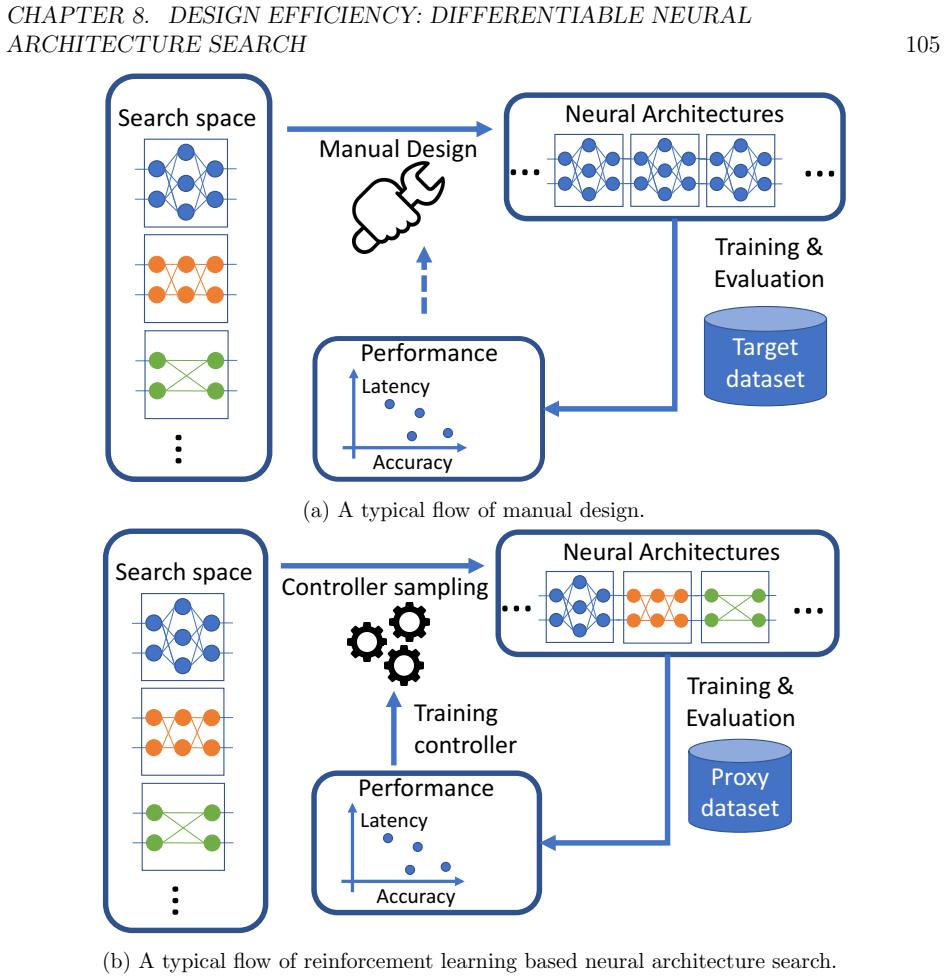
Four mechanisms carry the argument, each replacing an expensive step with a cheaper surrogate: the ConvDet layer (a fully convolutional detection head that replaces fully connected layers), the spherical projection of LiDAR point clouds onto dense 2D grids (letting ordinary 2D CNNs process 3D sensor data), the shift operator (a zero-FLOP, zero-parameter memory movement that replaces spatial convolution and leaves only $1\times1$ convolutions in the network), and the differentiable relaxation of architecture search into training a stochastic super net whose discrete layer choices become differentiable weights. Each converts an apparently necessary cost — parameter count, annotation labor, hardware operations, search compute — into something that can be reduced by design rather than accepted as fixed.
What would settle it
An independent reimplementation of SqueezeDet and Faster R-CNN on the same KITTI split, input resolution, and GPU, matched for mean average precision, could measure the true speed and energy margins; if they do not approach the reported 19.7x speedup and 35.2x energy saving at matched accuracy, the model-efficiency claim is weakened. The same re-run logic applies to the annotation tool (6.2x), the shift-based accelerator (11.6x), and the architecture search (421x), each against its own stated baseline.
Extended reading notes
Core claim
The paper's central claim is that deep neural networks can be made efficient enough for edge deployment by working at four levels rather than one: model design, data, hardware, and design automation. On the model level, SqueezeDet unifies region proposal and classification into a single convolutional detection layer, ConvDet, which replaces the fully connected detection head of prior single-stage detectors with a layer that has orders of magnitude fewer parameters; it matches Faster R-CNN accuracy on the KITTI benchmark while running at tens of frames per second on a desktop GPU with about 35x lower energy per frame. SqueezeSeg does the same for LiDAR point-cloud segmentation by projecting the cloud onto a spherical grid and feeding it to a compact SqueezeNet-style CNN, reaching over 100 frames per second. On the data level, the LATTE tool combines sensor fusion, one-click annotation, and Kalman-filter tracking to cut LiDAR annotation time 6.2x with better label quality, and SqueezeSegV2 adds a Context Aggregation Module, learned intensity rendering, geodesic correlation alignment, and progressive domain calibration so that models trained purely on simulated data approach the accuracy of models trained on real scans. On the hardware level, the shift operator moves data instead of multiplying it, eliminating spatial convolutions entirely and leaving networks composed only of 1x1 convolutions, which lets a purpose-built accelerator deliver 11.6x faster inference. On the design level, DNAS makes architecture search differentiable by training a stochastic super net whose discrete choices are smoothed into differentiable weights, discovering models with state-of-the-art accuracy-efficiency tradeoffs at 421x lower search cost than prior search methods.
Load-bearing premise
The reported gains — 10x model speedup, 6.2x annotation speedup, 11.6x inference speedup, and 421x search-cost reduction — are measured against specific baselines on specific datasets and hardware, and the dissertation assumes those comparisons are representative of what a strong competitor would achieve.
Editorial extensions
If this is right
- Edge applications like autonomous driving, augmented reality, and IoT can run sophisticated vision models in real time: the compact networks reported here run at roughly 30 to over 100 frames per second on desktop GPUs and are small enough to be quantized for embedded processors.
- LiDAR-based datasets become much cheaper to build: the annotation tool cuts labeling time 6.2x with higher label quality, while the domain-adaptation pipeline makes simulated data a viable substitute, relaxing the requirement for expensive real-world scans.
- Hardware for neural networks can be dramatically simpler: because shift-based networks contain only $1\times1$ convolutions, a compute unit dedicated to that single operator sustains the 11.6x inference speedup, suggesting that co-designed silicon can track network design closely.
- Model design can be automated: DNAS finds accurate, efficient networks at 421x lower search cost than earlier search methods, making per-device, per-task architecture search practical where it was previously prohibitive.
- The four levels compose: each targets a different bottleneck, so the gains multiply — a compact model, trained on cheap simulated data, searched automatically for a target accelerator, is the dissertation's picture of practical edge AI.
Reading between the lines
- If the efficiency numbers generalize beyond their specific baselines, the practical consequence is that model size and FLOPs are not destiny: the same task accuracy can be bought with 10x to 400x less compute, shifting the edge-AI bottleneck from inference hardware to data pipelines and deployment engineering.
- The shift operator's premise — that spatial mixing can be done by memory movement instead of multiplication — suggests a testable extension to other expensive layers such as attention mechanisms, where a similar 'move then mix' decomposition might cut cost without retraining.
- A natural extension of DNAS would be to search jointly over architecture, precision, and data strategy for a fixed target device; the dissertation treats the four efficiency axes separately, and a combined formulation could expose interactions among them.
- The domain-adaptation result's implicit promise is that synthetic training data plus unlabeled target data may eventually replace most real annotation; whether that holds at scale depends on whether the learned intensity rendering and correlation alignment continue to close the gap as objects, weather, and sensor configurations diversify.
Editorial analysis
A structured set of objections, weighed in public.
Referee Report
Summary. This dissertation, based on the author's prior published work, claims efficiency gains at four levels: model efficiency (SqueezeDet, SqueezeSeg), data efficiency (LATTE, SqueezeSegV2 with synthetic-data adaptation), hardware efficiency (Shift/Synetgy co-design), and design efficiency (DNAS). It reports large quantitative gains such as more than 10x faster detection, 6.2x faster LiDAR annotation, 11.6x faster inference on a co-designed accelerator, and 421x lower NAS cost. Each chapter presents a method, experiments on external benchmarks (KITTI, ImageNet, CIFAR), and comparisons against prior systems.
Significance. If the claims are accepted with their designated baselines, the work provides practically relevant techniques for deploying deep neural networks on resource-constrained platforms, and the Chapter 2 discussion of theoretical versus practical efficiency metrics is a useful contribution in its own right. The dissertation also ships open-source code for SqueezeDet and SqueezeSeg, and the ablations in Chapter 6 support component-level attributions. The main caveat is that the headline multipliers are baseline- and protocol-dependent; they are not intrinsic properties of the models or algorithms alone.
major comments (4)
- [Abstract and §3.4, Table 3.6] The central claim that the model-efficiency work is 'more than 10x faster' with 'lower energy' is an artifact of the chosen two-stage baselines. Table 3.6 reports YOLO at 25.8 FPS on the same TITAN X GPU, so SqueezeDet+ is only about 1.2x faster (32.1 vs. 25.8 FPS) and SqueezeDet is about 2.2x faster (57.2 vs. 25.8 FPS), with a roughly 5x energy advantage over YOLO for SqueezeDet rather than 35x. The abstract and Section 3.5 should state explicitly that the 19.7x speedup and 35.2x energy reduction are measured against the two-stage Faster R-CNN baselines of [3], so the numbers are not read as model-intrinsic properties.
- [§3.4, Table 3.6 and Fig. 3.7] The energy-efficiency comparison rests on a heuristic: GPU power is sampled with nvidia-smi at 0.1 s intervals and averaged over the middle third of the working period, and energy per frame is computed as average power divided by inference speed. This measures only GPU power rather than full-system energy, does not account for the idle-to-working transition, and no variance or repeated measurements are reported. Since the '35x lower energy' figure is part of the abstract, this measurement should be calibrated or the claim should be softened to an approximate GPU-power estimate.
- [§5.4, Table 5.1] The 6.2x annotation speedup is based on nine volunteers annotating 150 frames (1,116 instances), with the baseline and each feature tested on the same frames, but Table 5.1 reports no per-subject variance or statistical intervals for time or operation count. Human-subject timing is noisy, and without error bars the claimed speedup and the relative ordering of sensor fusion, one-click annotation, and tracking are not fully substantiated; standard deviations across subjects or per-condition ranges should be reported.
- [Abstract and Chapter 8] The '421x lower computational cost' claim for DNAS is not accompanied in the presented text by a precise definition of the cost metric (e.g., GPU-hours, same search space, same hardware, same evaluation protocol). NAS search-cost ratios are highly sensitive to the baseline search algorithm, implementation, and reward/evaluation choices; the exact comparison protocol and the corresponding table should be stated so the 421x figure is falsifiable.
minor comments (3)
- [§1.3, §3.4, §4.4] There are several typos: 'chpater' should be 'chapter' in Section 1.3, 'receptively' should be 'respectively' in Section 3.4, and 'Nividia' should be 'Nvidia' in Section 4.4.
- [List of Tables and §3.4] The list of tables in the front matter orders Table 3.6 before Table 3.5, while the body references Table 3.5 first; the ordering should be made consistent.
- [§5.1] In Section 5.1, the sentence beginning 'For example, a 2D bounding box can be determined...' would be clearer if the contrast between 2D and 3D annotation operations were separated into its own paragraph.
Circularity Check
No circularity found: the dissertation's efficiency claims are empirical comparisons against external baselines and datasets, not fits or definitions that reduce to their inputs.
full rationale
The primary claims of this dissertation are measured performance ratios: SqueezeDet is compared on KITTI against Faster R-CNN variants and YOLO (Tables 3.2 and 3.6), SqueezeSeg is benchmarked on KITTI and on Drive PX2 hardware, LATTE is evaluated by human annotation time against a stripped-down baseline, SqueezeSegV2's domain adaptation is tested on KITTI after training on GTA-LiDAR, and DNAS search cost is compared to previously published NAS costs. None of these comparisons is defined in terms of the quantity being predicted. The dissertation does summarize the author's own prior papers, and it cites several works by the same research group, but the load-bearing evidence in each chapter is an externally measurable result: speed in frames per second, energy in joules per frame, annotation time per instance, IoU on KITTI, and GPU-hours for search. There is no fitted parameter that is renamed as a prediction: the learned intensity rendering and domain calibration in Chapter 6 use unlabeled real data, but the reported accuracy is measured on labeled KITTI data after adaptation, and the adaptation procedure does not use the test labels. The headline multipliers are baseline-dependent, and a skeptic could argue that some baselines are favorable, but baseline selection is a fairness or correctness concern, not a circularity concern. No equation in the manuscript reduces one of the claimed results to its own definition, and no 'uniqueness theorem' or ansatz is imported from a self-citation to force the conclusion. I therefore find no circular step under the required standard of quoting a specific reduction.
Assumptions & free parameters
free parameters (6)
- SqueezeDet loss weights =
λ_bbox=5, λ+_conf=75, λ-_conf=100
- SqueezeSeg CRF kernel scales =
σ_alpha, σ_beta, σ_gamma (values not given)
- Focal loss gamma =
2
- Geodesic loss weight =
10
- LATTE clustering thresholds =
ε=0.3m, minPts=20 in SqueezeSeg instance experiments
- Intensity rendering regions =
n=10
assumptions (4)
- domain assumption Point-wise labels can be derived from 3D bounding boxes
- domain assumption LiDAR point clouds can be represented by a spherical 2D grid without losing key information
- domain assumption Simulated GTA-V data plus domain adaptation can substitute for real data
- standard math Standard deep learning training assumptions (backprop, SGD, batch norm) are valid
invented entities (2)
-
Shift operation
independent evidence
-
Context Aggregation Module (CAM)
independent evidence
Cite this review
Pith. "Pith review of Efficient Deep Neural Networks." pith.science (2026). https://pith.science/paper/DNC4YBFO
@misc{pith2026190808926,
  author       = {Pith},
  title        = {Pith review of: Efficient Deep Neural Networks},
  year         = {2026},
  howpublished = {\url{https://pith.science/paper/DNC4YBFO}},
  note         = {Machine review of arXiv:1908.08926}
}
read the original abstract
The success of deep neural networks (DNNs) is attributable to three factors: increased compute capacity, more complex models, and more data. These factors, however, are not always present, especially for edge applications such as autonomous driving, augmented reality, and internet-of-things. Training DNNs requires a large amount of data, which is difficult to obtain. Edge devices such as mobile phones have limited compute capacity, and therefore, require specialized and efficient DNNs. However, due to the enormous design space and prohibitive training costs, designing efficient DNNs for different target devices is challenging. So the question is, with limited data, compute capacity, and model complexity, can we still successfully apply deep neural networks? This dissertation focuses on the above problems and improving the efficiency of deep neural networks at four levels. Model efficiency: we designed neural networks for various computer vision tasks and achieved more than 10x faster speed and lower energy. Data efficiency: we developed an advanced tool that enables 6.2x faster annotation of a LiDAR point cloud. We also leveraged domain adaptation to utilize simulated data, bypassing the need for real data. Hardware efficiency: we co-designed neural networks and hardware accelerators and achieved 11.6x faster inference. Design efficiency: the process of finding the optimal neural networks is time-consuming. Our automated neural architecture search algorithms discovered, using 421x lower computational cost than previous search methods, models with state-of-the-art accuracy and efficiency.
Figures


Figures from the paper (58 more)






Reference graph
Works this paper leans on
-
[3]
Shallow Networks for High-Accuracy Road Object-Detection
Khalid Ashraf et al. “Shallow Networks for High-Accuracy Road Object-Detection”. In: arXiv:1606.01561 (2016)
work page Pith review arXiv 2016
-
[1]
The Vapnik-Chervonenkis dimension: Information versus com- plexity in learning
Yaser S Abu-Mostafa. “The Vapnik-Chervonenkis dimension: Information versus com- plexity in learning”. In: Neural Computation 1.3 (1989), pp. 312–317
1989
-
[2]
Efficient Interactive Annotation of Segmentation Datasets with Polygon-RNN++
David Acuna et al. “Efficient Interactive Annotation of Segmentation Datasets with Polygon-RNN++”. In: (2018)
2018
-
[4]
Label Refinery: Improving ImageNet Classification through Label Progression
Hessam Bagherinezhad et al. “Label Refinery: Improving ImageNet Classification through Label Progression”. In: arXiv preprint arXiv:1805.02641 (2018)
arXiv 2018
-
[5]
Estimating or propagating gradients through stochastic neurons for conditional computation
Yoshua Bengio, Nicholas L´ eonard, and Aaron Courville. “Estimating or propagating gradients through stochastic neurons for conditional computation”. In: arXiv preprint arXiv:1308.3432 (2013)
arXiv 2013
-
[6]
FINN-R: An End-to-End Deep-Learning Framework for Fast Exploration of Quantized Neural Networks
Michaela Blott et al. FINN-R: An End-to-End Deep-Learning Framework for Fast Exploration of Quantized Neural Networks . 2018. arXiv: 1809.04570 [cs.AR]
arXiv 2018
-
[7]
Unsupervised pixel-level domain adaptation with gen- erative adversarial networks
Konstantinos Bousmalis et al. “Unsupervised pixel-level domain adaptation with gen- erative adversarial networks”. In: CVPR. 2017, pp. 3722–3731
2017
-
[8]
A Unified Multi-scale Deep Convolutional Neural Network for Fast Object Detection
Zhaowei Cai et al. “A Unified Multi-scale Deep Convolutional Neural Network for Fast Object Detection”. In: ECCV. 2016
2016
Show all 181 references
-
[9]
Fast LIDAR-based Road Detection Using Fully Convolutional Neural Networks
Luca Caltagirone et al. “Fast LIDAR-based Road Detection Using Fully Convolutional Neural Networks.” In: Intelligent Vehicles Symposium (IV), 2017 IEEE . IEEE. 2017, pp. 1019–1024
2017
-
[10]
Annotating object instances with a polygon-rnn
Lluis Castrejon et al. “Annotating object instances with a polygon-rnn”. In: Pro- ceedings of the IEEE Conference on Computer Vision and Pattern Recognition . 2017, pp. 5230–5238
2017
-
[11]
Deeplab: Semantic image segmentation with deep con- volutional nets, atrous convolution, and fully connected crfs
Liang-Chieh Chen et al. “Deeplab: Semantic image segmentation with deep con- volutional nets, atrous convolution, and fully connected crfs”. In: arXiv preprint arXiv:1606.00915 (2016)
2016 arXiv
-
[12]
All You Need is a Few Shifts: Designing Efficient Convolu- tional Neural Networks for Image Classification
Weijie Chen et al. “All You Need is a Few Shifts: Designing Efficient Convolu- tional Neural Networks for Image Classification”. In:arXiv preprint arXiv:1903.05285 (2019). BIBLIOGRAPHY 136
2019 arXiv
-
[13]
Multi-view 3d object detection network for autonomous driving
Xiaozhi Chen et al. “Multi-view 3d object detection network for autonomous driving”. In: arXiv preprint arXiv:1611.07759 (2016)
2016 arXiv
-
[14]
Detnas: Neural architecture search on object detection
Yukang Chen et al. “Detnas: Neural architecture search on object detection”. In: arXiv preprint arXiv:1903.10979 (2019)
2019 arXiv
-
[15]
cuDNN: Efficient Primitives for Deep Learning
Sharan Chetlur et al. “cuDNN: Efficient Primitives for Deep Learning”. In: arXiv:1410.0759 (2014)
2014 arXiv
-
[16]
PACT: Parameterized Clipping Activation for Quantized Neu- ral Networks
Jungwook Choi et al. “PACT: Parameterized Clipping Activation for Quantized Neu- ral Networks”. In: arXiv preprint arXiv:1805.06085 (2018)
2018 arXiv
-
[17]
Xception: Deep Learning with Depthwise Separable Convolutions
Fran¸ cois Chollet. “Xception: Deep Learning with Depthwise Separable Convolutions”. In: arXiv preprint arXiv:1610.02357 (2016)
2016 arXiv
-
[18]
Visual Wake Words Dataset
Aakanksha Chowdhery et al. “Visual Wake Words Dataset”. In: arXiv preprint arXiv:1906.05721 (2019)
2019 arXiv
-
[19]
Domain adaptation for visual applications: A comprehensive sur- vey
Gabriela Csurka. “Domain adaptation for visual applications: A comprehensive sur- vey”. In: arXiv:1702.05374 (2017)
2017 arXiv
-
[20]
Histograms of Oriented Gradients for Human Detec- tion
Navneet Dalal and Bill Triggs. “Histograms of Oriented Gradients for Human Detec- tion”. In: CVPR. 2005
2005
-
[21]
Imagenet: A large-scale hierarchical image database
Jia Deng et al. “Imagenet: A large-scale hierarchical image database”. In: 2009 IEEE conference on computer vision and pattern recognition . Ieee. 2009, pp. 248–255
2009
-
[22]
HAWQ: Hessian AWare Quantization of Neural Networks with Mixed-Precision
Zhen Dong et al. “HAWQ: Hessian AWare Quantization of Neural Networks with Mixed-Precision”. In: arXiv preprint arXiv:1905.03696 (2019)
2019 arXiv
-
[23]
CARLA: An Open Urban Driving Simulator
Alexey Dosovitskiy et al. “CARLA: An Open Urban Driving Simulator”. In: Proceed- ings of the 1st Annual Conference on Robot Learning . 2017, pp. 1–16
2017
-
[24]
On the segmentation of 3D LIDAR point clouds
Bertrand Douillard et al. “On the segmentation of 3D LIDAR point clouds”. In: Robotics and Automation (ICRA), 2011 IEEE International Conference on . IEEE. 2011, pp. 2798–2805
2011
-
[25]
On the segmentation of 3D LIDAR point clouds
Bertrand Douillard et al. “On the segmentation of 3D LIDAR point clouds”. In: ICRA. 2011, pp. 2798–2805
2011
-
[26]
Dutta, A
A. Dutta, A. Gupta, and A. Zissermann. VGG Image Annotator (VIA) . http : / / www.robots.ox.ac.uk/~vgg/software/via/. 2016
2016
-
[27]
A Density-based Algorithm for Discovering Clusters a Density- based Algorithm for Discovering Clusters in Large Spatial Databases with Noise
Martin Ester et al. “A Density-based Algorithm for Discovering Clusters a Density- based Algorithm for Discovering Clusters in Large Spatial Databases with Noise”. In: Proceedings of the Second International Conference on Knowledge Discovery and Data Mining. KDD’96. Portland, ...
1996
-
[28]
The Pascal Visual Object Classes (VOC) Challenge
Mark Everingham et al. “The Pascal Visual Object Classes (VOC) Challenge”. In: IJCV (2010). BIBLIOGRAPHY 137
2010
-
[29]
Object detection with discriminatively trained part- based models
Pedro F. Felzenszwalb et al. “Object detection with discriminatively trained part- based models”. In: PAMI (2010)
2010
-
[30]
Scenic: a language for scenario specification and scene gen- eration
Daniel J Fremont et al. “Scenic: a language for scenario specification and scene gen- eration”. In: Proceedings of the 40th ACM SIGPLAN Conference on Programming Language Design and Implementation . ACM. 2019, pp. 63–78
2019
-
[31]
Domain-adversarial training of neural networks
Yaroslav Ganin et al. “Domain-adversarial training of neural networks”. In: JMLR 17.1 (2016), pp. 2096–2030
2016
-
[32]
A Neural Algorithm of Artistic Style
Leon A. Gatys, Alexander S. Ecker, and Matthias Bethge. “A Neural Algorithm of Artistic Style”. In: CoRR abs/1508.06576 (2015). arXiv: 1508.06576 . url: http: //arxiv.org/abs/1508.06576
2015 arXiv
-
[33]
Are we ready for autonomous driving? the kitti vision benchmark suite
Andreas Geiger, Philip Lenz, and Raquel Urtasun. “Are we ready for autonomous driving? the kitti vision benchmark suite”. In: Computer Vision and Pattern Recog- nition (CVPR), 2012 IEEE Conference on . IEEE. 2012, pp. 3354–3361
2012
-
[34]
Are we ready for autonomous driving? the kitti vision benchmark suite
Andreas Geiger, Philip Lenz, and Raquel Urtasun. “Are we ready for autonomous driving? the kitti vision benchmark suite”. In: CVPR. 2012, pp. 3354–3361
2012
-
[35]
Deep reconstruction-classification networks for unsuper- vised domain adaptation
Muhammad Ghifary et al. “Deep reconstruction-classification networks for unsuper- vised domain adaptation”. In: ECCV. 2016, pp. 597–613
2016
-
[36]
Domain generalization for object recognition with multi- task autoencoders
Muhammad Ghifary et al. “Domain generalization for object recognition with multi- task autoencoders”. In: ICCV. 2015, pp. 2551–2559
2015
-
[37]
SqueezeNext: Hardware-Aware Neural Network Design
Amir Gholami et al. “SqueezeNext: Hardware-Aware Neural Network Design”. In: arXiv preprint arXiv:1803.10615 (2018)
2018 arXiv
-
[38]
Fast R-CNN
Ross Girshick. “Fast R-CNN”. In: ICCV. 2015
2015
-
[39]
Deformable Part Models are Convolutional Neural Networks
Ross B. Girshick et al. “Deformable Part Models are Convolutional Neural Networks”. In: CVPR. 2015
2015
-
[40]
Rich feature hierarchies for accurate object detection and semantic segmentation
Ross B. Girshick et al. “Rich feature hierarchies for accurate object detection and semantic segmentation”. In: CVPR. 2014
2014
-
[41]
Supplementary Material: Rich feature hierarchies for accurate object detection and semantic segmentation
Ross B. Girshick et al. “Supplementary Material: Rich feature hierarchies for accurate object detection and semantic segmentation”. In: CVPR. 2014
2014
-
[42]
Software-Hardware Codesign for Efficient Neural Network Ac- celeration
Kaiyuan Guo et al. “Software-Hardware Codesign for Efficient Neural Network Ac- celeration”. In: IEEE Micro 37.2 (2017), pp. 18–25
2017
-
[43]
Ms-celeb-1m: Challenge of recognizing one million celebrities in the real world
Yandong Guo et al. “Ms-celeb-1m: Challenge of recognizing one million celebrities in the real world”. In: Electronic Imaging 2016.11 (2016), pp. 1–6
2016
-
[44]
Single path one-shot neural architecture search with uniform sam- pling
Zichao Guo et al. “Single path one-shot neural architecture search with uniform sam- pling”. In: arXiv preprint arXiv:1904.00420 (2019)
2019 arXiv
-
[45]
The unreasonable effectiveness of data
Alon Halevy, Peter Norvig, and Fernando Pereira. “The unreasonable effectiveness of data”. In: (2009). BIBLIOGRAPHY 138
2009
-
[46]
Deep Compression: Compressing DNNs with Pruning, Trained Quantization and Huffman Coding
S. Han, H. Mao, and W. Dally. “Deep Compression: Compressing DNNs with Pruning, Trained Quantization and Huffman Coding”. In: ICLR. 2016
2016
-
[47]
Deep compression: Compressing deep neural networks with pruning, trained quantization and huffman coding
Song Han, Huizi Mao, and William J Dally. “Deep compression: Compressing deep neural networks with pruning, trained quantization and huffman coding”. In: arXiv preprint arXiv:1510.00149 (2015)
2015 arXiv
-
[48]
Achieving human parity on automatic chinese to english news translation
Hany Hassan et al. “Achieving human parity on automatic chinese to english news translation”. In: arXiv preprint arXiv:1803.05567 (2018)
2018 arXiv
-
[49]
Deep Residual Learning for Image Recognition
Kaiming He et al. “Deep Residual Learning for Image Recognition”. In: arXiv:1512.03385 (2015)
2015 arXiv
-
[50]
Deep residual learning for image recognition
Kaiming He et al. “Deep residual learning for image recognition”. In: Proceedings of the IEEE conference on computer vision and pattern recognition . 2016, pp. 770–778
2016
-
[51]
Identity mappings in deep residual networks
Kaiming He et al. “Identity mappings in deep residual networks”. In: European con- ference on computer vision . Springer. 2016, pp. 630–645
2016
-
[52]
Mask r-cnn
Kaiming He et al. “Mask r-cnn”. In: Proceedings of the IEEE international conference on computer vision . 2017, pp. 2961–2969
2017
-
[53]
Addressnet: Shift-based primitives for efficient convolutional neural networks
Yihui He et al. “Addressnet: Shift-based primitives for efficient convolutional neural networks”. In: 2019 IEEE Winter Conference on Applications of Computer Vision (WACV). IEEE. 2019, pp. 1213–1222
2019
-
[54]
AMC: AutoML for Model Compression and Acceleration on Mobile Devices
Yihui He et al. “AMC: AutoML for Model Compression and Acceleration on Mobile Devices”. In: Proceedings of the European Conference on Computer Vision (ECCV) . 2018, pp. 784–800
2018
-
[55]
LIDAR-based 3D object perception
Michael Himmelsbach et al. “LIDAR-based 3D object perception”. In: Proceedings of 1st international workshop on cognition for technical systems . Vol. 1. 2008
2008
-
[56]
CyCADA: Cycle-Consistent Adversarial Domain Adaptation
Judy Hoffman et al. “CyCADA: Cycle-Consistent Adversarial Domain Adaptation”. In: ICML. 2018
2018
-
[58]
Mobilenets: Efficient convolutional neural networks for mobile vision applications
Andrew G Howard et al. “Mobilenets: Efficient convolutional neural networks for mobile vision applications”. In: arXiv preprint arXiv:1704.04861 (2017)
2017 arXiv
-
[59]
Searching for mobilenetv3
Andrew Howard et al. “Searching for mobilenetv3”. In: arXiv preprint arXiv:1905.02244 (2019)
2019 arXiv
-
[60]
Squeeze-and-excitation networks
Jie Hu, Li Shen, and Gang Sun. “Squeeze-and-excitation networks”. In: CVPR. 2018, pp. 7132–7141
2018
-
[61]
Densely Connected Convolutional Networks
Gao Huang et al. “Densely Connected Convolutional Networks.” In: CVPR. Vol. 1
-
[62]
Rethinking the inception architecture for computer vision
Gary B Huang et al. “Rethinking the inception architecture for computer vision”. In: ECCV Workshops. 2016. BIBLIOGRAPHY 139
2016
-
[63]
The apolloscape dataset for autonomous driving
Xinyu Huang et al. “The apolloscape dataset for autonomous driving”. In: Proceedings of the IEEE Conference on Computer Vision and Pattern Recognition Workshops . 2018, pp. 954–960
2018
-
[64]
DenseNet: Implementing Efficient ConvNet Descriptor Pyra- mids
Forrest N. Iandola et al. “DenseNet: Implementing Efficient ConvNet Descriptor Pyra- mids”. In: arXiv:1404.1869 (2014)
2014 arXiv
-
[66]
SqueezeNet: AlexNet-level accuracy with 50x fewer param- eters and ¡0.5MB model size
Forrest N. Iandola et al. “SqueezeNet: AlexNet-level accuracy with 50x fewer param- eters and ¡0.5MB model size”. In: arXiv:1602.07360 (2016)
2016 arXiv
-
[67]
Batch normalization: Accelerating deep network training by reducing internal covariate shift
Sergey Ioffe and Christian Szegedy. “Batch normalization: Accelerating deep network training by reducing internal covariate shift”. In: ICML. 2015, pp. 448–456
2015
-
[68]
Categorical reparameterization with gumbel- softmax
Eric Jang, Shixiang Gu, and Ben Poole. “Categorical reparameterization with gumbel- softmax”. In: arXiv preprint arXiv:1611.01144 (2016)
2016 arXiv
-
[69]
Caffe: Convolutional Architecture for Fast Feature Embedding
Yangqing Jia et al. “Caffe: Convolutional Architecture for Fast Feature Embedding”. In: arXiv:1408.5093 (2014)
2014 arXiv
-
[70]
Accelerating low bit-width convolutional neural networks with em- bedded FPGA
Li Jiao et al. “Accelerating low bit-width convolutional neural networks with em- bedded FPGA”. In: Field Programmable Logic and Applications (FPL), 2017 27th International Conference on. IEEE. 2017, pp. 1–4
2017
-
[71]
Perceptual Losses for Real-Time Style Transfer and Super-Resolution
Justin Johnson, Alexandre Alahi, and Fei-Fei Li. “Perceptual Losses for Real-Time Style Transfer and Super-Resolution”. In:CoRR abs/1603.08155 (2016). arXiv: 1603. 08155. url: http://arxiv.org/abs/1603.08155
2016 arXiv
-
[72]
Driving in the Matrix: Can Virtual Worlds Re- place Human-Generated Annotations for Real World Tasks?
Matthew Johnson-Roberson et al. “Driving in the Matrix: Can Virtual Worlds Re- place Human-Generated Annotations for Real World Tasks?” In:CoRR abs/1610.01983 (2016). url: http://arxiv.org/abs/1610.01983
2016 arXiv
-
[73]
Driving in the matrix: Can virtual worlds replace human-generated annotations for real world tasks?
Matthew Johnson-Roberson et al. “Driving in the matrix: Can virtual worlds replace human-generated annotations for real world tasks?” In: ICRA. 2017, pp. 746–753
2017
-
[74]
Local Binary Convo- lutional Neural Networks
Felix Juefei-Xu, Vishnu Naresh Boddeti, and Marios Savvides. “Local Binary Convo- lutional Neural Networks”. In: arXiv preprint arXiv:1608.06049 (2016)
2016 arXiv
-
[75]
Joint Training of Low-Precision Neural Network with Quantization Interval Parameters
Sangil Jung et al. “Joint Training of Low-Precision Neural Network with Quantization Interval Parameters”. In: arXiv preprint arXiv:1808.05779 (2018)
2018 arXiv
-
[76]
Adam: A method for stochastic optimization
Diederik P Kingma and Jimmy Ba. “Adam: A method for stochastic optimization”. In: arXiv preprint arXiv:1412.6980 (2014)
2014 arXiv
-
[77]
Free supervision from video games
Philipp Kr¨ ahenb¨ uhl. “Free supervision from video games”. In:CVPR. 2018, pp. 2955– 2964
2018
-
[78]
Efficient inference in fully connected crfs with gaussian edge potentials
Philipp Kr¨ ahenb¨ uhl and Vladlen Koltun. “Efficient inference in fully connected crfs with gaussian edge potentials”. In:Advances in neural information processing systems. 2011, pp. 109–117. BIBLIOGRAPHY 140
2011
-
[79]
Learning multiple layers of features from tiny images
Alex Krizhevsky and Geoffrey Hinton. Learning multiple layers of features from tiny images. Tech. rep. Citeseer, 2009
2009
-
[80]
ImageNet Classification with Deep Convolutional Neural Networks
Alex Krizhevsky, Ilya Sutskever, and Geoffrey E. Hinton. “ImageNet Classification with Deep Convolutional Neural Networks”. In: NIPS. 2012
2012
-
[81]
Imagenet classification with deep convolutional neural networks
Alex Krizhevsky, Ilya Sutskever, and Geoffrey E Hinton. “Imagenet classification with deep convolutional neural networks”. In: Advances in neural information processing systems. 2012, pp. 1097–1105
2012
-
[82]
Maestro: A Memory-on-Logic Architecture for Coordinated Parallel Use of Many Systolic Arrays
HT Kung et al. “Maestro: A Memory-on-Logic Architecture for Coordinated Parallel Use of Many Systolic Arrays”. In: ()
-
[83]
Research methods in human-computer interaction
Jonathan Lazar, Jinjuan Heidi Feng, and Harry Hochheiser. Research methods in human-computer interaction. Morgan Kaufmann, 2017
2017
-
[84]
Extremely low bit neural network: Squeeze the last bit out with admm
Cong Leng et al. “Extremely low bit neural network: Squeeze the last bit out with admm”. In: arXiv preprint arXiv:1707.09870 (2017)
2017 arXiv
-
[85]
Vehicle detection from 3d lidar using fully convolutional network
Bo Li, Tianlei Zhang, and Tian Xia. “Vehicle detection from 3d lidar using fully convolutional network”. In: arXiv preprint arXiv:1608.07916 (2016)
2016 arXiv
-
[86]
Adaptive Batch Normalization for practical domain adaptation
Yanghao Li et al. “Adaptive Batch Normalization for practical domain adaptation”. In: PR 80 (2018), pp. 109–117
2018
-
[87]
Tiny-dsod: Lightweight object detection for resource-restricted usages
Yuxi Li et al. “Tiny-dsod: Lightweight object detection for resource-restricted usages”. In: arXiv preprint arXiv:1807.11013 (2018)
2018 arXiv
-
[88]
FP-BNN: Binarized neural network on FPGA
Shuang Liang et al. “FP-BNN: Binarized neural network on FPGA”. In: Neurocom- puting 275 (2018), pp. 1072–1086
2018
-
[89]
Temporal shift module for efficient video un- derstanding
Ji Lin, Chuang Gan, and Song Han. “Temporal shift module for efficient video un- derstanding”. In: arXiv preprint arXiv:1811.08383 (2018)
2018 arXiv
-
[90]
Focal loss for dense object detection
Tsung-Yi Lin et al. “Focal loss for dense object detection”. In: IEEE TPAMI (2018)
2018
-
[91]
Microsoft COCO: Common Objects in Context
Tsung-Yi Lin et al. “Microsoft COCO: Common Objects in Context”. In: CoRR abs/1405.0312 (2014). arXiv: 1405.0312. url: http://arxiv.org/abs/1405.0312
2014 arXiv
-
[92]
Progressive neural architecture search
Chenxi Liu et al. “Progressive neural architecture search”. In: arXiv preprint arXiv:1712.00559 (2017)
2017 arXiv
-
[93]
Darts: Differentiable architecture search
Hanxiao Liu, Karen Simonyan, and Yiming Yang. “Darts: Differentiable architecture search”. In: arXiv preprint arXiv:1806.09055 (2018)
2018 arXiv
-
[94]
Coupled generative adversarial networks
Ming-Yu Liu and Oncel Tuzel. “Coupled generative adversarial networks”. In: NIPS. 2016, pp. 469–477
2016
-
[95]
Ssd: Single shot multibox detector
Wei Liu et al. “Ssd: Single shot multibox detector”. In: European conference on com- puter vision. Springer. 2016, pp. 21–37
2016
-
[96]
MetaPruning: Meta Learning for Automatic Neural Network Chan- nel Pruning
Zechun Liu et al. “MetaPruning: Meta Learning for Automatic Neural Network Chan- nel Pruning”. In: arXiv preprint arXiv:1903.10258 (2019). BIBLIOGRAPHY 141
2019 arXiv
-
[97]
Fully Convolutional Networks for Semantic Segmentation
Jonathan Long, Evan Shelhamer, and Trevor Darrell. “Fully Convolutional Networks for Semantic Segmentation”. In: CVPR. 2015
2015
-
[98]
Learning transferable features with deep adaptation net- works
Mingsheng Long et al. “Learning transferable features with deep adaptation net- works”. In: ICML. 2015, pp. 97–105
2015
-
[99]
Shufflenet v2: Practical guidelines for efficient cnn architecture design
Ningning Ma et al. “Shufflenet v2: Practical guidelines for efficient cnn architecture design”. In: arXiv preprint arXiv:1807.11164 (2018)
2018 arXiv
-
[100]
The concrete distribution: A continuous relaxation of discrete random variables
Chris J Maddison, Andriy Mnih, and Yee Whye Teh. “The concrete distribution: A continuous relaxation of discrete random variables”. In:arXiv preprint arXiv:1611.00712 (2016)
2016 arXiv
-
[101]
TensorFlow: Large-Scale Machine Learning on Heterogeneous Systems
Mart´ ın Abadi et al. “TensorFlow: Large-Scale Machine Learning on Heterogeneous Systems”. In: Google Technical Report (2015)
2015
-
[102]
3d convolutional neural networks for land- ing zone detection from lidar
Daniel Maturana and Sebastian Scherer. “3d convolutional neural networks for land- ing zone detection from lidar”. In: Robotics and Automation (ICRA), 2015 IEEE International Conference on. IEEE. 2015, pp. 3471–3478
2015
-
[103]
Segmentation of 3D lidar data in non-flat urban environments using a local convexity criterion
Frank Moosmann, Oliver Pink, and Christoph Stiller. “Segmentation of 3D lidar data in non-flat urban environments using a local convexity criterion”. In: Intelligent Ve- hicles Symposium, 2009 IEEE . IEEE. 2009, pp. 215–220
2009
-
[104]
Segmentation of 3D lidar data in non-flat urban environments using a local convexity criterion
Frank Moosmann, Oliver Pink, and Christoph Stiller. “Segmentation of 3D lidar data in non-flat urban environments using a local convexity criterion”. In: IV. 2009, pp. 215–220
2009
-
[105]
Minimal-Entropy Correlation Alignment for Unsupervised Deep Domain Adaptation
Pietro Morerio, Jacopo Cavazza, and Vittorio Murino. “Minimal-Entropy Correlation Alignment for Unsupervised Deep Domain Adaptation”. In: ICLR. 2018
2018
-
[106]
Deep Face Recognition
Omkar M Parkhi, Andrea Vedaldi, and Andrew Zisserman. “Deep Face Recognition.” In: BMVC. Vol. 1. 3. 2015, p. 6
2015
-
[107]
Automatic differentiation in PyTorch
Adam Paszke et al. “Automatic differentiation in PyTorch”. In: (2017)
2017
-
[108]
Visual domain adaptation: A survey of recent advances
Vishal M Patel et al. “Visual domain adaptation: A survey of recent advances”. In: IEEE SPM 32.3 (2015), pp. 53–69
2015
-
[109]
Dark memory and accelerator-rich system optimization in the dark silicon era
Ardavan Pedram et al. “Dark memory and accelerator-rich system optimization in the dark silicon era”. In: IEEE Design & Test 34.2 (2016), pp. 39–50
2016
-
[110]
Efficient Neural Architecture Search via Parameter Sharing
Hieu Pham et al. “Efficient Neural Architecture Search via Parameter Sharing”. In: arXiv preprint arXiv:1802.03268 (2018)
2018 arXiv
-
[111]
Boosting LiDAR-based semantic labeling by cross-modal train- ing data generation
Florian Piewak et al. “Boosting LiDAR-based semantic labeling by cross-modal train- ing data generation”. In: Proceedings of the European Conference on Computer Vision (ECCV). 2018
2018
-
[112]
Pointnet++: Deep hierarchical feature learning on point sets in a metric space
Charles Ruizhongtai Qi et al. “Pointnet++: Deep hierarchical feature learning on point sets in a metric space”. In: NIPS. 2017, pp. 5099–5108. BIBLIOGRAPHY 142
2017
-
[113]
Frustum pointnets for 3d object detection from rgb-d data
Charles R Qi et al. “Frustum pointnets for 3d object detection from rgb-d data”. In: arXiv preprint arXiv:1711.08488 (2017)
2017 arXiv
-
[114]
Pointnet: Deep learning on point sets for 3d classification and segmentation
Charles R Qi et al. “Pointnet: Deep learning on point sets for 3d classification and segmentation”. In: CVPR. 2017, pp. 77–85
2017
-
[115]
Going deeper with embedded fpga platform for convolutional neural network
Jiantao Qiu et al. “Going deeper with embedded fpga platform for convolutional neural network”. In: Proceedings of the 2016 ACM/SIGDA International Symposium on Field-Programmable Gate Arrays. 2016, pp. 26–35
2016
-
[116]
Language models are unsupervised multitask learners
Alec Radford et al. “Language models are unsupervised multitask learners”. In: Ope- nAI Blog 1.8 (2019)
2019
-
[118]
Xnor-net: Imagenet classification using binary convo- lutional neural networks
Mohammad Rastegari et al. “Xnor-net: Imagenet classification using binary convo- lutional neural networks”. In: European Conference on Computer Vision . Springer. 2016, pp. 525–542
2016
-
[119]
You Only Look Once: Unified, Real-Time Object Detection
Joseph Redmon et al. “You Only Look Once: Unified, Real-Time Object Detection”. In: CVPR. 2016
2016
-
[120]
Faster R-CNN: Towards Real-Time Object Detection with Re- gion Proposal Networks
Shaoqing Ren et al. “Faster R-CNN: Towards Real-Time Object Detection with Re- gion Proposal Networks”. In: NIPS. 2015
2015
-
[121]
Playing for benchmarks
Stephan R Richter, Zeeshan Hayder, and Vladlen Koltun. “Playing for benchmarks”. In: ICCV. 2017, pp. 2232–2241
2017
-
[122]
Playing for Data: Ground Truth from Computer Games
Stephan R. Richter et al. “Playing for Data: Ground Truth from Computer Games”. In: ECCV. 2016, pp. 102–118
2016
-
[123]
Playing for Data: Ground Truth from Computer Games
Stephan R. Richter et al. “Playing for Data: Ground Truth from Computer Games”. In: European Conference on Computer Vision (ECCV) . Ed. by Bastian Leibe et al. Vol. 9906. LNCS. Springer International Publishing, 2016, pp. 102–118
2016
-
[124]
ImageNet Large Scale Visual Recognition Challenge
Olga Russakovsky et al. “ImageNet Large Scale Visual Recognition Challenge”. In: International Journal of Computer Vision (IJCV) 115.3 (2015), pp. 211–252. doi: 10.1007/s11263-015-0816-y
2015 doi
-
[125]
MobileNetV2: Inverted Residuals and Linear Bottlenecks
Mark Sandler et al. “MobileNetV2: Inverted Residuals and Linear Bottlenecks”. In: Proceedings of the IEEE Conference on Computer Vision and Pattern Recognition . 2018, pp. 4510–4520
2018
-
[126]
Fusing lidar and images for pedestrian detection using convolutional neural networks
Joel Schlosser, Christopher K Chow, and Zsolt Kira. “Fusing lidar and images for pedestrian detection using convolutional neural networks”. In: Robotics and Automa- tion (ICRA), 2016 IEEE International Conference on . IEEE. 2016, pp. 2198–2205
2016
-
[127]
Discovering neural nets with low Kolmogorov complexity and high generalization capability
J¨ urgen Schmidhuber. “Discovering neural nets with low Kolmogorov complexity and high generalization capability”. In: Neural Networks 10.5 (1997), pp. 857–873. BIBLIOGRAPHY 143
1997
-
[128]
Facenet: A unified em- bedding for face recognition and clustering
Florian Schroff, Dmitry Kalenichenko, and James Philbin. “Facenet: A unified em- bedding for face recognition and clustering”. In: CVPR, pp. 815–823
-
[129]
Real-Time and Accurate Segmentation of 3-D Point Clouds Based on Gaussian Process Regression
Myung-Ok Shin et al. “Real-Time and Accurate Segmentation of 3-D Point Clouds Based on Gaussian Process Regression”. In: IEEE Transactions on Intelligent Trans- portation Systems (2017)
2017
-
[130]
Learning from simulated and unsupervised images through adversarial training
Ashish Shrivastava et al. “Learning from simulated and unsupervised images through adversarial training”. In: CVPR. 2017, pp. 2242–2251
2017
-
[131]
Mastering the game of go without human knowledge
David Silver et al. “Mastering the game of go without human knowledge”. In: Nature 550.7676 (2017), p. 354
2017
-
[134]
Very deep convolutional networks for large- scale image recognition
Karen Simonyan and Andrew Zisserman. “Very deep convolutional networks for large- scale image recognition”. In: arXiv preprint arXiv:1409.1556 (2014)
2014 arXiv
-
[135]
Single-path nas: Designing hardware-efficient convnets in less than 4 hours
Dimitrios Stamoulis et al. “Single-path nas: Designing hardware-efficient convnets in less than 4 hours”. In: arXiv preprint arXiv:1904.02877 (2019)
2019 arXiv
-
[136]
Throughput-optimized opencl-based fpga accelerator for large- scale convolutional neural networks
Naveen Suda et al. “Throughput-optimized opencl-based fpga accelerator for large- scale convolutional neural networks”. In: Proceedings of the 2016 International Sym- posium on Field-Programmable Gate Arrays. ACM. 2016, pp. 16–25
2016
-
[137]
Correlation alignment for unsupervised domain adaptation
Baochen Sun, Jiashi Feng, and Kate Saenko. “Correlation alignment for unsupervised domain adaptation”. In: Domain Adaptation in Computer Vision Applications . 2017, pp. 153–171
2017
-
[138]
Revisiting unreasonable effectiveness of data in deep learning era
Chen Sun et al. “Revisiting unreasonable effectiveness of data in deep learning era”. In: Proceedings of the IEEE international conference on computer vision. 2017, pp. 843– 852
2017
-
[139]
Going Deeper with Convolutions
Christian Szegedy et al. “Going Deeper with Convolutions”. In: arXiv:1409.4842 (2014)
2014 arXiv
-
[140]
Rethinking the inception architecture for computer vision
Christian Szegedy et al. “Rethinking the inception architecture for computer vision”. In: CVPR. 2016, pp. 2818–2826
2016
-
[141]
Mnasnet: Platform-aware neural architecture search for mobile
Mingxing Tan et al. “Mnasnet: Platform-aware neural architecture search for mobile”. In: arXiv preprint arXiv:1807.11626 (2018)
2018 arXiv
-
[142]
Stanley: The robot that won the DARPA Grand Challenge
Sebastian Thrun et al. “Stanley: The robot that won the DARPA Grand Challenge”. In: Journal of field Robotics 23.9 (2006), pp. 661–692
2006
-
[143]
Unbiased look at dataset bias
Antonio Torralba and Alexei A Efros. “Unbiased look at dataset bias”. In: CVPR. 2011, pp. 1521–1528. BIBLIOGRAPHY 144
2011
-
[144]
Adversarial discriminative domain adaptation
Eric Tzeng et al. “Adversarial discriminative domain adaptation”. In: CVPR. 2017, pp. 2962–2971
2017
-
[145]
Instance Normalization: The Missing Ingredient for Fast Stylization
Dmitry Ulyanov, Andrea Vedaldi, and Victor S. Lempitsky. “Instance Normalization: The Missing Ingredient for Fast Stylization”. In:CoRR abs/1607.08022 (2016). arXiv: 1607.08022. url: http://arxiv.org/abs/1607.08022
2016 arXiv
-
[146]
Learning Time/Memory-Efficient Deep Architec- tures with Budgeted Super Networks
Tom Veniat and Ludovic Denoyer. “Learning Time/Memory-Efficient Deep Architec- tures with Budgeted Super Networks”. In: arXiv preprint arXiv:1706.00046 (2017)
2017 arXiv
-
[147]
Efficiently Scaling up Crowd- sourced Video Annotation
Carl Vondrick, Donald Patterson, and Deva Ramanan. “Efficiently Scaling up Crowd- sourced Video Annotation”. In:International Journal of Computer Vision (). 10.1007/s11263- 012-0564-1, pp. 1–21. issn: 0920-5691. url: http://dx.doi.org/10.1007/s11263- 012-0564-1
-
[148]
LATTE: Accelerating LiDAR Point Cloud Annotation via Sensor Fusion, One-Click Annotation, and Tracking
Bernie Wang et al. “LATTE: Accelerating LiDAR Point Cloud Annotation via Sensor Fusion, One-Click Annotation, and Tracking”. In: arXiv preprint arXiv:1904.09085 (2019)
2019 arXiv
-
[149]
LDLS: 3-D Object Segmentation Through Label Diffusion From 2-D Images
Brian H Wang et al. “LDLS: 3-D Object Segmentation Through Label Diffusion From 2-D Images”. In: IEEE Robotics and Automation Letters 4.3 (2019), pp. 2902–2909
2019
-
[150]
What could move? finding cars, pedestrians and bicyclists in 3d laser data
Dominic Zeng Wang, Ingmar Posner, and Paul Newman. “What could move? finding cars, pedestrians and bicyclists in 3d laser data”. In: ICRA. 2012, pp. 4038–4044
2012
-
[151]
PointSeg: Real-Time Semantic Segmentation Based on 3D LiDAR Point Cloud
Yuan Wang et al. “PointSeg: Real-Time Semantic Segmentation Based on 3D LiDAR Point Cloud”. In: arXiv preprint arXiv:1807.06288 (2018)
2018 arXiv
-
[152]
An Introduction to the Kalman Filter
Greg Welch and Gary Bishop. An Introduction to the Kalman Filter. Tech. rep. Chapel Hill, NC, USA, 1995
1995
-
[153]
A discriminative feature learning approach for deep face recog- nition
Yandong Wen et al. “A discriminative feature learning approach for deep face recog- nition”. In: ECCV. 2016, pp. 499–515
2016
-
[154]
Simple statistical gradient-following algorithms for connectionist reinforcement learning
Ronald J Williams. “Simple statistical gradient-following algorithms for connectionist reinforcement learning”. In: Machine learning 8.3-4 (1992), pp. 229–256
1992
-
[155]
Face recognition in unconstrained videos with matched background similarity
Lior Wolf, Tal Hassner, and Itay Maoz. “Face recognition in unconstrained videos with matched background similarity”. In: CVPR. 2011, pp. 529–534
2011
-
[156]
Fbnet: Hardware-aware efficient convnet design via differentiable neural architecture search
Bichen Wu et al. “Fbnet: Hardware-aware efficient convnet design via differentiable neural architecture search”. In: Proceedings of the IEEE Conference on Computer Vision and Pattern Recognition. 2019, pp. 10734–10742
2019
-
[157]
Mixed Precision Quantization of ConvNets via Differentiable Neural Architecture Search
Bichen Wu et al. “Mixed Precision Quantization of ConvNets via Differentiable Neural Architecture Search”. In: arXiv preprint arXiv:1812.00090 (2018)
2018 arXiv
-
[158]
Shift: A Zero FLOP, Zero Parameter Alternative to Spatial Con- volutions
Bichen Wu et al. “Shift: A Zero FLOP, Zero Parameter Alternative to Spatial Con- volutions”. In: arXiv:1711.08141 (2017)
2017 arXiv
-
[159]
SqueezeDet: Unified, Small, Low Power Fully Convolutional Neu- ral Networks for Real-Time Object Detection for Autonomous Driving
Bichen Wu et al. “SqueezeDet: Unified, Small, Low Power Fully Convolutional Neu- ral Networks for Real-Time Object Detection for Autonomous Driving.” In: CVPR Workshops. 2017, pp. 446–454. BIBLIOGRAPHY 145
2017
-
[160]
Squeezedet: Unified, small, low power fully convolutional neural networks for real-time object detection for autonomous driving
Bichen Wu et al. “Squeezedet: Unified, small, low power fully convolutional neural networks for real-time object detection for autonomous driving”. In: arXiv preprint arXiv:1612.01051 (2016)
2016 arXiv
-
[161]
Squeezeseg: Convolutional neural nets with recurrent crf for real- time road-object segmentation from 3d lidar point cloud
Bichen Wu et al. “Squeezeseg: Convolutional neural nets with recurrent crf for real- time road-object segmentation from 3d lidar point cloud”. In: 2018 IEEE Interna- tional Conference on Robotics and Automation (ICRA) . IEEE. 2018, pp. 1887–1893
2018
-
[162]
Squeezeseg: Convolutional neural nets with recurrent crf for real- time road-object segmentation from 3d lidar point cloud
Bichen Wu et al. “Squeezeseg: Convolutional neural nets with recurrent crf for real- time road-object segmentation from 3d lidar point cloud”. In: ICRA. 2018
2018
-
[163]
Squeezesegv2: Improved model structure and unsupervised domain adaptation for road-object segmentation from a lidar point cloud
Bichen Wu et al. “Squeezesegv2: Improved model structure and unsupervised domain adaptation for road-object segmentation from a lidar point cloud”. In: arXiv preprint arXiv:1809.08495 (2018)
2018 arXiv
-
[164]
A Compact DNN: Approaching GoogLeNet-Level Accuracy of Classification and Domain Adaptation
Chunpeng Wu et al. “A Compact DNN: Approaching GoogLeNet-Level Accuracy of Classification and Domain Adaptation”. In: CoRR abs/1703.04071 (2017). arXiv: 1703.04071. url: http://arxiv.org/abs/1703.04071
2017 arXiv
-
[165]
Subcategory-aware Convolutional Neural Networks for Object Pro- posals and Detection
Yu Xiang et al. “Subcategory-aware Convolutional Neural Networks for Object Pro- posals and Detection”. In: arXiv:1604.04693 (2016)
2016 arXiv
-
[167]
Aggregated residual transformations for deep neural networks
Saining Xie et al. “Aggregated residual transformations for deep neural networks”. In: arXiv preprint arXiv:1611.05431 (2016)
2016 arXiv
-
[168]
Netadapt: Platform-aware neural network adaptation for mobile applications
Tien-Ju Yang et al. “Netadapt: Platform-aware neural network adaptation for mobile applications”. In: Energy 41 (2018), p. 46
2018
-
[169]
Synetgy: Algorithm-hardware Co-design for ConvNet Accelerators on Embedded FPGAs
Yifan Yang et al. “Synetgy: Algorithm-hardware Co-design for ConvNet Accelerators on Embedded FPGAs”. In: arXiv preprint arXiv:1811.08634 (2018)
2018 arXiv
-
[170]
Imagenet training in minutes
Yang You et al. “Imagenet training in minutes”. In: Proceedings of the 47th Interna- tional Conference on Parallel Processing . ACM. 2018, p. 1
2018
-
[171]
BDD100K: A diverse driving video database with scalable annotation tooling
Fisher Yu et al. “BDD100K: A diverse driving video database with scalable annotation tooling”. In: arXiv preprint arXiv:1805.04687 (2018)
2018 arXiv
-
[172]
On compressing deep models by low rank and sparse decomposition
Xiyu Yu et al. “On compressing deep models by low rank and sparse decomposition”. In: Proceedings of the IEEE Conference on Computer Vision and Pattern Recognition. 2017, pp. 7370–7379
2017
-
[173]
A LiDAR Point Cloud Generator: from a Virtual World to Autonomous Driving
Xiangyu Yue et al. “A LiDAR Point Cloud Generator: from a Virtual World to Autonomous Driving”. In: ICMR. 2018, pp. 458–464
2018
-
[174]
Fast segmentation of 3D point clouds: A paradigm on LiDAR data for autonomous vehicle applications
Dimitris Zermas, Izzat Izzat, and Nikolaos Papanikolopoulos. “Fast segmentation of 3D point clouds: A paradigm on LiDAR data for autonomous vehicle applications”. In: Robotics and Automation (ICRA), 2017 IEEE International Conference on. IEEE. 2017, pp. 5067–5073. BIBLIOGRAPHY 146
2017
-
[175]
Joint face detection and alignment using multitask cascaded convolutional networks
Kaipeng Zhang et al. “Joint face detection and alignment using multitask cascaded convolutional networks”. In: IEEE Signal Processing Letters 23.10 (2016), pp. 1499– 1503
2016
-
[176]
LiSeg: Lightweight Road-object Semantic Segmentation In 3D LiDAR Scans For Autonomous Driving
Wenquan Zhang et al. “LiSeg: Lightweight Road-object Semantic Segmentation In 3D LiDAR Scans For Autonomous Driving”. In: 2018 IEEE Intelligent Vehicles Sym- posium (IV). IEEE. 2018, pp. 1021–1026
2018
-
[178]
Efficient L-Shape Fitting for Vehicle Detection Using Laser Scan- ners
Xiao Zhang et al. “Efficient L-Shape Fitting for Vehicle Detection Using Laser Scan- ners”. In: 2017 IEEE Intelligent Vehicles Symposium . June 2017
2017
-
[179]
ShuffleNet: An Extremely Efficient Convolutional Neural Network for Mobile Devices. arXiv 2017
X Zhang et al. “ShuffleNet: An Extremely Efficient Convolutional Neural Network for Mobile Devices. arXiv 2017”. In: arXiv preprint arXiv:1707.01083 ()
2017 arXiv
-
[180]
Curriculum domain adaptation for semantic segmentation of urban scenes
Yang Zhang, Philip David, and Boqing Gong. “Curriculum domain adaptation for semantic segmentation of urban scenes”. In: ICCV. 2017, pp. 2039–2049
2017
-
[181]
Conditional random fields as recurrent neural networks
Shuai Zheng et al. “Conditional random fields as recurrent neural networks”. In: Pro- ceedings of the IEEE International Conference on Computer Vision . 2015, pp. 1529– 1537
2015
-
[182]
Dorefa-net: Training low bitwidth convolutional neural net- works with low bitwidth gradients
Shuchang Zhou et al. “Dorefa-net: Training low bitwidth convolutional neural net- works with low bitwidth gradients”. In: arXiv preprint arXiv:1606.06160 (2016)
2016 arXiv
-
[183]
Trained ternary quantization
Chenzhuo Zhu et al. “Trained ternary quantization”. In: arXiv preprint arXiv:1612.01064 (2016)
2016 arXiv
-
[184]
Training Compact Neural Networks with Binary Weights and Low Precision Activations
Bohan Zhuang, Chunhua Shen, and Ian Reid. “Training Compact Neural Networks with Binary Weights and Low Precision Activations”. In:arXiv preprint arXiv:1808.02631 (2018)
2018 arXiv
-
[185]
Towards Effective Low-bitwidth Convolutional Neural Networks
B. Zhuang et al. “Towards Effective Low-bitwidth Convolutional Neural Networks”. In: arXiv preprint arXiv:1711.00205 (2017)
2017 arXiv
-
[186]
Deep Unsupervised Convolutional Domain Adaptation
Junbao Zhuo et al. “Deep Unsupervised Convolutional Domain Adaptation”. In: ACM MM. 2017, pp. 261–269
2017
-
[187]
Neural architecture search with reinforcement learn- ing
Barret Zoph and Quoc V Le. “Neural architecture search with reinforcement learn- ing”. In: arXiv preprint arXiv:1611.01578 (2016)
2016 arXiv
-
[188]
Learning transferable architectures for scalable image recogni- tion
Barret Zoph et al. “Learning transferable architectures for scalable image recogni- tion”. In: arXiv preprint arXiv:1707.07012 2.6 (2017)
2017 arXiv
Reviewed August 14, 2026 · model on record in the stance chip above.
Discussion (0). Continue with ORCID to comment.