REVIEW 4 major objections 5 minor 1 cited by
QP-SNN: Quantized and Pruned Spiking Neural Networks
T0 review · 4 major / 5 minor · reviewed 2026-08-08 · deepseek-v4-flash
Pith's one-line read A quantized-and-pruned spiking network reaches 95.06% accuracy on CIFAR-10 with a 1.61 MB model.
desk verdict Solid SNN compression engineering, but the new SVS pruning criterion is under-validated: no epsilon sweep, no random or firing-rate baselines, and a shaky SOTA comparison. read the letter →
The pith
A machine-rendered reading of the paper's core claim, the machinery that carries it, and where it could break.
The reading
What carries the argument
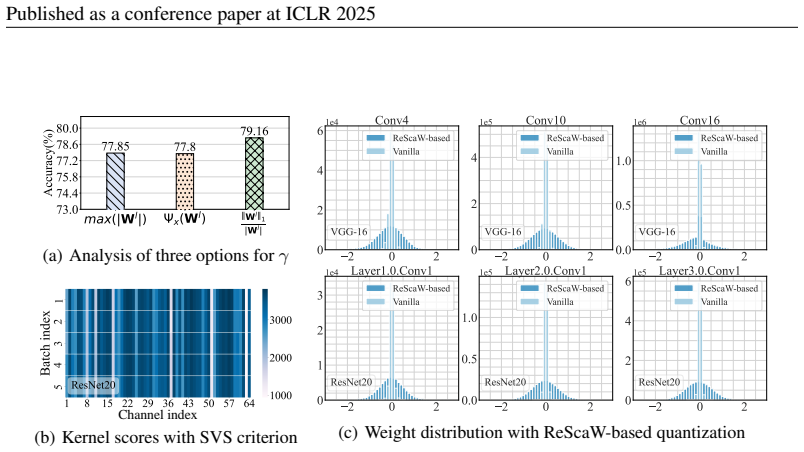
Two objects carry the argument. The first is the rescaling coefficient $\gamma$ in ReScaW: before uniform quantization, each layer's weights are divided by $\gamma$ (default $\gamma=\|W^l\|_1/|W^l|$, the mean absolute weight), so the clamped values occupy the full grid $\{0,\dots,2^b-1\}$ instead of a small corner of it. The second is the SVS pruning score: for each convolutional kernel $f$ in layer $l$, the spikes it produces are averaged over the time window to form $S^l_{f} = \frac{1}{T}\sum_t S^{l,f}[t] = P\Sigma Q^\top$, and the score is $\mathrm{E}_B\big[\sum_i \mathbb{I}(\sigma_i>\epsilon)\big]$ — the expected number of singular values above a tiny threshold $\epsilon=10^{-6}$ over a mini-batch. Kernels with low expected rank of their spatiotemporal spike activity are removed. The surrounding QP-SNN baseline combines these with the Leaky Integrate-and-Fire neuron, spatio-temporal backpropagation for training, and straight-through estimation through the quantization step.
What would settle it
Re-run pruning on the same trained model with $\epsilon = 10^{-3}, 10^{-6}, 10^{-9}$ and with random kernel removal at identical pruning ratios; if post-fine-tune accuracy varies strongly with $\epsilon$ or is no better than random, the SVS score is not identifying task-critical kernels.
Extended reading notes
Core claim
The paper claims that the performance penalty of jointly quantizing and structurally pruning spiking neural networks is mostly caused by two identifiable defects, and that both have simple remedies. Vanilla uniform quantization leaves most integer codes unused because trained weights cluster near zero; dividing weights by a layer-wise scale before mapping them onto the grid recovers bit-width utilization and adds 0.63% accuracy in the quantized-only setting and 4.24% in the full baseline. The existing spiking-channel-activity (SCA) kernel-scoring criterion, which averages membrane-potential magnitudes, gives unstable scores across input batches; replacing it with a score based on the number of significant singular values of each kernel's time-averaged spike map raises the minimum batch-to-batch cosine similarity from roughly 0.87–0.95 to 0.993–1.000 and adds 4.16% in the baseline. Together the two fixes turn the QP-SNN baseline into a model that, at 2 timesteps, reports 95.06% on CIFAR-10 with a 1.61 MB model, 75.13% on CIFAR-100 with 1.79 MB, and 53.07% on TinyImageNet with 2.72 MB, plus 82.10% on DVS-CIFAR10 with 1.61 MB. On ImageNet, it reports the first structured-pruning result for SNNs: 61.36% top-1 accuracy at 8-bit weights in a 13.28 MB model.
Load-bearing premise
The load-bearing premise is that the number of large singular values in a kernel's average spike pattern tells you how much that kernel matters for the task, and that the threshold $\epsilon$ can be fixed once for all layers.
Editorial extensions
If this is right
- On CIFAR-10, the 2-bit, pruned ResNet20 reaches 95.06% accuracy with a 1.61 MB model at 2 timesteps, and the 4-bit variant reaches 95.41%.
- On CIFAR-100, the 2-bit model reports 75.13% accuracy at 1.79 MB, and on TinyImageNet it reports 53.07% at 2.72 MB — higher accuracy than the 27.92 MB prior model it compares against.
- On DVS-CIFAR10, the 8-bit pruned model reports 82.10% accuracy at 1.61 MB, an 88.55% size reduction relative to the compared unstructured pruning method.
- QP-SNN reports the first structured-pruning result on ImageNet for spiking networks: 61.36% top-1 accuracy at 8-bit weights with a 13.28 MB model.
- The same pipeline compresses a spiking transformer 8.28x in model size (to 2.25 MB) and 2.25x in power consumption, with accuracy dropping 2.15 points to 76.94% on CIFAR-100.
- The ablation comparison of operation order shows that quantizing first and then pruning outperforms pruning first by 1.39% on CIFAR-100.
Reading between the lines
- Because ReScaW only rescales weights before rounding, it should transfer to other uniform quantizers and to non-spiking networks whose weights concentrate near zero; the paper does not test that transfer.
- The SVS score is essentially a rank estimate of each kernel's averaged spike pattern, so a direct follow-up would test whether these kernel rankings agree with leave-one-out accuracy changes after fine-tuning, separating 'informative spikes' from 'task-critical kernels'.
- If the reported SOPs and power figures carry over to hardware, the combination of 2-bit weights and structured pruning puts spiking classifiers in the sub-2 MB regime comfortable for microcontrollers, but actual chip-level latency still needs measurement.
Editorial analysis
A structured set of objections, weighed in public.
Referee Report
Summary. The paper proposes QP-SNN, a method that combines uniform weight quantization and structured channel pruning for spiking neural networks. It first builds a QP-SNN baseline using vanilla uniform quantization (Eq. 6) and the SCA pruning criterion (Eq. 7). To recover the accuracy lost by aggressive compression, it introduces two components: ReScaW, a per-layer weight-rescaling strategy applied before quantization (Eq. 10), and SVS, a pruning criterion that counts the singular values of time-averaged spike maps exceeding a threshold epsilon (Eq. 13). Experiments on CIFAR-10, CIFAR-100, TinyImageNet, ImageNet, and DVS-CIFAR10 report favorable accuracy-versus-model-size trade-offs, including a 2-bit CIFAR-10 ResNet20 model at 95.06% accuracy with 1.61 MB, and ablations on CIFAR-100 ResNet20 show that each proposed component improves the baseline.
Significance. If the reported results hold, the paper makes a useful engineering contribution: it demonstrates that the combination of uniform quantization and structured pruning can produce small SNNs with modest accuracy loss, and it reports the first structured-pruning result on ImageNet in the SNN literature. The paper is clearly organized and contains extensive experiments across static and neuromorphic datasets, including a compact algorithm description in Appendix A. However, the central state-of-the-art claim currently rests on uncontrolled comparisons, and the load-bearing SVS criterion is not tested against simple baselines or epsilon variations. These weaknesses are fixable, but they are substantial enough that the current evidence does not fully support the claimed contribution.
major comments (4)
- [§5.2, Table 1] The state-of-the-art claim is not yet supported by the comparisons in Table 1. The table omits quantized-SNN baselines, including the authors' own Q-SNNs (Wei et al., 2024a), which is cited in the related work but not compared. In addition, the CIFAR-10/100 rows compare across different architectures (VGG-16, 6Conv2FC) and timesteps, so the reported gains could be due to the architecture or training recipe rather than to QP-SNN. Please add same-architecture, same-training-protocol baselines, including a version of the QP-SNN baseline with random pruning at identical pruning ratios, and a direct comparison with Q-SNNs.
- [§4.2, Eq. (13); §5.1; Table 4; Appendix F.2] The SVS criterion is the central novelty, but its sensitivity to the threshold epsilon is not tested. In §5.1, epsilon is set to 1e-6 after the statement that the singular values show minimal variation; if the singular values do not have a clear gap, the integer count in Eq. (13) can change abruptly with epsilon, altering the kernel ranking and the pruned accuracy. Moreover, the ablation in Table 4 only compares SVS against SCA, and the near-unity AvgCosS values in Appendix F.2 may reflect low score diversity rather than discriminative power. Please report the distribution of SVS scores per layer, sweep epsilon (e.g., 1e-3, 1e-6, 1e-9), and compare SVS against random pruning, firing-rate-based pruning, and L1-norm-based pruning at the same ratios.
- [§5.2, Table 1; Appendix G, Tables 9-10] The accuracy numbers in Table 1 are non-monotonic in bit width (e.g., CIFAR-10 ResNet20: 8-bit 95.12%, 4-bit 95.41%, 2-bit 95.06%; CIFAR-100: 75.29%, 75.77%, 75.13%), and the per-layer pruning ratios in Appendix G are manually selected and differ across configurations. This confounds the bit-width comparison: the 4-bit model may simply be pruned less aggressively than the 8-bit model. Please state explicitly that the pruning ratios are chosen separately for each bit-width/size setting, and provide a controlled comparison at fixed pruning ratios across bit widths to establish the effect of quantization alone.
- [§4.1, Eq. (9)-(10); Fig. 5(c)] The ReScaW strategy with gamma = ||W^l||_1 / |W^l|, the selected default, scales the weights so that the mean absolute value is 1. This implies that a substantial fraction of weights will be clamped at the [-1,1] boundary in Eq. (10), so the statement in §4.1 that the scaling options 'can scale weights to span [-1,1]' is not accurate for this choice. Please quantify the fraction of clamped weights and the effective bit-width utilization after ReScaW, and discuss why the improvement is not simply an indirect change of the effective learning rate or gradient scale.
minor comments (5)
- [Title and running header] The method name is used inconsistently as QP-SNN and QP-SNNS; please unify the naming.
- [§4.2, Eq. (11)] The notation in Eq. (11) mixes h/w and H/W without defining their relationship; please use consistent case for the spatial dimensions of the spike map.
- [Appendix G, Tables 9-11] The column headers are confusing: model-size values are listed under 'Channel Pruning Ratio'. Please relabel the columns to indicate which bit-width and model-size configuration each pruning-ratio column corresponds to.
- [Appendix G, Model size calculation] The paper keeps the first convolutional layer and the final fully connected layer in full precision, but the effect of this choice on the reported compression and on the accuracy is not analyzed; a sentence or small experiment would help.
- [§5.2, ImageNet paragraph] The claim that this is the first structured-pruning result on ImageNet for SNNs would benefit from a citation to substantiate it, or should be softened to 'to our knowledge'.
Circularity Check
No significant circularity: the reported accuracy gains are measured against external benchmarks, and neither ReScaW nor SVS is defined in terms of the target results.
full rationale
The paper's central claims are not circular. ReScaW's bit-width-utilization gain is structural (rescaling weights so the percentile range spans [-1,1] before quantization, Eq. 9-10), and the claimed accuracy benefit is measured independently in Table 4 (e.g., A vs B, C vs D). The SVS pruning criterion (Eq. 13) is computed from spatiotemporal spike maps via SVD; its effectiveness is evaluated by an ablation against the SCA-based baseline (Table 4, C vs E) and by benchmarks against external published methods on CIFAR, TinyImageNet, ImageNet, and DVS-CIFAR10. The choice of epsilon=1e-6 and the manually selected pruning ratios (Section G) are hyperparameter/selection concerns rather than fitted inputs that force the reported outcomes; no equation in the paper reduces the predicted accuracy to these choices by construction. The self-citations (Wei et al. 2024a,b; Cao et al. 2025) appear only in related-work context and are not load-bearing for the proposed pipeline. The high AvgCosS of SVS could partly reflect low score diversity, but that is an empirical-validity concern, not a circular-derivation one.
Assumptions & free parameters
free parameters (3)
- Per-layer pruning ratios =
0.1 to 0.93 across 25+ layers (Tables 9-11)
- Singular-value threshold epsilon =
1e-6
- Gamma scale form =
1-norm mean value
assumptions (3)
- standard math Any matrix has a singular value decomposition with ordered singular values.
- ad hoc to paper The number of singular values above epsilon indicates the information richness of the spike activity.
- domain assumption Weights are concentrated near zero so the [-1,1] clamp rarely activates; rescaling improves bit-width utilization.
Cite this review
Pith. "Pith review of QP-SNN: Quantized and Pruned Spiking Neural Networks." pith.science (2026). https://pith.science/paper/DUT3THUM
@misc{pith2026250205905,
  author       = {Pith},
  title        = {Pith review of: QP-SNN: Quantized and Pruned Spiking Neural Networks},
  year         = {2026},
  howpublished = {\url{https://pith.science/paper/DUT3THUM}},
  note         = {Machine review of arXiv:2502.05905}
}
read the original abstract
Brain-inspired Spiking Neural Networks (SNNs) leverage sparse spikes to encode information and operate in an asynchronous event-driven manner, offering a highly energy-efficient paradigm for machine intelligence. However, the current SNN community focuses primarily on performance improvement by developing large-scale models, which limits the applicability of SNNs in resource-limited edge devices. In this paper, we propose a hardware-friendly and lightweight SNN, aimed at effectively deploying high-performance SNN in resource-limited scenarios. Specifically, we first develop a baseline model that integrates uniform quantization and structured pruning, called QP-SNN baseline. While this baseline significantly reduces storage demands and computational costs, it suffers from performance decline. To address this, we conduct an in-depth analysis of the challenges in quantization and pruning that lead to performance degradation and propose solutions to enhance the baseline's performance. For weight quantization, we propose a weight rescaling strategy that utilizes bit width more effectively to enhance the model's representation capability. For structured pruning, we propose a novel pruning criterion using the singular value of spatiotemporal spike activities to enable more accurate removal of redundant kernels. Extensive experiments demonstrate that integrating two proposed methods into the baseline allows QP-SNN to achieve state-of-the-art performance and efficiency, underscoring its potential for enhancing SNN deployment in edge intelligence computing.
Figures


Figures from the paper (14 more)



Forward citations
Cited by 1 Pith paper
-
Efficient EEG Seizure Detection Using INT8 Quantization, Channel Pruning, and Spiking Neural Networks
On a shared 1D-CNN baseline for CHB-MIT seizure detection, INT8 quantization cut model size from 1.63 to 0.44 MB and latency by 2.8x with preserved AUC, while SNN conversion was 288x slower on CPU.
Reference graph
Works this paper leans on
-
[3]
Binary event-driven spiking transformer.arXiv preprint arXiv:2501.05904,
Honglin Cao, Zijian Zhou, Wenjie Wei, Ammar Belatreche, Yu Liang, Dehao Zhang, Malu Zhang, Yang Yang, and Haizhou Li. Binary event-driven spiking transformer.arXiv preprint arXiv:2501.05904,
-
[5]
Shikuang Deng, Yuhang Li, Shanghang Zhang, and Shi Gu. Temporal efficient training of spiking neural network via gradient re-weighting.arXiv preprint arXiv:2202.11946,
-
[6]
It can be seen from this figure that only the weight distribution of the first layer is relatively wide, with ana value of 0.7, which corresponds to a bit-width utilization rate of 70.12%. In contrast, theavalue for the subsequent layers are predominantly around 0.2, resulting in a significantly lower bit-width utilization rate of approximately 20.31%. 18...
work page 2025
-
[7]
Towards accurate post-training quantization for vision transformer
11 Published as a conference paper at ICLR 2025 Yifu Ding, Haotong Qin, Qinghua Yan, Zhenhua Chai, Junjie Liu, Xiaolin Wei, and Xianglong Liu. Towards accurate post-training quantization for vision transformer. InProceedings of the 30th ACM international conference on multimedia, pp. 5380–5388,
work page 2025
-
[8]
As can be seen from the figure, the maximumavalue is 0.44 (Conv1), corresponding to a bit width utilization rate of 44.22%. Moreover, theavalue of subsequent layers is mainly around 0.3, resulting in a significantly lower bit width utilization rate of about 30.27%. 19 Published as a conference paper at ICLR 2025 /uni00000013/uni00000011/uni00000018 /uni00...
work page 2025
-
[9]
12 Published as a conference paper at ICLR 2025 Souvik Kundu, Gourav Datta, Massoud Pedram, and Peter A Beerel. Spike-thrift: Towards energy- efficient deep spiking neural networks by limiting spiking activity via attention-guided compres- sion. InProceedings of the IEEE/CVF winter conference on applications of computer vision, pp. 3953–3962,
work page 2025
-
[11]
Yaxin Li, Qi Xu, Jiangrong Shen, Hongming Xu, Long Chen, and Gang Pan. Towards efficient deep spiking neural networks construction with spiking activity based pruning.arXiv preprint arXiv:2406.01072,
-
[12]
Furthermore, we calculatedAvgCosS l for each layer in ResNet20, and themin l AvgCosSl is 0.870
It can be seen from this figure that the SCA-based pruning criterion yields varying scores for the same kernel when process- ing different input samples. Furthermore, we calculatedAvgCosS l for each layer in ResNet20, and themin l AvgCosSl is 0.870. This indicates that the SCA criterion is not robust enough to inputs. 21 Published as a conference paper at...
work page 2025
Show all 32 references
-
[13]
Lite-snn: Designing lightweight and efficient spiking neural network through spatial-temporal compressive network search and joint optimization.arXiv preprint arXiv:2401.14652,
Qianhui Liu, Jiaqi Yan, Malu Zhang, Gang Pan, and Haizhou Li. Lite-snn: Designing lightweight and efficient spiking neural network through spatial-temporal compressive network search and joint optimization.arXiv preprint arXiv:2401.14652,
-
[14]
Integer-valued training and spike- driven inference spiking neural network for high-performance and energy-efficient object detec- tion.arXiv preprint arXiv:2407.20708,
Xinhao Luo, Man Yao, Yuhong Chou, Bo Xu, and Guoqi Li. Integer-valued training and spike- driven inference spiking neural network for high-performance and energy-efficient object detec- tion.arXiv preprint arXiv:2407.20708,
-
[15]
Spinnaker: A 1-w 18-core system- on-chip for massively-parallel neural network simulation.IEEE Journal of Solid-State Circuits, 48(8):1943–1953,
Eustace Painkras, Luis A Plana, Jim Garside, Steve Temple, Francesco Galluppi, Cameron Patter- son, David R Lester, Andrew D Brown, and Steve B Furber. Spinnaker: A 1-w 18-core system- on-chip for massively-parallel neural network simulation.IEEE Journal of Solid-State Circuit...
1943
-
[17]
We still only display the layers that perform pruning operation. In VGG-16, ResNet20, and VGGSNN, themin l AvgCosSl values are 0.997, 0.993, and 1.000 respectively, which exceed the correspondingmin l AvgCosSl when using the SCA-Based pruning criterion by 13.4%, 14.1%, and 5.0...
2009
-
[19]
Ternary spike-based neuromorphic signal processing system.arXiv preprint arXiv:2407.05310, 2024a
Shuai Wang, Dehao Zhang, Ammar Belatreche, Yichen Xiao, Hongyu Qing, Wenjie We, Malu Zhang, and Yang Yang. Ternary spike-based neuromorphic signal processing system.arXiv preprint arXiv:2407.05310, 2024a. Shuai Wang, Dehao Zhang, Kexin Shi, Yuchen Wang, Wenjie Wei, Jibin Wu, a...
-
[20]
Q-snns: Quantized spiking neural networks.arXiv preprint arXiv:2406.13672, 2024a
Wenjie Wei, Yu Liang, Ammar Belatreche, Yichen Xiao, Honglin Cao, Zhenbang Ren, Guoqing Wang, Malu Zhang, and Yang Yang. Q-snns: Quantized spiking neural networks.arXiv preprint arXiv:2406.13672, 2024a. Wenjie Wei, Malu Zhang, Jilin Zhang, Ammar Belatreche, Jibin Wu, Zijing Xu...
-
[21]
Convolutional neural network pruning: A survey
14 Published as a conference paper at ICLR 2025 Sheng Xu, Anran Huang, Lei Chen, and Baochang Zhang. Convolutional neural network pruning: A survey. In2020 39th Chinese Control Conference (CCC), pp. 7458–7463. IEEE,
2025
-
[22]
Spike-driven transformer v2: Meta spiking neural network architecture inspiring the design of next-generation neuromorphic chips.arXiv preprint arXiv:2404.03663, 2024a
Man Yao, Jiakui Hu, Tianxiang Hu, Yifan Xu, Zhaokun Zhou, Yonghong Tian, Bo Xu, and Guoqi Li. Spike-driven transformer v2: Meta spiking neural network architecture inspiring the design of next-generation neuromorphic chips.arXiv preprint arXiv:2404.03663, 2024a. Man Yao, Jiaku...
2017 arXiv
-
[24]
Spikingformer: Spike-driven residual learning for transformer-based spiking neural net- work.arXiv preprint arXiv:2304.11954,
Chenlin Zhou, Liutao Yu, Zhaokun Zhou, Zhengyu Ma, Han Zhang, Huihui Zhou, and Yonghong Tian. Spikingformer: Spike-driven residual learning for transformer-based spiking neural net- work.arXiv preprint arXiv:2304.11954,
-
[25]
Trained ternary quantization.arXiv preprint arXiv:1612.01064,
Chenzhuo Zhu, Song Han, Huizi Mao, and William J Dally. Trained ternary quantization.arXiv preprint arXiv:1612.01064,
-
[27]
Moreover, it is worth noting that the advanced works (Deng et al
It can be seen that QP-SNN exhibits competitive SOPs compared to compression work in the SNN domain, and exhibits extremely low model size due to quantization. Moreover, it is worth noting that the advanced works (Deng et al. (2021); Shi et al. (2024)) focus on unstructured pr...
2021
-
[31]
We also calculateAvgCosS l for each layer in VGGSNN, and themin l AvgCosSl is 0.952
As can be seen from the figure, The kernel score’s fluctuation with input data is better compared to both ResNet and VGG-16, but in deeper layers, the fluctuation is higher. We also calculateAvgCosS l for each layer in VGGSNN, and themin l AvgCosSl is 0.952. 22 Published as a ...
2025
-
[2002]
Pruning filters for efficient convnets.arXiv preprint arXiv:1608.08710,
Hao Li, Asim Kadav, Igor Durdanovic, Hanan Samet, and Hans Peter Graf. Pruning filters for efficient convnets.arXiv preprint arXiv:1608.08710,
-
[2005]
Deep rewiring: Training very sparse deep networks.arXiv preprint arXiv:1711.05136,
Guillaume Bellec, David Kappel, Wolfgang Maass, and Robert Legenstein. Deep rewiring: Training very sparse deep networks.arXiv preprint arXiv:1711.05136,
-
[2012]
A. L. Hodgkin and A. F. Huxley. A quantitative description of membrane current and its ap- plication to conduction and excitation in nerve.The Journal of Physiology, pp. 500–544. doi: 10.1113/jphysiol.1952.sp004764. URLhttp://dx.doi.org/10.1113/jphysiol. 1952.sp004764. Yangfan...
1952 doi
-
[2016]
First, the initial SNN model undergoes ReScaW-based uniform quantization, where weights are rescaled and quantized, followed by iterative training with backpropagation
15 Published as a conference paper at ICLR 2025 A THE OVERALL WORKFLOW OFQP-SNN We present the workflow of QP-SNN in Algorithm 1, which consists of two main steps: quantization and pruning. First, the initial SNN model undergoes ReScaW-based uniform quantization, where weights...
2025
-
[2017]
Estimating or propagating gradients through stochastic neurons for conditional computation.arXiv preprint arXiv:1308.3432,
Yoshua Bengio, Nicholas L ´eonard, and Aaron Courville. Estimating or propagating gradients through stochastic neurons for conditional computation.arXiv preprint arXiv:1308.3432,
-
[2018]
A comprehensive survey on model quantization for deep neural networks in image classification.ACM Transactions on Intelligent Systems and Technology, 14(6):1–50,
13 Published as a conference paper at ICLR 2025 Babak Rokh, Ali Azarpeyvand, and Alireza Khanteymoori. A comprehensive survey on model quantization for deep neural networks in image classification.ACM Transactions on Intelligent Systems and Technology, 14(6):1–50,
2025
-
[2019]
Malu Zhang, Jiadong Wang, Jibin Wu, Ammar Belatreche, Burin Amornpaisannon, Zhixuan Zhang, Venkata Pavan Kumar Miriyala, Hong Qu, Yansong Chua, Trevor E Carlson, et al. Rectified linear postsynaptic potential function for backpropagation in deep spiking neural networks.IEEE tr...
1947
-
[2020]
Bibert: Accurate fully binarized bert.arXiv preprint arXiv:2203.06390,
Haotong Qin, Yifu Ding, Mingyuan Zhang, Qinghua Yan, Aishan Liu, Qingqing Dang, Ziwei Liu, and Xianglong Liu. Bibert: Accurate fully binarized bert.arXiv preprint arXiv:2203.06390,
-
[2021]
Autoaugment: Learning augmentation policies from data.arXiv preprint arXiv:1805.09501,
Ekin D Cubuk, Barret Zoph, Dandelion Mane, Vijay Vasudevan, and Quoc V Le. Autoaugment: Learning augmentation policies from data.arXiv preprint arXiv:1805.09501,
-
[2022]
Improved regularization of convolutional neural networks with cutout.arXiv preprint arXiv:1708.04552,
Terrance DeVries. Improved regularization of convolutional neural networks with cutout.arXiv preprint arXiv:1708.04552,
-
[2023]
Scaling deep spiking neural networks with binary stochastic activations
Deboleena Roy, Indranil Chakraborty, and Kaushik Roy. Scaling deep spiking neural networks with binary stochastic activations. In2019 IEEE International Conference on Cognitive Computing (ICCC), pp. 50–58. IEEE, 2019a. Kaushik Roy, Akhilesh Jaiswal, and Priyadarshini Panda. To...
-
[2024]
Neuromor- phic data augmentation for training spiking neural networks
Yuhang Li, Youngeun Kim, Hyoungseob Park, Tamar Geller, and Priyadarshini Panda. Neuromor- phic data augmentation for training spiking neural networks. InComputer Vision–ECCV 2022: 17th European Conference, Tel Aviv, Israel, October 23–27, 2022, Proceedings, Part VII, pp. 631–...
2022
Reviewed August 8, 2026 · model on record in the stance chip above.
Discussion (0). Continue with ORCID to comment.