REVIEW 6 major objections 6 minor 87 references
Memory Offloading for Large Language Model Inference with Latency SLO Guarantees
T0 review · 6 major / 6 minor · reviewed 2026-08-08 · deepseek-v4-flash
Pith's one-line read Select-N shows LLM memory offloading can meet latency SLOs by turning the memory/latency tradeoff into a single tunable interval, using 2.37x more host memory than FlexGen and raising throughput 1.85x.
desk verdict A real engineering advance on SLO-aware offloading with an honest evaluation, but the central determinism assumption and the under-derived interval formula need referee attention before the guarantee claims can be trusted. read the letter →
The pith
A machine-rendered reading of the paper's core claim, the machinery that carries it, and where it could break.
The reading
What carries the argument
The central object is the offloading interval, defined as the number of consecutive layers kept in GPU memory before one layer's state is offloaded to host memory. The load-bearing mechanism is that offloaded state is prefetched when compute reaches the first layer of the interval, so the transfer time of one offloaded layer is overlapped with the computation of several layers, not just one as in DeepSpeed and FlexGen. The paper argues this works because each decoder layer's compute time is deterministic, depending only on batch size and sequence length, allowing an offline performance record to predict which interval will meet a given SLO. The per-bus coordinator then uses the minimum and maximum valid intervals for each GPU, plus an estimate of PCIe bandwidth consumed per interval, to pick intervals that keep all GPUs within their SLOs while maximizing aggregate host memory use.
What would settle it
A direct test is to run a long serving workload under sustained GPU load and measure per-layer compute time distributions; if any layer's compute time drifts by more than the SLO slack used by Select-N, and SLO violations appear despite correct interval selection, the determinism premise is falsified. Alternatively, instrument a production server to record actual per-layer times across different thermal and clock states and show they vary enough to break the offline decision.
Extended reading notes
Core claim
Select-N's central claim is that the tension between meeting latency SLOs and maximizing host memory usage reduces to picking one integer: the offloading interval. For an interval of i, the state of every i-th decoder layer is offloaded to host memory, and the transfer is prefetched when computation begins on the first layer of that interval, so the load of one layer is hidden by the compute of i layers. Because each decoder layer has the same structure, the same operations, and the same input size within a phase, the paper asserts that per-layer compute time is deterministic for a given model, batch size, and sequence length. This determinism lets an offline analyzer build a performance record mapping SLO, batch size, and sequence length to the optimal interval, while a per-bus coordinator adjusts intervals at each inference iteration when GPUs share PCIe bandwidth. The paper reports that Select-N consistently meets TTFT and TPOT SLOs across batch sizes and contention scenarios, uses 2.37x more host memory than FlexGen under the same SLOs, and improves serving throughput over FlexGen by up to 1.85x, while also enabling models whose memory demands exceed GPU capacity.
Load-bearing premise
The load-bearing premise is that each decoder layer's compute time is deterministic and depends only on batch size and sequence length, so an offline performance record remains accurate during online serving; if GPU clocks, thermal state, or other contention perturb per-layer compute time beyond the SLO slack, the chosen interval no longer guarantees the SLO.
Editorial extensions
If this is right
- If Select-N's claims hold, LLM serving can meet TTFT and TPOT SLOs while offloading far more state to host memory, cutting GPU memory cost without sacrificing responsiveness.
- The same offloading interval mechanism can support models larger than GPU memory, since the interval can be reduced until enough layers are offloaded to fit the model.
- Separating prefill and decoding becomes more effective, because the analyzer can assign different optimal intervals to the compute-intensive prefill phase and the memory-intensive decoding phase.
- Under PCIe bandwidth contention, dynamic per-iteration interval adjustment should keep all GPUs sharing a bus within their SLOs, whereas static offloading schemes like FlexGen can violate SLOs at smaller batch sizes.
- Because larger memory savings translate into more GPU blocks for tokens, Select-N supports larger batch sizes, longer input sequences, and longer output sequences than a fixed-portion offloader at the same SLO.
Reading between the lines
- If the deterministic per-layer compute time premise holds across a wider range of models and hardware, the offline-record approach could be reused as a cheap admission-control signal: a request whose required interval is below the GPU's feasible minimum can be rejected before entering the queue.
- The paper does not address slow drift in compute time from GPU clock throttling, thermal state, or co-tenant interference; a natural testable extension is to add a lightweight online re-measurement that adjusts the interval when observed layer times drift beyond the SLO slack.
- The interval abstraction could combine with KV-cache offloading policies, since Select-N currently bounds host memory usage by layer-state transfers while leaving KV-cache management to the underlying page-based allocator; unifying both under one memory budget is a plausible next step.
Editorial analysis
A structured set of objections, weighed in public.
Referee Report
Summary. The paper presents Select-N, a memory-offloading system for decoder-only LLM inference that introduces an 'offloading interval' knob to trade host-memory usage against latency SLOs. The design assumes per-layer compute time is deterministic, uses an offline analyzer to build a performance record mapping SLOs, batch sizes, and sequence lengths to the smallest SLO-satisfying interval, and adds a per-bus coordinator to adjust intervals under PCIe bandwidth contention. Evaluations on A10 GPUs with OPT, Qwen2-beta, and LLaMA models claim that Select-N consistently meets TTFT and TPOT SLOs, uses 2.37x more host memory than a modified SLO-aware FlexGen, and improves throughput by up to 1.85x.
Significance. If the deterministic-compute premise holds, the offloading-interval abstraction is a simple and practical way to expose the SLO/memory trade-off, and Select-N is a plausible improvement over DeepSpeed and FlexGen for latency-bounded serving. The paper has clear strengths: it provides a concrete two-stage design, an implementation on vLLM, a comparison against a reasonable SLO-aware FlexGen variant, explicit treatment of PCIe contention, and a commitment to open-sourcing. However, the central guarantee is only as strong as the unstated determinism model and the un-derived interval formula, and the evaluation does not currently demonstrate tail-latency or statistical robustness. The headline memory and throughput ratios are presented as general results even though they are per-configuration or best-case numbers, which overstates the empirical support. The contribution is potentially significant for systems practice, but the paper needs a careful revision of its formal analysis and evaluation reporting.
major comments (6)
- [4.4] The expression L_offload = floor(t_compute*(1+delta)/t_trans) and interval = floor(L/L_offload) is presented without a derivation, and the definition of delta ('the SLO quotient over the computation time without offloading') is ambiguous. As written, the formula does not follow from the stated timing model: if no-offload total compute time is L*t_compute and the SLO is a multiple of it, the number of offloadable transfers should be bounded by the SLO slack divided by t_trans, yielding an L_offload that depends on L, whereas the paper's expression makes L_offload independent of L. Please derive the formula from a precise timing model, define delta explicitly, and state what happens when t_trans > t_compute*(1+delta), where the floor gives zero and the subsequent interval formula becomes undefined.
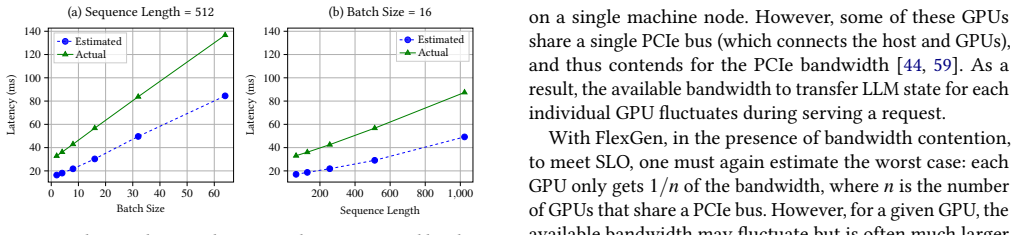
- [4.3 / Figure 7] The mechanism inserts a synchronization point before each offloaded layer and performs both a host-to-GPU load and a GPU-to-host store per offloaded layer. The critical-path cost therefore includes synchronization overhead and possible contention between the load and store streams, yet the offline record appears to account only for a single CPU-to-GPU transfer time t_trans. Please specify how the interval formula accounts for these overheads, or present experiments showing that they are negligible for the evaluated models and batch sizes.
- [4.3-4.5] The SLO guarantee rests on treating per-layer compute time as deterministic and stationary, but the paper provides no variance or repetition data for t_compute, and the online coordinator adjusts only for PCIe bandwidth contention, not for compute-time drift from GPU clock throttling, thermal state, or other sources. Given the claim that Select-N 'consistently meets SLOs,' please report the distribution of per-layer compute times and of end-to-end latencies over repeated runs (e.g., p50 and p99), and either extend the coordinator to handle compute-time drift or state explicitly the conditions under which the deterministic assumption holds.
- [5.3 / Figure 10] The headline '2.37x more host memory' is not an aggregate result. In Figure 10(a), the Select-N/FlexGen memory ratio is about 1.66 at batch size 4, 1.62 at batch size 8, 2.37 at batch size 16, and 2.15 at batch size 32; only the batch-16 point matches the 2.37x figure. Similarly, the '1.85x throughput' is described in Section 5.3 as the best case but is presented in the abstract and introduction as a general result. Please report per-configuration numbers accurately and qualify the abstract and introduction accordingly.
- [5.2 / Figures 9, 12, 13] SLO compliance is a tail-latency property, but the evaluation reports only point values with no error bars, percentiles, repetition counts, or confidence intervals for the latency measurements. This is a load-bearing issue for the central claim of 'consistently meets SLOs.' Please add statistical summaries across multiple runs for the SLO experiments, at minimum p50 and p99 for TTFT and TPOT in Figures 9, 12, and 13.
- [5.1] The workload is generated by a 'randomly designed dataloader,' and the assertion that real-world workloads such as ShareGPT can equally be supported is not demonstrated. Since the paper's contribution is a production-oriented SLO guarantee, please add at least one trace-based or real-workload evaluation, or clearly scope the claims to synthetic workloads.
minor comments (6)
- [4.2] The workflow subtracts waiting time from the SLO, but the paper does not describe how waiting time is measured or bounded; please clarify the queueing model used for this adjustment.
- [4.4] The statement that 'if their product exceeds a certain threshold, the optimal offloading interval becomes 1' is not justified, and the threshold is not defined; without this, the claim that at most 100 pairs need sampling is hard to verify.
- [5.5 / Figure 12] The figure legend includes 'Select-N-OPT' and 'Select-N-LLaMA' curves, but the text discusses only the FlexGen-OPT comparison; please clarify what each curve represents and how the LLaMA task's SLO is evaluated.
- [5.5] The text says that it is not feasible to run a naive no-offloading baseline for models that exceed GPU memory, yet the section still reports SLO compliance against a 100 ms TPOT threshold; please state explicitly that this threshold is an external choice rather than a percentage of naive execution time.
- [Various] The manuscript contains several typos, including 'basd' in Section 4.2, 'Obvervation' in Sections 3.2 and 3.3, 'seperation' in Section 4.4, and 'amout' in Section 2.2; please proofread carefully.
- [References] References [28] and [29] are duplicated; please remove the duplicate.
Circularity Check
No significant circularity: Select-N's interval is an explicit SLO-tuned knob, and its memory/throughput gains are independent empirical comparisons.
full rationale
No load-bearing circular step is present. Select-N's interval-selection formula in §4.4 is an explicit design rule: given measured per-layer compute time t_compute, transfer time t_trans, and the target SLO encoded in δ, it computes the smallest offloading interval that should keep the transfer hidden within compute time plus SLO slack. The SLO-compliance measurements in §5.2 are a check that the implementation honors this rule on the same hardware, not a scientific prediction derived from the same fitted values; the interval choice is a tuning mechanism, not a claimed first-principles result. The substantive comparative claims—2.37× more host memory and 1.85× throughput over FlexGen—are empirical outcomes of a head-to-head evaluation, not consequences of the tuning formula itself. The paper's determinism assumption is a genuine correctness risk (the evaluation reports no variance or percentiles, and the coordinator only adjusts for PCIe contention, not compute-time drift), but that is an empirical/robustness concern, not circularity. No self-citation is load-bearing; the only same-group citation (Llumnix, [62]) appears in related work and does not justify the design or the interval-selection rule.
Assumptions & free parameters
assumptions (3)
- domain assumption The computation time of each decoder layer is deterministic and identical across layers and iterations for a fixed batch size and sequence length.
- domain assumption Offline measurements of per-layer compute and transfer time on a dedicated server transfer to online servers aside from PCIe contention.
- ad hoc to paper The formula L_offload = floor(t_compute(1+delta)/t_trans) and interval = floor(L/L_offload) correctly characterizes SLO feasibility.
Cite this review
Pith. "Pith review of Memory Offloading for Large Language Model Inference with Latency SLO Guarantees." pith.science (2026). https://pith.science/paper/DWL4V6KA
@misc{pith2026250208182,
  author       = {Pith},
  title        = {Pith review of: Memory Offloading for Large Language Model Inference with Latency SLO Guarantees},
  year         = {2026},
  howpublished = {\url{https://pith.science/paper/DWL4V6KA}},
  note         = {Machine review of arXiv:2502.08182}
}
read the original abstract
Offloading large language models (LLMs) state to host memory during inference promises to reduce operational costs by supporting larger models, longer inputs, and larger batch sizes. However, the design of existing memory offloading mechanisms does not take latency service-level objectives (SLOs) into consideration. As a result, they either lead to frequent SLO violations or underutilize host memory, thereby incurring economic loss and thus defeating the purpose of memory offloading. This paper presents Select-N, a latency-SLO-aware memory offloading system for LLM serving. A key challenge in designing Select-N is to reconcile the tension between meeting SLOs and maximizing host memory usage. Select-N overcomes it by exploiting a unique characteristic of modern LLMs: during serving, the computation time of each decoder layer is deterministic. Leveraging this, Select-N introduces offloading interval, an internal tunable knob that captures the tradeoff between SLOs and host memory usage, thereby reducing the aforementioned challenge to pick an optimal offloading interval. With that, Select-N proposes a two-stage approach to automatically pick the offloading interval. The first stage is offline that generates the range of optimal offloading interval, while the second stage adjusts offloading interval at the granularity of inference iteration based on runtime hardware status. Our evaluation shows that Select-N consistently meets SLOs and improves the serving throughput over existing mechanisms by 1.85X due to maximizing the use of host memory.
Figures


Figures from the paper (10 more)


Reference graph
Works this paper leans on
-
[1]
URL https://huggingface.co/ docs/accelerate/index
Hugging face accelerate., 2025. URL https://huggingface.co/ docs/accelerate/index
2025
-
[2]
URL https://sharegpt.com/
Sharegpt teams., 2025. URL https://sharegpt.com/
2025
-
[3]
A. Acharya, B. Singh, and N. Onoe. Llm based generation of item- description for recommendation system. In Proceedings of the 17th ACM Conference on Recommender Systems, RecSys ’23, page 1204–1207, New York, NY, USA, 2023. Association for Computing Machinery. ISBN 9798400702419. doi: 10.1145/3604915.3610647. URL https: //doi.org/10.1145/3604915.3610647
-
[4]
SYMPHONY: Improving Memory Management for LLM Inference Workloads
S. Agarwal, A. Mao, A. Akella, and S. Venkataraman. Symphony: Im- proving memory management for llm inference workloads, 2024. URL https://arxiv.org/abs/2412.16434
work page Pith review arXiv 2024
-
[5]
A. Agrawal, A. Panwar, J. Mohan, N. Kwatra, B. S. Gulavani, and R. Ram- jee. Sarathi: Efficient llm inference by piggybacking decodes with chun- ked prefills, 2023. URL https://arxiv.org/abs/2308.16369
arXiv 2023
-
[6]
K. Alizadeh, I. Mirzadeh, D. Belenko, K. Khatamifard, M. Cho, C. C. D. Mundo, M. Rastegari, and M. Farajtabar. Llm in a flash: Efficient large language model inference with limited memory, 2024. URL https://arxiv.org/abs/2312.11514
arXiv 2024
-
[7]
Alomari, N
A. Alomari, N. Idris, A. Q. M. Sabri, and I. Alsmadi. Deep reinforcement and transfer learning for abstractive text summa- rization: A review. Computer Speech & Language , 71:101276,
-
[8]
R. Y. Aminabadi, S. Rajbhandari, A. A. Awan, C. Li, D. Li, E. Zheng, O. Ruwase, S. Smith, M. Zhang, J. Rasley, and Y. He. Deepspeed- infer- ence: Enabling efficient inference of transformer models at unprece- dented scale. In SC22: International Conference for High Performance Computing, Networking, Storage and Analysis, pages 1–15, 2022. doi: 10.1109/SC4...
arXiv 2022
Show all 87 references
-
[9]
Bambhaniya, R
A. Bambhaniya, R. Raj, G. Jeong, S. Kundu, S. Srinivasan, M. Elavazha- gan, M. Kumar, and T. Krishna. Demystifying platform requirements for diverse llm inference use cases, 2024. URL https://arxiv.org/ abs/2406.01698
2024 arXiv
-
[10]
Cao and L
S. Cao and L. Wang. Awesome: Gpu memory-constrained long doc- ument summarization using memory mechanism and global salient content, 2023. URL https://arxiv.org/abs/2305.14806
2023 arXiv
-
[11]
M. Chen, J. Tworek, H. Jun, Q. Yuan, H. P. de Oliveira Pinto, J. Ka- plan, H. Edwards, Y. Burda, N. Joseph, G. Brockman, A. Ray, R. Puri, G. Krueger, M. Petrov, H. Khlaaf, G. Sastry, P. Mishkin, B. Chan, S. Gray, N. Ryder, M. Pavlov, A. Power, L. Kaiser, M. Bavarian, C. Winter...
2021 arXiv
-
[12]
S. Chen, Z. Guan, Y. Liu, and P. B. Gibbons. Practical offloading for fine-tuning llm on commodity gpu via learned subspace projectors,
-
[13]
Cheng, Y
R. Cheng, Y. Peng, Y. Lai, X. Wei, R. Chen, and H. Chen. Kunserve: Elastic and efficient large language model serving with parameter- centric memory management, 2024. URL https://arxiv.org/abs/ 2412.18169
2024
-
[14]
Choquette, W
J. Choquette, W. Gandhi, O. Giroux, N. Stam, and R. Krashinsky. Nvidia a100 tensor core gpu: Performance and innovation. IEEE Micro, 41(2): 29–35, 2021. doi: 10.1109/MM.2021.3061394
2021
-
[15]
Crankshaw, X
D. Crankshaw, X. Wang, G. Zhou, M. J. Franklin, J. E. Gonza- lez, and I. Stoica. Clipper: A Low-Latency online prediction serving system. In 14th USENIX Symposium on Networked Systems Design and Implementation (NSDI 17) , pages 613–627, Boston, MA, Mar. 2017. USENIX Associatio...
2017
-
[16]
Crankshaw, G.-E
D. Crankshaw, G.-E. Sela, X. Mo, C. Zumar, I. Stoica, J. Gonzalez, and A. Tumanov. Inferline: latency-aware provisioning and scaling for pre- diction serving pipelines. In Proceedings of the 11th ACM Symposium on Cloud Computing , SoCC ’20, page 477–491, New York, NY, USA,
-
[17]
S. K. Dam, C. S. Hong, Y. Qiao, and C. Zhang. A complete survey on llm-based ai chatbots, 2024. URL https://arxiv.org/abs/2406. 16937
2024
-
[18]
T. Dao. Flashattention-2: Faster attention with better parallelism and work partitioning, 2023. URL https://arxiv.org/abs/2307. 08691
2023
-
[19]
T. Dao, D. Fu, S. Ermon, A. Rudra, and C. Ré. Flashattention: Fast and memory-efficient exact attention with io-awareness. In S. Koyejo, S. Mohamed, A. Agarwal, D. Belgrave, K. Cho, and A. Oh, editors, Advances in Neural Information Processing Systems , volume 35, pages 16344–...
2022
-
[20]
Donthi, M
S. Donthi, M. Spencer, O. Patel, J. Doh, and E. Rodan. Improving llm abilities in idiomatic translation, 2024. URL https://arxiv.org/ abs/2407.03518
2024 arXiv
-
[21]
J. Duan, S. Zhang, Z. Wang, L. Jiang, W. Qu, Q. Hu, G. Wang, Q. Weng, H. Yan, X. Zhang, X. Qiu, D. Lin, Y. Wen, X. Jin, T. Zhang, and P. Sun. Ef- ficient training of large language models on distributed infrastructures: A survey, 2024. URL https://arxiv.org/abs/2407.20018
2024 arXiv
-
[22]
Elliott, M
M. Elliott, M. Luciano, and J. Fortes. Integrating large language models and the idigbio portal for conversational data exploration and retrieval. Biodiversity Information Science and Standards , 8:e142696, 2024
2024
-
[23]
Gambhir and V
M. Gambhir and V. Gupta. Recent automatic text summarization techniques: a survey. Artificial Intelligence Review, 47(1):1–66, 2017
2017
-
[24]
B. Gao, Z. He, P. Sharma, Q. Kang, D. Jevdjic, J. Deng, X. Yang, Z. Yu, and P. Zuo. Cost-Efficient large language model serv- ing for multi-turn conversations with CachedAttention. In 2024 USENIX Annual Technical Conference (USENIX ATC 24) , pages 111– 126, Santa Clara, CA, Ju...
2024
-
[25]
S. Gao, Y. Chen, and J. Shu. Fast state restoration in llm serving with hcache, 2024. URL https://arxiv.org/abs/2410.05004
2024 arXiv
-
[26]
Griggs, X
T. Griggs, X. Liu, J. Yu, D. Kim, W.-L. Chiang, A. Cheung, and I. Stoica. Mélange: Cost efficient large language model serving by exploiting gpu heterogeneity, 2024. URL https://arxiv.org/abs/2404.14527
2024 arXiv
-
[27]
Q. Gu. Llm-based code generation method for golang compiler testing. In Proceedings of the 31st ACM Joint European Software Engineering Conference and Symposium on the Foundations of Software Engineering , ESEC/FSE 2023, page 2201–2203, New York, NY, USA, 2023. Association for...
2023
-
[28]
Gujarati, R
A. Gujarati, R. Karimi, S. Alzayat, W. Hao, A. Kaufmann, Y. Vigfusson, and J. Mace. Serving DNNs like clockwork: Performance predictability from the bottom up. In 14th USENIX Symposium on Operating Sys- tems Design and Implementation (OSDI 20) , pages 443–462. USENIX Associati...
2020
-
[29]
Gujarati, R
A. Gujarati, R. Karimi, S. Alzayat, W. Hao, A. Kaufmann, Y. Vigfusson, and J. Mace. Serving DNNs like clockwork: Performance predictability 14 from the bottom up. In 14th USENIX Symposium on Operating Sys- tems Design and Implementation (OSDI 20) , pages 443–462. USENIX Associ...
2020
-
[30]
Holmes, M
C. Holmes, M. Tanaka, M. Wyatt, A. A. Awan, J. Rasley, S. Rajbhan- dari, R. Y. Aminabadi, H. Qin, A. Bakhtiari, L. Kurilenko, and Y. He. Deepspeed-fastgen: High-throughput text generation for llms via mii and deepspeed-inference, 2024. URL https://arxiv.org/abs/ 2401.08671
2024 arXiv
-
[31]
S. Hong, Y. Lin, B. Liu, B. Liu, B. Wu, C. Zhang, C. Wei, D. Li, J. Chen, J. Zhang, J. Wang, L. Zhang, L. Zhang, M. Yang, M. Zhuge, T. Guo, T. Zhou, W. Tao, X. Tang, X. Lu, X. Zheng, X. Liang, Y. Fei, Y. Cheng, Z. Gou, Z. Xu, and C. Wu. Data interpreter: An llm agent for data ...
2024 arXiv
-
[33]
C. Hu, H. Huang, L. Xu, X. Chen, J. Xu, S. Chen, H. Feng, C. Wang, S. Wang, Y. Bao, N. Sun, and Y. Shan. Inference without interference: Disaggregate llm inference for mixed downstream workloads, 2024. URL https://arxiv.org/abs/2401.11181
2024 arXiv
-
[34]
E. J. Hu, Y. Shen, P. Wallis, Z. Allen-Zhu, Y. Li, S. Wang, L. Wang, and W. Chen. Lora: Low-rank adaptation of large language models, 2021. URL https://arxiv.org/abs/2106.09685
2021 arXiv
-
[35]
Jayaram Subramanya, D
S. Jayaram Subramanya, D. Arfeen, S. Lin, A. Qiao, Z. Jia, and G. R. Ganger. Sia: Heterogeneity-aware, goodput-optimized ml-cluster scheduling. In Proceedings of the 29th Symposium on Operating Systems Principles , SOSP ’23, page 642–657, New York, NY, USA,
-
[36]
Jiang, Y
X. Jiang, Y. Zhou, S. Cao, I. Stoica, and M. Yu. Neo: Saving gpu mem- ory crisis with cpu offloading for online llm inference, 2024. URL https://arxiv.org/abs/2411.01142
2024 arXiv
-
[37]
H. Jin, R. Lai, C. F. Ruan, Y. Wang, T. C. Mowry, X. Miao, Z. Jia, and T. Chen. A system for microserving of llms, 2024. URL https: //arxiv.org/abs/2412.12488
2024 arXiv
-
[38]
Y. Jin, T. Wang, H. Lin, M. Song, P. Li, Y. Ma, Y. Shan, Z. Yuan, C. Li, Y. Sun, T. Wu, X. Chu, R. Huan, L. Ma, X. You, W. Zhou, Y. Ye, W. Liu, X. Xu, Y. Zhang, T. Dong, J. Zhu, Z. Wang, X. Ju, J. Song, H. Cheng, X. Li, J. Ding, H. Guo, and Z. Zhang. P/d-serve: Serving disaggr...
2024 arXiv
-
[39]
Kasner and O
Z. Kasner and O. Dusek. Beyond traditional benchmarks: Analyz- ing behaviors of open LLMs on data-to-text generation. In L.-W. Ku, A. Martins, and V. Srikumar, editors,Proceedings of the 62nd Annual Meeting of the Association for Computational Linguistics (Volume 1: Long Paper...
2024 doi
-
[40]
Koshkin, K
R. Koshkin, K. Sudoh, and S. Nakamura. Transllama: Llm-based simul- taneous translation system, 2024. URL https://arxiv.org/abs/ 2402.04636
2024 arXiv
-
[41]
Koziolek, S
H. Koziolek, S. Grüner, R. Hark, V. Ashiwal, S. Linsbauer, and N. Es- kandani. Llm-based and retrieval-augmented control code genera- tion. In Proceedings of the 1st International Workshop on Large Lan- guage Models for Code, LLM4Code ’24, page 22–29, New York, NY, USA,
-
[42]
W. Kwon, Z. Li, S. Zhuang, Y. Sheng, L. Zheng, C. H. Yu, J. Gon- zalez, H. Zhang, and I. Stoica. Efficient memory management for large language model serving with pagedattention. In Proceedings of the 29th Symposium on Operating Systems Principles , SOSP ’23, page 611–626, New...
2023
-
[43]
W. Lee, J. Lee, J. Seo, and J. Sim. InfiniGen: Efficient generative inference of large language models with dynamic KV cache man- agement. In 18th USENIX Symposium on Operating Systems Design and Implementation (OSDI 24) , pages 155–172, Santa Clara, CA, July
-
[44]
C. Li, Y. Sun, L. Jin, L. Xu, Z. Cao, P. Fan, D. Kaeli, S. Ma, Y. Guo, and J. Yang. Priority-based pcie scheduling for multi-tenant multi-gpu systems. IEEE Computer Architecture Letters, 18(2):157–160, 2019. doi: 10.1109/LCA.2019.2955119
2019
-
[45]
Li and Y
K. Li and Y. Zhang. Planning first, question second: An LLM-guided method for controllable question generation. In L.-W. Ku, A. Mar- tins, and V. Srikumar, editors, Findings of the Association for Com- putational Linguistics: ACL 2024 , pages 4715–4729, Bangkok, Thai- land, Au...
2024 doi
-
[46]
ISBN 9798400705793
Association for Computing Machinery. ISBN 9798400705793. doi: 10.1145/3643795.3648384. URL https://doi.org/10.1145/ 3643795.3648384
-
[47]
B. Lin, C. Zhang, T. Peng, H. Zhao, W. Xiao, M. Sun, A. Liu, Z. Zhang, L. Li, X. Qiu, S. Li, Z. Ji, T. Xie, Y. Li, and W. Lin. Infinite-llm: Efficient llm service for long context with distattention and distributed kvcache,
-
[48]
S.-C. Liu, S. Wang, W. Lin, C.-W. Hsiung, Y.-C. Hsieh, Y.-P. Cheng, S.-H. Luo, T. Chang, and J. Zhang. Jarvix: A llm no code plat- form for tabular data analysis and optimization, 2023. URL https: //arxiv.org/abs/2312.02213
2023 arXiv
-
[49]
ISBN 978-1-939133-40-3
USENIX Association. ISBN 978-1-939133-40-3. URL https: //www.usenix.org/conference/osdi24/presentation/lee
-
[50]
P. Ma, R. Ding, S. Wang, S. Han, and D. Zhang. InsightPilot: An LLM-empowered automated data exploration system. In Y. Feng and E. Lefever, editors, Proceedings of the 2023 Conference on Em- pirical Methods in Natural Language Processing: System Demonstra- tions, pages 346–352...
2023 doi
-
[51]
Patel, E
P. Patel, E. Choukse, C. Zhang, A. Shah, Í. Goiri, S. Maleki, and R. Bianchini. Splitwise: Efficient generative llm inference using phase splitting. In 2024 ACM/IEEE 51st Annual International Sym- posium on Computer Architecture (ISCA) , pages 118–132, 2024. doi: 10.1109/ISCA5...
2024
-
[52]
Z. Li, L. Zheng, Y. Zhong, V. Liu, Y. Sheng, X. Jin, Y. Huang, Z. Chen, H. Zhang, J. E. Gonzalez, and I. Stoica. AlpaServe: Statistical multiplex- ing with model parallelism for deep learning serving. In 17th USENIX Symposium on Operating Systems Design and Implementation (OSD...
2023
-
[53]
R. Peng, K. Liu, P. Yang, Z. Yuan, and S. Li. Embedding-based retrieval with llm for effective agriculture information extracting from unstruc- tured data, 2023. URL https://arxiv.org/abs/2308.03107
2023 arXiv
-
[54]
URL https://arxiv.org/abs/2401.02669
-
[55]
Radford, J
A. Radford, J. Wu, R. Child, D. Luan, D. Amodei, I. Sutskever, et al. Language models are unsupervised multitask learners. OpenAI blog, 1 (8):9, 2019
2019
-
[56]
Y. Lu, W. Zhu, L. Li, Y. Qiao, and F. Yuan. Llamax: Scaling linguis- tic horizons of llm by enhancing translation capabilities beyond 100 languages, 2024. URL https://arxiv.org/abs/2407.05975
2024 arXiv
-
[57]
H. Shen, L. Chen, Y. Jin, L. Zhao, B. Kong, M. Philipose, A. Krish- namurthy, and R. Sundaram. Nexus: a gpu cluster engine for ac- celerating dnn-based video analysis. In Proceedings of the 27th ACM Symposium on Operating Systems Principles , SOSP ’19, page 322–337, New York, ...
2019
-
[58]
Sheng, L
Y. Sheng, L. Zheng, B. Yuan, Z. Li, M. Ryabinin, B. Chen, P. Liang, C. Re, I. Stoica, and C. Zhang. FlexGen: High-throughput gener- ative inference of large language models with a single GPU. In A. Krause, E. Brunskill, K. Cho, B. Engelhardt, S. Sabato, and J. Scar- lett, edit...
2023
-
[59]
Patke, D
A. Patke, D. Reddy, S. Jha, H. Qiu, C. Pinto, C. Narayanaswami, Z. Kalbarczyk, and R. Iyer. Queue management for slo-oriented large language model serving. In Proceedings of the 2024 ACM Sympo- sium on Cloud Computing , SoCC ’24, page 18–35, New York, NY, USA,
2024
-
[60]
ISBN 9798400712869
Association for Computing Machinery. ISBN 9798400712869. doi: 10.1145/3698038.3698523. URL https://doi.org/10.1145/ 3698038.3698523
-
[61]
Strati, S
F. Strati, S. Mcallister, A. Phanishayee, J. Tarnawski, and A. Klimovic. Déjàvu: Kv-cache streaming for fast, fault-tolerant generative llm serv- ing, 2024. URL https://arxiv.org/abs/2403.01876
2024 arXiv
-
[62]
A. Qiao, S. K. Choe, S. J. Subramanya, W. Neiswanger, Q. Ho, H. Zhang, G. R. Ganger, and E. P. Xing. Pollux: Co-adaptive cluster scheduling for goodput-optimized deep learning. In 15th USENIX Symposium on 15 Operating Systems Design and Implementation (OSDI 21) , pages 1–18. U...
2021
-
[63]
Taori, I
R. Taori, I. Gulrajani, T. Zhang, Y. Dubois, X. Li, C. Guestrin, P. Liang, and T. B. Hashimoto. Stanford alpaca: an instruction-following llama model (2023). URL https://github. com/tatsu-lab/stanford_alpaca, 1(9), 2023
2023
-
[64]
J. Ren, S. Rajbhandari, R. Y. Aminabadi, O. Ruwase, S. Yang, M. Zhang, D. Li, and Y. He. ZeRO-Offload: Democratizing Billion-Scale model training. In 2021 USENIX Annual Technical Conference (USENIX ATC 21) , pages 551–564. USENIX Association, July 2021. ISBN 978-1-939133-23-6....
2021
-
[65]
Ugare, T
S. Ugare, T. Suresh, H. Kang, S. Misailovic, and G. Singh. Syncode: Llm generation with grammar augmentation, 2024. URL https: //arxiv.org/abs/2403.01632
2024 arXiv
-
[66]
Vaswani, N
A. Vaswani, N. Shazeer, N. Parmar, J. Uszkoreit, L. Jones, A. N. Gomez, L. Kaiser, and I. Polosukhin. Attention is all you need.(nips), 2017. arXiv preprint arXiv:1706.03762, 10:S0140525X16001837, 2017
2017 arXiv
-
[67]
M. Side, F. Yao, and Z. Zhang. Lockeddown: Exploiting contention on host-gpu pcie bus for fun and profit. In 2022 IEEE 7th European Symposium on Security and Privacy (EuroS&P) , pages 270–285, 2022. doi: 10.1109/EuroSP53844.2022.00025
2022
-
[68]
Sivakumar
S. Sivakumar. Performance optimization of large language models (llms) in web applications. International Journal of Advanced Scientific Research, 8:1077–1096, 02 2024
2024
-
[69]
G. Xiao, Y. Tian, B. Chen, S. Han, and M. Lewis. Efficient streaming language models with attention sinks, 2024. URL https://arxiv. org/abs/2309.17453
2024 arXiv
-
[70]
B. Sun, Z. Huang, H. Zhao, W. Xiao, X. Zhang, Y. Li, and W. Lin. Llum- nix: Dynamic scheduling for large language model serving. In 18th USENIX Symposium on Operating Systems Design and Implementation (OSDI 24), pages 173–191, Santa Clara, CA, July 2024. USENIX Asso- ciation. ...
2024
-
[71]
Xiong, H
Y. Xiong, H. Wu, C. Shao, Z. Wang, R. Zhang, Y. Guo, J. Zhao, K. Zhang, and Z. Pan. Layerkv: Optimizing large language model serving with layer-wise kv cache management, 2024. URL https://arxiv.org/ abs/2410.00428
2024 arXiv
-
[72]
Touvron, L
H. Touvron, L. Martin, K. Stone, P. Albert, A. Almahairi, Y. Babaei, N. Bashlykov, S. Batra, P. Bhargava, S. Bhosale, D. Bikel, L. Blecher, C. C. Ferrer, M. Chen, G. Cucurull, D. Esiobu, J. Fernandes, J. Fu, W. Fu, B. Fuller, C. Gao, V. Goswami, N. Goyal, A. Hartshorn, S. Hoss...
2023 arXiv
-
[73]
G.-I. Yu, J. S. Jeong, G.-W. Kim, S. Kim, and B.-G. Chun. Orca: A dis- tributed serving system for Transformer-Based generative models. In 16th USENIX Symposium on Operating Systems Design and Imple- mentation (OSDI 22), pages 521–538, Carlsbad, CA, July 2022. USENIX Associati...
2022
-
[74]
Z. Yuan, Y. Shang, Y. Zhou, Z. Dong, Z. Zhou, C. Xue, B. Wu, Z. Li, Q. Gu, Y. J. Lee, Y. Yan, B. Chen, G. Sun, and K. Keutzer. Llm in- ference unveiled: Survey and roofline model insights, 2024. URL https://arxiv.org/abs/2402.16363
2024 arXiv
-
[75]
Y. Wang, Y. Kordi, S. Mishra, A. Liu, N. A. Smith, D. Khashabi, and H. Ha- jishirzi. Self-instruct: Aligning language models with self-generated instructions, 2023. URL https://arxiv.org/abs/2212.10560
2023 arXiv
-
[76]
B. Wu, Y. Zhong, Z. Zhang, S. Liu, F. Liu, Y. Sun, G. Huang, X. Liu, and X. Jin. Fast distributed inference serving for large language models,
-
[77]
URL https://arxiv.org/abs/2305.05920
-
[78]
Zhong, S
Y. Zhong, S. Liu, J. Chen, J. Hu, Y. Zhu, X. Liu, X. Jin, and H. Zhang. DistServe: Disaggregating prefill and decoding for goodput-optimized large language model serving. In 18th USENIX Symposium on Operating Systems Design and Implementation (OSDI 24) , pages 193–210, Santa C...
2024
-
[79]
Xiao and X
L. Xiao and X. Chen. Enhancing llm with evolutionary fine tuning for news summary generation, 2023. URL https://arxiv.org/abs/ 2307.02839
2023 arXiv
-
[80]
J. Zhu, Y. Zhou, J. Zhang, and C. Zong. Attend, translate and sum- marize: An efficient method for neural cross-lingual summarization. In D. Jurafsky, J. Chai, N. Schluter, and J. Tetreault, editors,Proceed- ings of the 58th Annual Meeting of the Association for Computational ...
2020 doi
-
[81]
Xu and G
R. Xu and G. Li. A comparative study of offline models and online llms in fake news detection. arXiv preprint arXiv:2409.03067, 2024
2024 arXiv
-
[84]
Zhang, Y
H. Zhang, Y. Tang, A. Khandelwal, and I. Stoica. SHEPHERD: Serving DNNs in the wild. In 20th USENIX Symposium on Net- worked Systems Design and Implementation (NSDI 23) , pages 787– 808, Boston, MA, Apr. 2023. USENIX Association. ISBN 978- 1-939133-33-5. URL https://www.usenix...
2023
-
[85]
Zhang, S
S. Zhang, S. Roller, N. Goyal, M. Artetxe, M. Chen, S. Chen, C. Dewan, M. Diab, X. Li, X. V. Lin, T. Mihaylov, M. Ott, S. Shleifer, K. Shus- ter, D. Simig, P. S. Koura, A. Sridhar, T. Wang, and L. Zettlemoyer. Opt: Open pre-trained transformer language models, 2022. URL https:...
2022 arXiv
-
[86]
P. Zhao, H. Zhang, F. Fu, X. Nie, Q. Liu, F. Yang, Y. Peng, D. Jiao, S. Li, J. Xue, Y. Tao, and B. Cui. Efficiently training 7b llm with 1 million sequence length on 8 gpus, 2024. URL https://arxiv.org/abs/ 2407.12117
2024 arXiv
-
[88]
X. Zhou, X. Zhao, and G. Li. Llm-enhanced data management. arXiv preprint arXiv:2402.02643, 2024
2024 arXiv
-
[2020]
ISBN 9781450381376
Association for Computing Machinery. ISBN 9781450381376. doi: 10.1145/3419111.3421285. URL https://doi.org/10.1145/ 3419111.3421285
-
[2022]
doi: https://doi.org/10.1016/j.csl.2021
ISSN 0885-2308. doi: https://doi.org/10.1016/j.csl.2021. 101276. URL https://www.sciencedirect.com/science/ article/pii/S0885230821000796
2021 doi
-
[2024]
URL https://arxiv.org/abs/2406.10181
Reviewed August 8, 2026 · model on record in the stance chip above.
Discussion (0). Continue with ORCID to comment.