REVIEW 4 major objections 5 minor 19 references
Contravariance Theory: Strong Alignment for Minimal Solutions to Hard Tasks
T0 review · 4 major / 5 minor · reviewed 2026-08-03 · deepseek-v4-flash
Pith's one-line read For minimal solutions to sufficiently hard tasks, weak affine equivalence between adjacent layers forces unit-level axis equivalence, and terminal weak equivalence alone zippers alignment upstream through every layer.
desk verdict The conditional theorems are real and worth refereeing, but the abstract's 'convergent evolution is inevitable' is not licensed by the paper's own assumptions—terminal weak equivalence is assumed, not proved. read the letter →
The pith
A machine-rendered reading of the paper's core claim, the machinery that carries it, and where it could break.
The reading
What carries the argument
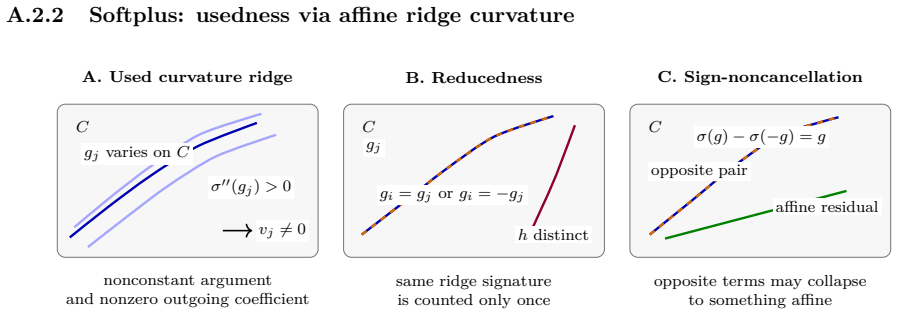
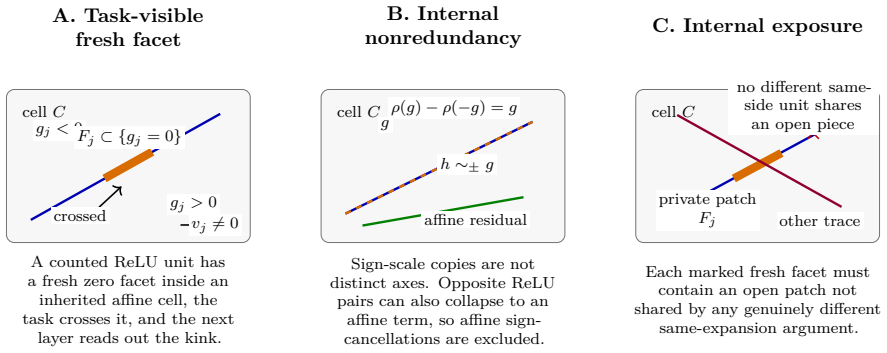
The load-bearing mechanism is the task-visible nonlinear signature of a gate. For ReLU, this is a kink trace: the zero set of a unit that the task patch crosses and that the next layer reads out. For softplus, it is the curvature ridge of the smooth activation, identified via pole and monodromy data. The central identity is the commutation lemma: if weak alignment holds at adjacent layers, the affine comparison map commutes with the nonlinear block. Since an injective affine map cannot create or destroy a used nonlinear signature, the singular and curvature sets of the two networks must coincide, forcing coordinate-wise matching. Zippering then upgrades this from adjacent layers to the whole
What would settle it
Retrain many minimal networks on a task whose layer-l gate budget m_l(ε) is known, from bottleneck or pruning experiments, to be a small fraction of d_l. If near-perfect weak alignment at layers l and l+1 is observed but AxisAlign is far above m_l/d_l, or if a task with very low m_l/d_l nevertheless produces near-perfect AxisAlign, the theorem's core inequality fails.
Extended reading notes
Core claim
On its own terms, the paper establishes that for ReLU and softplus networks that are minimal in the sense that every counted unit leaves a private task-visible nonlinear signature, weak alignment and strong alignment coincide when the task-hardness ratio m_l(ε)/d_l is near one. Theorem 1 proves that every used A-side axis at layer l is matched to a distinct B-side axis with (E_l z)_{π(j)} = α_j z_j, giving the lower bound AxisAlign ≥ m_l/d_l. An asymptotic version gives the same conclusion when weak-alignment errors shrink. The zippering theorems prove that terminal weak equivalence at some layer s generically forces strong alignment at every upstream layer, using backward induction and one-
Load-bearing premise
The theory's real-world force rests on task hardness—m_l(ε)/d_l near 1, meaning real tasks force most gates to be genuinely used—and on training dynamics not concentrating on the measure-zero exceptional parameter sets; the paper explicitly says both remain unproven (Section 8 and Appendix Remark 5).
Editorial extensions
If this is right
- For sufficiently hard tasks, the choice of comparison metric stops mattering: task performance, linear or affine similarity, and unit-level privileged-axis alignment all coincide.
- Privileged axes, including Gabor-like tuning structures, arise from end-to-end task optimization rather than architectural accident.
- Convergent evolution between independently trained networks—and between artificial networks and brains—is mathematically forced for minimal solutions to hard tasks, conditional on minimality and non-degeneracy.
- Raw RSA and CKA comparisons can be dominated by task-irrelevant symmetries; canonicalized versions of these metrics expose a core task-relevant geometry that obeys weak–strong equivalence.
- In transformers, privileged axes live in the MLP and attention branches, so unit-level comparisons should look there rather than in the residual stream.
Reading between the lines
- Editorial inference: the paper makes m_l/d_l directly measurable—layerwise bottlenecking, pruning, or width-restricted retraining estimate the gate budget—so the theory's central inequality can be tested empirically without exact weak alignment.
- Editorial inference: if task hardness drives axis emergence, then easy and hard versions of the same task should show a discontinuous jump in AxisAlign when m_l/d_l crosses a threshold, and alignment differences between seeds should be most pronounced near task-relevant layers.
- Editorial inference: the RSA/CKA analysis implies that raw similarity benchmarks mixing high- and low-performance models may be measuring task-irrelevant symmetry differences; canonicalized comparisons should correlate more strongly with behavior only in the high-performance regime the paper studies.
- Editorial inference: the soft zippering bound predicts a downstream-to-upstream error gradient—terminal alignment error should grow with distance upstream, so deep networks should show progressively worse axis alignment in earlier layers.
Editorial analysis
A structured set of objections, weighed in public.
Referee Report
Summary. The paper formalizes a 'contravariance principle' for deep neural networks. For ReLU and softplus networks, it proves two families of theorems. First, exact and asymptotic weak–strong equivalence: if two networks are weakly (affinely) equivalent at two adjacent layers and the layer's axes are task-used, then the used axes are strongly (coordinatewise) aligned, with an alignment lower bound m_ℓ(ε)/d_ℓ (Theorems 1–2 and Appendix Theorems 1–3). Second, zippering: if minimal, regular, generic networks are weakly equivalent at a terminal layer, then alignment propagates upstream to all compared layers, with exact, asymptotic, and soft quantitative versions (Theorems 3–4 and Appendix Theorems 6–8). The appendix develops minimality, MLR/MFR regularity, genericity of the exceptional sets, and extensions to transformers, RSA, and CKA. The paper concludes that for minimal solutions to sufficiently hard tasks, weak and strong alignment coincide and convergent representations are mathematically inevitable.
Significance. If the conditional theorems are correct, this is a substantial contribution to the theory of representational alignment. The paper gives precise, internally coherent mathematical mechanisms showing that affine equivalence across a nonlinear layer forces axis-level equivalence, and that terminal weak equivalence can, under explicit minimality and regularity assumptions, force upstream strong alignment. The theorems are genuinely conditional and the proof structure is detailed, with separate treatments for the nonsmooth ReLU and smooth softplus cases. The explicit use of a hardness budget m_ℓ(ε)/d_ℓ, rather than a fitted constant, is a strength, and the paper candidly identifies the main unverified premises: measuring the used-axis budget for real tasks and proving that trained networks do not concentrate on exceptional sets. However, the central conceptual claim in the abstract goes beyond what the theorems prove, because terminal weak equivalence is assumed rather than derived.
major comments (4)
- [Abstract; Theorem 3; Appendix Theorem 6] The abstract states that 'for any two minimal DNN solutions to a sufficiently hard task' weak terminal equivalence zippers to upstream strong alignment. But Theorem 3 and Appendix Theorem 6 assume terminal weak equivalence as a hypothesis; no theorem establishes that two independently obtained minimal solvers of the same hard task are terminally weakly equivalent. The used-axis budget m_ℓ(ε) in Definition 4 constrains the number of used axes, not the solution set up to affine equivalence. Thus the paper proves a conditional implication, not the unconditional convergence claim advertised. This is the load-bearing gap identified in Section 4's open question ('what leads to the repeated re-convergence in the first place?'). Please reframe the main claims as conditional on terminal weak equivalence, or provide a separate theorem deriving terminal weak equivalence from task hardness and minim
- [Section 8; Appendix Remark 5] The NeuroAI conclusion that convergent evolution is 'mathematically inevitable' rests on two unproven empirical premises: (1) that m_ℓ(ε)/d_ℓ is near 1 for real tasks, and (2) that training dynamics do not concentrate on the measure-zero exceptional sets. The paper acknowledges both, and the Section 8 discussion correctly says that estimating m_ℓ/d_ℓ 'will require empirical probes.' These are not internal inconsistencies, but they are load-bearing for the paper's central claim. The theorems remain interesting as conditional results; please state the main conclusions with these caveats in the abstract and introduction rather than only in the discussion.
- [Appendix Theorem 3 / Eq. (2)] The asymptotic weak–strong theorem involves a constant κ_K(θ) defined as an infimum over a compact family K, and the bound's usefulness depends on κ_K being non-vanishing. The proof shows positivity by contradiction using the exact theorem. This is valid only if the limiting 'zero-defect' member satisfies the exact theorem's usedness assumptions. Since the sequence is allowed to lie in a compact family of tuples, the limit may have trace families that degenerate as n→∞. The paper does not state an explicit uniform usedness margin for Theorem 2. Please clarify what quantitative version of usedness is preserved in the compact limit, or add the needed nondegeneracy condition to the statement of Appendix Theorem 3.
- [Section 5; Appendix A.12] The RSA section claims that raw RSA is 'in some sense a stricter metric than linear similarity' and then shows that raw RSA is sensitive to task-irrelevant symmetries. This is not contradictory, but the distinction is central and should be stated more carefully: the strong-alignment results do not control multiplicities, and the paper's own example shows that high AxisAlign and high weak alignment do not imply high raw RSA. The discussion should make clear that the 'bring RSA into the fold' program is conditional on a canonicalization procedure, not a consequence of Theorems 1–4 alone.
minor comments (5)
- [Section 3 vs Appendix Section A.2.2] There is a numbering collision: the main text's Theorem 2 is the asymptotic weak–strong theorem, while Appendix A.2.2's Theorem 2 is the exact softplus weak–strong theorem. This will confuse readers; please renumber the appendix results or use a prefix.
- [Appendix Remark 5] Typo: 'assupmtion' should be 'assumption'. Also, the remark should be numbered as a limitation in the main text, not only in the appendix, since it directly affects the interpretation of Theorem 3.
- [Definition 4 / Eq. (1)] The 'used-axis budget' m_ℓ(ε) is defined via a set F_{ℓ,≤k} of networks with at most k used axes. This is clear, but the phrase 'with at most k used layer-ℓ axes' relies on the informal usedness definition for softplus (Definition 3). Since the formal softplus usedness is only given in Appendix Definition 6, please cross-reference the appendix at the point of Definition 4 in the main text.
- [Section 5, 'RSA is in some sense a stricter metric'] This sentence is immediately qualified in the next paragraph, but the initial phrasing is misleading. Consider rewording to avoid the impression that raw RSA is always a stronger similarity notion than linear regression.
- [Appendix A.6.4, Lemma 12] The lemma states that character resonances are 'a countable union of proper affine subsets.' Since the parameter space is finite-dimensional, countable union of measure-zero sets is acceptable, but please state explicitly that the union is locally finite or that the parameter space is σ-compact, so that the measure-zero conclusion follows without additional set-theoretic assumptions.
Circularity Check
No significant circularity: core theorems are derived in-paper from stated premises; the main gap is an unproven terminal-weak-equivalence antecedent and a non-load-bearing self-citation, not a construction-level reduction.
full rationale
The central derivations are not circular. Theorem 1 assumes exact weak equivalence at adjacent layers plus usedness, and proves, by commuting the diagram through the nonlinearity and matching kink traces / curvature ridges, that every used A-side axis is matched to a B-side axis; the lower bound AxisAlign >= m_l(eps)/d_l is then read off from the independently defined used-axis budget m_l(eps), not from fitted alignment data. Theorem 3 / Appendix Theorem 6 similarly proves a genuine conditional: if terminal weak equivalence holds, then minimality plus MLR/MFR plus genericity lets a backward induction identify scalar arguments layer by layer. That implication is contentful and self-contained. The abstract's stronger, unconditional phrasing — 'for any two minimal DNN solutions to a sufficiently hard task ... alignment zippers up' — is not licensed by Theorem 3, which begins by supposing terminal weak equivalence; the paper never proves that two independently obtained minimal solvers of the same hard task are terminally weakly equivalent. That is a scope gap or unproven premise, not an equation-level circularity. The self-citation to Nayebi [2026, Corollary 5] asserts only an arbitrary invertible isomorphism, not affine weak equivalence, and is not used inside the zippering proof, so it is not load-bearing for the theorem chain; the empirical zippering figure is also cited only as motivation. The paper itself flags the open problem of what causes repeated re-convergence and the unproven nonconcentration of training on exceptional sets (Section 4 and Appendix Remark 5). These are honest limitations rather than circular steps. Hence the derivation is largely self-contained, and the modest score reflects the unsupported advertisement and self-citation presence, not a reduction of the conclusions to the assumptions.
Assumptions & free parameters
free parameters (5)
- κ_K(θ) (asymptotic weak–strong constant)
- L_ℓ (soft-zippering Lipschitz constants)
- c (quantitative minimality margin)
- ε_r (Lemma 11 local error thresholds)
- m_ℓ(ε)/d_ℓ (used-axis budget ratio)
assumptions (7)
- domain assumption The compared networks are affine-ReLU or affine-softplus feedforward networks of transparent layer blocks
- domain assumption Task hardness in the sense of a high used-axis budget: m_ℓ(ε)/d_ℓ close to 1
- ad hoc to paper Networks are minimal (Softplus pole-separated minimality, Def 10; ReLU EFF-minimality, Def 12)
- ad hoc to paper Regularity: MLR (Def 16) for softplus cross-matches and coherent MFR (Def 17) for ReLU
- domain assumption Learning dynamics do not concentrate on the measure-zero exceptional sets
- domain assumption For real brains, minimality holds
- standard math Standard analytic/algebraic background: ridge-function identifiability via line-restriction and Fourier decay; UFD property of Laurent polynomial rings; algebraic-geometry dimension counting
invented entities (3)
-
used-axis budget m_ℓ(ε)
-
exceptional sets of parameters (null networks; MLR/MFR failures; Jacobian-singular loci)
-
formalized contravariance principle
Cite this review
Pith. "Pith review of Contravariance Theory: Strong Alignment for Minimal Solutions to Hard Tasks." pith.science (2026). https://pith.science/paper/E5FDQDDQ
@misc{pith2026260708561,
  author       = {Pith},
  title        = {Pith review of: Contravariance Theory: Strong Alignment for Minimal Solutions to Hard Tasks},
  year         = {2026},
  howpublished = {\url{https://pith.science/paper/E5FDQDDQ}},
  note         = {Machine review of arXiv:2607.08561}
}
read the original abstract
A series of results from the NeuroAI over the past fifteen years have raised core questions both about how to compare Deep Neural Network (DNN) models to the brain, and about how much convergent evolution to expect between artificial networks and real brain networks. Here, we show that for any two minimal DNN solutions to a sufficiently hard task: (i) "weak" alignment of network representations based on affine mappings guarantees "strong" alignment of privileged axes, and (ii) alignment "zippers" up the network hierarchy, causing the emergence of privileged axes from end-to-end task optimization. These results formalize the notion of contravariance from Cao and Yamins [2024], and illustrate important consequences for the theory of NeuroAI: with sufficiently strong tasks, choice of metric for inter-network comparison is not all that sensitive, and that convergent evolution is probably inevitable.
Figures


Figures from the paper (27 more)






Reference graph
Works this paper leans on
-
[1]
Ifv j = 0, thej-th term may be deleted
-
[2]
Ifg j≡γonV, thej-th term may be deleted and the affine part replaced by a(z)↦−→a(z) +vjσ(γ)
-
[3]
doi: 10.18653/v1/2020.blackboxnlp-1.4. 22 Jason Phang, Haokun Liu, and Samuel R. Bowman. Fine-tuned transformers show clusters of similar representations across layers. InProceedings of the Fourth BlackboxNLP Workshop on An- alyzing and Interpreting Neural Networks for NLP, pages 529–538. Association for Computational Linguistics, 2021. doi: 10.18653/v1/2...
arXiv 2020
-
[4]
Sincegj is affine, the residual−vigj can be absorbed into the affine parta
If gi =−gj on V, then the two terms may be replaced by one Softplus term plus an affine residual: viσ(gi) +vjσ(gj) = (vi +vj)σ(gj)−v igj. Sincegj is affine, the residual−vigj can be absorbed into the affine parta. Ifvi +vj = 0, no nonlinear Softplus term remains from this pair
-
[5]
generically
More generally, if for a nonempty setS ∑ j∈S vjgj is constant onC, then simultaneously replacinggj by−gj for allj∈S changes the expansion only by a bias term. Consequently, modulo affine residuals, every finite Softplus expansion can be reduced to one in which all remaining nonlinear terms have nonzero coefficient, nonconstant argument, and no two remaini...
2015
-
[6]
Ifv i +vj = 0, both nonlinear terms disappear
Ifg i =g j onV, then the two terms may be replaced by one term: viσ(gi) +vjσ(gj) = (vi +vj)σ(gj). Ifv i +vj = 0, both nonlinear terms disappear
-
[9]
Minimality is an intrinsic condition on each expansion: every counted unit leaves a “private” task-visible nonlinear signature
First strengthen the notion of usedness from single axes/gates tominimalityof entire layer-wise expansions (§A.4.2). Minimality is an intrinsic condition on each expansion: every counted unit leaves a “private” task-visible nonlinear signature. From equality of two one-step expansions, those private signatures one side of the quality must be reproduced on...
-
[10]
We then seek to understand what happens when two minimal layers collide. We show that the property ofidentifiability– that is, the recovery of equal internal constituent operations – can be ensured by a set of very simple conditions onregularity(§A.4.3 and §A.4.4)
Show all 19 references
-
[11]
obvious self-collisions
When then show how identifiability, based on minimality and regularity, leads to exact zippering (§A.4) – assuming perfect terminal equivalence of last-layer representations. Looking ahead, in the next sections that follow, we show that (when one more additional condition on t...
1978
-
[12]
Intrinsic minimality fails only on analytic or algebraic degeneracy sets, conditional on task- usedness and task exposure
-
[13]
The regularity mechanisms fail only on resonance, incidence, or rank-defect sets, provided the required condition holds at one point on each relevant stratum
-
[14]
verification tool
Jacobian regularity, after fixing the standard hidden-unit order and ReLU normalization, fails on the zero set of an analytic Gram determinant, provided the full-rank condition holds at least at one point. 62 The first two give generic identifiability. The third controls the g...
2012
-
[15]
First, intrinsic minimality removes representations that are already redundant inside one expansion
-
[16]
Second, MLR or MFR rules out a nontrivial equal-function pair at a point where the relevant nonlinear signatures are identifiable
-
[17]
all ends well
Third, by not actually ruling them out but showing that they are rare. The generic null-net theorem doesnotclaim that every exceptional identity is impossible: it allows resonant nontrivial collisions on lower-dimensional subsets, but prevents them from filling a full- dimensi...
2008
-
[18]
Combining with the previous bound yields ∥P[u]−P[v]∥ F≤ 2 √ 2δ√ 1−δ 2 = 2 √ 2(1−θ)√ 1−(1−θ) 2
A direct calculation gives ∥P[u]−P[v]∥ 2 F = 2(1−c 2)≤4(1−c). Combining with the previous bound yields ∥P[u]−P[v]∥ F≤ 2 √ 2δ√ 1−δ 2 = 2 √ 2(1−θ)√ 1−(1−θ) 2. The sign ofαis irrelevant becauseP[αv] =P[v]. Choose the injective matching used in Appendix Theorem 3. There arem−B θ g...
-
[19]
Orthogonal projection is nonexpansive, so the same bound holds after applyingΠ H
Averaging the projector differences and using the triangle inequality gives ∥Rax(A)−R ax(B)∥F≤ 1 m [ (m−B θ) 2 √ 2(1−θ)√ 1−(1−θ) 2 +Bθ √ 2 ] ≤ 2 √ 2(1−θ)√ 1−(1−θ) 2 + √ 2Bθ m ≤ 2 √ 2(1−θ)√ 1−(1−θ) 2 + √ 2 m e2 weak κ(θ)2, where the final line uses(82). Orthogonal projection is...
2024
-
[2020]
Amil Merchant, Elahe Rahimtoroghi, Ellie Pavlick, and Ian Tenney
doi: 10.1162/tacl_a_00349. Amil Merchant, Elahe Rahimtoroghi, Ellie Pavlick, and Ian Tenney. What happens to BERT embeddings during fine-tuning? InProceedings of the Third BlackboxNLP Workshop on Analyzing and Interpreting Neural Networks for NLP, pages 33–44. Association for ...
-
[2024]
21 Ansh Soni, Sudhanshu Srivastava, Marvin Maechler, Konrad Kording, and Meenakshi Khosla
Version 2 posted September 14, 2025. 21 Ansh Soni, Sudhanshu Srivastava, Marvin Maechler, Konrad Kording, and Meenakshi Khosla. Conclusions drawn from neural network to brain alignment depend strongly on the chosen similarity measure.bioRxiv, 2024. doi: 10.1101/2024.08.07.6070...
2025
Reviewed August 3, 2026 · model on record in the stance chip above.
Discussion (0). Continue with ORCID to comment.