REVIEW 5 major objections 7 minor 2 cited by
Rethinking Weight-Averaged Model-merging
T0 review · 5 major / 7 minor · reviewed 2026-08-12 · deepseek-v4-flash
Pith's one-line read Weight-averaged model merging works because weights are class-specific templates and averaging acts as an implicit regularizer that shrinks weight magnitude and variance, explaining both its successes and its failures.
desk verdict Worth engaging for the empirical comparison, but the regularization explanation is a conjecture, not a proof. read the letter →
The pith
A machine-rendered reading of the paper's core claim, the machinery that carries it, and where it could break.
The reading
What carries the argument
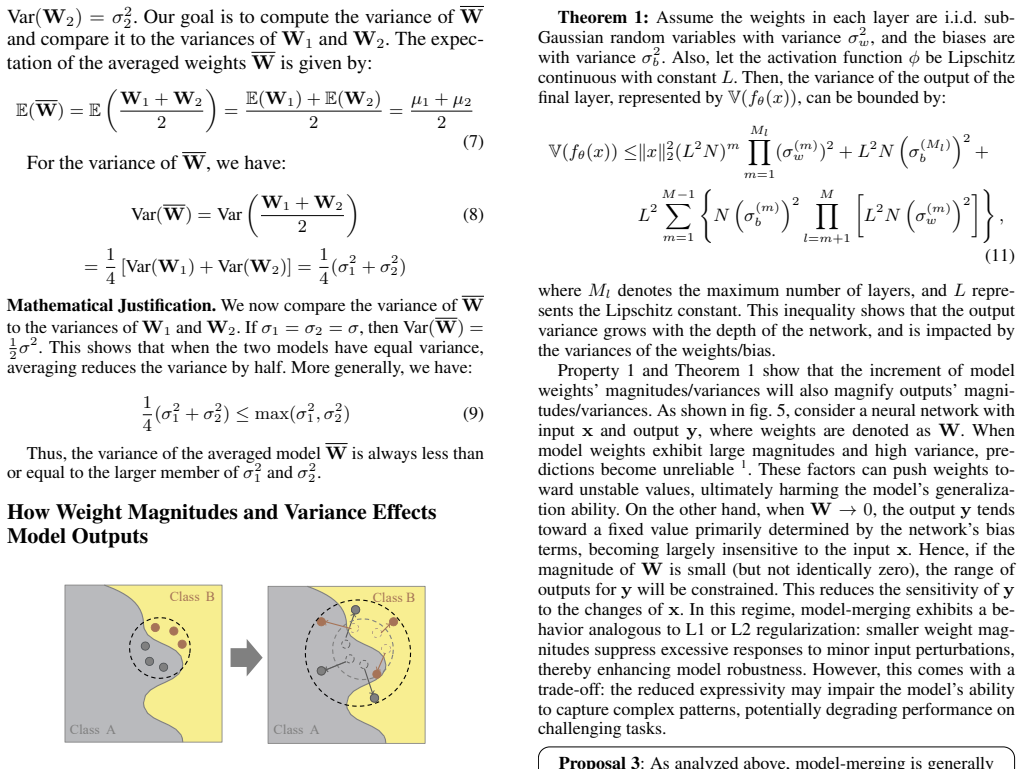
The load-bearing objects are: (1) the template interpretation of weights, where a row of the weight matrix is a class-specific pattern matched to an input by the inner product $w^\top x = \lVert w\rVert\lVert x\rVert\cos\theta$, so merging two weight matrices is a Mixup-like linear combination of templates; (2) the linear-equivalence identity $h = \tfrac{1}{2}(W_1+W_2)x = \tfrac{1}{2}(W_1x + W_2x)$, which holds only without non-linearities and breaks under activations such as ReLU; (3) the norm bound $\lVert (W_1+W_2)/2\rVert \le \max(\lVert W_1\rVert,\lVert W_2\rVert)$ from the triangle inequality and the variance identity $\operatorname{Var}((W_1+W_2)/2) = \frac{1}{4}(\sigma_1^2+\sigma_2^2) \le \max(\sigma_1^2,\sigma_2^2)$, which together show that averaging shrinks weight magnitude and variance; and (4) the Lipschitz bounds (Property 1 and Theorem 1) that connect smaller weight magnitudes and variances to smaller, stabler outputs. These pieces carry the argument from template structure to regularization to the observed architecture- and dataset-dependent behavior.
What would settle it
Train the same architecture on the same task from different random seeds, measure the linear-mode-connectivity barrier between every pair, and check whether the benefits of uniform weight averaging disappear exactly when the barrier is high. A sharper test is to permute the neurons of one model before averaging, which preserves its function but destroys neuron compatibility, and verify that merging accuracy falls to the same catastrophic levels as the PathMNIST and DeiT-Tiny collapses.
Extended reading notes
Core claim
The paper's central claim is that weight-averaged model merging is not arbitrary interpolation but a structured operation on learned templates. Each row of a classifier's weight matrix encodes a class prototype, and inner products match inputs to those prototypes; averaging two weight matrices therefore blends prototype sets the way Mixup blends images, giving the merged model a broader set of patterns to match. At the same time, averaging provably reduces the maximum weight magnitude and the variance of weights, and via the paper's Lipschitz bounds (Property 1 and Theorem 1) this shrinks the magnitude and variance of the network's outputs, making predictions less sensitive to input perturbations. The paper concludes that merging is implicitly a regularizer that trades expressiveness for stability, which is why it can beat individual models on compatible same-task models but degrades sharply for ViTs, for models trained on mismatched tasks, and on datasets like PathMNIST and CelebA where weight conflicts dominate.
Load-bearing premise
The entire template and regularization story assumes the models being averaged are neuron-compatible, meaning they sit in the same loss basin without permutation mismatch; the paper's own experiments show that when this fails, uniform averaging collapses, with accuracy dropping to 32.42% on PathMNIST and 8.91% for DeiT-Tiny on TinyImageNet.
Editorial extensions
If this is right
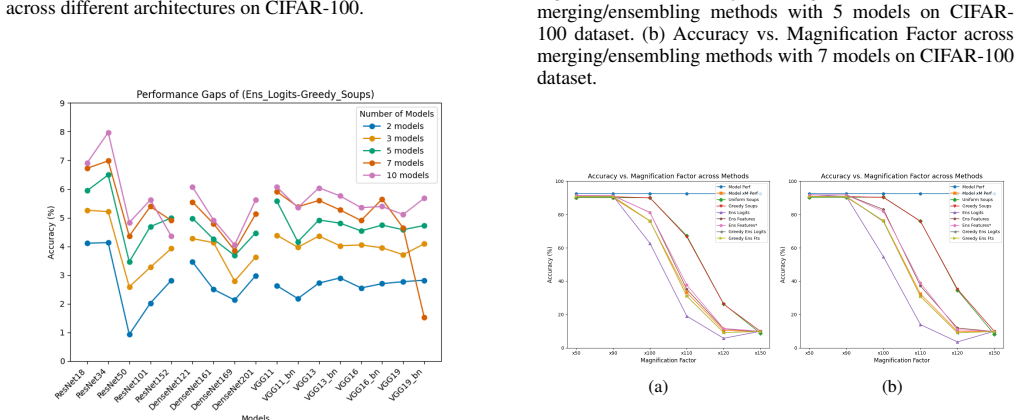
- Because averaging shrinks weight magnitude and variance, merged models should be more stable than ensembles under weight perturbation, which the paper's scaling experiments (up to ×100) confirm.
- Merging should be attempted only among neuron-compatible models; greedy soups, which select models by validation performance, recover much of the loss that uniform soups suffer on incompatible models such as PathMNIST (from 32.42% back to 88.48%).
- For vision transformers, uniform weight averaging is ineffective and worsens as more models are added, so logit or feature ensembling is the safer strategy for those architectures.
- Because merging acts as a regularizer, its benefits should be largest when individual models are overfit or noisy and smallest when they are already well-regularized.
- The template view implies that merging across tasks produces composite templates (for example bicycle plus bottle), which is why cross-task soups can help on one task while sacrificing fine-grained class structure.
Reading between the lines
- I infer that the regularization effect of merging could be repurposed as a no-training defense: averaging weights of models trained with different augmentations should suppress input sensitivity, a prediction that could be tested under adversarial or label-noise perturbations.
- The template/Mixup analogy suggests a data-free probe for class similarity: interpolating two class templates in weight space and measuring which test images the merged template activates could reveal semantic overlap between classes.
- One extension the paper leaves implicit is that permutation-alignment should be a mandatory pre-processing step before averaging ViT weights; the observed DeiT collapse predicts that aligned ViTs would recover soup gains.
- The merging–ensembling gap peaks at a particular magnification factor (×100 on CIFAR-100, ×110 on CIFAR-10), suggesting a sweet spot where weight shrinkage still helps without destroying expressiveness; a practical follow-up is to rescale averaged weights to a target norm before deployment.
Signed reviews
Editorial analysis
A structured set of objections, weighed in public.
Referee Report
Summary. The paper presents an interpretability-oriented analysis of weight-averaged model merging. The authors offer three perspectives: (1) interpreting learned weights as class templates, so that weight averaging acts like a Mixup operation in parameter space; (2) empirically comparing weight-space averaging (model merging) with feature-space averaging (model ensembling) across CNNs and ViTs on several datasets; and (3) arguing that merging implicitly regularizes by reducing weight magnitudes and variances, making predictions more robust. The paper concludes with three 'Proposals' that blend these observations into practical guidance. The empirical sections report accuracy comparisons for uniform and greedy soups versus logit/feature ensembles, plus experiments where parameter magnitudes are artificially scaled to study robustness.
Significance. If the central claims were established, the paper would offer a useful intuitive account of why model soups work, a broad empirical map of when merging versus ensembling is preferable, and a concrete robustness mechanism. The empirical scope is genuinely broad: multiple architectures (ResNet, DenseNet, VGG, ViT, DeiT), multiple datasets, and model counts from 2 to 10. The template visualizations are a compelling pedagogical device. However, the theoretical backbone is not sound as written: the variance derivation omits a covariance term, the magnitude argument proves only a non-increase bound rather than 'typical reduction', and the output-magnitude/variance conclusions are not implied by the stated upper bounds. The paper never directly measures whether real merged models have lower weight magnitude or variance than their constituents, so the regularization narrative—which is the paper's central explanatory claim—remains unsupported. The comparative empirical results would still be of interest, but the interpretability thesis needs substantial reworking.
major comments (5)
- [The Model Predictions and Weight Magnitudes, Eq. (8)] The variance formula Var((W1+W2)/2) = 1/4(σ1² + σ2²) silently omits the covariance term. For random matrices the correct expression is 1/4(σ1² + σ2² + 2Cov(W1,W2)). Since independently trained networks typically have correlated weights, the subsequent claim that averaging 'always' reduces variance relative to the larger member is not derived. The inequality (9) can be salvaged for any covariance with correlation ≤1, but the derivation as printed is invalid and the assumptions must be stated explicitly, or the general result must be proved.
- [Analysis of Weight Magnitude After Averaging, Eqs. (5)–(6)] Equations (5)–(6) establish only the non-increase bound ∥(W1+W2)/2∥ ≤ max(∥W1∥,∥W2∥). The text then asserts that averaging 'typically reduces' the maximum weight magnitude. A non-increase bound does not support a typical-reduction claim; equality occurs when the maximum is attained at the same entry in both matrices, and even near-equal maxima give a reduction only by happenstance. If the authors intend an empirical 'typically', they should measure the actual L∞ norms of merged versus individual models across their experimental settings rather than rely solely on the bound.
- [How Weight Magnitudes and Variance Effects Model Outputs, Property 1 and Theorem 1 (Eqs. (10)–(11))] Property 1 and Theorem 1 are upper bounds on output norm and variance under i.i.d. sub-Gaussian assumptions on the weights. The statement that 'the increment of model weights' magnitudes/variances will also magnify outputs' magnitudes/variances' does not follow from upper bounds; monotonicity is not a logical consequence, because cancellations in the weighted sum can make output variance decrease even when weight variance increases. The magnification experiments (Figure 7b, Table 10) artificially scale every parameter by ×90–×100 but never compare the actual weight magnitude/variance of the merged model against its constituents. Consequently, Proposal 3 and the abstract's claim that merging 'implicitly serves as a form of regularization' are not established by the supplied mathematics or experiments. To support this claim, the authors should directly measure norms and variances of real merged weights and test whether output stability actually improves in the un-scaled setting.
- [Linear Model Scenarios, Eq. (1), and the template narrative in Section 'The Patterns Contained in Model Weights'] The equivalence between weight averaging and feature averaging in Eq. (1) holds only under the assumption of 'no symmetric neuron mismatch issue.' The paper extends the 'meaningful linear combination' and Mixup-like template interpretation to deep networks without verifying that the trained models lie in the same loss basin or are permutation-compatible. The paper's own results show severe violations of this condition: uniform soups on PathMNIST collapse from 90.04% to 32.42% (Table 1), and DeiT-Tiny on TinyImageNet falls to 8.91% with 10 models (Supplementary Table 9). In these cases the template-matching explanation does not apply, yet the paper does not explicitly condition Proposal 1 on compatibility or discuss how its failures are predicted by the framework. Without an explicit compatibility condition and a discussion of the failure cases, the template narrative is not a falsifiable explanation of when merging will succeed.
- [Experiments and Supplementary Tables 1, 3–7, 9] All reported accuracies are single runs without error bars or significance tests. Since the paper's central empirical message is that ensembling consistently outperforms merging and that gaps widen with more models (Figures 3 and 7a), the lack of repeated-seed statistics makes it impossible to assess whether these differences are reliable. Additionally, many training details (optimizer hyperparameters, epochs, augmentation, pretraining initialization, and the exact construction of the 'Ens Features' variant) are deferred to supplementary material without enough specification in the main text to reproduce the comparisons. At minimum, the authors should report mean±std over multiple seeds for the headline tables and figures.
minor comments (7)
- [Throughout] The abbreviations 'Grd Ens Lgt', 'Ens Fts', 'Perf Ave' are used inconsistently across captions, tables, and text; please define each abbreviation at first use and use it uniformly.
- [Figure 3 and Table 1] The caption of Figure 3 refers to 'Performance Average' while the text and Table 1 use 'Perf Ave'; please unify the terminology.
- [Supplementary 'Theoretical Proofs'] The proof section refers to 'Eq. 14' but the main text numbers equations differently; cross-references between main text and supplementary equations should be corrected.
- [Section 'The Model Predictions and Weight Magnitudes'] In Figure 4, the scale of the axes and the statement that points are 'computed on the same data batch' are unclear; please describe how the scatter points are generated.
- [Supplementary Table 5] The entry '81.95' for 'Grd Ens Fts' on CIFAR-10 with 5 models appears inconsistent with the rest of the column (~92.6) and should be verified.
- [References] The citation for Property 1 and Theorem 1 to Wang et al. 2024 should be cited prominently in the main text, not only in the proof appendix, and the applicability of its security-oriented assumptions to trained vision models should be discussed.
- [Related Work and Introduction] The reference to model arithmetic uses Mikolov 2013 (word2vec) as a catch-all; please cite the specific model-arithmetic works (e.g., Ilharco et al. 2022, Zhou et al. 2024b) in that sentence.
Circularity Check
No circularity: the paper's mathematical identities, bounds, and empirical comparisons do not reduce to its conclusions.
full rationale
After walking the derivation chain, I find no circular step that reduces a prediction to its inputs. The mathematical content in Eqs. 1-4 is an identity showing that weight averaging equals feature averaging for linear layers, and Eqs. 5-9 are elementary bounds on the norm and variance of an average; none of these are fitted to accuracy numbers. Property 1 and Theorem 1 are attributed to Wang et al. 2024 but their proofs are reproduced in the appendix under explicit i.i.d. sub-Gaussian and Lipschitz assumptions, so even if that citation shares an author with the present paper, it is independent support because it does not assume the merging outcome it is used to explain. The magnification experiments are direct empirical interventions on scaled weights, not fitted parameters renamed as predictions, and the paper reports multiple negative results (e.g., uniform soups at 32.42% on PathMNIST and DeiT-Tiny at 8.91% on TinyImageNet) that would be impossible if the narrative were tautologically forced. Concerns that the regularization claim overreaches the upper bounds in Eqs. 10-11 are correctness and interpretation risks, not circularity.
Assumptions & free parameters
free parameters (1)
- Magnitude factors =
90, 100, 110
assumptions (4)
- domain assumption No symmetric neuron mismatch between models being averaged (weights are permutation-compatible).
- domain assumption W1 and W2 are independent random matrices when computing Var(W) = 1/4 (sigma1^2 + sigma2^2).
- domain assumption Trained network weights behave as i.i.d. sub-Gaussian random variables.
- standard math Activation functions are Lipschitz continuous with constant L.
Cite this review
Pith. "Pith review of Rethinking Weight-Averaged Model-merging." pith.science (2026). https://pith.science/paper/E7UWY6ES
@misc{pith2026241109263,
  author       = {Pith},
  title        = {Pith review of: Rethinking Weight-Averaged Model-merging},
  year         = {2026},
  howpublished = {\url{https://pith.science/paper/E7UWY6ES}},
  note         = {Machine review of arXiv:2411.09263}
}
read the original abstract
Model merging, particularly through weight averaging, has shown surprising effectiveness in saving computations and improving model performance without any additional training. However, the interpretability of why and how this technique works remains unclear. In this work, we reinterpret weight-averaged model merging through the lens of interpretability and provide empirical insights into the underlying mechanisms that govern its behavior. We approach the problem from three perspectives: (1) we analyze the learned weight structures and demonstrate that model weights encode structured representations that help explain the compatibility of weight averaging; (2) we compare averaging in weight space and feature space across diverse model architectures (CNNs and ViTs) and datasets, aiming to expose under which circumstances what combination paradigm will work more effectively; (3) we study the effect of parameter scaling on prediction stability, highlighting how weight averaging acts as a form of regularization that contributes to robustness. By framing these analyses in an interpretability context, our work contributes to a more transparent and systematic understanding of model merging for stakeholders interested in the safety and reliability of untrained model combination methods. The code is available at https://github.com/billhhh/Rethink-Merge.
Figures


Figures from the paper (18 more)





Forward citations
Cited by 2 Pith papers
-
Task Vector Bases: A Unified and Scalable Framework for Compressed Task Arithmetic
Task Vector Bases compresses T task vectors into M softmax-mixed basis vectors that preserve task arithmetic operations, with empirical gains over PCA and random selection.
-
Merging Models on the Fly Without Retraining: A Sequential Approach to Scalable Continual Model Merging
A continual model merging method, OPCM, sequentially projects each new task vector into a subspace orthogonal to the current merged model, achieving 5-8% higher average accuracy than baselines on CLIP-ViT tasks.
Reference graph
Works this paper leans on
-
[1]
, " * write output.state after.block = add.period write newline
ENTRY address archivePrefix author booktitle chapter edition editor eid eprint howpublished institution isbn journal key month note number organization pages publisher school series title type volume year label extra.label sort.label short.list INTEGERS output.state before.all mid.sentence after.sentence after.block FUNCTION init.state.consts #0 'before.a...
-
[2]
write newline
" write newline "" before.all 'output.state := FUNCTION n.dashify 't := "" t empty not t #1 #1 substring "-" = t #1 #2 substring "--" = not "--" * t #2 global.max substring 't := t #1 #1 substring "-" = "-" * t #2 global.max substring 't := while if t #1 #1 substring * t #2 global.max substring 't := if while FUNCTION word.in bbl.in capitalize " " * FUNCT...
-
[3]
K.; Hayase, J.; and Srinivasa, S
Ainsworth, S. K.; Hayase, J.; and Srinivasa, S. 2022. Git re-basin: Merging models modulo permutation symmetries. arXiv preprint arXiv:2209.04836
arXiv 2022
-
[4]
Almakky, I.; Sanjeev, S.; Hashmi, A. U. R.; Qazi, M. A.; and Yaqub, M. 2024. MedMerge: Merging Models for Effective Transfer Learning to Medical Imaging Tasks. arXiv preprint arXiv:2403.11646
work page Pith review arXiv 2024
-
[5]
Croce, F.; Rebuffi, S.-A.; Shelhamer, E.; and Gowal, S. 2023. Seasoning model soups for robustness to adversarial and natural distribution shifts. In Proceedings of the IEEE/CVF Conference on Computer Vision and Pattern Recognition, 12313--12323
work page 2023
-
[6]
Daheim, N.; M \"o llenhoff, T.; Ponti, E. M.; Gurevych, I.; and Khan, M. E. 2023. Model merging by uncertainty-based gradient matching. arXiv preprint arXiv:2310.12808
arXiv 2023
-
[7]
Dekoninck, J.; Fischer, M.; Beurer-Kellner, L.; and Vechev, M. 2023. Controlled text generation via language model arithmetic. arXiv preprint arXiv:2311.14479
arXiv 2023
-
[8]
Dosovitskiy, A. 2020. An image is worth 16x16 words: Transformers for image recognition at scale. arXiv preprint arXiv:2010.11929
arXiv 2020
Show all 51 references
-
[9]
Entezari, R.; Sedghi, H.; Saukh, O.; and Neyshabur, B. 2021. The role of permutation invariance in linear mode connectivity of neural networks. arXiv preprint arXiv:2110.06296
2021 arXiv
-
[10]
P.; and Wilson, A
Garipov, T.; Izmailov, P.; Podoprikhin, D.; Vetrov, D. P.; and Wilson, A. G. 2018. Loss surfaces, mode connectivity, and fast ensembling of dnns. Advances in neural information processing systems, 31
2018
-
[11]
He, K.; Zhang, X.; Ren, S.; and Sun, J. 2016. Deep residual learning for image recognition. In Proceedings of the IEEE conference on computer vision and pattern recognition, 770--778
2016
-
[12]
Huang, G.; Liu, Z.; Van Der Maaten, L.; and Weinberger, K. Q. 2017. Densely connected convolutional networks. In Proceedings of the IEEE conference on computer vision and pattern recognition, 4700--4708
2017
-
[13]
T.; Wortsman, M.; Gururangan, S.; Schmidt, L.; Hajishirzi, H.; and Farhadi, A
Ilharco, G.; Ribeiro, M. T.; Wortsman, M.; Gururangan, S.; Schmidt, L.; Hajishirzi, H.; and Farhadi, A. 2022. Editing models with task arithmetic. arXiv preprint arXiv:2212.04089
2022 arXiv
-
[14]
Jang, D.-H.; Yun, S.; and Han, D. 2024. Model stock: All we need is just a few fine-tuned models. In European Conference on Computer Vision, 207--223. Springer
2024
-
[15]
Jordan, K.; Sedghi, H.; Saukh, O.; Entezari, R.; and Neyshabur, B. 2022. Repair: Renormalizing permuted activations for interpolation repair. arXiv preprint arXiv:2211.08403
2022 arXiv
-
[16]
Khanuja, S.; Johnson, M.; and Talukdar, P. 2021. Mergedistill: Merging pre-trained language models using distillation. arXiv preprint arXiv:2106.02834
2021 arXiv
-
[17]
Krizhevsky, A. 2009. Learning Multiple Layers of Features from Tiny Images. Technical report, University of Toronto
2009
-
[18]
Le, Y.; and Yang, X. 2015. Tiny imagenet visual recognition challenge. CS 231N, 7(7): 3
2015
-
[19]
Li, W.; Peng, Y.; Zhang, M.; Ding, L.; Hu, H.; and Shen, L. 2023. Deep model fusion: A survey. arXiv preprint arXiv:2309.15698
2023 arXiv
-
[20]
Liu, Z.; Luo, P.; Wang, X.; and Tang, X. 2015. Deep Learning Face Attributes in the Wild. In Proceedings of International Conference on Computer Vision (ICCV)
2015
-
[21]
Ma, C.; Wang, H.; and Hoi, S. C. 2019. Multi-label thoracic disease image classification with cross-attention networks. In Medical Image Computing and Computer Assisted Intervention--MICCAI 2019: 22nd International Conference, Shenzhen, China, October 13--17, 2019, Proceedings...
2019
-
[22]
S.; and Raffel, C
Matena, M. S.; and Raffel, C. A. 2022. Merging models with fisher-weighted averaging. Advances in Neural Information Processing Systems, 35: 17703--17716
2022
-
[23]
Mikolov, T. 2013. Efficient estimation of word representations in vector space. arXiv preprint arXiv:1301.3781, 3781
2013 arXiv
-
[24]
Navon, A.; Shamsian, A.; Fetaya, E.; Chechik, G.; Dym, N.; and Maron, H. 2023. Equivariant deep weight space alignment. arXiv preprint arXiv:2310.13397
2023 arXiv
-
[25]
Ortiz-Jimenez, G.; Favero, A.; and Frossard, P. 2023. Task arithmetic in the tangent space: Improved editing of pre-trained models. Advances in Neural Information Processing Systems, 36: 66727--66754
2023
-
[26]
Rame, A.; Couairon, G.; Dancette, C.; Gaya, J.-B.; Shukor, M.; Soulier, L.; and Cord, M. 2024. Rewarded soups: towards pareto-optimal alignment by interpolating weights fine-tuned on diverse rewards. Advances in Neural Information Processing Systems, 36
2024
-
[27]
Sanjeev, S.; Zhaksylyk, N.; Almakky, I.; Hashmi, A. U. R.; Qazi, M. A.; and Yaqub, M. 2024. FissionFusion: fast geometric generation and hierarchical souping for medical image analysis. In International Conference on Medical Image Computing and Computer-Assisted Intervention, ...
2024
-
[28]
Simonyan, K. 2014. Very deep convolutional networks for large-scale image recognition. arXiv preprint arXiv:1409.1556
2014 arXiv
-
[29]
P.; Adilova, L.; Kamp, M.; Fischer, A.; Sch \"o lkopf, B.; and Hofmann, T
Singh, S. P.; Adilova, L.; Kamp, M.; Fischer, A.; Sch \"o lkopf, B.; and Hofmann, T. 2024. Landscaping linear mode connectivity. arXiv preprint arXiv:2406.16300
2024 arXiv
-
[30]
P.; and Jaggi, M
Singh, S. P.; and Jaggi, M. 2020. Model fusion via optimal transport. Advances in Neural Information Processing Systems, 33: 22045--22055
2020
-
[31]
Steiner, A.; Kolesnikov, A.; Zhai, X.; Wightman, R.; Uszkoreit, J.; and Beyer, L. 2021. How to train your vit? data, augmentation, and regularization in vision transformers. arXiv preprint arXiv:2106.10270
2021 arXiv
-
[32]
Stoica, G.; Bolya, D.; Bjorner, J.; Ramesh, P.; Hearn, T.; and Hoffman, J. 2023. Zipit! merging models from different tasks without training. arXiv preprint arXiv:2305.03053
2023 arXiv
-
[33]
Sung, Y.-L.; Li, L.; Lin, K.; Gan, Z.; Bansal, M.; and Wang, L. 2023. An empirical study of multimodal model merging. arXiv preprint arXiv:2304.14933
2023 arXiv
-
[34]
Touvron, H.; Cord, M.; Douze, M.; Massa, F.; Sablayrolles, A.; and J \'e gou, H. 2021. Training data-efficient image transformers & distillation through attention. In International conference on machine learning, 10347--10357. PMLR
2021
-
[35]
Tversky, A.; and Gati, I. 1982. Similarity, separability, and the triangle inequality. Psychological review, 89(2): 123
1982
-
[36]
Wang, H.; Almakky, I.; Ma, C.; Saeed, N.; and Yaqub, M. 2025. In-Model Merging for Enhancing the Robustness of Medical Imaging Classification Models. arXiv preprint arXiv:2502.20516
2025 arXiv
-
[37]
Wang, H.; Yurochkin, M.; Sun, Y.; Papailiopoulos, D.; and Khazaeni, Y. 2020. Federated learning with matched averaging. arXiv preprint arXiv:2002.06440
2020 arXiv
-
[38]
Wang, X.; Peng, Y.; Lu, L.; Lu, Z.; Bagheri, M.; and Summers, R. M. 2017. Chestx-ray8: Hospital-scale chest x-ray database and benchmarks on weakly-supervised classification and localization of common thorax diseases. In Proceedings of the IEEE conference on computer vision an...
2017
-
[39]
Wang, Z.; Ma, Z.; Feng, X.; Sun, R.; Wang, H.; Xue, M.; and Bai, G. 2024. CoreLocker: Neuron-level Usage Control. In 2024 IEEE Symposium on Security and Privacy (SP), 222--222. IEEE Computer Society
2024
-
[40]
Y.; Roelofs, R.; Gontijo-Lopes, R.; Morcos, A
Wortsman, M.; Ilharco, G.; Gadre, S. Y.; Roelofs, R.; Gontijo-Lopes, R.; Morcos, A. S.; Namkoong, H.; Farhadi, A.; Carmon, Y.; Kornblith, S.; et al. 2022. Model soups: averaging weights of multiple fine-tuned models improves accuracy without increasing inference time. In Inter...
2022
-
[41]
A.; and Bansal, M
Yadav, P.; Tam, D.; Choshen, L.; Raffel, C. A.; and Bansal, M. 2024. Ties-merging: Resolving interference when merging models. Advances in Neural Information Processing Systems, 36
2024
-
[42]
Yang, E.; Shen, L.; Guo, G.; Wang, X.; Cao, X.; Zhang, J.; and Tao, D. 2024. Model merging in llms, mllms, and beyond: Methods, theories, applications and opportunities. arXiv preprint arXiv:2408.07666
2024 arXiv
-
[43]
Yang, E.; Wang, Z.; Shen, L.; Liu, S.; Guo, G.; Wang, X.; and Tao, D. 2023 a . Adamerging: Adaptive model merging for multi-task learning. arXiv preprint arXiv:2310.02575
2023 arXiv
-
[44]
Yang, J.; Shi, R.; and Ni, B. 2021. MedMNIST Classification Decathlon: A Lightweight AutoML Benchmark for Medical Image Analysis. In IEEE 18th International Symposium on Biomedical Imaging (ISBI), 191--195
2021
-
[45]
Yang, J.; Shi, R.; Wei, D.; Liu, Z.; Zhao, L.; Ke, B.; Pfister, H.; and Ni, B. 2023 b . MedMNIST v2-A large-scale lightweight benchmark for 2D and 3D biomedical image classification. Scientific Data, 10(1): 41
2023
-
[46]
Yu, L.; Yu, B.; Yu, H.; Huang, F.; and Li, Y. 2024. Language models are super mario: Absorbing abilities from homologous models as a free lunch. In Forty-first International Conference on Machine Learning
2024
-
[47]
Zhang, H. 2017. mixup: Beyond empirical risk minimization. arXiv preprint arXiv:1710.09412
2017 arXiv
-
[48]
Zhang, J.; Chi, J.; Li, Z.; Cai, K.; Zhang, Y.; and Tian, Y. 2024. Badmerging: Backdoor attacks against model merging. arXiv preprint arXiv:2408.07362
2024 arXiv
-
[49]
Zhang, J.; Liu, J.; He, J.; et al. 2023. Composing parameter-efficient modules with arithmetic operation. Advances in Neural Information Processing Systems, 36: 12589--12610
2023
-
[50]
Zhou, Y.; Song, L.; Wang, B.; and Chen, W. 2024 a . MetaGPT: Merging Large Language Models Using Model Exclusive Task Arithmetic. arXiv preprint arXiv:2406.11385
2024 arXiv
-
[51]
Zhou, Z.; Chen, Z.; Chen, Y.; Zhang, B.; and Yan, J. 2024 b . On the Emergence of Cross-Task Linearity in Pretraining-Finetuning Paradigm. In Forty-first International Conference on Machine Learning (ICML 2024)
2024
Reviewed August 12, 2026 · model on record in the stance chip above.
Discussion (0). Continue with ORCID to comment.