Cosmological Stealth fields and Non-Equilibrium thermodynamics
Pith reviewed 2026-07-01 04:57 UTC · model grok-4.3
The pith
Stealth scalar fields track non-equilibrium cosmological evolution as thermodynamic attractors without gravitational backreaction.
A machine-rendered reading of the paper's core claim, the machinery that carries it, and where it could break.
Core claim
Stealth fields, defined by the identical vanishing of their energy-momentum tensor, satisfy a generalized Riccati equation in which the dissipative pressure acts as the thermodynamic driving term. In terms of y equals dot phi over H phi the system admits a stable attractor branch selected by entropy production and an unstable repeller branch. A bulk viscous realization shows that irreversible entropy production drives the universe to an asymptotic de Sitter state while the stealth field tracks the dissipative background.
What carries the argument
The generalized Riccati equation for scalar-field kinematics that follows from the stealth condition, with dissipative pressure serving as the driving term and structuring the two thermodynamic branches.
Load-bearing premise
The assumption that a non-minimally coupled scalar field can be made to have its energy-momentum tensor vanish identically by hand in flat FLRW, without this cancellation failing once a concrete potential or perturbations appear.
What would settle it
A explicit calculation or simulation in which the energy-momentum tensor of the scalar field fails to remain zero after a specific potential is introduced or linear perturbations are added, causing the Riccati structure and thermodynamic branches to disappear.
Figures

read the original abstract
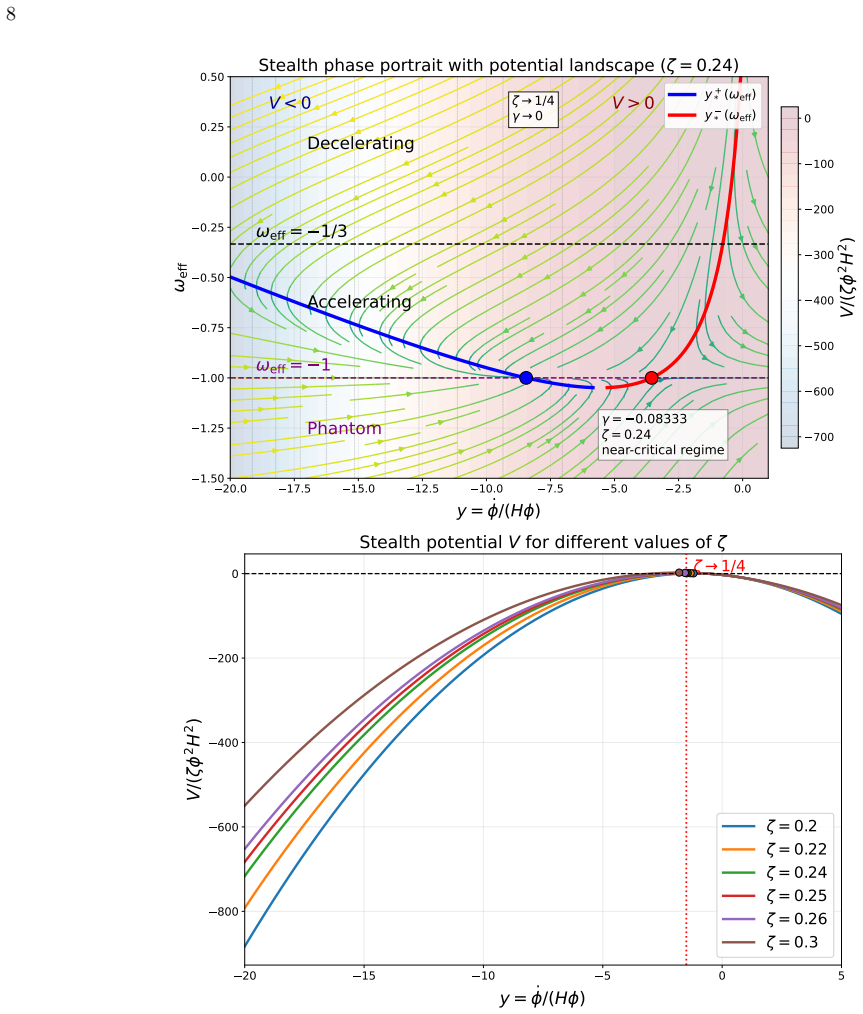
We investigate the connection between cosmological stealth scalar fields and non-equilibrium thermodynamics in a spatially flat Friedmann-Lema\^{i}tre-Robertson-Walker (FLRW) background. We consider a non-minimally coupled scalar field whose energy-momentum tensor vanishes identically, allowing the field to evolve on a dissipative cosmological background without producing gravitational backreaction. We show that the stealth condition leads to a generalized Riccati equation for the scalar-field kinematics, where the dissipative pressure acts as a thermodynamic driving term. In terms of the variable $y=\dot{\phi}/(H\phi)$, the system admits two thermodynamic branches: a stable attractor selected by entropy production and an unstable repeller. We also construct the corresponding phase-space structure in the $(y,\omega_{\rm eff})$ plane and identify a near-critical regime associated with $\zeta=1/4$. Finally, we reconstruct the stealth potential and present a bulk viscous realization in which irreversible entropy production drives the universe toward an asymptotic de Sitter state while the stealth field tracks the dissipative background. Our results suggest that stealth fields can be interpreted as dynamically non-trivial thermodynamic trackers of non-equilibrium cosmological evolution.
Editorial analysis
A structured set of objections, weighed in public.
Referee Report
Summary. The manuscript investigates the connection between cosmological stealth scalar fields and non-equilibrium thermodynamics in a spatially flat FLRW background. A non-minimally coupled scalar field is taken to have identically vanishing energy-momentum tensor, allowing evolution without gravitational backreaction. This stealth condition is shown to yield a generalized Riccati equation for the kinematic variable y = ˙φ/(Hφ) with dissipative pressure as the driving term. The system admits two thermodynamic branches (stable attractor selected by entropy production and unstable repeller), a phase-space structure in the (y, ω_eff) plane with a near-critical regime at ζ = 1/4, a reconstructed stealth potential, and a bulk-viscous realization in which irreversible entropy production drives the universe to asymptotic de Sitter while the stealth field tracks the background. The central suggestion is that stealth fields act as dynamically non-trivial thermodynamic trackers of non-equilibrium cosmological evolution.
Significance. If the central derivations hold and the imposed stealth condition remains dynamically consistent, the work supplies a concrete link between stealth scalars and dissipative thermodynamics, offering a mechanism for scalar fields to track viscous FLRW evolution without backreaction and to select attractors via entropy production. This could be of interest for late-time cosmological models that combine non-minimal coupling, bulk viscosity, and stealth behavior, provided the algebraic structure survives explicit potentials and perturbations.
major comments (2)
- [derivation of the Riccati equation and thermodynamic branches] The stealth condition (scalar EMT vanishes identically) is imposed directly on the non-minimally coupled field in flat FLRW and is used to derive the generalized Riccati equation. No explicit verification is given that this cancellation is preserved once linear metric and field perturbations are introduced or once a concrete V(φ) is substituted; if the cancellation fails, the Riccati structure, the (y, ω_eff) phase portrait, and the thermodynamic-branch interpretation all collapse. This is load-bearing for the central claim.
- [potential reconstruction and bulk-viscous realization] The reconstruction of the stealth potential and the bulk-viscous realization are presented as concrete realizations, yet the manuscript does not demonstrate that the reconstructed V(φ) continues to satisfy T_{μν}=0 identically when inserted back into the full field equations on the dissipative background. This check is required to confirm that the attractor selection by entropy production is not an artifact of the imposition step.
minor comments (2)
- [phase-space analysis] The notation for the dissipative pressure and the parameter ζ should be defined at first use with an explicit equation reference; the statement that ζ = 1/4 corresponds to a near-critical regime would benefit from a short derivation showing how this value emerges from the Riccati coefficients.
- [introduction] The abstract and introduction would be strengthened by a brief comparison with prior stealth-field literature (e.g., the original stealth conditions and their cosmological applications) to clarify the precise advance.
Simulated Author's Rebuttal
We thank the referee for the careful and constructive review of our manuscript. We respond point by point to the major comments below.
read point-by-point responses
-
Referee: The stealth condition (scalar EMT vanishes identically) is imposed directly on the non-minimally coupled field in flat FLRW and is used to derive the generalized Riccati equation. No explicit verification is given that this cancellation is preserved once linear metric and field perturbations are introduced or once a concrete V(φ) is substituted; if the cancellation fails, the Riccati structure, the (y, ω_eff) phase portrait, and the thermodynamic-branch interpretation all collapse. This is load-bearing for the central claim.
Authors: The stealth condition is imposed as an algebraic identity on the background EMT in flat FLRW, from which the generalized Riccati equation for y follows directly via the background field equations; this holds independently of the specific form of V(φ). The derivation does not rely on a particular potential, and the reconstruction section shows how the non-minimal coupling can be chosen to enforce the identity for given backgrounds. We agree that an explicit linear perturbation analysis would provide additional confirmation. In the revised manuscript we will add a clarifying paragraph stating that the background identity is preserved by construction and noting that a full perturbation study lies beyond the present scope. revision: partial
-
Referee: The reconstruction of the stealth potential and the bulk-viscous realization are presented as concrete realizations, yet the manuscript does not demonstrate that the reconstructed V(φ) continues to satisfy T_{μν}=0 identically when inserted back into the full field equations on the dissipative background. This check is required to confirm that the attractor selection by entropy production is not an artifact of the imposition step.
Authors: The reconstruction solves the stealth condition T_μν=0 for V(φ) on the prescribed dissipative background, so substitution back into the field equations recovers the original identity by construction. In the bulk-viscous realization the dissipative pressure enters the effective equations while the stealth constraint is maintained throughout. We will add an explicit verification subsection in the revised manuscript that substitutes the reconstructed quantities and confirms T_μν=0 holds identically on the background. revision: yes
Circularity Check
No significant circularity detected; derivation follows directly from imposed stealth assumption without tautological reduction
full rationale
The paper imposes the stealth condition (scalar EMT vanishes identically) as an explicit modeling assumption on the non-minimally coupled field in flat FLRW. It then derives the generalized Riccati equation for y = ˙φ/(Hφ), identifies the two thermodynamic branches, reconstructs the potential, and constructs the bulk-viscous realization as algebraic consequences of that assumption. No quoted step shows a 'prediction' that reduces by construction to a fitted parameter or to the stealth condition itself. No self-citation is invoked as load-bearing justification for uniqueness or ansatz. The central interpretation (stealth fields as thermodynamic trackers) is presented as a reading of the derived phase-space structure rather than an independent claim that loops back to the inputs. This is ordinary model-building from stated assumptions and therefore scores 0.
Axiom & Free-Parameter Ledger
free parameters (1)
- zeta
axioms (2)
- domain assumption Spatially flat FLRW background with non-minimally coupled scalar field whose energy-momentum tensor vanishes identically.
- domain assumption Dissipative pressure acts as thermodynamic driving term in the generalized Riccati equation.
invented entities (1)
-
thermodynamic branches (stable attractor and unstable repeller)
no independent evidence
Reference graph
Works this paper leans on
-
[1]
Stability Analysis and the Thermodynamic Selection While the quadratic constraint(20) yields two mathe- matically valid steady states,y+ ∗ and y− ∗ , we must deter- mine their dynamical stability to understand the physical fate of the stealth field. A fixed pointy∗ is a stable at- tractor (a sink) if small kinematic perturbationsδy decay over entropic tim...
-
[2]
Since the dissipative pressureΠmay evolve dynamically as entropy is produced, the effective thermo- dynamic state of the cosmic fluid can naturally become time-dependent
Two-dimensional phase-space structure From the perspective of irreversible thermodynamics, there is no fundamental reason for the effective equa- tion of stateωeffto remain constant during cosmological evolution. Since the dissipative pressureΠmay evolve dynamically as entropy is produced, the effective thermo- dynamic state of the cosmic fluid can natura...
-
[3]
Consequently, the structure of the phase space changes qualitatively, revealing the existence of a degeneracy point of the Riccati dynamics in the stealth dynamics
Near-critical phase portrait and degeneracy point of the Riccati dynamics A particularly interesting dynamical regime emerges when the non-minimal coupling parameter approaches the critical value ζc = 1 4 .(46) At this point, the effective coupling coefficientγ vanishes, and the nonlinear Riccati structure degenerates into a linear dynamical equation. Con...
-
[4]
Phase portrait and stealth potential landscape In order to visualize the role played by the stealth potential, the quantity V ζϕ2H2 =− 6y+ 1 2ζ y2 + 3 ,(49) was superimposed onto the phase portrait as a background potential landscape in the upper panel of Fig. 2. The resulting contour structure illustrates how the thermody- namic flow evolves across regio...
2023
-
[5]
Planck 2018 results. VI. Cosmological parameters
N. Aghanim et al. (Planck Collaboration), Astronomy & Astrophysics641, A6 (2020), arXiv:1807.06209 [astro- ph.CO]
work page internal anchor Pith review Pith/arXiv arXiv 2020
-
[6]
Faraoni,Cosmology in Scalar-Tensor Gravity, Funda- mental Theories of Physics (Springer Netherlands, 2004)
V. Faraoni,Cosmology in Scalar-Tensor Gravity, Funda- mental Theories of Physics (Springer Netherlands, 2004)
2004
-
[7]
Gravitational Cheshire effect: Nonminimally coupled scalar fields may not curve spacetime
E. Ayon-Beato, C. Martinez, R. Troncoso, and J. Zanelli, Phys. Rev. D71, 104037 (2005), arXiv:hep-th/0505086
work page internal anchor Pith review Pith/arXiv arXiv 2005
-
[8]
E. Ayón-Beato, C. Martínez, and J. Zanelli, General Relativity and Gravitation38, 145 (2006), arXiv:hep- th/0403228 [hep-th]
-
[9]
The Conformal Stealth of any Standard Cosmology
E. Ayón-Beato, A. A. García, P. I. Ramírez-Baca, and C. A. Terrero-Escalante, Phys. Rev. D88, 063523 (2013), arXiv:1307.6534 [gr-qc]
work page internal anchor Pith review Pith/arXiv arXiv 2013
-
[10]
Cosmological stealths with nonconformal couplings
E. Ayón-Beato, P. I. Ramírez-Baca, and C. A. Terrero-Escalante, Phys. Rev. D97, 043505 (2018), arXiv:1512.09375 [gr-qc]
work page internal anchor Pith review Pith/arXiv arXiv 2018
-
[11]
E. Ayón-Beato, M. Hassaine, and P. A. Sánchez, Eur. Phys. J. C85, 259 (2025), arXiv:2408.00086 [hep-th]
-
[12]
Are stealth scalar fields stable?
V. Faraoni and A. F. Zambrano Moreno, Physical Review D81, 124050 (2010), arXiv:1006.1936 [gr-qc]
work page internal anchor Pith review Pith/arXiv arXiv 2010
-
[13]
Creation of the universe with a stealth scalar field
H. Maeda and K.-I. Maeda, Physical Review D86, 124045 (2012), arXiv:1208.5777 [gr-qc]
work page internal anchor Pith review Pith/arXiv arXiv 2012
-
[14]
Stealth configurations in vector-tensor theories of gravity
J. Chagoya and G. Tasinato, JCAP01, 046 (2018), arXiv:1707.07951 [hep-th]
work page internal anchor Pith review Pith/arXiv arXiv 2018
-
[15]
Mimicking the LCDM model with Stealths
C. Campuzano, V. H. Cárdenas, and R. Herrera, Euro- pean Physical Journal C76, 698 (2016), arXiv:1611.08433 [gr-qc]. 12
work page internal anchor Pith review Pith/arXiv arXiv 2016
-
[16]
Aguilar, A
G. Aguilar, A. Alvarez, and C. Campuzano, Journal of Physics: Conference Series1030, 012011 (2018)
2018
-
[17]
Eckart, Phys
C. Eckart, Phys. Rev.58, 919 (1940)
1940
-
[18]
Israel, Annals of Physics100, 310 (1976)
W. Israel, Annals of Physics100, 310 (1976)
1976
-
[19]
Israel and J
W. Israel and J. Stewart, Annals of Physics118, 341 (1979)
1979
-
[20]
Prigogine, J
I. Prigogine, J. Geheniau, E. Gunzig, and P. Nardone, General Relativity and Gravitation21, 767 (1989)
1989
-
[21]
Maartens, arXiv e-prints (1996), arXiv:astro- ph/9609119 [astro-ph]
R. Maartens, arXiv e-prints (1996), arXiv:astro- ph/9609119 [astro-ph]
-
[22]
W. Zimdahl, Physical Review D53, 5483 (1996), arXiv:astro-ph/9601189 [astro-ph]
work page internal anchor Pith review Pith/arXiv arXiv 1996
-
[23]
Collisional equilibrium, particle production and the inflationary universe
W. Zimdahl, J. Triginer, and D. Pavón, Physical Review D54, 6101 (1996), arXiv:gr-qc/9608038 [gr-qc]
work page internal anchor Pith review Pith/arXiv arXiv 1996
-
[24]
Kinetic theory for particle production
J. Triginer, W. Zimdahl, and D. Pavón, Classical and Quantum Gravity13, 403 (1996), arXiv:gr-qc/9602028 [gr-qc]
work page internal anchor Pith review Pith/arXiv arXiv 1996
-
[25]
J. A. S. Lima, A. S. M. Germano, and L. R. W. Abramo, Physical Review D53, 4287 (1996), arXiv:gr-qc/9511006 [gr-qc]
work page internal anchor Pith review Pith/arXiv arXiv 1996
-
[26]
R. O. Ramos, M. V. dos Santos, and I. Waga, Physical Re- view D89, 083524 (2014), arXiv:1404.2604 [astro-ph.CO]
work page internal anchor Pith review Pith/arXiv arXiv 2014
-
[27]
M. Cruz, N. Cruz, and S. Lepe, Physical Review D96 (2017), 10.1103/physrevd.96.124020
-
[28]
M. Cruz, N. Cruz, and S. Lepe, Physics Letters B769, 159 (2017)
2017
-
[29]
Tamayo, Revista Mexicana de Física68, 020704 (2022), arXiv:2006.14153 [gr-qc]
D. Tamayo, Revista Mexicana de Física68, 020704 (2022), arXiv:2006.14153 [gr-qc]
-
[30]
Paul, Physical Review D111, 083540 (2025), arXiv:2504.00422 [gr-qc]
T. Paul, Physical Review D111, 083540 (2025), arXiv:2504.00422 [gr-qc]
-
[31]
L. Gavassino and J. Noronha, Physical Review D109 (2024), 10.1103/physrevd.109.096040
-
[32]
Growth of matter overdensities in non-minimal torsion-matter coupling theories
M. Gonzalez-Espinoza, G. Otalora, J. Saavedra, and N. Videla, Eur. Phys. J. C78, 799 (2018), arXiv:1808.01941 [gr-qc]
work page internal anchor Pith review Pith/arXiv arXiv 2018
-
[33]
Zimdahl, Monthly Notices of the Royal Astronomical Society288, 665–673 (1997)
W. Zimdahl, Monthly Notices of the Royal Astronomical Society288, 665–673 (1997)
1997
-
[34]
R. O. Ramos, M. Vargas dos Santos, and I. Waga, Phys- ical Review D89(2014), 10.1103/physrevd.89.083524
-
[35]
V. H. Cárdenas and M. Cruz, Physics of the Dark Universe 44, 101452 (2024)
2024
-
[36]
T. Schiavone, M. D. Angelis, L. A. Escamilla, G. Montani, and E. D. Valentino, “Revisiting the Matter Creation Process: Observational Constraints on Gravitationally Induced Dark Energy and the Hubble Tension,” (2026), arXiv:2601.14222 [astro-ph.CO]
work page internal anchor Pith review Pith/arXiv arXiv 2026
-
[37]
Timeisentropy: Ageometricproof,
H.Quevedo,“Timeisentropy: Ageometricproof,” (2024), arXiv:2410.07639 [gr-qc]
-
[38]
I. Brevik, E. Elizalde, S. Nojiri, and S. D. Odintsov, Phys- ical Review D84(2011), 10.1103/physrevd.84.103508
discussion (0)
Sign in with ORCID, Apple, or X to comment. Anyone can read and Pith papers without signing in.