REVIEW 3 major objections 4 minor 15 references
A hierarchical partitioning scheme lets classical computers train 128-qubit quantum convolutional networks for image classification without exponential memory blow-up.
Reviewed by Pith at T0; open to challenge. T0 means a machine referee read the full paper against a public rubric. the ladder, T0–T4 →
T0 review · grok-4.5
2026-07-13 05:43 UTC pith:EAX3O5VA
load-bearing objection Practical hierarchical density-matrix scheme that actually trains 128-qubit QCNNs classically, but the approximation fidelity is unchecked and the MNIST evidence is tiny. the 3 major comments →
A Novel Parallel QCNN Architecture with Efficient Classical Simulability
The pith
A machine-rendered reading of the paper's core claim, the machinery that carries it, and where it could break.
Core claim
A hierarchical partitioning architecture that repeatedly applies local QCNN blocks, traces out source qubits, and recombines neighboring density matrices by tensor product allows classical simulation and training of a 128-qubit quantum convolutional network—impossible without the architecture—while preserving or improving binary classification accuracy relative to a monolithic circuit of the same total qubit count.
What carries the argument
The binary-tree reduction of density matrices: after each local convolution-pooling layer the even (source) qubits are traced out, neighboring reduced density matrices are combined by tensor product, and the number of active processes is halved until one register remains for final reduction and measurement.
Load-bearing premise
That repeatedly discarding source qubits by partial trace and gluing the remaining density matrices back together still faithfully approximates the full multi-qubit circuit that would be executed on real quantum hardware.
What would settle it
Train identical 16-qubit and 32-qubit models both with and without partitioning on the same MNIST split; if the partitioned models systematically lose several accuracy points once the approximation error is isolated, the central claim fails.
If this is right
- Classical HPC clusters can train QCNNs whose total qubit count exceeds the ~50-qubit full-state simulation barrier.
- Memory cost becomes linear in the number of partitions rather than exponential in total qubits.
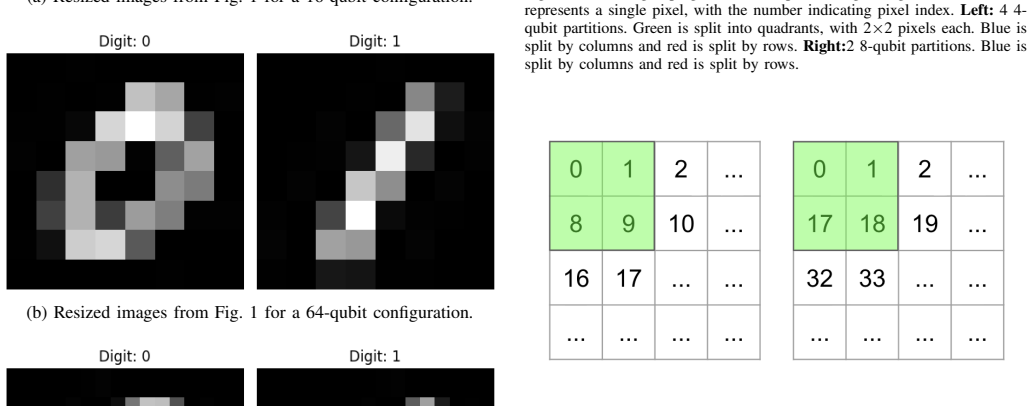
- Image-partition grouping (rows, columns, quadrants, 2x2 tiles) becomes a tunable hyper-parameter that can raise or lower final accuracy.
- The same reduction tree can be executed natively on quantum hardware by simply discarding the traced-out qubits after each pooling stage.
- Larger total qubit counts (more retained pixels) can improve accuracy even when each process remains only four qubits.
Where Pith is reading between the lines
- Because each process re-uses the same local parameters, the scheme automatically implements a weight-sharing inductive bias analogous to classical CNN kernels, which may explain the occasional accuracy gains.
- The claimed reduction of barren plateaus is a plausible side-effect of keeping every local circuit shallow and low-dimensional; systematic gradient-variance measurements across partition sizes would test this.
- The same tree-reduction idea could be applied to other hierarchical quantum models (quantum graph networks, hierarchical quantum autoencoders) that currently face the same simulation wall.
Editorial analysis
A structured set of objections, weighed in public.
Referee Report
Summary. The manuscript introduces a hierarchical parallel QCNN architecture for binary MNIST classification (0 vs 1). Images are downsampled and partitioned across processes; each process runs local convolutional/pooling layers (parameterized 2-qubit unitaries after Z-feature-map encoding), after which source qubits are discarded via partial trace, neighboring reduced density matrices are recombined by tensor product, and the process is repeated in a binary-tree reduction until a single process remains and is reduced to one measured qubit. The scheme is claimed to enable classical simulation of 64- and 128-qubit models (impossible for exact full-state simulation) while matching or exceeding the accuracy of unpartitioned models of equal total qubit count on small instances, with a speculative link to reduced barren plateaus.
Significance. If the approximation is faithful and the accuracy claims hold under stronger validation, the work would provide a practical route to classically train and study QCNN-scale models far beyond the ~50-qubit exact-simulation barrier, using only modest per-process memory and MPI-style parallelism. The explicit memory formulas (Eqs. 2–3), parameter-count scaling (Eqs. 6–10 and Table I), and open description of the reduction tree are useful engineering contributions. The experimental demonstration that certain partition geometries remain competitive with monolithic baselines on 12- and 16-qubit problems is a concrete positive result.
major comments (3)
- [III-C] Section III-C (Eqs. 4–5, Figs. 12–13) replaces every inter-partition interaction by a partial trace over source qubits followed by a tensor product of the reduced density matrices. This is exact only while the partitions remain unentangled; subsequent convolutional layers on the recombined register cannot recreate the entanglement that would have been generated by a true multi-partition circuit (Fig. 10). No fidelity, total-variation, or final-expectation comparison between the approximate evolution and an exact full-state simulation is reported on any instance small enough to run both ways. Without that check the 64- and 128-qubit accuracies cannot be claimed to belong to a genuine QCNN.
- [IV] All accuracy claims rest on a 125-sample subset (100 train / 25 test), 100 epochs, learning rate 0.1, and 10 random seeds, with no error bars, confidence intervals, or statistical tests (Section IV, Figs. 14–15). The reported differences between partition geometries and the monolithic baselines are therefore not shown to be significant; the same holds for the claim that 64- and 128-qubit models “perform similarly” to the best small models.
- [Abstract / V] The abstract and conclusion attribute any accuracy gains to a reduction of barren plateaus, yet no gradient-variance, landscape, or trainability diagnostic is supplied. The statement remains pure speculation and should either be removed or supported by explicit measurements.
minor comments (4)
- [III-A] Fig. 6 caption and axis labels should state units (bytes) and whether the curves include density-matrix overhead after the first reduction.
- [III-D] Table I header “Qubits per process” is clear, but the body rows mix total-qubit and per-process counts; a second column for total qubits would avoid ambiguity.
- [Abstract] The text repeatedly writes “Barren plateaus” with capital B; standard usage is lowercase.
- [I-A] Reference [3] reports a 61-qubit simulation with compression; the claim that 128 qubits is “impossible \ldots without the novel architecture” should be qualified to “exact full-state simulation.”
Circularity Check
No circularity: experimental architecture paper with empirical accuracy comparisons and standard linear-algebra resource formulas.
full rationale
The paper introduces a hierarchical partitioning scheme for QCNN simulation (partial traces over source qubits followed by tensor-product recombination of density matrices, binary-tree reduction of processes, shared local parameters, etc.) and reports empirical binary-classification accuracies on a tiny MNIST 0/1 subset for systems up to 128 qubits. All load-bearing claims are either (a) direct experimental measurements of train/test accuracy under stochastic gradient descent with the parameter-shift rule, or (b) elementary counting arguments for memory (Eqs. 2–3) and parameter totals (Eqs. 6–10, Table I) that follow immediately from the circuit topology and the complex128 state-vector representation. No quantity is fitted to data and then re-presented as a prediction; no uniqueness theorem or ansatz is imported via self-citation to force a result; and the architecture itself is not defined in terms of the accuracy numbers it later reports. The work is therefore self-contained against its own benchmarks and exhibits none of the six circularity patterns.
Axiom & Free-Parameter Ledger
free parameters (4)
- learning_rate =
0.1
- parameters_updated_per_sample =
15
- initial_parameter_range =
[-0.1, 0.1]
- downsampling_target_size =
N pixels matching qubit count
axioms (4)
- ad hoc to paper Partial trace over source qubits followed by tensor product of the remaining density matrices is a faithful enough approximation of the full multi-qubit circuit for classification purposes.
- domain assumption A 125-sample binary subset of MNIST is sufficient to compare architectural variants and to claim competitive accuracy.
- domain assumption Shared local parameters across partitions emulate the weight-sharing of a classical convolutional kernel.
- standard math State-vector memory scales as 2^{N+4} bytes (complex128).
invented entities (1)
-
hierarchical partition-merge QCNN with binary-tree density-matrix reduction
no independent evidence
read the original abstract
This work presents a study of an implementation of a novel Quantum Convolutional Neural Network (QCNN) for binary classification of images from the Modified National Institute of Standards and Technology (MNIST) dataset. Using a novel architecture inspired by previous QCNN and classical convolutional neural network (CNN) implementations, we use a hierarchical partitioning approach to implement a QCNN circuit that can be approximated and simulated efficiently on a classical machine for a large problem. First, the original image is partitioned such that each process handles a smaller portion of the image, which is encoded into independent states. Then, these partitions merge and combine, resulting in states that contain information from both partitions while halving the number of processes. After repeating this until one process remains, we reduce the dimensionality of the state until a single qubit remains for measurement. Using this approach, we can use multiple processes in parallel to simulate a large QCNN program without the need for exponentially growing hardware requirements as the number of qubits increases. In our work, we use this scheme to train a 128-qubit model, which is impossible to run on any classical supercomputer without the novel architecture. We also explore the impact of this new model architecture on prediction accuracy by training it to perform binary classification on the MNIST dataset with a small number of qubits, and comparing it to a model without partitioning. Our initial findings show that partitioning images into smaller sub-images with this architecture does not degrade the model's performance and sometimes even improves it, likely because it reduces the Barren plateaus issue in the partitioning process.
Figures




Reference graph
Works this paper leans on
-
[1]
Quantum convolutional neural networks,
I. Cong, S. Choi, and M. D. Lukin, “Quantum convolutional neural networks,” Nature Physics, vol. 15, no. 12, pp. 1273–1278, 2019, doi: 10.1038/s41567-019-0648-8
-
[2]
P. R ¨oseler, O. Schaudt, H. Berg, C. Bauckhage, and M. Koch, “Efficient quantum convolutional neural networks for image classification: Over- coming hardware constraints,” arXiv preprint arXiv:2505.05957, 2025, doi: 10.48550/arXiv.2505.05957
-
[3]
Full-state quantum circuit simulation by using data compression,
X.-C. Wu, S. Di, E. M. Dasgupta, F. Cappello, H. Finkel, Y . Alexeev, and F. T. Chong, “Full-state quantum circuit simulation by using data compression,” in Proc. Int. Conf. High Performance Computing, Networking, Storage and Analysis (SC ’19), Denver, CO, USA, 2019, Art. no. 80, pp. 1–24, doi: 10.1145/3295500.3356155
-
[4]
The Quantum Convolutional Neural Network,
“The Quantum Convolutional Neural Network,”Qiskit Machine Learning Documentation. [Online]. Available: https://qiskit-community.github.io/qiskit-machine-learning/tutorials/ 11 quantum convolutional neural networks.html. [Accessed: Sep. 23, 2025]
2025
-
[5]
The MNIST database of handwritten digits,
Y . LeCun, C. Cortes, and C. J. C. Burges, “The MNIST database of handwritten digits,” 1998. [Online]. Available: http://yann.lecun.com/ exdb/mnist/
1998
-
[6]
A. Klawonn, M. Lanser, and J. Weber, “Model parallel training and transfer learning for convolutional neural networks by domain decom- position,” arXiv preprint arXiv:2408.14442, 2024
Pith/arXiv arXiv 2024
-
[7]
K. Chinzei, Q. H. Tran, K. Maruyama, H. Oshima, and S. Sato, “Splitting and parallelizing of quantum convolutional neural networks for learning translationally symmetric data,” Phys. Rev. Research, vol. 6, no. 2, p. 023042, Apr. 2024, doi: 10.1103/PhysRevResearch.6.023042
-
[8]
An introduction to convolutional neural networks,
K. O’Shea and R. Nash, “An introduction to convolutional neural networks,” arXiv preprint arXiv:1511.08458, 2015, doi: 10.48550/arXiv.1511.08458
-
[9]
Optimal quantum circuits for general two- qubit gates,
F. Vatan and C. Williams, “Optimal quantum circuits for general two- qubit gates,” arXiv preprint arXiv:quant-ph/0308006, Aug. 2003
Pith/arXiv arXiv 2003
-
[10]
A Herculean task: classical simulation of quantum computers,
X. Xu, S. Benjamin, J. Chen, J. Sun, X. Yuan, and P. Zhang, “A Herculean task: classical simulation of quantum computers,” Sci- ence Bulletin, vol. 70, no. 23, pp. 4104–4112, Dec. 2025, doi: 10.1016/j.scib.2025.10.016
-
[11]
Statevector.py,
Qiskit Development Team, “Statevector.py,” Qiskit: An Open- Source SDK for Quantum Computing, GitHub repository. [On- line]. Available: https://github.com/Qiskit/qiskit/blob/stable/2.4/qiskit/ quantum info/states/statevector.py#L276 . Accessed: Apr. 18, 2026
2026
-
[12]
Density matrices and partial trace,
D. Unruh, “Density matrices and partial trace,” lecture notes, University of Tartu, 2020. [Online]. Available: https://kodu.ut.ee/ ∼unruh/courses/ qc/2020/materials/lab density trace.pdf
2020
-
[13]
What is stochastic gradient descent?,
A. Gutowska, “What is stochastic gradient descent?,” IBM. [Online]. Available: https://www.ibm.com/think/topics/stochastic-gradient-descent . [Accessed: Mar. 18, 2026]
2026
-
[14]
Evaluating analytic gradients on quantum hardware,
M. Schuld et al., “Evaluating analytic gradients on quantum hardware,” Phys. Rev. A, vol. 99, no. 3, p. 032331, 2019
2019
-
[15]
Quantum convolutional neural network based on variational quantum circuits,
S. Huang, Y . Huang, and H. Chen, “Quantum convolutional neural network based on variational quantum circuits,” Optics Communications, vol. 545, p. 129993, 2023, doi: 10.1016/j.optcom.2023.129993
discussion (0)
Sign in with ORCID, Apple, or X to comment. Anyone can read and Pith papers without signing in.