A Three-Layer Architecture for Fault-Tolerant Quantum Computing
Pith reviewed 2026-06-26 10:34 UTC · model grok-4.3
The pith
A hardware-agnostic three-layer framework organizes fault-tolerant quantum computation as a universal abstract standard.
A machine-rendered reading of the paper's core claim, the machinery that carries it, and where it could break.
Core claim
Drawing from classical computer architecture, the paper claims that real execution workflows of fault-tolerant quantum algorithms can define a decoupled three-layer high-level framework that functions as a universal abstract standard rather than a platform-specific scheme, with the Fault-Tolerance Layer serving as the architectural bridge between logical programs and hardware execution.
What carries the argument
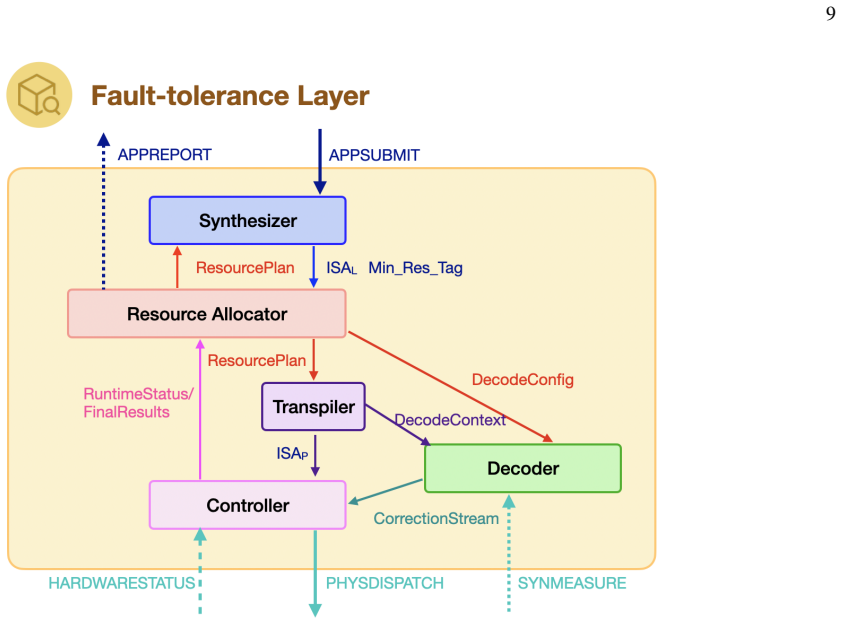
The three-layer architecture (Application Layer, Fault-Tolerance Layer, Hardware Layer), with the Fault-Tolerance Layer characterized by its five internal components, interfaces, and execution-correction-adaptation paths.
Load-bearing premise
Real execution workflows of fault-tolerant quantum algorithms can be used to define a decoupled, hardware- and code-agnostic model that still functions as a practical universal abstract standard.
What would settle it
Demonstration that any single abstract three-layer model either loses correctness when applied across different error-correction codes or requires platform-specific adjustments that violate the claimed decoupling.
Figures





read the original abstract
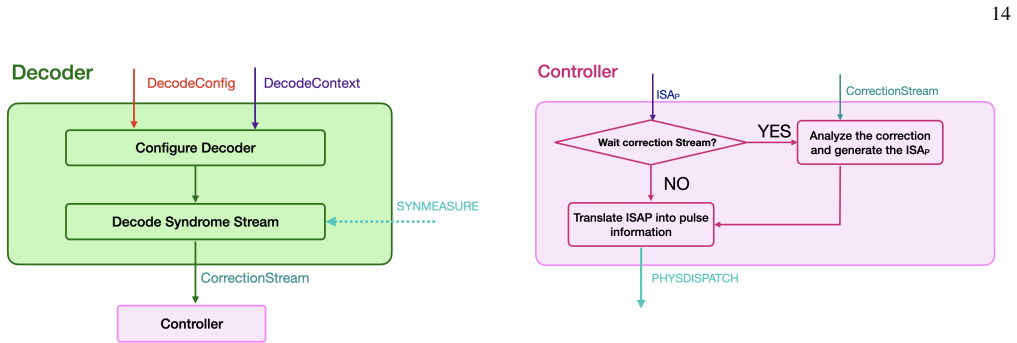
Fault tolerance is an indispensable prerequisite for constructing large-scale universal quantum computers. Drawing philosophies from classical computer architecture, this paper presents a hardware-agnostic three-layer high-level architectural framework for generic fault-tolerant quantum computation. Guided by the real execution workflows of fault-tolerant quantum algorithms, the proposed model is decoupled from specific physical qubit hardware platforms and quantum error correction codes, serving as a universal abstract standard rather than a platform-specific implementation scheme. Special attention is devoted to the intermediate Fault-Tolerance Layer, which serves as the architectural bridge between application-level logical programs and hardware-level execution. We systematically characterize its five internal components, the interfaces and data exchanged among them, and the execution, correction, and adaptation paths that together enable logical synthesis, fault-tolerant resources management, decoding, and runtime fault-tolerant control. An end-to-end example is further provided to illustrate the full-stack operating pipeline of fault-tolerant quantum algorithms under this framework. Given the increasing emphasis on modular, heterogeneous, and cross-layer fault-tolerant quantum systems, our architecture provides a unified foundational model for organizing such designs.
Editorial analysis
A structured set of objections, weighed in public.
Referee Report
Summary. The paper proposes a hardware-agnostic three-layer architecture (Application, Fault-Tolerance, Physical) for fault-tolerant quantum computation. Guided by FTQC execution workflows, it focuses on the intermediate Fault-Tolerance Layer, characterizing its five internal components, interfaces, data exchanges, and execution/correction/adaptation paths to enable logical synthesis, resource management, decoding, and runtime control. An end-to-end example illustrates the full-stack pipeline, positioning the model as a universal abstract standard decoupled from specific hardware platforms and QEC codes.
Significance. If the proposed decoupling can be shown to accommodate diverse FTQC workflows without hidden platform-specific assumptions, the architecture would supply a much-needed high-level organizing framework for modular and heterogeneous quantum systems. The explicit treatment of interfaces and an end-to-end example constitute concrete strengths that could help standardize cross-layer design discussions.
major comments (2)
- [Abstract] Abstract and the section describing the guiding principle: the claim that real execution workflows suffice to define a decoupled, hardware- and code-agnostic model that still functions as a practical universal standard is asserted without any mapping of concrete FTQC algorithms onto the five components or any test of the interfaces; this assumption is load-bearing for the universality assertion.
- [Fault-Tolerance Layer characterization] Section characterizing the Fault-Tolerance Layer: the five components and their execution/correction/adaptation paths are described at a purely structural level with no quantitative illustration (resource overhead, latency bounds, or failure-rate propagation) showing that the abstraction remains functional once instantiated; without such grounding the bridge function between logical programs and physical execution remains unverified.
minor comments (1)
- [Figures and example] Figure captions and the end-to-end example would benefit from explicit cross-references to the five components so readers can trace data flow without ambiguity.
Simulated Author's Rebuttal
We thank the referee for the constructive comments. We address each major comment point by point below, maintaining that the manuscript's scope as a high-level architectural framework is appropriate for the claims made.
read point-by-point responses
-
Referee: [Abstract] Abstract and the section describing the guiding principle: the claim that real execution workflows suffice to define a decoupled, hardware- and code-agnostic model that still functions as a practical universal standard is asserted without any mapping of concrete FTQC algorithms onto the five components or any test of the interfaces; this assumption is load-bearing for the universality assertion.
Authors: The end-to-end example in Section 5 explicitly traces a representative fault-tolerant quantum algorithm through the five components of the Fault-Tolerance Layer, showing the data exchanges, interfaces, and execution/correction/adaptation paths. This example is derived from standard FTQC workflows (e.g., logical gate synthesis and decoding loops) and thereby grounds the universality claim without embedding platform-specific assumptions. We maintain that the structural characterization plus this concrete pipeline illustration suffices to support the abstract standard; no additional mappings are required for the paper's stated contribution. revision: no
-
Referee: [Fault-Tolerance Layer characterization] Section characterizing the Fault-Tolerance Layer: the five components and their execution/correction/adaptation paths are described at a purely structural level with no quantitative illustration (resource overhead, latency bounds, or failure-rate propagation) showing that the abstraction remains functional once instantiated; without such grounding the bridge function between logical programs and physical execution remains unverified.
Authors: Because the architecture is deliberately hardware- and code-agnostic, any quantitative metrics such as resource overhead or latency would depend on a specific choice of QEC code and physical platform, which would undermine the goal of a universal abstract standard. The manuscript verifies the bridge function at the architectural level through the defined interfaces, data flows, and the end-to-end example; quantitative instantiation and performance analysis belong to follow-on implementation studies rather than this framework paper. revision: no
Circularity Check
No significant circularity
full rationale
The paper is a high-level conceptual proposal defining a three-layer architecture (Application, Fault-Tolerance, Physical) and its components by deliberate abstraction from real FTQC workflows. No equations, fitted parameters, predictions, theorems, or scaling laws are asserted that could reduce to inputs by construction. No self-citation chains, uniqueness theorems, or ansatzes are invoked in a load-bearing manner. The decoupling is achieved by design choice, not derivation, making the model self-contained against external benchmarks.
Axiom & Free-Parameter Ledger
axioms (1)
- domain assumption Fault tolerance is an indispensable prerequisite for constructing large-scale universal quantum computers.
Reference graph
Works this paper leans on
-
[1]
Shor, Fault-tolerant quantum computation, inProceedings of 37th Conference on Foundations of Computer Science(1996) pp
P. Shor, Fault-tolerant quantum computation, inProceedings of 37th Conference on Foundations of Computer Science(1996) pp. 56–65
1996
-
[2]
Preskill, Reliable quantum computers, Proceedings of the Royal Society of London
J. Preskill, Reliable quantum computers, Proceedings of the Royal Society of London. Series A: Mathematical, Physical and Engineering Sciences454, 385 (1998)
1998
-
[3]
E. T. Campbell, B. M. Terhal, and C. Vuillot, Roads towards fault-tolerant universal quantum computation, Nature549, 172 (2017)
2017
-
[4]
B. M. Terhal, Quantum error correction for quantum memories, Reviews of Modern Physics87, 307 (2015)
2015
-
[5]
M. Mohseni, A. Scherer, K. G. Johnson, O. Wertheim, M. Ot- ten, N. Anand, N. A. Aadit, Y. Alexeev, G. Ben-Shach, K. M. Bresniker,et al., How to build a quantum supercomputer: Scaling from hundreds to millions of qubits, arXiv preprint arXiv:2411.10406 (2024)
Pith/arXiv arXiv 2024
-
[6]
D. A. P. David A, L. John,et al.,Computer organization and design: the hardware/software interface(ELSEVEIR, 2017)
2017
-
[7]
Ding and F
Y. Ding and F. T. Chong,Quantum Computer Systems: Research for Noisy Intermediate-Scale Quantum Computers(Springer Na- ture, 2022)
2022
-
[8]
Zhang, X
F. Zhang, X. Zhu, R. Chao, C. Huang, L. Kong, G. Chen, D. Ding, H. Feng, Y. Gao, X. Ni, L. Qiu, Z. Wei, Y. Yang, Y. Zhao, Y. Shi, W. Zhang, P. Zhou, and J. Chen, A Classical Architecture for Digital Quantum Computers, ACM Transac- tions on Quantum Computing5, 3:1 (2023)
2023
-
[9]
Kobori, Y
T. Kobori, Y. Suzuki, Y. Ueno, T. Tanimoto, S. Todo, and Y. Tokunaga, LSQCA: Resource-Efficient Load/Store Archi- tecture for Limited-Scale Fault-Tolerant Quantum Computing, in2025 IEEE International Symposium on High Performance Computer Architecture (HPCA)(2025) pp. 304–320
2025
-
[10]
A. G. Fowler, M. Mariantoni, J. M. Martinis, and A. N. Cleland, Surface codes: Towards practical large-scale quantum compu- tation, Physical Review A—Atomic, Molecular, and Optical Physics86, 032324 (2012)
2012
-
[11]
Gidney and M
C. Gidney and M. Eker ˚a, How to factor 2048 bit rsa integers in 8 hours using 20 million noisy qubits, Quantum5, 433 (2021)
2048
-
[12]
C. Gidney, N. Shutty, and C. Jones, Magic state cultiva- tion: Growing T states as cheap as CNOT gates (2024), arXiv:2409.17595
Pith/arXiv arXiv 2024
-
[13]
Litinski, A game of surface codes: Large-scale quantum computing with lattice surgery, Quantum3, 128 (2019)
D. Litinski, A game of surface codes: Large-scale quantum computing with lattice surgery, Quantum3, 128 (2019)
2019
-
[14]
Ryan-Anderson, J
C. Ryan-Anderson, J. G. Bohnet, K. Lee, D. Gresh, A. Hankin, J. P. Gaebler, D. Francois, A. Chernoguzov, D. Lucchetti, N. C. Brown,et al., Realization of real-time fault-tolerant quantum error correction, Physical Review X11, 041058 (2021)
2021
-
[15]
Acharya, D
R. Acharya, D. A. Abanin, L. Aghababaie-Beni, I. Aleiner, T. I. Andersen, M. Ansmann, F. Arute, K. Arya, A. Asfaw, N. Astrakhantsev, J. Atalaya, R. Babbush, D. Bacon, B. Ballard, J. C. Bardin, J. Bausch, A. Bengtsson, A. Bilmes, S. Black- well, S. Boixo, G. Bortoli, A. Bourassa, J. Bovaird, L. Brill, M. Broughton, D. A. Browne, B. Buchea, B. B. Buckley, D...
2025
-
[16]
N. C. Jones, R. Van Meter, A. G. Fowler, P. L. McMahon, J. Kim, T. D. Ladd, and Y. Yamamoto, Layered architecture for quantum computing, Physical Review X2, 031007 (2012)
2012
-
[17]
P. W. Shor, Scheme for reducing decoherence in quantum com- puter memory, Physical review A52, R2493 (1995)
1995
-
[18]
Gottesman, Class of quantum error-correcting codes saturat- ing the quantum Hamming bound, Physical Review A54, 1862 (1996)
D. Gottesman, Class of quantum error-correcting codes saturat- ing the quantum Hamming bound, Physical Review A54, 1862 (1996)
1996
-
[19]
A. R. Calderbank and P. W. Shor, Good quantum error- correcting codes exist, Physical Review A54, 1098 (1996)
1996
-
[20]
A. M. Steane, Simple quantum error-correcting codes, Physical Review A54, 4741 (1996)
1996
-
[21]
Eastin and E
B. Eastin and E. Knill, Restrictions on Transversal Encoded Quantum Gate Sets, Physical Review Letters102, 110502 (2009)
2009
-
[22]
Bravyi and A
S. Bravyi and A. Kitaev, Universal quantum computation with ideal Clifford gates and noisy ancillas, Physical Review A71, 022316 (2005)
2005
-
[23]
Bravyi and J
S. Bravyi and J. Haah, Magic-state distillation with low over- head, Physical Review A—Atomic, Molecular, and Optical Physics86, 052329 (2012)
2012
-
[24]
J. Koch, T. M. Yu, J. Gambetta, A. A. Houck, D. I. Schuster, J. Majer, A. Blais, M. H. Devoret, S. M. Girvin, and R. J. Schoelkopf, Charge-insensitive qubit design derived from the cooper pair box, Physical Review A—Atomic, Molecular, and Optical Physics76, 042319 (2007)
2007
-
[25]
Ivezic, IBM Unveils Condor: 1,121-Qubit Quantum Proces- sor (2023)
M. Ivezic, IBM Unveils Condor: 1,121-Qubit Quantum Proces- sor (2023)
2023
-
[26]
Ivezic, IBM Unveils 156-Qubit ‘Heron R2’ Quantum Pro- cessor (2024)
M. Ivezic, IBM Unveils 156-Qubit ‘Heron R2’ Quantum Pro- cessor (2024)
2024
-
[27]
D. Gao, D. Fan, C. Zha, J. Bei, G. Cai, J. Cai, S. Cao, F. Chen, J. Chen, K. Chen, X. Chen, X. Chen, Z. Chen, Z. Chen, Z. Chen, W. Chu, H. Deng, Z. Deng, P. Ding, X. Ding, Z. Ding, S. Dong, Y. Dong, B. Fan, Y. Fu, S. Gao, L. Ge, M. Gong, J. Gui, C. Guo, S. Guo, X. Guo, L. Han, T. He, L. Hong, Y. Hu, H.-L. Huang, Y.-H. Huo, T. Jiang, Z. Jiang, H. Jin, Y. L...
2025
-
[28]
Somoroff, Q
A. Somoroff, Q. Ficheux, R. A. Mencia, H. Xiong, R. Kuzmin, and V. E. Manucharyan, Millisecond Coherence in a Supercon- ducting Qubit, Physical Review Letters130, 267001 (2023)
2023
-
[29]
K. N. Nesterov, C. Wang, V. E. Manucharyan, and M. G. Vavilov, Cnot Gates for Fluxonium Qubits via Selective Darkening of Transitions, Physical Review Applied18, 034063 (2022)
2022
-
[30]
Bluvstein, H
D. Bluvstein, H. Levine, G. Semeghini, T. T. Wang, S. Ebadi, M. Kalinowski, A. Keesling, N. Maskara, H. Pichler, M. Greiner, V. Vuleti´c, and M. D. Lukin, A quantum processor based on coherent transport of entangled atom arrays, Nature604, 451 (2022)
2022
-
[31]
Bluvstein, S
D. Bluvstein, S. J. Evered, A. A. Geim, S. H. Li, H. Zhou, T. Manovitz, S. Ebadi, M. Cain, M. Kalinowski, D. Hangleiter, J. P. Bonilla Ataides, N. Maskara, I. Cong, X. Gao, P. Sales Rodriguez, T. Karolyshyn, G. Semeghini, M. J. Gul- lans, M. Greiner, V. Vuleti´c, and M. D. Lukin, Logical quantum processor based on reconfigurable atom arrays, Nature626, 58 (2024)
2024
-
[32]
J. I. Cirac and P. Zoller, Quantum Computations with Cold Trapped Ions, Physical Review Letters74, 4091 (1995)
1995
-
[33]
Monroe, D
C. Monroe, D. M. Meekhof, B. E. King, W. M. Itano, and D. J. Wineland, Demonstration of a Fundamental Quantum Logic Gate, Physical Review Letters75, 4714 (1995)
1995
-
[34]
D. J. Wineland, M. Barrett, J. Britton, J. Chiaverini, B. De- Marco, W. M. Itano, B. Jelenkovi ´c, C. Langer, D. Leibfried, V. Meyer, T. Rosenband, and T. Sch¨atz, Quantum information processing with trapped ions, Philosophical Transactions of the Royal Society A: Mathematical, Physical and Engineering Sci- ences361, 1349 (2003). 25
2003
-
[35]
J. M. Pino, J. M. Dreiling, C. Figgatt, J. P. Gaebler, S. A. Moses, M. S. Allman, C. H. Baldwin, M. Foss-Feig, D. Hayes, K. Mayer, C. Ryan-Anderson, and B. Neyenhuis, Demonstration of the trapped-ion quantum CCD computer architecture, Nature 592, 209 (2021)
2021
-
[36]
Wang, C.-Y
P. Wang, C.-Y. Luan, M. Qiao, M. Um, J. Zhang, Y. Wang, X. Yuan, M. Gu, J. Zhang, and K. Kim, Single ion qubit with estimated coherence time exceeding one hour, Nature Commu- nications12, 233 (2021)
2021
-
[37]
S. A. Moses, C. H. Baldwin, M. S. Allman, R. Ancona, L. Ascar- runz, C. Barnes, J. Bartolotta, B. Bjork, P. Blanchard, M. Bohn, J. G. Bohnet, N. C. Brown, N. Q. Burdick, W. C. Burton, S. L. Campbell, J. P. Campora, C. Carron, J. Chambers, J. W. Chan, Y. H. Chen, A. Chernoguzov, E. Chertkov, J. Colina, J. P. Curtis, R. Daniel, M. DeCross, D. Deen, C. Delan...
2023
-
[38]
Marxer, J
F. Marxer, J. Mro˙ zek, J. Andersson, L. Abdurakhimov, J. Adam, V. Bergholm, R. Beriwal, C. F. Chan, S. Dahl, S. R. Das, F. Deppe, O. Fedorets, Z. Gao, A. Gomez Frieiro, D. Gusenkova, A. Guthrie, T. Hiltunen, H. Hsu, E. Hyypp ¨a, J. Ikonen, S. Inel, S. W. Jolin, A. Karis, S.-G. Kim, W. Kindel, A. Komlev, M. Koistinen, R. Kokkoniemi, S. Kumar, H.-S. Ku, J....
2026
-
[39]
A. Yu. Kitaev, Fault-tolerant quantum computation by anyons, Annals of Physics303, 2 (2003)
2003
-
[40]
Raussendorf and J
R. Raussendorf and J. Harrington, Fault-Tolerant Quantum Computation with High Threshold in Two Dimensions, Physical Review Letters98, 190504 (2007)
2007
-
[41]
A. G. Fowler, M. Mariantoni, J. M. Martinis, and A. N. Cleland, Surface codes: Towards practical large-scale quantum compu- tation, Physical Review A86, 032324 (2012)
2012
-
[42]
Krinner, N
S. Krinner, N. Lacroix, A. Remm, A. Di Paolo, E. Genois, C. Leroux, C. Hellings, S. Lazar, F. Swiadek, J. Herrmann, G. J. Norris, C. K. Andersen, M. M¨ uller, A. Blais, C. Eichler, and A. Wallraff, Realizing repeated quantum error correction in a distance-three surface code, Nature605, 669 (2022)
2022
-
[43]
Chamberland, G
C. Chamberland, G. Zhu, T. J. Yoder, J. B. Hertzberg, and A. W. Cross, Topological and Subsystem Codes on Low-Degree Graphs with Flag Qubits, Physical Review X10, 011022 (2020)
2020
-
[44]
Sundaresan, T
N. Sundaresan, T. J. Yoder, Y. Kim, M. Li, E. H. Chen, G. Harper, T. Thorbeck, A. W. Cross, A. D. C ´orcoles, and M. Takita, Demonstrating multi-round subsystem quantum error correction using matching and maximum likelihood decoders, Nature Communications14, 2852 (2023)
2023
-
[45]
T. He, W. Lin, R. Wang, Y. Li, J. Bei, J. Cai, S. Cao, D. Chen, K. Chen, X. Chen, Z. Chen, Z. Chen, Z. Chen, W. Chu, H. Deng, X. Ding, Z. Ding, B. Fan, D. Fan, Y. Fu, D. Gao, M. Gong, J. Gui, C. Guo, S. Guo, L. Han, L. Hong, Y. Hu, H.-L. Huang, Y.-H. Huo, C. Jiang, L. Jiang, T. Jiang, Z. Jiang, H. Jin, D. Li, D. Li, J. Li, J. Li, J. Li, J. Li, N. Li, S. L...
2025
-
[46]
Bravyi, A
S. Bravyi, A. W. Cross, J. M. Gambetta, D. Maslov, P. Rall, and T. J. Yoder, High-threshold and low-overhead fault-tolerant quantum memory, Nature627, 778 (2024)
2024
-
[47]
T. J. Yoder, E. Schoute, P. Rall, E. Pritchett, J. M. Gambetta, A. W. Cross, M. Carroll, and M. E. Beverland, Tour de gross: A modular quantum computer based on bivariate bicycle codes (2025), arXiv:2506.03094
Pith/arXiv arXiv 2025
-
[48]
S. J. Evered, D. Bluvstein, M. Kalinowski, S. Ebadi, T. Manovitz, H. Zhou, S. H. Li, A. A. Geim, T. T. Wang, N. Maskara, H. Levine, G. Semeghini, M. Greiner, V. Vuleti ´c, and M. D. Lukin, High-fidelity parallel entangling gates on a neutral-atom quantum computer, Nature622, 268 (2023)
2023
-
[49]
Y. Wu, S. Kolkowitz, S. Puri, and J. D. Thompson, Erasure con- version for fault-tolerant quantum computing in alkaline earth Rydberg atom arrays, Nature Communications13, 4657 (2022)
2022
-
[50]
Pecorari, S
L. Pecorari, S. Jandura, G. K. Brennen, and G. Pupillo, High-rate quantum LDPC codes for long-range-connected neutral atom registers, Nature Communications16, 1111 (2025)
2025
-
[51]
Q. Xu, J. P. Bonilla Ataides, C. A. Pattison, N. Raveendran, D. Bluvstein, J. Wurtz, B. Vasi ´c, M. D. Lukin, L. Jiang, and H. Zhou, Constant-overhead fault-tolerant quantum computa- tion with reconfigurable atom arrays, Nature Physics20, 1084 (2024)
2024
-
[52]
B. W. Reichardt, A. Paetznick, D. Aasen, I. Basov, J. M. Bello- Rivas, P. Bonderson, R. Chao, W. van Dam, M. B. Hastings, A. Paz, M. P. da Silva, A. Sundaram, K. M. Svore, A. Vaschillo, Z. Wang, M. Zanner, W. B. Cairncross, C.-A. Chen, D. Crow, H. Kim, J. M. Kindem, J. King, M. McDonald, M. A. Norcia, A. Ryou, M. Stone, L. Wadleigh, K. Barnes, P. Battagli...
Pith/arXiv arXiv 2024
-
[53]
M. N. H. Chow, V. Buchemmavari, S. Omanakuttan, B. J. Little, 26 S. Pandey, I. H. Deutsch, and Y.-Y. Jau, Circuit-Based Leakage- to-Erasure Conversion in a Neutral-Atom Quantum Processor, PRX Quantum5, 040343 (2024)
2024
-
[54]
Sales Rodriguez, J
P. Sales Rodriguez, J. M. Robinson, P. N. Jepsen, Z. He, C. Duck- ering, C. Zhao, K.-H. Wu, J. Campo, K. Bagnall, M. Kwon, T. Karolyshyn, P. Weinberg, M. Cain, S. J. Evered, A. A. Geim, M. Kalinowski, S. H. Li, T. Manovitz, J. Amato-Grill, J. I. Basham, L. Bernstein, B. Braverman, A. Bylinskii, A. Choukri, R. J. DeAngelo, F. Fang, C. Fieweger, P. Frederic...
2025
-
[55]
L ¨oschnauer, J
C. L ¨oschnauer, J. Mosca Toba, A. Hughes, S. King, M. Weber, R. Srinivas, R. Matt, R. Nourshargh, D. Allcock, C. Ballance, C. Matthiesen, M. Malinowski, and T. Harty, Scalable, High- Fidelity All-Electronic Control of Trapped-Ion Qubits, PRX Quantum6, 040313 (2025)
2025
-
[56]
F. A. An, A. Ransford, A. Schaffer, L. R. Sletten, J. Gaebler, J. Hostetter, and G. Vittorini, High Fidelity State Preparation and Measurement of Ion Hyperfine Qubits with $I>\frac{1}{2}$, Physical Review Letters129, 130501 (2022)
2022
-
[57]
Ryan-Anderson, J
C. Ryan-Anderson, J. G. Bohnet, K. Lee, D. Gresh, A. Hankin, J. P. Gaebler, D. Francois, A. Chernoguzov, D. Lucchetti, N. C. Brown, T. M. Gatterman, S. K. Halit, K. Gilmore, J. A. Gerber, B. Neyenhuis, D. Hayes, and R. P. Stutz, Realization of Real- Time Fault-Tolerant Quantum Error Correction, Physical Review X11, 041058 (2021)
2021
-
[58]
L. Egan, D. M. Debroy, C. Noel, A. Risinger, D. Zhu, D. Biswas, M. Newman, M. Li, K. R. Brown, M. Cetina, and C. Monroe, Fault-tolerant control of an error-corrected qubit, Nature598, 281 (2021)
2021
-
[59]
Postler, S
L. Postler, S. Heu𝛽en, I. Pogorelov, M. Rispler, T. Feldker, M. Meth, C. D. Marciniak, R. Stricker, M. Ringbauer, R. Blatt, P. Schindler, M. M¨ uller, and T. Monz, Demonstration of fault- tolerant universal quantum gate operations, Nature605, 675 (2022)
2022
-
[60]
C. Ryan-Anderson, N. C. Brown, C. H. Baldwin, J. M. Dreiling, C. Foltz, J. P. Gaebler, T. M. Gatterman, N. Hewitt, C. Holliman, C. V. Horst, J. Johansen, D. Lucchetti, T. Mengle, M. Matheny, Y. Matsuoka, K. Mayer, M. Mills, S. A. Moses, B. Neyen- huis, J. Pino, P. Siegfried, R. P. Stutz, J. Walker, and D. Hayes, High-fidelity and Fault-tolerant Teleportat...
arXiv 2024
-
[61]
Daguerre, R
L. Daguerre, R. Blume-Kohout, N. C. Brown, D. Hayes, and I. H. Kim, Experimental Demonstration of High-Fidelity Logi- cal Magic States from Code Switching, Physical Review X15, 041008 (2025)
2025
-
[62]
Svore, A
K. Svore, A. Geller, M. Troyer, J. Azariah, C. Granade, B. Heim, V. Kliuchnikov, M. Mykhailova, A. Paz, and M. Roetteler, Q#: Enabling Scalable Quantum Computing and Development with a High-level DSL, inProceedings of the Real World Domain Specific Languages Workshop 2018, RWDSL2018 (Association for Computing Machinery, New York, NY, USA, 2018) pp. 1– 10
2018
-
[63]
A. Javadi-Abhari, M. Treinish, K. Krsulich, C. J. Wood, J. Lish- man, J. Gacon, S. Martiel, P. D. Nation, L. S. Bishop, A. W. Cross,et al., Quantum computing with qiskit, arXiv preprint arXiv:2405.08810 (2024)
Pith/arXiv arXiv 2024
-
[64]
V. Bergholm, J. Izaac, M. Schuld, C. Gogolin, S. Ahmed, V. Ajith, M. S. Alam, G. Alonso-Linaje, B. AkashNarayanan, A. Asadi, J. M. Arrazola, U. Azad, S. Banning, C. Blank, T. R. Bromley, B. A. Cordier, J. Ceroni, A. Delgado, O. D. Matteo, A. Dusko, T. Garg, D. Guala, A. Hayes, R. Hill, A. Ijaz, T. Isac- sson, D. Ittah, S. Jahangiri, P. Jain, E. Jiang, A. ...
Pith/arXiv arXiv 2022
-
[65]
Ho and D
A. Ho and D. Bacon, Announcing cirq: an open source frame- work for nisq algorithms, Google AI Blog18(2018)
2018
-
[66]
A. S. Green, P. L. Lumsdaine, N. J. Ross, P. Selinger, and B. Valiron, Quipper: a scalable quantum programming lan- guage, inProceedings of the 34th ACM SIGPLAN conference on Programming language design and implementation(2013) pp. 333–342
2013
-
[67]
D. S. Steiger, T. H¨aner, and M. Troyer, Projectq: an open source software framework for quantum computing, Quantum2, 49 (2018)
2018
-
[68]
Watkins, A
D. Watkins, A. Paler, S. J. Devitt, and Z. Computing, Benchq: Toolchain for benchmarking fault-tolerant quantum computa- tion resources, Open-source GitHub repository (2023), accessed June 20, 2026
2023
-
[69]
R. S. Smith, E. C. Peterson, M. G. Skilbeck, and E. J. Davis, An open-source, industrial-strength optimizing compiler for quantum programs, Quantum Science & Technology5, 044001 (2020)
2020
-
[70]
K. Yin, X. Fang, Z. Chen, A. Li, D. Hayes, E. Kaur, R. Nejabati, H. Haeffner, W. Campbell, E. Hudson, J. Palsberg, T. Hum- ble, and Y. Ding, Flexion: Adaptive In-Situ Encoding for On- Demand QEC in Ion Trap Systems (2025), arXiv:2504.16303
arXiv 2025
-
[71]
Sivarajah, S
S. Sivarajah, S. Dilkes, A. Cowtan, W. Simmons, A. Edging- ton, and R. Duncan, t|ket>: A retargetable compiler for NISQ devices, Quantum Science and Technology6, 014003 (2021)
2021
-
[72]
Watkins, H
G. Watkins, H. M. Nguyen, K. Watkins, S. Pearce, H.-K. Lau, and A. Paler, A high performance compiler for very large scale surface code computations, Quantum8, 1354 (2024)
2024
-
[73]
P. Wegmann, A. ´Swierkowska, E. Giortamis, and P. Bhatotia, Chipmunq: A Fault-Tolerant Compiler for Chiplet Quantum Architectures (2026), arXiv:2603.16389
arXiv 2026
-
[74]
Scherer, S
A. Scherer, S. Balaniuk, G. A. Dagnew, E. Gabbassov, S. Gera, A. H. Kavaki, A. Khalid, X. Kong, M. Kramer, B. Kulchyt- skyy, P. Lotfi, H.-A. Nguyen, K. Nguyen, K. Olfert, A. Silva, B. Torosov, Y. Wang, Z. Webb, C.-W. Yang, X. Zhang, and P. Ronagh, Automated Design, Compilation, and Performance Benchmarking for Fault-Tolerant Quantum Computer Architec- tur...
2026
-
[75]
J. Liu, Y. Lee, Y. Xu, G. Huang, and X. Wu, A scalable open- source qec system with sub-microsecond decoding-feedback la- tency (2026), arXiv:2603.16203 [quant-ph]
arXiv 2026
-
[76]
Y. Ueno, M. Kondo, M. Tanaka, Y. Suzuki, and Y. Tabuchi, QECOOL: On-Line Quantum Error Correction with a Super- conducting Decoder for Surface Code, in2021 58th ACM/IEEE Design Automation Conference (DAC)(2021) pp. 451–456
2021
-
[77]
Y. Ueno, M. Kondo, M. Tanaka, Y. Suzuki, and Y. Tabuchi, 27 QULATIS: A Quantum Error Correction Methodology toward Lattice Surgery, in2022 IEEE International Symposium on High-Performance Computer Architecture (HPCA)(2022) pp. 274–287
2022
-
[78]
Burgholzer, J
L. Burgholzer, J. Echavarria, P. Hopf, Y. Stade, D. Rovara, L. Schmid, E. Kaya, B. Mete, M. N. Farooqi, M. Chung,et al., The munich quantum software stack: Connecting end users, integrating diverse quantum technologies, accelerating hpc, in Proceedings of the Supercomputing Asia and International Con- ference on High Performance Computing in Asia Pacific ...
2026
-
[79]
E. Wong, V. Leyton-Ortega, D. Claudino, S. R. Johnson, A. J. Adams, S. Afrose, M. Gowrishankar, A. Cabrera, and T. S. Humble, A cross-platform execution engine for the quantum intermediate representation: E. wong et al., The Journal of Supercomputing81, 1521 (2025)
2025
-
[80]
S. A. Caldwell, M. Khazraee, E. Agostini, T. Lassiter, C. Simp- son, O. Kahalon, M. Kanuri, J.-S. Kim, S. Stanwyck, M. Li, J. Olle, C. Chamberland, B. Howe, B. Schmitt, J. G. Lietz, A. McCaskey, J. Ye, A. Li, A. B. Magann, C. I. Ostrove, K. Rudinger, R. Blume-Kohout, K. Young, N. E. Miller, Y. Xu, G. Huang, I. Siddiqi, J. Lange, C. Zimmer, and T. Humble, ...
arXiv 2025
discussion (0)
Sign in with ORCID, Apple, or X to comment. Anyone can read and Pith papers without signing in.