Trace anomaly and non-scalar gluon EMT contributions in near-threshold quarkonium scattering on the light front
Pith reviewed 2026-06-27 17:47 UTC · model grok-4.3
The pith
The forward light-front ratio reproduces the QCD EMT result for gluon contributions without spurious boost enhancement
A machine-rendered reading of the paper's core claim, the machinery that carries it, and where it could break.
Core claim
The forward light-front ratio reproduces the result obtained by combining the QCD EMT mass decomposition with the compact-quarkonium chromoelectric operator-product expansion, without introducing any spurious boost enhancement. The off-forward light-front form-factor combination is equivalent to the corresponding covariant expression, and the scalar form-factor radius is reinterpreted as a transverse light-front radius providing a longitudinal-boost-invariant transverse-density interpretation.
What carries the argument
The projection of the traceless gluon energy-momentum tensor onto the threshold chromoelectric structure in light-front variables, which isolates the normal gluon-energy factor matching the covariant decomposition
If this is right
- Gluon momentum fraction follows from the T_g^{++} matrix element in light-front variables
- Normal gluon-energy factor arises only after projecting the traceless EMT onto the threshold chromoelectric structure
- Off-forward light-front form-factor combination equals the covariant expression for the non-scalar gluon-EMT contribution
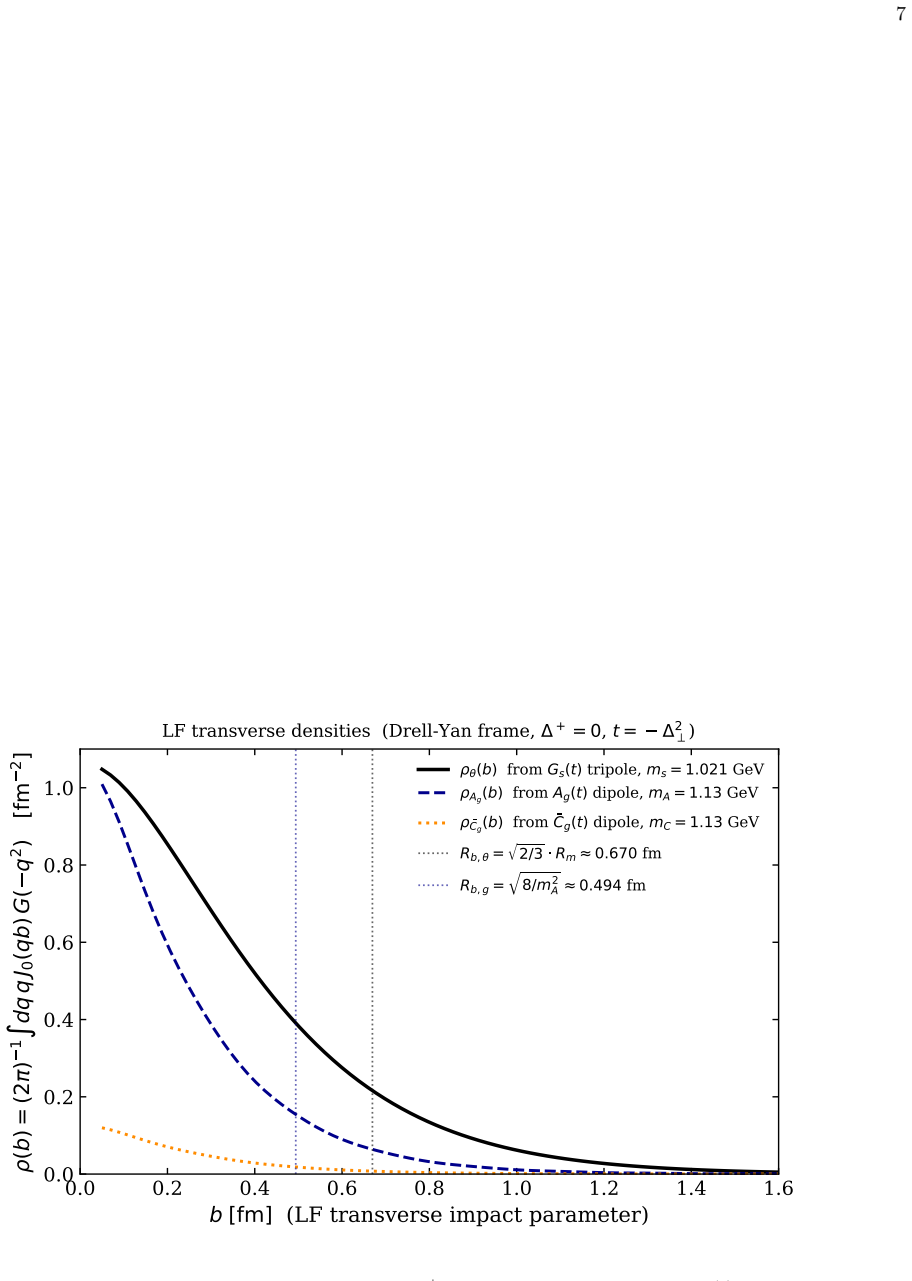
- Scalar form-factor radius admits interpretation as transverse light-front radius in the Drell-Yan frame
Where Pith is reading between the lines
- The equivalence opens the possibility of computing these EMT contributions using light-front wave functions or basis light-front quantization methods
- The transverse light-front radius interpretation may provide new insights into the spatial distribution of gluon energy in the nucleon
- This formulation could be tested against results from covariant calculations in different frames to confirm the absence of boost artifacts
Load-bearing premise
The traceless part of the gluon EMT, when projected onto the threshold chromoelectric structure in light-front variables, yields exactly the normal gluon-energy factor that appears in the covariant mass decomposition
What would settle it
An explicit computation of the forward light-front ratio in a solvable model or lattice simulation that deviates from the expected value from the QCD EMT mass decomposition combined with the chromoelectric OPE would falsify the claimed reproduction
Figures
read the original abstract
We present a light-front formulation of the scalar trace-anomaly and non-scalar gluon energy-momentum-tensor contributions entering the compact-heavy-quarkonium chromoelectric interaction with a nucleon. The construction reformulates, in light-front variables, the separation between the scalar trace-anomaly contribution to the compact-quarkonium chromoelectric interaction and the forward normal gluon-energy contribution appearing in the QCD EMT mass decomposition. In light-front variables, the gluon momentum fraction follows from the $T_g^{++}$ matrix element, while the normal gluon-energy factor arises only after projecting the traceless EMT onto the threshold chromoelectric structure. In this way the forward light-front ratio reproduces the result obtained by combining the QCD EMT mass decomposition with the compact-quarkonium chromoelectric operator-product expansion (OPE), without introducing any spurious boost enhancement. We also construct the off-forward light-front form-factor combination controlling the non-scalar gluon-EMT contribution and show its equivalence to the corresponding covariant expression. Finally, the scalar form-factor radius is reinterpreted as a transverse light-front radius, providing a longitudinal-boost-invariant transverse-density interpretation in the Drell--Yan frame. The work is therefore not a new mass-radius extraction, but a light-front operator formulation connecting the QCD EMT mass decomposition, the compact-quarkonium chromoelectric OPE, modern gluon momentum fractions, and light-front transverse densities.
Editorial analysis
A structured set of objections, weighed in public.
Referee Report
Summary. The paper claims to provide a light-front formulation of the scalar trace-anomaly and non-scalar gluon EMT contributions entering the compact-heavy-quarkonium chromoelectric interaction with a nucleon. It reformulates the separation between the scalar trace-anomaly contribution and the forward normal gluon-energy contribution from the QCD EMT mass decomposition in light-front variables, showing that the forward light-front ratio (from T_g^{++} matrix element followed by traceless projection) reproduces the covariant result obtained by combining the QCD EMT mass decomposition with the compact-quarkonium chromoelectric OPE, without spurious boost enhancement. It also constructs the off-forward light-front form-factor combination and shows equivalence to the covariant expression, while reinterpreting the scalar form-factor radius as a transverse light-front radius providing a longitudinal-boost-invariant transverse-density interpretation in the Drell-Yan frame.
Significance. If the central equivalence holds, the work supplies a useful operator-level bridge connecting the QCD EMT mass decomposition, the compact-quarkonium chromoelectric OPE, modern gluon momentum fractions, and light-front transverse densities. This could facilitate light-front calculations of near-threshold quarkonium scattering and provide a boost-invariant density interpretation. The paper explicitly positions itself as a reformulation rather than a new mass-radius extraction.
major comments (1)
- [Abstract (forward light-front ratio paragraph)] Abstract (paragraph on forward light-front ratio): the central claim that the traceless projection of the gluon EMT onto the threshold chromoelectric structure in light-front variables exactly recovers the normal gluon-energy factor (with no spurious boost terms) is asserted but the provided text supplies no explicit derivation steps, intermediate expressions, or checks against known covariant limits. This projection is load-bearing for the no-spurious-enhancement result.
minor comments (1)
- The abstract mentions T_g^{++} for the momentum fraction but does not name the additional light-front operators or projectors used for the traceless part; adding one sentence would improve clarity without altering the technical content.
Simulated Author's Rebuttal
We thank the referee for the positive assessment and the recommendation of minor revision. We address the single major comment below.
read point-by-point responses
-
Referee: Abstract (paragraph on forward light-front ratio): the central claim that the traceless projection of the gluon EMT onto the threshold chromoelectric structure in light-front variables exactly recovers the normal gluon-energy factor (with no spurious boost terms) is asserted but the provided text supplies no explicit derivation steps, intermediate expressions, or checks against known covariant limits. This projection is load-bearing for the no-spurious-enhancement result.
Authors: We agree that the abstract, being a concise summary, does not contain the intermediate steps. The full derivation of the traceless projection of the gluon EMT in light-front variables, the resulting forward ratio, and its explicit equivalence to the covariant QCD EMT mass decomposition plus chromoelectric OPE (without spurious boost terms) are given in the main text. We will revise the abstract to include a brief reference to these steps and the relevant sections so that the central claim is more self-contained. revision: yes
Circularity Check
No significant circularity; explicit reformulation of known results
full rationale
The paper's central claim is an explicit light-front reformulation of the QCD EMT mass decomposition combined with the compact-quarkonium chromoelectric OPE, showing that the forward ratio from T_g^{++} and traceless projection reproduces the covariant gluon-energy factor without spurious boost terms. This is presented as a coordinate re-expression connecting existing quantities (gluon momentum fractions, transverse densities) rather than a derivation that reduces to fitted inputs or self-referential premises. No self-citations are invoked as load-bearing uniqueness theorems, no parameters are fitted then renamed as predictions, and no ansatz is smuggled via prior work. The construction is self-contained against external benchmarks via operator definitions, warranting a score of 0.
Axiom & Free-Parameter Ledger
axioms (1)
- domain assumption Standard QCD energy-momentum tensor decomposition and compact-quarkonium chromoelectric OPE remain valid when rewritten in light-front coordinates.
Reference graph
Works this paper leans on
-
[1]
A QCD analysis of the mass structure of the nucleon,
X.-D. Ji, “A QCD analysis of the mass structure of the nucleon,” Phys. Rev. Lett.74, 1071 (1995), arXiv:hep-ph/9410274
Pith/arXiv arXiv 1995
-
[2]
Short-distance analysis for heavy quark systems. I. Diagrammatics,
M. E. Peskin, “Short-distance analysis for heavy quark systems. I. Diagrammatics,” Nucl. Phys. B156, 365 (1979)
1979
-
[3]
Short-distance analysis for heavy quark systems. II. Applications,
G. Bhanot and M. E. Peskin, “Short-distance analysis for heavy quark systems. II. Applications,” Nucl. Phys. B156, 391 (1979)
1979
-
[4]
J/ψphotoproduction and the gluon structure of the nucleon,
D. Kharzeev, H. Satz, A. Syamtomov, and G. Zinovjev, “J/ψphotoproduction and the gluon structure of the nucleon,” Eur. Phys. J. C9, 459 (1999), arXiv:hep-ph/9901375
Pith/arXiv arXiv 1999
-
[5]
The mass radius of the proton,
D. E. Kharzeev, “The mass radius of the proton,” Phys. Rev. D104, 054015 (2021), arXiv:2102.00110
arXiv 2021
-
[6]
Determining the proton’s gluonic gravitational form factors,
B. Duran et al., “Determining the proton’s gluonic gravitational form factors,” Nature615, 813 (2023), arXiv:2207.05212
arXiv 2023
-
[7]
Forces within hadrons on the light front,
A. Freese and G. A. Miller, “Forces within hadrons on the light front,” Phys. Rev. D103, 094023 (2021), arXiv:2102.01683
arXiv 2021
-
[8]
Light-front synchronization and rest-frame densities of the proton: Electromagnetic densities,
A. Freese and G. A. Miller, “Light-front synchronization and rest-frame densities of the proton: Electromagnetic densities,” Phys. Rev. D107, 074036 (2023), arXiv:2302.09171
arXiv 2023
-
[9]
Quark and gluon contributions to the QCD trace anomaly,
Y. Hatta, A. Rajan, and K. Tanaka, “Quark and gluon contributions to the QCD trace anomaly,” JHEP12, 008 (2018), arXiv:1810.05116
Pith/arXiv arXiv 2018
-
[10]
Forces inside hadrons: pressure, surface tension, mechanical radius, and all that,
M. V. Polyakov and P. Schweitzer, “Forces inside hadrons: pressure, surface tension, mechanical radius, and all that,” Int. J. Mod. Phys. A33, 1830025 (2018), arXiv:1805.06596
Pith/arXiv arXiv 2018
-
[11]
Gluon gravitational structure of hadrons of different spin,
D. A. Pefkou, D. C. Hackett, and P. E. Shanahan, “Gluon gravitational structure of hadrons of different spin,” Phys. Rev. D105, 054509 (2022), arXiv:2107.10368
arXiv 2022
-
[12]
Parton distribution functions,αs, and heavy-quark masses for LHC Run II,
S. Alekhin, J. Blümlein, S. Moch, and R. Placčakyt˙ e, “Parton distribution functions,αs, and heavy-quark masses for LHC Run II,” Phys. Rev. D96, 014011 (2017), arXiv:1701.05838
Pith/arXiv arXiv 2017
-
[13]
New CTEQ global analysis of quantum chromodynamics with high-precision data from the LHC,
T.-J. Hou et al., “New CTEQ global analysis of quantum chromodynamics with high-precision data from the LHC,” Phys. Rev. D103, 014013 (2021), arXiv:1912.10053
Pith/arXiv arXiv 2021
-
[14]
Parton distributions from LHC, HERA, Tevatron and fixed target data: MSHT20 PDFs,
S. Bailey, T. Cridge, L. A. Harland-Lang, A. D. Martin, and R. S. Thorne, “Parton distributions from LHC, HERA, Tevatron and fixed target data: MSHT20 PDFs,” Eur. Phys. J. C81, 341 (2021), arXiv:2012.04684
arXiv 2021
-
[15]
The path to proton structure at 1% accuracy,
R. D. Ball et al. (NNPDF Collaboration), “The path to proton structure at 1% accuracy,” Eur. Phys. J. C82, 428 (2022), arXiv:2109.02653
arXiv 2022
discussion (0)
Sign in with ORCID, Apple, or X to comment. Anyone can read and Pith papers without signing in.