Characterisation of the NewAthena WFI's DEPFET Flight Production's Operational Parameters
Pith reviewed 2026-06-26 19:25 UTC · model grok-4.3
The pith
Tests on 64x64 DEPFET prototypes identify optimal parameters for NewAthena's flight detectors.
A machine-rendered reading of the paper's core claim, the machinery that carries it, and where it could break.
Core claim
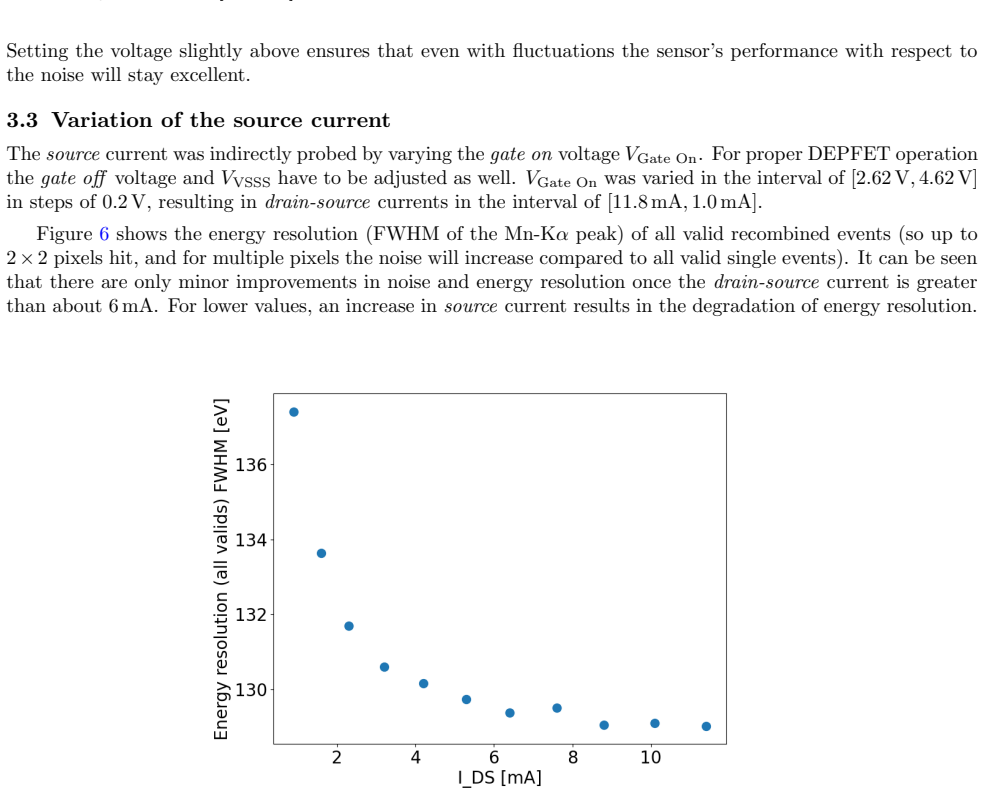
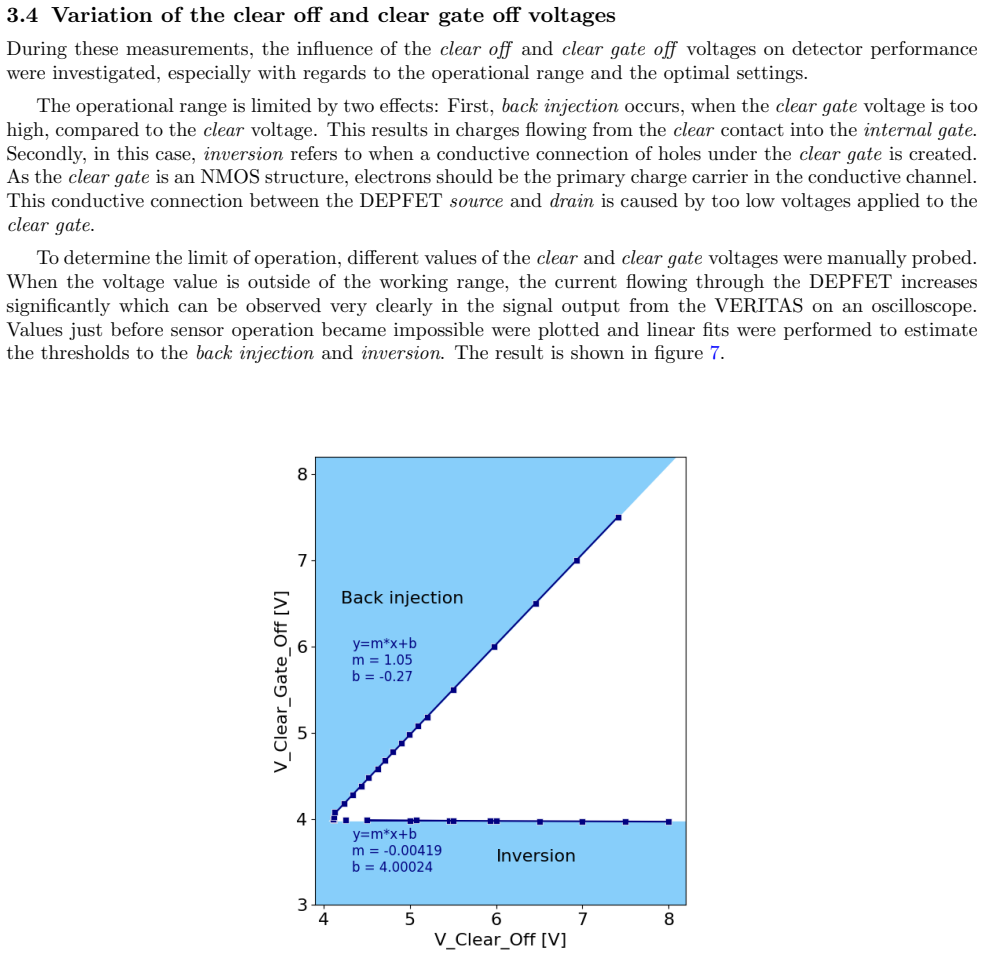
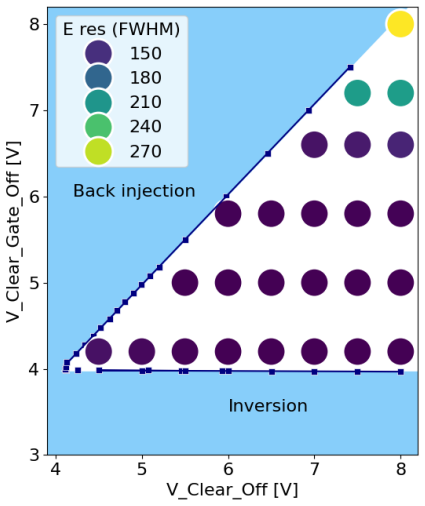
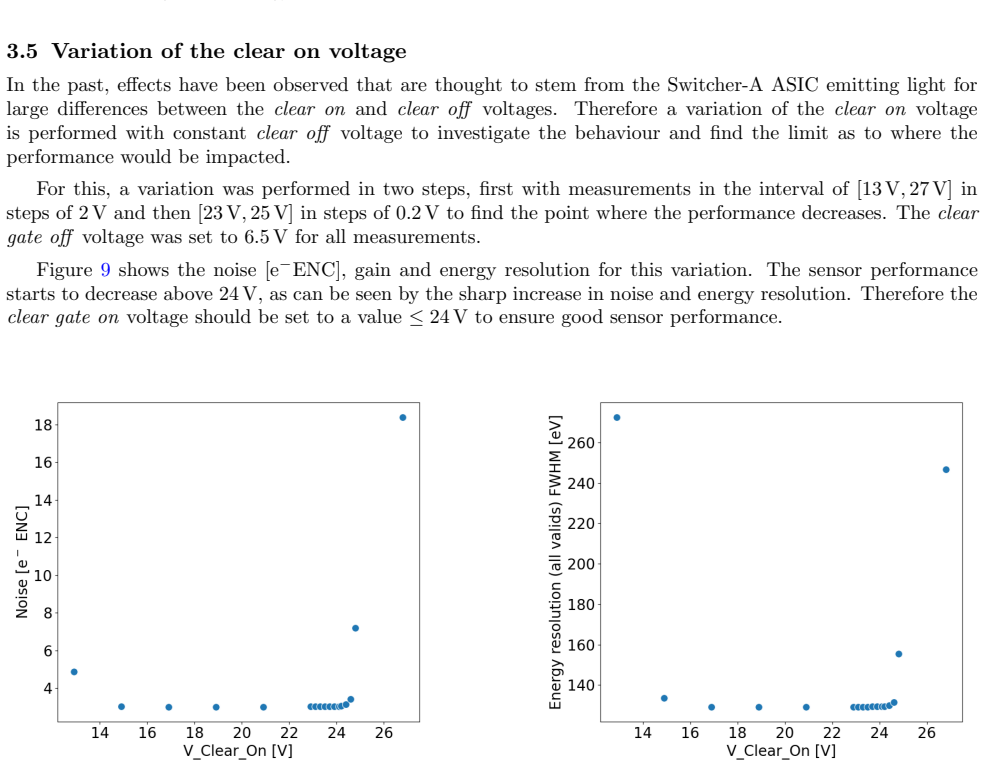
Prototype sensors of 64 by 64 pixels were used to analyse the sensor's operational range and to optimise the ASIC and DEPFET parameters i.e. current and voltage settings, as well as the DEPFET read-out timing parameters, resulting in an improved energy resolution, reduced noise and otherwise improved sensor characteristics.
What carries the argument
DEPFET pixels in rolling shutter mode, with parameter optimization through prototype testing to set currents, voltages and timing.
If this is right
- Improved energy resolution for X-ray sources observed by the Wide Field Imager.
- Reduced noise levels allowing better detection of faint signals.
- Optimized settings applicable to the 2x2 array of 512x512 Large Detectors.
- Support for 2 ms frame time across the 40 by 40 arcmin field of view.
Where Pith is reading between the lines
- Verification on full-size detectors will be needed to confirm the parameter transfer.
- Similar optimization approaches could apply to other DEPFET-based instruments.
- The improved characteristics may enable new science cases for bright source observations with the Fast Detector.
Load-bearing premise
The results from small prototype sensors scale without major changes to the large flight detectors.
What would settle it
Energy resolution measurements on the actual flight Large Detectors using the reported parameters show no improvement compared to default settings.
Figures




read the original abstract
NewAthena's Wide Field Imager (WFI) uses detectors made up from Depleted P-Channel Field Effect Transistor (DEPFET) pixels operated in rolling shutter mode. The Large Detector Array (LDA) contains a 2 $\times$ 2 array of 512 $\times$ 512 pixels Large Detectors (LDs) allowing for a field of view of 40' $\times$ 40' with a frame time of 2 ms while the 64 $\times$ 64 pixels Fast Detector (FD) can observe very bright X-ray sources due to a faster frame time of 0.08 ms. Prototype sensors (64 $\times$ 64 pixels) were used to analyse the sensor's operational range and to optimise the ASIC and DEPFET parameters i.e. current and voltage settings, as well as the DEPFET read-out timing parameters, resulting in an improved energy resolution, reduced noise and otherwise improved sensor characteristics.
Editorial analysis
A structured set of objections, weighed in public.
Referee Report
Summary. The manuscript reports on the characterization of operational parameters for the DEPFET sensors of the NewAthena Wide Field Imager (WFI). Using 64×64 pixel prototype sensors, the authors analyze the operational range and optimize ASIC and DEPFET parameters including current and voltage settings as well as readout timing parameters. This optimization is claimed to result in improved energy resolution, reduced noise, and other improved sensor characteristics for the flight hardware consisting of 512×512 pixel Large Detectors.
Significance. If the optimizations are shown to be valid for the full-size detectors, this work would be important for the successful operation of the WFI instrument on the NewAthena mission, providing the necessary parameter settings for the DEPFET flight production. The paper addresses a practical engineering need for the mission.
major comments (2)
- [Abstract] Abstract: The abstract claims that the optimizations on prototype sensors result in improved energy resolution and reduced noise, but supplies no quantitative data, error bars, methods details, or baseline comparisons, preventing evaluation of the central claim.
- [Abstract] Abstract: The transfer of optimized parameters from 64×64 prototypes to 512×512 flight Large Detectors is assumed without any discussion or data on scaling effects such as changes in total capacitance, row/column driver loading, or thermal gradients, which is load-bearing for the applicability to flight hardware.
minor comments (1)
- [Abstract] Abstract: The phrase 'otherwise improved sensor characteristics' is vague and should be specified if possible.
Simulated Author's Rebuttal
We thank the referee for the detailed review and constructive comments. We address each major comment below and will revise the manuscript to strengthen the presentation of results and applicability to flight hardware.
read point-by-point responses
-
Referee: [Abstract] Abstract: The abstract claims that the optimizations on prototype sensors result in improved energy resolution and reduced noise, but supplies no quantitative data, error bars, methods details, or baseline comparisons, preventing evaluation of the central claim.
Authors: We agree that the abstract would benefit from quantitative support. The body of the manuscript contains the relevant measurements (energy resolution values, noise figures, and comparisons to unoptimized settings), but these were not summarized numerically in the abstract. In the revised version we will incorporate specific results, including achieved FWHM at Mn-Kα, noise reduction in electrons rms, and baseline comparisons, along with brief method references. revision: yes
-
Referee: [Abstract] Abstract: The transfer of optimized parameters from 64×64 prototypes to 512×512 flight Large Detectors is assumed without any discussion or data on scaling effects such as changes in total capacitance, row/column driver loading, or thermal gradients, which is load-bearing for the applicability to flight hardware.
Authors: The manuscript presents prototype results intended to define operational parameters for the flight production. We acknowledge that explicit discussion of scaling is absent. In revision we will add a dedicated paragraph in the introduction or conclusions section addressing the design rationale for transferability (identical pixel architecture, per-pixel current sources, and rolling-shutter timing independent of array size) while noting that full validation on 512×512 devices remains future work. No new scaling data will be added because none were acquired in this study. revision: yes
Circularity Check
No circularity; empirical characterization paper with no derivations or fitted predictions
full rationale
The manuscript reports experimental measurements on 64x64 prototype DEPFET sensors to determine operational ranges and optimize ASIC/DEPFET currents, voltages, and readout timing. No equations, first-principles derivations, or statistical predictions appear in the provided text. The central statements are direct empirical outcomes (improved energy resolution, reduced noise) from prototype testing; scaling assumptions to 512x512 flight devices are stated as context rather than derived results. No self-citations, ansatzes, or renamings of known results are load-bearing. This is a standard instrumentation characterization report whose claims rest on external measurement data, not internal redefinition.
Axiom & Free-Parameter Ledger
Reference graph
Works this paper leans on
-
[1]
Silicon pore x-ray optics for the NewAthena telescope,
Maximilien J. Collon et al., “Silicon pore x-ray optics for the NewAthena telescope,” in [Space Telescopes and Instrumentation 2024: Ultraviolet to Gamma Ray], den Herder, J.-W. A., Nikzad, S., and Nakazawa, K., eds.,13093, 1309319, International Society for Optics and Photonics, SPIE (2024)
2024
-
[2]
The hot and energetic universe: A white paper presenting the science theme moti- vating the athena+ mission,
Kirpal Nandra et al., “The hot and energetic universe: A white paper presenting the science theme moti- vating the athena+ mission,” (2013)
2013
-
[3]
VERITAS 2.2: a low noise source follower and drain current readout integrated circuit for the wide field imager on the Athena x-ray satellite,
Herrmann, S., Koch, A., Obergassel, S., Treberspurg, W., Bonholzer, M., and Meidinger, N., “VERITAS 2.2: a low noise source follower and drain current readout integrated circuit for the wide field imager on the Athena x-ray satellite,” in [High Energy, Optical, and Infrared Detectors for Astronomy VIII], Holland, A. D. and Beletic, J., eds.,10709, 1070935...
2018
-
[4]
The VERITAS 2.3 readout ASIC for the ATHENA Wide Field Imager,
Schweingruber, A.-K., Herrmann, S., Orel, P., Dakshinamurthy, A. K., Mayr, A., M¨ uller-Seidlitz, J., Reiffers, J., Albrecht, S., Schnetler, H., Allen, S. W., and Morris, G., “The VERITAS 2.3 readout ASIC for the ATHENA Wide Field Imager,” in [Space Telescopes and Instrumentation 2024: Ultraviolet to Gamma Ray], den Herder, J.-W. A., Nikzad, S., and Nakaz...
2024
-
[5]
(in preparation, 2027)
Kirpal Nandra et al. (in preparation, 2027)
2027
-
[6]
The Wide Field Imager for the NewAthena mission: preliminary design and verification,
Antonelli, V., Pietschner, D., Strecker, R., Mican, B., M¨ oller, J. P., S¨ onmez, A., Saraf, A., Schnetler, H., and Nandra, P., “The Wide Field Imager for the NewAthena mission: preliminary design and verification,” in [Space Telescopes and Instrumentation 2024: Ultraviolet to Gamma Ray], den Herder, J.-W. A., Nikzad, S., and Nakazawa, K., eds.,13093, 13...
2024
-
[7]
Spectral performance budget for ATHENA’s Wide Field Imager,
Mayr, A., M¨ uller-Seidlitz, J., Emberger, V., Andritschke, R., Reiffers, J., Schweingruber, A., Albrecht, S., and Schnetler, H., “Spectral performance budget for ATHENA’s Wide Field Imager,” in [Modeling, Systems Engineering, and Project Management for Astronomy XI], Egner, S. E. and Roberts, S., eds.,13099, 130992E, International Society for Optics and ...
2024
-
[8]
Spectroscopic performance of detectors for Athena’s WFI: measurements and simulation,
M¨ uller-Seidlitz, J., Andritschke, R., Emberger, V., Bonholzer, M., Hauser, G., Lechner, P., Mayr, A., Reiffers, J., Schweingruber, A., and Treberspurg, W., “Spectroscopic performance of detectors for Athena’s WFI: measurements and simulation,” in [Space Telescopes and Instrumentation 2024: Ultraviolet to Gamma Ray], den Herder, J.-W. A., Nikzad, S., and...
2024
-
[9]
Private communication
WFI consortium. Private communication
-
[10]
A megahertz active pixel sensor for x-ray astronomy,
M¨ uller-Seidlitz, J., “A megahertz active pixel sensor for x-ray astronomy,” (January 2020)
2020
-
[11]
Roan, a root based analysis framework,
Lauf, T. and Andritschke, R., “Roan, a root based analysis framework,” (2013)
2013
-
[12]
Achievable noise performance of spectroscopic prototype depfet detectors,
Treberspurg, W., Meidinger, N., M¨ uller-Seidlitz, J., and Herrmann, S., “Achievable noise performance of spectroscopic prototype depfet detectors,”Journal of Instrumentation13, P12001 (December 2018)
2018
-
[13]
Achievable time resolution of spectroscopic prototype depfet detectors,
Treberspurg, W., Hauser, G., Meidinger, N., M¨ uller-Seidlitz, J., and Ott, S., “Achievable time resolution of spectroscopic prototype depfet detectors,”Journal of Instrumentation14, P03019 (March 2019)
2019
-
[14]
Low-temperature proton irradiation with DEPFETs for Athena’s wide field imager,
Emberger, V., Andritschke, R., Azhdarzadeh, P., Hauser, G., Mayr, A., M¨ uller-Seidlitz, J., Rezaei, A., and Treberer-Treberspurg, W., “Low-temperature proton irradiation with DEPFETs for Athena’s wide field imager,” in [Space Telescopes and Instrumentation 2024: Ultraviolet to Gamma Ray], den Herder, J.-W. A., Nikzad, S., and Nakazawa, K., eds.,13093, 13...
2024
discussion (0)
Sign in with ORCID, Apple, or X to comment. Anyone can read and Pith papers without signing in.