REVIEW 3 major objections 4 minor 65 references
Dynamics and non-integrability of the Swinging Atwood Machine with a massive string: chaos, periodic orbits and resonance structures
T0 review · 3 major / 4 minor · reviewed 2026-08-11 · deepseek-v4-flash
Pith's one-line read Any nonzero string mass destroys the unique integrable case of the Swinging Atwood Machine, and the proof runs through an SL(2,C) differential Galois group.
desk verdict A new non-integrability theorem for the massive-string SAM that looks right but hides its key algebraic verification behind 'direct substitution'; worth refereeing, but Lemma 3 needs to be checkable. read the letter →
The pith
A machine-rendered reading of the paper's core claim, the machinery that carries it, and where it could break.
The reading
What carries the argument
The load-bearing mechanism is the normal variational equation, the linearised equation for infinitesimal angular perturbations along an explicit radial solution on the invariant manifold $\Theta=0$, $P_\Theta=0$. After the change of independent variable $z=-\alpha R/3$ and the standard removal of the first-derivative term, the normal variational equation becomes a Fuchsian equation $y''=r(z)y$ with regular singular points $\{0,1,z_+,z_-,\infty\}$; the identity $D'(R)=2Q(R)$ is what lets the equation be written in the compact form (7.2). The Kovacic algorithm then classifies the possible differential Galois subgroups of $\mathrm{SL}(2,\mathbb{C})$. The singularity data, with a simple pole at $0$ and double poles at $1$, $z_\pm$, and $\infty$ having exponent differences $0$, $1/2$, $1/2$, and $3$, eliminate the finite and dihedral cases, leaving only the triangular (reducible) case or the full group. The proof excludes the triangular case by showing that its would-be Liouvillian candidate $\omega(z)$ cannot satisfy the Riccati equation $\omega'+\omega^2=r(z)$ unless $1+\mu+\alpha=0$, which is impossible for positive parameters. Hence the group is $\mathrm{SL}(2,\mathbb{C})$.
What would settle it
Substitute the explicit candidate $\omega(z)=1/z + 1/(2(z-1)) + 1/(4(z-z_+)) + 1/(4(z-z_-))$ and the rational function $r(z)$ from (7.9) into the Riccati equation $\omega'+\omega^2=r(z)$ with symbolic parameters $\mu,\eta,\alpha,E$, and compare numerator polynomials; if the residual vanishes for any positive parameters with $1+\mu+\alpha\neq 0$, Lemma 3 is false and the proof does not establish non-integrability, whereas non-vanishing at generic parameter values confirms the obstruction.
Extended reading notes
Core claim
The central claim is Theorem 1: for positive parameters $\mu$, $\eta$, $\alpha$ with $\alpha\neq 0$, the Hamiltonian system (2.8) of the Swinging Atwood Machine with a massive string is not Liouville integrable in the class of first integrals that are meromorphic functions of the phase-space variables. Since the proof works for generic energy levels, an extra first integral that would have to exist independently of energy is excluded. Along the invariant manifold $\Theta=0$, $P_\Theta=0$, the paper constructs explicit non-stationary radial solutions $R(\tau)=A\cosh(\omega_0(\tau-\tau_0))+\delta$, linearises the full system about them, and shows that the normal variational equation has differential Galois group $\mathrm{SL}(2,\mathbb{C})$ except for degenerate parameter values. By the Morales–Ramis theorem the non-Abelian identity component of this group forbids meromorphic Liouville integrability, so the classical integrable $\mu=3$ case is destroyed by every nonzero string mass.
Load-bearing premise
The load-bearing premise is the unproved algebraic assertion inside Lemma 3 that the candidate $\omega(z)$ satisfies the Riccati equation $\omega'+\omega^2=r(z)$ only when $\mathcal{M}=1+\mu+\alpha=0$; the paper states this follows by 'direct substitution' and gives no derivation, so if that identity is wrong the exclusion of the triangular Galois group, and with it the $\mathrm{SL}(2,\mathbb{C})$ conclusion, does not follow.
Editorial extensions
If this is right
- For every nonzero string mass, including the near-massless regime $\alpha\ll 1$, the classical $\mu=3$ integrable case is broken and no additional meromorphic first integral exists.
- The differential Galois group of the normal variational equation is generically $\mathrm{SL}(2,\mathbb{C})$, so the non-integrability is an algebraic property, not an accident of particular parameter values.
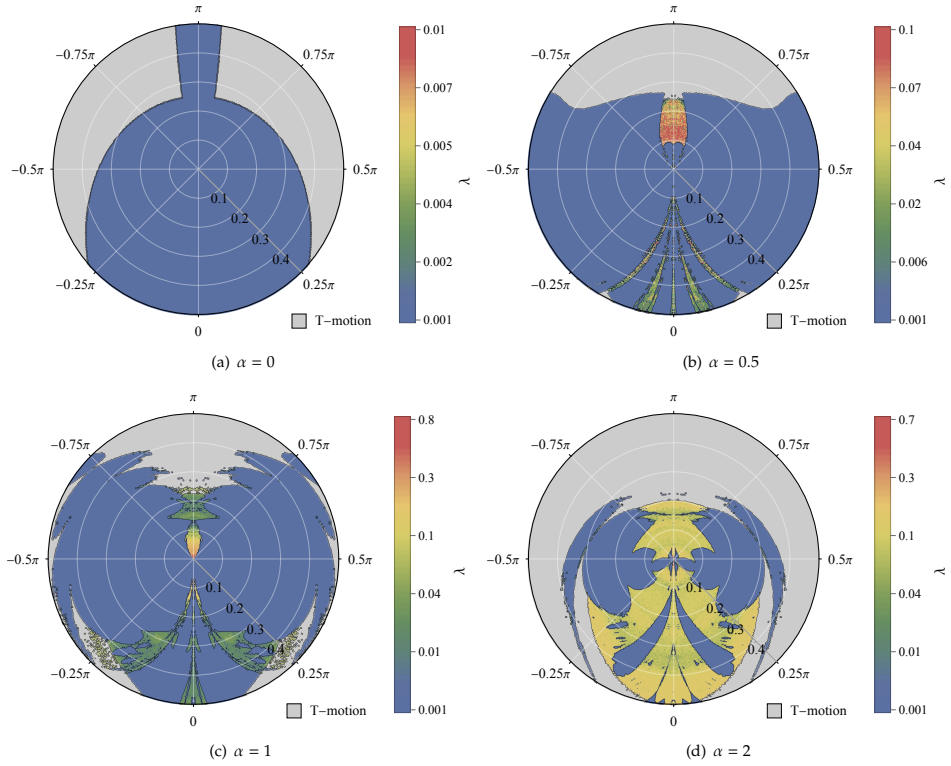
- Numerical Lyapunov maps show the chaotic layer around the radial solution's separatrix growing with $\alpha$, consistent with the theorem's prediction of destroyed tori.
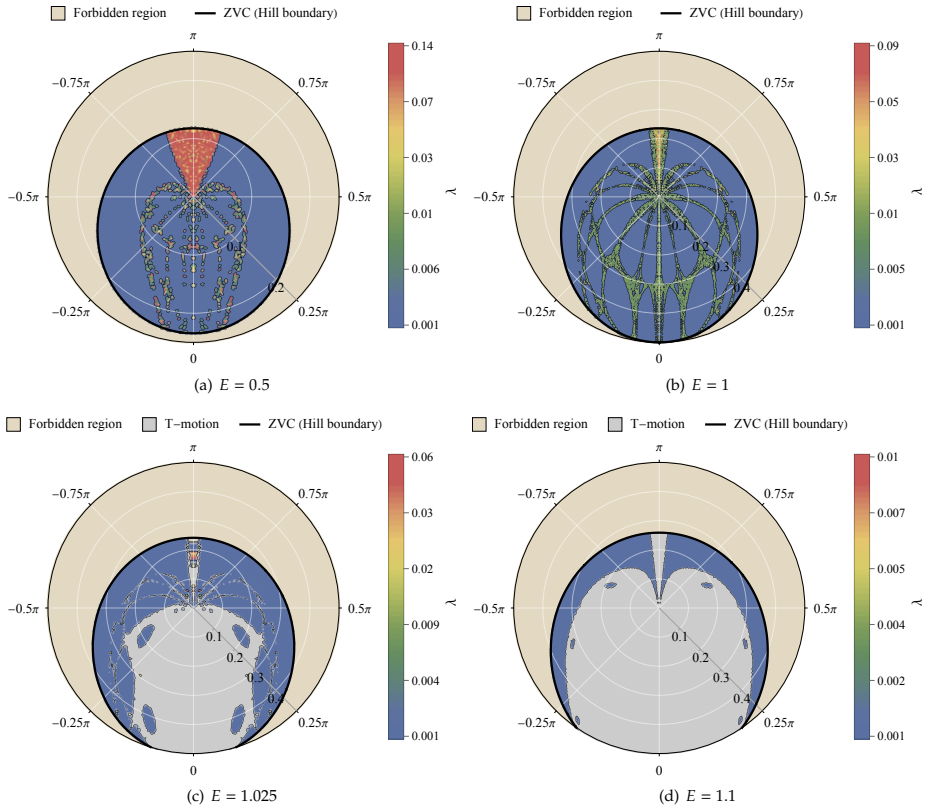
- The Lyapunov Refined Maps reveal that the regular regions of the non-integrable system still contain organized resonance families and periodic-orbit webs, so the loss of integrability does not mean loss of all structure.
- Because the obstruction is independent of the energy level at generic energies, any hypothetical meromorphic first integral would have to exist also at the exceptional stationary energy, and hence cannot exist at all.
Reading between the lines
- Beyond the paper, the same Morales–Ramis plus Kovacic template could be applied to other variable-length and distributed-mass pendula; the fragile algebraic identity in Lemma 3 is the first place to check when adapting it.
- If the lemma's 'direct substitution' identity were ever found to fail at special parameters, the theorem would not cover those parameters; a symbolic verification of the Riccati identity is therefore a concrete next test.
- The Lyapunov Refined Map construction, presented here as a numerical tool, could be exported to other two-parameter Hamiltonian families to expose resonance networks that ordinary Lyapunov maps miss.
- Physically, the result suggests that exactly integrable mechanical models are structurally unstable against distributed mass, so observed near-integrable behaviour in real ropes and cables would have to come from small but nonzero string masses in a transient or weak-coupling regime.
Editorial analysis
A structured set of objections, weighed in public.
Referee Report
Summary. The paper studies the Swinging Atwood Machine with a massive string, deriving a two-degree-of-freedom Hamiltonian with configuration-dependent inertia. It presents an extensive numerical study using Poincaré sections, Lyapunov maps, and a new 'Lyapunov Refined Map' method, and it proves a non-integrability theorem: for all positive μ, η, α with α≠0, the system has no additional meromorphic first integral, so the classical integrable case μ=3 is destroyed by any nonzero string mass. The proof uses Morales–Ramis theory, reduces the normal variational equation along a non-stationary radial solution to a Fuchsian equation, and applies the Kovacic algorithm to conclude that the differential Galois group is generically SL(2,C).
Significance. If the theorem is correct, it is a valuable rigorous result: it turns a well-known isolated integrable case of a classical mechanical system into a structurally unstable feature, and it does so through a fully constructive Morales–Ramis/Kovacic analysis. The numerical LRM methodology, with the public code deposit, is also a useful diagnostic tool for visualizing resonance organization inside regular regions. The main proof is credible and the computations in the variational-equation step are consistent. The decisive Riccati substitution in Lemma 3 is omitted, but I verified that it reduces to a simple identity, so the result is very likely correct; the manuscript needs to make that verification explicit.
major comments (3)
- [Sec. 7, Lemma 3] The exclusion of Kovacic Case 1 rests entirely on the sentence that 'direct substitution' of the candidate ω into the Riccati equation (7.13) is possible only if M=1+μ+α=0. This is load-bearing and no algebra is shown. Please include the computation. In fact, with b=(μ+αη−1)/3 one has the identity ω = B1/(2B2), so ω′+ω²−r = B3/B2 = M(2−3z)/(12 z(z−1)P(z)). Hence (7.13) holds iff M=0. Adding this one-line derivation would remove the gap; as written, the proof of Theorem 1 is incomplete at this point.
- [Sec. 7, Lemma 3] The assertion that 'the condition Δ₁=0 excludes the finite and dihedral cases' is not a consequence of Lemma 2 as stated in the paper. Lemma 2 allows Case 2 when a double pole is present and allows Case 3 when all exponent differences are rational. Please state the precise result from [3,65] that is being invoked, or give a short argument (e.g., equal exponents produce a unipotent local monodromy incompatible with the identity components of the finite and dihedral cases). Without this, the reduction to 'Case 1 or Case 4' is not self-contained.
- [Sec. 7.2.2 and Theorem 1] The proof is carried out only for generic energies: E≠E₀, and implicitly for energies avoiding P(0)=0 and P(1)=0, where the singularity pattern degenerates. The paper's one-sentence genericity argument is too terse. Please expand it: a complete set of meromorphic first integrals would exist on an open dense set of energy values, so excluding finitely many exceptional energies is harmless. Also state that the constant A in (3.11) can always be chosen so that the real solution has R(τ)>0 for all τ (e.g., A<δ when δ>0, or A>|δ| when δ≤0), so that the particular solution lies in the smooth domain of the Hamiltonian.
minor comments (4)
- [Sec. 7, Lemma 3] The symbol P is used both for the quadratic P(z)=z²+bz+c and for the polynomial that appears in the Kovacic algorithm ('the polynomial P must be constant'). This is confusing; please rename one of them, for example Q(z) for the quadratic.
- [Eq. (6.1)] In the definition of 𝒫_raw, if no j∈{1,…,k_max} satisfies 𝒜_j, the minimum is not defined. Please state that 𝒫_raw is empty in that case.
- [Throughout] There are several typos and spacing issues: 'Kovacice' should be 'Kovacic', 'equlibrium' should be 'equilibrium', and 'Morales–Ramistheory' should be 'Morales–Ramis theory'. A careful proofreading pass is needed.
- [Sec. 7.2.1] The statement that equation (7.5) reduces to the Gauss hypergeometric equation is justified by a citation to [64], but since the integrable case μ=3 is central to the motivation, it would be helpful to display the hypergeometric parameters or at least the integrability condition explicitly.
Circularity Check
No significant circularity: the non-integrability theorem is derived from external Morales–Ramis/Kovacic theory, and the numerical LRM analysis is independent of the proof.
full rationale
The paper's central claim, Theorem 1, is a parameter-free statement about the Hamiltonian system (2.8) for all α≠0. The derivation chain is: construct an invariant manifold, obtain explicit non-stationary radial solutions, linearize to the normal variational equation, rationalize it, reduce to normal form, and apply the Kovacic algorithm. Each step uses standard external theory (Morales–Ramis and Kovacic) and explicit formulas given in the paper; no fitted parameter or numerical output enters the proof. The numerical Lyapunov Refined Maps, including the thresholds λ_thr=0.005, ε_rep=0.02, d_tol=0.005, g_tol=1.1, are used only for classification and visualization, not as inputs to the integrability argument. Self-citations to the authors' previous LRM and pendulum papers [3,4,8,16,48,55] are contextual or methodological and are not load-bearing: the LRM algorithm is fully specified in Section 6.2, and the proof's Kovacic exclusions cite the external reference [65] alongside [3]. The one genuinely fragile step is the claim in Lemma 3 that substituting the Case 1 candidate ω(z) into the Riccati equation (7.13) forces ℳ=1+μ+α=0; the paper says this follows by 'direct substitution' without showing the algebra. That is an omitted computational verification, and an error there would weaken the proof, but it is not circular: it is a claimed identity inside the proof, not an input reused as the conclusion. There is no step where a quantity is defined in terms of the target result, no fitted value is renamed as a prediction, and no author-specific uniqueness theorem is invoked to force the conclusion. The derivation is therefore self-contained with respect to its own inputs, and the paper receives a circularity score of 0.
Assumptions & free parameters
free parameters (3)
- Lyapunov regularity threshold λ_thr =
5×10^-3
- Period-recurrence tolerances (ε_tol, d_tol, g_tol) =
0.005, 0.005, 1.1
- Maximum tested period k_max =
30
assumptions (5)
- standard math Morales-Ramis theorem: if a Hamiltonian system is Liouville integrable with meromorphic first integrals, then the identity component of the differential Galois group of the variational equations along any particular solution is Abelian.
- standard math Kovacic algorithm classification and necessary conditions (Lemma 1 and Lemma 2).
- standard math A change of independent variable and the gauge transformation (7.8) preserve the identity component of the differential Galois group.
- domain assumption Physical string model: straight segments slide freely through massless, frictionless pulleys; wrapped pulley segments contribute zero kinetic energy; the swinging branch velocity field is linear in arc length.
- ad hoc to paper The chosen energy E is generic, E≠E0, and admits a real non-stationary solution with A≠0.
Cite this review
Pith. "Pith review of Dynamics and non-integrability of the Swinging Atwood Machine with a massive string: chaos, periodic orbits and resonance structures." pith.science (2026). https://pith.science/paper/EGTBADQZ
@misc{pith2026260809310,
  author       = {Pith},
  title        = {Pith review of: Dynamics and non-integrability of the Swinging Atwood Machine with a massive string: chaos, periodic orbits and resonance structures},
  year         = {2026},
  howpublished = {\url{https://pith.science/paper/EGTBADQZ}},
  note         = {Machine review of arXiv:2608.09310}
}
read the original abstract
Building upon our previous studies on nonlinear variable-length pendulum systems, we investigate the Swinging Atwood Machine with a massive string. In contrast to the classical model, string inertia introduces a configuration-dependent moment of inertia, leading to a modified Hamiltonian structure and substantially richer dynamics. To uncover the global organization of the phase space, we combine Poincar\'e sections, bifurcation diagrams, and Lyapunov exponent maps with our recently developed numerical framework, ,,Lyapunov Refined Maps". This approach provides a unified visualization of periodic, quasi-periodic, chaotic, and terminating motions, revealing intricate resonance networks and high-order periodic structures. We investigate the influence of the string mass, system parameters, and energy by constructing Lyapunov maps in parameter and initial-condition spaces and on fixed-energy surfaces. Liouville integrability is studied within the Morales--Ramis theory. By analyzing the normal variational equations along explicit non-stationary radial solutions and applying the Kovacic algorithm, we prove that the differential Galois group is generically SL(2,C), providing a rigorous obstruction to meromorphic Liouville integrability for every nonzero string mass. Thus, the exceptional integrable case of the classical Swinging Atwood Machine is destroyed by the inclusion of string inertia.
Figures


Figures from the paper (11 more)




Reference graph
Works this paper leans on
-
[1]
T.Shinbrot,C.Grebogi,J.Wisdom,andJ.A.Yorke.Chaosinadoublependulum.Am.J.Phys.,60(6):491–499, 1992
work page 1992
-
[2]
Anumericalanalysisofchaosinthedoublependulum.ChaosSolitonsFractals, 29(2):417–422, 2006
T.StachowiakandT.Okada. Anumericalanalysisofchaosinthedoublependulum.ChaosSolitonsFractals, 29(2):417–422, 2006
work page 2006
-
[3]
T. Stachowiak and W. Szumiński. Non-integrability of restricted double pendula.Phys. Lett. A, 379(47– 48):3017–3024, 2015
work page 2015
-
[4]
W.SzumińskiandT.Kapitaniak. Dynamicsandnon-integrabilityofthevariable-lengthdoublependulum: Exploring chaos and periodicity via the Lyapunov Refined Maps.J. Sound Vib., 611:119099, 2025
work page 2025
-
[5]
P. A. Broucke and R. Baxa. Periodic solutions of a spring-pendulum system.Celest. Mech., 8:261–267, 1973
work page 1973
-
[6]
W. K. Lee and H. D. Park. Chaotic dynamics of a harmonically excited spring-pendulum system with internal resonance.Nonlinear Dyn., 14(3):211–229, 1997
work page 1997
-
[7]
A. J. Maciejewski, M. Przybylska, and J.-A. Weil. Non-integrability of the generalized spring-pendulum problem.J. Phys. A, 37(7):2579–2597, 2004
work page 2004
-
[8]
W. Szumiński and A. J. Maciejewski. Dynamics and non-integrability of the double spring pendulum.J. Sound Vib., 589:118550, 2024
work page 2024
Show all 65 references
-
[9]
H. N. Huynh and L. Y. Chew. Two-coupled pendulum system: Bifurcation, chaos and the potential landscape approach.Int. J. Bifurcation Chaos, 20(8):2427–2442, 2010
2010
-
[10]
Numericalsimulationandgeometricalanalysisontheonset ofchaosinasystemoftwocoupledpendulums.Commun.NonlinearSci.Numer.Simul.,18(2):291–307,2013
H.N.Huynh,T.P.T.Nguyen,andL.Y.Chew. Numericalsimulationandgeometricalanalysisontheonset ofchaosinasystemoftwocoupledpendulums.Commun.NonlinearSci.Numer.Simul.,18(2):291–307,2013
2013
-
[11]
A. A. Elmandouh. On the integrability of the motion of the 3D swinging Atwood machine and related problems.Phys. Lett. A, 380(9):989–991, 2016
2016
-
[12]
Dynamicsandintegrabilityanalysisoftwopendulumscoupledbyaspring
W.SzumińskiandD.Woźniak. Dynamicsandintegrabilityanalysisoftwopendulumscoupledbyaspring. Commun. Nonlinear Sci. Numer. Simul., 83:105099, 2020
2020
-
[13]
Tufillaro, T
N. Tufillaro, T. A. Abbott, and D. J. Griffiths. Swinging Atwood’s Machine.Am. J. Phys., 52(10):895–903, 1984
1984
-
[14]
SwingingAtwood’smachine: Integrabilityanddynamics.J.Phys
J.Casasayas,A.Nunes,andN.Tufillaro. SwingingAtwood’smachine: Integrabilityanddynamics.J.Phys. France, 51(16):1693–1702, 1990
1990
-
[15]
Szumiński and A
W. Szumiński and A. J. Maciejewski. Dynamics and integrability of the swinging Atwood machine gener- alisations.Nonlinear Dyn., 110:2101–2128, 2022
2022
-
[16]
Nonlinear Dyn., 112:4117–4145, 2024
W.Szumiński.Anewmodelofvariable-lengthcoupledpendulums: Fromhyperchaostosuperintegrability. Nonlinear Dyn., 112:4117–4145, 2024. 37
2024
-
[17]
R. B. Levien and S. M. Tan. Double pendulum: An experiment in chaos.Am. J. Phys., 61(11):1038–1044, 1993
1993
-
[18]
SwingingAtwoodmachine: Experimental and numerical results, and a theoretical study.Physica D, 239(12):1067–1081, 2010
O.Pujol,J.P.Pérez,J.-P.Ramis,C.Simó,S.Simon,andJ.-A.Weil. SwingingAtwoodmachine: Experimental and numerical results, and a theoretical study.Physica D, 239(12):1067–1081, 2010
2010
-
[19]
Tufillaro
N. Tufillaro. Motions of a swinging Atwood’s machine.J. Phys. France, 46(9):1495–1500, 1985
1985
-
[20]
N. A. Lemos. Atwood’s machine with a massive string.Eur. J. Phys., 38:065001, 2017
2017
-
[21]
Cveticanin
L. Cveticanin. A review on dynamics of variable-mass systems.J. Serbian Soc. Comput. Mech., 6(1):56–73, 2012
2012
-
[22]
Irschik and A
H. Irschik and A. K. Belyaev, editors.Dynamics of Mechanical Systems with Variable Mass. Springer, Vienna, 2014
2014
-
[23]
C. P. Pesce. The application of Lagrange equations to mechanical systems with mass explicitly dependent on position.J. Appl. Mech., 70(5):751–756, 2003
2003
-
[24]
P.Olejnik,G.Yakubu,K.Pepa,andJ.Awrejcewicz.Adoublevariable-lengthpendulumwithcounterweight mass, kinematic excitation and electromagnetic forcing.Nonlinear Dyn., 111:19723–19747, 2023
2023
-
[25]
Computationaldynamicsofa3Delasticstringpendulumattached to a rigid body and an inertially fixed reel mechanism.Nonlinear Dyn., 64:97–115, 2011
T.Lee,M.Leok,andN.H.McClamroch. Computationaldynamicsofa3Delasticstringpendulumattached to a rigid body and an inertially fixed reel mechanism.Nonlinear Dyn., 64:97–115, 2011
2011
-
[26]
F. Ju, Y. S. Choo, and F. S. Cui. Dynamic response of tower crane induced by the pendulum motion of the payload.Int. J. Solids Struct., 43(2):376–389, 2006
2006
-
[27]
J.L.deMenezesNeto,G.C.Araujo,Y.PérezRothen,andC.Vidal.Parametricstabilityofadoublependulum with variable length and with its center of mass in an elliptic orbit.J. Geom. Mech., 14(3):381–408, 2022
2022
-
[28]
Freundlich and D
J. Freundlich and D. Sado. Dynamics of a coupled mechanical system containing a spherical pendulum and a fractional damper.Meccanica, 55:2541–2553, 2020
2020
-
[29]
R. H. Plaut and L. N. Virgin. Pendulum models of ponytail motion during walking and running.J. Sound Vib., 332(16):3768–3780, 2013
2013
-
[30]
H. Yang, B. Wu, J. Li, Y. Bao, and G. Xu. A spring-loaded inverted pendulum model for analysis of human-structure interaction on vibrating surfaces.J. Sound Vib., 522:116727, 2022
2022
-
[31]
Energyharvestingfromhumanwalkingmotionusingpendulum-basedelectro- magnetic generators.J
H.SharghiandO.Bilgen. Energyharvestingfromhumanwalkingmotionusingpendulum-basedelectro- magnetic generators.J. Sound Vib., 534:117036, 2022
2022
-
[32]
Marszał, B
M. Marszał, B. Witkowski, K. Jankowski, P. Perlikowski, and T. Kapitaniak. Energy harvesting from pendulum oscillations.Int. J. Non-Linear Mech., 94:251–256, 2017
2017
-
[33]
C.-H. He, T. S. Amer, D. Tian, A. F. Abolila, and A. A. Galal. Controlling the kinematics of a spring- pendulum system using an energy-harvesting device.J. Low Freq. Noise Vib. Act. Control, 41(3):1234–1257, 2022
2022
-
[34]
M. K. Abohamer, J. Awrejcewicz, and T. S. Amer. Modeling of the vibration and stability of a dynamical system coupled with an energy-harvesting device.Alex. Eng. J., 63:377–397, 2023
2023
-
[35]
Yakubu, P.Olejnik, and J.Awrejcewicz
G. Yakubu, P.Olejnik, and J.Awrejcewicz. Modeling, simulation, andanalysis ofa variable-lengthpendu- lum water pump.Energies, 14(23), 2021
2021
-
[36]
Yakubu, P
G. Yakubu, P. Olejnik, and J. Awrejcewicz. On the modeling and simulation of variable-length pendulum systems: A review.Arch. Comput. Methods Eng., 29:2397–2415, 2022
2022
-
[37]
J. J. Morales-Ruiz.Differential Galois Theory and Non-Integrability of Hamiltonian Systems. Birkhäuser, Basel, 1999. 38
1999
-
[38]
Kovalevskaya, Liapounov, Painlevé, ZiglinanddifferentialGaloistheory.Regul.Chaotic Dyn., 5(3):251–272, 2000
J.J.Morales-Ruiz. Kovalevskaya, Liapounov, Painlevé, ZiglinanddifferentialGaloistheory.Regul.Chaotic Dyn., 5(3):251–272, 2000
2000
-
[39]
A. J. Maciejewski and W. Szumiński. Non-integrability of the semiclassical Jaynes–Cummings models without the rotating-wave approximation.Appl. Math. Lett., 82:132–139, 2018
2018
-
[40]
Yagasaki
K. Yagasaki. Nonintegrability of the unfolding of the fold–Hopf bifurcation.Nonlinearity, 31(2):341, 2018
2018
-
[41]
P. B. Acosta-Humánez, M. Alvarez-Ramírez, and T. J. Stuchi. Nonintegrability of the Armbruster– Guckenheimer–KimquarticHamiltonianthroughMorales–Ramistheory.SIAMJ.Appl.Dyn.Syst.,17(1):78– 96, 2018
2018
-
[42]
Huang, S
K. Huang, S. Shi, and W. Li. Meromorphic and formal first integrals for the Lorenz system.J. Nonlinear Math. Phys., 25(1):106–121, 2018
2018
-
[43]
T. Combot. Integrability of the one-dimensional Schrödinger equation.J. Math. Phys., 59(2):022105, 2018
2018
-
[44]
A. A. Elmandouh. On the integrability of 2D Hamiltonian systems with variable Gaussian curvature. Nonlinear Dyn., 93:933–943, 2018
2018
-
[45]
Szumiński
W. Szumiński. On certain integrable and superintegrable weight-homogeneous Hamiltonian systems. Commun. Nonlinear Sci. Numer. Simul., 67:600–616, 2018
2018
-
[46]
IntegrabilityanalysisofnaturalHamiltoniansystemsincurvedspaces.Commun.Nonlinear Sci
W.Szumiński. IntegrabilityanalysisofnaturalHamiltoniansystemsincurvedspaces.Commun.Nonlinear Sci. Numer. Simul., 64:246–255, 2018
2018
-
[47]
Pikovsky and A
A. Pikovsky and A. Politi.Lyapunov Exponents: A Tool to Explore Complex Dynamics. Cambridge University Press, Cambridge, 2016
2016
-
[48]
Szumiński
W. Szumiński. Lyapunov Integrability Test (LIT): A numerical framework for exploring integrability in continuous dynamical systems. Preprint, 2026
2026
-
[49]
Benettin, L
G. Benettin, L. Galgani, A. Giorgilli, and J.-M. Strelcyn. Lyapunov characteristic exponents for smooth dynamical systems and for Hamiltonian systems: A method for computing all of them. Parts I and II: Theory and numerical application.Meccanica, 15:9–30, 1980
1980
-
[50]
Fractalaspectsoftheiterationof𝑧↦→𝑧 2+𝑐,etc.Ann.N.Y.Acad.Sci., 357:249–259,1980
B.B.Mandelbrot. Fractalaspectsoftheiterationof𝑧↦→𝑧 2+𝑐,etc.Ann.N.Y.Acad.Sci., 357:249–259,1980
1980
-
[51]
UnboundedorbitsofaswingingAtwood’smachine.Am.J.Phys., 56(12):1117–1120, 1988
N.Tufillaro,A.Nunes,andJ.Casasayas. UnboundedorbitsofaswingingAtwood’smachine.Am.J.Phys., 56(12):1117–1120, 1988
1988
-
[52]
Tufillaro
N. Tufillaro. Periodic orbits of the integrable swinging Atwood’s machine.Am. J. Phys., 63:121–126, 1995
1995
-
[53]
G. Julia. Mémoire sur l’itération des fonctions rationnelles.J. Math. Pures Appl., 1:47–245, 1918
1918
-
[54]
Milnor.Dynamics in One Complex Variable, volume 160 ofAnnals of Mathematics Studies
J. Milnor.Dynamics in One Complex Variable, volume 160 ofAnnals of Mathematics Studies. Princeton University Press, Princeton, NJ, 3rd edition, 2006
2006
-
[55]
Szumiński
W. Szumiński. Lyapunov Refined Maps (LRM): A numerical framework for exploring periodic orbits and resonance structures in continuous dynamical systems. Preprint, 2026
2026
-
[56]
A. J. Maciejewski and M. Przybylska. Non-integrability of the three-body problem.Celest. Mech. Dyn. Astron., 110(1):17–30, 2011
2011
-
[57]
DifferentialGaloisapproachtothenon-integrabilityoftheheavytop problem.Ann
A.J.MaciejewskiandM.Przybylska. DifferentialGaloisapproachtothenon-integrabilityoftheheavytop problem.Ann. Fac. Sci. Toulouse Math., 14(1):123–160, 2005
2005
-
[58]
Przybylska and A
M. Przybylska and A. J. Maciejewski. Top on a smooth plane.Chaos, 34(4):043144, 2024
2024
-
[59]
A. J. Maciejewski, M. Przybylska, L. Simpson, and W. Szumiński. Non-integrability of the dumbbell and point-mass problem.Celest. Mech. Dyn. Astron., 117(3):315–330, 2013. 39
2013
-
[60]
Szumiński and A
W. Szumiński and A. J. Maciejewski. Integrability of non-homogeneous Hamiltonian systems with gyro- scopic coupling.Nonlinear Dyn., 114:435, 2026
2026
-
[61]
van der Put
M. van der Put. Galois theory of differential equations, algebraic groups and Lie algebras.J. Symbolic Comput., 28:441–473, 1999
1999
-
[62]
Przybylska and W
M. Przybylska and W. Szumiński. Non-integrability of the flail triple pendulum.Chaos Solitons Fractals, 53:60–74, 2013
2013
-
[63]
Analgorithmforsolvingsecond-orderlinearhomogeneousdifferentialequations.J.Symbolic Comput., 2(1):3–43, 1986
J.J.Kovacic. Analgorithmforsolvingsecond-orderlinearhomogeneousdifferentialequations.J.Symbolic Comput., 2(1):3–43, 1986
1986
-
[64]
J. J. Morales-Ruiz and J.-P. Ramis. A note on the non-integrability of some Hamiltonian systems with a homogeneous potential.Methods Appl. Anal., 8(1):113–120, 2001
2001
-
[65]
A. J. Maciejewski and M. Przybylska. Non-integrability of ABC flow.Phys. Lett. A, 303(4):265–272, 2002. 40
2002
Reviewed August 11, 2026 · model on record in the stance chip above.
Discussion (0). Continue with ORCID to comment.