REVIEW 4 major objections 7 minor 56 references
Ripple Signatures of Majorana Hybridization across a Topological Quantum Quench
T0 review · 4 major / 7 minor · reviewed 2026-08-14 · deepseek-v4-flash
Pith's one-line read After a topology-changing quench, two initially separated Majorana boundary modes propagate inward, hybridize, and interfere, producing density ripples that directly signal the loss of Majorana character.
desk verdict The ripple observation is intriguing, but the paper's causal claim that the ripples come from hybridizing Majorana components is undercut by its own appendix describing the same pattern as a bulk critical response. read the letter →
The pith
A machine-rendered reading of the paper's core claim, the machinery that carries it, and where it could break.
The reading
What carries the argument
The load-bearing machinery is the self-consistent time-dependent Bogoliubov–de Gennes (TDBdG) framework: the quasiparticle spinor $\Psi_\eta(x,t)$ evolves under a time-dependent BdG Hamiltonian while the pairing order parameter $\Delta(x,t)$ is updated from the evolving quasiparticle wave functions, so the condensate and the quasiparticles respond to each other throughout the quench. Around this framework, the paper builds a boundary-sensitive dynamical phase diagram in the space of initial and final Zeeman fields, and introduces the Majorana fidelity $F(t)=|\langle v|u\rangle|/(|u||v|)$, a normalized particle-hole self-conjugacy overlap that distinguishes a well-defined Majorana state ($F\approx 1$) from a hybridized finite-energy quasiparticle ($F\to 0$). The combination of spatially resolved wave-function dynamics and fidelity evolution carries the argument: it traces the survival, oscillation, hybridization, and eventual loss of Majorana character that the density ripples report.
What would settle it
Run a numerically exact many-body simulation of the same Zeeman-field quench for a smaller trapped system, or perform time-resolved density imaging on a spin-orbit-coupled Fermi gas after the quench: the central claim is falsified if no inward-colliding ripple pattern with a central density peak appears for topological-to-trivial quenches, or if a comparable ripple pattern appears for trivial-to-topological quenches, because the proposed mechanism is specifically direction-dependent and tied to the initial Majorana content.
Extended reading notes
Core claim
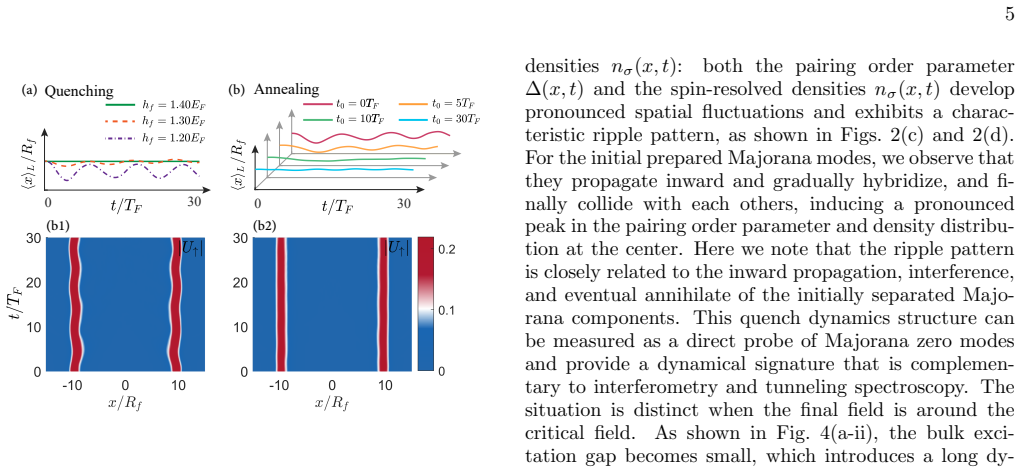
On the paper's own terms, the central discovery is that a sudden Zeeman-field quench from the topological into the trivial phase converts Majorana boundary modes into a detectable interference pattern. The initially separate Majorana components retain boundary localization only transiently, then propagate toward the trap center, hybridize with each other and with finite-energy Bogoliubov quasiparticles, and generate pronounced ripples in the pairing order parameter $\Delta(x,t)$ and the spin-resolved density $n_\sigma(x,t)$; the same mechanism appears in finite-time ramps across the transition. The paper introduces a normalized particle-hole self-conjugacy fidelity $F(t)$ that stays near unity for intratopological quenches and collapses to zero when the two Majorana components overlap after a topology-changing quench, quantifying the dynamical loss of Majorana character. Because trivial-to-topological quenches and quenches confined entirely to the trivial phase do not produce the same boundary-driven ripple response, the paper attributes the ripples specifically to the coherent hybridization of the initially separated Majorana states.
Load-bearing premise
The load-bearing premise is that the self-consistent time-dependent Bogoliubov–de Gennes mean-field treatment faithfully captures the strongly quenched dynamics of the trapped $N=100$ gas; the paper does not benchmark this approximation against an exact many-body calculation, so if beyond-mean-field fluctuations or trap details change how the boundary quasiparticles move and mix, the ripple pattern could have a different origin.
Editorial extensions
If this is right
- Intratopological quenches leave Majorana zero modes dynamically robust, but with boundary-localized oscillations whose amplitude grows with quench strength and shrinks as the ramp becomes slower.
- Topology-changing quenches produce a ripple pattern in the density and pairing field that is a direct, time-resolved signature of Majorana hybridization and loss of self-conjugacy.
- The Majorana fidelity provides a quantitative measure for the dynamical phase diagram, separating persistent Majorana dynamics from boundary-bulk hybridization and complete loss of Majorana character.
- Near the critical field, the small excitation gap creates an intermediate hybrid regime with gradual fidelity decay, so the classification is not binary.
- Finite-time ramps across the transition reproduce the ripple mechanism, meaning the signature is not an artifact of the sharp sudden-quench protocol.
Reading between the lines
- One testable extension is to measure the time at which the two inward-propagating wave packets collide at the trap center and check that this collision time scales with the inverse hybridization energy splitting as the final Zeeman field approaches the critical value.
- If the ripple attribution is correct, time-resolved density imaging alone could act as a Majorana detector, without requiring tunneling contacts or equilibrium spectroscopy, and the same boundary-sensitive diagnostic could be applied to other symmetry-protected edge modes in one-dimensional topological phases.
- Because the claim is made within a self-consistent mean-field approximation, the strongest check would be an exact many-body simulation of a smaller trapped system with the same quench protocol; if ripples survive with the same direction dependence and collision dynamics, the mechanism is likely robust beyond mean field.
Editorial analysis
A structured set of objections, weighed in public.
Referee Report
Summary. The paper studies quantum quench dynamics of a one-dimensional spin-orbit-coupled fermionic superfluid within a self-consistent time-dependent Bogoliubov-de Gennes framework. For quenches that remain inside the topological phase, it reports coherent boundary-localized oscillations of the density and pairing field, interpreted as nonadiabatic deformation of surviving Majorana modes. For quenches from the topological to the trivial phase, it reports pronounced spatiotemporal ripples in the density and order parameter, which the abstract and Sec. III-C attribute to inward propagation, hybridization, and interference of the initially separated Majorana boundary states. A particle-hole self-conjugacy fidelity is introduced to quantify the loss of Majorana character, and a boundary-sensitive dynamical phase diagram is constructed in the (h_i, h_f) plane. Appendices provide supplementary finite-time ramp results and trivial-side control quenches.
Significance. If the central attribution is correct, the paper would establish a time-resolved density observable that is directly sensitive to Majorana hybridization, complementary to equilibrium tunneling and interferometric probes, and relevant to ultracold-atom emulations of topological superconductors. The work has several genuine strengths: the TDBdG simulation self-consistently updates the pairing field; multiple control protocols are shown (intra-topological, trivial-to-trivial, trivial-to-topological); finite-time annealing is used to separate adiabatic from nonadiabatic behavior; and the Majorana fidelity in Eq. (5) provides a quantitative, if one-dimensional, diagnostic. However, the central causal claim is not yet distinguished from a generic low-energy critical response, and the Appendix B attribution partially contradicts the main-text narrative. The needed additional analysis—a quantitative decomposition of the ripple signal and a near-critical trivial-side control—is well within the scope of the manuscript, so the result is potentially significant but not yet established.
major comments (4)
- [Sec. III-C and Appendix B (text near Fig. 5)] The main text, abstract, and conclusion attribute the ripple pattern specifically to the coherent hybridization and interference of initially separated Majorana boundary states, but Appendix B states that, in the same cross-critical protocols, the time-dependent Zeeman field excites low-energy bulk quasiparticle modes near the critical point and that propagation and interference of these excitations produce the oscillatory spatial structures. These are two different causal explanations. The manuscript needs a quantitative decomposition of the post-quench density response into (i) contributions from the projection of the initial Majorana wavefunctions onto final eigenstates and (ii) contributions from generic bulk modes of the final Hamiltonian. Without such a decomposition, the central claim that the ripples are a Majorana signature rather than a generic critical response is unestablished.
- [Appendix B, Fig. 6 and Sec. III-A] The only trivial-to-trivial control uses h_i = 0.70 E_F and h_f = 0.50 E_F, which are far from the critical field h_c = 0.94 E_F. This control therefore does not test whether a trivial initial state brought close to the critical point produces the same ripple structures as the topological-to-trivial quench. I request a trivial-to-trivial quench with both fields near h_c (for example h_i = 0.92 E_F and h_f = 0.80 E_F) and a quantitative comparison of the density ripple amplitude, spatial structure, and fidelity dynamics with the results in Fig. 4. Similarly, the claim in Sec. III-A that the ripple mechanism is absent for reverse trivial-to-topological quenches needs to be supported by a comparison of the reverse quench with the same closeness to the critical point; Fig. 7 alone does not establish the claimed asymmetry.
- [Sec. III-C, Eq. (5)] The Majorana fidelity F(t) is computed on the lowest-energy quasiparticle mode. In the trivial phase after the quench, the lowest-energy mode is generally a finite-energy bulk mode, so a drop in F(t) does not by itself prove that the initial Majorana components hybridize; it may only indicate that the mode tracked is no longer the zero-energy boundary mode. The manuscript should demonstrate that the tracked mode is continuously connected to the initial Majorana mode, for example by monitoring the overlap between the time-evolved wavefunction and the initial Majorana components, or by checking for level crossings or identity swaps in the low-energy spectrum. Without this, the fidelity collapse is not a self-contained proof of Majorana hybridization.
- [Sec. II, Eqs. (2)-(4)] The simulations use a self-consistent time-dependent BdG approximation for a small trapped system (N = 100) with a sudden, large-amplitude quench, but the accuracy of this mean-field treatment is not benchmarked for the parameter regime considered. For a one-dimensional system with attractive interactions, beyond-mean-field fluctuations can be significant, and the quench injects considerable energy. I request either a benchmark against time-dependent DMRG or exact diagonalization for a reduced system size, or at minimum a discussion of the expected validity of the TDBdG approximation for the qualitative mechanism claimed, including how the results depend on the chosen interaction strength gamma and on the system size.
minor comments (7)
- [Abstract] The sentence 'these ripple structures originates from' should be 'originate from'.
- [Sec. III-A] The sentence 'we introduce a spatially potential that allows boundary states to be engineered within a prescribed region of the system' is vague and not followed by any equation, figure, or quantitative description; it should be clarified or removed.
- [Sec. III-B] The phrase 'We next adobe finite-time annealing' contains a typo: it should be 'adopt'.
- [Sec. III-A] The phrase 'a nonadiabatic deformation fo surviving Majorana modes' contains a typo: it should be 'of'.
- [Eq. (5)] The notation in Eq. (5) is not fully defined: the inner products and norms should be written explicitly with integrals, and the mode index (lowest-energy mode) should be stated in the equation itself rather than only in the surrounding text.
- [Sec. II and Appendix A] The dimensionless interaction strength gamma and the spin-orbit coupling strength alpha used in the simulations are not listed; the results in Figs. 2-7 cannot be reproduced without this information.
- [Sec. III-A and Fig. 1] The phase boundaries in Fig. 1 are described only qualitatively ('dashed lines', 'white gradient area'). A quantitative criterion, such as a threshold on the amplitude or spatial width of density oscillations, should be given so that the phase diagram is reproducible.
Circularity Check
No circularity: the density ripples and the Majorana fidelity are separately computed from the TDBdG simulation, and no equation reduces the explanation to the input.
full rationale
The paper's central derivation is numerical: it solves the time-dependent BdG equations (2)-(4) for a specified initial state and quench protocol, with no free parameter fitted to the target observable. The density ripples are a computed output of Eq. (4); the Majorana fidelity F(t) (Eq. 5) is a separately defined diagnostic on the lowest-energy quasiparticle mode. Although both quantities are built from the same BdG amplitudes, F is not inserted into the density evolution, and the observed drop of F for cross-topological quenches is a nontrivial computed result rather than an identity. The paper does not claim to derive the ripples mathematically from F; it offers a causal interpretation. Appendix B's statement that low-energy bulk quasiparticle modes near the critical point produce ripples is a limitation and an alternative explanation, and the trivial-to-trivial control at h_i=0.70E_F, h_f=0.50E_F stays far from h_c, so the Majorana-specific attribution is under-controlled. However, an under-controlled causal attribution is a scientific weakness, not a circular reduction. The only apparent self-citation is ref. [39] in a background list [37-41], and it is not load-bearing. No step in the derivation equates the output to the input by construction.
Assumptions & free parameters
free parameters (4)
- Dimensionless interaction strength gamma = -m g_1D/(hbar^2 n) =
not stated
- Spin-orbit coupling strength alpha =
not stated
- Fidelity thresholds 0.99 and 0.8 =
0.99, 0.8
- Atom number N and trap frequency omega =
N=100; omega not stated
assumptions (3)
- domain assumption The interaction can be decoupled in the mean-field (Bogoliubov-de Gennes) approximation with the self-consistency condition on Delta(x,t).
- domain assumption A harmonic trap V_trap = m omega^2 x^2 / 2 is the only external potential, and the local topological criterion h_z^2 > mu(x)^2 + Delta(x)^2 is a valid guide in the trapped system.
- domain assumption The initial state is the self-consistent zero-temperature ground state of the pre-quench Hamiltonian, and the quench is sudden (Heaviside step).
Cite this review
Pith. "Pith review of Ripple Signatures of Majorana Hybridization across a Topological Quantum Quench." pith.science (2026). https://pith.science/paper/EIXA3DSS
@misc{pith2026260810052,
  author       = {Pith},
  title        = {Pith review of: Ripple Signatures of Majorana Hybridization across a Topological Quantum Quench},
  year         = {2026},
  howpublished = {\url{https://pith.science/paper/EIXA3DSS}},
  note         = {Machine review of arXiv:2608.10052}
}
read the original abstract
The crossover between topology and nonequilibrium dynamics has emerged as a rich frontier, in which quantum systems can exhibit unique dynamical phenomena that lie beyond the reach of equilibrium. Of particular interest are quench dynamics across topological phase, as it may reveal the information about the underlying Majorana zero-energy states. Here, we investigate the fate of Majorana boundary modes in a quenched fermionic superfluid using self-consistent time-dependent Bogoliubov-de Gennes theory. For quantum quenches within the topological regime, Majorana boundary modes survive but undergo coherent boundary oscillations arising from the nonadiabatic deformation of their wave functions. Furthermore, a pronounced ripple pattern appears in the post-quench density distribution following a sudden topology-changing quench. Here we identify that these ripple structures originates from the coherent hybridization and interference of the initially separated Majorana boundary states. Our findings establish nonequilibrium boundary dynamics as a new approach for probing Majorana physics, which is complementary to conventional equilibrium measurements.
Figures


Figures from the paper (3 more)


Reference graph
Works this paper leans on
-
[1]
Stern and N
A. Stern and N. H. Lindner, Topological quantum compu- tation—from basic concepts to first experiments, Science 339, 1179 (2013)
2013
-
[2]
Nayak, S
C. Nayak, S. H. Simon, A. Stern, M. Freedman, and S. Das Sarma, Non-abelian anyons and topological quan- tum computation, Rev. Mod. Phys.80, 1083 (2008)
2008
-
[3]
Loss and D
D. Loss and D. P. DiVincenzo, Quantum computation with quantum dots, Phys. Rev. A57, 120 (1998)
1998
-
[4]
S. D. Sarma, M. Freedman, and C. Nayak, Majorana zero modes and topological quantum computation, npj Quantum Information1, 15001 (2015)
2015
-
[5]
Eisert, M
J. Eisert, M. Friesdorf, and C. Gogolin, Quantum many- body systems out of equilibrium, Nature Physics11, 124 (2015)
2015
-
[6]
C. Yang, L. Li, and S. Chen, Dynamical topological in- variant after a quantum quench, Phys. Rev. B97, 060304 (2018)
2018
-
[7]
Y. Dong, L. Dong, M. Gong, and H. Pu, Dynamical phases in quenched spin–orbit-coupled degenerate fermi gas, Nature Communications6, 6103 (2015)
work page 2015
-
[8]
P. D. Sacramento, Fate of majorana fermions and chern numbers after a quantum quench, Phys. Rev. E90, 032138 (2014)
work page 2014
Show all 56 references
-
[9]
Chung, Y.-H
M.-C. Chung, Y.-H. Jhu, P. Chen, C.-Y. Mou, and X. Wan, A memory of majorana modes through quan- tum quench, Scientific Reports6, 29172 (2016)
2016
-
[10]
D’Alessio and M
L. D’Alessio and M. Rigol, Dynamical preparation of flo- quet chern insulators, Nature Communications6, 8336 (2015)
2015
-
[11]
Bloch, J
I. Bloch, J. Dalibard, and W. Zwerger, Many-body physics with ultracold gases, Rev. Mod. Phys.80, 885 (2008)
2008
-
[12]
Meinert, M
F. Meinert, M. J. Mark, E. Kirilov, K. Lauber, P. Wein- mann, A. J. Daley, and H.-C. N¨ agerl, Quantum quench in an atomic one-dimensional ising chain, Phys. Rev. Lett. 111, 053003 (2013)
2013
-
[13]
Trotzky, Y.-A
S. Trotzky, Y.-A. Chen, A. Flesch, I. P. McCulloch, U. Schollw¨ ock, J. Eisert, and I. Bloch, Probing the re- laxation towards equilibrium in an isolated strongly cor- related one-dimensional bose gas, Nature Physics8, 325 (2012)
2012
-
[14]
Meinert, M
F. Meinert, M. J. Mark, E. Kirilov, K. Lauber, P. Wein- mann, M. Gr¨ obner, A. J. Daley, and H.-C. N¨ agerl, Ob- servation of many-body dynamics in long-range tunneling after a quantum quench, Science344, 1259 (2014)
2014
-
[15]
Liu and H
X.-J. Liu and H. Hu, Topological superfluid in one- 10 dimensional spin-orbit-coupled atomic fermi gases, Phys. Rev. A85, 033622 (2012)
2012
-
[16]
Wang, Z.-Q
P. Wang, Z.-Q. Yu, Z. Fu, J. Miao, L. Huang, S. Chai, H. Zhai, and J. Zhang, Spin-orbit coupled degenerate fermi gases, Phys. Rev. Lett.109, 095301 (2012)
2012
-
[17]
Zhang, S.-C
J.-Y. Zhang, S.-C. Ji, Z. Chen, L. Zhang, Z.-D. Du, B. Yan, G.-S. Pan, B. Zhao, Y.-J. Deng, H. Zhai, S. Chen, and J.-W. Pan, Collective dipole oscillations of a spin- orbit coupled bose-einstein condensate, Phys. Rev. Lett. 109, 115301 (2012)
2012
-
[18]
B. Liu, X. Li, B. Wu, and W. V. Liu, Chiral superfluidity with p-wave symmetry from an interacting s-wave atomic fermi gas, Nature Communications5, 5064 (2014)
2014
-
[19]
E. A. Yuzbashyan, O. Tsyplyatyev, and B. L. Altshuler, Relaxation and persistent oscillations of the order pa- rameter in fermionic condensates, Phys. Rev. Lett.96, 097005 (2006)
2006
-
[20]
M. Sato, Y. Takahashi, and S. Fujimoto, Non-abelian topological order ins-wave superfluids of ultracold fermionic atoms, Phys. Rev. Lett.103, 020401 (2009)
2009
-
[21]
Y. A. Liao, A. S. C. Rittner, T. Paprotta, W. Li, G. B. Partridge, R. G. Hulet, S. K. Baur, and E. J. Mueller, Spin-imbalance in a one-dimensional fermi gas, Nature 467, 567 (2010)
2010
-
[22]
Haller, M
E. Haller, M. Gustavsson, M. J. Mark, J. G. Danzl, R. Hart, G. Pupillo, and H.-C. N¨ agerl, Realization of an excited, strongly correlated quantum gas phase, Science 325, 1224 (2009)
2009
-
[23]
Haller, M
E. Haller, M. J. Mark, R. Hart, J. G. Danzl, L. Reichs¨ ollner, V. Melezhik, P. Schmelcher, and H.- C. N¨ agerl, Confinement-induced resonances in low- dimensional quantum systems, Phys. Rev. Lett.104, 153203 (2010)
2010
-
[24]
S.-G. Peng, H. Hu, X.-J. Liu, and P. D. Drummond, Confinement-induced resonances in anharmonic waveg- uides, Phys. Rev. A84, 043619 (2011)
2011
-
[25]
Fan, X.-L
G. Fan, X.-L. Chen, and P. Zou, Probing two higgs oscil- lations in a one-dimensional fermi superfluid with raman- type spin-orbit coupling, Frontiers of Physics17, 52502 (2022)
2022
-
[26]
Polkovnikov, K
A. Polkovnikov, K. Sengupta, A. Silva, and M. Vengalat- tore, Colloquium: Nonequilibrium dynamics of closed in- teracting quantum systems, Rev. Mod. Phys.83, 863 (2011)
2011
-
[27]
C. Qu, Z. Zheng, M. Gong, Y. Xu, L. Mao, X. Zou, G. Guo, and C. Zhang, Topological superfluids with finite-momentum pairing and majorana fermions, Nature Communications4, 2710 (2013)
2013
-
[28]
Hegde, V
S. Hegde, V. Shivamoggi, S. Vishveshwara, and D. Sen, Quench dynamics and parity blocking in majorana wires, New Journal of Physics17, 053036 (2015)
2015
-
[29]
P. Wang, W. Yi, and G. Xianlong, Topological phase transition in the quench dynamics of a one-dimensional fermi gas with spin–orbit coupling, New Journal of Physics17, 013029 (2015)
2015
-
[30]
Wilczek, Majorana returns, Nature Physics5, 614 (2009)
F. Wilczek, Majorana returns, Nature Physics5, 614 (2009)
2009
-
[31]
Mourik, K
V. Mourik, K. Zuo, S. M. Frolov, S. R. Plissard, E. P. A. M. Bakkers, and L. P. Kouwenhoven, Signa- tures of majorana fermions in hybrid superconductor- semiconductor nanowire devices, Science336, 1003 (2012)
2012
-
[32]
R. M. Lutchyn, J. D. Sau, and S. Das Sarma, Ma- jorana fermions and a topological phase transition in semiconductor-superconductor heterostructures, Phys. Rev. Lett.105, 077001 (2010)
2010
-
[33]
A. Y. Kitaev, Unpaired majorana fermions in quantum wires, Physics-Uspekhi44, 131 (2001)
2001
-
[34]
R. M. Lutchyn, E. P. A. M. Bakkers, L. P. Kouwen- hoven, P. Krogstrup, C. M. Marcus, and Y. Oreg, Majo- rana zero modes in superconductor–semiconductor het- erostructures, Nature Reviews Materials3, 52 (2018)
2018
-
[35]
Delfino, Quantum quenches with integrable pre- quench dynamics, Journal of Physics A: Mathematical and Theoretical47, 402001 (2014)
G. Delfino, Quantum quenches with integrable pre- quench dynamics, Journal of Physics A: Mathematical and Theoretical47, 402001 (2014)
2014
-
[36]
R. A. Barankov, L. S. Levitov, and B. Z. Spivak, Col- lective rabi oscillations and solitons in a time-dependent bcs pairing problem, Phys. Rev. Lett.93, 160401 (2004)
2004
-
[37]
Bulgac and S
A. Bulgac and S. Yoon, Large amplitude dynamics of the pairing correlations in a unitary fermi gas, Phys. Rev. Lett.102, 085302 (2009)
2009
-
[38]
Zhang and W
W. Zhang and W. Yi, Topological Fulde–Ferrell–Larkin–Ovchinnikov states in spin–orbit- coupled fermi gases, Nature Communications4, 2711 (2013)
2013
-
[39]
Wang, A.-C
L.-L. Wang, A.-C. Ji, Q. Sun, and J. Li, Exotic vor- tex states with discrete rotational symmetry in atomic fermi gases with spin-orbital–angular-momentum cou- pling, Phys. Rev. Lett.126, 193401 (2021)
2021
-
[40]
Zhang, Y
X. Zhang, Y. Chen, Z. Wu, J. Wang, J. Fan, S. Deng, and H. Wu, Observation of a superradiant quantum phase transition in an intracavity degenerate fermi gas, Science 373, 1359 (2021)
2021
-
[41]
Zanardi and N
P. Zanardi and N. Paunkovi´ c, Ground state overlap and quantum phase transitions, Phys. Rev. E74, 031123 (2006)
2006
-
[42]
Wang, G.-Q
X.-Q. Wang, G.-Q. Luo, J.-Y. Liu, W. V. Liu, A. Hem- merich, and Z.-F. Xu, Evidence for an atomic chiral su- perfluid with topological excitations, Nature596, 227 (2021)
2021
-
[43]
Moritz, T
H. Moritz, T. St¨ oferle, M. K¨ ohl, and T. Esslinger, Excit- ing collective oscillations in a trapped 1d gas, Phys. Rev. Lett.91, 250402 (2003)
2003
-
[44]
Dutta and A
A. Dutta and A. Dutta, Probing the role of long-range interactions in the dynamics of a long-range kitaev chain, Phys. Rev. B96, 125113 (2017)
2017
-
[45]
Dziarmaga, Dynamics of a quantum phase transition and relaxation to a steady state, Advances in Physics59, 1063 (2010)
J. Dziarmaga, Dynamics of a quantum phase transition and relaxation to a steady state, Advances in Physics59, 1063 (2010)
2010
-
[46]
M. I. K. Munk, R. Egger, and K. Flensberg, Fidelity and visibility loss in majorana qubits by entanglement with environmental modes, Phys. Rev. B99, 155419 (2019)
2019
-
[47]
You, Y.-W
W.-L. You, Y.-W. Li, and S.-J. Gu, Fidelity, dynamic structure factor, and susceptibility in critical phenomena, Phys. Rev. E76, 022101 (2007)
2007
-
[48]
Garnerone, D
S. Garnerone, D. Abasto, S. Haas, and P. Zanardi, Fi- delity in topological quantum phases of matter, Phys. Rev. A79, 032302 (2009)
2009
-
[49]
Panahiyan, W
S. Panahiyan, W. Chen, and S. Fritzsche, Fidelity sus- ceptibility near topological phase transitions in quantum walks, Phys. Rev. B102, 134111 (2020)
2020
-
[50]
Zhao and H.-Q
J.-H. Zhao and H.-Q. Zhou, Singularities in ground-state fidelity and quantum phase transitions for the kitaev model, Phys. Rev. B80, 014403 (2009)
2009
-
[51]
Gu, Fidelity approach to quantum phase transi- tions, International Journal of Modern Physics B24, 4371 (2010)
S.-J. Gu, Fidelity approach to quantum phase transi- tions, International Journal of Modern Physics B24, 4371 (2010)
2010
-
[52]
transition probability
A. Uhlmann, The “transition probability” in the state 11 space of a∗-algebra, Reports on Mathematical Physics 9, 273 (1976)
1976
-
[53]
Jozsa, Fidelity for mixed quantum states, Journal of Modern Optics41, 2315 (1994)
R. Jozsa, Fidelity for mixed quantum states, Journal of Modern Optics41, 2315 (1994)
1994
-
[54]
M. A. Nielsen and I. L. Chuang,Quantum Computation and Quantum Information(Cambridge University Press, Cambridge, 2010)
2010
-
[55]
Wang, C.-S
X. Wang, C.-S. Yu, and X. Yi, An alternative quantum fidelity for mixed states of qudits, Physics Letters A373, 58 (2008)
2008
-
[56]
C. H. Lee and J. C. W. Song, Quenched topological boundary modes can persist in a trivial system, Com- munications Physics4, 145 (2021)
2021
Reviewed August 14, 2026 · model on record in the stance chip above.
Discussion (0). Continue with ORCID to comment.