Spontaneous spin splitting and tunable valley polarization in a two-dimensional fully compensated ferrimagnet
Pith reviewed 2026-06-25 20:14 UTC · model grok-4.3
The pith
Janus Mn2BrI monolayer realizes fully compensated ferrimagnetism with spontaneous spin splitting and tunable valley polarization.
A machine-rendered reading of the paper's core claim, the machinery that carries it, and where it could break.
Core claim
The inequivalent Mn layers in the Janus Mn2BrI monolayer produce a fully compensated ferrimagnet that breaks PT symmetry, generating spontaneous spin splitting from the built-in electrostatic potential; with SOC and an out-of-plane Néel vector this yields valley polarization, and hole doping plus strain further enable anomalous Hall effect and giant piezomagnetism.
What carries the argument
The built-in layer-dependent electrostatic potential arising from the asymmetric Br and I termination layers that lifts spin degeneracy without net magnetization.
If this is right
- Hole doping makes anomalous Hall effect responses allowed through valley-contrasting Berry curvatures.
- Biaxial strain shifts the valence-band extrema and produces giant piezomagnetism.
- The material supplies a zero-net-magnetization platform for valleytronic devices operable above room temperature.
- Valley polarization appears once the Néel vector is oriented perpendicular to the plane under spin-orbit coupling.
Where Pith is reading between the lines
- Similar Janus constructions with other transition-metal pairs may produce additional compensated ferrimagnets with comparable spin-splitting behavior.
- The combination of doping and strain supplies independent electrical and mechanical knobs for controlling valleytronic responses in a single material.
- Device integration could exploit the absence of stray fields while retaining ultrafast spin dynamics characteristic of antiferromagnetic order.
Load-bearing premise
The magnetic anisotropy energies and the doping-induced stabilization of an out-of-plane Néel vector calculated for the ideal monolayer remain stable when temperature fluctuations, defects, or substrate coupling are present.
What would settle it
Direct measurement of a finite net magnetic moment or the absence of spin splitting in angle-resolved photoemission spectra of a synthesized Mn2BrI monolayer would falsify the compensated ferrimagnetism and spontaneous splitting claims.
Figures

read the original abstract
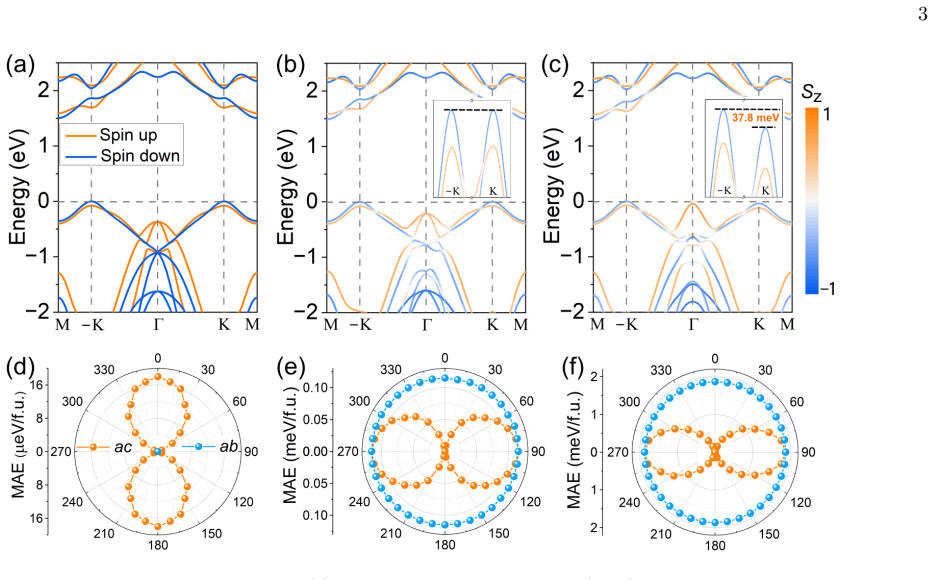
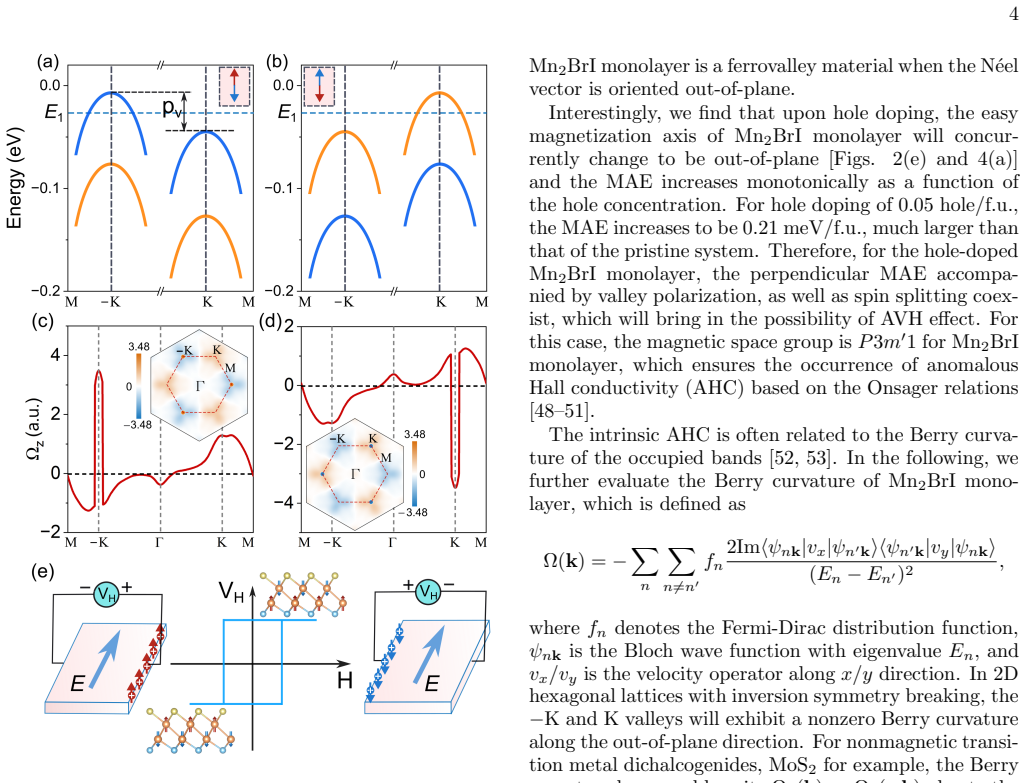
Materials with controllable valley polarization and anomalous valley Hall (AVH) effect are highly desired in valleytronic applications. While current AVH studies primarily focus on ferromagnetic materials, two-dimensional (2D) antiferromagnets are more attractive for valleytronics since they possess zero net magnetization, negligible stray fields, and ultrafast spin dynamics. Nevertheless, the joint space-inversion and time-reversal ($PT$) symmetry in conventional collinear antiferromagnets prohibits the occurrence of AVH response. The recently proposed fully compensated ferrimagnets break $PT$ symmetry, and the spin-opposite sublattices are not related by crystal symmetry, providing a natural platform for the coexistence of spontaneous spin splitting, valley polarization, and anomalous-Hall compatible symmetry. Herein, we demonstrate that such compensated ferrimagnetism can be realized in a Janus Mn$_{2}$BrI monolayer, with a N\'{e}el temperature above room temperature. Spontaneous spin splitting is observed due to the built-in layer-dependent electrostatic potential. When SOC is considered, valley polarization emerges for an out-of-plane N\'{e}el vector. Moreover, proper hole doping stabilizes the perpendicular magnetic anisotropy and the two valleys exhibit markedly different Berry curvatures, thereby making AHE responses allowed. Furthermore, the valence band extrema of Mn$_{2}$BrI monolayer can be effectively tuned by external biaxial strain and giant piezomagnetism can be achieved. Our results identify Janus Mn$_{2}$BrI monolayer as a promising fully compensated ferrimagnetic platform for 2D valleytronics and spintronics.
Editorial analysis
A structured set of objections, weighed in public.
Referee Report
Summary. The manuscript claims that the Janus Mn2BrI monolayer is a fully compensated ferrimagnet with Néel temperature above room temperature, exhibiting spontaneous spin splitting from layer-dependent electrostatic potential. With SOC and out-of-plane Néel vector it shows valley polarization; hole doping stabilizes perpendicular anisotropy, yielding markedly different Berry curvatures at the two valleys that enable AHE, while biaxial strain tunes the valence band extrema and produces giant piezomagnetism.
Significance. If the central claims hold, the work provides a concrete 2D compensated-ferrimagnet platform that breaks PT symmetry without net magnetization, enabling spontaneous spin splitting, valley polarization, and AHE in a system free of stray fields. The combination of doping-tunable anisotropy and strain-induced piezomagnetism would be of direct interest for valleytronic and spintronic device concepts.
major comments (2)
- [Magnetic anisotropy and doping effects] Section on magnetic anisotropy and doping effects: the stabilization of perpendicular magnetic anisotropy (and thus the out-of-plane Néel vector required for valley polarization and AHE) is obtained from zero-temperature DFT MAE calculations on an ideal monolayer; no Monte Carlo or spin-dynamics simulations are presented to test whether this anisotropy survives thermal fluctuations at or above room temperature.
- [Néel-temperature and exchange-parameter section] Néel-temperature and exchange-parameter section: the claim of Néel temperature above room temperature rests on exchange parameters extracted from DFT; the manuscript does not report the spin Hamiltonian, the method used to obtain TN (mean-field, Monte Carlo, etc.), or error bars on the parameters, making it impossible to assess robustness against the small MAE values typical in 2D magnets.
minor comments (2)
- [Computational details] Figure captions and text should explicitly state the k-point sampling and supercell sizes used for the doped and strained calculations to allow reproducibility.
- [Abstract and piezomagnetism discussion] The abstract states 'giant piezomagnetism' without a numerical benchmark; the main text should compare the piezomagnetic coefficient to known 2D materials.
Simulated Author's Rebuttal
We thank the referee for the constructive comments. We address each major point below and will revise the manuscript to incorporate the requested details and additional calculations.
read point-by-point responses
-
Referee: [Magnetic anisotropy and doping effects] Section on magnetic anisotropy and doping effects: the stabilization of perpendicular magnetic anisotropy (and thus the out-of-plane Néel vector required for valley polarization and AHE) is obtained from zero-temperature DFT MAE calculations on an ideal monolayer; no Monte Carlo or spin-dynamics simulations are presented to test whether this anisotropy survives thermal fluctuations at or above room temperature.
Authors: We agree that zero-temperature DFT MAE alone does not fully establish thermal stability of the out-of-plane Néel vector. In the revised manuscript we will add Monte Carlo simulations of the spin model (including the computed anisotropy) to demonstrate that the perpendicular configuration remains stable against thermal fluctuations up to and above room temperature, thereby supporting the conditions required for valley polarization and AHE. revision: yes
-
Referee: [Néel-temperature and exchange-parameter section] Néel-temperature and exchange-parameter section: the claim of Néel temperature above room temperature rests on exchange parameters extracted from DFT; the manuscript does not report the spin Hamiltonian, the method used to obtain TN (mean-field, Monte Carlo, etc.), or error bars on the parameters, making it impossible to assess robustness against the small MAE values typical in 2D magnets.
Authors: We acknowledge that the original manuscript omitted these technical details. The revised version will explicitly present the spin Hamiltonian, state the method employed to obtain TN, and include error bars (or sensitivity analysis) on the exchange parameters extracted from DFT. This will enable readers to evaluate the robustness of the TN estimate relative to the small MAE scale. revision: yes
Circularity Check
No circularity: claims rest on independent DFT computations
full rationale
The paper derives its central results (Néel temperature, spontaneous spin splitting, valley polarization under SOC, doping-stabilized PMA, differing Berry curvatures, strain-tuned piezomagnetism) directly from first-principles DFT calculations of total energies, band structures, MAE, and Berry curvature on the Janus Mn2BrI monolayer. These quantities are computed outputs, not algebraically forced by any parameter fitted to the target observables themselves. No self-definitional loops, fitted-input predictions, or load-bearing self-citations appear in the derivation chain; the work is self-contained against external benchmarks.
Axiom & Free-Parameter Ledger
axioms (2)
- domain assumption Density functional theory with spin-orbit coupling accurately captures the valley splitting and Berry curvature in this magnetic monolayer.
- domain assumption The calculated magnetic anisotropy energy correctly predicts the preferred Néel vector orientation under hole doping.
Reference graph
Works this paper leans on
-
[1]
are shown in Fig. S3. The band structure calcu- lated with a modestU effof 4 eV is very close to that calculated using HSE06 functional, therefore, in the fol- lowing, we choose to use PBE+Umethod withU effof 4 eV. When considering the AFM1 spin configuration, both the space inversion (P) and time reversal (T) symme- tries are broken for not only the Janu...
-
[2]
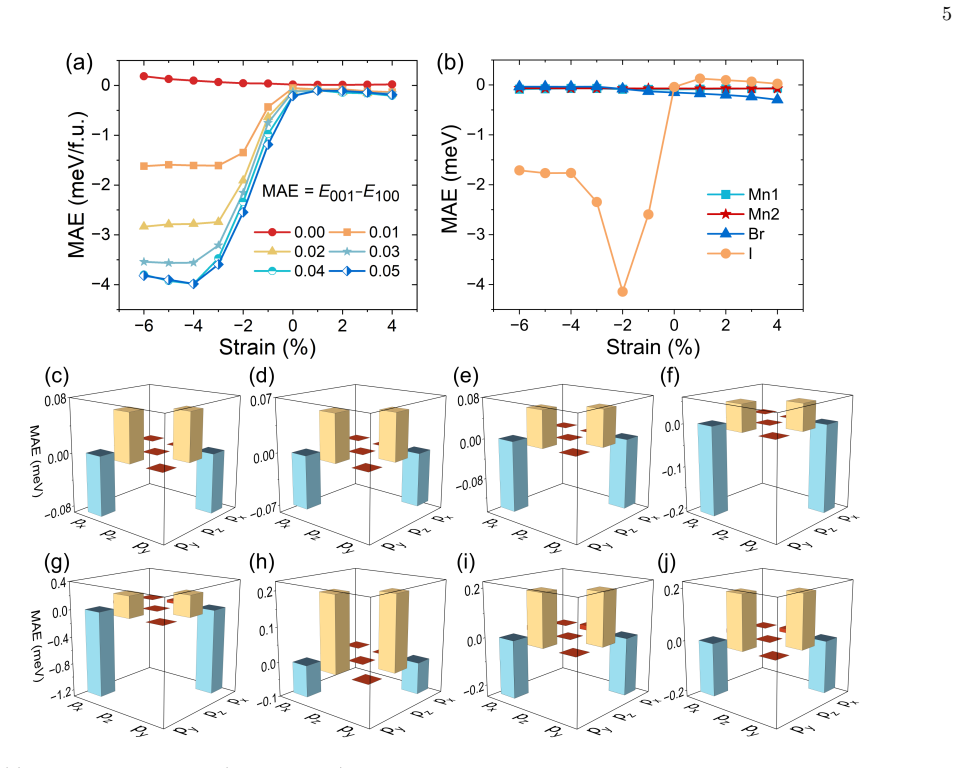
Magnetic anisotropy energy Firstly, we will show that the MAE of Mn 2BrI mono- layer can be further increased by hole-doping combined with the method of strain. Here, only the biaxial strain is considered, which is defined asϵ=(a−a 0)/a0, where a0 andaare the in-plane lattice constants of the Mn 2BrI monolayer before and after the strain is applied, respe...
-
[3]
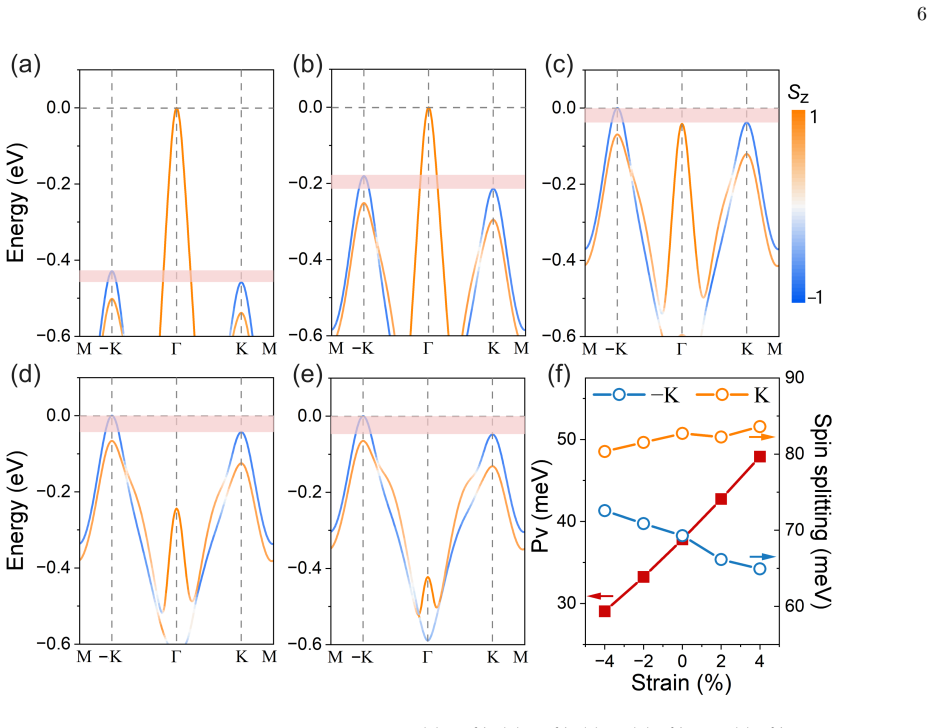
Valley polarization and anomalous valley Hall effect We further investigate the strain effect on the valley polarization of Mn 2BrI monolayer, as shown in Fig. 5. Since the easy magnetization axis tends to be out-of- plane upon hole doping for all the strain range consid- ered, we plot the band structures when N´ eel vector is along out-of-plane direction...
-
[4]
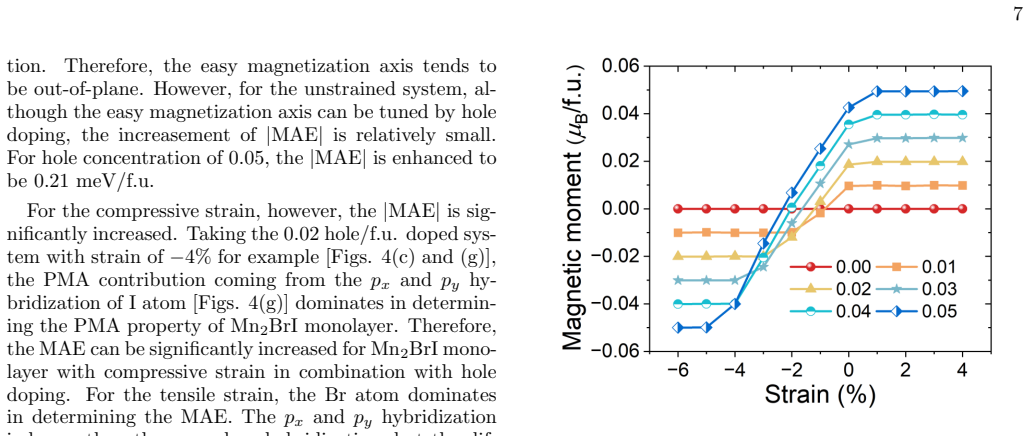
Piezomagnetism of Mn 2BrI monolayer Since the valence band extrema at−K, K, and Γ points of Mn2BrI monolayer can be effectively tuned by exter- nal strain and the spin polarization at Γ point is dif- ferent from those at−K and K points, we can expect that piezomagnetism could exist in Mn 2BrI monolayer. Net magnetic moment (m) can be obtained by integrat-...
-
[5]
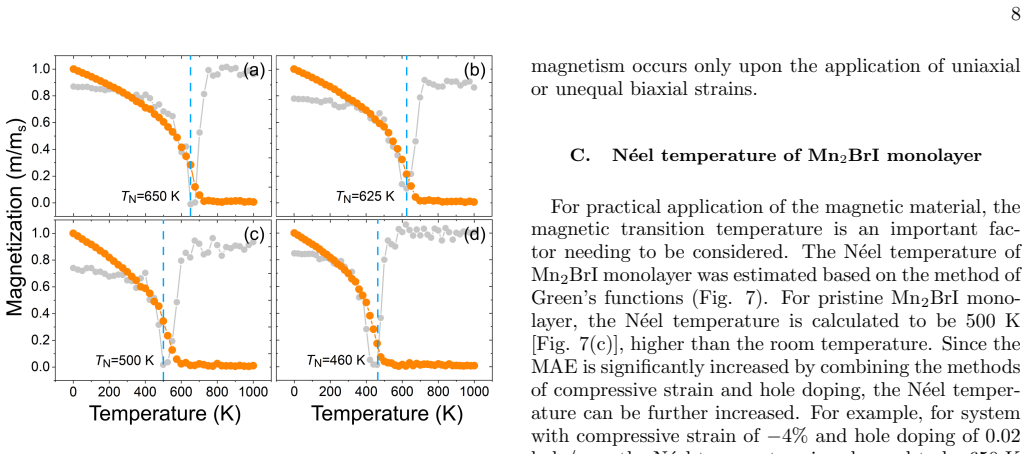
and V 2SeTeO [22] monolayers, for which the piezo- magnetism occurs only upon the application of uniaxial or unequal biaxial strains. C. N´ eel temperature of Mn 2BrI monolayer For practical application of the magnetic material, the magnetic transition temperature is an important fac- tor needing to be considered. The N´ eel temperature of Mn2BrI monolaye...
2021
-
[6]
Rycerz, J
A. Rycerz, J. Tworzydlo, and C. W. J. Beenakker, Valley filter and valley valve in graphene, Nat. Phys.3, 172 (2007)
2007
-
[7]
Gunawan, Y
O. Gunawan, Y. P. Shkolnikov, K. Vakili, T. Gokmen, E. P. De Poortere, and M. Shayegan, Valley susceptibility of an interacting two-dimensional electron system, Phys. Rev. Lett.97, 186404 (2006)
2006
-
[8]
D. Xiao, W. Yao, and Q. Niu, Valley-contrasting physics in graphene: magnetic moment and topological trans- port, Phys. Rev. Lett.99, 236809 (2007)
2007
-
[9]
Xiao, G.-B
D. Xiao, G.-B. Liu, W. X. Feng, X. D. Xu, and W. Yao, Coupled spin and valley physics in monolayers of MoS2 and other group-VI dichalcogenides, Phys. Rev. Lett.108, 196802 (2012)
2012
-
[10]
J. R. Schaibley, H. Yu, G. Clark, P. Rivera, J. S. Ross, K. L. Seyler, W. Yao, and X. Xu, Valleytronics in 2D materials, Nat. Rev. Mater.1, 16055 (2016)
2016
-
[11]
Tong, S.-J
W.-Y. Tong, S.-J. Gong, X. G. Wan, and C.-G. Duan, Concepts of ferrovalley material and anomalous valley Hall effect, Nat. Commun.7, 13612 (2016)
2016
-
[12]
P. Zhao, Y. D. Ma, C. G. Lei, H. Wang, B. B. Huang, and Y. Dai, Single-layer LaBr 2: Two-dimensional val- leytronic semiconductor with spontaneous spin and val- ley polarizations, Appl. Phys. Lett.115, 261605 (2019)
2019
-
[13]
X. Y. Feng, X. L. Xu, Z. L. He, R. Peng, Y. Dai, B. B. Huang, and Y. D. Ma, Valley-related multiple Hall effect in monolayer VSi 2P4, Phys. Rev. B104, 075421 (2021)
2021
-
[14]
R. Peng, Y. D. Ma, X. L. Xu, Z. L. He, B. B. Huang, and Y. Dai, Intrinsic anomalous valley Hall effect in single- layer Nb3I8, Phys. Rev. B102, 035412 (2020)
2020
-
[15]
ˇZuti´ c, J
I. ˇZuti´ c, J. Fabian, and S. Das Sarma, Spintronics: Fun- damentals and applications, Rev. Mod. Phys.76, 323 (2004)
2004
-
[16]
Jungwirth, J
T. Jungwirth, J. Sinova, A. Manchon, X. Marti, J. Wun- derlich, and C. Felser, The multiple directions of antifer- romagnetic spintronics, Nat. Phys.14, 200 (2018)
2018
-
[17]
X. Li, T. Cao, Q. Niu, J. R. Shi, and J. Feng, Coupling the valley degree of freedom to antiferromagnetic order, Proc. Natl. Acad. Sci. USA110, 3738 (2013)
2013
-
[18]
W. H. Du, R. Peng, Z. L. He, Y. Dai, B. B. Huang, and Y. D. Ma, Anomalous valley Hall effect in antiferromagnetic monolayers, npj 2D Mater. Appl.6, 11 (2022)
2022
-
[19]
Zhang, X
T. Zhang, X. L. Xu, B. B. Huang, Y. Dai, L. Z. Kou, and Y. D. Ma, Layer-polarized anomalous Hall effects in valleytronic van der Waals bilayersm, Mater. Horiz.10, 483 (2023)
2023
-
[20]
Y. Meng, C. X. Zhang, C. B. Luo, C. Y. He, C. Tang, and Y. P. Sun, Tunable layer-polarized anomalous Hall effect in two-dimensional 3R-GdBrI bilayer, Appl. Phys. Lett.126, 252407 (2025)
2025
-
[21]
S.-D. Guo, W. Xu, Y. XUe, G. Q. Zhu, and Y. S. Ang, Layer-locked anomalous valley Hall effect in a two- dimensionalA-type tetragonal antiferromagnetic insula- tor, Phys. Rev. B109, 134426 (2024)
2024
-
[22]
Guo, Y.-L
S.-D. Guo, Y.-L. Tao, Z.-Y. Zhuo, G. Q. Zhu, and Y. S. Ang, Electric-field-tuned anomalous valley Hall effect inA-type hexagonal antiferromagnetic monolayers, Phys. Rev. B109, 134402 (2024)
2024
-
[23]
ˇSmejkal, J
L. ˇSmejkal, J. Sinova, and T. Jungwirth, Beyond conven- tional ferromagnetism and antiferromagnetism: A phase with nonrelativistic spin and crystal rotation symmetry, Phys. Rev. X12, 031042 (2022)
2022
-
[24]
ˇSmejkal, J
L. ˇSmejkal, J. Sinova, and T. Jungwirth, Emerging re- search landscape of altermagnetism, Phys. Rev. X12, 040501 (2022)
2022
-
[25]
L. Bai, W. X. Feng, S. Y. Liu, L. ˇSmejkal, Y. Mokrousov, and Y. G. Yao, Altermagnetism: Exploring new frontiers in magnetism and spintronics, Adv. Funct. Mater.34, 2409327 (2024)
2024
-
[26]
H.-Y. Ma, M. L. Hu, N. N. Li, J. P. Liu, W. Yao, J.-F. Jia, and J. W. Liu, Multifunctional antiferromagnetic materi- als with giant piezomagnetism and noncollinear spin cur- rent, Nat. Commun.12, 2846 (2021)
2021
-
[27]
Y. Zhu, T. K. Chen, Y. C. Li, L. Qiao, X. N. Ma, C. Liu, T. Hu, H. Gao, and W. Ren, Multipiezo effect in altermagnetic V 2SeTeO monolayer, Nano Lett.24, 472 (2024)
2024
-
[28]
J. L. Gong, Y. Wang, Y. L. Han, Z. X. Cheng, X. T. Wang, Z.-M. Yu, and Y. G. Yao, Hidden real topology and unusual magnetoelectric responses in two- dimensional antiferromagnets, Adv. Mater.36, 2402232 (2024)
2024
-
[29]
Y. Z. Wu, L. Deng, X. Yin, J. W. Tong, F. B. Tian, and X. M. Zhang, Valley-related multipiezo effect and non- collinear spin current in an altermagnet Fe 2Se2O mono- layer, Nano Lett.24, 10534 (2024)
2024
-
[30]
S. Lee, S. Lee, S. Jung, J. Jung, D. Kim, Y. Lee, B. Seok, J. Kim, B. G. Park, L. ˇSmejkal, C.-J. Kang, and C. Kim, Broken Kramers degeneracy in altermagnetic MnTe, Phys. Rev. Lett.132, 036702 (2024)
2024
-
[31]
Zhang, C
R.-W. Zhang, C. X. Cui, R. Z. Li, J. Y. Duan, L. Li, Z.-M. Yu, and Y. G. Yao, Predictable gate-field control of spin in altermagnets with spin-layer coupling, Phys. Rev. Lett.133, 056401 (2024)
2024
-
[32]
K. X. Zou, Y. X. Yang, B. J. Xin, W. T. Wu, Y. H. Cheng, H. Dong, H. Liu, F. Luo, F. Lu, and W.-H. Wang, Monolayer M 2X2O as potential 2D altermagnets and half-metals: a first principles study, J. Phys.: Con- dens. Matter37, 055804 (2025)
2025
-
[33]
van Leuken and R
H. van Leuken and R. A. de Groot, Half-metallic antifer- romagnets, Phys. Rev. Lett.74, 1171 (1995)
1995
-
[34]
M. ˇZic, K. Rode, N. Thiyagarajah, Y.-C. Lau, D. Betto, J. M. D. Coey, S. Sanvito, K. J. O’Shea, C. A. Fergu- son, D. A. MacLaren, and T. Archer, Designing a fully compensated half-metallic ferrimagnet, Phys. Rev. B93, 140202(R) (2016)
2016
-
[35]
Kawamura, K
T. Kawamura, K. Yoshimi, K. Hashimoto, A. Kobayashi, and T. Misawa, Compensated ferrimagnets with colossal spin splitting in organic compounds, Phys. Rev. Lett. 132, 156502 (2024)
2024
-
[36]
Liu, S.-D
Y. Liu, S.-D. Guo, Y. Li, and C.-C. Liu, Two-dimensional fully compensated ferrimagnetism, Phys. Rev. Lett.134, 116703 (2025)
2025
-
[37]
Kresse and J
G. Kresse and J. Furthm¨ uller, Efficient iterative schemes for ab initio total-energy calculations using a plane-wave basis set, Phys. Rev. B54, 11169 (1996)
1996
-
[38]
Kresse and J
G. Kresse and J. Furthm¨ uller, Efficiency of ab-initio total energy calculations for metals and semiconductors using a plane-wave basis set, Comput. Mater. Sci.6, 15 (1996)
1996
-
[39]
J. P. Perdew, K. Burke, and M. Ernzerhof, Generalized gradient approximation made simple, Phys. Rev. Lett. 77, 3865 (1996). 10
1996
-
[40]
P. E. Bl¨ ochl, Projector augmented-wave method, Phys. Rev. B50, 17953 (1994)
1994
-
[41]
S. L. Dudarev, G. A. Botton, S. Y. Savrasov, C. J. Humphreys, and A. P. Sutton, Electron-energy-loss spec- tra and the structural stability of nickel oxide: An LSDA+U study, Phys. Rev. B57, 1505 (1998)
1998
-
[42]
Togo and I
A. Togo and I. Tanaka, First principles phonon calcula- tions in materials science, Scr. Mater.108, 1 (2015)
2015
-
[43]
Nos´ e, A unified formulation of the constant temper- ature molecular dynamics methods, J
S. Nos´ e, A unified formulation of the constant temper- ature molecular dynamics methods, J. Chem. Phys.81, 511 (1984)
1984
-
[44]
Marzari and D
N. Marzari and D. Vanderbilt, Maximally localized gen- eralized Wannier functions for composite energy bands, Phys. Rev. B56, 12847 (1997)
1997
-
[45]
A. A. Mostofi, J. R. Yates, Y.-S. Lee, I. Souza, D. Vander- bilt, and N. Marzari, WANNIER90: A tool for obtaining maximally localised Wannier functions, Comput. Phys. Commun.178, 685 (2008)
2008
-
[46]
X. He, N. Helbig, M. J. Verstraete, and E. Bousquet, TB2J: A python package for computing magnetic interac- tion parameters, Comput. Phys. Commun.264, 107938 (2021)
2021
-
[47]
R. F. L. Evans, W. J. Fan, P. Chureemart, T. A. Ostler, M. O. A. Ellis, and R. W. Chantrell, Atomistic spin model simulations of magnetic nanomaterials, J. Phys.: Condens. Matter26, 103202 (2014)
2014
-
[48]
J. D. Corbett, Extended metal-metal bonding in halides of the early transition metals, Acc. Chem. Res.14, 239 (1981)
1981
-
[49]
when different biaxial strains are applied, with SOC considered
See Supplemental Material for different spin configura- tions considered in this work, relative energy difference as a function ofU efffor different spin configurations, band structures of Mn 2BrI monolayer calculated using HSE06 and PBE+Umethods with differentU effvalues, band structures of Mn 2Br2 and Mn 2I2 without consid- ering SOC, Berry curvature fo...
-
[50]
J. Heyd, G. E. Scuseria, and M. Ernzerhof, Hybrid func- tionals based on a screened Coulomb potential, J. Chem. Phys.118, 8207 (2003)
2003
-
[51]
Z. Y. Zhu, Y. C. Cheng, and U. Schwingenschl¨ ogl, Gi- ant spin-orbit-induced spin splitting in two-dimensional transition-metal dichalcogenide semiconductors, Phys. Rev. B84, 153402 (2011)
2011
-
[52]
P. H. Jiang, L. Li, Z. L. Liao, Y. X. Zhao, and Z. C. Zhong, Spin direction-controlled electronic band struc- ture in two-dimensional ferromagnetic CrI 3, Nano Lett. 18, 3844 (2018)
2018
-
[53]
J. ˇZelezn´ y, Symmetr: a Python package for determining symmetry properties of crystals, arXiv:2602.21034
-
[54]
H. T. Stokes, D. M. Hatch, and B. J. Campbell, FIND- SYM: program for identifying the space-group symmetry of a crystal, J. Appl. Cryst.38, 237 (2005)
2005
-
[55]
S. V. Gallego, J. M. Perez-Mato, L. Elcoro, E. S. Tasci, R. M. Hanson, K. Momma, M. I. Aroyo, and G. Madariaga, MAGNDATA: towards a database of magnetic struc- tures. II. The incommensurate case, J. Appl. Cryst.49, 1750 (2016)
2016
-
[56]
S. V. Gallego, J. M. Perez-Mato, L. Elcoro, E. S. Tasci, R. M. Hanson, M. I. Aroyo, and G. Madariaga, MAGN- DATA: towards a database of magnetic structures. II. The incommensurate case, J. Appl. Cryst.49, 1941 (2016)
1941
-
[57]
Nagaosa, J
N. Nagaosa, J. Sinova, S. Onoda, A. H. MacDonald, and N. P. Ong, Anomalous Hall effect, Rev. Mod. Phys.82, 1539 (2010)
2010
-
[58]
Xiao, M.-C
D. Xiao, M.-C. Chang, and Q. Niu, Berry phase effects on electronic properties, Rev. Mod. Phys.82, 1959 (2010)
1959
discussion (0)
Sign in with ORCID, Apple, or X to comment. Anyone can read and Pith papers without signing in.