CP asymmetries in Dto K⁰_(S,L)P and Dto K⁰_(S,L)V decays
Pith reviewed 2026-06-30 20:19 UTC · model grok-4.3
The pith
CP asymmetries from amplitude interference and kaon mixing reach order 10^{-3} in four D decays.
A machine-rendered reading of the paper's core claim, the machinery that carries it, and where it could break.
Core claim
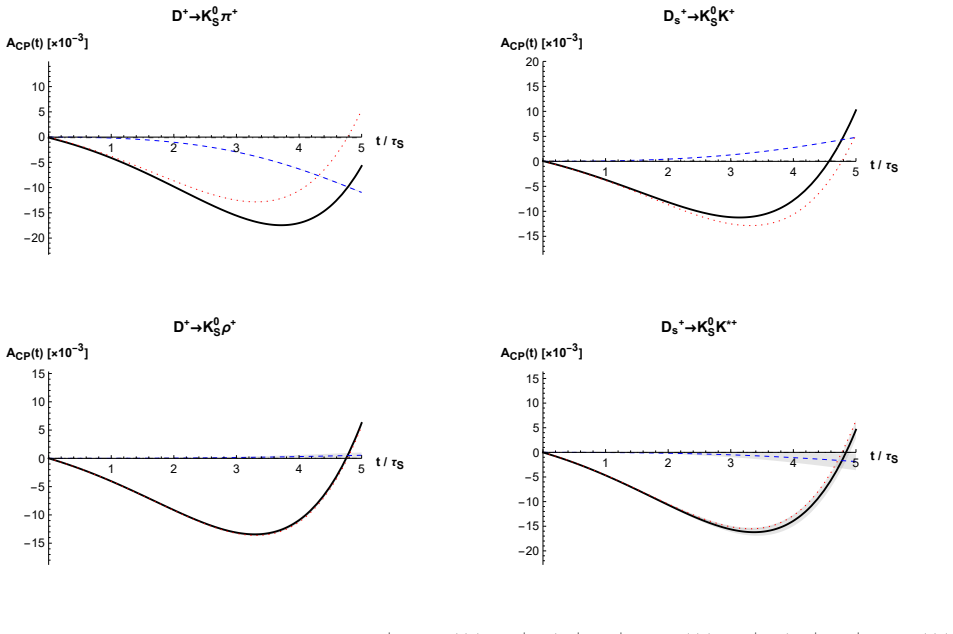
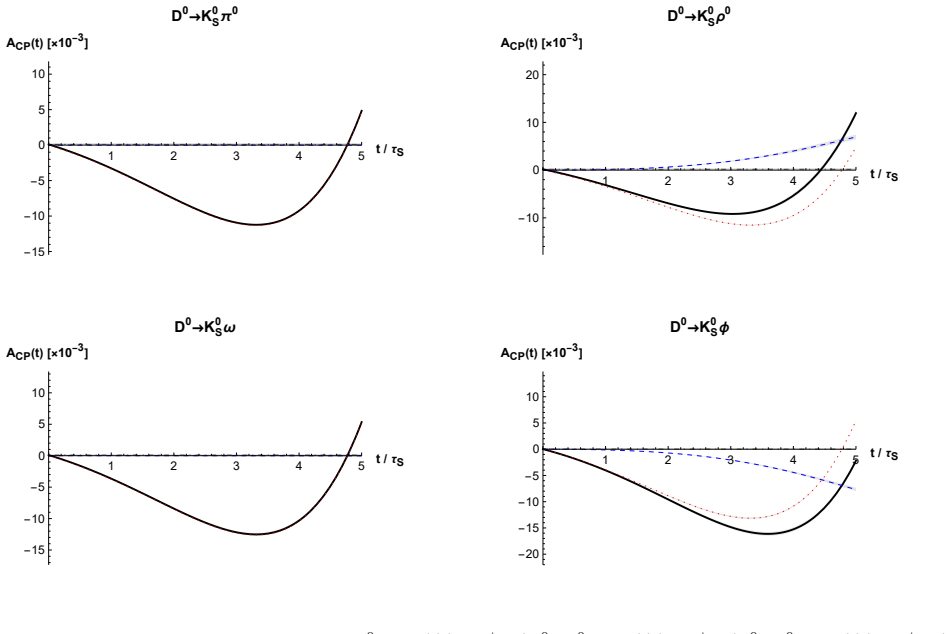
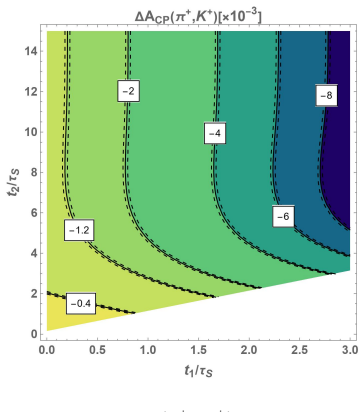
The central claim is that the interference between Cabibbo-favored and doubly Cabibbo-suppressed amplitudes with neutral kaon mixing generates CP-violating effects of order 10^{-3} in the D+→K0Sπ+, D+s→K0SK+, D0→K0Sρ0, and D0→K0Sϕ modes. The formulas account for D0-D0bar mixing and KL final states for the first time. Hadronic parameters extracted via global fit of branching fractions in the topological diagram approach mitigate the tension between theory and experiment for the KS-KL asymmetries in the D0→K0S,Lω and D0→K0S,Lϕ modes. The difference between the CP asymmetries in D+→K0Sπ+ and D+s→K0SK+ is measurable at LHCb and Belle II.
What carries the argument
The topological diagram approach, which extracts hadronic parameters from a global fit to branching fractions and thereby fixes the sizes of the interfering Cabibbo-favored and doubly Cabibbo-suppressed amplitudes that drive the CP asymmetries together with kaon mixing.
If this is right
- The KS-KL asymmetry tension in D0→K0S,Lω and D0→K0S,Lϕ is reduced by the new parameter extraction.
- O(10^{-3}) CP-violating effects appear in the four specified modes from the CF-DCS interference plus kaon mixing.
- The formulas now include D0 mixing and KL modes explicitly for all channels considered.
- The difference between the CP asymmetries in D+→K0Sπ+ and D+s→K0SK+ becomes experimentally accessible at LHCb and Belle II.
Where Pith is reading between the lines
- If the predicted difference between the two charged-D modes is confirmed, it would provide a clean test of the relative sizes of the Cabibbo-favored and doubly Cabibbo-suppressed amplitudes without requiring new hadronic modeling.
- The same parameter set can be used to forecast CP asymmetries in additional D decay channels not yet measured.
- Observation of these 10^{-3} effects at the expected level would constrain the possible size of any beyond-Standard-Model contribution to the same observables.
Load-bearing premise
The hadronic parameters extracted via global fit of branching fractions in the topological diagram approach correctly determine the CP asymmetries in the listed modes.
What would settle it
A precision measurement of the time-integrated CP asymmetry in D+→K0Sπ+ that lies well below or above the 10^{-3} range would show whether the extracted parameters and interference mechanism produce the predicted size.
Figures

read the original abstract
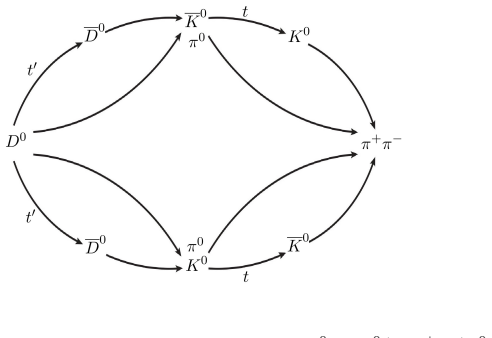
$D$ meson decays into neutral kaons involve both Cabibbo-favored and doubly Cabibbo-suppressed amplitudes as well as final-state kaon mixing, providing abundant sources of CP violation. In this work, we analyze CP asymmetries in the $D\to K^0_{S,L}P$ and $D\to K^0_{S,L}V$ decays, where $P$ and $V$ denote pseudoscalar and vector mesons respectively. The formulas of the time-dependent and time-integrated CP asymmetries in these modes are derived, in which the $D^0-\overline D^0$ mixing effects and the $K^0_L$ modes are considered for the first time. The hadronic parameters that determine CP asymmetries are extracted by the global fit of branching fractions within the topological diagram approach. A significant result is that the tension between theoretical predictions and experimental data for the $K_S^0-K_L^0$ asymmetries in $D^0\to K_{S,L}^0\omega$ and $D^0\to K_{S,L}^0\phi$ modes is mitigated. The CP-violating effects arising from the interference between Cabibbo-favored and doubly Cabibbo-suppressed amplitudes with neutral kaon mixing could reach to $\mathcal{O}(10^{-3})$ order in the $D^+\to K^0_S\pi^+$, $D^+_s\to K^0_SK^+$, $D^0\to K^0_S\rho^0$, and $D^0\to K^0_S\phi$ modes. The difference between the CP asymmetries in the $D^+\to K^0_S\pi^+$ and $D^+_s\to K^0_SK^+$ modes is available on LHCb and Belle II in the near future.
Editorial analysis
A structured set of objections, weighed in public.
Referee Report
Summary. The manuscript analyzes CP asymmetries in D meson decays to neutral kaons plus a pseudoscalar or vector meson (D → K_{S,L}^0 P and D → K_{S,L}^0 V). It derives time-dependent and time-integrated CP asymmetry formulas that incorporate D^0-¯D^0 mixing and the K_L modes explicitly for the first time. Hadronic parameters are extracted from a global fit to branching fractions in the topological diagram approach. The central claims are that this framework mitigates the existing tension between theory and data for the K_S^0-K_L^0 asymmetries in the ω and ϕ modes, and that CP-violating effects from interference between Cabibbo-favored and doubly Cabibbo-suppressed amplitudes (with kaon mixing) reach O(10^{-3}) in the D^+ → K_S^0 π^+, D_s^+ → K_S^0 K^+, D^0 → K_S^0 ρ^0, and D^0 → K_S^0 ϕ channels, with the difference between the first two modes testable at LHCb and Belle II.
Significance. If the results hold, the work supplies concrete, testable predictions at the 10^{-3} level for CP violation in charm decays that lie within the sensitivity of current and near-future experiments. The explicit retention of D mixing and K_L modes in the time-integrated rates is a clear methodological advance over prior treatments and directly addresses the reported K_S^0-K_L^0 tension in the vector modes. The global fit to branching fractions within the topological diagram approach provides a systematic, data-driven determination of the hadronic parameters that enter the asymmetries.
minor comments (3)
- [abstract and §2] The abstract states that the formulas are derived 'in which the D^0-¯D^0 mixing effects and the K_L^0 modes are considered for the first time,' but the manuscript should explicitly compare the new time-integrated expressions to the earlier literature expressions (e.g., those omitting mixing) to quantify the numerical impact of each term.
- [§3 (parameter extraction)] The global fit to branching fractions is used to fix the hadronic parameters that enter the CP asymmetries; the manuscript should report the χ²/dof of that fit and the correlation matrix among the extracted parameters so that the propagated uncertainty on the O(10^{-3}) predictions can be assessed.
- [§4 (numerical results)] Table or figure presenting the numerical CP asymmetries for the four highlighted modes should include both the central values and the uncertainties propagated from the fit; without this, the claim that the effects 'could reach to O(10^{-3})' remains qualitative.
Simulated Author's Rebuttal
We thank the referee for the positive assessment of our manuscript, including the recognition of the methodological advance in retaining D mixing and K_L modes, the data-driven extraction of hadronic parameters, and the concrete predictions at the 10^{-3} level. The recommendation for minor revision is noted. No major comments were provided in the report.
Circularity Check
No significant circularity; predictions use external branching-fraction data
full rationale
The paper derives time-dependent and time-integrated CP-asymmetry formulas that explicitly retain D^0-Dbar^0 mixing and K_L^0 modes. Hadronic parameters in the topological-diagram approach are determined by a global fit to measured branching fractions (external experimental inputs). These parameters are then inserted into the derived expressions to obtain numerical A_CP values. Because the input data are independent branching-fraction measurements and the central formulas are constructed from first-principles amplitudes plus mixing, the numerical results do not reduce to the inputs by definition or by self-citation. No load-bearing step matches any of the enumerated circularity patterns.
Axiom & Free-Parameter Ledger
free parameters (1)
- hadronic parameters in topological diagram approach
axioms (2)
- domain assumption Topological diagram approach correctly parametrizes the hadronic matrix elements in D decays
- domain assumption Cabibbo-favored and doubly Cabibbo-suppressed amplitudes interfere as described by the Standard Model CKM structure
Reference graph
Works this paper leans on
-
[1]
A. D. Sakharov, Pisma Zh. Eksp. Teor. Fiz.5, 32 (1967) [JETP Lett.5, 24 (1967)] [Sov. Phys. Usp.34, 392 (1991)] [Usp. Fiz. Nauk161, 61 (1991)]. 17
1967
-
[2]
Cabibbo, Phys
N. Cabibbo, Phys. Rev. Lett.10, 531 (1963)
1963
-
[3]
Kobayashi and T
M. Kobayashi and T. Maskawa, Prog. Theor. Phys.49, 652 (1973)
1973
-
[4]
S. L. Glashow, J. Iliopoulos and L. Maiani, Phys. Rev. D2, 1285 (1970)
1970
-
[5]
Observation of $C\!P$ violation in charm decays
R. Aaijet al.[LHCb], Phys. Rev. Lett.122, no.21, 211803 (2019) [arXiv:1903.08726 [hep-ex]]
work page internal anchor Pith review Pith/arXiv arXiv 2019
-
[6]
I. I. Y. Bigi and H. Yamamoto, Phys. Lett. B349, 363 (1995) [hep-ph/9502238]
work page internal anchor Pith review Pith/arXiv arXiv 1995
-
[7]
Z. Z. Xing, Phys. Lett. B353, 313-318 (1995) [erratum: Phys. Lett. B363, 266 (1995)] [arXiv:hep-ph/9505272 [hep-ph]]
work page internal anchor Pith review Pith/arXiv arXiv 1995
-
[8]
Y. I. Azimov, Eur. Phys. J. A4, 21 (1999) [hep-ph/9808386]
work page internal anchor Pith review Pith/arXiv arXiv 1999
-
[9]
New CP-violating parameters in cascade decays
A. Amorim, M. G. Santos and J. P. Silva, Phys. Rev. D59, 056001 (1999) [hep-ph/9807364]
work page internal anchor Pith review Pith/arXiv arXiv 1999
-
[10]
H. J. Lipkin and Z. z. Xing, Phys. Lett. B450, 405 (1999) [hep-ph/9901329]
work page internal anchor Pith review Pith/arXiv arXiv 1999
- [11]
-
[12]
The diquark model: New Physics effects for charm and kaon decays
G. D’Ambrosio and D. N. Gao, Phys. Lett. B513, 123 (2001) [hep-ph/0105078]
work page internal anchor Pith review Pith/arXiv arXiv 2001
-
[13]
CP Violation in \tau ->\nu\pi K_S and D->\pi K_S: The Importance of K_S-K_L Interference
Y. Grossman and Y. Nir, JHEP1204, 002 (2012) [arXiv:1110.3790 [hep-ph]]
work page internal anchor Pith review Pith/arXiv arXiv 2012
- [14]
-
[15]
F. S. Yu, D. Wang and H. n. Li, Phys. Rev. Lett.119, no. 18, 181802 (2017) [arXiv:1707.09297 [hep-ph]]
work page internal anchor Pith review Pith/arXiv arXiv 2017
-
[16]
Navaset al.[Particle Data Group], Phys
S. Navaset al.[Particle Data Group], Phys. Rev. D110, no.3, 030001 (2024)
2024
-
[17]
Y. Grossman, P. Leo, A. Martini, G. Papiri and A. Rostomyan, JHEP04, 179 (2026) [arXiv:2509.07071 [hep-ph]]
-
[18]
Testing New Indirect CP Violation
Y. Grossman, Y. Nir and G. Perez, Phys. Rev. Lett.103, 071602 (2009) [arXiv:0904.0305 [hep-ph]]
work page internal anchor Pith review Pith/arXiv arXiv 2009
-
[19]
New Physics and CP Violation in Singly Cabibbo Suppressed D Decays
Y. Grossman, A. L. Kagan and Y. Nir, Phys. Rev. D75, 036008 (2007) [hep-ph/0609178]
work page internal anchor Pith review Pith/arXiv arXiv 2007
-
[20]
Averages of $b$-hadron, $c$-hadron, and $\tau$-lepton properties as of 2023
S. Banerjeeet al.[Heavy Flavor Averaging Group (HFLAV)], Phys. Rev. D113, no.1, 012008 (2026) [arXiv:2411.18639 [hep-ex]]
work page internal anchor Pith review Pith/arXiv arXiv 2026
- [21]
- [22]
-
[23]
G. C. Branco, L. Lavoura and J. P. Silva, Int. Ser. Monogr. Phys.103, 1 (1999)
1999
-
[24]
H. Y. Cheng and C. W. Chiang, Phys. Rev. D81, 074021 (2010) [arXiv:1001.0987 [hep-ph]]
work page internal anchor Pith review Pith/arXiv arXiv 2010
-
[25]
M. Ablikimet al.[BESIII], Phys. Rev. D108, no.9, 092003 (2023) [arXiv:2306.05194 [hep-ex]]
-
[26]
M. Ablikimet al.[BESIII], Phys. Rev. Lett.132, no.9, 091802 (2024) [arXiv:2307.12852 [hep-ex]]
-
[27]
Wang, JHEP03, 155 (2022) [arXiv:2111.11201 [hep-ph]]
D. Wang, JHEP03, 155 (2022) [arXiv:2111.11201 [hep-ph]]
-
[28]
D. Wang, F. S. Yu, P. F. Guo and H. Y. Jiang, Phys. Rev. D95, no.7, 073007 (2017) [arXiv:1701.07173 [hep-ph]]
work page internal anchor Pith review Pith/arXiv arXiv 2017
- [29]
-
[30]
Comparison of D --> K_s^0 pi and D --> K_L^0 pi Decay Rates
Q. Heet al.[CLEO], Phys. Rev. Lett.100, 091801 (2008) [arXiv:0711.1463 [hep-ex]]
work page internal anchor Pith review Pith/arXiv arXiv 2008
-
[31]
Study of the Decays $D_{s}^{+} \rightarrow K_{S}^{0}K^{+}$ and $K_{L}^{0}K^{+}$
M. Ablikimet al.[BESIII], Phys. Rev. D99, no.11, 112005 (2019) [arXiv:1903.04164 [hep-ex]]
work page internal anchor Pith review Pith/arXiv arXiv 2019
-
[32]
M. Ablikimet al.[BESIII], Phys. Rev. D105, no.9, 092010 (2022) [arXiv:2202.13601 [hep-ex]]
-
[33]
M. E. Peskin and D. V. Schroeder, Reading, USA: Addison-Wesley (1995) 842 p. 18
1995
discussion (0)
Sign in with ORCID, Apple, or X to comment. Anyone can read and Pith papers without signing in.