REVIEW 3 major objections 5 minor 42 references
Incremental Evaluation and Training in Relational Deep Learning
T0 review · 3 major / 5 minor · reviewed 2026-08-15 · deepseek-v4-flash
Pith's one-line read Incrementally fine-tuned relational deep learning models consistently outperform expensive from-scratch retraining, so static snapshot benchmarks understate temporal degradation.
desk verdict A useful incremental evaluation protocol for RDL, but the 'consistently outperform' claim is not supported by the paper's own full-training tables. read the letter →
The pith
A machine-rendered reading of the paper's core claim, the machinery that carries it, and where it could break.
The reading
What carries the argument
The load-bearing mechanism is the multi-episodic evaluation loop. A task is defined by a future-pointing query $Q_{\Delta w}(t)$ that produces labels in a window of size $\Delta w$ after each anchor time $t$; consecutive anchors are spaced by a fixed increment $\Delta I$, and each episode appends the newly revealed rows and links to the historical graph while a leakage barrier keeps validation and test horizons strictly ahead. This loop supports four training regimes, from scratch, cumulative fine-tuning, incremental fine-tuning, and upsampled fine-tuning, and the evaluation metric assigns sample weight $(1-\alpha)^{i-1}$ to the $i$-th future window, reducing to a uniform mean at $\alpha=0$ and isolating the next window as $\alpha\to 1$. The incremental protocol is what turns an otherwise static benchmark into a measure of temporal robustness.
What would settle it
Re-run one classification task with early stopping and checkpoint selection restricted to labels available at or before the current episode, then compare fine-tuned and from-scratch models on the next increment. If fine-tuning no longer matches or beats from-scratch, the paper's deployment-oriented claim would not survive realistic operation.
Extended reading notes
Core claim
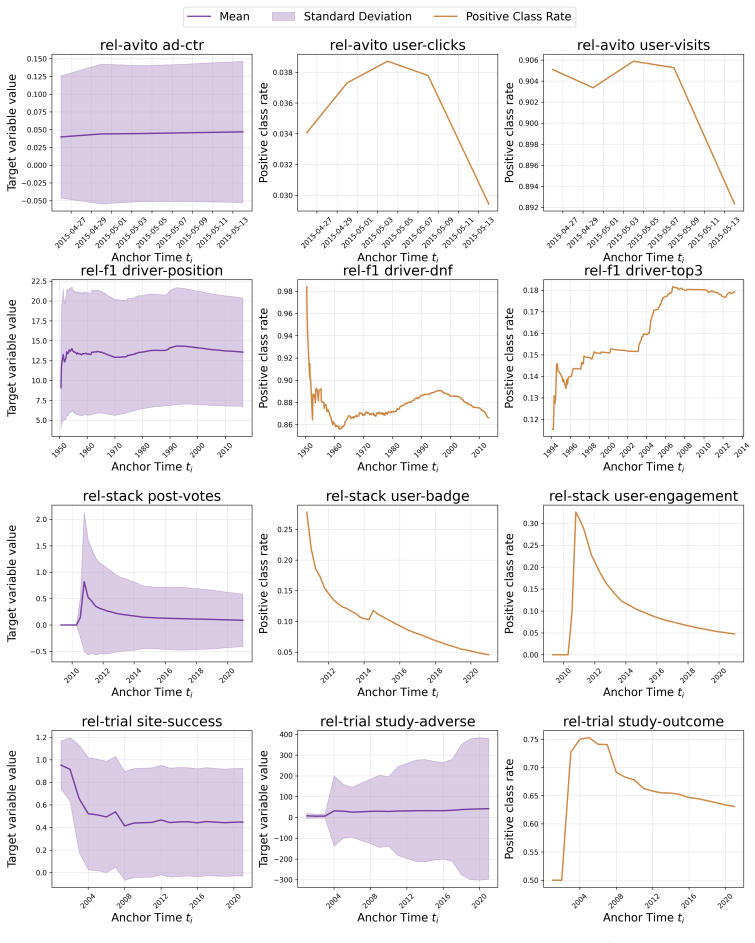
The paper's central claim is that standard single-episode RDL benchmarks are inadequate because relational databases grow continuously, and that a multi-episode protocol is both necessary and practical. On its own terms, the paper demonstrates that temporal concept drift, the distribution of target values shifting as time advances, occurs in the majority of the twelve tasks it studies, that models trained from scratch at each episode degrade further from the horizon they start from, and that three fine-tuning regimes (cumulative, incremental, and upsampled) transfer knowledge well enough to match or beat from-scratch retraining, sometimes within a hundred training steps. The newly proposed exponential-decay metric weights each future window by $(1-\alpha)^{i-1}$, so a decay near 1 isolates performance on the immediate next window; varying the decay preserves the relative ranking of regimes in most tasks. The paper concludes that snapshot evaluation should give way to incremental evaluation and that incremental fine-tuning should replace repeated from-scratch training as the default strategy for RDL models deployed on growing databases.
Load-bearing premise
The reported advantage assumes it is fair to pick each episode's best checkpoint by validating on the next increment of labels, because the same future labels also appear in the reported score; if a deployed model must act before seeing those labels, the fine-tuning advantage may be optimistic.
Editorial extensions
If this is right
- Static single-episode scores likely overstate long-horizon performance; multi-episode evaluation is needed to see how quickly a model obsolesces.
- Incremental fine-tuning becomes a strong and cheap default, so repeated from-scratch retraining can be dropped in most continuous-deployment settings.
- Near-future-weighted evaluation can change which regime looks best in some tasks, so benchmark reports should state the decay factor alongside the metric.
- Few-step adaptation suggests pretrained RDL weights are a practical starting point for continual deployment, reducing per-update compute.
Reading between the lines
- If checkpoints cannot be selected using next-increment labels, the reported fine-tuning advantage is optimistic; testing with past-only validation is a direct check.
- The same protocol could serve as a continual-learning benchmark for relational data, bridging RDL and continual graph learning.
- The time-weighted metric could be generalized to arbitrary operational cost curves, not just exponential decay.
- Extending from append-only growth to updates and deletions is the next stress test; the paper itself flags CRUD operations as open.
Signed reviews
Editorial analysis
A structured set of objections, weighed in public.
Referee Report
Summary. The paper proposes an incremental, multi-episode evaluation and training paradigm for Relational Deep Learning (RDL). It formalizes episode-wise data increments, three fine-tuning regimes (cumulative, incremental, and upsampled) plus a from-scratch baseline, and an exponential-decay time-weighted evaluation metric. Using 12 tasks from RelBench, the paper reports temporal concept drift in most tasks and claims that incrementally fine-tuned models consistently outperform from-scratch baselines, with transfer learning happening in very few training steps. The contributions are framed as a move from static snapshot evaluation to continuous, horizon-shifting evaluation for RDL.
Significance. The multi-episodic evaluation paradigm is a conceptually useful contribution: standard RDL benchmarks evaluate a single chronological split, while real databases grow continuously. The paper's drift analysis over 12 tasks and the proposal of a near-future-weighted metric are also valuable for the community. If the central performance claim were robust, the work would justify a shift toward incremental fine-tuning in RDL practice. However, the claim of consistent superiority of fine-tuning is not supported by the paper's own tables, and the checkpoint-selection protocol in the incremental experiments uses future labels. The framework and analysis remain useful, but the headline empirical conclusion needs substantial rework before the paper can be recommended for publication.
major comments (3)
- [Abstract, Tables 3-4] The abstract and conclusion claim that incrementally fine-tuned models 'consistently outperform' from-scratch baselines. This is contradicted by the paper's own full results. In Table 3, from-scratch wins on driver-position at decay 0.0 (3.106 vs. best fine-tuned 3.256) and at decay 0.3 (2.827 vs. 2.858); on site-success, from-scratch achieves 0.393 vs. 0.428 for cumulative fine-tuning. In Table 4, from-scratch wins on user-clicks at decay 0.0 (0.648 vs. 0.659), on driver-dnf at decay 0.0 (0.814 vs. 0.763), and on study-outcome at decay 0.0 (0.657 vs. 0.633). The evidence supports task-dependent gains, not 'consistent' superiority; the claim should be substantially weakened or the analysis should identify which regime helps when.
- [5.3, Figures 5 and 9] In Section 5.3, the checkpoint for each episode is selected 'via validation on the subsequent increment (up to t_{i+1})', and Figures 5 and 9 then report the validation score for that same subsequent increment. This uses the labels of the very data being scored to choose the early-stopped checkpoint. In a real deployment, t_{i+1} labels are unavailable at the time of the update. This protocol gives the fine-tuning regimes an oracle advantage that the from-scratch baseline does not receive in the same way. Please redo the comparison with checkpoint selection based only on information available at t_i (for example, a held-out portion of the already-observed increment), or report results for fixed training budgets without early stopping on the next increment.
- [Appendix A.1] The 2000-step and 2-hour caps per incremental step may under-train the from-scratch baseline, especially for large tasks such as post-votes (2.45M training samples). A fine-tuned model starts from a previously trained initialization, so it needs fewer steps to reach good performance; the comparison is then confounded by compute budget rather than measuring generalization. The paper should report whether from-scratch models converge within the cap, e.g., by showing training curves or using a convergence-based stopping rule, or should use a compute-matched protocol in which from-scratch receives the cumulative number of steps spent by all fine-tuning episodes.
minor comments (5)
- [5.1, Table 1] Tasks on rel-avito and rel-f1 driver-top3 have only two training episodes. For these tasks, the claimed transfer ability rests on a single fine-tuning step and should be explicitly reported as a caveat in the text.
- [4.3, Eq. (1)] Equation (1) uses (1-alpha)^{i-1}, which is undefined at alpha = 1 for i = 1. Please state that alpha is in [0,1) and treat alpha close to 1 as the limit that isolates the first window.
- [3.1] The symbol T is used both for the set of relations' tables and for the time domain in the mapping tau: V -> T. This overloaded notation makes the definition of tau confusing; please use different symbols, e.g., T_t for the time domain.
- [References] References [13] and [14] are the same paper (Gorishniy et al., 'Revisiting deep learning models for tabular data'). Please merge them.
- [Figures 2-3, Table 1] There are several formatting issues: Figure 2 shows 'TRAIN V AL' with an extra space; Figure 3's caption says 'full range off the task windows' instead of 'full range of the task windows'; Table 1's header 'Total Nof' appears to be missing a symbol or space. Please correct these in a final polish.
Circularity Check
No significant circularity: the paper's central claims rest on comparative experiments against standard baselines, not on definitional fits or self-citation chains.
full rationale
This is an empirical benchmark paper rather than a derivation, so there is no equation whose output is defined by a fitted parameter. The time-weighted metric in Eq. (1) is an explicitly user-chosen weighting with sensitivity analysis (Table 2), not a fitted prediction, and the decay parameter is not estimated from the data. The checkpoint-selection protocol in Section 5.3, which validates on the subsequent increment, is a lookahead or selection-bias concern that could make the reported fine-tuning advantage optimistic, but it is not a circular reduction: all compared regimes undergo the same selection procedure, and the paper's own Tables 3 and 4 provide independent full-training evaluations on the original validation and test splits. Self-citations to ReDeLEx [29], tabular transformers [30], and task-agnostic pretraining [31] appear in related-work and implementation contexts, but they do not supply the load-bearing evidence for the incremental fine-tuning comparison, which is generated by the paper's own experiments on RelBench tasks. No uniqueness theorem, ansatz, or fitted input is imported from the authors' prior work to force the main conclusion. The limitations section explicitly acknowledges the scope of the claims (append-only growth, catastrophic forgetting, and challenges for study-outcome), which further indicates that the paper is not concealing a circular step. Therefore, the central claims are self-contained empirical results, and no significant circularity is present.
Assumptions & free parameters
free parameters (4)
- Per-episode training budget (max_steps) =
2000 optimization steps, 100 batches per epoch, 2-hour cap
- Incremental data mixing probability p =
0.5
- Decay rate alpha =
0, 0.3, 0.9
- Model and sampling hyperparameters =
2 GNN layers, hidden 128, 32 then 16 neighbors, batch 128, learning rate 0.001
assumptions (4)
- domain assumption RelBench task queries and chronological splits correctly define future prediction labels without temporal leakage.
- domain assumption Append-only database growth is the relevant deformation of a real-world database.
- domain assumption GraphSAGE with tabular ResNet encoders is a representative state-of-the-art RDL model.
- domain assumption Temporal neighbor sampling with 32 and 16 neighbors approximates the full temporal graph context well enough.
Cite this review
Pith. "Pith review of Incremental Evaluation and Training in Relational Deep Learning." pith.science (2026). https://pith.science/paper/ELNIZIFL
@misc{pith2026260813023,
  author       = {Pith},
  title        = {Pith review of: Incremental Evaluation and Training in Relational Deep Learning},
  year         = {2026},
  howpublished = {\url{https://pith.science/paper/ELNIZIFL}},
  note         = {Machine review of arXiv:2608.13023}
}
read the original abstract
Relational Deep Learning (RDL) models multi-tabular databases as temporal heterogeneous graphs to enable end-to-end representation learning. However, prevailing RDL evaluation practices rely on static, single-episode dataset snapshots, overlooking the continuous, time-evolving nature of real-world databases. Consequently, current RDL benchmarks fail to capture how model performance changes as new data accumulates over time. To address this limitation, we introduce an incremental, multi-episode evaluation and training paradigm to assess and improve the temporal robustness and adaptability of state-of-the-art RDL models. Using established large-scale datasets, we examine data evolution and model training dynamics, demonstrating that temporal concept drifts occur in the majority of predictive tasks. We present multiple incremental training regimes for fine-tuning the models and demonstrate that transfer learning is both feasible and highly effective in the RDL setting. Alongside a new temporal evaluation metric that prioritizes near-future accuracy, we show that our incrementally fine-tuned models consistently outperform the standard, expensive, from-scratch trained baselines.
Figures


Figures from the paper (7 more)




Reference graph
Works this paper leans on
-
[1]
R. Agrawal, A. Somani, and Y . Xu. Storage and querying of e-commerce data. InVLDB, volume 1, pages 149–158, 2001
work page 2001
-
[2]
Brody, U
S. Brody, U. Alon, and E. Yahav. How attentive are graph attention networks? InInternational Conference on Learning Representations, 2022
2022
-
[3]
D. D. Chamberlin and R. F. Boyce. SEQUEL: A structured English query language. In Proceedings of the 1974 ACM SIGFIDET (now SIGMOD) workshop on Data description, access and control, SIGFIDET ’74, pages 249–264, New York, NY , USA, 1974. Association for Computing Machinery
work page 1974
-
[4]
K.-Y . Chen, P.-H. Chiang, H.-R. Chou, T.-W. Chen, and D. T.-H. Chang. Trompt: towards a better deep neural network for tabular data. InProceedings of the 40th International Conference on Machine Learning, ICML’23. JMLR.org, 2023
work page 2023
-
[5]
T. Chen, C. Kanatsoulis, and J. Leskovec. RelGNN: Composite message passing for relational deep learning. InForty-second International Conference on Machine Learning, 2025
work page 2025
-
[6]
E. F. Codd. A relational model of data for large shared data banks.Commun. ACM, 13(6):377–387, June 1970
work page 1970
- [7]
-
[8]
C. R. Da Xu, E. Korpeoglu, S. Kumar, and P. Awasthi. Inductive representation learning on temporal graphs. InInternational Conference on Learning Representations, 2020
work page 2020
Show all 42 references
-
[9]
V . P. Dwivedi, S. Jaladi, Y . Shen, F. Lopez, C. I. Kanatsoulis, R. Puri, M. Fey, and J. Leskovec. Relational graph transformer. InTemporal Graph Learning Workshop @ KDD 2025, 2025
2025
-
[10]
V . P. Dwivedi, C. Kanatsoulis, S. Huang, and J. Leskovec. Relational deep learning: Challenges, foundations and next-generation architectures. InProceedings of the 31st ACM SIGKDD Conference on Knowledge Discovery and Data Mining V .2, KDD ’25, page 5999–6009, New York, NY , ...
2025
-
[11]
M. Fey, W. Hu, K. Huang, J. E. Lenssen, R. Ranjan, J. Robinson, R. Ying, J. You, and J. Leskovec. Position: Relational deep learning - graph representation learning on relational databases. InForty-first International Conference on Machine Learning, 2024
2024
-
[12]
M. Fey, V . Kocijan, F. Lopez, J. E. Lenssen, and J. Leskovec. KumoRFM: A Foundation Model for In-Context Learning on Relational Data. May 2025
2025
-
[14]
Gorishniy, I
Y . Gorishniy, I. Rubachev, V . Khrulkov, and A. Babenko. Revisiting deep learning models for tabular data. InProceedings of the 35th International Conference on Neural Information Processing Systems, NIPS ’21, pages 18932–18943, Red Hook, NY , USA, 2021. Curran Associates Inc
2021
-
[15]
J. Gu, R. Ranjan, C. Kanatsoulis, H. Tang, M. Jurkovic, V . Hudovernik, M. Znidar, P. Chaturvedi, P. Shroff, F. Li, and J. Leskovec. RelBench v2: A Large-Scale Benchmark and Repository for Relational Data, Feb. 2026. arXiv:2602.12606 [cs]
2026 arXiv
-
[16]
Hamilton, Z
W. Hamilton, Z. Ying, and J. Leskovec. Inductive Representation Learning on Large Graphs. In Advances in Neural Information Processing Systems, volume 30. Curran Associates, Inc., 2017. 10
2017
-
[17]
W. Hu, Y . Yuan, Z. Zhang, A. Nitta, K. Cao, V . Kocijan, J. Leskovec, and M. Fey. Pytorch frame: A modular framework for multi-modal tabular learning.arXiv preprint arXiv:2404.00776, 2024
2024 arXiv
-
[18]
X. Hu, W. Tang, C.-K. Hsieh, and S. Shi. Tabtransformer: Tabular data modeling using contextual embeddings.arXiv preprint arXiv:2012.06678, 2020
2012 arXiv
-
[19]
Hudovernik, F
V . Hudovernik, F. López, V . Kocijan, A. Nitta, J. E. Lenssen, J. Leskovec, and M. Fey. KumoRFM-2: Scaling Foundation Models for Relational Learning, Apr. 2026. arXiv:2604.12596 [cs]
2026 arXiv
-
[20]
Jurkovic, V
M. Jurkovic, V . Hudovernik, and E. Štrumbelj. Syntherela: A benchmark for synthetic relational database generation. InWill Synthetic Data Finally Solve the Data Access Problem?, 2025
2025
-
[21]
S. M. Kazemi, R. Goel, K. Jain, I. Robertson, H. Schmid, S. Srinivasan, S. Kieffer, Y . Chen, and P. Poupart. Representation learning for dynamic graphs: A survey.The Journal of Machine Learning Research, 21(1):2648–2718, 2020
2020
-
[22]
Kocijan, J
V . Kocijan, J. Sunil, J. E. Lenssen, V . Deb, X. Xe, F. R. Gomez, M. Fey, and J. Leskovec. Pre- dictive Query Language: A Domain-Specific Language for Predictive Modeling on Relational Databases, Feb. 2026. arXiv:2602.09572 [cs]
2026 arXiv
-
[23]
Kothapalli, R
V . Kothapalli, R. Ranjan, V . Hudovernik, V . P. Dwivedi, J. Hoffart, C. Guestrin, and J. Leskovec. PluRel: Synthetic Data unlocks Scaling Laws for Relational Foundation Models, Feb. 2026. arXiv:2602.04029 [cs]
2026 arXiv
-
[24]
Lachi, M
D. Lachi, M. Mohammadi, J. Meyer, V . Arora, T. Palczewski, and E. L. Dyer. RGP: A Cross-Attention based Graph Transformer for Relational Deep Learning. Oct. 2025
2025
-
[25]
Lachi, A
V . Lachi, A. Longa, B. Bevilacqua, B. Lepri, A. Passerini, and B. Ribeiro. Boosting Relational Deep Learning with Pretrained Tabular Models, Apr. 2025. arXiv:2504.04934 [cs]
2025 arXiv
-
[26]
J. Lu, A. Liu, F. Dong, F. Gu, J. Gama, and G. Zhang. Learning under concept drift: A review. IEEE transactions on knowledge and data engineering, 31(12):2346–2363, 2018
2018
-
[27]
Moritz, R
P. Moritz, R. Nishihara, S. Wang, A. Tumanov, R. Liaw, E. Liang, M. Elibol, Z. Yang, W. Paul, M. I. Jordan, and I. Stoica. Ray: A distributed framework for emerging ai applications, 2018
2018
-
[28]
G. I. Parisi, R. Kemker, J. L. Part, C. Kanan, and S. Wermter. Continual lifelong learning with neural networks: A review.Neural networks, 113:54–71, 2019
2019
-
[29]
Peleška and G
J. Peleška and G. Šír. Redelex: A framework for relational deep learning exploration. In Machine Learning and Knowledge Discovery in Databases., pages 438–456. Springer Nature Switzerland, 2025
2025
-
[30]
Peleška and G
J. Peleška and G. Šír. Tabular transformers meet relational databases.ACM Trans. Intell. Syst. Technol., 16(5), Sept. 2025
2025
-
[31]
Peleška and G
J. Peleška and G. Šír. Task-Agnostic Contrastive Pretraining for Relational Deep Learning, June
-
[32]
Ranjan, V
R. Ranjan, V . Hudovernik, M. Znidar, C. Kanatsoulis, R. Upendra, M. Mohammadi, J. Meyer, T. Palczewski, C. Guestrin, and J. Leskovec. Relational Transformer: Toward Zero-Shot Foundation Models for Relational Data, Oct. 2025. arXiv:2510.06377 [cs]
2025
-
[33]
Robinson, R
J. Robinson, R. Ranjan, W. Hu, K. Huang, J. Han, A. Dobles, M. Fey, J. E. Lenssen, Y . Yuan, Z. Zhang, X. He, and J. Leskovec. Relbench: A benchmark for deep learning on relational databases. InThe Thirty-eight Conference on Neural Information Processing Systems Datasets and B...
2024
-
[34]
Rossi, B
E. Rossi, B. Chamberlain, F. Frasca, D. Eynard, F. Monti, and M. Bronstein. Temporal graph networks for deep learning on dynamic graphs.arXiv preprint arXiv:2006.10637, 2020
2006 arXiv
-
[35]
Veliˇckovi´c, G
P. Veliˇckovi´c, G. Cucurull, A. Casanova, A. Romero, P. Liò, and Y . Bengio. Graph attention networks. InInternational Conference on Learning Representations, 2018. 11
2018
-
[36]
Y . Wang, X. Wang, Q. Gan, M. Wang, Q. Yang, D. Wipf, and M. Zhang. Griffin: Towards a Graph-Centric Relational Database Foundation Model, May 2025. arXiv:2505.05568 [cs]
2025 arXiv
-
[37]
Wehrstein, C
J. Wehrstein, C. Binnig, F. Ozcan, S. Vasudevan, Y . Gan, and Y . Wang. Towards foundation database models. InProceedings of the 15th Annual Conference on Innovative Data Systems Research (CIDR), 2025
2025
-
[38]
J. White. PubMed 2.0.Medical Reference Services Quarterly, 39(4):382–387, Oct. 2020
2020
-
[39]
F. Wu, V . P. Dwivedi, and J. Leskovec. Large language models are good relational learners. InProceedings of the 63rd Annual Meeting of the Association for Computational Linguistics (Volume 1: Long Papers), pages 7835–7854, 2025
2025
-
[40]
J. Yin, P. Huo, B. Zhu, H. Yan, S. Wang, S. Pan, and C. Zhang. Rel-MOSS: Towards Imbalanced Relational Deep Learning on Relational Databases, Mar. 2026. arXiv:2603.07916 [cs]
2026 arXiv
-
[41]
Zahradník, J
L. Zahradník, J. Neumann, and G. Šír. A deep learning blueprint for relational databases. In NeurIPS 2023 Second Table Representation Learning Workshop, 2023
2023
-
[42]
Zhang, D
X. Zhang, D. Song, and D. Tao. Continual graph learning.IEEE Transactions on Pattern Analysis and Machine Intelligence, 2022. 12 A Technical appendices and supplementary material This appendix provides additional implementation details, full data-distribution analyses, and ex-...
2022
-
[2025]
arXiv:2506.22530 [cs]
Reviewed August 15, 2026 · model on record in the stance chip above.
Discussion (0). Continue with ORCID to comment.