UMB: A Unified Markov Binary Format for Probabilistic Model Checking (extended version)
Pith reviewed 2026-06-26 22:30 UTC · model grok-4.3
The pith
A binary format built on bit-level primitives unifies representation and exchange of probabilistic systems for model checking.
A machine-rendered reading of the paper's core claim, the machinery that carries it, and where it could break.
Core claim
UMB provides a clean, unified, and efficient explicit-state file format for representing a wide range of probabilistic systems, based on a general underlying mathematical model and encoded using a small set of bit-level primitive data structures.
What carries the argument
The UMB format, which encodes models via bit-level primitive data structures on top of a general mathematical model of probabilistic systems.
If this is right
- Interoperability between probabilistic model checking tools increases because models can be exchanged without custom converters.
- Overhead from writing and reading model files decreases due to the compact binary encoding.
- New practical use cases become feasible through the supplied Python library and continuous validation infrastructure.
- Adoption by prominent tools allows shared model repositories and cross-tool experiments.
Where Pith is reading between the lines
- Standard benchmarks could be distributed once in UMB rather than duplicated across tool-specific formats.
- Future tools could be written to read UMB directly, reducing the need for high-level language parsers in some workflows.
- The format's extensibility via bit-level primitives may support emerging model types without breaking existing readers.
Load-bearing premise
A single binary format built on bit-level primitives can represent the full range of probabilistic systems handled by existing tools without significant loss of performance or expressiveness.
What would settle it
A concrete probabilistic system from an existing tool that cannot be losslessly encoded in UMB or that produces measurably slower model-checking times after conversion to and from the format.
Figures

read the original abstract
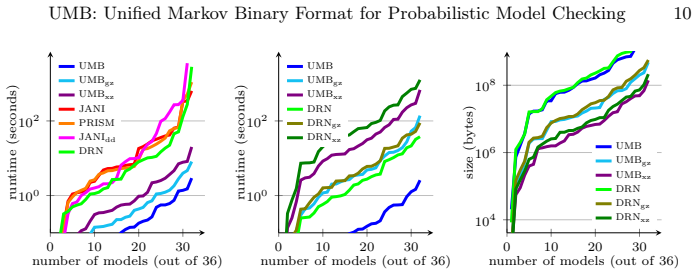
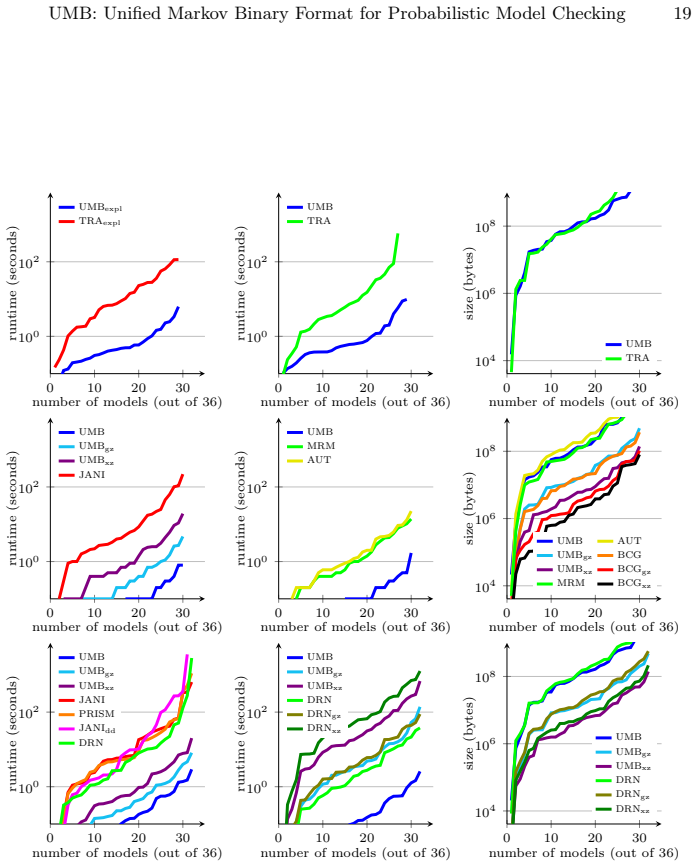
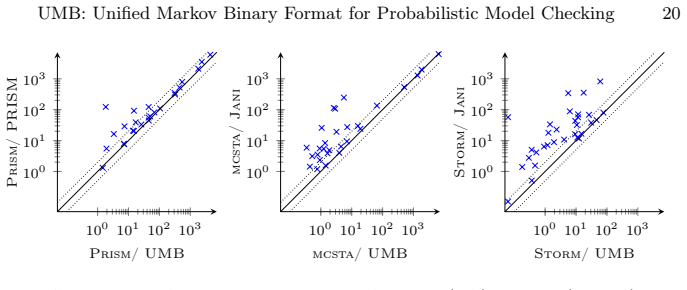
This paper presents the unified Markov binary (UMB) format, an efficient, extensible, and well-supported explicit-state file format for representing a wide range of probabilistic systems. UMB addresses the problem that, while probabilistic model checking tools often support common high-level modelling languages, there is no effective mechanism for exchanging low-level model representations. In practice, textual, tool-specific formats are used, hampering interoperability and resulting in large overheads in writing and reading model files. UMB provides a clean, unified, and efficient solution, based on a general underlying mathematical model, and encoded using a small set of bit-level primitive data structures. The format has already been adopted by prominent tools and comes with a convenient Python library for reading, manipulating, creating, and validating models, plus infrastructure for cross-tool installation and continuous validation. We report on both the efficiency of the file format and the new practical use cases that it facilitates.
Editorial analysis
A structured set of objections, weighed in public.
Referee Report
Summary. The paper presents the Unified Markov Binary (UMB) format, a binary explicit-state file format for a wide range of probabilistic models (DTMCs, CTMCs, MDPs, parametric). It claims to solve interoperability problems caused by tool-specific textual formats by providing an efficient, extensible representation based on a general underlying mathematical model encoded with a small set of bit-level primitive data structures. The work reports adoption by prominent tools, a supporting Python library for reading/manipulating/validating models, and infrastructure for cross-tool use, along with efficiency results and new practical use cases.
Significance. If the format achieves its claimed generality and efficiency without loss of expressiveness or performance for the full range of models, it would reduce I/O overhead in probabilistic model checking workflows and enable standardized model exchange across tools.
major comments (2)
- [Abstract] Abstract and evaluation sections: the central claims of efficiency, extensibility, and successful representation of the full range of probabilistic systems (including parametric and continuous-time models) are asserted without quantitative benchmarks, error measurements, file-size comparisons, or I/O timing data against existing tool-specific formats; this evidence is load-bearing for the efficiency and adoption claims.
- [Encoding and model mapping sections] Sections describing the bit-level encoding and mathematical model mapping: the paper does not detail how transition probabilities/rates are stored (e.g., IEEE floats vs. fixed-width rationals) or how parametric/symbolic parameters and unbounded rates are handled within the claimed small set of primitives; if additional structures are required, this undermines the 'small set' and 'no significant loss of expressiveness' assertions.
minor comments (1)
- The Python library and validation infrastructure are described at a high level; concrete usage examples or API signatures would improve clarity for readers intending to adopt the format.
Simulated Author's Rebuttal
We thank the referee for the constructive feedback. We address each major comment below, indicating revisions where appropriate to strengthen the manuscript.
read point-by-point responses
-
Referee: [Abstract] Abstract and evaluation sections: the central claims of efficiency, extensibility, and successful representation of the full range of probabilistic systems (including parametric and continuous-time models) are asserted without quantitative benchmarks, error measurements, file-size comparisons, or I/O timing data against existing tool-specific formats; this evidence is load-bearing for the efficiency and adoption claims.
Authors: The evaluation section does report efficiency results and new use cases enabled by UMB, consistent with the abstract summary. We agree, however, that the presentation would be strengthened by additional explicit quantitative data such as direct file-size and I/O timing comparisons against tool-specific formats. We will revise the evaluation section to include these benchmarks. revision: yes
-
Referee: [Encoding and model mapping sections] Sections describing the bit-level encoding and mathematical model mapping: the paper does not detail how transition probabilities/rates are stored (e.g., IEEE floats vs. fixed-width rationals) or how parametric/symbolic parameters and unbounded rates are handled within the claimed small set of primitives; if additional structures are required, this undermines the 'small set' and 'no significant loss of expressiveness' assertions.
Authors: The format is built on a small set of bit-level primitives that encode the required data types for probabilities, rates, and parametric models without loss of expressiveness. We will add explicit clarification in the revised encoding and model-mapping sections describing the storage of transition probabilities/rates and the handling of parametric and continuous-time elements. revision: yes
Circularity Check
No circularity: format specification with no derivation chain
full rationale
This paper defines a binary file format (UMB) for exchanging explicit-state probabilistic models. It contains no mathematical derivations, equations, predictions, fitted parameters, or uniqueness theorems. The central claims concern design choices for bit-level primitives, extensibility, and tool adoption; these are presented as engineering decisions rather than results derived from prior self-citations or self-definitional steps. No load-bearing argument reduces to its own inputs by construction. The paper is self-contained as a specification document.
Axiom & Free-Parameter Ledger
Reference graph
Works this paper leans on
-
[1]
In: Beyer, D., Hartmanns, A., Kordon, F
Andriushchenko, R., Bork, A., Budde, C.E., Češka, M., Hahn, E.M., Hartmanns, A., Israelsen, B., Jansen, N., Jeppson, J., Junges, S., Köhl, M.A., Könighofer, B., Křetínský, J., Meggendorfer, T., Parker, D., Pranger, S., Quatmann, T., Ruijters, E., Taylor, L., Volk, M., Weininger, M., Zhang, Z.: Tools at the frontiers of quantitative verification: QComp 202...
-
[2]
Andriushchenko, R., Ceska, M., Junges, S., Katoen, J.P., Stupinský, S.: PAYNT: A tool for inductive synthesis of probabilistic programs. In: Silva, A., Leino, K.R.M. (eds.) 33rd International Conference on Computer Aided Verification (CAV 2021). Lecture Notes in Computer Science, vol. 12759, pp. 856–869. Springer (2021). https://doi.org/10.1007/978-3-030-...
-
[3]
Ashok, P., Jackermeier, M., Kretínský, J., Weinhuber, C., Weininger, M., Yadav, M.: dtControl 2.0: Explainable strategy representation via decision tree learning steered by experts. In: Groote, J.F., Larsen, K.G. (eds.) 27th International Conference on Tools and Algorithms for the Construction and Analysis of Systems (TACAS 2021). Lecture Notes in Compute...
-
[4]
In: Bouajjani, A., Holík, L., Wu, Z
Azeem, M., Evangelidis, A., Kretínský, J., Slivinskiy, A., Weininger, M.: Optimistic and topological value iteration for simple stochastic games. In: Bouajjani, A., Holík, L., Wu, Z. (eds.) 20th International Symposium on Automated Technology for Veri- fication and Analysis (ATVA 2022). Lecture Notes in Computer Science, vol. 13505, pp. 285–302. Springer ...
-
[5]
In: Clarke, E.M., Henzinger, T.A., Veith, H., Bloem, R
Baier, C., de Alfaro, L., Forejt, V., Kwiatkowska, M.: Model checking probabilistic systems. In: Clarke, E.M., Henzinger, T.A., Veith, H., Bloem, R. (eds.) Handbook UMB: Unified Markov Binary Format for Probabilistic Model Checking 12 of Model Checking, pp. 963–999. Springer (2018).https://doi.org/10.1007/ 978-3-319-10575-8_28
2018
-
[6]
MIT Press (2008)
Baier, C., Katoen, J.P.: Principles of model checking. MIT Press (2008)
2008
-
[7]
Beyer, D., Kanav, S., Kleinert, T., Richter, C.: Construction of verifier combinations from off-the-shelf components. Formal Methods Syst. Des.66(1), 99–130 (2025). https://doi.org/10.1007/S10703-024-00449-Y
-
[8]
Bohnenkamp, H.C., D’Argenio, P.R., Hermanns, H., Katoen, J.P.: MoDeST: A compositional modeling formalism for hard and softly timed systems. IEEE Trans. Software Eng.32(10), 812–830 (2006).https://doi.org/10.1109/TSE.2006.104
-
[9]
Budde, C.E., Dehnert, C., Hahn, E.M., Hartmanns, A., Junges, S., Turrini, A.: JANI: quantitative model and tool interaction. In: Legay, A., Margaria, T. (eds.) 23rd International Conference on Tools and Algorithms for the Construction and Analysis of Systems (TACAS 2017). Lecture Notes in Computer Science, vol. 10206, pp. 151–168 (2017).https://doi.org/10...
-
[10]
Budde, C.E., Hartmanns, A., Klauck, M., Kretínský, J., Parker, D., Quatmann, T., Turrini, A., Zhang, Z.: On correctness, precision, and performance in quantitative verification - QComp 2020 competition report. In: Margaria, T., Steffen, B. (eds.) 9th International Symposium on Leveraging Applications of Formal Methods, Verifi- cation and Validation (ISoLA...
-
[11]
Butkova, Y., Fox, G.: Optimal time-bounded reachability analysis for concurrent systems. In: Vojnar, T., Zhang, L. (eds.) 25th International Conference on Tools and Algorithms for the Construction and Analysis of Systems (TACAS 2019). Lecture Notes in Computer Science, vol. 11428, pp. 191–208. Springer (2019). https://doi.org/10.1007/978-3-030-17465-1_11
-
[12]
Butkova, Y., Hartmanns, A., Hermanns, H.: A Modest approach to Markov au- tomata. ACM Trans. Model. Comput. Simul.31(3), 14:1–14:34 (2021).https: //doi.org/10.1145/3449355
-
[13]
In: Finkbeiner, B., Pu, G., Zhang, L
Butkova, Y., Hatefi, H., Hermanns, H., Krcál, J.: Optimal continuous time Markov decisions. In: Finkbeiner, B., Pu, G., Zhang, L. (eds.) 13th International Symposium on Automated Technology for Verification and Analysis (ATVA 2015). Lecture Notes in Computer Science, vol. 9364, pp. 166–182. Springer (2015).https://doi. org/10.1007/978-3-319-24953-7_12
-
[14]
Condon, A.: The complexity of stochastic games. Inf. Comput.96(2), 203–224 (1992).https://doi.org/10.1016/0890-5401(92)90048-K
-
[15]
David, A., Jensen, P.G., Larsen, K.G., Mikucionis, M., Taankvist, J.H.: Uppaal Stratego. In: Baier, C., Tinelli, C. (eds.) 21st International Conference on Tools and Algorithms for the Construction and Analysis of Systems (TACAS 2015). Lecture Notes in Computer Science, vol. 9035, pp. 206–211. Springer (2015).https: //doi.org/10.1007/978-3-662-46681-0_16
-
[16]
In: 25th Annual IEEE Symposium on Logic in Computer Science (LICS 2010)
Eisentraut, C., Hermanns, H., Zhang, L.: On probabilistic automata in continuous time. In: 25th Annual IEEE Symposium on Logic in Computer Science (LICS 2010). pp. 342–351. IEEE Computer Society (2010).https://doi.org/10.1109/ LICS.2010.41
2010
-
[17]
In: Dutle, A., Muñoz, C.A., Narkawicz, A
Fehnker, A., Chaudhary, K.: Twenty percent and a few days – optimising a Bitcoin majority attack. In: Dutle, A., Muñoz, C.A., Narkawicz, A. (eds.) 10th International NASA Formal Methods Symposium (NFM 2018). Lecture Notes in Computer Science, vol. 10811, pp. 157–163. Springer (2018).https://doi.org/10.1007/ 978-3-319-77935-5_11 UMB: Unified Markov Binary ...
2018
-
[18]
Garavel, H., Lang, F., Mateescu, R., Serwe, W.: CADP 2011: a toolbox for the construction and analysis of distributed processes. Int. J. Softw. Tools Technol. Transf.15(2), 89–107 (2013).https://doi.org/10.1007/S10009-012-0244-Z
-
[19]
Givan, R., Leach, S.M., Dean, T.L.: Bounded-parameter Markov decision processes. Artif. Intell.122(1-2), 71–109 (2000).https://doi.org/10.1016/S0004-3702(00) 00047-3
-
[20]
Gros, T.P., Hermanns, H., Hoffmann, J., Klauck, M., Steinmetz, M.: Deep statistical model checking. In: Gotsman, A., Sokolova, A. (eds.) 40th IFIP WG 6.1 Inter- national Conference on Formal Techniques for Distributed Objects, Components, and Systems (FORTE 2020). Lecture Notes in Computer Science, vol. 12136, pp. 96–114. Springer (2020).https://doi.org/1...
-
[21]
In: Goodloe, A., Person, S
Guck, D., Han, T., Katoen, J.P., Neuhäußer, M.R.: Quantitative timed analy- sis of interactive Markov chains. In: Goodloe, A., Person, S. (eds.) 4th Interna- tional NASA Formal Methods Symposium (NFM 2012). Lecture Notes in Com- puter Science, vol. 7226, pp. 8–23. Springer (2012).https://doi.org/10.1007/ 978-3-642-28891-3_4
2012
-
[22]
Hahn, E.M., Hartmanns, A., Hensel, C., Klauck, M., Klein, J., Kretínský, J., Parker, D., Quatmann, T., Ruijters, E., Steinmetz, M.: The 2019 comparison of tools for the analysis of quantitative formal models - (QComp 2019 competition report). In: Vojnar, T., Zhang, L. (eds.) 25th International Conference on Tools and Algorithms for the Construction and An...
-
[23]
Hahn, E.M., Hartmanns, A., Hermanns, H., Katoen, J.P.: A compositional modelling and analysis framework for stochastic hybrid systems. Formal Methods Syst. Des. 43(2), 191–232 (2013).https://doi.org/10.1007/S10703-012-0167-Z
-
[24]
Hartmanns, A., Hermanns, H.: The Modest Toolset: An integrated environment for quantitative modelling and verification. In: Ábrahám, E., Havelund, K. (eds.) 20th International Conference on Tools and Algorithms for the Construction and Analysis of Systems (TACAS 2014). LNCS, vol. 8413, pp. 593–598. Springer (2014). https://doi.org/10.1007/978-3-642-54862-8_51
-
[25]
In: Finkbeiner, B., Pu, G., Zhang, L
Hartmanns, A., Hermanns, H.: Explicit model checking of very large MDP using partitioning and secondary storage. In: Finkbeiner, B., Pu, G., Zhang, L. (eds.) 13th International Symposium on Automated Technology for Verification and Analysis (ATVA 2015). Lecture Notes in Computer Science, vol. 9364, pp. 131–147. Springer (2015).https://doi.org/10.1007/978-...
-
[26]
In: Krötzsch, M., Stepanova, D
Hartmanns, A., Hermanns, H.: A Modest Markov automata tutorial. In: Krötzsch, M., Stepanova, D. (eds.) Reasoning Web – 15th International Summer School 2019, Tutorial Lectures. Lecture Notes in Computer Science, vol. 11810, pp. 250–276. Springer (2019).https://doi.org/10.1007/978-3-030-31423-1_8
-
[27]
Hartmanns, A., Junges, S., Quatmann, T., Weininger, M.: The revised practitioner’s guide to MDP model checking algorithms. Int. J. Softw. Tools Technol. Transf. (2026).https://doi.org/10.1007/s10009-026-00848-y
-
[28]
Hartmanns, A., Klauck, M., Parker, D., Quatmann, T., Ruijters, E.: The quantita- tive verification benchmark set. In: Vojnar, T., Zhang, L. (eds.) 25th International Conference on Tools and Algorithms for the Construction and Analysis of Sys- tems (TACAS 2019). Lecture Notes in Computer Science, vol. 11427, pp. 344–350. Springer (2019).https://doi.org/10....
-
[29]
Hensel, C.: The probabilistic model checker Storm: symbolic methods for proba- bilistic model checking. Ph.D. thesis, RWTH Aachen University, Germany (2018), http://publications.rwth-aachen.de/record/752011 UMB: Unified Markov Binary Format for Probabilistic Model Checking 14
2018
-
[30]
Hensel, C., Junges, S., Katoen, J.P., Quatmann, T., Volk, M.: The probabilistic model checker Storm. Int. J. Softw. Tools Technol. Transf.24(4), 589–610 (2022). https://doi.org/10.1007/S10009-021-00633-Z
-
[31]
In: Kiyavash, N., Mooij, J.M
Ho, Q.H., Feather, M.S., Rossi, F., Sunberg, Z., Lahijanian, M.: Sound heuristic search value iteration for undiscounted POMDPs with reachability objectives. In: Kiyavash, N., Mooij, J.M. (eds.) 40th Conference on Uncertainty in Artificial Intelligence (UAI 2024). Proceedings of Machine Learning Research, vol. 244, pp. 1681–1697. PMLR (2024),https://proce...
2024
-
[32]
Jeppson, J., Volk, M., Israelsen, B., Roberts, R., Williams, A., Buecherl, L., Myers, C.J., Zheng, H., Winstead, C., Zhang, Z.: STAMINA in C++: modernizing an infinite-state probabilistic model checker. In: Jansen, N., Tribastone, M. (eds.) 20th International Conference on Quantitative Evaluation of Systems (QEST 2023). Lecture Notes in Computer Science, ...
-
[33]
Johannsen, C., Nukala, K., Dureja, R., Irfan, A., Shankar, N., Tinelli, C., Vardi, M.Y., Rozier, K.Y.: The MoXI model exchange tool suite. In: Gurfinkel, A., Ganesh, V. (eds.) 36th International Conference on Computer Aided Verification (CAV 2024). Lecture Notes in Computer Science, vol. 14681, pp. 203–218. Springer (2024). https://doi.org/10.1007/978-3-0...
-
[34]
Kaelbling, L.P., Littman, M.L., Cassandra, A.R.: Planning and acting in partially observable stochastic domains. Artif. Intell.101(1-2), 99–134 (1998).https://doi. org/10.1016/S0004-3702(98)00023-X
-
[35]
In: Bertrand, N., Dubslaff, C., Klüppelholz, S
Kwiatkowska, M., Norman, G., Parker, D.: Probabilistic model checking: Applica- tions and trends. In: Bertrand, N., Dubslaff, C., Klüppelholz, S. (eds.) Principles of Formal Quantitative Analysis. Lecture Notes in Computer Science, vol. 15760, pp. 158–173. Springer (2025).https://doi.org/10.1007/978-3-031-97439-7_7
-
[36]
In: Gopalakrishnan, G., Qadeer, S
Kwiatkowska, M.Z., Norman, G., Parker, D.: PRISM 4.0: Verification of prob- abilistic real-time systems. In: Gopalakrishnan, G., Qadeer, S. (eds.) 23rd In- ternational Conference on Computer Aided Verification (CAV 2011). Lecture Notes in Computer Science, vol. 6806, pp. 585–591. Springer (2011). https: //doi.org/10.1007/978-3-642-22110-1_47
-
[37]
Kwiatkowska, M.Z., Norman, G., Segala, R., Sproston, J.: Automatic verification of real-time systems with discrete probability distributions. Theor. Comput. Sci. 282(1), 101–150 (2002).https://doi.org/10.1016/S0304-3975(01)00046-9
-
[38]
Leerkes, P., Melse, I., Heck, L., Volk, M., Junges, S.: Stormvogel: Probabilistic model checking for almost everyone. Tech. rep., Radboud University Nijmegen (2025),https://hdl.handle.net/2066/325553
2025
-
[39]
Meggendorfer, T., Weininger, M.: Playing games with your PET: extending the partial exploration tool to stochastic games. In: Gurfinkel, A., Ganesh, V. (eds.) 36th International Conference on Computer Aided Verification (CAV 2024). Lecture Notes in Computer Science, vol. 14683, pp. 359–372. Springer (2024).https: //doi.org/10.1007/978-3-031-65633-0_16
-
[40]
prismmodelchecker.org/manual/Appendices/ExplicitModelFiles
PRISM developers: PRISM explicit model format specification, https://www. prismmodelchecker.org/manual/Appendices/ExplicitModelFiles
-
[41]
prismmodelchecker.org/manual/ThePRISMLanguage
PRISM developers: PRISM modelling language documentation, https://www. prismmodelchecker.org/manual/ThePRISMLanguage
-
[42]
Puterman, M.L.: Markov Decision Processes: Discrete Stochastic Dynamic Pro- gramming. Wiley Series in Probability and Statistics, Wiley (1994). https: //doi.org/10.1002/9780470316887
-
[43]
SIAM (2003) UMB: Unified Markov Binary Format for Probabilistic Model Checking 15
Saad, Y.: Iterative Methods for Sparse Linear Systems. SIAM (2003) UMB: Unified Markov Binary Format for Probabilistic Model Checking 15
2003
-
[44]
Shapley, L.S.: Stochastic games. Proceedings of the National Academy of Sciences 39(10), 1095–1100 (1953).https://doi.org/10.1073/pnas.39.10.1095
-
[45]
Storm developers: DRN format description, https://www.stormchecker.org/ documentation/background/drn.html
-
[46]
Waddoups, N., Boe, J., Hartmanns, A., Basu, P., Roy, S., Chakraborty, K., Zhang, Z.: Probabilistic verification for modular network-on-chip systems. In: 27th International Conference on Verification, Model Checking, and Abstract Inter- pretation (VMCAI 2026). Lecture Notes in Computer Science, Springer (2026). https://doi.org/10.1007/978-3-032-15700-3_18 ...
discussion (0)
Sign in with ORCID, Apple, or X to comment. Anyone can read and Pith papers without signing in.