REVIEW 4 major objections 7 minor 61 references
Discourse-Aware Semantic Self-Attention for Narrative Reading Comprehension
T0 review · 4 major / 7 minor · reviewed 2026-08-14 · deepseek-v4-flash
Pith's one-line read Adding discourse and semantic relation labels to self-attention heads improves narrative reading comprehension by up to 3.4 Rouge-L points over the QANet baseline.
desk verdict A well-motivated architecture for injecting discourse annotations into self-attention, but the headline Rouge-L gain rests on unsupported single runs and hand-selected configurations. read the letter →
The pith
A machine-rendered reading of the paper's core claim, the machinery that carries it, and where it could break.
The reading
What carries the argument
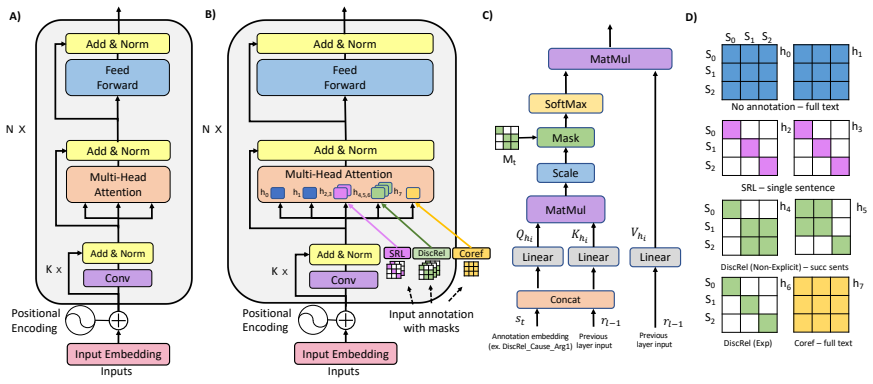
The central object is the Discourse-Aware Semantic Self-Attention (DASSA) encoder block, a modification of the standard transformer encoder block. Each attention head is augmented with two inputs: an embedding vector for the linguistic annotation type (e.g., 'SRL Arg1', 'DiscRel Cause.Reason Arg2', or a coreference-cluster label) concatenated to the query and key inputs, and a symmetric attention-scope mask $M_t$ that restricts which tokens the head may attend to (one sentence for SRL; two neighboring sentences for non-explicit discourse relations; the full context for coreference). This combination encodes relational knowledge as flat token labels plus a scope mask, avoiding the $n^2$ memory cost of explicit graph edge representations and reducing memory to $2 n d_h H$ per head. The mechanism lets the model dedicate some heads to local, discourse-structured reasoning while keeping other heads free for full-context attention.
What would settle it
Train the DASSA model with the same attention-scope masks but with relation labels randomly permuted across tokens; if Rouge-L stays at the reported +3.4 improvement over QANet, the semantic content of the annotations is not what drives the gain. Alternatively, measure the accuracy of the SRL, coreference, and discourse-parsing tools on a sample of NarrativeQA summaries; if accuracy is near chance on the spans that carry the answer, the annotations cannot be supplying the claimed signal.
Extended reading notes
Core claim
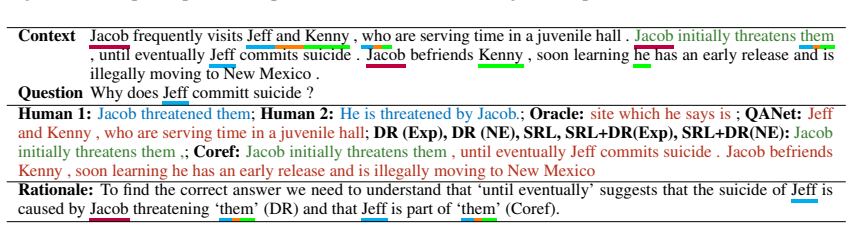
The paper's central discovery is that dedicating self-attention heads to discourse-semantic relations improves answer-span prediction on long narratives. Concretely, replacing standard multi-head self-attention in QANet's modeling layer with Discourse-Aware Semantic Self-Attention — where each head focuses on a specific relation type, such as an SRL argument role, a PDTB-style discourse relation, or a coreference cluster — yields up to +3.4 Rouge-L on the NarrativeQA test set. The authors find that the strongest and most consistent gains come from explicit discourse relations that hold within a sentence, followed by semantic role relations within a sentence, and that long-distance coreference relations help in mid-length contexts. They also show improvements on nearly all question types and across context lengths, with particularly large gains on 'when' and 'how' questions.
Load-bearing premise
The automatically generated discourse, semantic-role, and coreference annotations are accurate enough on narrative stories to provide useful training signal, but the paper reports no annotation accuracy or error analysis, so the observed gains could in principle come from the attention-scope masks rather than the semantic content.
Editorial extensions
If this is right
- A reading-comprehension system can gain up to +3.4 Rouge-L over the plain QANet baseline by adding discourse-semantic annotations to self-attention heads, without changing the underlying training objective.
- Intra-sentential explicit discourse relations and sentence-internal semantic role relations deliver the most consistent gains, suggesting that local, relation-structured attention is especially useful for narrative question answering.
- Long-distance coreference relations improve performance mainly in mid-sized contexts, and almost all annotation combinations improve 'when' questions over the baseline.
- Because the DASSA block is used only in selected encoder layers and adds only small label-embedding and mask computations, the approach scales to long contexts without significant extra memory.
Reading between the lines
- The attention-scope masks alone, independent of the relation labels, may account for part of the reported gains; a natural control experiment would replace the sense labels with random labels while keeping the same masks and measure whether the improvement persists.
- The approach suggests a cheap way to inject structured knowledge into existing transformer checkpoints: instead of retraining with multi-task objectives, one could annotate the input offline and bias attention heads, potentially transferring to other long-document tasks such as summarization or story generation.
- The paper's finding that specific question types benefit from specific annotations points to a testable extension: dynamically selecting which annotation types to activate per question, for example routing 'why' questions toward discourse-relation heads, could improve the fine-grained results further.
- The authors' oracle answer-mapping procedure, which uses Rouge-L to select training spans, is itself an upper-bound choice; if that selection were biased toward spans that happen to align with SRL or discourse annotations, some of the training-signal gain could be an artifact of the oracle rather than of the model, and this is worth testing.
Signed reviews
Editorial analysis
A structured set of objections, weighed in public.
Referee Report
Summary. The paper proposes Discourse-Aware Semantic Self-Attention (DASSA), an extension of the QANet self-attention encoder for reading comprehension. The model augments selected self-attention heads with linguistic annotation types: semantic role labeling (SRL), coreference clusters, and shallow discourse relations (explicit and non-explicit). The annotations are provided as token-level label embeddings plus attention scope masks. The authors evaluate on the NarrativeQA summary setting, using a span-extraction formulation with their own Rouge-L-based oracle. They report up to +3.4 Rouge-L improvement over a QANet baseline and present fine-grained results by question type and context length, claiming that intra-sentential (explicit) discourse relations, SRL, and long-distance coreference are most beneficial.
Significance. If the central empirical claim is reliable, this is a useful contribution: it is one of the first attempts to inject discourse-level information into a self-attention reading-comprehension model, and the proposed mechanism is lightweight, adding only label embeddings and attention masks without increasing computational complexity. The paper is also transparent in describing its oracle construction, the annotation tools, and the head-allocation configurations, and it includes control conditions (NoSense, Sent span 3) that attempt to separate the contribution of sense labels from raw attention scope. However, the headline result rests on single runs with no variance estimates or significance testing, and the control comparisons are not statistically supported, so the empirical case is not yet convincing enough to support the paper's central claim as stated. The code-release commitment and the fine-grained evaluation are strengths, but they do not by themselves fix the statistical weakness of the main comparison.
major comments (4)
- [Section 6 and Figure 4] All reported results are single test-set runs, with no confidence intervals, significance tests, or repeated-run variance. The conclusion in Section 7 states that DASSA 'yields significant (+3.43 Rouge-L) improvement', but 'significant' is used in the everyday sense and is not backed by any statistical procedure. Since the 10.5k test questions are clustered within 355 documents, a paired test or bootstrap by document would be feasible and appropriate. The absence of such support is load-bearing because the central claim is precisely that the observed gain is real and attributable to the annotations.
- [Section 6.2, Figure 4] The control conditions 'DR (Exp NoSense)', 'DR (NonE NoSense)', and 'Sent span 3' are intended to isolate the effect of sense labels from attention scope. For example, DR (Exp) shows +3.43 while DR (Exp NoSense) shows +1.34. With single runs, it is impossible to know whether this gap is signal or noise, especially given that roughly fifteen configurations are compared and the best performer is highlighted. The paper should provide variance estimates or a proper multiple-comparison-aware analysis before concluding that semantic content, rather than the attention mask alone, drives the improvement.
- [Section 4 and Table 1] The oracle used for training supervision, 'Oracle (Ours)', reaches 70.82 Rouge-L, whereas the original 'Oracle (original)' from Kocisky et al. reaches 59.92. This means the QANet and DASSA results are not directly comparable to previously published NarrativeQA systems (e.g., RMR, DecaProp) that likely used the original oracle or a different span-mapping procedure. The absolute positions in Table 1 should be interpreted with this caveat, and the paper should either re-run previous systems under the same oracle or explicitly refrain from claiming that the proposed model outperforms prior work.
- [Section 2] The paper does not report any accuracy or error analysis for the three automatic annotation tools (SRL from He et al., neuralcoref, and the discourse parser of Mihaylov and Frank) on narrative text. Since the entire method depends on these annotations being accurate enough to provide useful training signal, the lack of any annotation-quality evaluation leaves open the possibility that the gains come from the attention scope masks or from annotation noise rather than from the intended semantic relations. At minimum, a sample-based accuracy estimate or a comparison with gold annotations for a subset would strengthen the interpretation.
minor comments (7)
- [Abstract and throughout] The metric name appears both as 'Rouge-L' and 'Rouge-L'; the standard spelling is ROUGE-L and should be used consistently.
- [Section 3.2, Eq. (1)] The notation 'mask softmax(..., M_t)' is not defined precisely; please specify whether the mask is added to the logits before softmax or applied multiplicatively after softmax, and how the mask values are normalized.
- [Section 6.2, Figure 4] The 'Sent span 3' configuration is described only in prose; please specify in the text or a caption how Sent1/Sent2/Sent3 labels are assigned and why this serves as a control for attention scope.
- [Section 6.1, Table 1] The 'DR (Exp) EMA' row is not explained beyond 'EMA is Exponential Moving Average'; please provide the EMA decay schedule or cite the reference for this training technique.
- [Section 4] There is a typo: 'devided' should be 'divided'.
- [Section 5, related work] Khashabi et al. 2018 appears as both '2018a' and '2018b' in the text and references, but the entries appear to refer to the same work; please consolidate.
- [Section 6.2, Figure 5] The claim that 'all models show improvement over length 800-1000' is based on a single run per model; please temper the wording until variance is reported.
Circularity Check
No circular dependence found: the +3.4 Rouge-L gain is an empirical outcome, not a re-derivation of the annotation inputs.
full rationale
The paper's derivation chain is empirical rather than analytic: discourse-semantic annotations are injected as additional attention-head inputs and masks, and the claimed improvement over QANet is measured on the NarrativeQA test set. No equation in the paper reconstructs the reported Rouge-L score from the annotation types, and no fitted parameter is later renamed as a prediction. The nearest self-citation is in Section 2: "we use the discourse relation sense disambiguation system from Mihaylov and Frank (2016) which is trained on the data provided by the CoNLL Shared Task on Shallow Discourse Parsing (Xue et al., 2016)." That parser is an off-the-shelf tool trained on an external shared task, not fitted to NarrativeQA or to the proposed DASSA objective, so the citation is not load-bearing in a circular sense. The custom "Oracle (ours)" answer-span retrieval based on Rouge-L is applied identically to the QANet baseline and to all enhanced configurations, so it cannot by construction force the relative gain attributed to discourse-semantic annotations. The paper does not present a formal derivation of the +3.4 Rouge-L improvement from its inputs; it reports single-run test-set results. Concerns about statistical significance, multiple comparisons, and the absence of confidence intervals are validity risks rather than evidence of circularity, and they do not change the fact that the central claim is an empirical comparison rather than a self-referential construction. Accordingly, no circular step is present.
Assumptions & free parameters
free parameters (4)
- attention head allocation =
varies per config, e.g., 3 SRL, 2 DR (Exp), 3 No heads
- label embedding size =
16
- DASSA encoder blocks =
blocks 1, 3, 5
- oracle tie-breaking window size =
15 tokens
assumptions (3)
- domain assumption The annotation tools (SRL, coreference, discourse parser) are accurate enough to provide useful signal for question answering.
- domain assumption The Rouge-L based answer span oracle produces valid training targets for span prediction.
- domain assumption Self-attention heads can learn to use token-level annotation embeddings and attention masks effectively.
Cite this review
Pith. "Pith review of Discourse-Aware Semantic Self-Attention for Narrative Reading Comprehension." pith.science (2026). https://pith.science/paper/ENJGIFEP
@misc{pith2026190810721,
  author       = {Pith},
  title        = {Pith review of: Discourse-Aware Semantic Self-Attention for Narrative Reading Comprehension},
  year         = {2026},
  howpublished = {\url{https://pith.science/paper/ENJGIFEP}},
  note         = {Machine review of arXiv:1908.10721}
}
read the original abstract
In this work, we propose to use linguistic annotations as a basis for a \textit{Discourse-Aware Semantic Self-Attention} encoder that we employ for reading comprehension on long narrative texts. We extract relations between discourse units, events and their arguments as well as coreferring mentions, using available annotation tools. Our empirical evaluation shows that the investigated structures improve the overall performance, especially intra-sentential and cross-sentential discourse relations, sentence-internal semantic role relations, and long-distance coreference relations. We show that dedicating self-attention heads to intra-sentential relations and relations connecting neighboring sentences is beneficial for finding answers to questions in longer contexts. Our findings encourage the use of discourse-semantic annotations to enhance the generalization capacity of self-attention models for reading comprehension.
Figures


Figures from the paper (5 more)



Reference graph
Works this paper leans on
-
[1]
URL: " 'urlintro :=
ENTRY address author booktitle chapter edition editor howpublished institution journal key month note number organization pages publisher school series title type volume year eprint doi pubmed url lastchecked label extra.label sort.label short.list INTEGERS output.state before.all mid.sentence after.sentence after.block STRINGS urlintro eprinturl eprintpr...
-
[2]
write newline
" write newline "" before.all 'output.state := FUNCTION n.dashify 't := "" t empty not t #1 #1 substring "-" = t #1 #2 substring "--" = not "--" * t #2 global.max substring 't := t #1 #1 substring "-" = "-" * t #2 global.max substring 't := while if t #1 #1 substring * t #2 global.max substring 't := if while FUNCTION word.in bbl.in capitalize " " * FUNCT...
-
[3]
Lisa Bauer, Yicheng Wang, and Mohit Bansal. 2018. https://doi.org/10.18653/v1/D18-1454 Commonsense for generative multi-hop question answering tasks . In Proceedings of the 2018 Conference on Empirical Methods in Natural Language Processing, pages 4220--4230, Brussels, Belgium
-
[4]
Danqi Chen, Jason Bolton, and Christopher D. Manning. 2016. http://www.aclweb.org/anthology/P16-1223 A thorough examination of the cnn/daily mail reading comprehension task . In Proceedings of the 54th Annual Meeting of the Association for Computational Linguistics, pages 2358--2367, Berlin, Germany
work page 2016
-
[5]
Danqi Chen, Adam Fisch, Jason Weston, and Antoine Bordes. 2017. https://doi.org/10.18653/v1/P17-1171 Reading W ikipedia to answer open-domain questions . In Proceedings of the 55th Annual Meeting of the Association for Computational Linguistics, pages 1870--1879, Vancouver, Canada
-
[6]
Fran c ois Chollet. 2016. http://arxiv.org/abs/1610.02357 Xception: Deep learning with depthwise separable convolutions . CoRR, abs/1610.02357
arXiv 2016
-
[7]
Zihang Dai, Zhilin Yang, Yiming Yang, Jaime Carbonell, Quoc Le, and Ruslan Salakhutdinov. 2019. https://www.aclweb.org/anthology/P19-1285 Transformer- XL : Attentive language models beyond a fixed-length context . In Proceedings of the 57th Annual Meeting of the Association for Computational Linguistics, pages 2978--2988, Florence, Italy
work page 2019
-
[8]
Rajarshi Das, Manzil Zaheer, Siva Reddy, and Andrew McCallum. 2017. https://doi.org/10.18653/v1/P17-2057 Question answering on knowledge bases and text using universal schema and memory networks . In Proceedings of the 55th Annual Meeting of the Association for Computational Linguistics (Volume 2: Short Papers), pages 358--365
Show all 61 references
-
[9]
Nicola De Cao, Wilker Aziz, and Ivan Titov. 2019. https://doi.org/10.18653/v1/N19-1240 Question answering by reasoning across documents with graph convolutional networks . In Proceedings of the 2019 Conference of the North A merican Chapter of the Association for Computational...
2019 doi
-
[10]
Jacob Devlin, Ming-Wei Chang, Kenton Lee, and Kristina Toutanova. 2019. https://doi.org/10.18653/v1/N19-1423 BERT : Pre-training of deep bidirectional transformers for language understanding . In Proceedings of the 2019 Conference of the North A merican Chapter of the Associat...
2019 doi
-
[11]
Cohen, and Ruslan Salakhutdinov
Bhuwan Dhingra, Zhilin Yang, William W. Cohen, and Ruslan Salakhutdinov. 2017. Linguistic knowledge as memory for recurrent neural networks. volume abs/1703.02620
2017 arXiv
-
[12]
Liu, Matthew Peters, Michael Schmitz, and Luke Zettlemoyer
Matt Gardner, Joel Grus, Mark Neumann, Oyvind Tafjord, Pradeep Dasigi, Nelson F. Liu, Matthew Peters, Michael Schmitz, and Luke Zettlemoyer. 2018. https://doi.org/10.18653/v1/W18-2501 A llen NLP : A deep semantic natural language processing platform . In Proceedings of Worksho...
2018 doi
-
[13]
Luheng He, Kenton Lee, Mike Lewis, and Luke Zettlemoyer. 2017. https://doi.org/10.18653/v1/P17-1044 Deep semantic role labeling: What works and what ' s next . In Proceedings of the 55th Annual Meeting of the Association for Computational Linguistics, pages 473--483, Vancouver, Canada
2017 doi
-
[14]
Karl Moritz Hermann, Tomas Kocisky, Edward Grefenstette, Lasse Espeholt, Will Kay, Mustafa Suleyman, and Phil Blunsom. 2015. Teaching machines to read and comprehend. In C. Cortes, N. D. Lawrence, D. D. Lee, M. Sugiyama, and R. Garnett, editors, Advances in Neural Information ...
2015
-
[15]
Felix Hill, Antoine Bordes, Sumit Chopra, and Jason Weston. 2016. The goldilocks principle: Reading children's books with explicit memory representations. In ICLR
2016
-
[16]
Minghao Hu, Yuxing Peng, Zhen Huang, Xipeng Qiu, Furu Wei, and Ming Zhou. 2018 a . https://doi.org/10.24963/ijcai.2018/570 Reinforced mnemonic reader for machine reading comprehension . In Proceedings of International Joint Conferences on Artificial Intelligence Organization, ...
2018 doi
-
[17]
Minghao Hu, Yuxing Peng, Furu Wei, Zhen Huang, Dongsheng Li, Nan Yang, and Ming Zhou. 2018 b . https://www.aclweb.org/anthology/D18-1232 Attention-guided answer distillation for machine reading comprehension . In Proceedings of the 2018 Conference on Empirical Methods in Natur...
2018
-
[18]
Mandar Joshi, Eunsol Choi, Daniel Weld, and Luke Zettlemoyer. 2017. http://aclweb.org/anthology/P17-1147 Triviaqa: A large scale distantly supervised challenge dataset for reading comprehension . In Proceedings of the 55th Annual Meeting of the Association for Computational Li...
2017
-
[19]
Rudolf Kadlec, Martin Schmid, Ond r ej Bajgar, and Jan Kleindienst. 2016. http://www.aclweb.org/anthology/P16-1086 Text understanding with the attention sum reader network . In Proceedings of the 54th Annual Meeting of the Association for Computational Linguistics (Volume 1: L...
2016
-
[20]
Gomez, and Fran c ois Chollet
Lukasz Kaiser, Aidan N. Gomez, and Fran c ois Chollet. 2017 a . http://arxiv.org/abs/1706.03059 Depthwise separable convolutions for neural machine translation . CoRR, abs/1706.03059
2017 arXiv
-
[21]
Gomez, Noam Shazeer, Ashish Vaswani, Niki Parmar, Llion Jones, and Jakob Uszkoreit
Lukasz Kaiser, Aidan N. Gomez, Noam Shazeer, Ashish Vaswani, Niki Parmar, Llion Jones, and Jakob Uszkoreit. 2017 b . http://arxiv.org/abs/1706.05137 One model to learn them all . CoRR, abs/1706.05137
2017 arXiv
-
[22]
Daniel Khashabi, Tushar Khot, Ashish Sabharwal, and Dan Roth. 2018 a . http://ai2-website.s3.amazonaws.com/publications/2018 \_ aaai \_ semanticilp.pdf Question Answering as Global Reasoning over Semantic Abstractions . In AAAI
2018
-
[23]
Daniel Khashabi, Tushar Khot, Ashutosh Sabharwal, and Dan Roth. 2018 b . Question answering as global reasoning over semantic abstractions. In AAAI
2018
-
[24]
Tushar Khot, Ashish Sabharwal, and Peter Clark. 2017. https://doi.org/10.18653/v1/P17-2049 Answering complex questions using open information extraction . In Proceedings of the 55th Annual Meeting of the Association for Computational Linguistics (Volume 2: Short Papers), pages...
2017 doi
-
[25]
Kingma and Jimmy Lei Ba
Diederik P. Kingma and Jimmy Lei Ba. 2015. Adam: a Method for Stochastic Optimization . International Conference on Learning Representations 2015, pages 1--15
2015
-
[26]
Tomas Kocisky, Jonathan Schwarz, Phil Blunsom, Chris Dyer, Karl Moritz Hermann, Gabor Melis, and Edward Grefenstette. 2018. http://aclweb.org/anthology/Q18-1023 The narrativeqa reading comprehension challenge . Transactions of the Association for Computational Linguistics, 6:317--328
2018
-
[27]
Rik Koncel-Kedziorski, Dhanush Bekal, Yi Luan, Mirella Lapata, and Hannaneh Hajishirzi. 2019. https://doi.org/10.18653/v1/N19-1238 T ext G eneration from K nowledge G raphs with G raph T ransformers . pages 2284--2293
2019 doi
-
[28]
Yuan Li, Xiaodan Liang, Zhiting Hu, Yinbo Chen, and Eric P. Xing. 2019. https://openreview.net/forum?id=HJei-2RcK7 Graph transformer
2019
-
[29]
Chin-Yew Lin. 2004. https://www.aclweb.org/anthology/W04-1013 ROUGE : A package for automatic evaluation of summaries . In Text Summarization Branches Out: Proceedings of the ACL -04 Workshop , pages 74--81, Barcelona, Spain
2004
-
[30]
Inderjeet Mani. 2012. https://doi.org/10.2200/S00459ED1V01Y201212HLT018 Computational Modeling of Narrative , volume 5
2012 doi
-
[31]
Todor Mihaylov and Anette Frank. 2016. Discourse relation sense classification using cross-argument semantic similarity based on word embeddings. In Proceedings of the Twentieth Conference on Computational Natural Language Learning - Shared Task
2016
-
[32]
Todor Mihaylov and Anette Frank. 2018. https://doi.org/10.18653/v1/P18-1076 Knowledgeable reader: Enhancing cloze-style reading comprehension with external commonsense knowledge . In Proceedings of the 56th Annual Meeting of the Association for Computational Linguistics, pages...
2018 doi
-
[33]
Takeshi Onishi, Hai Wang, Mohit Bansal, Kevin Gimpel, and David McAllester. 2016. https://aclweb.org/anthology/D16-1241 Who did what: A large-scale person-centered cloze dataset . In Proceedings of the 2016 Conference on Empirical Methods in Natural Language Processing, pages ...
2016
-
[34]
Simon Ostermann, Ashutosh Modi, Michael Roth, Stefan Thater, and Manfred Pinkal. 2018. http://aclweb.org/anthology/L18-1564 Mcscript: A novel dataset for assessing machine comprehension using script knowledge . In Proceedings of the Eleventh International Conference on Languag...
2018
-
[35]
Martha Palmer, Daniel Gildea, and Paul Kingsbury. 2005. https://doi.org/10.1162/0891201053630264 The proposition bank: An annotated corpus of semantic roles . Computational Linguistics, 31(1):71--106
2005 doi
-
[36]
Matthew Peters, Mark Neumann, Mohit Iyyer, Matt Gardner, Christopher Clark, Kenton Lee, and Luke Zettlemoyer. 2018. https://doi.org/10.18653/v1/N18-1202 Deep contextualized word representations . In Proceedings of the 2018 Conference of the North A merican Chapter of the Assoc...
2018 doi
-
[37]
Rashmi Prasad, Nikhil Dinesh, Alan Lee, Eleni Miltsakaki, Livio Robaldo, Aravind Joshi, and Bonnie Webber. 2008. The P enn D iscourse treebank 2.0. In Proceedings of the Sixth International Conference on Language Resources and Evaluation (LREC-08), Marrakech, Morocco
2008
-
[38]
Alec Radford, Karthik Narasimhan, Tim Salimans, and Ilya Sutskever. 2018 a . https://doi.org/10.1093/aob/mcp031 GPT: Improving Language Understanding by Generative Pre-Training . arXiv, pages 1--12
2018 doi
-
[39]
Alec Radford, Karthik Narasimhan, Tim Salimans, and Ilya Sutskever. 2018 b . Improving Language Understanding by Generative Pre-Training
2018
-
[40]
Alec Radford, Jeff Wu, Rewon Child, David Luan, Dario Amodei, and Ilya Sutskever. 2019. Language models are unsupervised multitask learners
2019
-
[41]
Pranav Rajpurkar, Jian Zhang, Konstantin Lopyrev, and Percy Liang. 2016. https://aclweb.org/anthology/D16-1264 Squad: 100,000+ questions for machine comprehension of text . In Proceedings of the 2016 Conference on Empirical Methods in Natural Language Processing, pages 2383--2...
2016
-
[42]
Burges, and Erin Renshaw
Matthew Richardson, Christopher J.C. Burges, and Erin Renshaw. 2013. http://www.aclweb.org/anthology/D13-1020 MCTest : A challenge dataset for the open-domain machine comprehension of text . In Proceedings of the 2013 Conference on Empirical Methods in Natural Language Process...
2013
-
[43]
Minjoon Seo, Aniruddha Kembhavi, Ali Farhadi, and Hananneh Hajishirzi. 2017. Bi-Directional Attention Flow for Machine Comprehension . In Proceedings of International Conference of Learning Representations 2017, pages 1--12
2017
-
[44]
Peter Shaw, Jakob Uszkoreit, and Ashish Vaswani. 2018. https://doi.org/10.18653/v1/N18-2074 Self-attention with relative position representations . In Proceedings of the 2018 Conference of the North A merican Chapter of the Association for Computational Linguistics: Human Lang...
2018 doi
-
[45]
Linfeng Song, Zhiguo Wang, Mo Yu, Yue Zhang, Radu Florian, and Daniel Gildea. 2018. http://arxiv.org/abs/1809.02040 Exploring Graph-structured Passage Representation for Multi-hop Reading Comprehension with Graph Neural Networks
2018 arXiv
-
[46]
Emma Strubell, Patrick Verga, Daniel Andor, David Weiss, and Andrew McCallum. 2018. http://aclweb.org/anthology/D18-1548 Linguistically-informed self-attention for semantic role labeling . In Proceedings of the 2018 Conference on Empirical Methods in Natural Language Processin...
2018
-
[47]
Haitian Sun, Bhuwan Dhingra, Manzil Zaheer, Kathryn Mazaitis, Ruslan Salakhutdinov, and William Cohen. 2018. http://aclweb.org/anthology/D18-1455 Open domain question answering using early fusion of knowledge bases and text . In Proceedings of the 2018 Conference on Empirical ...
2018
-
[48]
Kai Sun, Dian Yu, Dong Yu, and Claire Cardie. 2019. https://doi.org/10.18653/v1/N19-1270 Improving machine reading comprehension with general reading strategies . In Proceedings of the 2019 Conference of the North A merican Chapter of the Association for Computational Linguist...
2019 doi
-
[49]
Niket Tandon, Bhavana Dalvi, Joel Grus, Wen-tau Yih, Antoine Bosselut, and Peter Clark. 2018. http://aclweb.org/anthology/D18-1006 Reasoning about actions and state changes by injecting commonsense knowledge . In Proceedings of the 2018 Conference on Empirical Methods in Natur...
2018
-
[50]
Yi Tay, Anh Tuan Luu, and Siu Cheung Hui. 2018 a . https://doi.org/10.18653/v1/D18-1238 Multi-granular sequence encoding via dilated compositional units for reading comprehension . In Proceedings of the 2018 Conference on Empirical Methods in Natural Language Processing, pages...
2018 doi
-
[51]
Yi Tay, Luu Anh Tuan, Siu Cheung Hui, and Jian Su. 2018 b . Densely connected attention propagation for reading comprehension. In Proceedings of the 32Nd International Conference on Neural Information Processing Systems, NIPS'18, pages 4911--4922
2018
-
[52]
Gomez, Lukasz Kaiser, and Illia Polosukhin
Ashish Vaswani, Noam Shazeer, Niki Parmar, Jakob Uszkoreit, Llion Jones, Aidan N. Gomez, Lukasz Kaiser, and Illia Polosukhin. 2017. http://arxiv.org/abs/1706.03762 Attention Is All You Need . In Nips
2017 arXiv
-
[53]
Petar Veli c kovi \' c , Guillem Cucurull, Arantxa Casanova, Adriana Romero, Pietro Li \` o , and Yoshua Bengio. 2018. https://openreview.net/forum?id=rJXMpikCZ Graph Attention Networks . International Conference on Learning Representations
2018
-
[54]
Alex Wang, Amanpreet Singh, Julian Michael, Felix Hill, Omer Levy, and Samuel Bowman. 2018 a . http://aclweb.org/anthology/W18-5446 Glue: A multi-task benchmark and analysis platform for natural language understanding . In Proceedings of the 2018 EMNLP Workshop BlackboxNLP: An...
2018
-
[55]
Liang Wang, Meng Sun, Wei Zhao, Kewei Shen, and Jingming Liu. 2018 b . https://doi.org/10.18653/v1/S18-1120 Yuanfudao at semeval-2018 task 11: Three-way attention and relational knowledge for commonsense machine comprehension . In Proceedings of The 12th International Workshop...
2018 doi
-
[56]
Dirk Weissenborn, Tomas Kocisky, and Chris Dyer. 2017 a . http://arxiv.org/abs/1706.02596 Dynamic integration of background knowledge in neural NLU systems . CoRR, abs/1706.02596
2017 arXiv
-
[57]
Dirk Weissenborn, Georg Wiese, and Laura Seiffe. 2017 b . https://doi.org/10.18653/v1/K17-1028 Making neural qa as simple as possible but not simpler . In Proceedings of the 21st Conference on Computational Natural Language Learning (CoNLL 2017), pages 271--280. Association fo...
2017 doi
-
[58]
Kun Xu, Siva Reddy, Yansong Feng, Songfang Huang, and Dongyan Zhao. 2016. https://doi.org/10.18653/v1/P16-1220 Question answering on F reebase via relation extraction and textual evidence . In Proceedings of the 54th Annual Meeting of the Association for Computational Linguist...
2016 doi
-
[59]
Nianwen Xue, Hwee Tou Ng, Sameer Pradhan, Bonnie Webber, Attapol Rutherford, Chuan Wang, and Hongmin Wang. 2016. The conll-2016 shared task on multilingual shallow discourse parsing. In Proceedings of the Twentieth Conference on Computational Natural Language Learning - Shared...
2016
-
[60]
Wen-tau Yih, Matthew Richardson, Chris Meek, Ming-Wei Chang, and Jina Suh. 2016. https://doi.org/10.18653/v1/P16-2033 The value of semantic parse labeling for knowledge base question answering . In Proceedings of the 54th Annual Meeting of the Association for Computational Lin...
2016 doi
-
[61]
Adams Wei Yu, David Dohan, Minh-Thang Luong, Rui Zhao, Kai Chen, Mohammad Norouzi, and Quoc V. Le. 2018. http://arxiv.org/abs/1804.09541 QANet: Combining Local Convolution with Global Self-Attention for Reading Comprehension . In ICLR 2018
2018 arXiv
Reviewed August 14, 2026 · model on record in the stance chip above.
Discussion (0). Continue with ORCID to comment.