REVIEW 3 major objections 5 minor 2 cited by
Reinforced Refinement with Self-Aware Expansion for End-to-End Autonomous Driving
T0 review · 3 major / 5 minor · reviewed 2026-08-07 · deepseek-v4-flash
Pith's one-line read R2SE: a self-aware refinement loop that turns imitation-learned end-to-end driving into a hard-case specialist without forgetting the generalist.
desk verdict Plausible refinement pipeline with strong experiments, but the paper as written inverts its own expansion gate and contains other sign errors, so the executed test-time policy is underspecified. read the letter →
The pith
A machine-rendered reading of the paper's core claim, the machinery that carries it, and where it could break.
The reading
What carries the argument
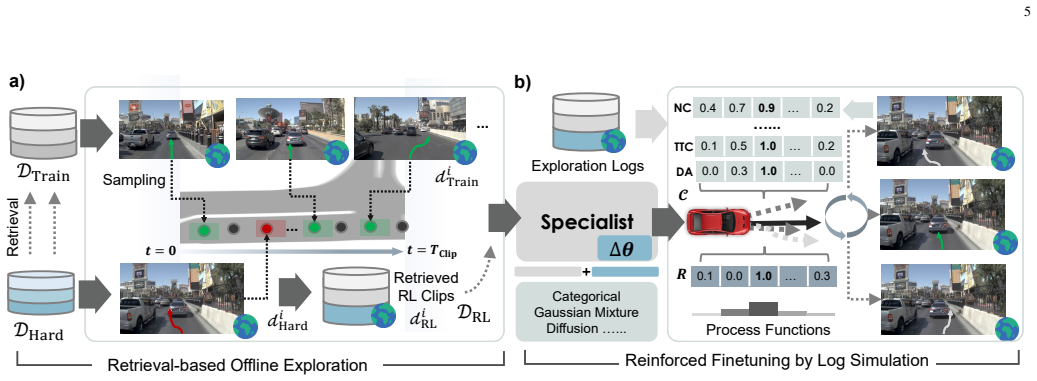
The load-bearing machinery is a three-part closed loop: (1) a difficulty score $F_X$ that fuses the closed-loop PDM Score, normalized perception loss, and SOTIF Shannon entropy to select the hard-case subset $\mathcal{D}_{\text{hard}}$; (2) a residual reinforced specialist composed of $K$ low-rank adapters (LoRA) attached to detached generalist weights, trained by GRPO with a constrained-MDP penalty where rewards and costs derive from non-reactive log simulation; and (3) a self-aware expansion policy that models the specialist's ensemble uncertainty with a Generalized Pareto Distribution (GPD) and activates the specialist only when the GPD cumulative probability exceeds a threshold $\sigma$. The GPD tail model is the piece that lets the system decide when a specialist is confident enough to overrule the generalist, and the adapter ensemble provides the uncertainty estimate for free.
What would settle it
Run the same R2SE-refined policy in a reactive closed-loop simulator (or on a real vehicle) on the navtest scenarios and compare the score gap against the non-reactive PDMS gap: if the refined policy no longer outperforms the baseline, or if the improvement reverses, then the claim that non-reactive PDMS is a faithful training and evaluation signal for hard-case refinement is falsified.
Extended reading notes
Core claim
The key discovery is that hard-case refinement can be decoupled from general-knowledge retention by freezing the pretrained policy and attaching a small ensemble of low-rank adapters that learn only residual corrections. These adapters are trained with a GRPO-based reinforcement learning objective that includes cost constraints, using non-reactive log simulation to provide dense per-step process rewards and costs. At test time, the system fits a Generalized Pareto Distribution to the ensemble uncertainty observed on the hard-case training set and expands the specialist adapter only when the test input falls within that tail; otherwise it reverts to the generalist. This mechanism yields a PDMS of 91.6 on the NAVSIM navtest split (up from 87.0 for the Hydra-MDP baseline), the highest reported driving score and success rate on CARLA Bench2Drive among compared end-to-end systems, and a lower forgetting rate than full fine-tuning, EWC, and dynamic networks.
Load-bearing premise
The whole refinement loop—selecting hard cases, computing rewards and costs, and evaluating success—uses non-reactive log simulation with the PDM Score as a proxy for real closed-loop driving quality, so if that proxy diverges from true on-road safety, the reported gains may not transfer to real vehicles.
Editorial extensions
If this is right
- Any pretrained end-to-end planner, whether categorical, Gaussian-mixture, or diffusion-based, can be refined on hard cases by attaching LoRA ensembles and running the same GRPO-plus-cost loop, since the RL objective reduces to a negative log-likelihood for categorical/GMM policies and to conditional-guidance optimization for diffusion policies.
- The hard-case allocation step means only a small percentage of training data (top 1% by difficulty) drives refinement; the paper shows that roughly 500 hard clips (0.45% of the training set) already produce most of the PDMS gain, so the pipeline is substantially more data-efficient than full RL fine-tuning.
- Forgetting is structurally bounded: generalist weights are detached and adapters are low-rank, so refinement cannot overwrite the pretrained policy, and the GPD gate reverts to the generalist on out-of-tail inputs.
- The same adapter ensemble yields uncertainty estimates that plug into online adaptation schemes, as demonstrated by the paper's R2SE-TTT and R2SE-RS variants, which further improve PDMS beyond the base refinement.
- If the claims hold, the standard practice of fine-tuning an end-to-end driving policy on all available data can be replaced by targeted, logged-only refinement on the few hard cases, which would make continual improvement of deployed systems more practical.
Reading between the lines
- Since non-reactive PDMS is both the training reward and the evaluation metric, the reported gains could partly reflect optimization toward that specific closed-loop proxy; a reactive simulator or real-vehicle test would be needed to confirm that the refinement generalizes to true closed-loop safety.
- The GPD gate depends on a hard-case uncertainty buffer collected offline; under distribution shift beyond that buffer, the gate may silently revert to the generalist, so continual expansion of the hard-case buffer would be needed for long-term deployment.
- The data-efficiency numbers suggest that logged-data-only RL refinement of large end-to-end models is feasible in practice; extending R2SE with generative scene or behavior augmentation, as the paper lists as future work, could remove the residual dependence on having hard clips already present in the log.
- Because the method is architecture-agnostic, it could plausibly be applied to vision-language-model planners or world-model planners that currently address data rarity but not the hard-case underfitting that behavioral cloning leaves unsolved.
Editorial analysis
A structured set of objections, weighed in public.
Referee Report
Summary. The paper proposes R2SE, a model-agnostic pipeline for refining end-to-end autonomous driving policies. A generalist IL policy is first pretrained; hard cases are identified from closed-loop log simulation using PDMS and an entropy-based uncertainty term; LoRA adapter ensembles are fine-tuned on these cases with GRPO under cost constraints; and at test time a GPD-based uncertainty estimate is used to decide whether to "expand" to the specialist adapters or fall back to the generalist. Experiments are reported on the NAVSIM nuPlan leaderboard and on CARLA Bench2Drive, with ablations over refinement components, adapter ranks, hard-case thresholds, expansion distributions, and expansion confidence. The main reported results are a PDMS gain from 87.0 (Hydra-MDP baseline) to 91.6 for R2SE-MDP, and improved driving score / success rate on Bench2Drive relative to several end-to-end baselines.
Significance. If the mechanism were as described in the prose, R2SE would be a useful contribution: the pipeline is model-agnostic, combines IL pretraining with cost-constrained RL fine-tuning, and explicitly targets anti-forgetting via low-rank adapters and uncertainty-gated expansion. The empirical breadth is a strength: two closed-loop benchmarks, multiple base architectures (categorical and diffusion), test-time adaptation variants, and ablations covering the main design choices. However, the formal specification of the core mechanism is internally inconsistent. The expansion gate in Eq. (15) and Algorithm 2 is inverted relative to the prose and to the ablation trend in Table VIII, and Eqs. (1), (3), and (5) contain sign/inequality errors that affect the stated pretraining objective, the difficulty score, and the hard-case selection rule. Because the expansion step is credited with a +1.9 PDMS gain in Table III and with the anti-forgetting behavior, the manuscript does not currently pin down which policy is actually executed at test time. These issues are fixable, but they are load-bearing for the central claim.
major comments (3)
- [§III-C, Eq. (15), Algorithm 2; §IV-C5, Table VIII] The adapter expansion gate is specified with opposite semantics in different places. Eq. (15) uses the specialist when P_GPD(U_test) > σ and the generalist when P_GPD(U_test) ≤ σ, and Algorithm 2 lines 9–12 repeat this. The prose immediately above Eq. (15) states that OOD/high-uncertainty cases should revert to the generalist, with the specialist used only for confident cases. Table VIII reports Expand Rate increasing from 2.09 at σ=0.05 to 82.8 at σ=0.95. Under Eq. (15), increasing σ makes the specialist condition harder to satisfy, so Expand Rate should fall; the observed rise is consistent only with the opposite gate (specialist when P_GPD ≤ σ). Since the expansion component is credited with a +1.9 PDMS gain in Table III (ID-4 vs. ID-0) and with the paper's anti-forgetting claim, the manuscript does not currently specify which policy actually runs at test time. The authors must correct Eq. (15)/Algorithm 2 to match the implemented policy and confirm that the ablation trend in Table VIII is interpreted consistently (a rising Expand Rate cannot simultaneously mean more frequent fallback to the generalist).
- [§III-A1, Eq. (1)] The behavior-cloning term is written as max KL(π_exp∥πθ) = max Σ_M π_exp(X) log(π_exp(X)/πθ(X)). This maximizes the divergence from the expert distribution rather than matching it; the standard BC objective is to minimize KL(π_exp∥πθ), which is equivalent to maximizing E_{π_exp}[log πθ(X)] when the entropy of π_exp is constant. As written, Eq. (1) also has the wrong sign for the stated pretraining objective, since subtracting a positive KL term would reward divergence from the expert. This needs correction because the generalist policy is the foundation on which the specialist fine-tuning and expansion are built.
- [§III-A2, Eqs. (3)–(5)] The difficulty score has sign problems that contradict the stated monotonic relationship with case difficulty. Eq. (3) defines F_Ent(Ŷ) as Σ_m πθ(ŷ_m|X) log πθ(ŷ_m|X), which is the negative of Shannon entropy; with this sign, high planning uncertainty decreases F_X in Eq. (4) and can even make it negative, exactly opposite to the intended "difficulty increases with uncertainty" behavior. In addition, Eq. (5) selects D_hard = {d | F_X ≤ Q_ϵ(F)}, which is the set of lowest-difficulty cases, while the text and implementation (Sec. IV-A3, "99th percentile (ϵ=1)") describe selecting the hardest cases. The authors should either define F as a loss-like quantity consistently or change the inequality in Eq. (5) so that hard-case allocation matches the reported experiments.
minor comments (5)
- [§III-B2, Eq. (10)] The sentence "Following GRPO, we emit the clip term for simplicity, and KL(·||·) term as it already presents in L_pretrain" is unclear: the final objective in Eq. (10) does not show the clip, the KL, or the relative coefficient, so the exact GRPO surrogate used in the experiments is not fully specified.
- [Appendix C, Theorem 1] Theorem 1 states a PAC-Bayes bound for the adapter ensemble, but the proof is not actually supplied; the sentence "This follows directly from the PAC-Bayes bound" is not a derivation. If this theorem is meant to support a formal guarantee, the proof should be included.
- [§IV-A3, Algorithm 1] Algorithm 1 line 22 writes the combined loss as L_RL + α_Pretrain L_Pretrain, but α_Pretrain is not defined in the main text or in Table IX. Please define this coefficient and state its value for each experimental setup.
- [Fig. 5b and §IV-B4] The text states that EWC has overhead "exceeding ×4.1 MFLOPs" while Fig. 5b reports FLOPs values in units of M; please clarify whether the values are mega-FLOPs or relative multipliers, and make the text consistent with the figure.
- [§IV-C5, Table VIII] The column ER is introduced as "Expand Rate" but the surrounding text describes it as a measure of fallback to the generalist. Please define ER explicitly and align the terminology with the gate in Eq. (15).
Circularity Check
PDMS closes the loop from hard-case selection to RL reward to headline metric; the reported nuPlan gains are partly the training objective restated as evaluation, though CARLA provides independent support.
-
fitted input called prediction
[Section III-A2 (Eqs. 2, 4), Section III-B2 (Eq. 10), Section IV-A2 (Eq. 17)]
""While as the final output, planning feedback FPlan( ˆY,X) requires strict quantification using PDMScore (PDMS) [2]"; "Reward and cost terms follow the standardized process supervisions [74] (Fig. 3b) leveraging planning feedback: Rt =1(t=T) γ^{T−t} Fplan( ˆY,X)"; "the planning trajectories from the E2E model are comprehensively evaluated by PDMS"."
Eq. 4 defines case difficulty as F_X = (1 − F_Plan(Ŷ,X)) + ...; Eq. 5 selects D_Hard as hard cases with low F_X, i.e., low PDMS. Eq. 10 then fits the specialist adapters by maximizing R_t = γ^{T−t} F_plan(Ŷ,X) over exactly those D_Hard clips. Section IV-A2 reports success with PDMS, the same scalar. Thus the nuPlan 'hard-case refinement' result is the training reward (and the selection criterion) reported back as the evaluation metric; the specialist is not independently tested on a metric it was not trained to maximize. The reduction is partial, not total: navtest is held out, and CARLA DS/SR and the VAD/TCP transfer tables use different metrics, so the central claim retains independent content.
full rationale
The main circularity concern is the single-scalar loop: PDMS is used to identify hard cases (Eqs. 2 and 4), to select D_Hard (Eq. 5), to define the GRPO reward/cost for fitting specialists (Eq. 10), and to evaluate the headline nuPlan result (Eq. 17). Consequently, the +4.6 PDMS gain over the Hydra-MDP baseline is partly the optimization objective restated as the outcome, rather than an independent confirmation of hard-case generalization. The paper does provide genuine external grounding: Bench2Drive uses the different Driving Score and success rate metrics, and the VAD/TCP transfer results are measured on a different base architecture and scenario suite. These independent results prevent the score from rising to 6 or above. The gate-polarity inconsistency between Eq. 15/Algorithm 2 (specialist when P_GPD > σ) and the prose/Fig. 2 (revert to generalist when uncertain), together with the Expand Rate trend in Table VIII, is a serious internal coherence defect that affects whether the expansion mechanism behaves as claimed; however, an inconsistency is not a circular reduction of a prediction to an input, so it does not add to the circularity score. No load-bearing self-citation chain was found: the NAVSIM PDMS benchmark and the Pickands-Balkema-De Haan theorem are external, machine-independent support, and the cited prior works do not supply the central derivation.
Assumptions & free parameters
free parameters (8)
- beta_Per =
0.1
- beta_Ent =
0.01
- epsilon =
1.00 (top 1%)
- sigma =
0.75
- K =
6
- r =
16
- lambda =
1
- gamma =
0.99
assumptions (6)
- domain assumption Non-reactive NAVSIM log simulation is a faithful proxy for real closed-loop driving quality.
- domain assumption The LoRA ensemble variance in Eq. 16 is a calibrated measure of out-of-distribution uncertainty at test time.
- standard math The Pickands-Balkema-de Haan theorem applies to the uncertainty tail at the chosen threshold.
- standard math The PAC-Bayes bound from Langford and Shawe-Taylor applies to the LoRA ensemble.
- domain assumption The importance sampling ratio IS(X) in Eq. 10 is bounded and valid for the policy ratio.
- ad hoc to paper Increasing the hard-case threshold improves expansion-boundary estimation via the Central Limit Theorem.
Cite this review
Pith. "Pith review of Reinforced Refinement with Self-Aware Expansion for End-to-End Autonomous Driving." pith.science (2026). https://pith.science/paper/ENOVKCSF
@misc{pith2026250609800,
  author       = {Pith},
  title        = {Pith review of: Reinforced Refinement with Self-Aware Expansion for End-to-End Autonomous Driving},
  year         = {2026},
  howpublished = {\url{https://pith.science/paper/ENOVKCSF}},
  note         = {Machine review of arXiv:2506.09800}
}
read the original abstract
End-to-end autonomous driving has emerged as a promising paradigm for directly mapping sensor inputs to planning maneuvers using learning-based modular integrations. However, existing imitation learning (IL)-based models suffer from generalization to hard cases, and a lack of corrective feedback loop under post-deployment. While reinforcement learning (RL) offers a potential solution to tackle hard cases with optimality, it is often hindered by overfitting to specific driving cases, resulting in catastrophic forgetting of generalizable knowledge and sample inefficiency. To overcome these challenges, we propose Reinforced Refinement with Self-aware Expansion (R2SE), a novel learning pipeline that constantly refines hard domain while keeping generalizable driving policy for model-agnostic end-to-end driving systems. Through reinforcement fine-tuning and policy expansion that facilitates continuous improvement, R2SE features three key components: 1) Generalist Pretraining with hard-case allocation trains a generalist imitation learning (IL) driving system while dynamically identifying failure-prone cases for targeted refinement; 2) Residual Reinforced Specialist Fine-tuning optimizes residual corrections using reinforcement learning (RL) to improve performance in hard case domain while preserving global driving knowledge; 3) Self-aware Adapter Expansion dynamically integrates specialist policies back into the generalist model, enhancing continuous performance improvement. Experimental results in closed-loop simulation and real-world datasets demonstrate improvements in generalization, safety, and long-horizon policy robustness over state-of-the-art E2E systems, highlighting the effectiveness of reinforce refinement for scalable autonomous driving.
Figures


Figures from the paper (9 more)


Forward citations
Cited by 2 Pith papers
-
SpaceDrive: Infusing Spatial Awareness into VLM-based Autonomous Driving
SpaceDrive replaces textual coordinate tokens with shared 3D positional encodings in a VLM driving planner, achieving state-of-the-art open-loop planning on nuScenes and 78.02 Driving Score on Bench2Drive.
-
MindDrive: A Vision-Language-Action Model for Autonomous Driving via Online Reinforcement Learning
An autonomous-driving vision-language model that uses online RL over discrete language actions, with a separate action expert mapping decisions to trajectories, reports DS 78.04 and SR 55.09% on Bench2Drive.
Reference graph
Works this paper leans on
-
[1]
DECODE: Domain-aware Continual Domain Expansion for Motion Prediction
B. Li, H. Zhu, and H. X. Liu, “Decode: Domain-aware con- tinual domain expansion for motion prediction,”arXiv preprint arXiv:2411.17917, 2024
work page Pith review arXiv 2024
-
[2]
Navsim: Data- driven non-reactive autonomous vehicle simulation and benchmarking,
D. Dauner, M. Hallgarten, T. Li, X. Weng, Z. Huang, Z. Yang, H. Li, I. Gilitschenski, B. Ivanovic, M. Pavoneet al., “Navsim: Data- driven non-reactive autonomous vehicle simulation and benchmarking,” Advances in Neural Information Processing Systems, vol. 37, pp. 28 706–28 719, 2024
2024
-
[3]
Milestones in autonomous driving and intelligent vehicles: Survey of surveys,
L. Chen, Y . Li, C. Huang, B. Li, Y . Xing, D. Tian, L. Li, Z. Hu, X. Na, Z. Liet al., “Milestones in autonomous driving and intelligent vehicles: Survey of surveys,”IEEE Transactions on Intelligent Vehicles, 2022
2022
-
[4]
End- to-end autonomous driving: Challenges and frontiers,
L. Chen, P. Wu, K. Chitta, B. Jaeger, A. Geiger, and H. Li, “End- to-end autonomous driving: Challenges and frontiers,”arXiv preprint arXiv:2306.16927, 2023
arXiv 2023
-
[5]
A review of mo- tion planning techniques for automated vehicles,
D. González, J. Pérez, V . Milanés, and F. Nashashibi, “A review of mo- tion planning techniques for automated vehicles,”IEEE Transactions on intelligent transportation systems, vol. 17, no. 4, pp. 1135–1145, 2015
2015
-
[6]
Planning-oriented autonomous driving,
Y . Hu, J. Yang, L. Chen, K. Li, C. Sima, X. Zhu, S. Chai, S. Du, T. Lin, W. Wanget al., “Planning-oriented autonomous driving,” in Proceedings of the IEEE/CVF Conference on Computer Vision and Pattern Recognition, 2023, pp. 17 853–17 862
2023
-
[7]
Vad: Vectorized scene representation for efficient autonomous driving,
B. Jiang, S. Chen, Q. Xu, B. Liao, J. Chen, H. Zhou, Q. Zhang, W. Liu, C. Huang, and X. Wang, “Vad: Vectorized scene representation for efficient autonomous driving,”arXiv preprint arXiv:2303.12077, 2023
arXiv 2023
-
[8]
Hybrid- prediction integrated planning for autonomous driving,
H. Liu, Z. Huang, W. Huang, H. Yang, X. Mo, and C. Lv, “Hybrid- prediction integrated planning for autonomous driving,”IEEE Trans- actions on Pattern Analysis and Machine Intelligence, 2025
2025
Show all 104 references
-
[9]
Corner case generation and analysis for safety assessment of autonomous vehicles,
H. Sun, S. Feng, X. Yan, and H. X. Liu, “Corner case generation and analysis for safety assessment of autonomous vehicles,”Transportation research record, vol. 2675, no. 11, pp. 587–600, 2021
2021
-
[10]
Curse of rarity for autonomous vehicles,
H. X. Liu and S. Feng, “Curse of rarity for autonomous vehicles,” nature communications, vol. 15, no. 1, p. 4808, 2024
2024
-
[11]
Dense reinforcement learning for safety validation of autonomous vehicles,
S. Feng, H. Sun, X. Yan, H. Zhu, Z. Zou, S. Shen, and H. X. Liu, “Dense reinforcement learning for safety validation of autonomous vehicles,”Nature, vol. 615, no. 7953, pp. 620–627, 2023
2023
-
[12]
Dy- namically conservative self-driving planner for long-tail cases,
W. Zhou, Z. Cao, N. Deng, X. Liu, K. Jiang, and D. Yang, “Dy- namically conservative self-driving planner for long-tail cases,”IEEE Transactions on Intelligent Transportation Systems, vol. 24, no. 3, pp. 3476–3488, 2022
2022
-
[13]
Towards corner case detection for autonomous driving,
J.-A. Bolte, A. Bar, D. Lipinski, and T. Fingscheidt, “Towards corner case detection for autonomous driving,” in2019 IEEE Intelligent vehicles symposium (IV). IEEE, 2019, pp. 438–445
2019
-
[14]
Gameformer: Game-theoretic modeling and learning of transformer-based interactive prediction and planning for autonomous driving,
Z. Huang, H. Liu, and C. Lv, “Gameformer: Game-theoretic modeling and learning of transformer-based interactive prediction and planning for autonomous driving,”arXiv preprint arXiv:2303.05760, 2023
2023 arXiv
-
[15]
Generalized predictive model for autonomous driving,
J. Yang, S. Gao, Y . Qiu, L. Chen, T. Li, B. Dai, K. Chitta, P. Wu, J. Zeng, P. Luoet al., “Generalized predictive model for autonomous driving,” inProceedings of the IEEE/CVF Conference on Computer Vision and Pattern Recognition, 2024, pp. 14 662–14 672
2024
-
[16]
Vista: A generalizable driving world model with high fidelity and versatile controllability,
S. Gao, J. Yang, L. Chen, K. Chitta, Y . Qiu, A. Geiger, J. Zhang, and H. Li, “Vista: A generalizable driving world model with high fidelity and versatile controllability,”arXiv preprint arXiv:2405.17398, 2024
2024 arXiv
-
[17]
Survey of deep reinforcement learning for motion planning of autonomous vehicles,
S. Aradi, “Survey of deep reinforcement learning for motion planning of autonomous vehicles,”IEEE Transactions on Intelligent Transporta- tion Systems, vol. 23, no. 2, pp. 740–759, 2020
2020
-
[18]
Think2drive: Efficient reinforce- ment learning by thinking with latent world model for autonomous driving (in carla-v2),
Q. Li, X. Jia, S. Wang, and J. Yan, “Think2drive: Efficient reinforce- ment learning by thinking with latent world model for autonomous driving (in carla-v2),” inEuropean Conference on Computer Vision. Springer, 2024, pp. 142–158
2024
-
[19]
Improved deep reinforcement learning with expert demonstrations for urban autonomous driving,
H. Liu, Z. Huang, J. Wu, and C. Lv, “Improved deep reinforcement learning with expert demonstrations for urban autonomous driving,” in2022 IEEE intelligent vehicles symposium (IV). IEEE, 2022, pp. 921–928
2022
-
[20]
Efficient deep reinforcement learning with imitative expert priors for autonomous driving,
Z. Huang, J. Wu, and C. Lv, “Efficient deep reinforcement learning with imitative expert priors for autonomous driving,”IEEE Transactions on Neural Networks and Learning Systems, vol. 34, no. 10, pp. 7391– 7403, 2022
2022
-
[21]
Model-free deep reinforcement learning for urban autonomous driving,
J. Chen, B. Yuan, and M. Tomizuka, “Model-free deep reinforcement learning for urban autonomous driving,” in2019 IEEE intelligent transportation systems conference (ITSC). IEEE, 2019, pp. 2765– 2771
2019
-
[22]
Rad: Training an end-to-end driving policy via large-scale 3dgs-based reinforcement learning,
H. Gao, S. Chen, B. Jiang, B. Liao, Y . Shi, X. Guo, Y . Pu, H. Yin, X. Li, X. Zhanget al., “Rad: Training an end-to-end driving policy via large-scale 3dgs-based reinforcement learning,”arXiv preprint arXiv:2502.13144, 2025
2025
-
[23]
Dtpp: Differentiable joint conditional prediction and cost evalua- tion for tree policy planning in autonomous driving,
Z. Huang, P. Karkus, B. Ivanovic, Y . Chen, M. Pavone, and C. Lv, “Dtpp: Differentiable joint conditional prediction and cost evalua- tion for tree policy planning in autonomous driving,”arXiv preprint arXiv:2310.05885, 2023
2023 arXiv
-
[24]
Diffstack: A differentiable and modular control stack for autonomous vehicles,
P. Karkus, B. Ivanovic, S. Mannor, and M. Pavone, “Diffstack: A differentiable and modular control stack for autonomous vehicles,” in Conference on Robot Learning. PMLR, 2023, pp. 2170–2180
2023
-
[25]
Centaur: Robust end-to-end autonomous driving with test- time training,
C. Sima, K. Chitta, Z. Yu, S. Lan, P. Luo, A. Geiger, H. Li, and J. M. Alvarez, “Centaur: Robust end-to-end autonomous driving with test- time training,”arXiv preprint arXiv:2503.11650, 2025
2025 arXiv
-
[26]
Differentiable integrated motion prediction and planning with learnable cost function for autonomous driving,
Z. Huang, H. Liu, J. Wu, and C. Lv, “Differentiable integrated motion prediction and planning with learnable cost function for autonomous driving,”arXiv preprint arXiv:2207.10422, 2022
2022 arXiv
-
[27]
Continuous improvement of self-driving cars using dynamic confidence-aware reinforcement learning,
Z. Cao, K. Jiang, W. Zhou, S. Xu, H. Peng, and D. Yang, “Continuous improvement of self-driving cars using dynamic confidence-aware reinforcement learning,”Nature Machine Intelligence, vol. 5, no. 2, pp. 145–158, 2023
2023
-
[28]
Continual pedestrian trajectory learning with social generative replay,
Y . Wu, A. Bighashdel, G. Chen, G. Dubbelman, and P. Jancura, “Continual pedestrian trajectory learning with social generative replay,” IEEE Robotics and Automation Letters, vol. 8, no. 2, pp. 848–855, 2022
2022
-
[29]
Human-guided continual learning for personalized decision-making of autonomous driving,
H. Yang, Y . Zhou, J. Wu, H. Liu, L. Yang, and C. Lv, “Human-guided continual learning for personalized decision-making of autonomous driving,”IEEE Transactions on Intelligent Transportation Systems, 2025
2025
-
[30]
Sustainable adaptation for autonomous driving with the mix- ture of progressive experts network,
Y . Cui, S. Yang, C. Wan, X. Li, J. Xing, Y . Zhang, Y . Huang, and H. Chen, “Sustainable adaptation for autonomous driving with the mix- ture of progressive experts network,”arXiv preprint arXiv:2502.05943, 2025
2025 arXiv
-
[31]
Lora: Low-rank adaptation of large language models
E. J. Hu, Y . Shen, P. Wallis, Z. Allen-Zhu, Y . Li, S. Wang, L. Wang, W. Chenet al., “Lora: Low-rank adaptation of large language models.” ICLR, vol. 1, no. 2, p. 3, 2022
2022
-
[32]
Bevformer: Learning bird’s-eye-view representation from multi-camera images via spatiotemporal transformers,
Z. Li, W. Wang, H. Li, E. Xie, C. Sima, T. Lu, Y . Qiao, and J. Dai, “Bevformer: Learning bird’s-eye-view representation from multi-camera images via spatiotemporal transformers,” inEuropean conference on computer vision. Springer, 2022, pp. 1–18
2022
-
[33]
Beverse: Unified perception and prediction in birds-eye-view for vision-centric autonomous driving,
Y . Zhang, Z. Zhu, W. Zheng, J. Huang, G. Huang, J. Zhou, and J. Lu, “Beverse: Unified perception and prediction in birds-eye-view for vision-centric autonomous driving,”arXiv preprint arXiv:2205.09743, 2022
2022 arXiv
-
[34]
Stretchbev: Stretching future instance pre- diction spatially and temporally,
A. K. Akan and F. Güney, “Stretchbev: Stretching future instance pre- diction spatially and temporally,” inEuropean Conference on Computer Vision. Springer, 2022, pp. 444–460
2022
-
[35]
Delving into the devils of bird’s-eye-view perception: A review, evaluation and recipe,
H. Li, C. Sima, J. Dai, W. Wang, L. Lu, H. Wang, J. Zeng, Z. Li, J. Yang, H. Denget al., “Delving into the devils of bird’s-eye-view perception: A review, evaluation and recipe,”IEEE Transactions on Pattern Analysis and Machine Intelligence, 2023
2023
-
[36]
Fusionad: Multi-modality fusion for pre- diction and planning tasks of autonomous driving,
T. Ye, W. Jing, C. Hu, S. Huang, L. Gao, F. Li, J. Wang, K. Guo, W. Xiao, W. Maoet al., “Fusionad: Multi-modality fusion for pre- diction and planning tasks of autonomous driving,”arXiv preprint arXiv:2308.01006, 2023. 16
2023 arXiv
-
[37]
Driveadapter: Breaking the coupling barrier of perception and planning in end-to-end autonomous driving,
X. Jia, Y . Gao, L. Chen, J. Yan, P. L. Liu, and H. Li, “Driveadapter: Breaking the coupling barrier of perception and planning in end-to-end autonomous driving,” inProceedings of the IEEE/CVF International Conference on Computer Vision, 2023, pp. 7953–7963
2023
-
[38]
Deepemplanner: An em motion planner with iterative interactions,
Z. Chen, M. Ye, S. Xu, T. Cao, and Q. Chen, “Deepemplanner: An em motion planner with iterative interactions,”arXiv preprint arXiv:2311.08100, 2023
2023 arXiv
-
[39]
Vadv2: End-to-end vectorized autonomous driving via probabilistic planning,
S. Chen, B. Jiang, H. Gao, B. Liao, Q. Xu, Q. Zhang, C. Huang, W. Liu, and X. Wang, “Vadv2: End-to-end vectorized autonomous driving via probabilistic planning,”arXiv preprint arXiv:2402.13243, 2024
2024 arXiv
-
[40]
Diffusiondrive: Truncated diffusion model for end-to-end autonomous driving,
B. Liao, S. Chen, H. Yin, B. Jiang, C. Wang, S. Yan, X. Zhang, X. Li, Y . Zhang, Q. Zhanget al., “Diffusiondrive: Truncated diffusion model for end-to-end autonomous driving,”arXiv preprint arXiv:2411.15139, 2024
2024 arXiv
-
[41]
Gpt-driver: Learning to drive with gpt,
J. Mao, Y . Qian, H. Zhao, and Y . Wang, “Gpt-driver: Learning to drive with gpt,”arXiv preprint arXiv:2310.01415, 2023
2023 arXiv
-
[42]
Drivevlm: The convergence of autonomous driving and large vision-language models,
X. Tian, J. Gu, B. Li, Y . Liu, C. Hu, Y . Wang, K. Zhan, P. Jia, X. Lang, and H. Zhao, “Drivevlm: The convergence of autonomous driving and large vision-language models,”arXiv preprint arXiv:2402.12289, 2024
2024 arXiv
-
[43]
A language agent for autonomous driving,
J. Mao, J. Ye, Y . Qian, M. Pavone, and Y . Wang, “A language agent for autonomous driving,”arXiv preprint arXiv:2311.10813, 2023
2023 arXiv
-
[44]
Drivelm: Driving with graph visual question answering,
C. Sima, K. Renz, K. Chitta, L. Chen, H. Zhang, C. Xie, P. Luo, A. Geiger, and H. Li, “Drivelm: Driving with graph visual question answering,”arXiv preprint arXiv:2312.14150, 2023
2023 arXiv
-
[45]
Unleashing generalization of end- to-end autonomous driving with controllable long video generation,
E. Ma, L. Zhou, T. Tang, Z. Zhang, D. Han, J. Jiang, K. Zhan, P. Jia, X. Lang, H. Sunet al., “Unleashing generalization of end- to-end autonomous driving with controllable long video generation,” arXiv preprint arXiv:2406.01349, 2024
2024 arXiv
-
[46]
Driving into the future: Multiview visual forecasting and planning with world model for autonomous driving,
Y . Wang, J. He, L. Fan, H. Li, Y . Chen, and Z. Zhang, “Driving into the future: Multiview visual forecasting and planning with world model for autonomous driving,” inProceedings of the IEEE/CVF Conference on Computer Vision and Pattern Recognition, 2024, pp. 14 749–14 759
2024
-
[47]
Deep reinforcement learning for autonomous driving: A survey,
B. R. Kiran, I. Sobh, V . Talpaert, P. Mannion, A. A. Al Sallab, S. Yo- gamani, and P. Pérez, “Deep reinforcement learning for autonomous driving: A survey,”IEEE transactions on intelligent transportation systems, vol. 23, no. 6, pp. 4909–4926, 2021
2021
-
[48]
Human-guided re- inforcement learning with sim-to-real transfer for autonomous naviga- tion,
J. Wu, Y . Zhou, H. Yang, Z. Huang, and C. Lv, “Human-guided re- inforcement learning with sim-to-real transfer for autonomous naviga- tion,”IEEE Transactions on Pattern Analysis and Machine Intelligence, vol. 45, no. 12, pp. 14 745–14 759, 2023
2023
-
[49]
Augmenting reinforcement learn- ing with transformer-based scene representation learning for decision- making of autonomous driving,
H. Liu, Z. Huang, X. Mo, and C. Lv, “Augmenting reinforcement learn- ing with transformer-based scene representation learning for decision- making of autonomous driving,”IEEE Transactions on Intelligent Vehicles, 2024
2024
-
[50]
Learning to drive from a world on rails,
D. Chen, V . Koltun, and P. Krähenbühl, “Learning to drive from a world on rails,” inProceedings of the IEEE/CVF International Conference on Computer Vision, 2021, pp. 15 590–15 599
2021
-
[51]
Feedback-guided autonomous driving,
J. Zhang, Z. Huang, A. Ray, and E. Ohn-Bar, “Feedback-guided autonomous driving,” inProceedings of the IEEE/CVF Conference on Computer Vision and Pattern Recognition, 2024, pp. 15 000–15 011
2024
-
[52]
End-to- end urban driving by imitating a reinforcement learning coach,
Z. Zhang, A. Liniger, D. Dai, F. Yu, and L. Van Gool, “End-to- end urban driving by imitating a reinforcement learning coach,” in Proceedings of the IEEE/CVF international conference on computer vision, 2021, pp. 15 222–15 232
2021
-
[53]
Think twice before driving: Towards scalable decoders for end-to-end autonomous driving,
X. Jia, P. Wu, L. Chen, J. Xie, C. He, J. Yan, and H. Li, “Think twice before driving: Towards scalable decoders for end-to-end autonomous driving,” inProceedings of the IEEE/CVF Conference on Computer Vision and Pattern Recognition, 2023, pp. 21 983–21 994
2023
-
[54]
Adawm: Adaptive world model based planning for autonomous driving,
H. Wang, X. Ye, F. Tao, C. Pan, A. Mallik, B. Yaman, L. Ren, and J. Zhang, “Adawm: Adaptive world model based planning for autonomous driving,”arXiv preprint arXiv:2501.13072, 2025
2025 arXiv
-
[55]
Tail: Task-specific adapters for imitation learning with large pretrained models,
Z. Liu, J. Zhang, K. Asadi, Y . Liu, D. Zhao, S. Sabach, and R. Fakoor, “Tail: Task-specific adapters for imitation learning with large pretrained models,”arXiv preprint arXiv:2310.05905, 2023
2023 arXiv
-
[56]
Preventing catas- trophic forgetting and distribution mismatch in knowledge distillation via synthetic data,
K. Binici, N. T. Pham, T. Mitra, and K. Leman, “Preventing catas- trophic forgetting and distribution mismatch in knowledge distillation via synthetic data,” inProceedings of the IEEE/CVF winter conference on applications of computer vision, 2022, pp. 663–671
2022
-
[57]
Self- correcting llm-controlled diffusion models,
T.-H. Wu, L. Lian, J. E. Gonzalez, B. Li, and T. Darrell, “Self- correcting llm-controlled diffusion models,” inProceedings of the IEEE/CVF Conference on Computer Vision and Pattern Recognition, 2024, pp. 6327–6336
2024
-
[58]
Active finetuning: Exploiting annotation budget in the pretraining-finetuning paradigm,
Y . Xie, H. Lu, J. Yan, X. Yang, M. Tomizuka, and W. Zhan, “Active finetuning: Exploiting annotation budget in the pretraining-finetuning paradigm,” inProceedings of the IEEE/CVF Conference on Computer Vision and Pattern Recognition, 2023, pp. 23 715–23 724
2023
-
[59]
Activead: Planning-oriented active learning for end-to-end autonomous driving,
H. Lu, X. Jia, Y . Xie, W. Liao, X. Yang, and J. Yan, “Activead: Planning-oriented active learning for end-to-end autonomous driving,” arXiv preprint arXiv:2403.02877, 2024
2024 arXiv
-
[60]
Robust autonomy emerges from self-play,
M. Cusumano-Towner, D. Hafner, A. Hertzberg, B. Huval, A. Petrenko, E. Vinitsky, E. Wijmans, T. Killian, S. Bowers, O. Seneret al., “Robust autonomy emerges from self-play,”arXiv preprint arXiv:2502.03349, 2025
2025 arXiv
-
[61]
Learning to drive via asymmetric self-play,
C. Zhang, S. Biswas, K. Wong, K. Fallah, L. Zhang, D. Chen, S. Casas, and R. Urtasun, “Learning to drive via asymmetric self-play,” in European Conference on Computer Vision. Springer, 2024, pp. 149– 168
2024
-
[62]
Finetuning generative trajectory model with reinforcement learning from human feedback,
D. Li, J. Ren, Y . Wang, X. Wen, P. Li, L. Xu, K. Zhan, Z. Xia, P. Jia, X. Langet al., “Finetuning generative trajectory model with reinforcement learning from human feedback,”arXiv preprint arXiv:2503.10434, 2025
2025
-
[63]
Confidence-aware reinforcement learning for self-driving cars,
Z. Cao, S. Xu, H. Peng, D. Yang, and R. Zidek, “Confidence-aware reinforcement learning for self-driving cars,”IEEE Transactions on Intelligent Transportation Systems, vol. 23, no. 7, pp. 7419–7430, 2021
2021
-
[64]
Monte carlo motion plan- ning for robot trajectory optimization under uncertainty,
L. Janson, E. Schmerling, and M. Pavone, “Monte carlo motion plan- ning for robot trajectory optimization under uncertainty,” inRobotics Research: Volume 2. Springer, 2017, pp. 343–361
2017
-
[65]
Deep eviden- tial regression,
A. Amini, W. Schwarting, A. Soleimany, and D. Rus, “Deep eviden- tial regression,”Advances in neural information processing systems, vol. 33, pp. 14 927–14 937, 2020
2020
-
[66]
Improving expert predictions with conformal prediction,
E. Straitouri, L. Wang, N. Okati, and M. G. Rodriguez, “Improving expert predictions with conformal prediction,” inInternational Confer- ence on Machine Learning. PMLR, 2023, pp. 32 633–32 653
2023
-
[67]
Forecast- peft: Parameter-efficient fine-tuning for pre-trained motion forecasting models,
J. Wang, K. Messaoud, Y . Liu, J. Gall, and A. Alahi, “Forecast- peft: Parameter-efficient fine-tuning for pre-trained motion forecasting models,”arXiv preprint arXiv:2407.19564, 2024
2024 arXiv
-
[68]
Motion style transfer: Modular low-rank adaptation for deep motion forecasting,
P. Kothari, D. Li, Y . Liu, and A. Alahi, “Motion style transfer: Modular low-rank adaptation for deep motion forecasting,” inConference on Robot Learning. PMLR, 2023, pp. 774–784
2023
-
[69]
Lord: Adapting differentiable driving policies to distribution shifts,
C. Diehl, P. Karkus, S. Veer, M. Pavone, and T. Bertram, “Lord: Adapting differentiable driving policies to distribution shifts,” inICRA, 2025
2025
-
[70]
Parting with misconceptions about learning-based vehicle motion planning,
D. Dauner, M. Hallgarten, A. Geiger, and K. Chitta, “Parting with misconceptions about learning-based vehicle motion planning,” in Conference on Robot Learning. PMLR, 2023, pp. 1268–1281
2023
-
[71]
A survey on an emerging safety challenge for autonomous vehicles: Safety of the intended functionality,
H. Wang, W. Shao, C. Sun, K. Yang, D. Cao, and J. Li, “A survey on an emerging safety challenge for autonomous vehicles: Safety of the intended functionality,”Engineering, vol. 33, pp. 17–34, 2024
2024
-
[72]
Sotif entropy: Online sotif risk quantification and mitigation for autonomous driving,
L. Peng, B. Li, W. Yu, K. Yang, W. Shao, and H. Wang, “Sotif entropy: Online sotif risk quantification and mitigation for autonomous driving,” IEEE Transactions on Intelligent Transportation Systems, vol. 25, no. 2, pp. 1530–1546, 2023
2023
-
[73]
Safe reinforcement learning in constrained markov decision processes,
A. Wachi and Y . Sui, “Safe reinforcement learning in constrained markov decision processes,” inInternational Conference on Machine Learning. PMLR, 2020, pp. 9797–9806
2020
-
[74]
Deepseekmath: Pushing the limits of mathematical reasoning in open language models,
Z. Shao, P. Wang, Q. Zhu, R. Xu, J. Song, X. Bi, H. Zhang, M. Zhang, Y . Li, Y . Wuet al., “Deepseekmath: Pushing the limits of mathematical reasoning in open language models,”arXiv preprint arXiv:2402.03300, 2024
2024 arXiv
-
[75]
Hydra-mdp: End-to-end multimodal planning with multi- target hydra-distillation,
Z. Li, K. Li, S. Wang, S. Lan, Z. Yu, Y . Ji, Z. Li, Z. Zhu, J. Kautz, Z. Wuet al., “Hydra-mdp: End-to-end multimodal planning with multi- target hydra-distillation,”arXiv preprint arXiv:2406.06978, 2024
2024 arXiv
-
[76]
Rehearsal revealed: The limits and merits of revisiting samples in continual learning,
E. Verwimp, M. De Lange, and T. Tuytelaars, “Rehearsal revealed: The limits and merits of revisiting samples in continual learning,” in Proceedings of the IEEE/CVF International Conference on Computer Vision, 2021, pp. 9385–9394
2021
-
[77]
Posterior network: Uncertainty estimation without ood samples via density-based pseudo- counts,
B. Charpentier, D. Zügner, and S. Günnemann, “Posterior network: Uncertainty estimation without ood samples via density-based pseudo- counts,”Advances in neural information processing systems, vol. 33, pp. 1356–1367, 2020
2020
-
[78]
Coles, J
S. Coles, J. Bawa, L. Trenner, and P. Dorazio,An introduction to statistical modeling of extreme values. Springer, 2001, vol. 208
2001
-
[79]
Statistical inference using extreme order statistics,
J. Pickands III, “Statistical inference using extreme order statistics,” the Annals of Statistics, pp. 119–131, 1975
1975
-
[80]
Parameter and quantile estimation for the generalized pareto distribution,
J. R. Hosking and J. R. Wallis, “Parameter and quantile estimation for the generalized pareto distribution,”Technometrics, vol. 29, no. 3, pp. 339–349, 1987. 17
1987
-
[81]
Navsim leaderboard,
nuPlan, “Navsim leaderboard,” https://huggingface.co/spaces/ AGC2024-P/e2e-driving-navsim/, 2024
2024
-
[82]
Carla: An open urban driving simulator,
A. Dosovitskiy, G. Ros, F. Codevilla, A. Lopez, and V . Koltun, “Carla: An open urban driving simulator,” inConference on robot learning. PMLR, 2017, pp. 1–16
2017
-
[83]
Bench2drive: Towards multi-ability benchmarking of closed-loop end-to-end autonomous driving,
X. Jia, Z. Yang, Q. Li, Z. Zhang, and J. Yan, “Bench2drive: Towards multi-ability benchmarking of closed-loop end-to-end autonomous driving,”Advances in neural information processing systems, 2024
2024
-
[84]
Pre- crash scenario typology for crash avoidance research,
W. G. Najm, J. D. Smith, M. Yanagisawa, A. Johnet al., “Pre- crash scenario typology for crash avoidance research,” United States. Department of Transportation. National Highway Traffic Safety . . . , Tech. Rep., 2007
2007
-
[85]
Trans- fuser: Imitation with transformer-based sensor fusion for autonomous driving,
K. Chitta, A. Prakash, B. Jaeger, Z. Yu, K. Renz, and A. Geiger, “Trans- fuser: Imitation with transformer-based sensor fusion for autonomous driving,”IEEE Transactions on Pattern Analysis and Machine Intelli- gence, 2022
2022
-
[86]
Drama: An efficient end-to-end motion planner for autonomous driving with mamba,
C. Yuan, Z. Zhang, J. Sun, S. Sun, Z. Huang, C. D. W. Lee, D. Li, Y . Han, A. Wong, K. P. Teeet al., “Drama: An efficient end-to-end motion planner for autonomous driving with mamba,”arXiv preprint arXiv:2408.03601, 2024
2024 arXiv
-
[87]
Goalflow: Goal-driven flow matching for multimodal trajec- tories generation in end-to-end autonomous driving,
Z. Xing, X. Zhang, Y . Hu, B. Jiang, T. He, Q. Zhang, X. Long, and W. Yin, “Goalflow: Goal-driven flow matching for multimodal trajec- tories generation in end-to-end autonomous driving,”arXiv preprint arXiv:2503.05689, 2025
2025
-
[88]
Hydra-next: Robust closed-loop driving with open-loop training,
Z. Li, S. Wang, S. Lan, Z. Yu, Z. Wu, and J. M. Alvarez, “Hydra-next: Robust closed-loop driving with open-loop training,”arXiv preprint arXiv:2503.12030, 2025
2025 arXiv
-
[89]
Para- drive: Parallelized architecture for real-time autonomous driving,
X. Weng, B. Ivanovic, Y . Wang, Y . Wang, and M. Pavone, “Para- drive: Parallelized architecture for real-time autonomous driving,” in Proceedings of the IEEE/CVF Conference on Computer Vision and Pattern Recognition, 2024, pp. 15 449–15 458
2024
-
[90]
Hidden biases of end-to-end driving datasets,
J. Zimmerlin, J. Beißwenger, B. Jaeger, A. Geiger, and K. Chitta, “Hidden biases of end-to-end driving datasets,”arXiv preprint arXiv:2412.09602, 2024
2024 arXiv
-
[91]
Rllib: Abstractions for distributed rein- forcement learning,
E. Liang, R. Liaw, R. Nishihara, P. Moritz, R. Fox, K. Goldberg, J. Gon- zalez, M. Jordan, and I. Stoica, “Rllib: Abstractions for distributed rein- forcement learning,” inInternational conference on machine learning. PMLR, 2018, pp. 3053–3062
2018
-
[92]
Trajectory-guided control prediction for end-to-end autonomous driving: A simple yet strong baseline,
P. Wu, X. Jia, L. Chen, J. Yan, H. Li, and Y . Qiao, “Trajectory-guided control prediction for end-to-end autonomous driving: A simple yet strong baseline,”Advances in Neural Information Processing Systems, vol. 35, pp. 6119–6132, 2022
2022
-
[93]
Rethinking the open-loop evaluation of end-to-end autonomous driving in nuscenes,
J.-T. Zhai, Z. Feng, J. Du, Y . Mao, J.-J. Liu, Z. Tan, Y . Zhang, X. Ye, and J. Wang, “Rethinking the open-loop evaluation of end-to-end autonomous driving in nuscenes,”arXiv preprint arXiv:2305.10430, 2023
2023 arXiv
-
[94]
Drivetransformer: Unified trans- former for scalable end-to-end autonomous driving,
X. Jia, J. You, Z. Zhang, and J. Yan, “Drivetransformer: Unified trans- former for scalable end-to-end autonomous driving,” inInternational Conference on Learning Representations (ICLR), 2025
2025
-
[95]
Transdiffuser: End-to-end trajectory generation with decorrelated multi-modal representation for autonomous driving,
X. Jiang, Y . Ma, P. Li, L. Xu, X. Wen, K. Zhan, Z. Xia, P. Jia, X. Lang, and S. Sun, “Transdiffuser: End-to-end trajectory generation with decorrelated multi-modal representation for autonomous driving,” arXiv preprint arXiv:2505.09315, 2025
2025
-
[96]
Carplanner: Consistent auto-regressive trajectory planning for large-scale reinforcement learning in autonomous driving,
D. Zhang, J. Liang, K. Guo, S. Lu, Q. Wang, R. Xiong, Z. Miao, and Y . Wang, “Carplanner: Consistent auto-regressive trajectory planning for large-scale reinforcement learning in autonomous driving,”arXiv preprint arXiv:2502.19908, 2025
2025 arXiv
-
[97]
Gen-drive: Enhancing diffusion generative driving policies with reward modeling and reinforcement learning fine-tuning,
Z. Huang, X. Weng, M. Igl, Y . Chen, Y . Cao, B. Ivanovic, M. Pavone, and C. Lv, “Gen-drive: Enhancing diffusion generative driving policies with reward modeling and reinforcement learning fine-tuning,”arXiv preprint arXiv:2410.05582, 2024
-
[98]
Lora learns less and forgets less,
D. Biderman, J. Portes, J. J. G. Ortiz, M. Paul, P. Greengard, C. Jen- nings, D. King, S. Havens, V . Chiley, J. Frankleet al., “Lora learns less and forgets less,”arXiv preprint arXiv:2405.09673, 2024
2024 arXiv
-
[99]
Mtgs: Multi-traversal gaussian splatting,
T. Li, Y . Qiu, Z. Wu, C. Lindström, P. Su, M. Nießner, and H. Li, “Mtgs: Multi-traversal gaussian splatting,”arXiv preprint arXiv:2503.12552, 2025
2025 arXiv
-
[100]
Decoupled diffusion sparks adaptive scene generation,
Y . Zhou, N. Ye, W. Ljungbergh, T. Li, J. Yang, Z. Yang, H. Zhu, C. Petersson, and H. Li, “Decoupled diffusion sparks adaptive scene generation,”arXiv preprint arXiv:2504.10485, 2025
2025 arXiv
-
[101]
Welcome to the era of experience,
D. Silver and R. S. Sutton, “Welcome to the era of experience,”Preprint of a chapter to appear in Designing an Intelligence, edited by George Konidaris, MIT Press (forthcoming), 2025
2025
-
[102]
Does reinforcement learning really incentivize reasoning capacity in llms beyond the base model?
Y . Yue, Z. Chen, R. Lu, A. Zhao, Z. Wang, S. Song, and G. Huang, “Does reinforcement learning really incentivize reasoning capacity in llms beyond the base model?”arXiv preprint arXiv:2504.13837, 2025
2025 arXiv
-
[103]
Pac-bayes & margins,
J. Langford and J. Shawe-Taylor, “Pac-bayes & margins,”Advances in neural information processing systems, vol. 15, 2002. APPENDIX A. Additional Testing Results We supplement detailed Per-case Testing Results of R2SE refined E2E systems on NA VSIM [81] (nuPlan) and Bench2Drive ...
2002
-
[2021]
degree with the School of Mechanical and Aerospace Engineer- ing, Nanyang Technological University, Singapore
He is currently pursuing the Ph.D. degree with the School of Mechanical and Aerospace Engineer- ing, Nanyang Technological University, Singapore. He won Frist Place with Waymo Open Dataset Challenge 2024. His current research interests in- clude deep learning-enabled motion pr...
2024
Reviewed August 7, 2026 · model on record in the stance chip above.
Discussion (0). Sign in to comment.