REVIEW 4 major objections 5 minor 73 references
Assessing the Impact of the Quality of Textual Data on Feature Representation and Machine Learning Models
T0 review · 4 major / 5 minor · reviewed 2026-08-08 · deepseek-v4-flash
Pith's one-line read Machine-learning models for clinical text tolerate token-level errors below 10 percent, but performance drops sharply once error rates reach 10 percent or higher.
desk verdict Useful empirical threshold for clinical text quality, but the exact 10% boundary is statistically under-supported and the 'error-free' baseline is assumed, not measured. read the letter →
The pith
A machine-rendered reading of the paper's core claim, the machinery that carries it, and where it could break.
The reading
What carries the argument
The load-bearing object is a token-level error rate metric: the number of erroneous tokens divided by the total number of tokens, ignoring grammar and punctuation. Alongside it, the paper uses Mixtral 8x7B as a multipurpose tool for quantifying errors, generating misspelled counterparts, and correcting text in context. Together, these turn data quality into a controllable variable: the authors inject known rates into clean MIMIC notes, measure the real-world aged-care baseline, then train classifiers on TF-IDF, word2vec, and BERT features with logistic regression, random forests, and XGBoost.
What would settle it
Manually audit a random sample of untouched MIMIC-III progress notes with the same token-level ground-truth protocol; if the baseline error rate is nonzero, recalculate the injected rates and check whether the performance curve still bends at 10 percent. Also run injections at 7, 8, 9, 10, and 11 percent to determine whether the decline is a sharp threshold or a gradual slope.
Extended reading notes
Core claim
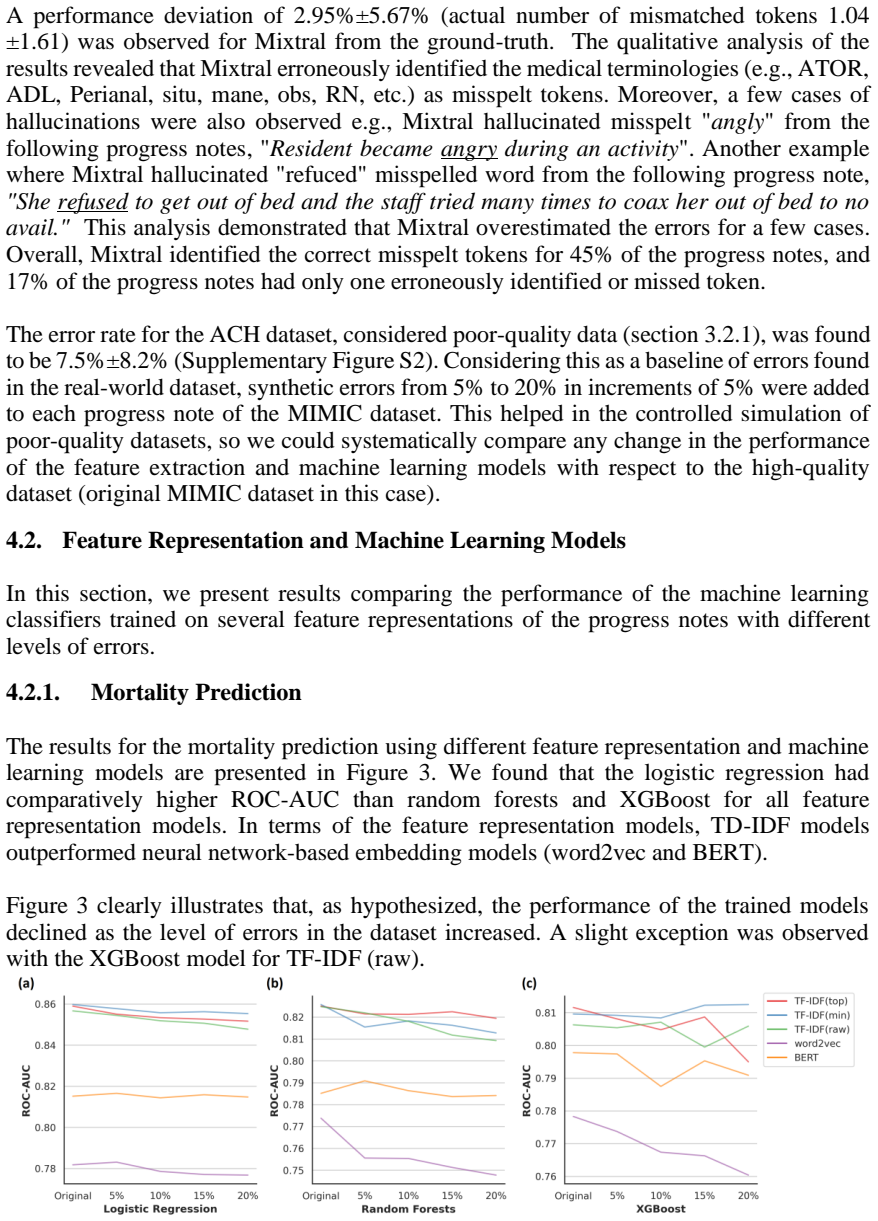
On the paper's own terms, the central discovery is a tolerance threshold: predictive models built on clinical free text are robust to small amounts of token-level noise, but cross a point near 10 percent injected errors where feature representations and classifiers lose accuracy. The authors reach this by injecting misspellings and missing whitespace into MIMIC-III at 5%, 10%, 15%, and 20%, while also correcting the aged-care dataset's measured 7.5% error rate with Mixtral; the absence of a major performance jump after correction is consistent with sub-10% noise. TF-IDF features outperform word2vec and BERT embeddings on both tasks, and the best classifier differs by dataset, with logistic regression leading on MIMIC and XGBoost leading on the aged-care data. Mixtral's error detection is imperfect, over-flagging medical terms and occasionally hallucinating errors, yet it matches the manually constructed ground truth within about three percentage points on a 136-note sample.
Load-bearing premise
The load-bearing premise is that MIMIC-III's progress notes are truly error-free and that Mixtral's error counts are accurate enough, so the injected rates are the real error rates.
Editorial extensions
If this is right
- Datasets with measured token error rates under 10 percent can be fed into predictive models without corrective preprocessing, saving compute and time.
- Datasets at or above 10 percent should be cleaned before modeling, because the reported AUC loss becomes substantial and task-dependent.
- A token-level error audit can run before model development and serve as a cheap quality gate, using an LLM to count errors.
- TF-IDF-based classifiers are a safer default for noisy clinical text than embedding features, since embeddings propagate and dilute token errors.
- For real-world notes near 8 percent error, LLM correction changes the vocabulary and feature space but does not move predictions much, so cleaning very low-error text may have limited payoff.
Reading between the lines
- If the 10 percent threshold generalizes, data-quality budgets should target corpora above it; below that threshold, cleaning effort may be better spent elsewhere, but this is an editorial extension rather than a paper claim.
- The threshold likely depends on error type: a misspelling that changes a word's meaning, such as a negation or a medication name, could hurt more than a missing space, so future work should weight errors by semantic severity rather than count tokens.
- Because the paper's metric ignores grammar and punctuation, a dataset measured at under 10 percent token errors could still be low quality for syntax-sensitive tasks like relation extraction or question answering, and the threshold may not transfer to those settings.
- A testable extension would be to inject semantically meaningful errors at 5 to 10 percent and compare AUC drops with random spelling errors, to see whether the tolerated band shrinks when mistakes change meaning.
Editorial analysis
A structured set of objections, weighed in public.
Referee Report
Summary. The paper studies how token-level textual errors affect feature representations and machine-learning classifiers for clinical text. It defines an error rate as the fraction of tokens with spelling or missing-whitespace errors, uses Mixtral to inject errors into the MIMIC-III mortality-prediction corpus at nominal rates of 5% to 20%, and also uses Mixtral to correct a private aged-care (ACH) corpus for depression and fall-risk prediction. The central empirical claim is that predictive performance (ROC-AUC) is tolerant to error rates below 10% but declines substantially at rates at or above 10%, and that the ACH corpus has an error rate of about 7.5-8%, so its performance is not severely degraded. The paper also reports that TF-IDF features outperform word2vec and BERT embeddings in these tasks.
Significance. If the 10% threshold is valid, the paper would provide practically useful guidance on when to invest in text cleaning for clinical NLP, and the combination of synthetic corruption and real-world LLM correction is a timely experimental design. The study is one of the few to systematically vary token-level noise in clinical text and to compare multiple feature representations and classifiers. Its strengths include a real-world low-quality dataset, a manual ground-truth evaluation of the LLM error detector, and transparent reporting of feature-count changes with error rate. However, the headline quantitative boundary is not currently supported by statistical evidence, the synthetic error-injection procedure appears to miscalibrate the actual error rates, and the two zero-error anchors of the analysis (original MIMIC and Mixtral-corrected ACH) are unverified. These issues limit the reliability of the central claim as stated.
major comments (4)
- [3.2.4, Eq. (1)] The synthetic error injection does not preserve the denominator of Eq. (1). When missing-whitespace errors are created by merging two adjacent tokens, the total number of tokens in the note decreases while the merged token is counted as a single erroneous token. If E tokens are selected for corruption and m of those are merges, the actual error rate becomes E / (N - m), which is larger than the nominal rate r = E/N. Since Figure 3 and the abstract report tolerance at nominal '<10%' and '>=10%', the x-axis is likely shifted right relative to the paper's own metric. The authors should compute and report the actual error rates of the corrupted notes after injection (using the same tokenization and counting procedure) and either adjust the injection algorithm or replot the performance curves against the measured rates.
- [4.2.1, Figure 3] The claim that performance 'declined significantly' for error rates >=10% is not supported by any inferential statistics. The figure shows ROC-AUC values at five discrete noise levels with no confidence intervals, error bars, or repeated runs. The differences between consecutive conditions appear small (often a few points of AUC), and no test establishes that the <10% versus >=10% comparison is significant. The authors should add variability estimates (e.g., bootstrap over patients or repeated corruption runs) and perform paired significance tests comparing the 0%/5% conditions with the 10%/15%/20% conditions. Without this, the specific 10% cutoff is an informal observation rather than an established result.
- [3.2.1 and 4.1.2] Both anchors of the error-rate scale are assumed rather than measured. The MIMIC corpus is declared 'error-free' because no errors have been reported, and the 'corrected' ACH dataset is produced by Mixtral, which the paper itself shows identifies all misspellings correctly in only 45% of notes and has a per-note deviation of 2.95% +/- 5.67% in estimated error rate. If MIMIC already contains a small percentage of typos or missing spaces, or if the corrected ACH still contains residual errors, the reported boundary of '<10% vs >=10%' is miscalibrated. The authors should quantify residual error rates in both corpora by sampling and manual inspection, and they should discuss how a nonzero baseline would shift the threshold claim.
- [4.1.2 vs Abstract/Discussion] The reporting of Mixtral's detection accuracy is internally inconsistent. Section 4.1.2 states that Mixtral identified the correct misspelt tokens for 45% of the progress notes, while the Abstract and Discussion report that Mixtral 'correctly detected errors in 63% of progress notes'. These are different metrics: the former likely means all misspellings in a note were correctly identified, whereas the latter might mean at least one error was detected. The authors should define both metrics explicitly and use them consistently throughout the paper, because the 63% vs 45% discrepancy directly affects how readers interpret the reliability of the error quantification and correction pipeline.
minor comments (5)
- [Throughout] The abbreviation 'TD-IDF' appears in several places (e.g., Section 3.4.1 and figure captions) and should be corrected to 'TF-IDF'.
- [Section 5] The sentence 'For the MIMIC dataset, linear regression shows higher prediction performance with TF-IDF features' should refer to 'logistic regression', since that is the classifier used in the experiments.
- [Section 3.2.4] The text says 'as this pattern was observed in real-life datasets (Table 2)', but the examples of missing whitespace are in Table 1. The cross-reference should be corrected.
- [Table S7] Table S7 lists the BERT feature dimensionality as 786, while the main text (Section 3.4.1) states that BERT embeddings have 768 dimensions. One of these is a typo and should be corrected.
- [Section 4.1.2] The sentence 'A performance deviation of 2.95 %±5.67% ... was observed' would be clearer if it specified whether this is the mean absolute deviation or the signed deviation of Mixtral's error rate from ground truth.
Circularity Check
No significant circularity: the central error-tolerance result is an empirical measurement on synthetically corrupted text, anchored by a manual ground-truth check.
full rationale
The paper's central claim (models tolerate token-level error rates below 10% but degrade at or above 10%) is an empirical finding: errors are injected into MIMIC-III at controlled nominal rates of 5, 10, 15, and 20%, and downstream ROC-AUC is measured across TF-IDF, word2vec, and BERT representations with several classifiers. The independent variable (error rate, Eq. 1) is set by construction in the synthetic experiments, but the dependent variable (model performance) is measured independently, so the relationship is not a fitted parameter renamed as a prediction. Mixtral's error quantification is partially validated against a manually corrected 136-note ground truth (Section 4.1.2), which breaks the potential loop of using the same LLM to corrupt, quantify, and correct text. The discussion of limitations explicitly acknowledges that the error metric is rudimentary and that not all error types were quantified, which is a validity caveat rather than circular reasoning. The main weaknesses are calibration concerns, not circularity: MIMIC-III is assumed error-free without direct measurement (Section 3.2.1), and the ACH 'corrected' dataset is Mixtral-generated without independent verification of zero remaining errors. These issues affect the absolute position of the 10% threshold on a true error-rate axis, but they do not make any equation or result equivalent to its own input. Self-citations in the paper (e.g., reference [3] for EHR data-mining challenges) are contextual and not load-bearing for the central conclusion. Therefore, no circular step can be exhibited, and the appropriate score is 0.
Assumptions & free parameters
free parameters (4)
- Minimum token frequency threshold for TF-IDF (min) =
5
- Top-token count for TF-IDF (top) =
5000
- Punctuation-token oversampling probability =
50% higher than non-punctuation tokens
- Minimum progress-note count per resident =
21
assumptions (7)
- domain assumption MIMIC-III progress notes are error-free, providing a clean baseline for synthetic error injection.
- domain assumption Mixtral's error-detection accuracy measured on 136 manually corrected ACH notes transfers to the full ACH dataset.
- domain assumption Token-level spelling and missing-whitespace errors are the relevant dimensions of data quality for this analysis.
- domain assumption Depression and fall labels from the ACH dataset are accurate as extracted from medical history and incident reports.
- domain assumption The MIMIC mortality cohort and preprocessing from Mahbub et al. [63] transfer to this study.
- domain assumption Pre-trained word2vec and Clinical BERT embeddings, without fine-tuning, are adequate for assessing the impact of errors on feature representation.
- domain assumption ROC-AUC from a single 2/3-1/3 split is sufficient to compare conditions.
Cite this review
Pith. "Pith review of Assessing the Impact of the Quality of Textual Data on Feature Representation and Machine Learning Models." pith.science (2026). https://pith.science/paper/EQMPVVFR
@misc{pith2026250208669,
  author       = {Pith},
  title        = {Pith review of: Assessing the Impact of the Quality of Textual Data on Feature Representation and Machine Learning Models},
  year         = {2026},
  howpublished = {\url{https://pith.science/paper/EQMPVVFR}},
  note         = {Machine review of arXiv:2502.08669}
}
read the original abstract
Background: Data collected in controlled settings typically results in high-quality datasets. However, in real-world applications, the quality of data collection is often compromised. It is well established that the quality of a dataset significantly impacts the performance of machine learning models. Methods: A rudimentary error rate metric was developed to evaluate textual dataset quality at the token level. Mixtral Large Language Model (LLM) was used to quantify and correct errors in low quality datasets. The study analyzed two healthcare datasets: the high-quality MIMIC-III public hospital dataset and a lower-quality private dataset from Australian aged care homes. Errors were systematically introduced into MIMIC at varying rates, while the ACH dataset quality was improved using the LLM. Results: For the sampled 35,774 and 6,336 patients from the MIMIC and ACH datasets respectively, we used Mixtral to introduce errors in MIMIC and correct errors in ACH. Mixtral correctly detected errors in 63% of progress notes, with 17% containing a single token misclassified due to medical terminology. LLMs demonstrated potential for improving progress note quality by addressing various errors. Under varying error rates, feature representation performance was tolerant to lower error rates (<10%) but declined significantly at higher rates. Conclusions: The study revealed that models performed relatively well on datasets with lower error rates (<10%), but their performance declined significantly as error rates increased (>=10%). Therefore, it is crucial to evaluate the quality of a dataset before utilizing it for machine learning tasks. For datasets with higher error rates, implementing corrective measures is essential to ensure the reliability and effectiveness of machine learning models.
Figures


Figures from the paper (1 more)

Reference graph
Works this paper leans on
-
[1]
A guide to deep learning in healthcare
Esteva A, Robicquet A, Ramsundar B, et al. A guide to deep learning in healthcare. Nat Med 2019; 25: 24–29
work page 2019
-
[2]
Mining electronic health records: towards better research applications and clinical care
Jensen PB, Jensen LJ, Brunak S. Mining electronic health records: towards better research applications and clinical care. Nat Rev Genet 2012; 13: 395– 405
work page 2012
-
[3]
The Secondary Use of Electronic Health Records for Data Mining: Data Characteristics and Challenges
Sarwar T, Seifollahi S, Chan J, et al. The Secondary Use of Electronic Health Records for Data Mining: Data Characteristics and Challenges. ACM Comput Surv 2022; 55: 33:1-33:40
work page 2022
-
[4]
Mining Electronic Health Records (EHRs): A Survey
Yadav P, Steinbach M, Kumar V, et al. Mining Electronic Health Records (EHRs): A Survey. ACM Comput Surv 2018; 50: 85:1-85:40
work page 2018
-
[5]
Mahendra M, Luo Y, Mills H, et al. Impact of Different Approaches to Preparing Notes for Analysis With Natural Language Processing on the Performance of Prediction Models in Intensive Care. Critical Care Explorations 2021; 3: e0450
work page 2021
-
[6]
An advanced review on text mining in medicine
Luque C, Luna JM, Luque M, et al. An advanced review on text mining in medicine. WIREs Data Mining and Knowledge Discovery 2019; 9: e1302
work page 2019
-
[7]
Natural Language Processing for EHR-Based Computational Phenotyping
Zeng Z, Deng Y, Li X, et al. Natural Language Processing for EHR-Based Computational Phenotyping. IEEE/ACM Transactions on Computational Biology and Bioinformatics 2019; 16: 139–153
work page 2019
-
[8]
Clinical Text Data in Machine Learning: Systematic Review
Spasic I, Nenadic G. Clinical Text Data in Machine Learning: Systematic Review. JMIR Medical Informatics 2020; 8: e17984
work page 2020
Show all 73 references
-
[9]
Attention is all you need
Vaswani A, Shazeer N, Parmar N, et al. Attention is all you need. In: Proceedings of the 31st International Conference on Neural Information Processing Systems. Red Hook, NY, USA: Curran Associates Inc., 2017, pp. 6000–6010
2017
-
[10]
Transformers for Multi-label Classification of Medical Text: An Empirical Comparison
Yogarajan V, Montiel J, Smith T, et al. Transformers for Multi-label Classification of Medical Text: An Empirical Comparison. In: Tucker A, Henriques Abreu P, Cardoso J, et al. (eds) Artificial Intelligence in Medicine. Cham: Springer International Publishing, 2021, pp. 114–123
2021
-
[11]
Measurement of Semantic Textual Similarity in Clinical Texts: Comparison of Transformer-Based Models
Yang X, He X, Zhang H, et al. Measurement of Semantic Textual Similarity in Clinical Texts: Comparison of Transformer-Based Models. JMIR Medical Informatics 2020; 8: e19735
2020
-
[12]
Limitations of Transformers on Clinical Text Classification
Gao S, Alawad M, Young MT, et al. Limitations of Transformers on Clinical Text Classification. IEEE Journal of Biomedical and Health Informatics 2021; 25: 3596–3607
2021
-
[13]
A Multimodal Transformer: Fusing Clinical Notes with Structured EHR Data for Interpretable In-Hospital Mortality Prediction
Lyu W, Dong X, Wong R, et al. A Multimodal Transformer: Fusing Clinical Notes with Structured EHR Data for Interpretable In-Hospital Mortality Prediction. AMIA Annu Symp Proc 2023; 2022: 719–728
2023
- [14]
-
[15]
A Survey on Evaluation of Large Language Models
Chang Y, Wang X, Wang J, et al. A Survey on Evaluation of Large Language Models. ACM Trans Intell Syst Technol 2024; 15: 39:1-39:45
2024
-
[16]
Hadi MU, Tashi QA, Qureshi R, et al. A Survey on Large Language Models: Applications, Challenges, Limitations, and Practical Usage, https://www.authorea.com/doi/full/10.36227/techrxiv.23589741.v1?commi t=b1cb46f5b0f749cf5f2f33806f7c124904c14967 (accessed 4 December 2024)
- [17]
-
[18]
Attention is not all you need: the complicated case of ethically using large language models in healthcare and medicine
Harrer S. Attention is not all you need: the complicated case of ethically using large language models in healthcare and medicine. eBioMedicine; 90. Epub ahead of print 1 April 2023. DOI: 10.1016/j.ebiom.2023.104512
2023
-
[19]
BioBERT: a pre-trained biomedical language representation model for biomedical text mining
Lee J, Yoon W, Kim S, et al. BioBERT: a pre-trained biomedical language representation model for biomedical text mining. Bioinformatics 2020; 36: 1234–1240
2020
- [20]
-
[21]
Domain-Specific Language Model Pretraining for Biomedical Natural Language Processing
Gu Y, Tinn R, Cheng H, et al. Domain-Specific Language Model Pretraining for Biomedical Natural Language Processing. ACM Trans Comput Healthcare 2021; 3: 2:1-2:23
2021
-
[22]
Don’t Stop Pretraining: Adapt Language Models to Domains and Tasks
Gururangan S, Marasović A, Swayamdipta S, et al. Don’t Stop Pretraining: Adapt Language Models to Domains and Tasks. In: Jurafsky D, Chai J, Schluter N, et al. (eds) Proceedings of the 58th Annual Meeting of the Association for Computational Linguistics. Online: Association fo...
-
[23]
SciBERT: A Pretrained Language Model for Scientific Text
Beltagy I, Lo K, Cohan A. SciBERT: A Pretrained Language Model for Scientific Text. In: Inui K, Jiang J, Ng V, et al. (eds) Proceedings of the 2019 Conference on Empirical Methods in Natural Language Processing and the 9th International Joint Conference on Natural Language Pro...
2019
-
[24]
MedCPT: Contrastive Pre-trained Transformers with large-scale PubMed search logs for zero-shot biomedical information retrieval
Jin Q, Kim W, Chen Q, et al. MedCPT: Contrastive Pre-trained Transformers with large-scale PubMed search logs for zero-shot biomedical information retrieval. Bioinformatics 2023; 39: btad651
2023
-
[25]
A large language model for electronic health records
Yang X, Chen A, PourNejatian N, et al. A large language model for electronic health records. npj Digit Med 2022; 5: 1–9
2022
-
[26]
MIMIC-III, a freely accessible critical care database
Johnson AEW, Pollard TJ, Shen L, et al. MIMIC-III, a freely accessible critical care database. Sci Data 2016; 3: 160035
2016
-
[27]
Annotating longitudinal clinical narratives for de- identification: The 2014 i2b2/UTHealth corpus
Stubbs A, Uzuner Ö. Annotating longitudinal clinical narratives for de- identification: The 2014 i2b2/UTHealth corpus. Journal of Biomedical Informatics 2015; 58: S20–S29
2014
-
[28]
Automated systems for the de-identification of longitudinal clinical narratives: Overview of 2014 i2b2/UTHealth shared task Track 1
Stubbs A, Kotfila C, Uzuner Ö. Automated systems for the de-identification of longitudinal clinical narratives: Overview of 2014 i2b2/UTHealth shared task Track 1. Journal of Biomedical Informatics 2015; 58: S11–S19
2014
-
[29]
Overview and Importance of Data Quality for Machine Learning Tasks
Jain A, Patel H, Nagalapatti L, et al. Overview and Importance of Data Quality for Machine Learning Tasks. In: Proceedings of the 26th ACM SIGKDD International Conference on Knowledge Discovery & Data Mining. New York, NY, USA: Association for Computing Machinery, pp. 3561–3562
-
[30]
Data Quality Toolkit: Automatic assessment of data quality and remediation for machine learning datasets
Gupta N, Patel H, Afzal S, et al. Data Quality Toolkit: Automatic assessment of data quality and remediation for machine learning datasets. Epub ahead of print 5 September 2021. DOI: 10.48550/arXiv.2108.05935
-
[31]
Data Validation for Machine Learning
Polyzotis N, Zinkevich M, Roy S, et al. Data Validation for Machine Learning. Proceedings of Machine Learning and Systems 2019; 1: 334–347
2019
-
[32]
Data Evaluation and Enhancement for Quality Improvement of Machine Learning
Chen H, Chen J, Ding J. Data Evaluation and Enhancement for Quality Improvement of Machine Learning. IEEE Transactions on Reliability 2021; 70: 831–847
2021
-
[33]
Data quality considerations for big data and machine learning: Going beyond data cleaning and transformations
Gudivada V, Apon A, Ding J. Data quality considerations for big data and machine learning: Going beyond data cleaning and transformations. International Journal on Advances in Software 2017; 10: 1–20
2017
-
[34]
Data Readiness Report
Afzal S, Rajmohan C, Kesarwani M, et al. Data Readiness Report. In: 2021 IEEE International Conference on Smart Data Services (SMDS), pp. 42–51
2021
-
[35]
Executing Data Quality Projects Ten Steps to Quality Data and Trusted Information (TM)
McGilvray D. Executing Data Quality Projects Ten Steps to Quality Data and Trusted Information (TM). Second. 2021
2021
-
[36]
A Short Review of the Literature on Automatic Data Quality
Chandran DR, Gupta V. A Short Review of the Literature on Automatic Data Quality. Journal of Computer and Communications 2022; 10: 55–73
2022
-
[37]
A Practical Framework for Evaluating the Quality of Knowledge Graph
Chen H, Cao G, Chen J, et al. A Practical Framework for Evaluating the Quality of Knowledge Graph. In: Zhu X, Qin B, Zhu X, et al. (eds) Knowledge Graph and Semantic Computing: Knowledge Computing and Language Understanding. Singapore: Springer, 2019, pp. 111–122
2019
-
[38]
Developing a systematic approach to assessing data quality in secondary use of clinical data based on intended use
Razzaghi H, Greenberg J, Bailey LC. Developing a systematic approach to assessing data quality in secondary use of clinical data based on intended use. Learning Health Systems 2022; 6: e10264
2022
-
[39]
Defining and measuring completeness of electronic health records for secondary use
Weiskopf NG, Hripcsak G, Swaminathan S, et al. Defining and measuring completeness of electronic health records for secondary use. Journal of Biomedical Informatics 2013; 46: 830–836
2013
-
[40]
Review: Electronic Health Records and the Reliability and Validity of Quality Measures: A Review of the Literature
Chan KS, Fowles JB, Weiner JP. Review: Electronic Health Records and the Reliability and Validity of Quality Measures: A Review of the Literature. Med Care Res Rev 2010; 67: 503–527
2010
-
[41]
Quality Indicators for Text Data
Kiefer C. Quality Indicators for Text Data. Gesellschaft für Informatik, Bonn, pp. 145–154
-
[42]
Outlier Detection for Improved Data Quality and Diversity in Dialog Systems
Larson S, Mahendran A, Lee A, et al. Outlier Detection for Improved Data Quality and Diversity in Dialog Systems. In: Burstein J, Doran C, Solorio T (eds) Proceedings of the 2019 Conference of the North American Chapter of the Association for Computational Linguistics: Human L...
2019
-
[43]
Aiming beyond the Obvious: Identifying Non- Obvious Cases in Semantic Similarity Datasets
Peinelt N, Liakata M, Nguyen D. Aiming beyond the Obvious: Identifying Non- Obvious Cases in Semantic Similarity Datasets. In: Korhonen A, Traum D, Màrquez L (eds) Proceedings of the 57th Annual Meeting of the Association for Computational Linguistics. Florence, Italy: Associa...
-
[44]
Evolutionary Data Measures: Understanding the Difficulty of Text Classification Tasks
Collins E, Rozanov N, Zhang B. Evolutionary Data Measures: Understanding the Difficulty of Text Classification Tasks. In: Korhonen A, Titov I (eds) Proceedings of the 22nd Conference on Computational Natural Language Learning. Brussels, Belgium: Association for Computational L...
-
[45]
Improving Neural Response Diversity with Frequency-Aware Cross-Entropy Loss
Jiang S, Ren P, Monz C, et al. Improving Neural Response Diversity with Frequency-Aware Cross-Entropy Loss. In: The World Wide Web Conference. New York, NY, USA: Association for Computing Machinery, pp. 2879–2885
-
[46]
Confident Learning: Estimating Uncertainty in Dataset Labels
Northcutt C, Jiang L, Chuang I. Confident Learning: Estimating Uncertainty in Dataset Labels. J Artif Int Res 2021; 70: 1373–1411
2021
-
[47]
Detecting errors in part-of-speech annotation
Dickinson M, Meurers WD. Detecting errors in part-of-speech annotation. In: Proceedings of the tenth conference on European chapter of the Association for Computational Linguistics - Volume 1. USA: Association for Computational Linguistics, pp. 107–114
-
[48]
Detecting errors within a corpus using anomaly detection
Eskin E. Detecting errors within a corpus using anomaly detection. In: Proceedings of the 1st North American chapter of the Association for Computational Linguistics conference. USA: Association for Computational Linguistics, 2000, pp. 148–153
2000
-
[49]
Detecting annotation noise in automatically labelled data
Rehbein I, Ruppenhofer J. Detecting annotation noise in automatically labelled data. In: Barzilay R, Kan M-Y (eds) Proceedings of the 55th Annual Meeting of the Association for Computational Linguistics (Volume 1: Long Papers). Vancouver, Canada: Association for Computational ...
-
[50]
Data Quality for Machine Learning Tasks
Gupta N, Mujumdar S, Patel H, et al. Data Quality for Machine Learning Tasks. In: Proceedings of the 27th ACM SIGKDD Conference on Knowledge Discovery & Data Mining. New York, NY, USA: Association for Computing Machinery, pp. 4040–4041
-
[51]
Dataset Cartography: Mapping and Diagnosing Datasets with Training Dynamics
Swayamdipta S, Schwartz R, Lourie N, et al. Dataset Cartography: Mapping and Diagnosing Datasets with Training Dynamics. In: Webber B, Cohn T, He Y, et al. (eds) Proceedings of the 2020 Conference on Empirical Methods in Natural Language Processing (EMNLP). Online: Association...
2020
-
[52]
Beyond Accuracy: Behavioral Testing of NLP Models with CheckList
Ribeiro MT, Wu T, Guestrin C, et al. Beyond Accuracy: Behavioral Testing of NLP Models with CheckList. In: Jurafsky D, Chai J, Schluter N, et al. (eds) Proceedings of the 58th Annual Meeting of the Association for Computational Linguistics. Online: Association for Computationa...
-
[53]
Impact of data quality for automatic issue classification using pre-trained language models
Colavito G, Lanubile F, Novielli N, et al. Impact of data quality for automatic issue classification using pre-trained language models. Journal of Systems and Software 2024; 210: 111838
2024
-
[54]
AutoCorrect, https://pypi.org/project/autocorrect/
-
[55]
Pyaspeller, https://pypi.org/project/pyaspeller/
-
[56]
Grammar Check, https://pypi.org/project/grammar-check/1.3.1/
-
[57]
A Comprehensive Survey of Grammatical Error Correction
Wang Y, Wang Y, Dang K, et al. A Comprehensive Survey of Grammatical Error Correction. ACM Trans Intell Syst Technol 2021; 12: 65:1-65:51
2021
-
[58]
The CoNLL-2014 Shared Task on Grammatical Error Correction
Ng HT, Wu SM, Briscoe T, et al. The CoNLL-2014 Shared Task on Grammatical Error Correction. In: Ng HT, Wu SM, Briscoe T, et al. (eds) Proceedings of the Eighteenth Conference on Computational Natural Language Learning: Shared Task. Baltimore, Maryland: Association for Computat...
2014
-
[59]
Grammatical Error Correction: A Survey of the State of the Art
Bryant C, Yuan Z, Qorib MR, et al. Grammatical Error Correction: A Survey of the State of the Art. Computational Linguistics 2023; 49: 643–701
2023
- [60]
-
[61]
Beyond ChatGPT: Enhancing Software Quality Assurance Tasks with Diverse LLMs and Validation Techniques
Widyasari R, Lo D, Liao L. Beyond ChatGPT: Enhancing Software Quality Assurance Tasks with Diverse LLMs and Validation Techniques. Epub ahead of print 2 September 2024. DOI: 10.48550/arXiv.2409.01001
- [62]
-
[63]
Unstructured clinical notes within the 24 hours since admission predict short, mid & long-term mortality in adult ICU patients
Mahbub M, Srinivasan S, Danciu I, et al. Unstructured clinical notes within the 24 hours since admission predict short, mid & long-term mortality in adult ICU patients. PLOS ONE 2022; 17: e0262182
2022
-
[64]
Mental health of older adults, https://www.who.int/news-room/fact- sheets/detail/mental-health-of-older-adults
-
[65]
WHO global report on falls prevention in older age, https://www.who.int/publications/i/item/9789241563536
-
[66]
Distributed representations of words and phrases and their compositionality
Mikolov T, Sutskever I, Chen K, et al. Distributed representations of words and phrases and their compositionality. In: Proceedings of the 26th International Conference on Neural Information Processing Systems - Volume 2. Red Hook, NY, USA: Curran Associates Inc., 2013, pp. 3111–3119
2013
-
[67]
BERT: Pre-training of Deep Bidirectional Transformers for Language Understanding
Devlin J, Chang M-W, Lee K, et al. BERT: Pre-training of Deep Bidirectional Transformers for Language Understanding. In: Burstein J, Doran C, Solorio T (eds) Proceedings of the 2019 Conference of the North American Chapter of the Association for Computational Linguistics: Huma...
2019
-
[68]
Publicly Available Clinical BERT Embeddings
Alsentzer E, Murphy J, Boag W, et al. Publicly Available Clinical BERT Embeddings. In: Rumshisky A, Roberts K, Bethard S, et al. (eds) Proceedings of the 2nd Clinical Natural Language Processing Workshop. Minneapolis, Minnesota, USA: Association for Computational Linguistics, ...
-
[69]
Longformer: The Long-Document Transformer
Beltagy I, Peters ME, Cohan A. Longformer: The Long-Document Transformer. Epub ahead of print 2 December 2020. DOI: 10.48550/arXiv.2004.05150. Supplementary Data Table S1: Sample queries demonstrating the extraction of tokens with errors using Mixtral. The blue text represents...
-
[70]
Resident buzzed at2300hrs on5/10/10,her legs felt like they were burning n she was in pain
Strictly proofread and correct any spelling mistakes in the following sentences. Only produce a single corrected text and do not provide any explanation. Return 'nil' if there is no mistake: “Resident buzzed at2300hrs on5/10/10,her legs felt like they were burning n she was in...
-
[71]
Resident was sleeping on round check,repositioned by2 x staff fluids given. nil problems settled ator
Strictly proofread and correct any spelling mistakes in the following sentences. Only produce a single corrected text and do not provide any explanation. Return 'nil' if there is no mistake: “Resident was sleeping on round check,repositioned by2 x staff fluids given. nil probl...
-
[72]
Resident
Correct any spelling mistakes in the following list. Only generate a list containing all the provided tokens along with the ones that have been corrected do not provide any explanation: ["Resident", "buzzed", "at2300hrs", "on5/10/10,her", "legs", "felt", "like", "they", "were"...
-
[73]
Resident
Correct any spelling mistakes in the following list. Only generate a list containing all the provided tokens along with the ones that have been corrected do not provide any explanation: ["Resident", "was", "sleeping", "on", "round", "check,repositioned", "by2", "x", "staff", "...
Reviewed August 8, 2026 · model on record in the stance chip above.
Discussion (0). Continue with ORCID to comment.