REVIEW 2 major objections 4 minor 24 references
Adding a drone-captured dense-traffic dataset to nuScenes training improves vehicle trajectory prediction and planning by up to 44.1% (ADE) and 44.3% (FDE).
Reviewed by Pith at T0; open to challenge. T0 means a machine referee read the full paper against a public rubric. the ladder, T0–T4 →
T0 review · deepseek-v4-flash
2026-08-03 10:14 UTC pith:ERYG5H5H
load-bearing objection Useful new drone dataset; headline nuScenes gain is confounded with dataset size, so the 44% number is not yet credible. the 2 major comments →
DeepUrban: Interaction-Aware Trajectory Prediction and Planning for Automated Driving by Aerial Imagery
The pith
A machine-rendered reading of the paper's core claim, the machinery that carries it, and where it could break.
Core claim
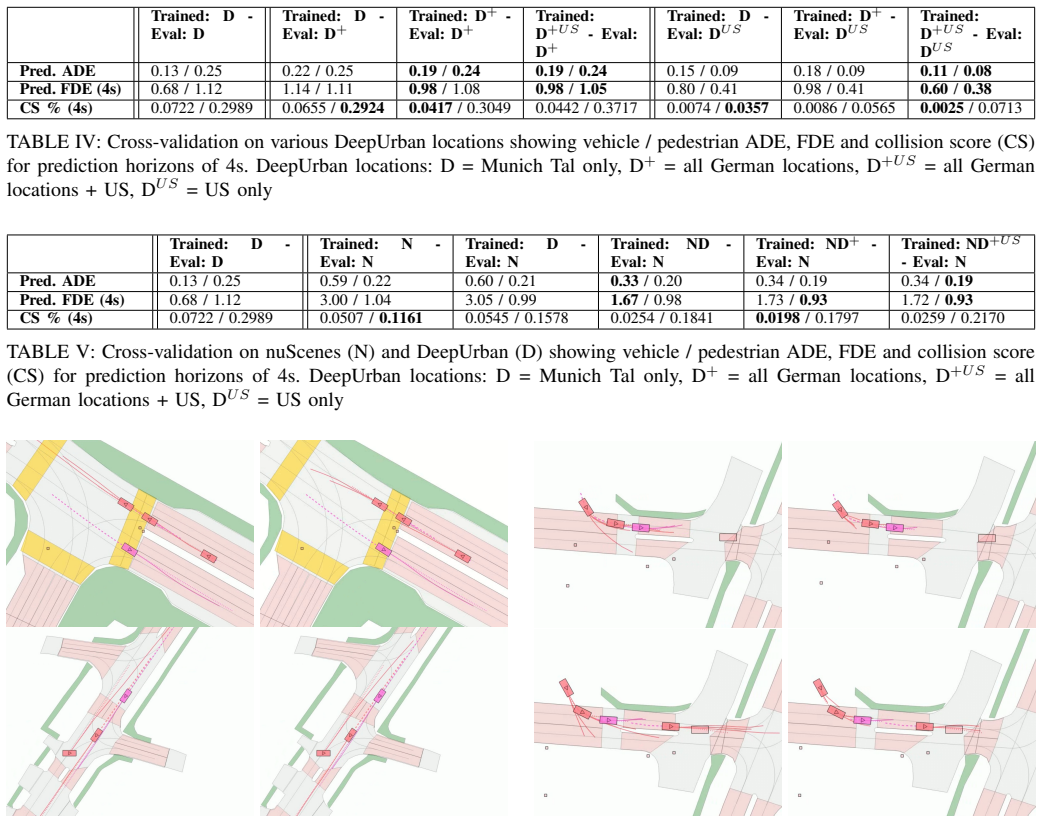
The paper's central claim is that appending 505 scenarios from the Munich Tal location of DeepUrban to the 500-scenario nuScenes training set, then training the scene-consistent prediction-and-planning method ScePT, improves vehicle trajectory accuracy on nuScenes validation: ADE drops from 0.59 m to 0.33 m (44.1%) and FDE from 3.00 m to 1.67 m (44.3%), with the collision score improving by 49.6%. The same trend holds when all German or all four DeepUrban locations are added, with the largest gains from area-specific data. The dataset itself supports training: ScePT's vehicle/pedestrian ADE on Munich Tal scales from 0.18/0.34 at 25% training data to 0.13/0.25 at 100%, and qualitative example
What carries the argument
The central object is the DeepUrban V1 dataset itself: 20-second scenario windows, resampled from 12.5 Hz to 10 Hz, extracted from drone footage at about 100 m altitude over four intersections, with 3D bounding boxes and tracks produced by a proprietary autolabeling pipeline, plus OpenDRIVE, lanelet2, and VectorMap road data. Scenarios are split 80/10/10 per location, and any vehicle moving at least 5 m in the window can be treated as an ego agent, enabling multiple planning perspectives per scene. The predictive machinery is ScePT, a discrete conditional variational autoencoder that groups agents into interaction cliques via Louvain clustering on a spatiotemporal scene graph, then plans wit
Load-bearing premise
The claim that DeepUrban improves nuScenes transfers relies on the 80/10/10 scenario split keeping temporally overlapping windows from the same drone recording out of both training and validation; the paper does not describe any cleanup of near-duplicate frames across splits.
What would settle it
Compute the timestamp overlap between every training and validation scenario in DeepUrban's Munich Tal split: if any validation scenario shares more than zero frames with a training scenario, retrain ScePT on a split where such windows are removed and check whether the 44% ADE improvement on nuScenes persists. Alternatively, train ScePT on nuScenes alone and evaluate on nuScenes validation while also evaluating a nuScenes-trained model on DeepUrban validation; if the cross-dataset improvement only appears in one direction, the transfer claim is weakened.
If this is right
- On nuScenes validation, training with DeepUrban's Munich Tal scenarios reduces vehicle ADE/FDE by 44.1%/44.3% and collision score by 49.6% compared with training on nuScenes alone.
- The dataset's multi-ego-agent design means a single 20-second scene yields multiple planning examples, a property not typical of onboard-vehicle datasets.
- Scaling experiments show that model accuracy on DeepUrban validation improves monotonically as training data increases from 25% to 100% (vehicle ADE falls from 0.18 m to 0.13 m).
- Cross-location evaluation shows that adding area-specific data helps more for that area, but mixing all locations still improves overall generalization.
- Qualitative results show that DeepUrban-trained models produce more conservative, pedestrian-aware trajectories, reducing predicted collision rates in dense scenes.
Where Pith is reading between the lines
- Because scenarios are extracted from continuous drone footage with up to 5 seconds of overlap, the 80/10/10 split may allow overlapping windows to fall in both training and validation; retraining with a non-overlapping split would test whether the 44% transfer gain is inflated by near-duplicate frames.
- The transfer result is shown with ScePT alone; other interaction-aware architectures or stronger baselines may show smaller gains, and the relative improvement will likely shrink as nuScenes models improve.
- The aerial augmentation strategy could be extended to other onboard benchmarks, but the optimal ratio of drone to onboard data, and how to balance geographic diversity, are open questions.
- Drone data provides a top-down global view with no ego-occlusion, so models trained purely on it may need adaptation when deployed with onboard sensors; the paper does not address this.
Editorial analysis
A structured set of objections, weighed in public.
Referee Report
Summary. The paper introduces DeepUrban V1, a drone-captured dataset of dense European urban intersections with a high share of vulnerable road users (VRUs), and integrates it into the TrajData dataloader. The authors evaluate a single state-of-the-art prediction/planning method, ScePT, on the dataset and perform cross-dataset experiments. The central claim is that adding DeepUrban scenarios to the nuScenes training set improves vehicle trajectory prediction and planning, with reported improvements up to 44.1% in ADE and 44.3% in FDE, plus a 49.6% collision-score improvement.
Significance. If the transfer result holds, DeepUrban would be a valuable complement to existing onboard-vehicle datasets, addressing the scarcity of high-density interaction scenarios in current benchmarks. The dataset's high VRU share, multi-ego-agent setup, and integration with TrajData are practical strengths, and the planned online benchmark is a useful community resource. However, the current evidence for the headline improvement is not yet convincing: the comparison is not size-matched, no variance estimates are provided, and only one model is evaluated.
major comments (2)
- [Section V-B.2, Table V] The central quantitative claim rests on a comparison between ScePT trained on nuScenes (N, 500 scenarios) and ScePT trained on nuScenes + DeepUrban Munich Tal (ND, ~505 additional scenarios). This roughly doubles the training data. No size-matched control (e.g., nuScenes plus an equal number of additional nuScenes scenarios or another non-DeepUrban dataset) is provided, and no repeated-seed statistics are reported. The 44.1% ADE / 44.3% FDE improvement could therefore be a data-quantity effect rather than a causal effect of DeepUrban's dense-urban content. This is a load-bearing gap for the abstract's headline claim.
- [Section III-B, Tables III–IV] Scenarios are 20-second windows with up to 5 seconds of overlap extracted from continuous drone recordings. The paper does not state that overlapping windows are prevented from appearing in both training and validation splits. If leakage occurs, the DeepUrban validation metrics in Tables III and IV are inflated, and any model selection based on those metrics would be compromised. The authors should either enforce and document overlap-cleared splits or quantify the overlap's effect. This issue does not directly contaminate the nuScenes transfer experiment, but it affects the dataset's own benchmark claims.
minor comments (4)
- [Section IV-B] In the metric definitions, the text says "x ij and y ij denote the coordinates" but only x appears in the formulas; the notation is inconsistent and should be cleaned up.
- [Abstract and Section V-B.2] The reported 44.1%/44.3% improvements are computed on the nuScenes validation set, but the abstract states the result without this qualification. The abstract or the results section should clearly indicate that these are validation-set numbers with no reported variance.
- [Figure 2] The second row shows the planned trajectory veering outside the drivable area. The explanation in the text is reasonable, but adding a label or annotation in the figure would help readers distinguish this planning artifact from a prediction error.
- [References, [24]] The text mentions a 'custom ScePT data split [24]' but does not describe what this split is or why it differs from the official nuScenes split. Please clarify.
Circularity Check
No significant circularity; the paper's central claim is an empirical benchmark result, not a derivation that reduces to its inputs.
full rationale
The paper's central assertion—that adding DeepUrban to nuScenes improves vehicle ADE/FDE by up to 44.1%/44.3%—is an empirical evaluation result, not a mathematical derivation. The training/evaluation protocol uses an external model (ScePT) and an external benchmark (nuScenes validation set). No equation in the paper defines the predicted ADE/FDE in terms of the input data, and no fitted parameter is renamed as a prediction. The cross-dataset comparison may be confounded by training-set size (nuScenes alone vs. nuScenes plus ~505 additional DeepUrban scenarios), but that is an attribution/correctness concern, not circularity: the measured error on nuScenes val is not equal to the input by construction. The temporal overlap between DeepUrban scenarios (up to 5 seconds in 20-second windows) is a potential data-leakage issue for DeepUrban's own validation numbers, but it does not make the headline nuScenes result circular. There are no load-bearing self-citations: references to DeepScenario and ScePT are external data/method sources, and the paper does not invoke a uniqueness theorem or prior author-derived functional form to force its conclusions. The manuscript explicitly notes that a detailed data description is deferred to a forthcoming DeepScenario publication, which is a transparency limitation but not a circular step. Overall, the derivation chain is self-contained and the reported improvement is an experimentally measured quantity rather than a tautology.
Axiom & Free-Parameter Ledger
free parameters (5)
- scenario_duration =
20 seconds
- ego_min_displacement =
5 meters within 20s
- max_overlap =
5 seconds
- resample_frequency =
10 Hz (from 12.5 Hz)
- ScePT_clique_size =
4 agents
axioms (4)
- domain assumption DeepScenario's proprietary autolabeling pipeline produces accurate 3D tracks and boundary boxes.
- domain assumption OpenDRIVE/lanelet2/VectorMap maps supplied with the raw data are accurate and complete for the recorded intersections.
- domain assumption The 80/10/10 scenario split does not allow temporally overlapping scenario windows to span train and validation splits.
- domain assumption ScePT's results are representative enough to support the claim about 'state-of-the-art' methods.
read the original abstract
The efficacy of autonomous driving systems hinges critically on robust prediction and planning capabilities. However, current benchmarks are impeded by a notable scarcity of scenarios featuring dense traffic, which is essential for understanding and modeling complex interactions among road users. To address this gap, we collaborated with our industrial partner, DeepScenario, to develop DeepUrban-a new drone dataset designed to enhance trajectory prediction and planning benchmarks focusing on dense urban settings. DeepUrban provides a rich collection of 3D traffic objects, extracted from high-resolution images captured over urban intersections at approximately 100 meters altitude. The dataset is further enriched with comprehensive map and scene information to support advanced modeling and simulation tasks. We evaluate state-of-the-art (SOTA) prediction and planning methods, and conducted experiments on generalization capabilities. Our findings demonstrate that adding DeepUrban to nuScenes can boost the accuracy of vehicle predictions and planning, achieving improvements up to 44.1 % / 44.3% on the ADE / FDE metrics. Website: https://iv.ee.hm.edu/deepurban
Figures


Reference graph
Works this paper leans on
-
[1]
NuPlan: A closed-loop ML-based planning benchmark for autonomous vehicles
H. Caesar, J. Kabzn, K. S. Tan, W. K. Fong, E. Wolff, A. Lang, L. Fletcher, O. Beijbom, and S. Omari, “NuPlan: A closed-loop ML-based planning benchmark for autonomous vehicles.”, in arXiv:2106.11810, 2021
Pith/arXiv arXiv 2021
-
[2]
CommonRoad: Composable Benchmarks for Motion Planning on Roads
M. Althoff, M. Koschi, and S. Manzinger, “CommonRoad: Composable Benchmarks for Motion Planning on Roads.”, in IEEE Intell. Veh, pp. 719–726,, 2017
2017
-
[3]
nuScenes: A multimodal dataset for autonomous driving
Holger Caesar, Varun Bankiti, Alex H Lang, Sourabh V ora, Venice Erin Liong, Qiang Xu, Anush Krishnan, Yu Pan, Giancarlo Baldan, and Oscar Beijbom, “nuScenes: A multimodal dataset for autonomous driving.”, in Proc. IEEE CVPR, pp. 11 621–11 631, 2020
2020
-
[4]
J. Bock, R. Krajewski, T. Moers, S. Runde, L. Vater, and L. Eckstein, ”The inD Dataset: A drone dataset of naturalistic road user trajectories at german intersections.”, in IEEE Intell. Veh, pp. 1929–1934, 2020
1929
-
[5]
W. Zhan, L. Sun, D. Wang et al., “INTERACTION Dataset: An INTER- national, Adversarial and Cooperative moTION Dataset in Interactive Driving Scenarios with Semantic Maps.”, in arXiv:1910.03088, 2019
Pith/arXiv arXiv 1910
-
[6]
Large Scale Interactive Motion Forecasting for Autonomous Driving: The W AYMO OPEN MOTION DATASET
S. Ettinger, S. Cheng, and B. Caine et al., “Large Scale Interactive Motion Forecasting for Autonomous Driving: The W AYMO OPEN MOTION DATASET.”, in Proc. IEEE ICCV , pp. 9710–9719, 2021
2021
-
[7]
Learning social etiquette: Human trajectory understanding in crowded scenes
A. Robicquet, A. Sadeghian, A. Alahi, and S. Savarese, “Learning social etiquette: Human trajectory understanding in crowded scenes.”, in Proc. of the ECCV , pp. 549–565, 2016
2016
-
[8]
Argoverse 2: Next Gen- eration Datasets for Self-Driving Perception and Forecasting
B. Wilson, W. Qi, T. Agarwal et al., “Argoverse 2: Next Gen- eration Datasets for Self-Driving Perception and Forecasting.”, in arXiv:2301.00493, 2023
Pith/arXiv arXiv 2023
-
[9]
Argoverse: 3D Tracking and Forecasting with Rich Maps
M.-F. Chang, J. Lambert, P. Sangkloy, J. Singh, S. Bak, A. Hartnett, D. Wang, P. Carr, S. Lucey, D. Ramanan, and J. Hays, “Argoverse: 3D Tracking and Forecasting with Rich Maps.”, in Proc. IEEE CVPR, pp. 8748–8757, 2019
2019
-
[10]
You’ll never walk alone: Modeling social behavior for multi-target tracking
S. Pellegrini, A. Ess, K. Schindler, and L. Van Gool, “You’ll never walk alone: Modeling social behavior for multi-target tracking.”, in Proc. IEEE ICCV , pp. 261–268, 2009
2009
-
[11]
Crowds by example
A. Lerner, Y . Chrysanthou, and D. Lischinski, “Crowds by example.”, in Computer Graphics Forum, vol. 26, p. 655–664, 2007
2007
-
[12]
trajdata: A Unified Interface to Multiple Human Trajectory Datasets
B. Ivanovic, G. Song and I. Gilitschenski et al., “trajdata: A Unified Interface to Multiple Human Trajectory Datasets.”, in arXiv2307.13924, 2023
Pith/arXiv arXiv 2023
-
[13]
One Thousand and One Hours: Self-driving Motion Prediction Dataset
J. Houston, G. Zuidhof, L. Bergamini, Y . Ye, A. Jain, S. Omari, V . Iglovikov, and P. Ondruska, “One Thousand and One Hours: Self-driving Motion Prediction Dataset.”, in CoRL, pp. 409–418, 2021
2021
-
[14]
Vision meets Robotics: The KITTI Dataset
A. Geiger, P. Lenz, C. Stiller, and R. Urtasun, “Vision meets Robotics: The KITTI Dataset.”, in IJRR, pp. 1231–1237, 2013
2013
-
[15]
Z. Huang, H. Liu, and C. Lv, ”GameFormer: Game-theoretic Modeling and Learning of Transformer-based Interactive Prediction and Planning for Autonomous Driving”, in arXiv:2303.05760, 2023
Pith/arXiv arXiv 2023
-
[16]
From Prediction to Planning With Goal Conditioned Lane Graph Traversals
M. Hallgarten, M. Stoll, and A. Zell, “From Prediction to Planning With Goal Conditioned Lane Graph Traversals.”, in arXiv:2302.07753, 2023
Pith/arXiv arXiv 2023
-
[17]
Y . Chen, B. Ivanovic and M. Pavone, ”ScePT: Scene-consistent, Policy- based Trajectory Predictions for Planning”, in Proc. IEEE CVPR, pp. 17103–17112, 2022
2022
-
[18]
Karkus, B
P. Karkus, B. Ivanovic, S. Mannor, and M. Pavone, ”DiffStack: A Differentiable and Modular Control Stack for Autonomous Vehicles”, in CoRL, pp. 2170-2180, 2022
2022
-
[19]
Dauner, M
D. Dauner, M. Hallgarten, A. Geiger, and K. Chitta, ”Parting with Misconceptions about Learning-based Vehicle Motion Planning”, in CoRL, pp. 1268-1281, 2023
2023
-
[20]
Y . Hu, K. Li, P. Liang, J. Qian, Z. Yang, H. Zhang, W. Shao, Z. Ding, W. Xu, and Q. Liu, ”Imitation with Spatial-Temporal Heatmap: 2nd Place Solution for NuPlan Challenge”, in Computing Research Repository”, in arXiv:2306.15700, 2023
Pith/arXiv arXiv 2023
-
[21]
Dupuis, M
M. Dupuis, M. Strobl, and H. Grezlikowski, ”OpenDRIVE 2010 and beyond - status and future of the de facto standard for the description pf road networks”, in DSC, pp. 231–242, 2010
2010
-
[22]
Poggenhans, J
F. Poggenhans, J. Pauls, J. Janosovits, S. Orf, M. Naumann, F. Kuhnt, and M. Mayr, ”lanelet2: A high-definition map framework for the future of automated driving”, in Proc. of the IEEE ITSC, pp. 1672–1679, 2018
2018
-
[23]
[Online]
”DeepScenario Dataset: Great Munich (v2), Fabulous Sindelfingen (v2), Stunning Stuttgart (v2), Visionary San Francisco (v2).”, 2023. [Online]. Available: https://app.deepscenario.com. [Accessed: 31-Jul-2024]
2023
-
[24]
Salzmann, B
T. Salzmann, B. Ivanovic, P. Chakravarty, and M. Pavone, ”Trajectron++: Dynamically feasible trajectory forecasting with heterogeneous data”, in Proc. of the ECCV , pp. 683–700, 2020
2020
discussion (0)
Sign in with ORCID, Apple, or X to comment. Anyone can read and Pith papers without signing in.