REVIEW 3 major objections 4 minor 36 references
In QKD, Key Metadata is Key
T0 review · 3 major / 4 minor · reviewed 2026-08-15 · deepseek-v4-flash
Pith's one-line read Quantum key distribution networks that cross administrative domains currently exchange keys without meaning; this paper argues that standardized, signed key metadata is the missing layer that enables semantic interoperability, and lays…
desk verdict A well-written, standards-grounded position paper that proposes a common QKD metadata profile as the path to semantic interoperability; the framework is sensible, but the load-bearing cost analysis is explicitly missing and the proposal remains economically unproven. read the letter →
The pith
A machine-rendered reading of the paper's core claim, the machinery that carries it, and where it could break.
The reading
What carries the argument
The load-bearing object is the metadata event: an append-only, digitally signed record of a single key operation—generation, relay, XOR combination or split, supply, voiding, or cross-domain handover. Each event carries an issuer (domain, node, certificate reference), occurrence and recording timestamps, a per-node sequence number chained to the previous event's digest, references to the events that produced its input keys, and a node signature; events therefore assemble into a directed lineage graph for every key. Metadata is shared as views of events, ranging from full records to signed summaries to zero-knowledge proofs, so a domain can prove compliance without revealing topology. The proposal also separates five metadata classes (key-associated context, service/request, entitlement/accounting, resource/inventory, and evidence/assurance) and fits transport into the extension fields of existing key-container APIs, making the design transport-independent.
What would settle it
Operate a three-domain relay where each hop attaches the full signed event chain and the metadata view is encrypted with one-time pad across domain boundaries; measure the ratio of key bits consumed by metadata to payload key bits delivered. If that ratio grows steeply with hop count and with split/merge operations—or exceeds even a small percentage of delivered key material on realistic routes—then the semantic-interoperability layer undermines the key-rate economics, and the central claim fails.
Extended reading notes
Core claim
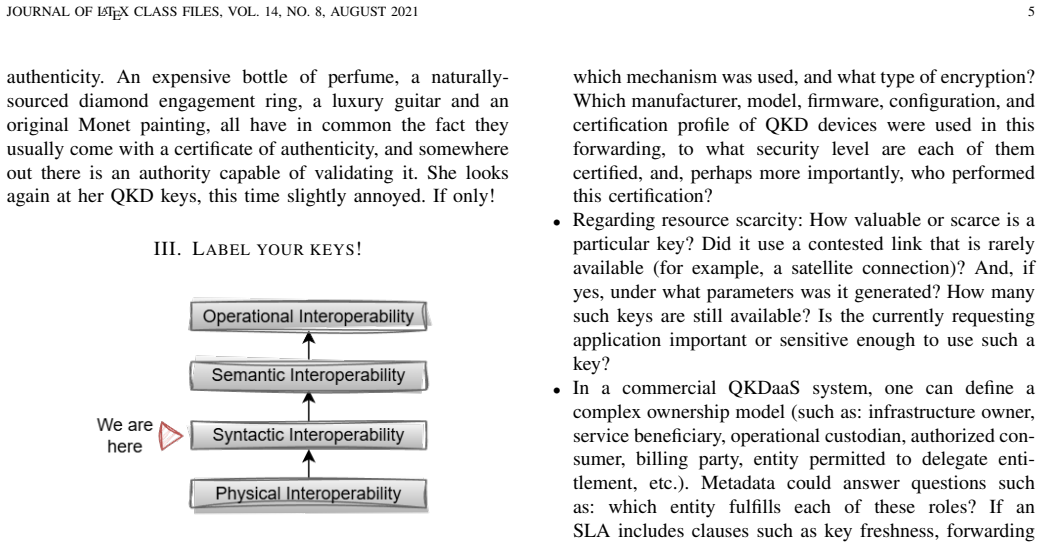
At its center, the paper claims that the current state of cross-domain QKD is syntactic interoperability: standard interfaces exchange a key value and a key identifier, but nothing guarantees what the key is, where it came from, how it was forwarded, who owns it, or whether it satisfies a request's policy constraints. It then argues that the next stage, semantic interoperability, requires a common, standardized QKD metadata profile—labels attached to keys and requests—and demonstrates through worked scenarios that without such labels, node breaches force maximally wide responses, scarce satellite keys cannot be protected, and QKD-as-a-service stalls on proprietary per-domain agreements. To get there, it proposes a metadata-aware key manager in which every key operation is recorded as a signed, chained event, and a six-step standardization roadmap spanning semantics, binding, transport, trust, rule enforcement, and governance. The paper's conclusion is prescriptive: build this profile before federated networks are fully interconnected, because key provenance that was never recorded can never be reconstructed.
Load-bearing premise
The proposal stands or falls on the unproven cost assumption that transporting and protecting metadata—especially encrypting it with one-time pads to preserve information-theoretic security—does not consume a prohibitive share of the QKD key material that the network exists to produce; the paper explicitly notes that this analysis has not been performed.
Editorial extensions
If this is right
- After a node compromise, operators can replay the signed event graph and identify exactly which keys passed through the affected node, so response and revocation are scoped rather than total.
- Scarce or expensive key material—for example satellite-generated keys—can be labeled and reserved, so low-priority traffic cannot drain the buffer before high-value requests arrive.
- Multi-tenant QKD-as-a-service becomes expressible in standard interfaces: ownership roles, quotas, billing, delegation, and SLA clauses such as freshness, jurisdiction, and assurance level can be requested, evidenced, and audited end to end.
- A link that injects classically generated random bits instead of genuine QKD keys can no longer pass unnoticed, because the key's provenance chain will lack the required signed device events.
- Delaying the metadata profile accumulates metadata debt: once keys are consumed, the per-key facts needed for future audits and incident response are gone forever, so standardization matters before large-scale federation.
Reading between the lines
- The event-graph design implies that a domain's key history becomes an auditable append-only record; a natural extension is a third-party auditor that periodically verifies node signatures and digest chains without ever seeing keys.
- Choosing how much metadata to share—full events, summaries, or zero-knowledge proofs—becomes a resource-allocation problem in its own right, because zero-knowledge proofs cost computation and one-time-pad encryption costs key material, so view policy will need to be priced in any QKD-as-a-service model.
- A testable extension would quantify the claimed metadata debt by instrumenting a live federated testbed to measure which per-key facts are already logged and how many incident-scope questions they answer; a high baseline would weaken the paper's urgency argument.
- Once node signatures and a certificate hierarchy are mandatory, QKD networks inherit classical public-key-infrastructure failure modes—compromised signing keys, expired certificates, disputed issuers—so the metadata standard would need a revocation and dispute-resolution mechanism, which the paper does not detail.
Signed reviews
Editorial analysis
A structured set of objections, weighed in public.
Referee Report
Summary. The paper argues that federated QKD networks currently enjoy syntactic interoperability through standards such as ETSI GS QKD 014 and ETSI GS QKD 020, but lack the semantic layer needed for cross-domain incident response, policy-constrained key requests, and QKD-as-a-Service. It introduces a four-level interoperability maturity model, derives five metadata classes, and proposes a six-layer standardization roadmap (semantics, binding, transport, trust, enforcement, governance). An annex defines a candidate event envelope with key relations, timestamps, digests, and node signatures, and shows how it would be carried in existing ETSI extension fields. The central claim is that a common QKD metadata profile is necessary and sufficient to move from syntactic to semantic interoperability.
Significance. The proposal addresses a real and timely gap: current key containers expose only key ID and value, so applications cannot verify provenance, path, jurisdiction, or freshness. The four-level model and metadata taxonomy are useful conceptual contributions, and the paper is transparent in flagging the missing cost analysis for metadata transport. The paper makes no quantitative predictions and does not fit data, so no circularity issue arises; the pertinent risk is technical feasibility. If the metadata overhead can be bounded and its trust model completed, the roadmap would be a valuable basis for standardization. As written, however, the paper is a position piece whose central feasibility claim rests on an unquantified and potentially prohibitive overhead.
major comments (3)
- [Section III] The feasibility of the proposal depends on the cost of transporting and protecting metadata, but the paper explicitly states that the one-time-pad encryption cost analysis "has not been performed yet." This is not a peripheral caveat: the Annex (Section C) event envelope contains timestamps, issuer identifiers, event digests, key relations, and signatures—on the order of one kilobyte—while the example keys are 256 bits. For a relayed key traversing several domains, OTP-encrypting the accumulated metadata would consume hundreds of bytes of key material per key, an overhead of one to two orders of magnitude. The paper mentions zero-knowledge proofs and PQC-based signing as alternatives, but does not give their cost or security tradeoffs. The central claim that semantic interoperability is achievable through metadata therefore remains unsubstantiated; either a quantitative overhead analysis or an explicit reframing of the paper as an open-problem roadmap is needed.
- [Annex, Requirement 10 / final paragraph] Requirement 10 states that metadata growth must be bounded, and the final paragraph asserts that metadata "grows only linearly with event actions, not exponentially." The paper does not specify the serialization or canonicalization that makes this true. In the proposed event graph, split and merge operations create DAG edges; if the "full event chain" is delivered as a nested or duplicated bundle, a key derived from many shared sub-events can carry the same ancestor event multiple times, and the bundle size is not controlled by the number of events. The event format uses references (event_id) rather than embedding, which suggests a compact representation, but the transport and view layers in Section IV-B do not mandate deduplication or define the linear bound. This requirement should either be proven for the proposed representation or the representation should be extended to make the bound explicit.
- [Section II-D and Section IV-B (trust layer)] The motivating fake-link scenario (Section II-D) is not solved by the proposed signed-event architecture. In that scenario, the domain officials who install the fake QKD link control the signing keys of the very nodes that would emit the metadata events; the Annex's node signature therefore certifies only that the node said so, not that a QKD device generated the key. The trust layer in Section IV-B lists who may assert claims and how claims are authenticated, but does not specify a root of trust that binds a key to an authenticated QKD device or detects an issuer that is itself compromised or rogue. The paper should either add complementary mechanisms (hardware attestation, independent audits, tamper-evident logs) or explicitly state that the metadata profile presupposes honest domain authorities and cannot by itself guarantee authenticity.
minor comments (4)
- [Section III] The sentence beginning "The first level and the easiest to implement practically as demonstrated throughout various deployments, Physical Interoperability" is missing a comma before "Physical Interoperability" and would benefit from a citation for the deployments it refers to.
- [Annex, Section C] The example event contains a typo in the field name "unkown_type_action" (should be "unknown_type_action"), and the same typo appears in the accompanying prose.
- [Section IV-B] The text refers to Figure 3 for the six-step roadmap, but the figure is not included in the manuscript text; ensure the figure is present in the final version.
- [Annex] The Annex appears after the references; it should be relabeled as an appendix and explicitly referenced from the main text (e.g., Section III or IV) so that readers know the example is normative rather than supplementary.
Circularity Check
No circularity: the paper is a standards-roadmap/position argument with no fitted values, no quantitative predictions, and no load-bearing self-citation.
full rationale
The paper makes no quantitative predictions and fits no parameters. Its central claim is that a common QKD key metadata profile is needed to move from syntactic to semantic interoperability, supported by scenario-driven requirements, a maturity model, a five-class metadata taxonomy, and a six-step standardization roadmap. The derivation chain is argumentative rather than mathematical: the requirements are derived from stories about incident response (Section II-A), resource scarcity (Section II-B), QKDaaS (Section II-C), and fake-link authenticity (Section II-D), not from any equation whose output is reused as its input. The proposed event schema in the Annex is illustrative, and the paper explicitly flags it as a starting point rather than a validated standard. Section III acknowledges that OTP-encrypting metadata per ITU-T Y.3803 may significantly increase key-rate usage and states that 'this analysis has not been performed yet'; this is an honest feasibility limitation, not circularity, because no key-rate prediction is claimed. The authors' self-citations [9,10,11] are used only as background motivation for KMS-level forwarding and virtualization research, not as justification for the metadata profile itself; there is no imported uniqueness theorem, no ansatz smuggled via self-citation, and no renamed empirical result presented as derivation. The paper is therefore self-contained with respect to its actual claims, and the appropriate finding is no significant circularity.
Assumptions & free parameters
assumptions (4)
- domain assumption Trusted-node relays can carry per-key metadata through existing ETSI extension mechanisms without loss or semantic drift.
- ad hoc to paper Information-theoretic security can be preserved when metadata is encrypted with one-time pads, and the resulting key-rate overhead is acceptable.
- domain assumption A hierarchical certificate authority structure for node signatures provides sufficient authenticity and resistance to compromise for cross-domain metadata.
- ad hoc to paper QKD metadata events can be kept linearly bounded while retaining enough information for audits.
invented entities (2)
-
QKD metadata event envelope (profile urn:qci:event:1.0)
-
Metadata views
Cite this review
Pith. "Pith review of In QKD, Key Metadata is Key." pith.science (2026). https://pith.science/paper/EUDUFGGW
@misc{pith2026260811502,
  author       = {Pith},
  title        = {Pith review of: In QKD, Key Metadata is Key},
  year         = {2026},
  howpublished = {\url{https://pith.science/paper/EUDUFGGW}},
  note         = {Machine review of arXiv:2608.11502}
}
read the original abstract
Federated interconnected QKD networks are becoming the norm, and with several standards already in place, interoperability is now technically feasible. Many aspects related to cross-domain key distribution, however, are left unresolved: breach announcement and mitigation, integration with the space segment, extension to a future QKD-as-a-Service commercial model, custom requests referring to key freshness, jurisdictions, security levels, etc. We argue that, to move from syntactic to semantic interoperability, a common language must be developed to ensure transfer of meaning along with the keys. We posit this is possible via QKD key metadata, and we propose a 6-step process to develop it as a standard.
Figures


Figures from the paper (1 more)

Reference graph
Works this paper leans on
-
[1]
A tweezer array with 6,100 highly coherent atomic qubits,
H. J. Manetsch, G. Nomura, E. Bataille, X. Lv, K. H. Leung, and M. Endres, “A tweezer array with 6,100 highly coherent atomic qubits,” Nature, vol. 647, no. 8088, pp. 60–67, 2025
work page 2025
-
[2]
Steady progress in approaching the quantum advantage,
McKinsey & Company, “Steady progress in approaching the quantum advantage,” https://www.mckinsey.com/capabilities/mckinsey-digital/ our-insights/steady-progress-in-approaching-the-quantum-advantage, 2024, accessed: June 10, 2024
work page 2024
-
[3]
Shor’s algorithm is possible with as few as 10,000 reconfigurable atomic qubits,
M. Cain, Q. Xu, R. King, L. R. Picard, H. Levine, M. Endres, J. Preskill, H.-Y . Huang, and D. Bluvstein, “Shor’s algorithm is possible with as few as 10,000 reconfigurable atomic qubits,”arXiv preprint arXiv:2603.28627, 2026
arXiv 2026
-
[4]
A. T ˘an˘asescu, D. Constantinescu, and P. G. Popescu, “Distribution of controlled unitary quantum gates towards factoring large numbers on today’s small-register devices,”Scientific Reports, vol. 12, no. 1, p. 21310, 2022
work page 2022
-
[5]
The european quantum communication infrastructure (EuroQCI) initiative,
European Commission, “The european quantum communication infrastructure (EuroQCI) initiative,” https://digital-strategy.ec.europa.eu/ en/policies/european-quantum-communication-infrastructure-euroqci, 2024, accessed: June 10, 2024
work page 2024
-
[6]
Quantum key distribution networks—key management: Amendment 1,
International Telecommunication Union, “Quantum key distribution networks—key management: Amendment 1,” International Telecommu- nication Union, ITU-T Recommendation Y .3803 (2020) Amd. 1, Nov
work page 2020
-
[7]
Quantum key distribution (QKD); protocol and data format of REST-based key delivery API,
European Telecommunications Standards Institute, “Quantum key distribution (QKD); protocol and data format of REST-based key delivery API,” European Telecommunications Standards Institute, ETSI Group Specification ETSI GS QKD 014 V1.1.1, Feb. 2019. [Online]. Available: https://www.etsi.org/deliver/etsi gs/QKD/001 099/ 014/01.01.01 60/gs qkd014v010101p.pdf
work page 2019
-
[8]
Quantum key distribution (QKD); application interface,
——, “Quantum key distribution (QKD); application interface,” European Telecommunications Standards Institute, ETSI Group Specification ETSI GS QKD 004 V2.1.1, Aug. 2020. [Online]. Available: https://www.etsi.org/deliver/etsi gs/QKD/001 099/ 004/02.01.01 60/gs qkd004v020101p.pdf
work page 2020
Show all 36 references
-
[9]
Optimal key forwarding strategy in qkd behaviours,
A.-B. Popa and P. G. Popescu, “Optimal key forwarding strategy in qkd behaviours,”Scientific Reports, vol. 14, no. 1, p. 13977, 2024
2024
-
[10]
The future of qkd networks,
——, “The future of qkd networks,”arXiv preprint arXiv:2407.00877, 2024
2024 arXiv
-
[11]
Cef: Connecting elaborate federal qkd networks,
A.-B. Popa and P. Popescu, “Cef: Connecting elaborate federal qkd networks,”arXiv preprint arXiv:2409.12027, 2024
2024 arXiv
-
[12]
Quantum key distribution (QKD); protocol and data format of REST-based interop- erable key management system API,
European Telecommunications Standards Institute, “Quantum key distribution (QKD); protocol and data format of REST-based interop- erable key management system API,” European Telecommunications Standards Institute, ETSI Group Specification ETSI GS QKD 020 V1.1.1, Jun. 2026. [On...
2026
-
[13]
Quantum key distribution network protocols: Key management layer, QKDN control layer and QKDN management layer,
ITU-T Focus Group on Quantum Information Technology for Networks, “Quantum key distribution network protocols: Key management layer, QKDN control layer and QKDN management layer,” International Telecommunication Union, ITU-T Technical Report FG QIT4N D2.3, Part 2, Nov. 2021. [...
2021
-
[14]
Quantum key distribution network for multiple applications,
A. Tajima, T. Kondoh, T. Ochi, M. Fujiwara, K. Yoshino, H. Iizuka, T. Sakamoto, A. Tomita, E. Shimamura, S. Asamiet al., “Quantum key distribution network for multiple applications,”Quantum Science and Technology, vol. 2, no. 3, p. 034003, 2017
2017
-
[15]
Quantum key distribution (QKD); control interface for software defined networks,
European Telecommunications Standards Institute, “Quantum key distribution (QKD); control interface for software defined networks,” European Telecommunications Standards Institute, ETSI Group Specification ETSI GS QKD 015 V2.1.1, Apr. 2022. [Online]. Available: https://www.ets...
2022
-
[16]
Quantum key distribu- tion network interworking—functional requirements,
International Telecommunication Union, “Quantum key distribu- tion network interworking—functional requirements,” International Telecommunication Union, ITU-T Recommendation Y .3813, Sep. 2024. [Online]. Available: https://www.itu.int/rec/T-REC-Y .3813-202409-I/en
2024
-
[17]
A qos-supported scheme for quantum key distribution,
X. Cheng, Y . Sun, and Y . Ji, “A qos-supported scheme for quantum key distribution,” in2011 International Conference on Advanced Intelligence and Awareness Internet (AIAI 2011). IET, 2011, pp. 220–224
2011
-
[18]
Demoquandt: a carrier-grade qkd network,
P. Horoschenkoff, J. Henrich, R. B ¨ohn, I. Khan, J. R ¨odiger, M. Gunkel, M. Bauch, J. Benda, P. Bl ¨acker, E. Eichhammeret al., “Demoquandt: a carrier-grade qkd network,”Journal of Optical Communications and Networking, vol. 17, no. 9, pp. 743–756, 2025
2025
-
[19]
Quantum key distribution networks-key management: A survey,
E. Dervisevic, A. Tankovic, E. Fazel, R. Kompella, P. Fazio, M. V oznak, and M. Mehic, “Quantum key distribution networks-key management: A survey,”ACM Computing Surveys, vol. 57, no. 10, pp. 1–36, 2025
2025
-
[20]
Key management systems for large-scale quantum key distribution networks,
P. James, S. Laschet, S. Ramacher, and L. Torresetti, “Key management systems for large-scale quantum key distribution networks,” inProceed- ings of the 18th International Conference on Availability, Reliability and Security, 2023, pp. 1–9
2023
-
[21]
Security requirements and measures for quantum key distribution networks—key management,
International Telecommunication Union, “Security requirements and measures for quantum key distribution networks—key management,” International Telecommunication Union, ITU-T Recommendation X.1712, Oct. 2021. [Online]. Available: https://handle.itu.int/11.1002/ 1000/14805
2021
-
[22]
Linking qkd testbeds across europe,
M. Brauer, R. J. Vicente, J. S. Buruaga, R. B. M ´endez, R.-P. Braun, M. Geitz, P. Rydlichkowski, H. H. Brunner, F. Fung, M. Peevet al., “Linking qkd testbeds across europe,”Entropy, vol. 26, no. 2, p. 123, 2024
2024
-
[23]
Topology- hiding path validation for large-scale quantum key distribution net- works,
S. Krenn, O. Mir, T. Lor ¨unser, S. Ramacher, and F. Wohner, “Topology- hiding path validation for large-scale quantum key distribution net- works,”arXiv preprint arXiv:2604.01831, 2026. ANNEX- HOW TO LABEL A KEY We start by laying out explicit requirements for a QKD key metad...
2026
-
[25]
Immutable cryptographic key provenance
-
[26]
Split/merge/relay/derivation composition
-
[27]
Lifecycle and inventory traceability
-
[28]
Jurisdiction and trust-policy evaluation
-
[29]
Verifiable, attributable claims rather than self-asserted JOURNAL OF LATEX CLASS FILES, VOL. 14, NO. 8, AUGUST 2021 9
2021
-
[30]
Selective disclosure of sensitive topology
-
[31]
Incident impact analysis
-
[32]
Rights, custody and delegation representation
-
[33]
Transport and vendor independence
-
[34]
Bounded metadata growth
-
[35]
Modelling a metadata-aware Key Manager We model a metadata-aware key manager as described in Figure 4
Versioning and algorithm agility A. Modelling a metadata-aware Key Manager We model a metadata-aware key manager as described in Figure 4. Within a node in a QKD network, we consider a Key Manager (KM) software which, for completeness, fulfills the roles of Key Management Agen...
2021
-
[36]
Cross-domain, inter-KM communication can request and transfer metadata via the extensionfield, already supported by ETSI GS QKD 020
to request specific metadata views; the KM may include resulting metadata views or a signed bundle with a reference to the node authoritative API in the key_container_extensionfield of the key container response as per the same standard. Cross-domain, inter-KM communication ca...
2027
-
[2023]
Available: https://handle.itu.int/11.1002/1000/15715
[Online]. Available: https://handle.itu.int/11.1002/1000/15715
Reviewed August 15, 2026 · model on record in the stance chip above.
Discussion (0). Continue with ORCID to comment.