REVIEW 4 major objections 3 minor 1 cited by
GynSurg: A Comprehensive Gynecology Laparoscopic Surgery Dataset
T0 review · 4 major / 3 minor · reviewed 2026-08-07 · deepseek-v4-flash
Pith's one-line read The paper introduces GynSurg, a public multi-task gynecologic laparoscopy dataset that pairs action and side-effect labels with pixel-level instrument and anatomy masks, and claims it is the largest and most diverse such dataset to date.
desk verdict GynSurg is a valuable multi-task dataset for gynecologic laparoscopy, but Table 2's clip counts do not follow from its stated extraction rule, so the reproducibility claims need a fix before the numbers can be trusted. read the letter →
The pith
A machine-rendered reading of the paper's core claim, the machinery that carries it, and where it could break.
The reading
What carries the argument
The load-bearing mechanism is the annotation protocol itself. GynSurg organizes videos into three-second clips with one-second overlap, which makes action and side-effect recognition comparable across models, and applies four-fold cross-validation with balanced sampling to handle severe class imbalance. For segmentation, the dataset groups instrument labels into 13 primary surgical instruments and 8 auxiliary tools, merges underrepresented classes for evaluation, and retains three anatomy classes (uterus, fallopian tube, ovary). This standardized setup lets one dataset support both temporal and pixel-level tasks under a single training and evaluation protocol.
What would settle it
Label the 75 unannotated videos with the same expert protocol and benchmark the published baselines on them; a substantial drop in per-class accuracy, or a strongly different action distribution, would show the annotated subset is not representative of the full procedure pool.
Extended reading notes
Core claim
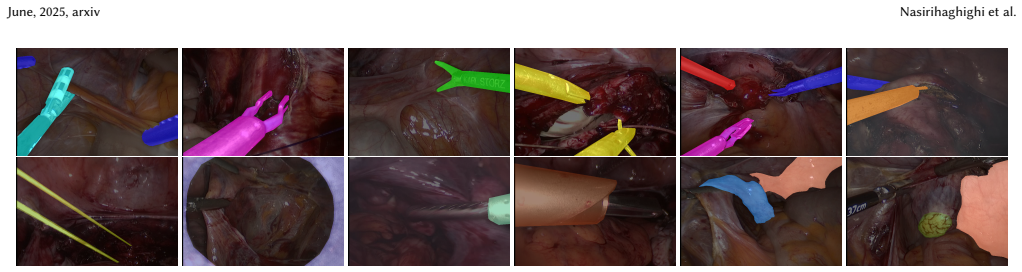
The central discovery is the dataset itself, as the authors state it: no prior public resource for gynecologic laparoscopy combines action-level temporal annotations with pixel-level spatial masks at this scale. GynSurg includes 152 high-definition videos annotated for four actions plus a rest class, with separate binary labels for bleeding and smoke on a dedicated subset, and 12,362 frames at 750x480 with masks for 21 instrument classes and four anatomy labels, from laparoscopic hysterectomy recordings. The paper reports that existing datasets cover only one or two tasks and are smaller, and it demonstrates GynSurg's usefulness by training standard models: ResNet-LSTM gives the best average action accuracy, DeepLabV3 leads instrument segmentation, and a center-point prompted Segment Anything Model reaches Dice scores above 80 percent on several classes.
Load-bearing premise
The load-bearing premise is that the 152 videos chosen from more than 600 recorded procedures fairly represent routine gynecologic laparoscopy, since the paper gives no selection criteria; if easier or cleaner cases were favored, the dataset's diversity and baseline numbers would not generalize.
Editorial extensions
If this is right
- Action recognition, side-effect detection, and segmentation can now be trained and evaluated on the same videos, so end-to-end surgical workflow models can be compared under one protocol.
- The separate bleeding and smoke labels make it possible to train detectors for events that matter for intraoperative assistance and postoperative review.
- The documented class imbalance can serve as a testbed for imbalance-robust training methods, since rare classes like transection are frequently misclassified.
- The 75 unannotated videos provide a ready-made setting for semi-supervised and self-supervised learning, as the paper states.
- Public release of the dataset and training splits makes the baselines reproducible and lets other researchers add new tasks.
Reading between the lines
- Because the 152 videos were selected from more than 600 recorded procedures without reported criteria, the strongest claim is about the annotated subset; labeling the 75 unannotated videos would turn them into a direct out-of-distribution test of the published baselines.
- The same videos could support additional annotations, such as surgical phase or skill labels, since actions and side effects are already localized in time; the paper does not propose this.
- The near-chance results on rare classes suggest the resource could be used to separate data-scarcity effects from model-architecture effects, which the paper does not pursue.
Editorial analysis
A structured set of objections, weighed in public.
Referee Report
Summary. The paper introduces GynSurg, a multi-task dataset for gynecologic laparoscopic surgery, comprising 152 expert-annotated videos for four actions and two side effects, 12,362 frames with pixel-level masks for instruments and anatomical structures, and 75 unannotated videos. The authors report benchmarks for action recognition, side-effect detection, and semantic segmentation using several standard architectures and a four-fold cross-validation protocol. The central claim is that GynSurg is the largest and most diverse multi-task gynecologic laparoscopy dataset to date, and the dataset and code are released publicly.
Significance. If the dataset is released as described, it is a potentially valuable resource for the surgical video analysis community. The paper's strengths include the public release of the dataset, the provision of training IDs and mask-creation code, the use of a standardized four-fold protocol with fold-wise standard deviations, and the breadth of baselined architectures (VGG/ResNet/ResNet3D for actions, DeepLabV3/UNet/PP/CE-Net/CPFNet/RecalNet/AdaptNet/SAM for segmentation). These features support reproducibility and make the resource useful for comparing future methods. However, several load-bearing inconsistencies must be resolved before the claims of comprehensiveness and reproducibility can be fully accepted.
major comments (4)
- [Section 2.1, Table 2] The reported clip counts are not consistent with the stated extraction rule. For a segment of duration D, partitioning into 3-second clips with a 1-second overlap yields about (D - 3)/2 clips per segment, so the totals should be approximately (total_duration - 3 * num_segments)/2 + num_segments. For Rest (790 segments, 24,067 s) this gives about 11,638 clips, not 1,100; for NeedlePassing (510 segments, 7,036 s) about 3,269, not 1,206; for Non-smoke (948 segments, 29,507 s) about 14,279, not 4,200. Bleeding is roughly consistent, so this is not simply a different unit. Either the extraction was not exhaustive as written (e.g., subsampling or a per-class cap) or one of the reported columns is incorrect. Because Table 2 is the primary evidence for dataset scale and class balance, the exact extraction rule and corrected counts must be provided for the benchmarks to be reproducible.
- [Section 2.1] The paper states that the 152 action videos were 'selected from over 600 recorded procedures' but gives no selection criteria. Without specifying how cases were chosen (e.g., random sampling, balancing by procedure type, exclusion of incomplete or low-quality recordings), the 'diverse' and 'comprehensive' claims cannot be evaluated, and benchmark results may not generalize to the broader population of gynecologic laparoscopies. Please document the selection protocol or explicitly analyze the potential selection bias.
- [Section 2.2 and Instrument Segmentation Setting] The abstract and Table 1 advertise 21 surgical instruments and 4 anatomical structures, but the evaluated segmentation benchmark uses only 7 instrument classes (after excluding trocar, clip applier, and corkscrew and merging suture-carrier, knot-pusher, needle-holder, and needle), 4 auxiliary classes (after excluding clip, colpotomizer, and glove and merging cannula/in-cannula and thread/thread-fragment), and 3 anatomical classes (after excluding the organ category). The reported Dice scores therefore do not cover the claimed 21 classes. The paper should clarify which classes are actually available and whether the released masks include all originally annotated classes; as written, the headline '21 instruments' overstates the evaluated scope.
- [Section 4.1, Table 5] The text states that ResNet-LSTM achieves 92.65% accuracy for bleeding and 86.03% for smoke, but Table 5 reports 88.26% and 80.69%, respectively (with F1 values of 92.51% and 85.58%). The text also says ResNet3D achieves 85.80% accuracy for smoke, while the table reports 83.54%. Please correct the text or the table so that the reported benchmark results are internally consistent.
minor comments (3)
- [Section 3.1] The training protocol is first described as 40 epochs, but later the same section says 'Models are optimized using cross-entropy loss over 30 epochs.' Please clarify which number is correct and reconcile the training schedule description.
- [Table 4 and Figure 4] Table 4 is titled 'Action recognition performance' and reports per-class values, while Figure 4 shows F1-scores; please state explicitly which metric is used in Table 4 and whether the per-class values are accuracy, precision, recall, or F1.
- [Abstract and Section 2.3] The dataset URL in the abstract uses 'GynSurge' while the GitHub repository is named 'GynSurg'; please harmonize the naming to avoid confusion for users.
Circularity Check
No significant circularity; the dataset's central claims rest on external annotations and public data, not on self-referential derivation.
full rationale
GynSurg is a dataset contribution, not a theoretical derivation. The central claim, that it is the largest and most diverse multi-task gynecologic laparoscopy dataset, is supported by independently collected video data, expert annotations, and public release, none of which are defined in terms of the paper's own benchmarks or conclusions. The action-recognition and segmentation experiments use standard architectures (VGG, ResNet, ResNet3D, DeepLabV3, UNet, SAM, and variants); while some of these baselines cite prior work by the same authors, the benchmark numbers are produced by training on the released dataset with conventional protocols and are externally reproducible from the public data and training IDs. Such self-citations are not load-bearing for the dataset's existence, scale, or annotation quality. The internal inconsistency in Table 2 between clip counts and total durations under the stated three-second, one-second-overlap extraction rule is a correctness/reproducibility issue, not a circularity issue, because the clip counts are not used to define the dataset's value and no prediction is forced by construction. No fitted parameter is renamed as a prediction, no uniqueness theorem is imported from the authors' prior work, and no known result is repackaged as an organizing principle. The paper is self-contained against external benchmarks and public availability, so no significant circularity is present.
Assumptions & free parameters
free parameters (2)
- lambda_ce (segmentation loss weighting) =
0.8
- sigma_smooth (Laplacian smoothing constant) =
1
assumptions (3)
- domain assumption Manual annotations by clinical experts are accurate and consistent enough to serve as ground truth.
- domain assumption The selected 152 action videos and 15 segmentation videos are representative of gynecologic laparoscopy.
- domain assumption The benchmark protocol and four-fold cross-validation yield meaningful estimates of model performance on this dataset.
Cite this review
Pith. "Pith review of GynSurg: A Comprehensive Gynecology Laparoscopic Surgery Dataset." pith.science (2026). https://pith.science/paper/EUN2LMGC
@misc{pith2026250611356,
  author       = {Pith},
  title        = {Pith review of: GynSurg: A Comprehensive Gynecology Laparoscopic Surgery Dataset},
  year         = {2026},
  howpublished = {\url{https://pith.science/paper/EUN2LMGC}},
  note         = {Machine review of arXiv:2506.11356}
}
read the original abstract
Recent advances in deep learning have transformed computer-assisted intervention and surgical video analysis, driving improvements not only in surgical training, intraoperative decision support, and patient outcomes, but also in postoperative documentation and surgical discovery. Central to these developments is the availability of large, high-quality annotated datasets. In gynecologic laparoscopy, surgical scene understanding and action recognition are fundamental for building intelligent systems that assist surgeons during operations and provide deeper analysis after surgery. However, existing datasets are often limited by small scale, narrow task focus, or insufficiently detailed annotations, limiting their utility for comprehensive, end-to-end workflow analysis. To address these limitations, we introduce GynSurg, the largest and most diverse multi-task dataset for gynecologic laparoscopic surgery to date. GynSurg provides rich annotations across multiple tasks, supporting applications in action recognition, semantic segmentation, surgical documentation, and discovery of novel procedural insights. We demonstrate the dataset quality and versatility by benchmarking state-of-the-art models under a standardized training protocol. To accelerate progress in the field, we publicly release the GynSurg dataset and its annotations
Figures


Figures from the paper (1 more)

Forward citations
Cited by 1 Pith paper
-
Stitch-Inferencer: Enhance Endoscopic Video Segmentation and Tracking via Panoramic Reconstruction
An inference-time framework builds an explicit panoramic memory from endoscopic video and uses it to improve off-the-shelf segmentation and tracking models without retraining.
Reference graph
Works this paper leans on
-
[1]
Aldahoul, N., Karim, H. A., Tan, M. J. T., and Fermin, J. L. Transfer learning and decision fusion for real time distortion classification in laparoscopic videos. IEEE Access 9 (2021), 115006–115018
work page 2021
-
[2]
Alshirbaji, T. A., Jalal, N. A., Docherty, P. D., Neumuth, T., and Möller, K. A deep learning spatial-temporal framework for detecting surgical tools in laparoscopic videos. Biomedical Signal Processing and Control 68 (2021), 102801
work page 2021
-
[3]
Encoder- decoder with atrous separable convolution for semantic image segmentation
Chen, L.-C., Zhu, Y., Papandreou, G., Schroff, F., and Adam, H. Encoder- decoder with atrous separable convolution for semantic image segmentation. In Proceedings of the European conference on computer vision (ECCV) (2018), pp. 801– 818
work page 2018
-
[4]
Surgical endoscopy 37, 7 (2023), 5164–5175
Den Boer, R., Jaspers, T., De Jongh, C., Pluim, J., V an Der Sommen, F., Boers, T., van Hillegersberg, R., V an Eijnatten, M., and Ruurda, J.Deep learning- based recognition of key anatomical structures during robot-assisted minimally invasive esophagectomy. Surgical endoscopy 37, 7 (2023), 5164–5175
work page 2023
-
[5]
Cpfnet: Context pyramid fusion network for medical image segmentation
Feng, S., Zhao, H., Shi, F., Cheng, X., Wang, M., Ma, Y., Xiang, D., Zhu, W., and Chen, X. Cpfnet: Context pyramid fusion network for medical image segmentation. IEEE Transactions on Medical Imaging 39 , 10 (2020), 3008–3018
work page 2020
-
[6]
Funke, I., Mees, S. T., Weitz, J., and Speidel, S. Video-based surgical skill assessment using 3d convolutional neural networks. International journal of computer assisted radiology and surgery 14 (2019), 1217–1225
work page 2019
-
[7]
Lensid: a cnn-rnn-based framework to- wards lens irregularity detection in cataract surgery videos
Ghamsarian, N., Taschwer, M., Putzgruber-Adamitsch, D., Sarny, S., El- Shabrawi, Y., and Schoeffmann, K. Lensid: a cnn-rnn-based framework to- wards lens irregularity detection in cataract surgery videos. In Medical Image Computing and Computer Assisted Intervention–MICCAI 2021: 24th International Conference, Strasbourg, France, September 27–October 1, 20...
work page 2021
-
[8]
Ghamsarian, N., Taschwer, M., Putzgruber-Adamitsch, D., Sarny, S., El- Shabrawi, Y., and Schöffmann, K. Recal-net: Joint region-channel-wise cali- brated network for semantic segmentation in cataract surgery videos. In Neural Information Processing (Cham, 2021), T. Mantoro, M. Lee, M. A. Ayu, K. W. Wong, and A. N. Hidayanto, Eds., Springer International P...
work page 2021
Show all 35 references
-
[9]
Deep- pyramid: Enabling pyramid view and deformable pyramid reception for semantic segmentation in cataract surgery videos
Ghamsarian, N., Taschwer, M., Sznitman, R., and Schoeffmann, K. Deep- pyramid: Enabling pyramid view and deformable pyramid reception for semantic segmentation in cataract surgery videos. In International Conference on Medical Image Computing and Computer-Assisted Intervention...
2022
-
[10]
Ce-net: Context encoder network for 2d medical image segmentation
Gu, Z., Cheng, J., Fu, H., Zhou, K., Hao, H., Zhao, Y., Zhang, T., Gao, S., and Liu, J. Ce-net: Context encoder network for 2d medical image segmentation. IEEE Transactions on Medical Imaging 38 , 10 (2019), 2281–2292
2019
-
[11]
J., Shen, Y., W allis, P., Allen-Zhu, Z., Li, Y., W ang, S., W ang, L., Chen, W., et al
Hu, E. J., Shen, Y., W allis, P., Allen-Zhu, Z., Li, Y., W ang, S., W ang, L., Chen, W., et al. Lora: Low-rank adaptation of large language models. ICLR 1, 2 (2022), 3
2022
-
[12]
C., Lo, W.-Y., et al.Segment anything
Kirillov, A., Mintun, E., Ravi, N., Mao, H., Rolland, C., Gustafson, L., Xiao, T., Whitehead, S., Berg, A. C., Lo, W.-Y., et al.Segment anything. In Proceedings of the IEEE/CVF international conference on computer vision (2023), pp. 4015–4026
2023
-
[13]
Kitaguchi, D., Takeshita, N., Matsuzaki, H., Takano, H., Owada, Y., Enomoto, T., Oda, T., Miura, H., Y amanashi, T., W atanabe, M., et al.Real-time automatic surgical phase recognition in laparoscopic sigmoidectomy using the convolu- tional neural network-based deep learning a...
2020
-
[14]
Laparoscopic surgery reduces the inci- dence of surgical site infections compared to the open approach for colorectal procedures: a meta-analysis
Kulkarni, N., and Arulampalam, T. Laparoscopic surgery reduces the inci- dence of surgical site infections compared to the open approach for colorectal procedures: a meta-analysis. Techniques in coloproctology 24, 10 (2020), 1017–1024
2020
-
[15]
Glenda: gynecologic laparoscopy endometriosis dataset
Leibetseder, A., Kletz, S., Schoeffmann, K., Keckstein, S., and Keckstein, J. Glenda: gynecologic laparoscopy endometriosis dataset. In International Conference on Multimedia Modeling (2019), Springer, pp. 439–450
2019
-
[16]
J., Kletz, S., Münzer, B., Schoeff- mann, K., and Keckstein, J
Leibetseder, A., Petscharnig, S., Primus, M. J., Kletz, S., Münzer, B., Schoeff- mann, K., and Keckstein, J. Lapgyn4: a dataset for 4 automatic content analysis problems in the domain of laparoscopic gynecology. In Proceedings of the 9th ACM multimedia systems conference (2018...
2018
-
[17]
Smoke detection in endoscopic surgery videos: a first step towards retrieval of semantic events
Loukas, C., and Georgiou, E. Smoke detection in endoscopic surgery videos: a first step towards retrieval of semantic events. The International Journal of Medical Robotics and Computer Assisted Surgery 11 , 1 (2015), 80–94
2015
-
[18]
Multimedia Tools and Applications 46 (2010), 521–544
Lux, M., Marqes, O., Schöffmann, K., Böszörmenyi, L., and Lajtai, G.A novel tool for summarization of arthroscopic videos. Multimedia Tools and Applications 46 (2010), 521–544
2010
-
[19]
Surgai: deep learning for computerized laparoscopic image understanding in gynaecology
Madad Zadeh, S., Francois, T., Calvet, L., Chauvet, P., Canis, M., Bartoli, A., and Bourdel, N. Surgai: deep learning for computerized laparoscopic image understanding in gynaecology. Surgical endoscopy 34 (2020), 5377–5383
2020
-
[20]
Relevance segmentation of laparoscopic videos
Münzer, B., Schoeffmann, K., and Böszörmenyi, L. Relevance segmentation of laparoscopic videos. In 2013 IEEE international symposium on multimedia (2013), IEEE, pp. 84–91
2013
-
[21]
Content-based processing and analysis of endoscopic images and videos: A survey
Münzer, B., Schoeffmann, K., and Böszörmenyi, L. Content-based processing and analysis of endoscopic images and videos: A survey. Multimedia Tools and Applications 77 (2018), 1323–1362
2018
-
[22]
Event recognition in laparoscopic gynecology videos with hybrid transformers
Nasirihaghighi, S., Ghamsarian, N., Husslein, H., and Schoeffmann, K. Event recognition in laparoscopic gynecology videos with hybrid transformers. In International Conference on Multimedia Modeling (2024), Springer, pp. 82–95
2024
-
[23]
Action recognition in video recordings from gynecologic laparoscopy
Nasirihaghighi, S., Ghamsarian, N., Stefanics, D., Schoeffmann, K., and Hus- slein, H. Action recognition in video recordings from gynecologic laparoscopy. In 2023 IEEE 36th International symposium on computer-based medical systems (CBMS) (2023), IEEE, pp. 29–34
2023
-
[24]
U-net: Convolutional networks for biomedical image segmentation
Ronneberger, O., Fischer, P., and Brox, T. U-net: Convolutional networks for biomedical image segmentation. In Medical Image Computing and Computer- Assisted Intervention – MICCAI 2015 (2015), pp. 234–241
2015
-
[25]
Keyframe extraction in endoscopic video
Schoeffmann, K., Del Fabro, M., Szkaliczki, T., Böszörmenyi, L., and Keck- stein, J. Keyframe extraction in endoscopic video. Multimedia Tools and Appli- cations 74 (2015), 11187–11206
2015
-
[26]
Video retrieval in laparoscopic video recordings with dynamic content descriptors
Schoeffmann, K., Husslein, H., Kletz, S., Petscharnig, S., Muenzer, B., and Beecks, C. Video retrieval in laparoscopic video recordings with dynamic content descriptors. Multimedia Tools and Applications 77 (2018), 16813–16832
2018
-
[27]
A., Ochoa-Ruiz, G., and Ali, S
Teevno, M. A., Ochoa-Ruiz, G., and Ali, S. A semi-supervised teacher-student framework for surgical tool detection and localization. Computer Methods in Biomechanics and Biomedical Engineering: Imaging & Visualization 11 , 4 (2023), 1033–1041
2023
-
[28]
Surgical endoscopy 35 (2021), 1651–1658
Tokuyasu, T., Iwashita, Y., Matsunobu, Y., Kamiyama, T., Ishikake, M., Sak- aguchi, S., Ebe, K., Tada, K., Endo, Y., Etoh, T., et al.Development of an artificial intelligence system using deep learning to indicate anatomical landmarks during laparoscopic cholecystectomy. Surgi...
2021
-
[29]
Learning spatiotemporal features with 3d convolutional networks
Tran, D., Bourdev, L., Fergus, R., Torresani, L., and Paluri, M. Learning spatiotemporal features with 3d convolutional networks. In Proceedings of the IEEE international conference on computer vision (2015), pp. 4489–4497
2015
-
[30]
Minimally invasive surgery: national trends in adoption and future directions for hospital strategy
Tsui, C., Klein, R., and Garabrant, M. Minimally invasive surgery: national trends in adoption and future directions for hospital strategy. Surgical endoscopy 27 (2013), 2253–2257
2013
-
[31]
Autolaparo: A new dataset of integrated multi-tasks for image-guided surgical automation in laparoscopic hysterectomy
Wang, Z., Lu, B., Long, Y., Zhong, F., Cheung, T.-H., Dou, Q., and Liu, Y. Autolaparo: A new dataset of integrated multi-tasks for image-guided surgical automation in laparoscopic hysterectomy. In International Conference on Medical Image Computing and Computer-Assisted Interv...
2022
-
[32]
Unified perceptual parsing for scene understanding
Xiao, T., Liu, Y., Zhou, B., Jiang, Y., and Sun, J. Unified perceptual parsing for scene understanding. In Proceedings of the European conference on computer vision (ECCV) (2018), pp. 418–434
2018
-
[33]
M., François, T., Comptour, A., Canis, M., Bourdel, N., and Bartoli, A
Zadeh, S. M., François, T., Comptour, A., Canis, M., Bourdel, N., and Bartoli, A. Surgai3. 8k: a labeled dataset of gynecologic organs in laparoscopy with appli- cation to automatic augmented reality surgical guidance. Journal of Minimally Invasive Gynecology 30, 5 (2023), 397–405
2023
-
[34]
Laparoscopic image-based critical action recognition and anticipation with explainable features
Zhang, J., Zhou, S., Wang, Y., Shi, S., Wan, C., Zhao, H., Cai, X., and Ding, H. Laparoscopic image-based critical action recognition and anticipation with explainable features. IEEE Journal of Biomedical and Health Informatics 27 , 11 (2023), 5393–5404
2023
-
[35]
Zhou, Z., Siddiqee, M. M. R., Tajbakhsh, N., and Liang, J.Unet++: Redesigning skip connections to exploit multiscale features in image segmentation. IEEE Transactions on Medical Imaging 39 , 6 (2020), 1856–1867
2020
Reviewed August 7, 2026 · model on record in the stance chip above.
Discussion (0). Continue with ORCID to comment.