REVIEW 2 major objections 5 minor 38 references
Angular clustering of distance indicators with galaxies can self-calibrate a constant magnitude offset and break its degeneracy with H0.
Reviewed by Pith at T0; open to challenge. T0 means a machine referee read the full paper against a public rubric. the ladder, T0–T4 →
T0 review · grok-4.5
2026-07-13 06:50 UTC pith:EWA5CUQS
load-bearing objection Clean geometric idea for floating a constant SN Ia calibration offset via joint redshift/distance-space angular cross-correlations; optimistic σ_ΔM≈0.05 is real under the stated CMB-anchoring, but that anchoring is load-bearing and untested with free A_s/σ_8. the 2 major comments →
Skipping the rungs! Calibrating distance indicators through their clustering with galaxies
The pith
A machine-rendered reading of the paper's core claim, the machinery that carries it, and where it could break.
Core claim
Angular cross-correlations of distance indicators with galaxy redshift catalogues, analysed jointly in redshift space and in observed-distance space, break the H0–ΔM degeneracy and thereby constrain a constant calibration bias without relying on primary distance-ladder anchors.
What carries the argument
The 2 imes2 angular data vector {C_gs_ℓ, C_gd_ℓ}: the galaxy–redshift-space and galaxy–distance-space cross-power spectra of the same set of candles, whose Limber kernels respond differently to a pure radial stretch α_ΔM = 10^{ΔM/5} than to a change in H0.
Load-bearing premise
Every cosmological parameter that sets the shape and amplitude of the matter power spectrum is fixed to its early-universe value, so the method assumes those clustering parameters are unbiased.
What would settle it
Apply the joint {C_gs_ℓ, C_gd_ℓ} pipeline to real overlapping SN Ia and galaxy catalogues (e.g., early LSST plus DESI) and check whether the recovered ΔM is consistent with zero at the forecasted ~0.05 mag precision; a statistically significant non-zero ΔM, or a posterior that cannot exclude |ΔM|~0.13, would falsify the claim that the method cleanly self-calibrates.
Editorial analysis
A structured set of objections, weighed in public.
Referee Report
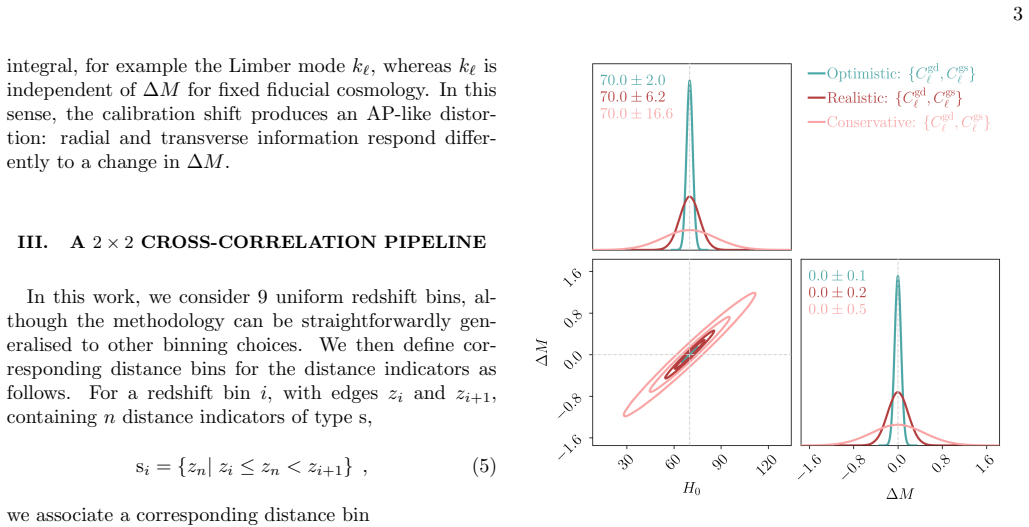
Summary. The paper proposes using angular cross-correlations of distance indicators (illustrated with SN Ia) with a galaxy redshift catalogue, measured both in redshift space (C_gs_ℓ) and in observed-distance space (C_gd_ℓ), to constrain a constant calibration offset ΔM that multiplies all inferred distances. Because ΔM remaps only the radial coordinate of the distance indicators while H0 rescales both radial and transverse distances, the two effects produce distinguishable AP-like distortions of the clustering pattern (Eq. 4 and Fig. 1). A 2×2 Gaussian likelihood is constructed from the joint data vector, with an analytic covariance that includes the non-vanishing s–d shot-noise term. Fisher forecasts for three survey configurations (conservative/realistic/optimistic) are presented, together with a log-normal mock + MCMC validation that recovers consistent (slightly broader) contours. In the optimistic case the authors obtain σ_ΔM ≈ 0.05–0.06 and σ_H0 ≈ 1.8–2 km s^{-1} Mpc^{-1}, sufficient in principle to test the ΔM ≈ 0.13 shift that would reconcile SH0ES and Planck as a pure low-z calibration systematic.
Significance. If the forecasts hold under realistic modelling, the method supplies a geometric, clustering-based consistency test of low-z distance-indicator calibration that is complementary to both the classical distance ladder and the inverse distance ladder. The explicit inclusion of ΔM as a free parameter, the joint use of redshift- and distance-space cross-spectra, and the transparent AP-like argument are genuine novelties relative to earlier cross-correlation studies of standard candles. The mock validation and the clear statement that the analysis anchors the power-spectrum shape to CMB-inferred parameters (A_s, n_s, Ω_b, ldots) are strengths that make the work reproducible and falsifiable. The result is therefore of direct interest for the Hubble-tension debate, provided the optimistic error bars survive the most important modelling extensions.
major comments (2)
- [§IV, Table I, §VI, Eq. (4)] The headline optimistic constraints (Table I, Fig. 2, abstract) are obtained after fixing A_s, n_s, Ω_b, N_eff (and T_CMB) to CMB fiducials while only marginalising over Ω_m, b_g, b_d (§IV and Fisher matrix after Eq. D2). Because C_ℓ ∝ b_g b_d A_s P_shape(k_ℓ) and the ΔM-induced distortion (Eq. 4) acts primarily through radial remapping and bin overlap, a free A_s (or σ_8) is largely degenerate with the bias product and can absorb part of the geometric signal that currently breaks the H0–ΔM degeneracy. Section VI acknowledges the assumption but does not report the Fisher block with A_s free; without that quantification it is unknown whether σ_ΔM remains ≲ 0.13 once amplitude freedom is restored. A short additional forecast (or a one-parameter extension of the existing Fisher) is needed before the claim that the method can test the SH0ES–Planck offset can be regarded as robust.
- [§V, Fig. 3] The mock validation (Fig. 3) freezes the same set of power-spectrum parameters and uses only six bins and a restricted multipole range. While the Fisher–MCMC comparison is reassuring under those conditions, it does not close the amplitude-degeneracy loophole identified above. At minimum the authors should state explicitly that the mock test inherits the same fixed-A_s assumption, or (preferably) re-run a subset of the MCMC with a free amplitude parameter to illustrate the degradation.
minor comments (5)
- [Abstract, Table I, §VI] Abstract quotes σ_ΔM ≈ 0.05 while Table I lists ±0.06 for the optimistic case; the text in §VI says “accuracy ≤ |0.1|”. Please reconcile the three statements.
- [§II, §VI] The linear-bias model is adopted throughout and the biases remain essentially unconstrained in the 2×2 pipeline (§VI). A brief quantitative statement of how much the H0–ΔM contours degrade when a free A_s is added (or when a simple scale-dependent bias is allowed) would strengthen the discussion even if full auto-spectra are left for future work.
- [Fig. 1] Figure 1 is conceptually clear but the middle panel caption could more explicitly note that the galaxy field is also diluted when H0 changes, whereas only the SN field is remapped when ΔM changes.
- [§II, §III] Typographical: “Calibra tion Systema tics” and “A2×2Cross-correla tion” in section headings appear to contain residual soft hyphens or spacing artefacts.
- [§IV] The optimistic f_sky = 0.8 assumes near-complete overlap of DESI+4HS with LSST/ZTF; a short sentence on how the forecast scales with f_sky would help readers assess intermediate survey combinations.
Circularity Check
No circular derivation: Fisher forecasts of ΔM/H0 from AP-like clustering under explicit fixed-CMB assumptions, not tautological reductions.
full rationale
The paper is a methodology-plus-Fisher-forecast Letter. Its central results (optimistic σ_ΔM ≈ 0.05, σ_H0 ≈ 1.8 km s^{-1} Mpc^{-1}) are obtained by constructing the data vector {C_gs_ℓ, C_gd_ℓ}, writing the Gaussian likelihood (Eq. 7) and analytic covariance (Eq. 8), and evaluating the Fisher matrix (Eq. D2) while freely varying {H0, ΔM, Ωm, bg, bd} and fixing the remaining ΛCDM parameters to CMB fiducials. The effect of a constant ΔM is derived from number conservation (Appendix B) and appears as a pure radial remapping α_ΔM = 10^{ΔM/5} inside the Limber integral (Eq. 4); this is not defined in terms of the forecasted uncertainties, nor is any parameter fitted to data and then re-predicted. Self-citations ([18], [19]) appear only as prior cross-correlation literature that is being generalised; they supply no uniqueness theorem or load-bearing ansatz that forces the present forecasts. The explicit choice to anchor the power-spectrum shape to CMB values is stated as an inverse-distance-ladder-style consistency test (Section VI), not a hidden tautology. Mock validation freezes the same parameters by design and merely checks pipeline recovery. No step reduces a claimed prediction or first-principles result to its own inputs by construction.
Axiom & Free-Parameter Ledger
free parameters (5)
- ΔM
- H0
- Ωm
- bg, bd
- κ (distance error scaling)
axioms (5)
- domain assumption Linear bias model δ_i = b_i δ_m with constant b_g, b_d
- domain assumption Early-Universe parameters (A_s, n_s, Ω_b, N_eff, …) fixed to CMB fiducials
- domain assumption Gaussian random fields and analytic Gaussian covariance (Eq. 8)
- domain assumption Limber approximation valid for ℓ_min=10 and k_max=0.1 h Mpc^{-1}
- ad hoc to paper Calibration systematic is a pure constant multiplicative shift α_ΔM = 10^{ΔM/5}
read the original abstract
We show that angular cross-correlations between distance indicators and galaxy redshift catalogues, when interpreted within an assumed cosmological model, can constrain potential biases in distance measurements induced by calibration systematics. As a test case, we consider a simple scenario in which a constant calibration offset $\Delta M$ shifts all observed distances by a multiplicative factor, and we produce Fisher forecasts for the constraining power on $\Delta M$ and $H_0$ from existing and upcoming surveys. In our most optimistic scenario, based on the expected number of SN Ia observed by LSST and the DESI final data release, we find $\sigma_{\Delta M} \approx 0.05$ and $\sigma_{H_0} \approx 1.81~\mathrm{km~s^{-1}~Mpc^{-1}}$. This has important implications for the Hubble tension, since explaining the discrepancy purely as a calibration systematic in low-$z$ measurements would require $\Delta M \approx 0.13$.
Figures



Reference graph
Works this paper leans on
-
[1]
A. R. Sandage, Physics Today23, 34 (1970)
1970
-
[2]
L. Verde, T. Treu, and A. G. Riess, Nature Astron.3, 891 (2019), arXiv:1907.10625 [astro-ph.CO]
Pith/arXiv arXiv 2019
-
[3]
Di Valentinoet al.(CosmoVerse Network), Phys
E. Di Valentinoet al.(CosmoVerse Network), Phys. Dark Univ.49, 101965 (2025), arXiv:2504.01669 [astro- ph.CO]
Pith/arXiv arXiv 2025
-
[4]
Abdallaet al., JHEAp34, 49 (2022), arXiv:2203.06142 [astro-ph.CO]
E. Abdallaet al., JHEAp34, 49 (2022), arXiv:2203.06142 [astro-ph.CO]
Pith/arXiv arXiv 2022
-
[5]
A. G. Riesset al., Astrophys. J. Lett.934, L7 (2022), arXiv:2112.04510 [astro-ph.CO]. 8
Pith/arXiv arXiv 2022
-
[6]
N. Aghanimet al.(Planck), Astron. Astrophys.641, A6 (2020), [Erratum: Astron.Astrophys. 652, C4 (2021)], arXiv:1807.06209 [astro-ph.CO]
Pith/arXiv arXiv 2020
-
[7]
J.-P. Hu and F.-Y. Wang, Universe9, 94 (2023), arXiv:2302.05709 [astro-ph.CO]
Pith/arXiv arXiv 2023
-
[8]
S. Vagnozzi, Phys. Rev. D102, 023518 (2020), arXiv:1907.07569 [astro-ph.CO]
Pith/arXiv arXiv 2020
-
[9]
Vagnozzi, Universe9, 393 (2023), arXiv:2308.16628 [astro-ph.CO]
S. Vagnozzi, Universe9, 393 (2023), arXiv:2308.16628 [astro-ph.CO]
Pith/arXiv arXiv 2023
-
[10]
E. Di Valentino, O. Mena, S. Pan, L. Visinelli, W. Yang, A. Melchiorri, D. F. Mota, A. G. Riess, and J. Silk, Class. Quant. Grav.38, 153001 (2021), arXiv:2103.01183 [astro- ph.CO]
Pith/arXiv arXiv 2021
-
[11]
D. Camarena and V. Marra, arXiv e-prints , arXiv:2307.02434 (2023), arXiv:2307.02434 [astro- ph.CO]
Pith/arXiv arXiv 2023
-
[12]
R. Camilleriet al.(DES), Mon. Not. Roy. Astron. Soc. 537, 1818 (2025), arXiv:2406.05049 [astro-ph.CO]
Pith/arXiv arXiv 2025
-
[13]
D. Camarena and V. Marra, Mon. Not. Roy. Astron. Soc. 495, 2630 (2020), arXiv:1910.14125 [astro-ph.CO]
Pith/arXiv arXiv 2020
-
[14]
Oguri, Physical Review D93, 10.1103/phys- revd.93.083511 (2016)
M. Oguri, Physical Review D93, 10.1103/phys- revd.93.083511 (2016)
doi:10.1103/phys- 2016
-
[15]
Ferri, I
J. Ferri, I. L. Tashiro, L. Abramo, I. Matos, M. Quartin, and R. Sturani, Journal of Cosmology and Astroparticle Physics2025(04), 008
-
[16]
S. Mukherjee, B. D. Wandelt, S. M. Nissanke, and A. Silvestri, Phys. Rev. D103, 043520 (2021), arXiv:2007.02943 [astro-ph.CO]
Pith/arXiv arXiv 2021
-
[17]
S. Mukherjee and B. D. Wandelt, preprint (2018), arXiv:1808.06615 [astro-ph.CO]
Pith/arXiv arXiv 2018
-
[18]
M. L. Cross-Parkin, C. Howlett, L. Giani, C. Blake, and T. M. Davis, preprint (2026), arXiv:2605.06783 [astro- ph.CO]
Pith/arXiv arXiv 2026
-
[19]
A. Q. Cheng and J. Gair, preprint (2026), arXiv:2603.13053 [astro-ph.CO]
Pith/arXiv arXiv 2026
-
[20]
Alcock and B
C. Alcock and B. Paczynski, Nature281, 358 (1979)
1979
-
[21]
C. e. a. Blake, MNRAS418, 1725 (2011), arXiv:1108.2637 [astro-ph.CO]
Pith/arXiv arXiv 2011
-
[22]
Lewis and A
A. Lewis and A. Challinor, CAMB: Code for Anisotropies in the Microwave Background, Astrophysics Source Code Library, record ascl:1102.026 (2011), ascl:1102.026
2011
-
[23]
R. A. Fisher, Phil. Trans. Roy. Soc. Lond. A222, 309 (1922)
1922
-
[24]
Collaboration, The Astronomical Journal164, 207 (2022)
D. Collaboration, The Astronomical Journal164, 207 (2022)
2022
-
[25]
E. C. Bellm, The zwicky transient facility (2014), arXiv:1410.8185 [astro-ph.IM]
Pith/arXiv arXiv 2014
-
[26]
C. Howlett, A. S. G. Robotham, C. D. P. La- gos, and A. G. Kim, Astrophys. J.847, 128 (2017), arXiv:1708.08236 [astro-ph.CO]
Pith/arXiv arXiv 2017
-
[27]
Ivezi´ cet al.(LSST), Astrophys
ˇZ. Ivezi´ cet al.(LSST), Astrophys. J.873, 111 (2019), arXiv:0805.2366 [astro-ph]
Pith/arXiv arXiv 2019
-
[28]
E. N. Tayloret al., The Messenger190, 46 (2023)
2023
-
[29]
Alonso, J
D. Alonso, J. Sanchez, and A. Slosar, Monthly Notices of the Royal Astronomical Society484, 4127–4151 (2019)
2019
-
[30]
Foreman-Mackey, D
D. Foreman-Mackey, D. W. Hogg, D. Lang, and J. Good- man, Publications of the Astronomical Society of the Pa- cific125, 306–312 (2013)
2013
-
[31]
S. R. Hinton, The Journal of Open Source Software1, 00045 (2016)
2016
-
[32]
L. Giani, C. Howlett, R. Ruggeri, F. Bianchini, K. Said, and T. M. Davis, JCAP2023(5), 002, arXiv:2301.08381 [astro-ph.CO]
-
[33]
N. Sch¨ oneberg, M. Simonovi´ c, J. Lesgourgues, and M. Zaldarriaga, JCAP2018(10), 047, arXiv:1807.09540 [astro-ph.CO]
-
[34]
M. LoVerde and N. Afshordi, Phys. Rev. D78, 123506 (2008), arXiv:0809.5112 [astro-ph]
Pith/arXiv arXiv 2008
-
[35]
Kaiser, mnras227, 1 (1987)
N. Kaiser, mnras227, 1 (1987)
1987
-
[36]
Krause and T
E. Krause and T. Eifler, Monthly Notices of the Royal Astronomical Society470, 2100–2112 (2017)
2017
-
[37]
C. R. Raoet al., Bull. Calcutta Math. Soc37, 81 (1945)
1945
-
[38]
Cram´ er,Mathematical methods of statistics, Vol
H. Cram´ er,Mathematical methods of statistics, Vol. 9 (Princeton university press, 1999)
1999
discussion (0)
Sign in with ORCID, Apple, or X to comment. Anyone can read and Pith papers without signing in.