REVIEW 5 major objections 4 minor 28 references
Maximum Solar Energy Tracking Leverage High-DoF Robotics System with Deep Reinforcement Learning
T0 review · 5 major / 4 minor · reviewed 2026-08-12 · deepseek-v4-flash
Pith's one-line read Robotic sun tracker with objectness loss beats static panels by 34%
desk verdict Central 34% energy-gain claim is unverifiable as written; equations are self-contradictory and the method-to-controller link is missing. read the letter →
The pith
A machine-rendered reading of the paper's core claim, the machinery that carries it, and where it could break.
The reading
What carries the argument
The key object is the solar alignment regularization term $\mathcal{E}_s$ in Eq. (1), an $\ell^\infty$ penalty between predicted solar points $d^s_k$ and ground-truth solar points $d^G_k$, which forces predictions to stay within the solar disc boundary. This is combined with an iterative refinement loss $\mathcal{E}_r$ in Eq. (2) that weights recent iterations more heavily, and the two are fused into the final objective $\mathcal{E}_P$ in Eq. (3). The control side uses a deep Q-network with experience replay and a target network to map environmental images to arm orientations.
What would settle it
Reproduce the experiment using a standard astronomical sun-position formula instead of the learned solar points; if the 34% energy gain persists, the objectness loss is not the cause. Or demand the labeling and calibration protocol and check whether the 81% and 58% numbers survive when those details are specified and reproduced.
Extended reading notes
Core claim
The central claim is that a solar-positioning regularization loss, applied only during training, makes a deep-Q-network-based controller track the sun reliably enough to outperform a static panel. The loss penalizes predicted solar points that fall outside the perceived solar disc, so the model learns to keep its estimates inside the correct boundary without needing a solar mask at inference time. The authors further claim that this approach, integrated with a six-degree-of-freedom robotic arm, achieves 81% training accuracy, 58% real-world positioning success in dynamic outdoor conditions, and a 34% improvement in energy collection over a static setup.
Load-bearing premise
The framework assumes that ground-truth solar points are available for every training image and that a simple L-infinity distance to those points captures everything that makes the sun trackable, with no stated protocol for how those labels are produced or how camera coordinates map to arm coordinates.
Editorial extensions
If this is right
- Runtime operations require no solar segmentation, which lowers latency and computational cost on embedded robot platforms.
- The reported 34% average energy gain over a static panel suggests meaningful yield improvements for autonomous solar harvesting systems.
- The 58% real-world success rate indicates the approach is feasible but not yet deployment-ready, leaving clear room for calibration and transfer improvements.
- The same objectness-regularized tracking idea could transfer to tracking other well-defined objects, such as aircraft or satellites, in robotic vision loops.
Reading between the lines
- The gap between 81% training accuracy and 58% real-world success suggests the evaluation chain—labeling, camera-to-arm calibration, and sim-to-real transfer—is where the method is most fragile; the paper does not address this gap.
- A cheaper baseline would be a conventional two-axis solar tracker; the paper only compares against a static panel, so the added value of high-DoF dexterity over simpler trackers is untested.
- A testable extension is to replace the learned solar-objectness loss with a standard astronomical sun-position formula during training; if the 34% energy gain persists, the objectness loss is not the cause of the improvement.
Editorial analysis
A structured set of objections, weighed in public.
Referee Report
Summary. The paper proposes an objectness regularization framework for solar tracking with a high-DoF robotic arm. The method trains a CNN/RNN to predict solar points while penalizing deviations from ground-truth solar positions via a proposed loss, then claims to integrate this with a DQN controller for 6-DOF panel orientation. The paper reports an 81% training accuracy, a 58% real-world success rate, and a 34% average energy gain over a static panel setup. The central claim is that the objectness regularization, applied only during training, enables robust outdoor solar tracking and improves energy collection.
Significance. If the claims held, the work could constitute a practical contribution to autonomous solar tracking by combining objectness-regularized visual prediction with high-DoF robotic control. The idea of using objectness only at training time is reasonable and could reduce inference cost. However, the manuscript as written does not provide enough detail to assess the method or verify the empirical results. There is no code, no dataset, no detailed experimental protocol, and no statistical grounding for the reported numbers, so the significance of the contribution cannot be established from the submitted text.
major comments (5)
- [Section III-B, Eq. (1)] The loss Es is written with d^s_k and d^U_k, but the text only defines d^s_k and d^G_k as predicted and ground-truth solar points, leaving d^U_k undefined; the subscript inconsistency (t vs k) and the undefined variable make the central training objective uninterpretable.
- [Section III-B, Eq. (2)] The equation introduces chi^{N-i} as a decay factor, while the text states 'where gamma < 1 denotes a decay factor'; chi is never defined, and the product over N copies of Es is not motivated or derived, so the iterative refinement loss cannot be evaluated or reproduced.
- [Section III-C] The DQN description in Eqs. (4)-(6) is generic and does not specify the state space, action space, or reward function, nor does it explain how the predicted solar points from Section III-B are used as inputs or how the network outputs map to 6-DOF joint commands; consequently, the claimed integration of objectness regularization with deep reinforcement learning is not demonstrated.
- [Section IV] The three headline numbers (81% training accuracy, 58% real-world success rate, and 34% average energy gain) are reported without trial counts, variance, confidence intervals, or a precise definition of 'success rate'; the comparison to a static panel also lacks information about the static panel's fixed orientation, so the 34% gain cannot be attributed to the proposed method rather than to the simple benefit of any moving panel.
- [Section III-B and IV] The training objective EP directly minimizes distance to ground-truth solar points, so the reported 81% training accuracy partly reflects the training objective itself; the paper provides no test-set evaluation, no ablation without the objectness loss, and no generalization measure, leaving the central robustness claim unsubstantiated.
minor comments (4)
- [Title] The title uses 'Leverage' where the intended verb is 'Leveraging' or 'Using'.
- [Section III-B] The notation is inconsistent: d^s_t, d^s_k, d^G_k, and d^U_k appear with no systematic indexing, making the equations difficult to follow.
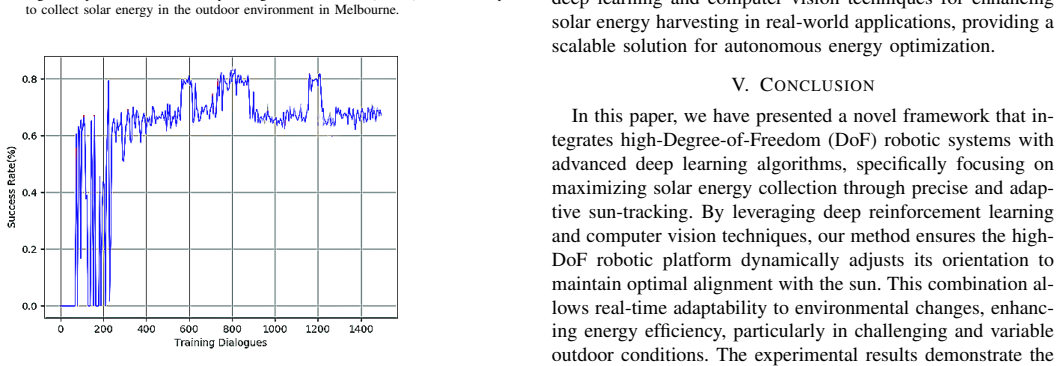
- [Section IV, Figs. 2-5] The figure captions are incomplete; for example, Fig. 4 merely repeats 'Performance (success rate) on tasks that are used for agent training', and the axes and units of the plots are not described in the text.
- [References] Several citations appear mismatched: reference [10] is an augmented reality paper cited for DQN experience replay, and reference [11] is a sentiment analysis paper cited for the iterative refinement loss; the authors should verify that all cited works actually support the claimed concepts.
Circularity Check
One minor fitted-input-as-prediction step; the deployment energy gain is externally measured and non-circular.
-
fitted input called prediction
[Section IV, 'Experiment Results', first results paragraph]
"The experimental results demonstrate that our method achieves a high success rate in both training(as shown in Fig3) and real-world implementation(as shown in Fig4), confirming its effectiveness. During the training phase, the algorithm attained an accuracy of 81% in predicting the optimal orientation angles for the solar panel based on environmental inputs."
The 81% training accuracy is measured on the same samples used to minimize EP (Eq. 3), which is a weighted combination of Es and Er. Es (Eq. 1) is the L-infinity distance between predicted solar points d^s_k and ground-truth points d^G_k, so optimizing EP directly fits the predicted points to the supervised labels. The reported training 'success rate' is therefore a report of the optimized training objective, not an independent prediction. It is not a held-out or deployment result and cannot by itself support the claim that the model predicts optimal angles. The 58% deployment success and 34% energy gain are externally measured and do not reduce to the loss.
full rationale
The only reduction I can exhibit with the paper's own equations is that the reported 81% 'training accuracy' is the value of the optimized objective EP (Eq. 3), which directly minimizes the L-infinity distance in Es (Eq. 1) between predicted and ground-truth solar points on the training set; calling this a prediction of optimal orientation angles is a fitted input presented as evidence. This is minor because the paper's central deployment claims — the 58% real-world success rate and the 34% energy gain over a static panel — are physical measurements external to the loss and are not derived from Eqs. (1)-(3). Eq. (1) contains undefined quantities (d^U_k) and an inconsistent symbol (ds_t vs d^G_k), and the DQN section (Eqs. 4-6) is never connected to Es or to the robot state/action space; these are correctness and completeness gaps, not circularity. Citation [14] is by overlapping authors, but the iterative-refinement loss is explicitly defined in Eq. (2) rather than imported as a black box, so it is not load-bearing self-citation. No uniqueness theorem is invoked. Overall circularity is low: one minor fitted-input-as-prediction step, with the headline empirical results remaining externally measured.
Assumptions & free parameters
free parameters (4)
- alpha
- beta
- chi (iterative refinement decay)
- gamma (DQN discount factor)
assumptions (4)
- domain assumption Ground-truth solar positions dG_k are available for every training sample.
- domain assumption A DQN with experience replay and target network can learn the solar tracking policy from the environment data E without a hand-crafted reward or state representation.
- ad hoc to paper The L-infinity solar-alignment penalty in Eq (1) is sufficient to enforce solar objectness and prevent drift at deployment.
- ad hoc to paper The product form of Er in Eq (2) defines a valid iterative refinement loss.
Cite this review
Pith. "Pith review of Maximum Solar Energy Tracking Leverage High-DoF Robotics System with Deep Reinforcement Learning." pith.science (2026). https://pith.science/paper/EWEHVKNT
@misc{pith2026241114568,
  author       = {Pith},
  title        = {Pith review of: Maximum Solar Energy Tracking Leverage High-DoF Robotics System with Deep Reinforcement Learning},
  year         = {2026},
  howpublished = {\url{https://pith.science/paper/EWEHVKNT}},
  note         = {Machine review of arXiv:2411.14568}
}
read the original abstract
Solar trajectory monitoring is a pivotal challenge in solar energy systems, underpinning applications such as autonomous energy harvesting and environmental sensing. A prevalent failure mode in sustained solar tracking arises when the predictive algorithm erroneously diverges from the solar locus, erroneously anchoring to extraneous celestial or terrestrial features. This phenomenon is attributable to an inadequate assimilation of solar-specific objectness attributes within the tracking paradigm. To mitigate this deficiency inherent in extant methodologies, we introduce an innovative objectness regularization framework that compels tracking points to remain confined within the delineated boundaries of the solar entity. By encapsulating solar objectness indicators during the training phase, our approach obviates the necessity for explicit solar mask computation during operational deployment. Furthermore, we leverage the high-DoF robot arm to integrate our method to improve its robustness and flexibility in different outdoor environments.
Figures


Figures from the paper (1 more)

Reference graph
Works this paper leans on
- [1]
-
[2]
Autonomous multi- robot servicing for spacecraft operation extension,
L. Gao, G. Cordova, C. Danielson, and R. Fierro, “Autonomous multi- robot servicing for spacecraft operation extension,” in 2023 IEEE/RSJ International Conference on Intelligent Robots and Systems (IROS) . IEEE, 2023, pp. 10 729–10 735
2023
-
[3]
Enhanced detection classification via clustering svm for various robot collaboration task,
R. Liu, X. Xu, Y . Shen, A. Zhu, C. Yu, T. Chen, and Y . Zhang, “Enhanced detection classification via clustering svm for various robot collaboration task,” arXiv preprint arXiv:2405.03026 , 2024
arXiv 2024
-
[4]
Advanced user credit risk prediction model using lightgbm, xgboost and tabnet with smoteenn,
C. Yu, Y . Jin, Q. Xing, Y . Zhang, S. Guo, and S. Meng, “Advanced user credit risk prediction model using lightgbm, xgboost and tabnet with smoteenn,” arXiv preprint arXiv:2408.03497, 2024. [Online]. Available: https://arxiv.org/abs/2408.03497
arXiv 2024
-
[5]
M. Zhu, Y . Zhang, Y . Gong, K. Xing, X. Yan, and J. Song, “Ensemble methodology: Innovations in credit default prediction using lightgbm, xgboost, and localensemble,” arXiv preprint arXiv:2402.17979 , 2024
work page Pith review arXiv 2024
-
[6]
Decentral- ized adaptive aerospace transportation of unknown loads using a team of robots,
L. Gao, K. Aubert, D. Saldana, C. Danielson, and R. Fierro, “Decentral- ized adaptive aerospace transportation of unknown loads using a team of robots,” arXiv preprint arXiv:2407.08084 , 2024
arXiv 2024
-
[7]
Ar overlay: Training image pose estimation on curved surface in a synthetic way,
S. Huang, Y . Song, Y . Kang, and C. Yu, “Ar overlay: Training image pose estimation on curved surface in a synthetic way,” arXiv preprint arXiv:2409.14577, 2024
arXiv 2024
-
[8]
Enhancing healthcare through large language models: A study on medical question answering,
H. Yu, C. Yu, Z. Wang, D. Zou, and H. Qin, “Enhancing healthcare through large language models: A study on medical question answering,” arXiv preprint arXiv:2408.04138 , 2024. [Online]. Available: https://arxiv.org/abs/2408.04138
arXiv 2024
Show all 28 references
-
[9]
P. I. Corke, W. Jachimczyk, and R. Pillat, Robotics, vision and control: fundamental algorithms in MATLAB . Springer, 2011, vol. 73
2011
-
[10]
6: Simultaneous tracking, tagging and mapping for augmented reality,
Y . Kang, Y . Xu, C. P. Chen, G. Li, and Z. Cheng, “6: Simultaneous tracking, tagging and mapping for augmented reality,” inSID Symposium Digest of Technical Papers , vol. 52. Wiley Online Library, 2021, pp. 31–33
2021
-
[11]
Fine- tuning gemma-7b for enhanced sentiment analysis of financial news headlines,
K. Mo, W. Liu, X. Xu, C. Yu, Y . Zou, and F. Xia, “Fine- tuning gemma-7b for enhanced sentiment analysis of financial news headlines,” arXiv preprint arXiv:2406.13626, 2024. [Online]. Available: https://arxiv.org/abs/2406.13626
2024 arXiv
-
[12]
Tie memories to e-souvenirs: Hybrid tangible ar souvenirs in the museum,
Y . Kang, Z. Zhang, M. Zhao, X. Yang, and X. Yang, “Tie memories to e-souvenirs: Hybrid tangible ar souvenirs in the museum,” in Adjunct Proceedings of the 35th Annual ACM Symposium on User Interface Software and Technology, 2022, pp. 1–3
2022
-
[13]
Hybrid multiscale search for dynamic planning of multi-agent drone traffic,
J. Xiang, J. Chen, and Y . Liu, “Hybrid multiscale search for dynamic planning of multi-agent drone traffic,” Journal of Guidance, Control, and Dynamics, vol. 46, no. 10, pp. 1963–1974, 2023
1963
-
[14]
Self- adaptive robust motion planning for high dof robot manipulator using deep mpc,
Y . Zhang, K. Mo, F. Shen, X. Xu, X. Zhang, J. Yu, and C. Yu, “Self- adaptive robust motion planning for high dof robot manipulator using deep mpc,” in 2024 3rd International Conference on Robotics, Artificial Intelligence and Intelligent Control (RAIIC). IEEE, 2024, pp. 139–143
2024
-
[15]
Multidimensional eigenwave multiplexing modu- lation for non-stationary channels,
Z. Zou and A. Dutta, “Multidimensional eigenwave multiplexing modu- lation for non-stationary channels,” in GLOBECOM 2023 - 2023 IEEE Global Communications Conference , 2023, pp. 2524–2529
2023
-
[16]
Learning to decompose asym- metric channel kernels for generalized eigenwave multiplexing,
Z. Zou, I. Amarasekara, and A. Dutta, “Learning to decompose asym- metric channel kernels for generalized eigenwave multiplexing,” inIEEE INFOCOM 2024 - IEEE Conference on Computer Communications , 2024, pp. 1341–1350
2024
-
[17]
Deepgi: An automated approach for gastrointestinal tract segmentation in mri scans,
Y . Zhang, Y . Gong, D. Cui, X. Li, and X. Shen, “Deepgi: An automated approach for gastrointestinal tract segmentation in mri scans,” arXiv preprint arXiv:2401.15354, 2024
2024 arXiv
-
[18]
Demonstration of chromocloth: Re-programmable multi-color textures through flexible and portable light source,
Y . Zhu, C. Honnet, Y . Kang, J. Zhu, A. J. Zheng, K. Heinz, G. Tang, L. Musk, M. Wessely, and S. Mueller, “Demonstration of chromocloth: Re-programmable multi-color textures through flexible and portable light source,” in Adjunct Proceedings of the 36th Annual ACM Symposium o...
2023
-
[19]
Looking from a different angle: Placing head-worn displays near the nose,
Y . Song, P. Arora, S. T. Varadharajan, R. Singh, M. Haynes, and T. Starner, “Looking from a different angle: Placing head-worn displays near the nose,” in Proceedings of the Augmented Humans International Conference 2024, 2024, pp. 28–45
2024
-
[20]
Retargeting destinations of passive props for enhancing haptic feedback in virtual reality,
X. Yang, Y . Kang, and X. Yang, “Retargeting destinations of passive props for enhancing haptic feedback in virtual reality,” in 2022 IEEE Conference on Virtual Reality and 3D User Interfaces Abstracts and Workshops (VRW). IEEE, 2022, pp. 618–619
2022
-
[21]
Comfortably going blank: Optimizing the position of optical combiners for monocular head-worn displays during inactivity,
P. Arora, Y . Song, R. Singh, S. T. Varadharajan, E. I. Kimmel, K. Huang, M. Haynes, and T. Starner, “Comfortably going blank: Optimizing the position of optical combiners for monocular head-worn displays during inactivity,” in Proceedings of the 2024 ACM International Symposi...
2024
-
[22]
Manipulator control system based on machine vision,
Y . Zhang, X. Wang, L. Gao, and Z. Liu, “Manipulator control system based on machine vision,” in International Conference on Applications and Techniques in Cyber Intelligence ATCI 2019: Applications and Techniques in Cyber Intelligence 7 . Springer, 2020, pp. 906–916
2019
-
[23]
Going blank comfortably: Positioning monocular head-worn displays when they are inactive,
Y . Song, P. Arora, R. Singh, S. T. Varadharajan, M. Haynes, and T. Starner, “Going blank comfortably: Positioning monocular head-worn displays when they are inactive,” in Proceedings of the 2023 ACM International Symposium on Wearable Computers , 2023, pp. 114–118
2023
-
[24]
Gradient-based learning applied to document recognition,
Y . LeCun, L. Bottou, Y . Bengio, and P. Haffner, “Gradient-based learning applied to document recognition,” Proceedings of the IEEE , vol. 86, no. 11, pp. 2278–2324, 1998
1998
-
[25]
Visualizing and understanding convo- lutional networks,
M. D. Zeiler and R. Fergus, “Visualizing and understanding convo- lutional networks,” in Computer Vision–ECCV 2014: 13th European Conference, Zurich, Switzerland, September 6-12, 2014, Proceedings, Part I 13. Springer, 2014, pp. 818–833
2014
-
[26]
Very deep convolutional networks for large-scale image recognition,
K. Simonyan and A. Zisserman, “Very deep convolutional networks for large-scale image recognition,” arXiv preprint arXiv:1409.1556 , 2014
2014 arXiv
-
[27]
Going deeper with convolutions,
C. Szegedy, W. Liu, Y . Jia, P. Sermanet, S. Reed, D. Anguelov, D. Erhan, V . Vanhoucke, and A. Rabinovich, “Going deeper with convolutions,” in Proceedings of the IEEE conference on computer vision and pattern recognition, 2015, pp. 1–9
2015
-
[28]
Adaptive robot detumbling of a non-rigid satellite,
L. Gao, C. Danielson, and R. Fierro, “Adaptive robot detumbling of a non-rigid satellite,” arXiv preprint arXiv:2407.17617 , 2024
2024 arXiv
Reviewed August 12, 2026 · model on record in the stance chip above.
Discussion (0). Continue with ORCID to comment.