The Majoron Cosmological Window: Dark Matter and Thermal Leptogenesis
Pith reviewed 2026-05-20 09:00 UTC · model grok-4.3
The pith
High-scale thermal leptogenesis fixes the majoron dark matter abundance from freeze-in and sets its visible decay couplings in the minimal model.
A machine-rendered reading of the paper's core claim, the machinery that carries it, and where it could break.
Core claim
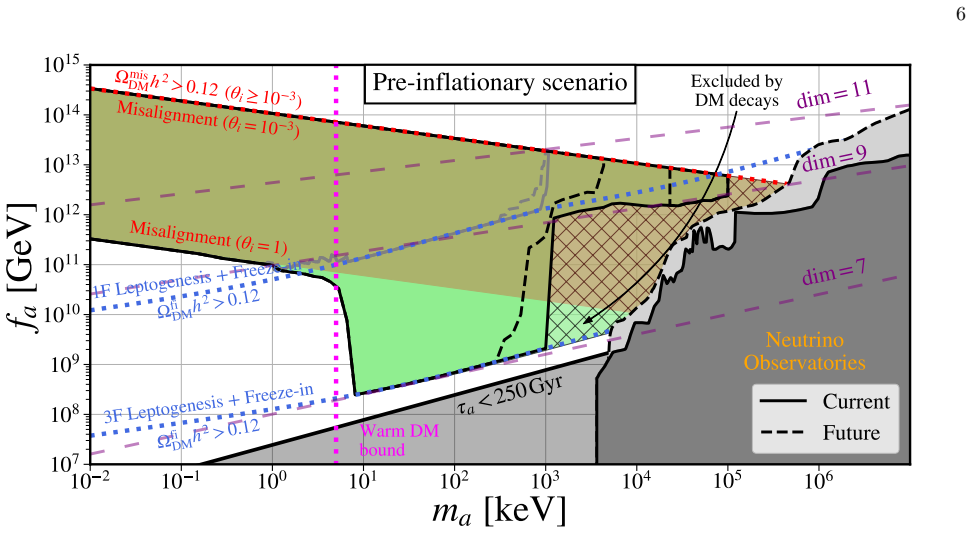
In the minimal majoron model, successful high-scale thermal leptogenesis constrains the right-handed-neutrino mass scale, thereby determining the irreducible freeze-in contribution to the majoron abundance and fixing the size of the couplings relevant for visible dark matter decays. Combining this with warm dark matter limits and indirect searches maps the resulting majoron cosmological window.
What carries the argument
The majoron dark matter candidate whose freeze-in abundance and decay couplings are fixed by the success of high-scale thermal leptogenesis in the minimal B-L model.
If this is right
- The model becomes more predictive because leptogenesis sets both the majoron relic density and its decay rate into photons or other visible particles.
- Current warm dark matter and indirect detection data already exclude parts of the parameter space, leaving a narrowed cosmological window.
- Future X-ray and gamma-ray telescopes have sensitivity to reach the remaining viable region for decaying majoron dark matter.
- The same right-handed neutrino scale that enables leptogenesis also controls the irreducible majoron production mechanism.
Where Pith is reading between the lines
- Confirmation of the window would link the origin of neutrino masses and the matter asymmetry directly to a testable dark matter candidate through a single symmetry-breaking scale.
- The scenario offers a concrete target for multi-messenger searches that combine cosmological structure data with astrophysical decay signals.
- If the leptogenesis scale is lower than assumed, the freeze-in abundance would increase and likely push the model into conflict with warm dark matter bounds.
Load-bearing premise
High-scale thermal leptogenesis occurs in the minimal majoron model and directly fixes the right-handed neutrino mass scale without extra parameters or adjustments to the majoron abundance.
What would settle it
Observation of majoron dark matter decays with a lifetime or branching ratio that falls outside the range fixed by the leptogenesis-constrained couplings, or a majoron mass that violates the warm dark matter structure formation bounds while still satisfying the leptogenesis scale.
Figures

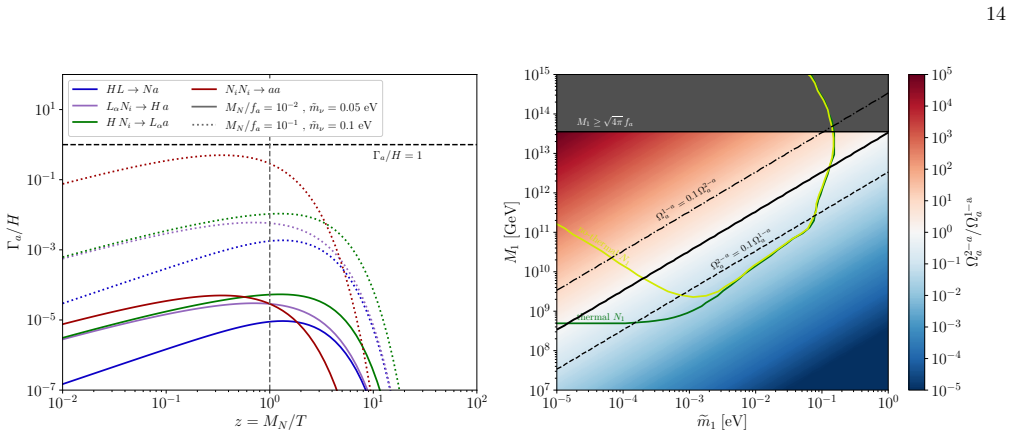

read the original abstract
The majoron is the Nambu-Goldstone boson associated with the spontaneous breaking of a global $B-L$ symmetry. Remarkably, the minimal majoron framework can simultaneously address three key empirical indications of physics beyond the Standard Model: neutrino masses, the matter-antimatter asymmetry, and dark matter. In this work, we identify the cosmologically viable region in which majoron dark matter and high-scale thermal leptogenesis can be realised simultaneously. We show that successful leptogenesis plays a central role in making this scenario predictive: by constraining the right-handed-neutrino mass scale, it determines the irreducible freeze-in contribution to the majoron abundance and fixes the size of the couplings relevant for visible dark matter decays. Combining the irreducible dark matter production mechanisms with warm dark matter limits and indirect searches for decaying dark matter, we map the resulting majoron cosmological window and show that future X- and gamma-ray telescopes can probe part of the surviving parameter space.
Editorial analysis
A structured set of objections, weighed in public.
Referee Report
Summary. The paper examines the minimal majoron model, in which the majoron arises from spontaneous breaking of global B-L and simultaneously explains neutrino masses via the seesaw, the baryon asymmetry via high-scale thermal leptogenesis, and dark matter via freeze-in production. The central claim is that successful leptogenesis tightly constrains the right-handed neutrino mass scale, which in turn fixes the irreducible majoron freeze-in yield and the couplings governing visible decays; combining this with warm-dark-matter bounds and indirect-detection limits delineates a predictive cosmological window that future X- and gamma-ray telescopes can partially probe.
Significance. If the leptogenesis constraint indeed removes free parameters as asserted, the work would be significant for offering a unified, predictive scenario for three empirical BSM signals with falsifiable implications for decaying dark matter searches. The explicit linkage between leptogenesis efficiency and the majoron abundance is a conceptual strength that distinguishes the analysis from generic majoron DM studies.
major comments (2)
- [Abstract / leptogenesis section] Abstract and the leptogenesis section: the assertion that high-scale thermal leptogenesis fixes a unique RH-neutrino mass scale (and thereby the freeze-in yield) without residual freedom in CP phases or washout is load-bearing for the predictivity claim. The minimal seesaw plus majoron setup still permits successful baryogenesis over a broader mass window once generic phases and possible majoron-mediated processes are included; a quantitative scan showing the resulting spread in the majoron abundance would be required to substantiate that the window is parameter-free.
- [DM production / freeze-in section] The freeze-in abundance calculation (presumably §4 or the DM production section): the paper must demonstrate explicitly that the majoron-induced interactions do not reopen a viable parameter space that would decouple the DM density from the leptogenesis scale. If the efficiency factor remains sensitive to the precise value of the majoron vev or the RH-neutrino Yukawas, the 'irreducible' contribution is not automatically fixed.
minor comments (2)
- [Abstract / conclusions] Clarify the precise mass range of the 'cosmological window' in the abstract and in the final summary plot; numerical bounds on the majoron mass and coupling should be stated explicitly rather than left as a qualitative interval.
- [Constraints section] Ensure that the warm-dark-matter and indirect-search constraints are applied consistently with the same parameter choices used for the leptogenesis calculation; cross-references between sections would help the reader verify that no post-hoc adjustment is introduced.
Simulated Author's Rebuttal
We thank the referee for the positive evaluation of our work's significance and for the detailed comments, which help clarify the predictivity of the majoron cosmological window. We address the major comments point by point below and will revise the manuscript to incorporate the requested demonstrations and scans.
read point-by-point responses
-
Referee: [Abstract / leptogenesis section] Abstract and the leptogenesis section: the assertion that high-scale thermal leptogenesis fixes a unique RH-neutrino mass scale (and thereby the freeze-in yield) without residual freedom in CP phases or washout is load-bearing for the predictivity claim. The minimal seesaw plus majoron setup still permits successful baryogenesis over a broader mass window once generic phases and possible majoron-mediated processes are included; a quantitative scan showing the resulting spread in the majoron abundance would be required to substantiate that the window is parameter-free.
Authors: We appreciate the referee's emphasis on this central claim. In the minimal majoron model, successful high-scale thermal leptogenesis requires right-handed neutrino masses above ~10^9 GeV to ensure the observed baryon asymmetry is generated before excessive washout, as outlined in our leptogenesis analysis. While CP phases and washout introduce variation, the viable parameter space remains constrained such that the effective scale governing freeze-in production varies only modestly. To strengthen this, we will add a quantitative scan over CP phases (including maximal and minimal cases) and assess majoron-mediated contributions in the revised leptogenesis section, demonstrating that the resulting spread in the majoron abundance is limited to within a factor of ~3 and does not erase the predictive cosmological window. revision: yes
-
Referee: [DM production / freeze-in section] The freeze-in abundance calculation (presumably §4 or the DM production section): the paper must demonstrate explicitly that the majoron-induced interactions do not reopen a viable parameter space that would decouple the DM density from the leptogenesis scale. If the efficiency factor remains sensitive to the precise value of the majoron vev or the RH-neutrino Yukawas, the 'irreducible' contribution is not automatically fixed.
Authors: We agree this explicit check is important for the 'irreducible' claim. The dominant freeze-in channel proceeds via right-handed neutrino decays, with the production rate set by the leptogenesis-fixed mass scale and the B-L breaking vev. Majoron-induced interactions are Planck-suppressed or tied to the same scale, so they do not open decoupled regions. In the revision we will expand the freeze-in section with a parameter variation plot showing that changes in the majoron vev (within neutrino-mass-consistent bounds) and Yukawa values alter the efficiency by at most O(1) factors, keeping the dark-matter density directly linked to the leptogenesis scale. revision: yes
Circularity Check
Leptogenesis provides independent constraint on RH neutrino scale without reducing to DM fit by construction
full rationale
The paper's central chain uses the observed baryon asymmetry to require successful high-scale thermal leptogenesis in the minimal majoron model, which then constrains the right-handed neutrino mass scale. This scale in turn sets the irreducible freeze-in majoron abundance and the size of visible decay couplings. No quoted equation or self-citation reduces the final majoron yield or cosmological window to a direct fit of the dark matter density itself; leptogenesis acts as an external anchor based on separate physics. The derivation remains self-contained against the baryon asymmetry benchmark and does not exhibit self-definitional, fitted-input, or load-bearing self-citation patterns that collapse the prediction to its inputs.
Axiom & Free-Parameter Ledger
axioms (1)
- domain assumption Spontaneous breaking of a global B-L symmetry produces a Nambu-Goldstone boson (the majoron) that can serve as dark matter while also generating neutrino masses.
invented entities (1)
-
majoron dark matter with freeze-in production tied to leptogenesis
no independent evidence
Lean theorems connected to this paper
-
IndisputableMonolith/Cost/FunctionalEquation.leanwashburn_uniqueness_aczel unclear?
unclearRelation between the paper passage and the cited Recognition theorem.
successful leptogenesis plays a central role in making this scenario predictive: by constraining the right-handed-neutrino mass scale, it determines the irreducible freeze-in contribution to the majoron abundance
What do these tags mean?
- matches
- The paper's claim is directly supported by a theorem in the formal canon.
- supports
- The theorem supports part of the paper's argument, but the paper may add assumptions or extra steps.
- extends
- The paper goes beyond the formal theorem; the theorem is a base layer rather than the whole result.
- uses
- The paper appears to rely on the theorem as machinery.
- contradicts
- The paper's claim conflicts with a theorem or certificate in the canon.
- unclear
- Pith found a possible connection, but the passage is too broad, indirect, or ambiguous to say the theorem truly supports the claim.
Reference graph
Works this paper leans on
-
[1]
6 For early discussions on thermalised DM majoron see [115, 116]
On the contrary, in the latter scenario, the symmetry is already broken before or during inflation, in which case a homogeneous patch with a randomθ i is inflated, meaning thatθ i is effectively an extra free parameter taking value in the interval|θ i| ∈[0, π]. 6 For early discussions on thermalised DM majoron see [115, 116]. A second contribution to the ...
-
[2]
As computing the BAU from thermal leptogenesis is the most computationally expensive task in our analysis, our starting point is an ensemble of points inP-space which is compatible with generating the correct BAU (see App. D)
-
[3]
From each pointP, it is possible to predict the majoron couplings to photons and charged fermions normalised to its decay constant,g aX fa withX= fSM, γ
-
[4]
(9) and (10)) yield the observed value ΩDMh2 ≃0.12
Using the irreducible contribution from misalign- ment, since eachP-point fixes the RHN masses and ˜mi, it is possible to find a trajectory inm a −f a space in which the sum of the two contributions to the DM abundance (Eqs. (9) and (10)) yield the observed value ΩDMh2 ≃0.12
-
[5]
III A, as their validity depends on DM being entirely made up of majorons
Over this trajectory, it is now possible to consis- tently apply DM decay constraints of Sec. III A, as their validity depends on DM being entirely made up of majorons
-
[6]
8 plane where the correct DM abundance can be re- produced
Since observational constraints place upper bounds ong aX as a function ofm a, these can be automat- ically converted to lower bounds onf a, which are only applicable in the trajectory of them a −f a 8 For simplicity and due to the precision with which they are mea- sured, we fix the light neutrino mixing anglesθ ij and the mass splittings ∆m2 21 and ∆m2 ...
-
[7]
Additionally, whenm a ≲5 keV, we remove the points in which the fraction of warm DMf wDM i.e., the contribution arising from freeze-in, exceeds the mixed wDM bounds (see Section III A). By repeating the above procedure for allP-points and marginalising over them, it is possible to consistently map thelargestpossible region of them a −f a in which leptogen...
-
[8]
In order to determine them a −f a region in which the correct DM abundance can be generated, one needs to take into account both the non-thermal contribution (misalignment and string radiation, with the latter only being present in the post-inflationary scenario) and the contribution from freeze-in. The former only depends onm a andf a (onceθ i has been f...
-
[9]
Over this trajectory, it is now consistent to apply observational bounds on decaying DM, as discussed in Sec. III A. In particular, the most relevant bounds we will consider are those stemming from visible majoron decays, mainly to photons, electrons, and muons. Even though we include decays to heavier particles, such asτorb-quarks, these do not play any ...
-
[10]
We then remove all points in them a −f a trajectory reproducing the DM abundance that do not satisfy the conditionf a < f DM−decay
-
[11]
For the region corresponding tom a <5 keV, we apply mixed wDM bounds, and remove points in the trajectory for which the frozen-in contribution is above the bounds mentioned in Sec. III A. We repeat this procedure for allP-points and we marginalize over them, thus charting the biggest region ofm a −f a space in which both thermal leptogenesis is successful...
-
[12]
The peak and magnitude of the signal are directly related to the mass and Yukawa of the lightest RHN
GWs can be emitted via bremsstrahlung directly during the decay of the RHN. The peak and magnitude of the signal are directly related to the mass and Yukawa of the lightest RHN. 18 Figure 4. Parameter space available (within the black contour) for thermal leptogenesis in relation to the peak and abundance of the GWs spectrum
-
[13]
h2Ωgw(fpeak gw ) 2.8×10 −16 #1/2 , Y≈10 −4 ×
If the RHN does not decay instantaneously, they can induce an early matter-dominated epoch, thus affecting the SM prediction for the stochastic cosmic gravitational microwave background (CGMB). The modification thus still bears information on the lightest RHN parameters. As noted in Ref. [161], the simultaneous measurement of both signals would unambiguou...
-
[14]
Minkowski,µ→eγat a Rate of One Out of10 9 Muon Decays?, Phys
P. Minkowski,µ→eγat a Rate of One Out of10 9 Muon Decays?, Phys. Lett. B67(1977) 421–428
work page 1977
-
[15]
Yanagida,Horizontal Symmetry and Masses of Neutrinos, Prog
T. Yanagida,Horizontal Symmetry and Masses of Neutrinos, Prog. Theor. Phys.64(1980) 1103
work page 1980
-
[16]
Complex Spinors and Unified Theories
M. Gell-Mann, P. Ramond, and R. Slansky,Complex Spinors and Unified Theories, Conf. Proc. C790927(1979) 315–321, [arXiv:1306.4669]
work page internal anchor Pith review Pith/arXiv arXiv 1979
-
[17]
R. N. Mohapatra and G. Senjanovic,Neutrino Mass and Spontaneous Parity Nonconservation, Phys. Rev. Lett.44 (1980) 912
work page 1980
-
[18]
J. Schechter and J. W. F. Valle,Neutrino Masses in SU(2) x U(1) Theories, Phys. Rev. D22(1980) 2227
work page 1980
-
[19]
S. Centelles Chuli´ a, A. Herrero-Brocal, and A. Vicente,The Type-I Seesaw family, JHEP07(2024) 060, [arXiv:2404.15415]. 19
-
[20]
M. Fukugita and T. Yanagida,Baryogenesis Without Grand Unification, Phys. Lett. B174(1986) 45–47
work page 1986
-
[21]
L. Covi, E. Roulet, and F. Vissani,CP violating decays in leptogenesis scenarios, Phys. Lett. B384(1996) 169–174, [hep-ph/9605319]
work page internal anchor Pith review Pith/arXiv arXiv 1996
-
[22]
Baryogenesis from mixed particle decays
L. Covi and E. Roulet,Baryogenesis from mixed particle decays, Phys. Lett. B399(1997) 113–118, [hep-ph/9611425]
work page internal anchor Pith review Pith/arXiv arXiv 1997
-
[23]
CP Violation and Baryogenesis due to Heavy Majorana Neutrinos
A. Pilaftsis,CP violation and baryogenesis due to heavy Majorana neutrinos, Phys. Rev. D56(1997) 5431–5451, [hep-ph/9707235]
work page internal anchor Pith review Pith/arXiv arXiv 1997
-
[24]
CP Asymmetry in Majorana Neutrino Decays
W. Buchmuller and M. Plumacher,CP asymmetry in Majorana neutrino decays, Phys. Lett. B431(1998) 354–362, [hep-ph/9710460]
work page internal anchor Pith review Pith/arXiv arXiv 1998
- [25]
- [26]
-
[27]
Y. Chikashige, R. N. Mohapatra, and R. D. Peccei,Are There Real Goldstone Bosons Associated with Broken Lepton Number?, Phys. Lett. B98(1981) 265–268
work page 1981
-
[28]
Y. Chikashige, R. N. Mohapatra, and R. D. Peccei,Spontaneously Broken Lepton Number and Cosmological Constraints on the Neutrino Mass Spectrum, Phys. Rev. Lett.45(1980) 1926
work page 1980
-
[29]
J. Schechter and J. W. F. Valle,Neutrino Decay and Spontaneous Violation of Lepton Number, Phys. Rev. D25(1982) 774
work page 1982
-
[30]
G. B. Gelmini and M. Roncadelli,Left-Handed Neutrino Mass Scale and Spontaneously Broken Lepton Number, Phys. Lett. B99(1981) 411–415
work page 1981
-
[31]
I. Z. Rothstein, K. S. Babu, and D. Seckel,Planck scale symmetry breaking and majoron physics, Nucl. Phys. B403 (1993) 725–748, [hep-ph/9301213]
work page internal anchor Pith review Pith/arXiv arXiv 1993
-
[32]
Quintessence Axion Potential Induced by Electroweak Instanton Effects
Y. Nomura, T. Watari, and T. Yanagida,Quintessence axion potential induced by electroweak instanton effects, Phys. Lett. B484(2000) 103–111, [hep-ph/0004182]
work page internal anchor Pith review Pith/arXiv arXiv 2000
-
[33]
Sub-GeV dark matter as pseudo-Goldstone from the seesaw scale
M. Frigerio, T. Hambye, and E. Masso,Sub-GeV dark matter as pseudo-Goldstone from the seesaw scale, Phys. Rev. X 1(2011) 021026, [arXiv:1107.4564]
work page internal anchor Pith review Pith/arXiv arXiv 2011
-
[34]
A. de Giorgi, L. Merlo, X. Ponce D´ ıaz, and S. Rigolin,The minimal massive Majoron Seesaw Model, JHEP03(2024) 094, [arXiv:2312.13417]
- [35]
-
[36]
Berbig,About electroweak domain walls in Majoron models,arXiv:2506.02910
M. Berbig,About electroweak domain walls in Majoron models,arXiv:2506.02910
-
[37]
Weinberg,A New Light Boson?, Phys
S. Weinberg,A New Light Boson?, Phys. Rev. Lett.40(1978) 223–226
work page 1978
-
[38]
Wilczek,Problem of StrongPandTInvariance in the Presence of Instantons, Phys
F. Wilczek,Problem of StrongPandTInvariance in the Presence of Instantons, Phys. Rev. Lett.40(1978) 279–282
work page 1978
-
[39]
R. D. Peccei and H. R. Quinn,CP Conservation in the Presence of Instantons, Phys. Rev. Lett.38(1977) 1440–1443
work page 1977
-
[40]
R. D. Peccei and H. R. Quinn,Constraints Imposed by CP Conservation in the Presence of Instantons, Phys. Rev. D16 (1977) 1791–1797
work page 1977
-
[41]
E. K. Akhmedov, Z. G. Berezhiani, R. N. Mohapatra, and G. Senjanovic,Planck scale effects on the majoron, Phys. Lett. B299(1993) 90–93, [hep-ph/9209285]
work page internal anchor Pith review Pith/arXiv arXiv 1993
-
[42]
J. M. Cline, K. Kainulainen, and K. A. Olive,Constraints on majoron models, neutrino masses and baryogenesis, Astropart. Phys.1(1993) 387–398, [hep-ph/9304229]
work page internal anchor Pith review Pith/arXiv arXiv 1993
-
[43]
J. Heeck and H. H. Patel,Majoron at two loops, Phys. Rev. D100(2019), no. 9 095015, [arXiv:1909.02029]
-
[44]
A. Herrero-Brocal and A. Vicente,The majoron coupling to charged leptons, JHEP01(2024) 078, [arXiv:2311.10145]
-
[45]
L. Di Luzio, F. Mescia, E. Nardi, P. Panci, and R. Ziegler,Astrophobic Axions, Phys. Rev. Lett.120(2018), no. 26 261803, [arXiv:1712.04940]
work page internal anchor Pith review Pith/arXiv arXiv 2018
-
[46]
F. Bj¨ orkeroth, L. Di Luzio, F. Mescia, E. Nardi, P. Panci, and R. Ziegler,Axion-electron decoupling in nucleophobic axion models, Phys. Rev. D101(2020), no. 3 035027, [arXiv:1907.06575]
-
[47]
L. Di Luzio, F. Mescia, E. Nardi, and S. Okawa,Renormalization group effects in astrophobic axion models, Phys. Rev. D106(2022), no. 5 055016, [arXiv:2205.15326]
-
[48]
Neutrino Lines from Majoron Dark Matter
C. Garcia-Cely and J. Heeck,Neutrino Lines from Majoron Dark Matter, JHEP05(2017) 102, [arXiv:1701.07209]
work page internal anchor Pith review Pith/arXiv arXiv 2017
-
[49]
K. Akita and M. Niibo,Updated constraints and future prospects on majoron dark matter, JHEP07(2023) 132, [arXiv:2304.04430]
- [50]
- [51]
-
[52]
A. G. Cohen and D. B. Kaplan,Thermodynamic Generation of the Baryon Asymmetry, Phys. Lett. B199(1987) 251–258
work page 1987
-
[53]
A. G. Cohen and D. B. Kaplan,SPONTANEOUS BARYOGENESIS, Nucl. Phys. B308(1988) 913–928
work page 1988
-
[54]
Spontaneous thermal Leptogenesis via Majoron oscillation
M. Ibe and K. Kaneta,Spontaneous thermal Leptogenesis via Majoron oscillation, Phys. Rev. D92(2015), no. 3 035019, [arXiv:1504.04125]
work page internal anchor Pith review Pith/arXiv arXiv 2015
- [55]
-
[56]
Wada,Majoron-driven leptogenesis in gauged U(1)Lµ-Lτmodel, Phys
J. Wada,Majoron-driven leptogenesis in gauged U(1)Lµ-Lτmodel, Phys. Rev. D110(2024), no. 10 103510, [arXiv:2404.10283]. 20
- [57]
-
[58]
H. Takahashi and J. Wada,Asymmetric Dark Matter from Low-Scale Spontaneous Leptogenesis,arXiv:2601.01849
-
[59]
I. Affleck and M. Dine,A New Mechanism for Baryogenesis, Nucl. Phys. B249(1985) 361–380
work page 1985
- [60]
-
[61]
Type II Seesaw Leptogenesis in a Majoron background
M. Berbig,Type II Seesaw Leptogenesis in a Majoron background, JHEP04(2026) 116, [arXiv:2506.23290]
work page internal anchor Pith review Pith/arXiv arXiv 2026
-
[62]
E. K. Akhmedov, V. A. Rubakov, and A. Y. Smirnov,Baryogenesis via neutrino oscillations, Phys. Rev. Lett.81 (1998) 1359–1362, [hep-ph/9803255]
work page internal anchor Pith review Pith/arXiv arXiv 1998
-
[63]
The $\nu$MSM, Dark Matter and Baryon Asymmetry of the Universe
T. Asaka and M. Shaposhnikov,TheνMSM, dark matter and baryon asymmetry of the universe, Phys. Lett. B620 (2005) 17–26, [hep-ph/0505013]
work page internal anchor Pith review Pith/arXiv arXiv 2005
- [64]
-
[65]
M. Escudero and S. J. Witte,The hubble tension as a hint of leptogenesis and neutrino mass generation, Eur. Phys. J. C81(2021), no. 6 515, [arXiv:2103.03249]
-
[66]
Brune,Leptogenesis in Majoron models without domain walls, Phys
T. Brune,Leptogenesis in Majoron models without domain walls, Phys. Rev. D107(2023), no. 9 096023, [arXiv:2201.12239]
- [67]
-
[68]
Brune,Leptogenesis in a Majoron plus triplet model, Phys
T. Brune,Leptogenesis in a Majoron plus triplet model, Phys. Rev. D111(2025), no. 11 115001, [arXiv:2501.11529]
-
[69]
Baryogenesis in the Singlet Majoron Model
I. Vilja,Baryogenesis in the singlet majoron model, Phys. Lett. B324(1994) 197–200, [hep-ph/9312283]
work page internal anchor Pith review Pith/arXiv arXiv 1994
-
[70]
Leptogenesis Bound on Spontaneous Symmetry Breaking of Global Lepton Number
P.-H. Gu and U. Sarkar,Leptogenesis Bound on Spontaneous Symmetry Breaking of Global Lepton Number, Eur. Phys. J. C71(2011) 1560, [arXiv:0909.5468]
work page internal anchor Pith review Pith/arXiv arXiv 2011
-
[71]
P.-H. Gu, E. Ma, and U. Sarkar,Pseudo-Majoron as Dark Matter, Phys. Lett. B690(2010) 145–148, [arXiv:1004.1919]
work page internal anchor Pith review Pith/arXiv arXiv 2010
-
[72]
Leptogenesis with a dynamical seesaw scale
D. Aristizabal Sierra, M. Tortola, J. W. F. Valle, and A. Vicente,Leptogenesis with a dynamical seesaw scale, JCAP07 (2014) 052, [arXiv:1405.4706]
work page internal anchor Pith review Pith/arXiv arXiv 2014
- [73]
- [74]
-
[75]
K. Akita, K. Hamaguchi, H. Kitagawa, and T. Yokoyama,Minimal Majoron Dark Matter,arXiv:2605.12946
work page internal anchor Pith review Pith/arXiv arXiv
-
[76]
G. F. Giudice, A. Notari, M. Raidal, A. Riotto, and A. Strumia,Towards a complete theory of thermal leptogenesis in the SM and MSSM, Nucl. Phys. B685(2004) 89–149, [hep-ph/0310123]
work page internal anchor Pith review Pith/arXiv arXiv 2004
-
[77]
Cold keV dark matter from decays and scatterings
J. Heeck and D. Teresi,Cold keV dark matter from decays and scatterings, Phys. Rev. D96(2017), no. 3 035018, [arXiv:1706.09909]
work page internal anchor Pith review Pith/arXiv arXiv 2017
-
[78]
Cold light dark matter in extended seesaw models
S. Boulebnane, J. Heeck, A. Nguyen, and D. Teresi,Cold light dark matter in extended seesaw models, JCAP04(2018) 006, [arXiv:1709.07283]
work page internal anchor Pith review Pith/arXiv arXiv 2018
-
[79]
NuFit-6.0: Updated global analysis of three-flavor neutrino oscillations
I. Esteban, M. C. Gonzalez-Garcia, M. Maltoni, I. Martinez-Soler, J. a. P. Pinheiro, and T. Schwetz,NuFit-6.0: updated global analysis of three-flavor neutrino oscillations, JHEP12(2024) 216, [arXiv:2410.05380]
work page internal anchor Pith review Pith/arXiv arXiv 2024
-
[80]
F. Capozzi and G. Raffelt,Axion and neutrino bounds improved with new calibrations of the tip of the red-giant branch using geometric distance determinations, Phys. Rev. D102(2020), no. 8 083007, [arXiv:2007.03694]
discussion (0)
Sign in with ORCID, Apple, or X to comment. Anyone can read and Pith papers without signing in.