Role of higher twist distributions in the tomography of proton
Pith reviewed 2026-06-27 16:30 UTC · model grok-4.3
The pith
Higher-twist T-even and T-odd TMDs in two quark-spectator models map the proton's quark structure and interpret components of the QCD energy-momentum tensor.
A machine-rendered reading of the paper's core claim, the machinery that carries it, and where it could break.
Core claim
In the light-front framework, higher-twist distributions that include both T-even and T-odd TMDs, obtained from a soft-wall AdS/QCD model and from a dipolar nucleon-quark-diquark vertex, furnish a comprehensive description that yields deeper insight into the proton's quark sector and supplies an interpretation of the different components of the energy-momentum tensor in QCD; the same functions are then used to generate predictions for the physical content of gravitational TMDs in momentum space.
What carries the argument
Higher-twist T-even and T-odd transverse momentum-dependent parton distributions computed in two quark-spectator models.
If this is right
- The T-even and T-odd higher-twist TMDs together give a more complete tomographic image of the proton in the quark sector.
- Different components of the QCD energy-momentum tensor receive a direct interpretation in terms of these distributions.
- Predictions for the momentum-space behavior of gravitational TMDs follow from the same parton distributions.
- The comparison between the soft-wall AdS/QCD and dipolar vertex models tests the robustness of the higher-twist picture.
Where Pith is reading between the lines
- Measurements of higher-twist effects at facilities such as the Electron-Ion Collider could discriminate between the two spectator constructions.
- The same framework may be extended to include gluon contributions or applied to other light hadrons.
- Gravitational TMDs extracted this way could eventually be confronted with lattice calculations of proton mechanical properties.
Load-bearing premise
The two chosen quark-spectator models capture the essential higher-twist dynamics without large uncontrolled contributions from other degrees of freedom.
What would settle it
Experimental extraction of a specific higher-twist TMD combination in semi-inclusive deep-inelastic scattering that deviates substantially from the numerical results obtained in both spectator models.
Figures



read the original abstract
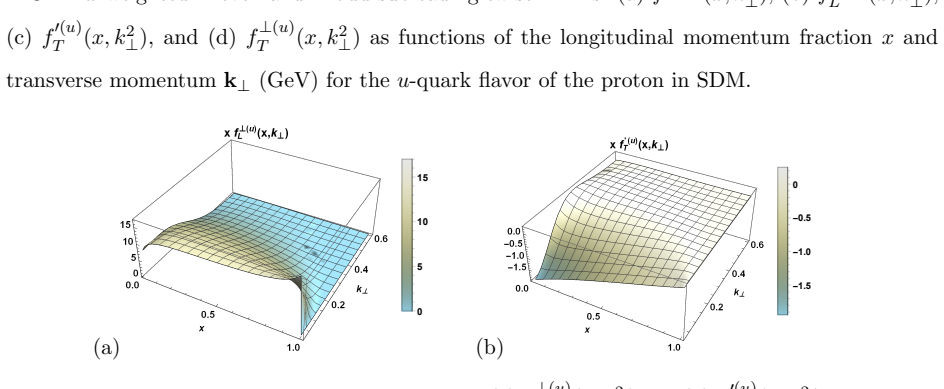
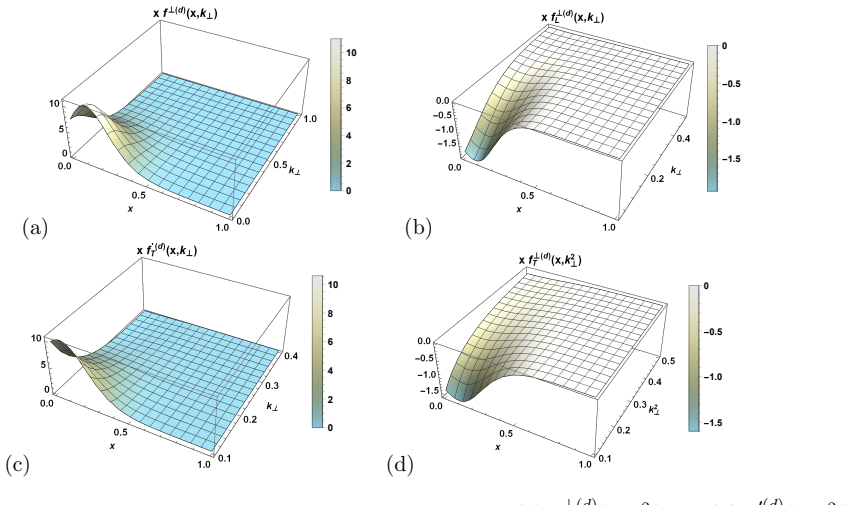
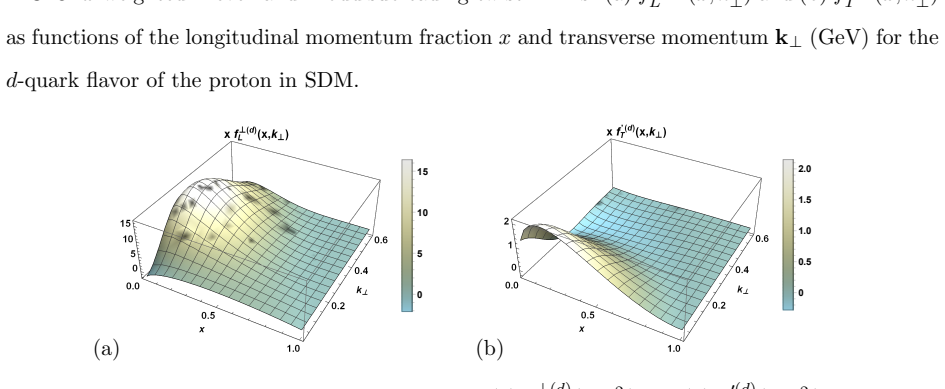
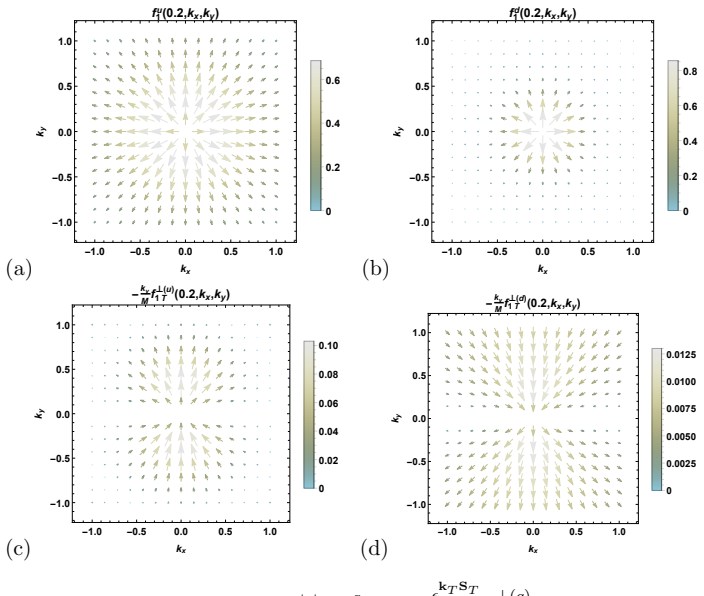
We have studied the higher-twist distributions of the proton, including T-even and T-odd transverse momentum-dependent parton distributions (TMDs). Under the umbrella of the light-front framework, we have chosen two distinctive approaches of quark-spectator systems for comparison, one inspired by the soft-wall AdS/QCD and another with a dipolar form factor at the nucleon-quark-diquark vertex. The comprehensive picture at higher-twist provided by both T-even and T-odd TMDs not only aids deeper insights into the internal structure of the proton in the quark sector but also provides an interpretation of different components of the energy-momentum tensor in quantum chromodynamics. Hence, using these standard parton distribution functions, further predictions regarding the physical insights of gravitational TMDs in momentum space are also provided.
Editorial analysis
A structured set of objections, weighed in public.
Referee Report
Summary. The paper examines higher-twist T-even and T-odd TMDs of the proton within the light-front quark-spectator framework. Two models are employed for comparison: the soft-wall AdS/QCD approach and a dipolar nucleon-quark-diquark vertex. The authors argue that these distributions yield a comprehensive picture of the proton's quark-sector structure, furnish interpretations of distinct components of the QCD energy-momentum tensor, and enable predictions for gravitational TMDs in momentum space.
Significance. If the qualitative features and EMT mappings survive beyond the specific model choices, the work would supply a useful bridge between higher-twist TMD phenomenology and gravitational form factors. The explicit comparison of two distinct spectator constructions is a positive feature. However, the absence of any external validation (lattice twist-3 matrix elements, alternative light-front wave functions, or gluon-inclusive calculations) substantially reduces the reach of the claimed interpretations and predictions.
major comments (1)
- The central claim that the two spectator models furnish a reliable interpretation of EMT components and gravitational TMDs rests on the untested assumption that omitted gluon and sea-quark degrees of freedom do not qualitatively alter the relevant twist-3 matrix elements. No comparison to lattice QCD twist-3 data or to other light-front constructions is presented, leaving the generality of the EMT mapping and gravitational-TMD predictions unverified.
Simulated Author's Rebuttal
We thank the referee for the careful reading of our manuscript and the constructive feedback. We respond to the major comment below.
read point-by-point responses
-
Referee: [—] The central claim that the two spectator models furnish a reliable interpretation of EMT components and gravitational TMDs rests on the untested assumption that omitted gluon and sea-quark degrees of freedom do not qualitatively alter the relevant twist-3 matrix elements. No comparison to lattice QCD twist-3 data or to other light-front constructions is presented, leaving the generality of the EMT mapping and gravitational-TMD predictions unverified.
Authors: The manuscript is framed explicitly within the light-front quark-spectator diquark framework, as stated in the abstract and Section 1. Both models are valence-quark constructions that omit explicit gluon and sea-quark degrees of freedom by design. The EMT interpretations follow directly from applying the standard twist-3 operator definitions to the model light-front wave functions, and the gravitational TMD predictions are obtained within the same framework. The work reports results for these two distinct spectator constructions and notes their qualitative consistency; it does not assert model independence or generality beyond the valence sector. We therefore regard the interpretations as reliable within the stated scope. External benchmarks such as lattice twist-3 matrix elements lie outside the present study. revision: no
Circularity Check
No circularity: explicit model calculations of TMDs and EMT interpretations remain independent of inputs
full rationale
The paper computes higher-twist T-even and T-odd TMDs in two distinct quark-spectator models (soft-wall AdS/QCD and dipolar vertex) within the light-front framework, then uses those results to interpret EMT components and offer gravitational TMD insights. No quoted equations, parameter fits, or self-citations are presented that would reduce any claimed prediction or interpretation to the input wave functions or vertices by construction. The two models are chosen for comparison rather than derived from each other, and the abstract supplies no evidence of fitted inputs being relabeled as predictions or of load-bearing uniqueness theorems imported from prior self-work. The derivation chain is therefore self-contained within the stated model assumptions.
Axiom & Free-Parameter Ledger
free parameters (2)
- soft-wall AdS/QCD parameters
- dipolar form factor parameters
axioms (1)
- domain assumption Light-front framework accurately describes higher-twist TMDs of the proton
Reference graph
Works this paper leans on
-
[1]
J. C. Collins and A. Metz, Phys. Rev. Lett.93, 252001 (2004)
2004
-
[2]
Polchinski and M
J. Polchinski and M. J. Strassler, JHEP05, 012 (2003)
2003
-
[3]
D. J. Gross and F. Wilczek, Phys. Rev. Lett.30, 1343-1346 (1973)
1973
-
[4]
H. D. Politzer, Phys. Rev. Lett.30, 1346-1349 (1973)
1973
-
[5]
X. d. Ji, J. p. Ma and F. Yuan, Phys. Rev. D71, 034005 (2005)
2005
-
[6]
J. C. Collins, D. E. Soper and G. F. Sterman, Adv. Ser. Direct. High Energy Phys.5, 1-91 (1989). 22
1989
-
[7]
D. J. Gross and S. B. Treiman, Phys. Rev. D4, 1059-1072 (1971)
1971
-
[8]
L. F. Alday, B. Eden, G. P. Korchemsky, J. Maldacena and E. Sokatchev, JHEP09, 123 (2011)
2011
-
[9]
J. w. Qiu and G. F. Sterman, Nucl. Phys. B353, 105-136 (1991)
1991
-
[10]
Bacchetta, M
A. Bacchetta, M. Diehl, K. Goeke, A. Metz, P. J. Mulders and M. Schlegel, JHEP02, 093 (2007)
2007
-
[11]
Meissner, A
S. Meissner, A. Metz and K. Goeke, Phys. Rev. D76, 034002 (2007)
2007
-
[12]
Meissner, A
S. Meissner, A. Metz and M. Schlegel, JHEP08, 056 (2009)
2009
-
[13]
Diehl, Eur
M. Diehl, Eur. Phys. J. A52, no.6, 149 (2016)
2016
-
[14]
Pasquini, S
B. Pasquini, S. Cazzaniga and S. Boffi, Phys. Rev. D78, 034025 (2008)
2008
-
[15]
Burkardt, C
M. Burkardt, C. A. Miller and W. D. Nowak, Rept. Prog. Phys.73, 016201 (2010)
2010
-
[16]
Barone, F
V. Barone, F. Bradamante and A. Martin, Prog. Part. Nucl. Phys.65, 267-333 (2010)
2010
-
[17]
C. A. Aidala, S. D. Bass, D. Hasch and G. K. Mallot, Rev. Mod. Phys.85, 655-691 (2013)
2013
-
[18]
J. J. Aubertet al.[European Muon], Phys. Lett. B130, 118-122 (1983)
1983
-
[19]
Arneodoet al.[European Muon], Z
M. Arneodoet al.[European Muon], Z. Phys. C34, 277 (1987)
1987
-
[20]
Airapetianet al.[HERMES], Phys
A. Airapetianet al.[HERMES], Phys. Rev. Lett.84, 4047-4051 (2000)
2000
-
[21]
Airapetianet al.[HERMES], Phys
A. Airapetianet al.[HERMES], Phys. Rev. D64, 097101 (2001)
2001
-
[22]
Airapetianet al.[HERMES], Phys
A. Airapetianet al.[HERMES], Phys. Lett. B562, 182-192 (2003)
2003
-
[23]
Bastami, A
S. Bastami, A. V. Efremov, P. Schweitzer, O. V. Teryaev and P. Zavada, Phys. Rev. D103, 014024 (2021)
2021
-
[24]
Lorc´ e, B
C. Lorc´ e, B. Pasquini and P. Schweitzer, JHEP01, 103 (2015)
2015
-
[25]
Pasquini and S
B. Pasquini and S. Rodini, Phys. Lett. B788, 414-424 (2019)
2019
-
[26]
Sharma and H
S. Sharma and H. Dahiya, Int. J. Mod. Phys. A37, 2250205 (2022)
2022
-
[27]
Sharma, N
S. Sharma, N. Kumar and H. Dahiya, Nucl. Phys. B992, 116247 (2023)
2023
-
[28]
Boer and P
D. Boer and P. J. Mulders, Phys. Rev. D57, 5780-5786 (1998)
1998
-
[29]
A. V. Belitsky and D. Mueller, Nucl. Phys. B503, 279-308 (1997)
1997
-
[30]
Lu and I
Z. Lu and I. Schmidt, Phys. Lett. B712, 451-455 (2012)
2012
-
[31]
X. Liu, W. Mao, X. Wang and B. Q. Ma, Phys. Rev. D104, 094043 (2021)
2021
-
[32]
Ohnishi and M
Y. Ohnishi and M. Wakamatsu, Phys. Rev. D69, 114002 (2004)
2004
-
[33]
Sharma, S
S. Sharma, S. Puhan, N. Kumar and H. Dahiya, PTEP2024, 103B05 (2024)
2024
-
[34]
Courtoy, A
A. Courtoy, A. S. Miramontes, H. Avakian, M. Mirazita and S. Pisano, Phys. Rev. D106, 23 014027 (2022)
2022
-
[35]
Pasquini, S
B. Pasquini, S. Rodini and A. Bacchetta, Phys. Rev. D100, 054039 (2019)
2019
-
[36]
Lorc´ e and Q
C. Lorc´ e and Q. T. Song, Phys. Lett. B843, 138016 (2023)
2023
-
[37]
Bacchetta, F
A. Bacchetta, F. Conti and M. Radici, Phys. Rev. D78, 074010 (2008)
2008
-
[38]
Maji and D
T. Maji and D. Chakrabarti, Phys. Rev. D94, no.9, 094020 (2016)
2016
-
[39]
Lorce, Phys
C. Lorce, Phys. Lett. B719, 185-190 (2013)
2013
-
[40]
Lorce, Phys
C. Lorce, Phys. Rev. D87, 034031 (2013)
2013
-
[41]
X. S. Chen, X. F. Lu, W. M. Sun, F. Wang and T. Goldman, Phys. Rev. Lett.100, 232002 (2008)
2008
-
[42]
Wakamatsu, Phys
M. Wakamatsu, Phys. Rev. D83, 014012 (2011)
2011
-
[43]
Hatta, Phys
Y. Hatta, Phys. Rev. D84, 041701 (2011)
2011
-
[44]
Hatta, Phys
Y. Hatta, Phys. Lett. B708, 186-190 (2012)
2012
-
[45]
Lorc´ e, H
C. Lorc´ e, H. Moutarde and A. P. Trawi´ nski, Eur. Phys. J. C79, 89 (2019)
2019
-
[46]
S. J. Brodsky, D. S. Hwang and I. Schmidt, Phys. Lett. B530, 99-107 (2002)
2002
-
[47]
S. J. Brodsky, D. S. Hwang and I. Schmidt, Nucl. Phys. B642, 344-356 (2002)
2002
-
[48]
Gurjar, D
B. Gurjar, D. Chakrabarti and C. Mondal, Phys. Rev. D106, 114027 (2022)
2022
-
[49]
G. F. de Teramond and S. J. Brodsky, [arXiv:1203.4025 [hep-ph]]
-
[50]
Chakrabarti, N
D. Chakrabarti, N. Kumar, T. Maji and A. Mukherjee, Eur. Phys. J. Plus135, no.6, 496 (2020)
2020
-
[51]
H. Y. Won, H. C. Kim and J. Y. Kim, JHEP05, 173 (2024). 24
2024
discussion (0)
Sign in with ORCID, Apple, or X to comment. Anyone can read and Pith papers without signing in.