REVIEW 3 major objections 4 minor 54 references
Decentralized SGD that deliberately keeps workers slightly out of sync finds flatter minima and beats centralized SGD in test accuracy.
Reviewed by Pith at T0; open to challenge. T0 means a machine referee read the full paper against a public rubric. the ladder, T0–T4 →
T0 review · deepseek-v4-flash
2026-08-03 05:11 UTC pith:F5JZATOE
load-bearing objection Strong empirical result showing adaptive consensus improves generalization, but the theory claiming Hessian-aligned disagreement is not established and needs major rework. the 3 major comments →
Decentralized SGD with Controlled Disagreement Finds Flatter Minima
The pith
A machine-rendered reading of the paper's core claim, the machinery that carries it, and where it could break.
Core claim
The paper claims that consensus errors in decentralized SGD are a useful implicit regularizer rather than a nuisance. By introducing an adaptive consensus scale γ(t) = (α(t)/α_max)^p, DSGD-AC maintains a controlled disagreement radius throughout training. A local stability analysis shows that high-curvature Hessian modes retain larger variance, so consensus errors concentrate along sharp directions; the average local loss decomposes into the central loss plus a Hessian-weighted disagreement penalty whose weights strictly increase with curvature. Under the assumption of Hessian-aligned minibatch noise, this yields an implicit spectral penalty that disproportionately penalizes large eigenvalue
What carries the argument
The central mechanism is the adaptive consensus factor γ(t) = (α(t)/α_max)^p, which weakens graph Laplacian damping as the learning rate shrinks, combined with an eigenmode analysis of the consensus-error recursion. This yields a stability condition α(t) < (2 + (λ_min(W)-1)γ(t))/λ_k(H) that lets low-curvature modes stabilize earlier while high-curvature modes retain variance, and a spectral penalty ω_t(λ) that is strictly increasing in the Hessian eigenvalue, producing the curvature tilt.
Load-bearing premise
The curvature-tilt conclusion rests on the assumption that minibatch SGD noise is approximately Hessian-aligned (Cov(g(x) − ∇F(x)) ≈ c_t L(x) H(x)) near the minimum, an assumption the paper cites from the literature but does not verify for the trained models; without that, the spectral penalty being increasing in curvature loses its grounding.
What would settle it
Compute the covariance of minibatch gradients on a trained WRN28-10 model and compare the top eigenvectors of that covariance with the top eigenvectors of the Hessian; if the alignment is weak, the claimed alignment of consensus errors with the dominant Hessian subspace is unsupported. Additionally, if DSGD-AC's test-accuracy advantage over centralized SGD disappears when the learning rate schedule is switched from cosine annealing to a constant schedule, the dependence on the late-training radius uptick would be suspect.
If this is right
- If the curvature-tilt account is correct, consensus errors act as a free sharpness-aware regularizer: DSGD-AC improves generalization without the 2× gradient cost of explicit sharpness-aware methods.
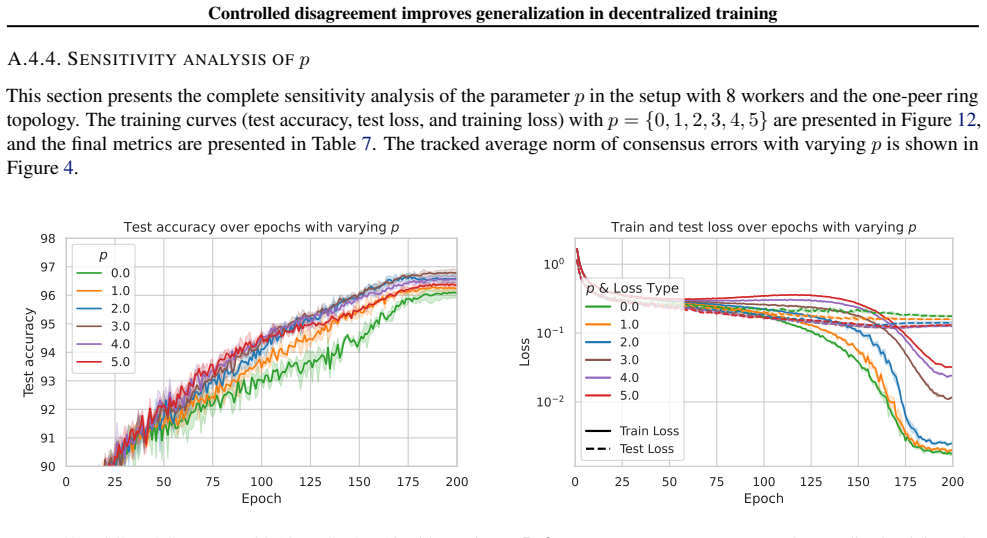
- Maintaining a controlled disagreement radius is necessary; p ≥ 2 keeps the radius non-vanishing as the step size decays, and p ≈ 3 with cosine schedules gives a mild late-training uptick that correlates with better test performance.
- The benefit persists across worker counts (8–32), topologies (ring, exponential, complete), and models, and transfers to a decentralized Adam variant for machine translation.
- DSGD-AC runs at 0.81–0.87× the wall-clock time of synchronous SGD, so the generalization gain does not require sacrificing the speed advantage of decentralized training.
- The deployed model is the global average of workers; the curvature tilt arises from the disagreement around that average, not from any single worker's trajectory.
Where Pith is reading between the lines
- A direct test would be to measure the gradient-noise covariance on the actually trained Wide ResNets and check whether its top eigenvectors match the Hessian's top eigenvectors; the curvature-tilt mechanism would be undercut if the dominant noise directions are unrelated to large-curvature directions.
- The same adaptive-consensus principle could guide communication-compression design: compressors that spend more budget early in training, or that selectively preserve high-curvature disagreement, could strengthen the alignment and push generalization further.
- If the effect is fundamentally spectral, DSGD-AC's gain should be most pronounced in overparameterized models with very ill-conditioned Hessians, and might be reproducible by any algorithm that injects curvature-aligned noise at a controlled radius, such as low-pass filtered SGD.
- The paper's appendix observes that adaptive optimizers like Adam destroy the anisotropic noise structure that AC relies on; combining AC with optimizers that restore that structure could be a promising route for extending the benefits to adaptive methods.
Editorial analysis
A structured set of objections, weighed in public.
Referee Report
Summary. The paper proposes DSGD-AC, a decentralized SGD variant that scales the consensus-mixing term by γ(t) = (α(t)/α_max)^p, where α(t) is the scheduled learning rate. The method intentionally preserves non-vanishing consensus errors during training. The authors claim that these errors are not isotropic noise but systematically align with the dominant Hessian subspace, acting as structured perturbations that bias optimization toward flatter minima. The paper reports consistent test-accuracy and test-loss improvements over both standard DSGD and synchronous SGD across CIFAR-100 image-classification setups (WRN28-10/WRN16-8, 8/16/32 workers, ring/exponential/complete topologies), plus an ablation on CIFAR-10 and a Transformer/WMT14 experiment with a decentralized Adam variant. The theoretical part consists of Proposition 3.1 on the disagreement radius, Proposition 3.2 on stability and alignment of consensus-error modes, and an appendix analysis (Lemma A.1, Proposition A.2, Corollary A.3) that derives a Hessian-weighted 'curvature tilt' under a Hessian-aligned SGD-noise assumption.
Significance. If the empirical claim holds, the paper makes a valuable practical point: a simple per-step scaling of the consensus term can turn decentralized training from an approximation of centralized SGD into a method that generalizes better than centralized SGD, without extra gradient evaluations. The experimental design is strong: three seeds, eighteen configurations, consistent accuracy gains, lower top-1 Hessian eigenvalues, careful BatchNorm calibration, and runtime measurements. The ablation over p and E_start is informative. However, the theoretical mechanism — the central advertised contribution — is not currently established. Proposition 3.1 contains an internal asymptotic inconsistency, Proposition 3.2 does not prove the claimed variance ordering, and Corollary A.3 depends on an unverified Hessian-aligned noise assumption. The empirical results are credible and useful, but the manuscript's claim to have proven that consensus errors are structured rather than random is not supported by the current analysis.
major comments (3)
- [Prop. 3.1 and Appendix A.1 (Eq. (14) and following lower bound)] The stated Θ(1) behavior for p=2 is contradicted by the proof's own lower bound. Appendix A.1 derives E||z_i||² ≥ (||μ_i||²/(λ_i²g_0²))(α)^{2-2p} + (σ_i²/(2λ_i g_0))(α)^{2-p}. For p=2 the first term is O(α^{-2}) unless μ_i=0, and for p=3 both terms diverge as α→0. Thus the quasi-stationary radius diverges rather than remaining Θ(1) or merely 'non-vanishing'. The fixed-point m_i = -(α/γ)μ_i/λ_i used in the proof also blows up for p≥2. This undermines the 'controlled disagreement' claim and the motivation for choosing p=3. The authors need either a finite-horizon analysis, an additional vanishing condition on μ, or a corrected statement.
- [Prop. 3.2 and Appendix A.2 (Eqs. (21), (25), and condition (9))] The proof establishes only the stability threshold (9); the assertion that high-curvature modes 'retain higher variance under the same injected noise' is not derived. For the per-mode AR(1) recursion, the stationary variance is S_{k,j}=α²q_{k,j}/(1-(1-γλ_j(L)-αλ_k(H))²). For fixed graph mode j, this quantity is not monotone in λ_k(H): modes with very small λ_k have large variance because the denominator is O(γλ_j), modes near the stability boundary also have large variance, and intermediate modes can have smaller variance. Stability alone therefore does not imply alignment with the dominant Hessian directions. To obtain the claimed concentration, one must show that q_{k,j} increases with λ_k(H), which is precisely the assumption imported later in Eq. (28), not a consequence of Proposition 3.2.
- [Cor. A.3, Eq. (28)] The monotone spectral penalty ω_t(λ) and the 'curvature tilt' rest entirely on the assumption Cov(g_i(x)−∇f_i(x))≈c_tL(x)H(x). The cited literature supports this in some settings, but the paper does not verify it for the trained WRN models, nor does it report any diagnostic such as the cosine similarity between the top eigenspaces of the gradient-noise covariance and the Hessian. If the noise covariance is closer to isotropic, q_{k,j} is roughly constant and the weight ω_t(λ)/λ is not increasing; the claimed mechanism fails. Since the abstract and Section 1 present this alignment as a proven result, Eq. (28) is load-bearing and needs direct validation, or the theoretical claims must be weakened to a conditional statement.
minor comments (4)
- [Algorithm 1 / Prop. 3.1] Algorithm 1 defines γ(t)=(α(t)/α_max)^p, while the proof uses γ(t)=g_0(α(t))^p. State explicitly that g_0=α_max^{-p} to avoid confusion.
- [Figure 3] The random-direction comparison would be more convincing if the perturbation norm were specified. Please report the scale used for the random directions and how it is matched to the consensus-error radius.
- [Table 5 / Appendix A.6] The DAdam-AC experiment is interesting, but the main text should note that the theoretical analysis does not cover adaptive optimizers (as acknowledged in A.6). Also, the DAdam baseline uses different β1, β2, and α0 than the Adam baseline; clarify whether these were independently tuned for the decentralized setting.
- [References and numbering] The reference 'Adam, K. D. B. J. et al.' is not the standard citation for Adam; use Kingma and Ba. Additionally, Eq. (28) appears both as the Hessian-aligned noise assumption in Corollary A.3 and as the loss definition in Appendix A.5.3; renumber to avoid ambiguity.
Circularity Check
No significant circularity; the empirical benchmark results stand independently, and the theoretical alignment claim is conditional on an external Hessian-aligned noise assumption rather than on a fitted parameter or self-citation.
full rationale
The paper's main theoretical chain is: DSGD-AC update (Eq. 5) -> disagreement recursion (Eq. 8) -> radius scaling (Prop. 3.1) -> per-mode stability (Prop. 3.2) -> loss-envelope/curvature-tilt analysis (Appendix A.3). Each step is an internal derivation from the algorithm's update rule and Taylor expansion, not a fitted parameter renamed as a prediction. The algorithm hyperparameters p and E_start are explicitly tuned from sensitivity tables and then fixed for the final benchmarks; the paper does not present these choices as theory-derived predictions, so no fitted-input-called-prediction circularity arises. The empirical claim that DSGD-AC beats DSGD and centralized SGD is supported by direct, repeatable benchmark comparisons (CIFAR-10/100, WMT14), i.e., it is self-contained against external baselines. The main weakness is in the alignment claim: Proposition 3.2's concluding sentence (high-curvature modes 'retain higher variance under the same injected noise') does not follow from the stationary variance formula in its own proof, and the only route to the 'systematic alignment' conclusion is Corollary A.3's assumption (28) that mini-batch SGD noise is Hessian-aligned, cited from Ziyin et al. (2022), Wu et al. (2022), and Mori et al. (2022). This is a load-bearing unverified assumption and a proof gap, but it is not circularity: Eq. (28) is an external, independently published claim, not a self-citation or a parameter fitted in this paper, and Corollary A.3 states the condition explicitly as an assumption. No uniqueness theorem, self-citation chain, or ansatz-smuggling step is load-bearing. Therefore, under the circularity rubric, the appropriate finding is no significant circularity (score 0).
Axiom & Free-Parameter Ledger
free parameters (2)
- p (consensus exponent) =
3 (best p ∈ [2,4] in sensitivity analysis)
- Estart (activation epoch of AC) =
10 (8 workers), 100 (16), 150 (32)
axioms (5)
- domain assumption SGD minibatch gradient noise is Hessian-aligned: Cov(g_i − ∇f_i) ≈ c_t L(x) H(x)
- domain assumption Local quadratic approximation: ∇f_i(x_i) ≈ H(x_i − x*) near a strongly convex minimizer
- domain assumption Quasi-stationary regime with bounded moments and independent innovations
- domain assumption Communication matrix W is fixed, symmetric, doubly stochastic with eigenvalues in (−1,1] and connected graph
- domain assumption Top-1 Hessian eigenvalue is a valid flatness/generalization surrogate
read the original abstract
Decentralized training is often regarded as inferior to centralized training because the consensus errors between workers are thought to undermine convergence and generalization. This work challenges this view by introducing decentralized SGD with Adaptive Consensus (DSGD-AC), which uses a time-dependent scaling mechanism to maintain consensus errors throughout the training. We show that adaptive consensus changes the stationary variance of disagreement modes by balancing two effects: it preserves consensus-error magnitude through weaker graph damping while still allowing curvature-dependent damping to shape the disagreement directions. This balance can produce a stronger Hessian-weighted loss-envelope penalty around the deployed model, even when normalized Hessian alignment is weaker than in standard DSGD. Empirical results on image classification show that DSGD-AC reaches flatter solutions and higher test accuracy than standard DSGD and even centralized SGD. Together, these results support consensus errors as a useful implicit regularizer and open a new perspective on the design of decentralized learning algorithms.
Figures




Reference graph
Works this paper leans on
-
[1]
write newline
" write newline "" before.all 'output.state := FUNCTION n.dashify 't := "" t empty not t #1 #1 substring "-" = t #1 #2 substring "--" = not "--" * t #2 global.max substring 't := t #1 #1 substring "-" = "-" * t #2 global.max substring 't := while if t #1 #1 substring * t #2 global.max substring 't := if while FUNCTION format.date year duplicate empty "emp...
-
[2]
Tensor F low: A system for large-scale machine learning
Abadi, M., Barham, P., Chen, J., Chen, Z., Davis, A., Dean, J., Devin, M., Ghemawat, S., Irving, G., Isard, M., et al. Tensor F low: A system for large-scale machine learning. In 12th USENIX symposium on operating systems design and implementation (OSDI 16), pp.\ 265--283, 2016
2016
-
[3]
Adam, K. D. B. J. et al. A method for stochastic optimization. arXiv preprint arXiv:1412.6980, 1412 0 (6), 2014
Pith/arXiv arXiv 2014
-
[4]
Alghunaim, S. A. and Yuan, K. A unified and refined convergence analysis for non-convex decentralized learning. IEEE Transactions on Signal Processing, 70: 0 3264--3279, 2022
2022
-
[5]
Stochastic gradient push for distributed deep learning
Assran, M., Loizou, N., Ballas, N., and Rabbat, M. Stochastic gradient push for distributed deep learning. In International Conference on Machine Learning, pp.\ 344--353. PMLR, 2019
2019
-
[6]
Improved stability and generalization guarantees of the decentralized SGD algorithm
Bellet, A., Tommasi, M., Scaman, K., Neglia, G., et al. Improved stability and generalization guarantees of the decentralized SGD algorithm. In Forty-first International Conference on Machine Learning, 2023
2023
-
[7]
and Ventura, E
Benedetti, M. and Ventura, E. Training neural networks with structured noise improves classification and generalization. Journal of Physics A: Mathematical and Theoretical, 57 0 (41): 0 415001, 2024
2024
-
[8]
Low-pass filtering SGD for recovering flat optima in the deep learning optimization landscape
Bisla, D., Wang, J., and Choromanska, A. Low-pass filtering SGD for recovering flat optima in the deep learning optimization landscape. In International Conference on Artificial Intelligence and Statistics, pp.\ 8299--8339. PMLR, 2022
2022
-
[9]
Findings of the 2014 workshop on statistical machine translation
Bojar, O., Buck, C., Federmann, C., Haddow, B., Koehn, P., Leveling, J., Monz, C., Pecina, P., Post, M., Saint-Amand, H., et al. Findings of the 2014 workshop on statistical machine translation. In Proceedings of the ninth workshop on statistical machine translation, pp.\ 12--58, 2014
2014
-
[10]
The road less scheduled
Defazio, A., Yang, X., Khaled, A., Mishchenko, K., Mehta, H., and Cutkosky, A. The road less scheduled. Advances in Neural Information Processing Systems, 37: 0 9974--10007, 2024
2024
-
[11]
Decentralized learning made easy with decentralizepy
Dhasade, A., Kermarrec, A.-M., Pires, R., Sharma, R., and Vujasinovic, M. Decentralized learning made easy with decentralizepy. In Proceedings of the 3rd Workshop on Machine Learning and Systems, pp.\ 34--41, 2023
2023
-
[12]
Sharpness-aware minimization for efficiently improving generalization
Foret, P., Kleiner, A., Mobahi, H., and Neyshabur, B. Sharpness-aware minimization for efficiently improving generalization. arXiv preprint arXiv:2010.01412, 2020
Pith/arXiv arXiv 2010
-
[13]
and Seferoglu, H
Gholami, P. and Seferoglu, H. Digest: Fast and communication efficient decentralized learning with local updates. IEEE Transactions on Machine Learning in Communications and Networking, 2: 0 1456--1474, 2024
2024
-
[14]
Gotmare, A., Keskar, N. S., Xiong, C., and Socher, R. A closer look at deep learning heuristics: Learning rate restarts, warmup and distillation. arXiv preprint arXiv:1810.13243, 2018
Pith/arXiv arXiv 2018
-
[15]
Gur-Ari, G., Roberts, D. A., and Dyer, E. Gradient descent happens in a tiny subspace. arXiv preprint arXiv:1812.04754, 2018
Pith/arXiv arXiv 2018
-
[16]
and Pu, S
Huang, K. and Pu, S. Cedas: A compressed decentralized stochastic gradient method with improved convergence. IEEE Transactions on Automatic Control, 2024
2024
-
[17]
Imfeld, M., Graldi, J., Giordano, M., Hofmann, T., Anagnostidis, S., and Singh, S. P. Transformer fusion with optimal transport. arXiv preprint arXiv:2310.05719, 2023
Pith/arXiv arXiv 2023
-
[18]
Fantastic generalization measures and where to find them
Jiang, Y., Neyshabur, B., Mobahi, H., Krishnan, D., and Bengio, S. Fantastic generalization measures and where to find them. arXiv preprint arXiv:1912.02178, 2019
Pith/arXiv arXiv 1912
-
[19]
Kalra, D. S. and Barkeshli, M. Why warmup the learning rate? underlying mechanisms and improvements. Advances in Neural Information Processing Systems, 37: 0 111760--111801, 2024
2024
-
[20]
S., Mudigere, D., Nocedal, J., Smelyanskiy, M., and Tang, P
Keskar, N. S., Mudigere, D., Nocedal, J., Smelyanskiy, M., and Tang, P. T. P. On large-batch training for deep learning: Generalization gap and sharp minima. arXiv preprint arXiv:1609.04836, 2016
Pith/arXiv arXiv 2016
-
[21]
Decentralized stochastic optimization and gossip algorithms with compressed communication
Koloskova, A., Stich, S., and Jaggi, M. Decentralized stochastic optimization and gossip algorithms with compressed communication. In International conference on machine learning, pp.\ 3478--3487. PMLR, 2019
2019
-
[22]
Consensus control for decentralized deep learning
Kong, L., Lin, T., Koloskova, A., Jaggi, M., and Stich, S. Consensus control for decentralized deep learning. In International Conference on Machine Learning, pp.\ 5686--5696. PMLR, 2021
2021
-
[23]
Learning multiple layers of features from tiny images
Krizhevsky, A., Hinton, G., et al. Learning multiple layers of features from tiny images. 2009
2009
-
[24]
Kwon, J., Kim, J., Park, H., and Choi, I. K. ASAM : Adaptive sharpness-aware minimization for scale-invariant learning of deep neural networks. In International conference on machine learning, pp.\ 5905--5914. PMLR, 2021
2021
-
[25]
An iteration method for the solution of the eigenvalue problem of linear differential and integral operators
Lanczos, C. An iteration method for the solution of the eigenvalue problem of linear differential and integral operators. Journal of research of the National Bureau of Standards, 45 0 (4): 0 255--282, 1950
1950
-
[26]
Pytorch distributed: Experiences on accelerating data parallel training
Li, S., Zhao, Y., Varma, R., Salpekar, O., Noordhuis, P., Li, T., Paszke, A., Smith, J., Vaughan, B., Damania, P., et al. Pytorch distributed: Experiences on accelerating data parallel training . arXiv preprint arXiv:2006.15704, 2020
Pith/arXiv arXiv 2006
-
[27]
Revisiting random weight perturbation for efficiently improving generalization
Li, T., Tao, Q., Yan, W., Lei, Z., Wu, Y., Fang, K., He, M., and Huang, X. Revisiting random weight perturbation for efficiently improving generalization. arXiv preprint arXiv:2404.00357, 2024 a
Pith/arXiv arXiv 2024
-
[28]
Friendly sharpness-aware minimization
Li, T., Zhou, P., He, Z., Cheng, X., and Huang, X. Friendly sharpness-aware minimization. In Proceedings of the IEEE/CVF conference on computer vision and pattern recognition, pp.\ 5631--5640, 2024 b
2024
-
[29]
Can decentralized algorithms outperform centralized algorithms? a case study for decentralized parallel stochastic gradient descent
Lian, X., Zhang, C., Zhang, H., Hsieh, C.-J., Zhang, W., and Liu, J. Can decentralized algorithms outperform centralized algorithms? a case study for decentralized parallel stochastic gradient descent. Advances in neural information processing systems, 30, 2017
2017
-
[30]
Lin, T., Karimireddy, S. P., Stich, S. U., and Jaggi, M. Quasi-global momentum: Accelerating decentralized deep learning on heterogeneous data . arXiv preprint arXiv:2102.04761, 2021
Pith/arXiv arXiv 2021
-
[31]
Random sharpness-aware minimization
Liu, Y., Mai, S., Cheng, M., Chen, X., Hsieh, C.-J., and You, Y. Random sharpness-aware minimization. Advances in neural information processing systems, 35: 0 24543--24556, 2022
2022
-
[32]
Loshchilov, I. and Hutter, F. SGDR : Stochastic gradient descent with warm restarts . arXiv preprint arXiv:1608.03983, 2016
Pith/arXiv arXiv 2016
-
[33]
Explicit eigenvalue regularization improves sharpness-aware minimization
Luo, H., Truong, T., Pham, T., Harandi, M., Phung, D., and Le, T. Explicit eigenvalue regularization improves sharpness-aware minimization. Advances in Neural Information Processing Systems, 37: 0 4424--4453, 2024
2024
-
[34]
Power-law escape rate of SGD
Mori, T., Ziyin, L., Liu, K., and Ueda, M. Power-law escape rate of SGD . In Proceedings of the 39th International Conference on Machine Learning, volume 162 of Proceedings of Machine Learning Research, pp.\ 15959--15975, 2022. URL https://proceedings.mlr.press/v162/mori22a.html
2022
-
[35]
Bleu: a method for automatic evaluation of machine translation
Papineni, K., Roukos, S., Ward, T., and Zhu, W.-J. Bleu: a method for automatic evaluation of machine translation. In Proceedings of the 40th annual meeting of the Association for Computational Linguistics, pp.\ 311--318, 2002
2002
-
[36]
and Nedi \'c , A
Pu, S. and Nedi \'c , A. Distributed stochastic gradient tracking methods. Mathematical Programming, 187 0 (1): 0 409--457, 2021
2021
-
[37]
Singh, S. P. and Jaggi, M. Model fusion via optimal transport. Advances in Neural Information Processing Systems, 33: 0 22045--22055, 2020
2020
-
[38]
Does SGD really happen in tiny subspaces? arXiv preprint arXiv:2405.16002, 2024
Song, M., Ahn, K., and Yun, C. Does SGD really happen in tiny subspaces? arXiv preprint arXiv:2405.16002, 2024
Pith/arXiv arXiv 2024
-
[39]
Momentum tracking: Momentum acceleration for decentralized deep learning on heterogeneous data
Takezawa, Y., Bao, H., Niwa, K., Sato, R., and Yamada, M. Momentum tracking: Momentum acceleration for decentralized deep learning on heterogeneous data. arXiv preprint arXiv:2209.15505, 2022
Pith/arXiv arXiv 2022
-
[40]
Beyond exponential graph: Communication-efficient topologies for decentralized learning via finite-time convergence
Takezawa, Y., Sato, R., Bao, H., Niwa, K., and Yamada, M. Beyond exponential graph: Communication-efficient topologies for decentralized learning via finite-time convergence. Advances in Neural Information Processing Systems, 36: 0 76692--76717, 2023
2023
-
[41]
N., Kaiser, ., and Polosukhin, I
Vaswani, A., Shazeer, N., Parmar, N., Uszkoreit, J., Jones, L., Gomez, A. N., Kaiser, ., and Polosukhin, I. Attention is all you need. Advances in neural information processing systems, 30, 2017
2017
-
[42]
P., and Jaggi, M
Vogels, T., Karimireddy, S. P., and Jaggi, M. Practical low-rank communication compression in decentralized deep learning. Advances in Neural Information Processing Systems, 33: 0 14171--14181, 2020
2020
-
[43]
Slow M o: Improving communication-efficient distributed SGD with slow momentum
Wang, J., Tantia, V., Ballas, N., and Rabbat, M. Slow M o: Improving communication-efficient distributed SGD with slow momentum . arXiv preprint arXiv:1910.00643, 2019
Pith/arXiv arXiv 1910
-
[44]
From promise to practice: realizing high-performance decentralized training
Wang, Z., Jiaojiao, Z., Xuyang, W., and Johansson, M. From promise to practice: realizing high-performance decentralized training. In The Thirteenth International Conference on Learning Representations. ICLR, 2025
2025
-
[45]
Wu, L., Wang, M., and Su, W. J. The alignment property of SGD noise and how it helps select flat minima: A stability analysis. In Advances in Neural Information Processing Systems, volume 35, pp.\ 16843--16857, 2022. URL https://arxiv.org/abs/2207.02628
Pith/arXiv arXiv 2022
-
[46]
Exponential graph is provably efficient for decentralized deep training
Ying, B., Yuan, K., Chen, Y., Hu, H., Pan, P., and Yin, W. Exponential graph is provably efficient for decentralized deep training. Advances in Neural Information Processing Systems, 34: 0 13975--13987, 2021
2021
-
[47]
DecentLaM: Decentralized momentum SGD for large-batch deep training
Yuan, K., Chen, Y., Huang, X., Zhang, Y., Pan, P., Xu, Y., and Yin, W. DecentLaM: Decentralized momentum SGD for large-batch deep training . In Proceedings of the IEEE/CVF International Conference on Computer Vision, pp.\ 3029--3039, 2021
2021
-
[48]
Zagoruyko, S. and Komodakis, N. Wide residual networks. arXiv preprint arXiv:1605.07146, 2016
Pith/arXiv arXiv 2016
-
[49]
Zhang, H. R., Li, D., and Ju, H. Noise stability optimization for finding flat minima: A H essian-based regularization approach. arXiv preprint arXiv:2306.08553, 2023
Pith/arXiv arXiv 2023
-
[50]
P., Ye, Y., Luo, Z.-Q., and Sun, R
Zhang, Y., Chen, C., Li, Z., Ding, T., Wu, C., Kingma, D. P., Ye, Y., Luo, Z.-Q., and Sun, R. Adam-mini: Use fewer learning rates to gain more. arXiv preprint arXiv:2406.16793, 2024
Pith/arXiv arXiv 2024
-
[51]
Towards theoretically understanding why sgd generalizes better than adam in deep learning
Zhou, P., Feng, J., Ma, C., Xiong, C., Hoi, S., and Weinan, E. Towards theoretically understanding why sgd generalizes better than adam in deep learning. arxiv 2020. arXiv preprint arXiv:2010.05627, 2010
Pith/arXiv arXiv 2020
-
[52]
Topology-aware generalization of decentralized SGD
Zhu, T., He, F., Zhang, L., Niu, Z., Song, M., and Tao, D. Topology-aware generalization of decentralized SGD . In International Conference on Machine Learning, pp.\ 27479--27503. PMLR, 2022
2022
-
[53]
Decentralized SGD and average-direction SAM are asymptotically equivalent
Zhu, T., He, F., Chen, K., Song, M., and Tao, D. Decentralized SGD and average-direction SAM are asymptotically equivalent . In International Conference on Machine Learning, pp.\ 43005--43036. PMLR, 2023
2023
-
[54]
Strength of minibatch noise in SGD
Ziyin, L., Liu, K., Mori, T., and Ueda, M. Strength of minibatch noise in SGD . In International Conference on Learning Representations, 2022. URL https://arxiv.org/abs/2102.05375
Pith/arXiv arXiv 2022
discussion (0)
Sign in with ORCID, Apple, or X to comment. Anyone can read and Pith papers without signing in.