REVIEW 3 major objections 5 minor 3 cited by
Affine Frequency Division Multiplexing: Extending OFDM for Scenario-Flexibility and Resilience
T0 review · 3 major / 5 minor · reviewed 2026-08-08 · deepseek-v4-flash
Pith's one-line read AFDM, a chirp-based waveform with two tunable parameters, achieves optimal diversity order in doubly dispersive channels, matching OTFS and beating OCDM and OFDM in high-mobility links.
desk verdict A competent, clearly written review of the authors' own AFDM work; solid as a tutorial, but the abstract overstates the diversity claim for fractional Doppler and the evidence base is almost entirely self-citation. read the letter →
The pith
A machine-rendered reading of the paper's core claim, the machinery that carries it, and where it could break.
The reading
What carries the argument
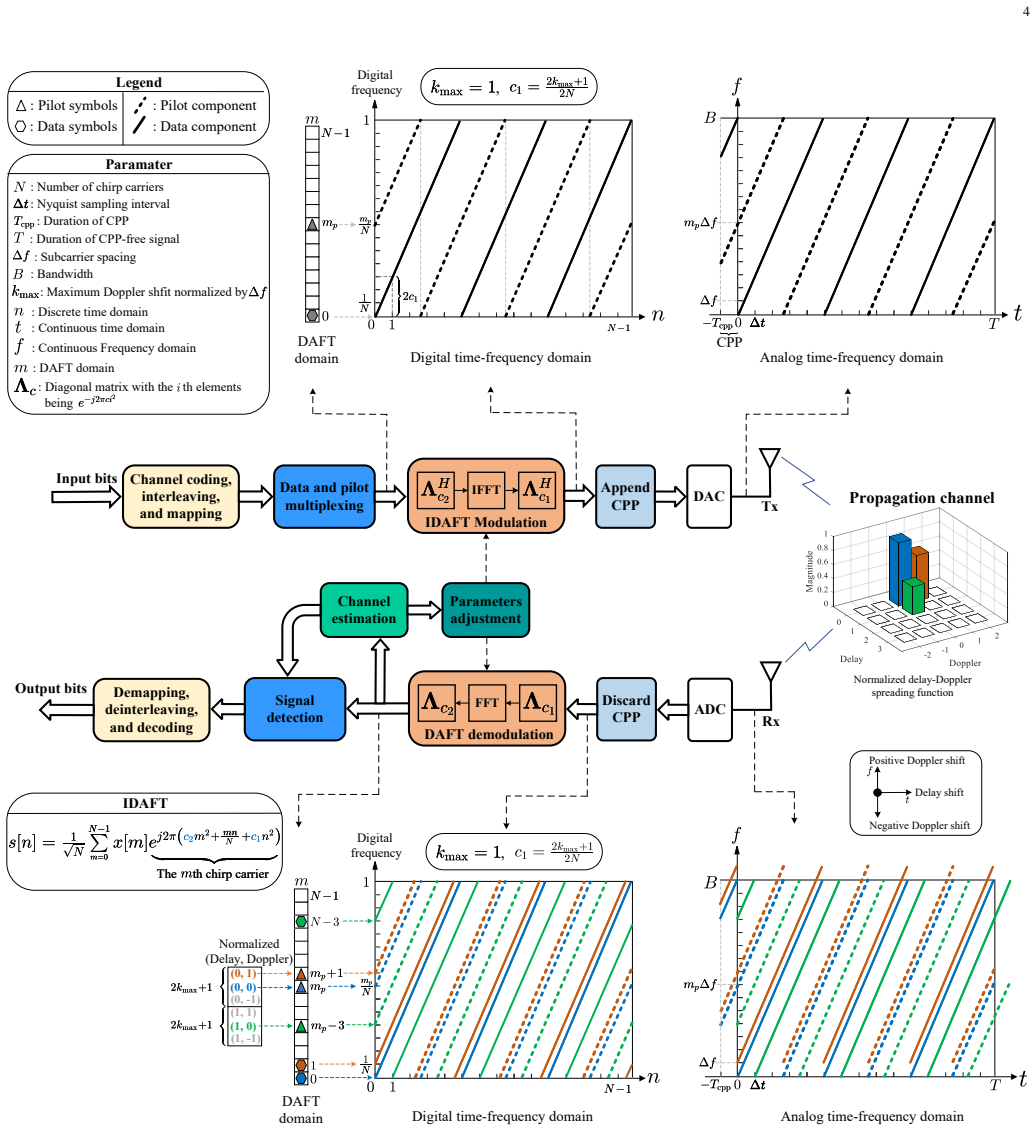
The carrier of the argument is the discrete affine Fourier transform (DAFT), a chirp-based generalization of the DFT that maps between the DAFT domain and time domain using two real parameters: $c_1$, which sets the common chirp rate through a quadratic phase in time, and $c_2$, which sets a quadratic phase in the subcarrier index. The mechanism that does the work is the parameter condition $|c_1| \geq \frac{2k_{\max}+1}{2N}$, which aligns Doppler shifts with unit shifts and delay shifts with $2N c_1$-unit shifts in the DAFT domain. Under that condition, the delay-Doppler channel becomes bijectively mapped onto the DAFT domain, so each path produces a separable spike, which AFDM exploits for channel estimation, diversity harvesting, and sparse detection.
What would settle it
Run an AFDM link with a single-path channel whose Doppler shift is a non-integer multiple of the subcarrier spacing (e.g., $0.3\Delta f$), using the default rectangle pulse shaping, and measure the empirical diversity order from the BER-versus-SNR slope. If the slope falls below one (the number of separable paths), or if the effective channel matrix shows significant off-diagonal energy beyond the predicted one-dimensional pattern, the claim that AFDM inherently achieves optimal diversity in arbitrary doubly dispersive channels would be contradicted in that regime.
Extended reading notes
Core claim
The central discovery the paper presents is that AFDM's two chirp parameters create a discrete affine Fourier transform (DAFT) domain in which each resolvable propagation path occupies a distinct, compact position, making the channel representation quasi-static and delay-Doppler separable. This separability is what allows AFDM to collect the full diversity of a doubly dispersive channel—essentially, every symbol passes through all paths in a way that can be combined at the receiver—and to estimate the channel from a single embedded pilot without a two-dimensional pilot grid. The paper demonstrates through simulations that uncoded AFDM matches OTFS in BER and significantly outperforms OCDM and OFDM in a six-path doubly selective channel, and it argues that these gains come with lower channel estimation overhead than OTFS because the DAFT-domain dispersion is one-dimensional rather than two-dimensional.
Load-bearing premise
The entire separability and diversity argument relies on the channel being a discrete sum of paths whose delay and Doppler shifts are exact integer multiples of the resolution, with $c_1$ chosen large enough to keep the mapping one-to-one; if fractional or continuously distributed shifts appear, the one-to-one mapping breaks and performance degrades without additional pulse shaping.
Editorial extensions
If this is right
- AFDM can serve as a single unified air interface across heterogeneous 6G use cases—from V2V and UAV links to satellite and underwater acoustic channels—by adapting $c_1$ and $c_2$ to each channel's delay-Doppler profile.
- Because the DAFT-domain dispersion is one-dimensional, AFDM's embedded-pilot channel estimation uses fewer guard resources than OTFS, translating to higher spectral efficiency in high-mobility links.
- AFDM retains OFDM's low-complexity FFT-based implementation when $c_1$ is set to an integer multiple of $1/(2N)$ and $c_2 = 0$, offering a low-cost migration path from existing OFDM hardware.
- In MIMO configurations, AFDM with a cyclic delay-Doppler shift code extracts optimal transmit diversity and achieves spectral efficiency that grows linearly with the number of transmit antennas.
Reading between the lines
- A corollary the paper leaves implicit: the two chirp parameters define a two-dimensional design space, so selecting $(c_1, c_2)$ for a deployment is itself an optimization problem that could trade off diversity gain against channel estimation overhead, detection complexity, and compatibility with OFDM numerologies.
- The paper's BER comparisons are drawn from specific simulated channel realizations; a cautious reader should test whether AFDM's 'optimal diversity' translates to coded systems with practical detectors, since the paper lists joint detection and decoding design as open future work.
- One testable prediction: if AFDM's DAFT-domain separability is as strong as claimed, then in a sparse channel with $P$ dominant paths, pilot overhead could be reduced to roughly $P$ symbols, independent of the delay and Doppler spread ranges—an experimentally checkable consequence.
- The physical-layer security suggestion (using $c_2$ as a secret key) is intriguing but unquantified; a practical next step would be to measure the secrecy rate or key-recovery difficulty against a passive eavesdropper with a mismatched $c_2$.
Signed reviews
Editorial analysis
A structured set of objections, weighed in public.
Referee Report
Summary. The manuscript is a tutorial/overview of affine frequency division multiplexing (AFDM), a chirp-based multicarrier waveform obtained by replacing the DFT in OFDM with the discrete affine Fourier transform (DAFT). It argues that AFDM's two chirp parameters, c1 and c2, allow the waveform to separate delay-Doppler paths in the DAFT domain, achieve optimal diversity order in doubly dispersive channels, and provide flexibility that makes it suitable for diverse 6G scenarios. The paper reviews the transceiver architecture, parameter-design guidelines, prospective applications (SAGIN, underwater acoustic, high-frequency bands, security), and technical challenges (channel estimation, pulse shaping, detection, MIMO/multi-user access), and closes with future research directions. No new technical derivations or reproducible simulations are included; the scientific evidence is drawn from the authors' prior publications and is presented in summarized form.
Significance. If the claims are correct, AFDM is a credible candidate waveform for high-mobility 6G links, and this paper provides a useful, accessible synthesis: the transceiver diagram in Fig. 3, the parameter-design guideline in Section III.B, and the structured discussion of applications and challenges are valuable for newcomers. The paper is honest in flagging open problems such as coded-AFDM design and full-duplex operation. However, the central performance claim (optimal diversity order and DD separability) is not re-derived or independently verified here, and the abstract states it without qualification. For a survey/tutorial, reliance on prior peer-reviewed work is acceptable, but the manuscript must clearly delimit the conditions under which the headline claims hold, particularly regarding fractional Doppler. With careful qualification and explicit pointers to the proofs, the paper would be a solid overview contribution.
major comments (3)
- [Abstract and Section III.B] The unqualified claim that AFDM 'achieves optimal diversity order in DDC' is broader than what the text establishes. The bijective DAFT-DD mapping described in Section III.B is exact only when path delays and Dopplers are integer multiples of the resolution and when |c1| >= (2kmax+1)/(2N); fractional Doppler or a continuous Doppler spectrum breaks the one-to-one correspondence. The paper itself acknowledges this in Section V.B via the 'symbol spreading effect,' and the pulse-shaping remedy is demonstrated only through the channel-estimation NMSE in Fig. 5(b), not through a proof that optimal diversity order is restored. Please qualify the abstract and Section III.B, or provide a proof/reference that extends the diversity claim to fractional-Doppler channels.
- [Section V.C and Fig. 5(c)] The BER comparison is used to support the central performance claim that 'AFDM delivers comparable BER performance to OTFS and outperforms OCDM and OFDM significantly,' but the manuscript gives no simulation details (detector types, pilot overhead, channel-realization count, or error bars), and the curves are simply attributed to the 'inherent optimal diversity order.' For a tutorial, a pointer to the original papers is acceptable, but as written the claim is not independently checkable from the manuscript. Please either provide the missing experimental setup or explicitly state that the curves are reproduced/adapted from [1] and [9], and add the channel conditions (e.g., integer delay/Doppler only) under which the comparison holds.
- [Section III.A] The paper defines 'optimal diversity order' as 'the number of propagation paths that are separable in DD domain,' which is not the standard asymptotic definition used in the diversity literature, where diversity order is the slope of the error-probability curve at high SNR. This nonstandard definition makes the central claim harder to interpret. Please replace it with the standard definition or justify explicitly why the number of separable paths is the relevant quantity, and state whether 'optimal' means full multipath diversity in the usual sense.
minor comments (5)
- [Fig. 3] The figure legend contains the typo 'Paramater'; it should read 'Parameter.'
- [Section IV.C heading] The heading 'High-Frequency-Band Communicatons' is misspelled; it should read 'High-Frequency-Band Communications.'
- [Section V.A] The sentence containing 'the FIDR estimated by the pilot' uses 'FIDR' where 'FDIR' (frequency-domain impulse response) is intended, since FDIR was defined earlier in the paper.
- [Section III.A] The statement that 'a unit Doppler shift corresponds to a unit shift in the DAFT domain, while a unit delay shift corresponds to 2Nc1-step shift in the DAFT domain' would be much clearer with explicit index equations; currently the reader must infer the exact mapping from the figure and from prior literature.
- [References] The evidence base is dominated by the authors' own prior work; for a survey, citing independent validations or third-party comparisons of AFDM would strengthen the credibility of the overview, especially for the diversity and BER claims.
Circularity Check
No significant circularity: the DAFT mapping is a transform-level derivation, the cited prior work is peer-reviewed, and the fractional-Doppler limitation is a scope caveat rather than a circular step.
full rationale
The paper is a review/tutorial, not a new self-contained derivation. The main claimed chain, DAFT maps delay and Doppler shifts to distinctive index shifts, and choosing |c1| >= (2kmax+1)/(2N) makes the map injective on the integer delay-Doppler grid, is a mathematical property of the transform and parameter choice, not an empirical fit (Section III.B). The optimal-diversity claim is stated as a consequence of DD-path separability and is supported by peer-reviewed prior work [1], [9]; although several of these references share authors with the present paper, they are externally published papers with their own stated assumptions and are not fitted to the data of this review, so citing them is not circular under the stated rules. The one definitional looseness is that the paper equates optimal diversity order with the number of propagation paths that are separable in the DD domain (Section III.A), which makes the headline claim close to a restatement of the separability design goal; however, path separability is a nontrivial property achieved by parameter choice, and the paper also provides independent BER simulations (Section V.C), so this is a pedagogical simplification rather than a circular derivation. The important caveat is fractional delay and Doppler: Section V.B explicitly admits that fractional shifts break the bijective mapping and induce symbol spreading, and pulse shaping is proposed as a mitigation without a proof that full diversity is restored; this is a correctness and scope limitation on the abstract's unqualified claim, not a circularity. No fitted parameter is renamed as a prediction, and no uniqueness theorem is imported from the authors' own work to forbid alternatives. Overall, the paper derives its central properties from the DAFT structure and external published results, so there is no significant circularity.
Assumptions & free parameters
assumptions (3)
- domain assumption The results cited from [1], [8]-[10], [12], [15] are correct.
- domain assumption The doubly dispersive channel is a discrete sum of paths with separable delay and Doppler shifts.
- domain assumption Chirp-periodic prefix (CPP) duration is at least the maximum delay shift.
Cite this review
Pith. "Pith review of Affine Frequency Division Multiplexing: Extending OFDM for Scenario-Flexibility and Resilience." pith.science (2026). https://pith.science/paper/F6MON4BB
@misc{pith2026250204735,
  author       = {Pith},
  title        = {Pith review of: Affine Frequency Division Multiplexing: Extending OFDM for Scenario-Flexibility and Resilience},
  year         = {2026},
  howpublished = {\url{https://pith.science/paper/F6MON4BB}},
  note         = {Machine review of arXiv:2502.04735}
}
read the original abstract
Next-generation wireless networks are conceived to provide reliable and high-data-rate communication services for diverse scenarios, such as vehicle-to-vehicle, unmanned aerial vehicles, and satellite networks. The severe Doppler spreads in the underlying time-varying channels induce destructive inter-carrier interference (ICI) in the extensively adopted orthogonal frequency division multiplexing (OFDM) waveform, leading to severe performance degradation. This calls for a new air interface design that can accommodate the severe delay-Doppler spreads in highly dynamic channels while possessing sufficient flexibility to cater to various applications. This article provides a comprehensive overview of a promising chirp-based waveform named affine frequency division multiplexing (AFDM). It is featured with two tunable parameters and achieves optimal diversity order in doubly dispersive channels (DDC). We study the fundamental principle of AFDM, illustrating its intrinsic suitability for DDC. Based on that, several potential applications of AFDM are explored. Furthermore, the major challenges and the corresponding solutions of AFDM are presented, followed by several future research directions. Finally, we draw some instructive conclusions about AFDM, hoping to provide useful inspiration for its development.
Figures


Figures from the paper (3 more)


Forward citations
Cited by 3 Pith papers
-
Affine Frequency Division Multiplexing Over Wideband Doubly-Dispersive Channels With Time-Scaling Effects
The paper derives AFDM transmission and detection for wideband doubly-dispersive channels with time-scaling effects, and shows optimized chirp parameters improve BER over existing schemes.
-
BEM-Assisted Low-Complexity Channel Estimation for AFDM Systems over Doubly Selective Channels
A low-complexity MMSE channel estimator for AFDM is derived by modeling the doubly selective channel with GCE-BEM, with closed-form NMSE and BER analysis that match simulations.
-
AFDM: Evolving OFDM Towards 6G+
AFDM is presented as an OFDM-backward-compatible 6G+ waveform whose added transceiver cost is two O(N) chirp rotations, supported by a generalized pulse-shaped FDFD channel formulation.
Reference graph
Works this paper leans on
-
[1]
Affine frequency division multiplexing for next-generation wireless communications,
A. Bemani, N. Ksairi and M. Kountouris, “Affine frequency division multiplexing for next-generation wireless communications,” IEEE Trans. Wireless Commun., vol. 22, no. 11, pp. 8214-8229, 2023
work page 2023
-
[9]
H. Yin et al., “Diagonally reconstructed channel estimation for MIMO- AFDM with inter-doppler interference in doubly selective channels,” IEEE Trans. Wireless Commun., vol. 23, no. 10, pp. 14066-14079, 2024
work page 2024
-
[2]
Orthogonal time-frequency space modulation: a promising next-generation waveform,
Z. Wei et al., “Orthogonal time-frequency space modulation: a promising next-generation waveform,” IEEE Wireless Commun., vol. 28, no. 4, pp. 136-144, 2021
work page 2021
-
[3]
Orthogonal chirp division multiplexing,
X. Ouyang and J. Zhao, “Orthogonal chirp division multiplexing,” IEEE Trans. Commun., vol. 64, no. 9, pp. 3946–3957, 2016
2016
-
[4]
A multicarrier architecture based upon the affine fourier transform,
T. Erseghe, N. Laurenti, and V . Cellini, “A multicarrier architecture based upon the affine fourier transform,” IEEE Trans. Commun. , vol. 53, no. 5, pp. 853-862, 2005
work page 2005
-
[5]
F. Hlawatsch and G. Matz, Wireless Communications over Rapidly Time- Varying Channels. Academic Press, 2011. 9
work page 2011
-
[6]
A simplified affine frequency division multiplexing system for high mobility communications,
J. Du et al., “A simplified affine frequency division multiplexing system for high mobility communications,”IEEE Wireless Commun. Netw. Conf. (WCNC), pp. 1-5, 2024
work page 2024
-
[7]
Special cases of DFT-based modulation and demodulation for affine frequency division multiplexing,
V . Savaux, “Special cases of DFT-based modulation and demodulation for affine frequency division multiplexing,” IEEE Trans. Commun., early access, 2024
work page 2024
Show all 15 references
-
[8]
Affine frequency division multiplexing for communi- cations on sparse time-varying channels,
W. Benzine et al., “Affine frequency division multiplexing for communi- cations on sparse time-varying channels,” IEEE Global Commun. Conf. (GLOBECOM), pp. 4921-4926, 2023
2023
-
[10]
Evaluation and design criterion for pulse-shaped AFDM,
H. Yin et al., “Evaluation and design criterion for pulse-shaped AFDM,” accepted by IEEE Global Commun. Conf. (GLOBECOM) , 2024
2024
-
[11]
AFDM-SCMA: a promising waveform for massive con- nectivity over high mobility channels,
Q. Luo et al., “AFDM-SCMA: a promising waveform for massive con- nectivity over high mobility channels,” IEEE Trans. Wireless Commun., vol. 23, no. 10, pp. 14421-14436, 2024
2024
-
[12]
Integrated sensing and communications with affine frequency division multiplexing,
A. Bemani, N. Ksairi and M. Kountouris, “Integrated sensing and communications with affine frequency division multiplexing,” IEEE Wireless Commun. Lett., vol. 13, no. 5, pp. 1255-1259, 2024
2024
-
[13]
AFDM-based bistatic integrated sensing and communi- cation in static scatterer environments,
J. Zhu et al. , “AFDM-based bistatic integrated sensing and communi- cation in static scatterer environments,” IEEE Wireless Commun. Lett. , vol. 13, no. 8, pp. 2245-2249, 2024
2024
-
[14]
Waveform and numerology to support 5G services and requirements,
A. A. Zaidi et al., “Waveform and numerology to support 5G services and requirements,” IEEE Commun. Mag. , vol. 54, no. 11, pp. 90-98, 2016
2016
-
[15]
Tao et al
Y . Tao et al. , ”Affine frequency division multiplexing with index modulation: Full diversity condition, performance analysis, and low- complexity detection, arXiv preprint arXiv: arXiv:2411.09938 , 2024
2024 arXiv
Reviewed August 8, 2026 · model on record in the stance chip above.
Discussion (0). Continue with ORCID to comment.