Effect of weak positional disorder on the miniband structure of spherical quantum dot chains
Pith reviewed 2026-06-26 11:33 UTC · model grok-4.3
The pith
Weak positional disorder broadens minibands in spherical quantum dot chains.
A machine-rendered reading of the paper's core claim, the machinery that carries it, and where it could break.
Core claim
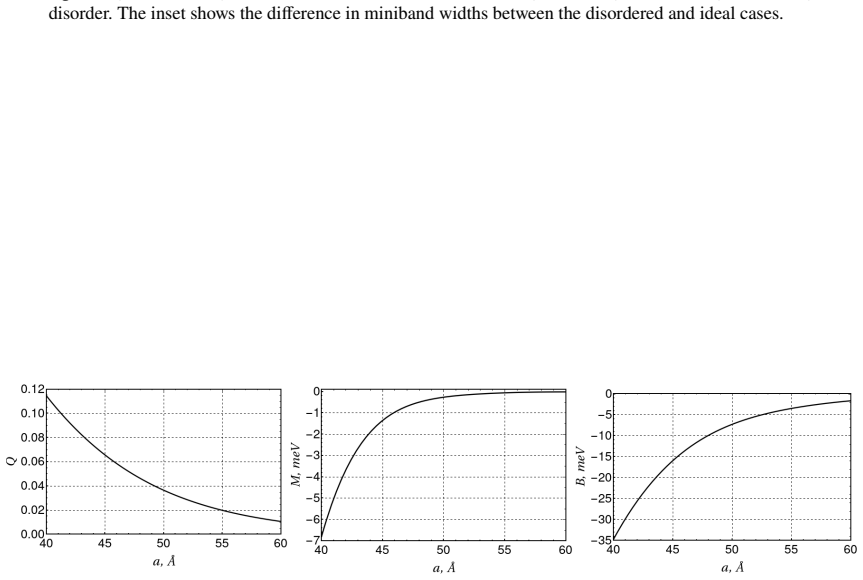
A theoretical framework is developed for the electron miniband structure in one-dimensional chains of spherical quantum dots subjected to weak positional disorder. Within the tight-binding approximation combined with the effective-medium approach, the stochastic fluctuations of the inter-dot spacing are mapped onto the renormalization of the key Hamiltonian parameters: the hopping integral B, the overlap integral Q, and the on-site energy shift M. Analytical expressions for these disorder-renormalized parameters are derived by performing an ensemble average over a narrow Gaussian distribution of positional deviations. The resulting generalized dispersion relation shows that weak positional d
What carries the argument
Renormalization of the hopping integral B, overlap integral Q, and on-site energy shift M through ensemble averaging over a Gaussian distribution of inter-dot spacings in the tight-binding effective-medium model.
If this is right
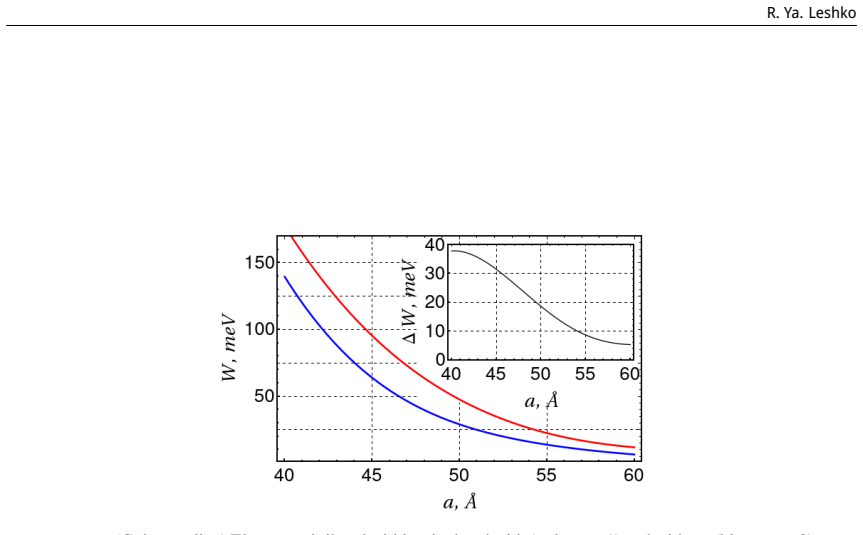
- For typical fabrication fluctuations of σ = 0.1 a, the miniband width increases by 8-12% depending on the mean inter-dot distance a.
- The sensitivity of the miniband width to disorder decreases rapidly with increasing lattice period due to exponential decay of wave functions.
- In the considered weak-disorder regime, the Anderson localization length significantly exceeds the lattice constant, so the miniband states remain delocalized.
Where Pith is reading between the lines
- Fabrication processes for quantum dot chains could tolerate small positional variations without losing delocalized transport properties.
- The broadening effect may influence design choices in optoelectronic devices based on quantum dot arrays.
- Similar renormalization approaches could apply to other one-dimensional nanostructure systems with weak disorder.
Load-bearing premise
The fluctuations in inter-dot spacing can be accounted for by renormalizing the Hamiltonian parameters through an ensemble average over a narrow Gaussian distribution in the tight-binding approximation.
What would settle it
Comparing the measured width of minibands in fabricated quantum dot chains with positional disorder of about 10 percent to the width in perfectly ordered chains would test if the predicted 8-12 percent broadening occurs.
Figures

read the original abstract
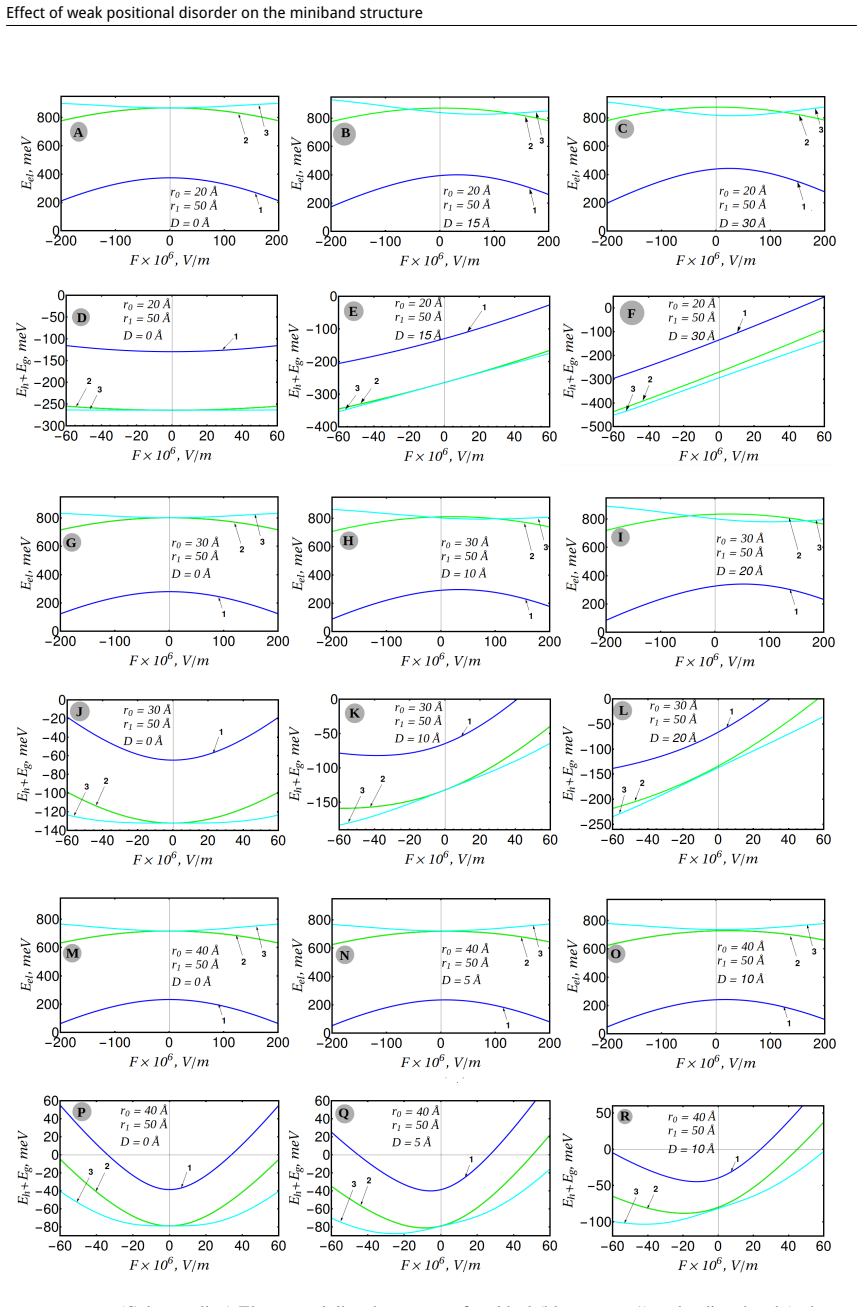
A theoretical framework is developed for the electron miniband structure in one-dimensional chains of spherical quantum dots subjected to weak positional disorder. Within the tight-binding approximation combined with the effective-medium approach, the stochastic fluctuations of the inter-dot spacing are mapped onto the renormalization of the key Hamiltonian parameters: the hopping integral $ B $, the overlap integral $ Q $, and the on-site energy shift $ M $. Analytical expressions for these disorder-renormalized parameters are derived by performing an ensemble average over a narrow Gaussian distribution of positional deviations ($ \sigma \ll a $). The resulting generalized dispersion relation shows that weak positional disorder causes a broadening of the minibands. Specifically, for typical fabrication fluctuations $\sigma = 0.1\,a $, the miniband width increases by 8-12\% (depending on the mean inter-dot distance $a$). At the same time, the sensitivity of the miniband width to disorder decreases rapidly with increasing lattice period due to the exponential decay of the electron wave functions. In the considered weak-disorder regime, the Anderson localization length significantly exceeds the lattice constant, so the miniband states remain delocalized.
Editorial analysis
A structured set of objections, weighed in public.
Referee Report
Summary. The paper develops a theoretical framework for the miniband structure of one-dimensional chains of spherical quantum dots with weak positional disorder. Using the tight-binding approximation combined with an effective-medium approach, stochastic fluctuations in inter-dot spacing (modeled as a narrow Gaussian with σ ≪ a) are mapped onto renormalized values of the hopping integral B, overlap integral Q, and on-site energy shift M via ensemble averaging; the resulting generalized dispersion relation is then used to show that such disorder broadens the minibands (by 8-12% for σ = 0.1a, with the effect weakening for larger mean spacing a) while leaving states delocalized.
Significance. If the effective-medium step is accurate, the work supplies analytical expressions for the disorder-renormalized parameters and a quantitative estimate of fabrication-induced broadening, which could guide tolerance analysis in quantum-dot arrays. The derivation of closed-form averages over the Gaussian and the observation that localization length remains long are useful contributions.
major comments (2)
- [main derivation (effective-medium mapping) and dispersion relation] The central step replaces the disordered secular equation by the clean dispersion evaluated at the averaged parameters <B>, <Q>, <M>. Because B, Q and M are deterministic functions of the identical instantaneous spacing d_i, their fluctuations are perfectly correlated; the manuscript provides no a-priori bound on the error incurred by interchanging the average and the product (especially with Q appearing in the denominator), nor any transfer-matrix or numerical diagonalization check that would confirm the reported 8-12% broadening is not an artifact of this replacement.
- [results for miniband width] The quoted percentage broadening (8-12% at σ = 0.1a) is obtained after inserting the averaged parameters into the clean tight-binding formula; without an explicit demonstration that the typical eigenvalue range of the random transfer-matrix product coincides with the range obtained from the averaged parameters, the quantitative claim remains conditional on the validity of the effective-medium approximation.
minor comments (2)
- The abstract states that the broadening 'depends on the mean inter-dot distance a'; the functional dependence and the specific values of a used for the 8-12% range should be stated explicitly in the main text or a table.
- Notation for the renormalized parameters (<B>, <Q>, <M>) and the original clean parameters should be introduced with a single consistent symbol set to avoid reader confusion when the averaged quantities are substituted back into the dispersion.
Simulated Author's Rebuttal
We thank the referee for the careful reading and constructive comments on the effective-medium approximation. We respond point by point below.
read point-by-point responses
-
Referee: [main derivation (effective-medium mapping) and dispersion relation] The central step replaces the disordered secular equation by the clean dispersion evaluated at the averaged parameters <B>, <Q>, <M>. Because B, Q and M are deterministic functions of the identical instantaneous spacing d_i, their fluctuations are perfectly correlated; the manuscript provides no a-priori bound on the error incurred by interchanging the average and the product (especially with Q appearing in the denominator), nor any transfer-matrix or numerical diagonalization check that would confirm the reported 8-12% broadening is not an artifact of this replacement.
Authors: We agree that B, Q and M are perfectly correlated through the common spacing d_i and that replacing the random secular equation by the clean dispersion at the averaged parameters omits higher-order fluctuation effects, particularly those arising from the denominator involving Q. The derivation supplies only the leading renormalization for σ ≪ a; no a-priori error bound is given because the focus was on obtaining closed-form averages. We will revise the manuscript to state explicitly that the mapping is an effective-medium approximation whose accuracy is not quantified beyond the weak-disorder assumption, and we will add a short discussion of the neglected correlation terms. revision: partial
-
Referee: [results for miniband width] The quoted percentage broadening (8-12% at σ = 0.1a) is obtained after inserting the averaged parameters into the clean tight-binding formula; without an explicit demonstration that the typical eigenvalue range of the random transfer-matrix product coincides with the range obtained from the averaged parameters, the quantitative claim remains conditional on the validity of the effective-medium approximation.
Authors: The 8-12% figure is obtained precisely by substituting the averaged parameters into the clean dispersion relation. We acknowledge that this leaves the quantitative claim conditional on the effective-medium step. In the revision we will qualify the reported broadening as a prediction within that approximation and note that a direct transfer-matrix comparison would be required to confirm the eigenvalue range for finite disorder. revision: partial
Circularity Check
No significant circularity; derivation uses explicit ensemble averaging within stated approximations
full rationale
The paper derives renormalized parameters B, Q, M via explicit ensemble averages over a Gaussian distribution of spacings inside the tight-binding + effective-medium framework, then inserts the averages into the clean dispersion relation to obtain a generalized formula. No step reduces a claimed prediction to a fitted input by construction, nor does any load-bearing premise rest on a self-citation chain or imported uniqueness theorem. The mapping of positional fluctuations to parameter renormalization is performed analytically from the model definitions rather than presupposing the miniband broadening result. The 8-12% width increase is an output of that calculation for the chosen σ = 0.1a, not an input. Concerns about correlation between B(Q,M) or validity of replacing random transfer-matrix products by products of averages pertain to approximation accuracy, not circularity.
Axiom & Free-Parameter Ledger
axioms (2)
- domain assumption Tight-binding approximation combined with effective-medium approach is valid for the electron states in the QD chain.
- domain assumption Positional deviations follow a narrow Gaussian distribution with σ ≪ a.
Reference graph
Works this paper leans on
-
[1]
XuQ.,WangZ.,ZhangT.,WangS.,PengS.,ZhangY.,LiP.,SongY.,PanQ.,Matter,2025,8,No.12,102459, doi:10.1016/j.matt.2025.102459
-
[2]
Yu L., Tian P., Liang K., Quantum Beam Sci., 2025,9, 9, doi:10.3390/qubs9010009
-
[3]
Gao P., Li C., Zhou H., He S., Yin Z., Ng K. W., Wang S., Opto-Electron. Sci., 2025,4, No. 6, 240028, doi:10.29026/oes.2025.240028
-
[4]
ZhengL.,ZhaiG.,ZhangY.,JinX.,GaoL.,YunZ.,MiaoY.,WangH.,WuY.,XuB.,SuperlatticesMicrostruct., 2020,140, 106460, doi:10.1016/j.spmi.2020.106460
-
[5]
Chandrasekaran S., Bowen C., Roscow J., Zhang Y., Dang D. K., Kim E. J., Misra R., Deng L., Chung J. S., Hur S. H., Phys. Rep., 2019,792, 1–33, doi:10.1016/j.physrep.2018.11.001
-
[7]
2, 94–123, doi:10.1016/j.nantod.2012.02.006
Lan H., Ding Y., Nano Today, 2012,7, No. 2, 94–123, doi:10.1016/j.nantod.2012.02.006
-
[8]
Hahn R. V. H., Rodríguez-Bolívar S., Rodosthenous P., Skibinsky-Gitlin E. S., Califano M., Gómez- Campos F. M., Nanomaterials, 2022,12, 3387, doi:10.3390/nano12193387
-
[9]
LiS.-S.,XiaJ.-B.,YuanZ.L.,XuZ.Y.,Phys.Rev.B,1996,54,11575–11581,doi:10.1103/PhysRevB.54.11575
-
[10]
Tkach M. V., Makhanets O. M., Zegrya G. G., Semicond. Sci. Technol., 2000,15, 395–398, doi:10.1088/0268- 1242/15/4/315
-
[11]
Lazarenkova O. L., Balandin A. A., J. Appl. Phys., 2001,89, 5509–5515, doi:10.1063/1.1366662
-
[12]
Nika D. L., Pokatilov E. P., Shao Q., Balandin A. A., Phys. Rev. B, 2007,76, 125417, doi:10.1103/PhysRevB.76.125417
-
[13]
TsaiY.-C.,LeeM.-Y.,LiY.,SamukawaS.,Jpn.J.Appl.Phys.,2016,55,04EJ14,doi:10.7567/JJAP.55.04EJ14. 23703-5 R. Ya. Leshko
-
[14]
BoichukV.I.,BilynskyI.V.,PazyukR.I.,Condens.MatterPhys.,2017,20,23704,doi:10.5488/CMP.20.23704
-
[15]
BilynskyiI.,LeshkoR.,BanduraH.,J.Phys.Chem.Solids,2020,21,584–590,doi:10.15330/pcss.21.4.584-590
-
[16]
Leshko R., Bandura H., Bilynskyi I., Slusarenko M., Physica B, 2024,690, 416272, doi:10.1016/j.physb.2024.416272
-
[17]
S., Nikoghosyan G., Physica B, 2022,628, 413574, doi:10.1016/j.physb.2021.413574
Nikoghosyan H. S., Nikoghosyan G., Physica B, 2022,628, 413574, doi:10.1016/j.physb.2021.413574
-
[18]
Vurgaftman I., Meyer J. R., Ram-Mohan L. R., J. Appl. Phys., 2001,89, 5815–5875, doi:10.1063/1.1368156
-
[19]
Faleev N. N., Honsberg C., Punegov V. I., J. Appl. Phys., 2013,113, 163506, doi:10.1063/1.4802662
-
[20]
D., Miranti R., Kikitsu T., Hikima T., Hashizume D., Matsushita N., Iwasa Y., Bisri S
Septianto R. D., Miranti R., Kikitsu T., Hikima T., Hashizume D., Matsushita N., Iwasa Y., Bisri S. Z., Nat Commun, 2023,14, No. 1, 2670, doi:10.1038/s41467-023-38216-y
-
[21]
Rep., 2017,7, 5625, doi:10.1038/s41598-017-05631-3
Kothari K., Maldovan M., Sci. Rep., 2017,7, 5625, doi:10.1038/s41598-017-05631-3
-
[22]
Cha M.-H., Hwang J., Sci. Rep., 2020,10, 16699, doi:10.1038/s41598-020-73578-z. Вплив слабкого позицiйного невпорядкування на мiнiзонну структуру в одновимiрних ланцюжках сферичних квантових точок Р . Я. Лешко Кафедра фiзики та iнформацiйних систем, Дрогобицький державний педагогiчний унiверситет iменi Iвана Франка, вул. Стрийська, 3, 82100 Дрогобич, Укра...
discussion (0)
Sign in with ORCID, Apple, or X to comment. Anyone can read and Pith papers without signing in.