Reduced Dynamical Maps in Finite Temperature Vibronic Coupling Models via Choi Matrices: Numerical Methods and Applications
Pith reviewed 2026-05-22 05:42 UTC · model grok-4.3
The pith
A single unitary evolution in a thermofield-doubled space yields the complete reduced dynamical map via the Choi isomorphism.
A machine-rendered reading of the paper's core claim, the machinery that carries it, and where it could break.
Core claim
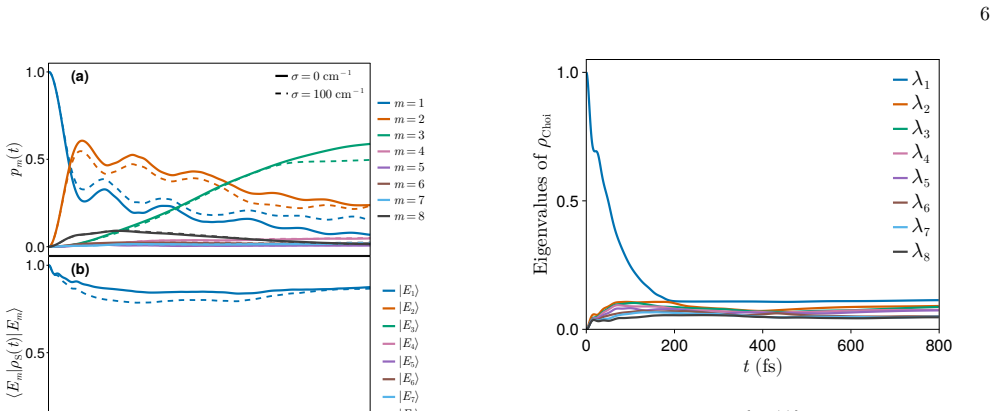
The reduced dynamical map is obtained from a single unitary propagation in a thermofield-doubled Hilbert space and represented in matrix form through the Choi-Jamiołkowski isomorphism. The TFD evolution is implemented in the TT representation, enabling efficient propagation of high-dimensional purified thermal states. The approach is illustrated for exciton transfer in the Fenna-Matthews-Olson complex with site-dependent structured spectral densities, allowing analysis of decoherence, relaxation, and finite-memory effects.
What carries the argument
Choi-Jamiołkowski isomorphism applied to the unitary propagator of the thermofield-doubled system-bath state, with tensor-train compression for propagation.
If this is right
- The extracted maps directly furnish memory kernels and transfer tensors without separate simulations.
- Decoherence and relaxation processes can be quantified for structured, site-dependent baths.
- The crossover from non-Markovian to effectively time-local dynamics becomes accessible through post-processing of the maps.
- Effective kinetic rate models for complex molecular systems can be derived from the same data.
Where Pith is reading between the lines
- The same single-propagation route could be applied to other open quantum systems that possess a thermal bosonic environment.
- It supplies a practical benchmark for testing the accuracy of approximate master equations at finite temperature.
- Improved tensor-train algorithms would extend the reachable system sizes while keeping the same formal extraction of the reduced map.
Load-bearing premise
Tensor-train truncation of the doubled thermal state must remain accurate enough during propagation to preserve the fidelity of the extracted reduced map over the relevant timescales.
What would settle it
Direct numerical comparison, for a small system size, between the Choi matrix obtained from this single-propagation method and the same matrix computed by exact diagonalization or repeated open-system propagations.
Figures



read the original abstract
We present a streamlined implementation of a computational framework for constructing and analyzing reduced dynamical maps for complex system--bath models at finite temperature. The methodology is based on three established ingredients of quantum dynamics: the Choi--Jamio{\l}kowski isomorphism for the representation of quantum channels, thermofield (TFD) purification of thermal environments, and tensor-train (TT) propagation of the resulting enlarged pure state. The reduced map is obtained from a single unitary propagation in a thermofield-doubled Hilbert space and represented in matrix form through the Choi--Jamio{\l}kowski isomorphism. The TFD evolution is implemented in the TT representation, enabling efficient propagation of high-dimensional purified thermal states. We illustrate the methodology for exciton transfer in the Fenna--Matthews--Olson complex with site-dependent structured spectral densities represented by discretized bosonic environments. The resulting maps are used to analyze decoherence, relaxation, and finite-memory effects, and to assess the crossover to an effectively time-local description. The proposed approach provides a route to compute reduced propagators and to post-process them into memory kernels, transfer tensors, and effective kinetic rate descriptions for complex molecular systems.
Editorial analysis
A structured set of objections, weighed in public.
Referee Report
Summary. The manuscript presents a numerical framework for computing reduced dynamical maps in finite-temperature system-bath models by propagating a single thermofield-doubled pure state under the doubled Hamiltonian in tensor-train format and extracting the reduced channel via the Choi-Jamiołkowski isomorphism after partial trace over the bath modes. The method is illustrated on exciton transfer in the Fenna-Matthews-Olson complex using site-dependent discretized bosonic environments, with the resulting maps analyzed for decoherence, relaxation, finite-memory effects, and crossover to effectively time-local dynamics.
Significance. If the truncation errors are demonstrably controlled, the approach offers a computationally efficient alternative to ensemble averaging for obtaining reduced propagators in complex vibronic models, enabling direct post-processing into memory kernels and transfer tensors. The reliance on established primitives (Choi isomorphism, TFD purification, TT compression) is a strength, and the single-propagation construction avoids the need for multiple initial-state simulations.
major comments (2)
- [Numerical Implementation] Numerical Implementation section (around the TT propagation description): the manuscript lacks a quantitative error analysis showing that per-step singular-value truncation in the thermofield-doubled state does not accumulate to produce violations of complete positivity or incorrect memory kernels in the extracted Choi matrix after tracing out the bath. The FMO example with site-dependent baths increases entanglement growth, so explicit bounds or convergence tests with respect to bond dimension and time are needed to support the central claim of reliable reduced maps.
- [FMO Application] FMO Application section (exciton transfer results): the reported crossover to time-local dynamics should include direct verification that the Choi matrices remain completely positive (e.g., non-negative eigenvalues) and trace-preserving across the simulated timescales; without this, the analysis of finite-memory effects risks being undermined by numerical artifacts from TT compression.
minor comments (2)
- The abstract mentions 'streamlined implementation' but does not specify the software or libraries used for TT propagation; adding this would improve reproducibility.
- Notation for the thermofield-doubled Hamiltonian and the partial-trace operation to obtain the Choi matrix should be made fully explicit with an equation reference for clarity.
Simulated Author's Rebuttal
We thank the referee for the careful reading of our manuscript and the constructive comments. We address each major comment below and describe the revisions that will be incorporated.
read point-by-point responses
-
Referee: [Numerical Implementation] Numerical Implementation section (around the TT propagation description): the manuscript lacks a quantitative error analysis showing that per-step singular-value truncation in the thermofield-doubled state does not accumulate to produce violations of complete positivity or incorrect memory kernels in the extracted Choi matrix after tracing out the bath. The FMO example with site-dependent baths increases entanglement growth, so explicit bounds or convergence tests with respect to bond dimension and time are needed to support the central claim of reliable reduced maps.
Authors: We agree that a quantitative error analysis is necessary to substantiate the reliability of the extracted reduced maps. In the revised manuscript we will add convergence studies with respect to TT bond dimension for the FMO example. These will include explicit checks that the eigenvalues of the Choi matrices remain non-negative and that trace preservation holds to machine precision across the simulated times. We will also demonstrate stability of the derived memory kernels under increasing bond dimension. While deriving rigorous a-priori bounds on accumulated truncation error is beyond the scope of the present numerical framework, the added numerical evidence will directly address the concern for the site-dependent bath case. revision: yes
-
Referee: [FMO Application] FMO Application section (exciton transfer results): the reported crossover to time-local dynamics should include direct verification that the Choi matrices remain completely positive (e.g., non-negative eigenvalues) and trace-preserving across the simulated timescales; without this, the analysis of finite-memory effects risks being undermined by numerical artifacts from TT compression.
Authors: We accept this point. The revised manuscript will include direct verification of complete positivity and trace preservation of the Choi matrices at representative times throughout the FMO simulations. These checks will be presented together with the discussion of the crossover to effectively time-local dynamics, thereby confirming that the reported finite-memory effects are not compromised by TT truncation artifacts. revision: yes
Circularity Check
No circularity: derivation rests on externally validated standard primitives
full rationale
The paper explicitly frames its method as a combination of three pre-existing, independently established techniques: the Choi-Jamiołkowski isomorphism for channel representation, thermofield doubling for thermal purification, and tensor-train compression for high-dimensional state propagation. These are cited as standard ingredients of quantum dynamics rather than derived or fitted within the present work. The reduced map is obtained by applying these tools to a thermofield-doubled Hamiltonian and extracting the Choi matrix via partial trace; no equation in the provided text defines the target map in terms of itself or renames a fitted quantity as a prediction. The FMO application is an illustration, not a load-bearing derivation. Consequently the central construction remains self-contained against external benchmarks and receives the default non-circularity finding.
Axiom & Free-Parameter Ledger
axioms (3)
- standard math The Choi-Jamiołkowski isomorphism correctly represents completely positive trace-preserving maps as operators on the doubled system space.
- standard math Thermofield doubling produces an exact purification of the thermal bath state that evolves unitarily under the doubled Hamiltonian.
- domain assumption Tensor-train decomposition can represent and propagate the high-dimensional purified state with controllable truncation error.
Lean theorems connected to this paper
-
IndisputableMonolith/Cost/FunctionalEquation.leanwashburn_uniqueness_aczel unclear?
unclearRelation between the paper passage and the cited Recognition theorem.
The reduced map is obtained from a single unitary propagation in a thermofield-doubled Hilbert space and represented in matrix form through the Choi–Jamiołkowski isomorphism.
-
IndisputableMonolith/Foundation/ArithmeticFromLogic.leanembed_strictMono_of_one_lt unclear?
unclearRelation between the paper passage and the cited Recognition theorem.
TFD evolution is implemented in the TT representation... leading eigenvalues of the normalized Choi state
What do these tags mean?
- matches
- The paper's claim is directly supported by a theorem in the formal canon.
- supports
- The theorem supports part of the paper's argument, but the paper may add assumptions or extra steps.
- extends
- The paper goes beyond the formal theorem; the theorem is a base layer rather than the whole result.
- uses
- The paper appears to rely on the theorem as machinery.
- contradicts
- The paper's claim conflicts with a theorem or certificate in the canon.
- unclear
- Pith found a possible connection, but the passage is too broad, indirect, or ambiguous to say the theorem truly supports the claim.
Reference graph
Works this paper leans on
-
[1]
Schulze, Jan and Shibl, Mohamed F. and. Multi-Layer Multi-Configuration Time-Dependent. J. Chem. Phys. , volume =. doi:10.1063/1.4948563 , urldate =
-
[2]
Scholes, Gregory D. and Fleming, Graham R. and Chen, Lin X. and. Nature , volume =. doi:10.1038/nature21425 , urldate =
-
[3]
Prior, Javier and Chin, Alex W. and Huelga, Susana F. and Plenio, Martin B. , year = 2010, journal =. doi:10.1103/PhysRevLett.105.050404 , urldate =
-
[4]
Tomographically Reconstructed Master Equations for Any Open Quantum Dynamics , author =. Quantum , volume =. doi:10.22331/q-2018-07-11-76 , urldate =
-
[5]
Pollock, Felix A. and. Non-. Phys. Rev. A , volume =. doi:10.1103/PhysRevA.97.012127 , urldate =
-
[6]
and Purkayastha, Archak and Clark, Stephen R
Strachan, David J. and Purkayastha, Archak and Clark, Stephen R. , year = 2025, publisher =. Accelerated Calculation of Impurity. doi:10.48550/ARXIV.2510.26651 , urldate =
-
[7]
Thermofield-Based Chain-Mapping Approach for Open Quantum Systems , author =. Phys. Rev. A , volume =. doi:10.1103/PhysRevA.92.052116 , urldate =
-
[8]
Runeson, Johan E. and Fay, Thomas P. and Manolopoulos, David E. , year = 2024, journal =. Exciton Dynamics from the Mapping Approach to Surface Hopping: Comparison with. doi:10.1039/D3CP05926J , urldate =
-
[9]
Percival, Donald B. and Walden, Andrew T. , year = 1993, edition =. Spectral. doi:10.1017/CBO9780511622762 , urldate =
-
[10]
Wilkins, David M. and Dattani, Nikesh S. , year = 2015, journal =. Why. doi:10.1021/ct501066k , urldate =
-
[11]
Ishizaki, Akihito and Fleming, Graham R. , year = 2009, journal =. On the Adequacy of the. doi:10.1063/1.3155214 , urldate =
-
[12]
Ishizaki, Akihito and Fleming, Graham R. , year = 2009, journal =. Unified Treatment of Quantum Coherent and Incoherent Hopping Dynamics in Electronic Energy Transfer:. doi:10.1063/1.3155372 , urldate =
-
[13]
Full Microscopic Simulations Uncover Persistent Quantum Effects in Primary Photosynthesis , author =. Sci. Adv. , volume =. doi:10.1126/sciadv.ady6751 , urldate =
-
[14]
The Role of Non-Equilibrium Vibrational Structures in Electronic Coherence and Recoherence in Pigment-Protein Complexes , author =. Nat Phys , volume =. doi:10.1038/nphys2515 , urldate =
-
[15]
Arimitsu, Toshihico , year = 1982, journal =
work page 1982
-
[16]
Beck, M. H. and Jackle, A. and Worth, G. A. and Meyer, H. -D. , year = 2000, journal =
work page 2000
-
[17]
doi:10.48550/arXiv.2301.06365 , archiveprefix =
Bhattacharjee, Suraka and Mandal, Koushik and Sinha, Supurna , year = 2023, number =. doi:10.48550/arXiv.2301.06365 , archiveprefix =. 2301.06365 , primaryclass =
-
[18]
Bhattacharyya, Srijan and Sayer, Thomas and. J. Chem. Phys. , volume =
-
[19]
B. J. Chem. Phys. , volume =
-
[20]
Borrelli, Raffaele and Dolgov, Sergey , year = 2021, journal =
work page 2021
-
[21]
Borrelli, Raffaele and Gelin, Maxim F. , year = 2016, journal =
work page 2016
-
[22]
Borrelli, Raffaele and Gelin, Maxim F. , year = 2017, journal =. doi:10.1038/s41598-017-08901-2 , langid =
-
[23]
Borrelli, Raffaele and Gelin, Maxim F. , year = 2021, journal =. doi:10.1002/wcms.1539 , langid =
-
[24]
Borrelli, Raffaele and Peluso, Andrea , year = 2015, journal =
work page 2015
-
[25]
Breuer, Heinz-Peter and Kappler, Bernd and Petruccione, Francesco , year = 2001, journal =
work page 2001
-
[26]
Breuer, Heinz-Peter and Petruccione, Francesco , title =
- [27]
-
[28]
Buser, Maximilian and Cerrillo, Javier and Schaller, Gernot and Cao, Jianshu , year = 2017, journal =
work page 2017
-
[29]
Cerrillo, Javier and Cao, Jianshu , year = 2014, journal =
work page 2014
-
[30]
Chen, Lipeng and Zhao, Yang , year = 2017, journal =
work page 2017
-
[31]
Choi, Man-Duen , year = 1975, journal =
work page 1975
-
[32]
Phys. Rev. B , volume =
-
[33]
Dolgov, Sergey V. , year = 2019, journal =. doi:10.1515/cmam-2018-0023 , chapter =
-
[34]
Annalen der Physik , volume =
-
[35]
and Borrelli, Raffaele and Domcke, Wolfgang , year = 2019, journal =
Gelin, Maxim F. and Borrelli, Raffaele and Domcke, Wolfgang , year = 2019, journal =
work page 2019
-
[36]
and Velardo, Amalia and Borrelli, Raffaele , year = 2021, journal =
Gelin, Maxim F. and Velardo, Amalia and Borrelli, Raffaele , year = 2021, journal =
work page 2021
-
[37]
Reports on Mathematical Physics , volume =
Jamio. Reports on Mathematical Physics , volume =
-
[38]
Karlewski, Christian and Marthaler, Michael , year = 2014, journal =
work page 2014
-
[39]
Kelly, Aaron and. J. Chem. Phys. , volume =
-
[40]
Landi, Alessandro and Borrelli, Raffaele and Capobianco, Amedeo and Velardo, Amalia and Peluso, Andrea , year = 2018, journal =
work page 2018
- [41]
- [42]
-
[43]
Lubich, C. and Oseledets, I. and Vandereycken, B. , year = 2015, journal =
work page 2015
-
[44]
and Geva, Eitan and Batista, Victor S
Lyu, Ningyi and Mulvihill, Ellen and Soley, Micheline B. and Geva, Eitan and Batista, Victor S. , year = 2023, journal =
work page 2023
-
[45]
Makri, Nancy , year = 1991, journal =
work page 1991
-
[46]
Makri, Nancy , year = 2018, journal =
work page 2018
-
[47]
Makri, Nancy , year = 2025, journal =
work page 2025
-
[48]
Computing partial traces and reduced density matrices
Maziero, Jonas , year = 2017, journal =. doi:10.1142/S012918311750005X , archiveprefix =. 1601.07458 , primaryclass =
work page internal anchor Pith review Pith/arXiv arXiv doi:10.1142/s012918311750005x 2017
- [49]
-
[50]
J. Chem. Phys. , volume =
-
[51]
Mori, Hazime , year = 1965, journal =
work page 1965
-
[52]
Nakajima, Sadao , year = 1958, journal =
work page 1958
- [53]
-
[54]
and Zhang, Peng , year = 2022, journal =
Nuomin, Hanggai and Beratan, David N. and Zhang, Peng , year = 2022, journal =
work page 2022
- [55]
-
[56]
Pfalzgraff, William C. and. J. Chem. Phys. , volume =
-
[57]
doi:10.1103/PhysRevB.104.045417 , langid =
Purkayastha, Archak and Guarnieri, Giacomo and Campbell, Steve and Prior, Javier and Goold, John , year = 2021, journal =. doi:10.1103/PhysRevB.104.045417 , langid =
-
[58]
Redfield, A. G. , editor =. Advances in
-
[59]
Rivera, Eva and Montemayor, Daniel and Masia, Marco and Coker, David F. , year = 2013, journal =
work page 2013
-
[60]
Sayer, Thomas and. J. Chem. Phys. , volume =
-
[61]
Sayer, Thomas and. J. Chem. Phys. , volume =. doi:10.1063/5.0185578 , langid =
- [62]
-
[63]
doi:10.1007/BF01323673 , langid =
Schmutz, Manfred , year = 1978, journal =. doi:10.1007/BF01323673 , langid =
-
[64]
Shi, Qiang and Geva, Eitan , year = 2003, journal =
work page 2003
-
[65]
and Purkayastha, Archak and Clark, Stephen R
Strachan, David J. and Purkayastha, Archak and Clark, Stephen R. , year = 2024, journal =
work page 2024
-
[66]
Strathearn, A. and Kirton, P. and Kilda, D. and Keeling, J. and Lovett, B. W. , year = 2018, journal =. doi:10.1038/s41467-018-05617-3 , langid =
-
[67]
doi:10.1063/5.0232232 , langid =
Takahashi, Hideaki and Borrelli, Raffaele , year = 2024, journal =. doi:10.1063/5.0232232 , langid =
-
[68]
Takahashi, Hideaki and Borrelli, Raffaele , year = 2025, journal =
work page 2025
-
[69]
and Chen, Lipeng , year = 2024, journal =
Takahashi, Hideaki and Borrelli, Raffaele and Gelin, Maxim F. and Chen, Lipeng , year = 2024, journal =
work page 2024
-
[70]
Takahashi, Yasushi and Umezawa, Hiroomi , year = 1996, journal =
work page 1996
-
[71]
Tamascelli, D. and Smirne, A. and Lim, J. and Huelga, S. F. and Plenio, M. B. , year = 2019, journal =
work page 2019
-
[72]
Tanimura, Yoshitaka , year = 1990, journal =
work page 1990
-
[73]
Tanimura, Yoshitaka , year = 2020, journal =
work page 2020
-
[74]
Tanimura, Yoshitaka and Kubo, Ryogo , year = 1989, journal =
work page 1989
-
[75]
Tokuyama, Michio and Mori, Hazime , year = 1976, journal =
work page 1976
-
[76]
Velardo, Amalia and Borrelli, Raffaele and Peluso, Andrea and Capobianco, Amedeo , year = 2016, journal =
work page 2016
-
[77]
Wang, Haobin , year = 2015, journal =
work page 2015
-
[78]
doi:10.1017/9781316848142 , langid =
Watrous, John , title =. doi:10.1017/9781316848142 , langid =
- [79]
-
[80]
White, Steven R. and Feiguin, Adrian E. , year = 2004, journal =
work page 2004
discussion (0)
Sign in with ORCID, Apple, or X to comment. Anyone can read and Pith papers without signing in.