REVIEW 3 major objections 3 minor 1 cited by
Carpet-3 detection of a photon-like air shower with estimated primary energy above 100 TeV in a spatial and temporal coincidence with GRB 221009A
T0 review · 3 major / 3 minor · reviewed 2026-08-09 · deepseek-v4-flash
Pith's one-line read A ~300 TeV photon-like air shower coincident with GRB 221009A is reported, with only a 3 × 10^-4 chance of being a hadronic cosmic ray.
desk verdict A careful single-event analysis that adds real new data, but the headline hadron probability of ~3e-4 is softer than it looks and needs a systematic robustness check. read the letter →
The pith
A machine-rendered reading of the paper's core claim, the machinery that carries it, and where it could break.
The reading
What carries the argument
The analysis is carried by the upgraded 410 $m^{2}$ underground muon detector of Carpet-3, which recorded only 3 muons for this event, and by a neural-network classifier that combines the 20x20 pattern of energy releases in the central Carpet array with reconstructed shower parameters (arrival angles, axis position, shower size, muon counts in both detector parts, and the azimuthal-asymmetry variable C_k). The classifier was trained on 6750 simulated photon showers and 6750 simulated proton showers generated with CORSIKA using the QGSJET-II-04 and FLUKA hadronic interaction models over an energy range of 100-1000 TeV. The quoted hadron probability is the fraction of simulated proton events that the network scores at or above the observed event's score, and the energy estimate comes from a power-law fit relating simulated gamma-ray primary energy to shower size N_e.
What would settle it
One decisive check would be to measure the distribution of muon counts for hadronic cosmic-ray showers of the same reconstructed size with the same detector and compare it with the simulation: if the observed fraction of showers with three or fewer muons is much larger than the simulated 0.127, the hadron probability rises accordingly. A second check would be an archival search in other air-shower datasets for photon-like events within the same time window and direction, which would either corroborate the GRB association or show it to be a chance fluctuation.
Extended reading notes
Core claim
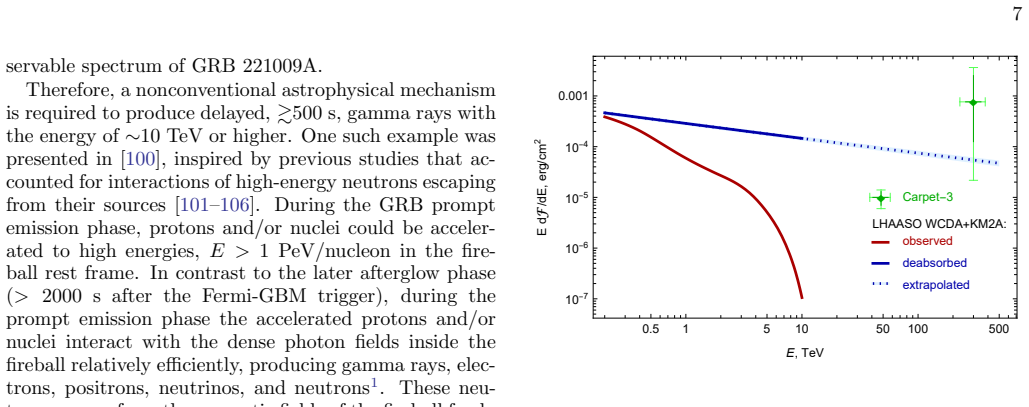
The central claim is that Carpet-3 detected a photon-like air shower with estimated primary energy 300+43-38 TeV, arriving 4536 seconds after the Fermi-GBM trigger from a direction 1.8 degrees from GRB 221009A, with a chance-coincidence probability of about 9 × $10^{-3}$ and an estimated probability of ~3 × $10^{-4}$ that the primary was hadronic. The paper states that this is the highest-energy event ever associated with any gamma-ray burst. Under the photon interpretation, the event also implies a fluence above 100 TeV of roughly (1.1 ± 0.9) × $10^{-3}$ erg/$cm^{2}$, consistent with the extension of the LHAASO spectrum to lower energies.
Load-bearing premise
The load-bearing premise is that the CORSIKA/QGSJET-II-04 and FLUKA simulations accurately reproduce both the Carpet-3 detector response and the muon content of real hadronic cosmic-ray showers; if actual proton or nuclei showers fluctuate to low muon counts more often than the simulations predict, the quoted 3 × $10^{-4}$ hadron probability and the 300 TeV gamma-ray energy estimate would be biased and the gamma-ray interpretation would lose support.
Editorial extensions
If this is right
- If the event is a genuine ~300 TeV photon from GRB 221009A, it would be the most energetic gamma ray ever linked to a GRB, exceeding the ~18 TeV LHAASO events by more than an order of magnitude.
- Its detection would imply that the standard absorption of such photons by extragalactic background light is somehow overcome, providing a target for axion-like-particle, Lorentz-invariance-violation, and other new-physics models.
- The event would set a lower bound on the GRB's very-high-energy emission that any afterglow model must reproduce, and the derived fluence above 100 TeV would connect to the LHAASO spectrum.
- The observation demonstrates the value of continuous, wide-field air-shower monitoring: at 4536 s after trigger the burst was at high elevation for Carpet-3 while LHAASO's field of view was closing and HAWC's was below the horizon.
Reading between the lines
- The authors do not attempt a search for additional events in the same direction; a dedicated archival search over other air-shower arrays' data could either strengthen the GRB association or show that the 9 × 10^-3 chance probability is the more relevant number.
- The neural-network classification rests on the simulated muon deficit for photons; a direct measurement of the muon-count distribution for hadronic showers of this size at the same altitude would test the 3 × 10^-4 figure independently of the next GRB.
- If the event is real but not from the GRB, the high Galactic latitude and proximity to known ultra-high-energy gamma-ray sources mean the Galactic-plane diffuse emission could produce occasional look-alikes, so future statistics rather than this single event will settle the origin.
Editorial analysis
A structured set of objections, weighed in public.
Referee Report
Summary. The paper reports a single air-shower event detected by the Carpet-3 array on 2022-10-09, with reconstructed Ne = 36400, zenith angle 26.5 deg, direction 1.8 deg from GRB 221009A, and at 4536 s after the GRB trigger. The event shows only 3 muons in the 410 m^2 underground muon detector. Using CORSIKA/QGSJET-II-04/FLUKA simulations, the authors estimate the primary energy as 300+43-38 TeV under a photon assumption, and using a neural-network classifier trained on simulated photon and proton showers they estimate the probability that the primary was a hadron as ~3e-4. They also estimate a data-driven chance coincidence probability of ~9e-3 for a background event satisfying the same selection on the day of the GRB. They conclude that this is the highest-energy event ever associated with any GRB and discuss implications for new physics in view of extragalactic background light absorption.
Significance. If correct, this would be a remarkable observation: a ~300 TeV photon candidate from a GRB, far above the previously highest-energy GRB photons (~18 TeV from LHAASO), with strong implications for GRB emission mechanisms, EBL opacity, and new-physics scenarios. The analysis is careful in several respects: the background estimate is data-driven rather than based on assumed source models; the neural network is evaluated on a held-out Monte Carlo test set; and the detector response is simulated with standard, publicly available codes. However, the headline probabilities rest on model-dependent simulations and post-hoc selection threshold choices, so the strength of the claim is sensitive to systematic effects that are not quantified in the manuscript.
major comments (3)
- [Sec. III C] The quoted hadron probability of ~3e-4 is the fraction of simulated proton events with neural-network prediction at or above the observed value 0.927. The Monte Carlo sample contains only proton and photon primaries generated with a single hadronic interaction model (QGSJET-II-04/FLUKA), while the real hadronic background includes nuclei and the high-energy hadronic model is itself uncertain. The paper does not assign any systematic uncertainty to this probability from model choice or composition. Given that Sec. III B shows that 12.7% of real hadronic events at matching Ne have n_mu <= 3, the additional suppression to 3e-4 comes primarily from spatial-pattern correlations that are not validated against data. Without a sensitivity study using alternative hadronic models or heavier primary species, the quoted probability could vary by an order of magnitude; a value of ~1e-2 would no longer strongly support the photon interpretation. This is a load-bearing number for the central claim.
- [Sec. II B and Sec. III C] The background selection criteria (Ne >= Nev_e and n_mu <= n_mu_ev, and later neural-network prediction >= 0.927) are defined using the observed event's own values. The reported chance probabilities (3.0e-3 and 9.0e-3) are therefore conditional on post-hoc thresholds, with no correction for the trials associated with choosing these cuts. For a valid frequentist p-value, one would need either a pre-specified selection or an explicit penalty for the cut optimization. As presented, the association probability is likely understated, and this directly affects the claim that the event is temporally and directionally coincident with GRB 221009A.
- [Sec. III A and Sec. III C] The Monte Carlo sample size is described inconsistently: the text states that 6750 photon and 6750 proton showers were generated, but the full Monte Carlo set is later quoted as 80609 events, split into 62007 training and 18602 test events. This discrepancy matters because the statistical precision of the 3e-4 hadron fraction depends on the total number of simulated hadrons; if only about 6750 protons were used, the fraction corresponds to only about 2 simulated events, giving a large Poisson uncertainty. The authors should reconcile these numbers and state explicitly how many simulated photon and proton events enter the neural-network classification and the energy estimate.
minor comments (3)
- [Sec. III B] The text contains a typographical error: 'Fig. 2)' should be 'Fig. 2.'.
- [Abstract and Sec. IV D] The phrase 'highest-energy event ever associated with any GRB' should be qualified as 'photon-like event' given that the hadronic probability is model-dependent; the conclusion should restate the systematic caveat from Sec. III C.
- [Sec. III D] The fluence uncertainty is estimated from Poisson statistics alone; the systematic uncertainty from the assumed E^-2 source spectrum and from the Monte Carlo efficiency is not propagated into the final fluence range.
Circularity Check
No significant circularity: the event classification, energy estimate, and coincidence probability are derived from independent Monte Carlo simulations and data-driven background rates, not from the conclusion.
full rationale
The paper's derivation chain is self-contained. The primary identification as photon-like rests on a neural network trained on independent CORSIKA/QGSJET-II-04/FLUKA Monte Carlo showers (6750 photons and 6750 protons), with the quoted hadron probability equal to the measured false-positive fraction of simulated protons at or above the observed network output (Sec. III C). The energy estimate of 300 TeV is conditional on the photon assumption and is obtained by inverting an MC-calibrated Ne-energy relation (Sec. III A), which is a standard estimator rather than a conclusion built into the input. The chance coincidence probability is data-driven: it is the observed rate of events satisfying the same photon-like selection criteria from the GRB direction over 667 live days (Sec. II B and III C), not a quantity derived from the GRB hypothesis. The fluence estimate in Sec. III D normalizes an assumed E^-2 spectrum to the single detected event and is explicitly labeled as an estimate with large Poisson uncertainties, so it is not presented as an independent prediction. Self-citations, including the preliminary telegram [48] and the Carpet-2 Monte Carlo description [86], are methodological references and are not load-bearing in the sense of substituting for evidence or forbidding alternatives. The main caveats—single-model hadronic simulation and proton-only training—are correctness/systematic-uncertainty concerns, not circularity. No equation or fitted parameter reduces to the paper's own conclusion by construction.
Assumptions & free parameters
free parameters (3)
- GRB spectrum power-law index for fluence =
2 (assumed E^-2)
- Fluence normalization =
1.1e-3 erg/cm2 above 100 TeV
- Neural network classification threshold =
0.71
assumptions (5)
- domain assumption The Monte Carlo code CORSIKA with QGSJET-II-04 and FLUKA accurately describes air shower development and muon production for photon and proton primaries in the 100-1000 TeV range.
- domain assumption The reconstructed direction of the Carpet-3 event has a 90% CL uncertainty of 4.7 degrees, so the 1.8 degree offset from the GRB direction is consistent with association.
- domain assumption The extragalactic background light model of Ref. [109] correctly predicts the attenuation of very high energy photons, so a 300 TeV photon from z=0.151 would be unexpected in the Standard Model.
- standard math Poisson statistics govern the occurrence of background events in the 667-day data set.
- domain assumption The observed event is from an astrophysical primary rather than detector noise.
Cite this review
Pith. "Pith review of Carpet-3 detection of a photon-like air shower with estimated primary energy above 100 TeV in a spatial and temporal coincidence with GRB 221009A." pith.science (2026). https://pith.science/paper/FERHE4H2
@misc{pith2026250202425,
  author       = {Pith},
  title        = {Pith review of: Carpet-3 detection of a photon-like air shower with estimated primary energy above 100 TeV in a spatial and temporal coincidence with GRB 221009A},
  year         = {2026},
  howpublished = {\url{https://pith.science/paper/FERHE4H2}},
  note         = {Machine review of arXiv:2502.02425}
}
abstract
The brightest cosmic gamma-ray burst (GRB) ever detected, GRB 221009A, was accompanied by photons of very high energies. These gamma rays may be used to test both the astrophysical models of the burst and our understanding of long-distance propagation of energetic photons, including potential new-physics effects. Here we present the observation of a photon-like air shower with the estimated primary energy of $300^{+43}_{-38}$ TeV, coincident (with the chance probability of $\sim 9\cdot 10^{-3}$) with the GRB in its arrival direction and time. Making use of the upgraded Carpet-3 muon detector and new machine learning analysis, we estimate the probability that the primary was hadronic as $\sim 3 \cdot 10^{-4}$. This is the highest-energy event ever associated with any GRB.
Figures


Figures from the paper (5 more)




Forward citations
Cited by 1 Pith paper
-
Gamma Ray Burst GRB 221009A: two distinct hints at once at new physics
For the 251 TeV photon from GRB 221009A, Lorentz invariance violation can raise the survival probability to near one, but the predicted count of 0.1 makes this only a weak hint.
Reference graph
Works this paper leans on
-
[1]
G. J. Fishman and C. A. Meegan, Gamma-ray bursts, Ann. Rev. Astron. Astrophys. 33, 415 (1995)
1995
-
[2]
Piran, Gamma-ray bursts and the fireball model, Phys
T. Piran, Gamma-ray bursts and the fireball model, Phys. Rept. 314, 575 (1999), arXiv:astro-ph/9810256
arXiv 1999
-
[3]
Piran, Gamma-ray bursts: A puzzle being resolved, Phys
T. Piran, Gamma-ray bursts: A puzzle being resolved, Phys. Rept. 333, 529 (2000), arXiv:astro-ph/9907392
arXiv 2000
-
[4]
Piran, The physics of gamma-ray bursts, Rev
T. Piran, The physics of gamma-ray bursts, Rev. Mod. Phys. 76, 1143 (2004), arXiv:astro-ph/0405503
arXiv 2004
-
[5]
Meszaros, Gamma-Ray Bursts, Rept
P. Meszaros, Gamma-Ray Bursts, Rept. Prog. Phys. 69, 2259 (2006), arXiv:astro-ph/0605208
arXiv 2006
-
[6]
P. Kumar and B. Zhang, The physics of gamma-ray bursts \& relativistic jets, Phys. Rept. 561, 1 (2015), arXiv:1410.0679 [astro-ph.HE]
arXiv 2015
-
[7]
Z. Dai, F. Daigne, and P. M´ esz´ aros, The Theory of Gamma-Ray Bursts, Space Sci. Rev. 212, 409 (2017)
2017
-
[8]
Kouveliotou, C
C. Kouveliotou, C. A. Meegan, G. J. Fishman, N. P. Bhyat, M. S. Briggs, T. M. Koshut, W. S. Paciesas, and G. N. Pendleton, Identification of two classes of gamma- ray bursts, Astrophys. J. Lett. 413, L101 (1993)
1993
Show all 111 references
-
[9]
Ghirlanda, L
G. Ghirlanda, L. Nava, G. Ghisellini, A. Celotti, and C. Firmani, Short versus Long Gamma-Ray Bursts: 9 spectra, energetics, and luminosities, Astron. Astro- phys. 496, 585 (2009), arXiv:0902.0983 [astro-ph.HE]
2009 arXiv
-
[10]
R. W. Klebesadel, I. B. Strong, and R. A. Olson, Ob- servations of Gamma-Ray Bursts of Cosmic Origin, As- trophys. J. Lett. 182, L85 (1973)
1973
-
[11]
Costa et al
E. Costa et al. , Discovery of an X-ray afterglow asso- ciated with the gamma-ray burst of 28 February 1997, Nature 387, 783 (1997), arXiv:astro-ph/9706065
1997 arXiv
-
[12]
M. J. Rees and P. Meszaros, Unsteady outflow models for cosmological gamma-ray bursts, Astrophys. J. Lett. 430, L93 (1994), arXiv:astro-ph/9404038
1994 arXiv
-
[13]
S. k. M. Rahaman, J. Granot, and P. Beniamini, Prompt gamma-ray burst emission from internal shocks – new insights, Mon. Not. Roy. Astron. Soc. 528, L45 (2023), arXiv:2308.00403 [astro-ph.HE]
2023 arXiv
-
[14]
M. J. Rees and P. M´ esz´ aros, Relativistic fireballs: en- ergy conversion and time-scales, Mon. Not. Roy. Astron. Soc. 258, 41P (1992)
1992
-
[15]
Meszaros and M
P. Meszaros and M. J. Rees, Optical and long wave- length afterglow from gamma-ray bursts, Astrophys. J. 476, 232 (1997), arXiv:astro-ph/9606043
1997 arXiv
-
[16]
R. Sari, T. Piran, and R. Narayan, Spectra and light curves of gamma-ray burst afterglows, Astrophys. J. Lett. 497, L17 (1998), arXiv:astro-ph/9712005
1998 arXiv
-
[17]
Meszaros, P
P. Meszaros, P. Laguna, and M. J. Rees, Gas dynamics of relativistically expanding gamma-ray burst sources: Kinematics, energetics, magnetic fields and efficiency, Astrophys. J. 415, 181 (1993), arXiv:astro-ph/9301007
1993 arXiv
-
[18]
Paczynski and J
B. Paczynski and J. E. Rhoads, Radio transients from gamma-ray bursters, Astrophys. J. Lett.418, L5 (1993), arXiv:astro-ph/9307024
1993 arXiv
-
[19]
Meszaros and M
P. Meszaros and M. J. Rees, Delayed GeV emission from cosmological gamma-ray bursts: Impact of a relativistic wind on external matter, Mon. Not. Roy. Astron. Soc. 269, L41 (1994), arXiv:astro-ph/9404056
1994 arXiv
-
[20]
Nine of them have energies ≳ 10 TeV in the baseline reconstruction
TeV during the time window (230–900) s after the trigger, while 16.7 were expected from the cosmic-ray background. Nine of them have energies ≳ 10 TeV in the baseline reconstruction. For each of them, the prob- ability that it is caused by a background cosmic ray lays between ...
2025 arXiv
-
[21]
Sari and A
R. Sari and A. A. Esin, On the Synchrotron self- compton emission from relativistic shocks and its im- plications for gamma-ray burst afterglows, Astrophys. J. 548, 787 (2001), arXiv:astro-ph/0005253
2001 arXiv
-
[22]
Meszaros, M
P. Meszaros, M. J. Rees, and H. Papathanassiou, Spec- tral properties of blast wave models of gamma-ray burst sources, Astrophys. J. 432, 181 (1994), arXiv:astro- ph/9311071
1994
-
[23]
V. A. Acciari et al. (MAGIC), Observation of inverse Compton emission from a long γ-ray burst, Nature 575, 459 (2019), arXiv:2006.07251 [astro-ph.HE]
2019 arXiv
-
[24]
V. A. Acciari et al. (MAGIC), Teraelectronvolt emission from the γ-ray burst GRB 190114C, Nature 575, 455 (2019), arXiv:2006.07249 [astro-ph.HE]
2019 arXiv
-
[26]
Abdalla et al
H. Abdalla et al. , A very-high-energy component deep in the γ-ray burst afterglow, Nature 575, 464 (2019), arXiv:1911.08961 [astro-ph.HE]
2019 arXiv
-
[27]
M. A. Williams et al. , GRB 221009A: Discovery of an Exceptionally Rare Nearby and Energetic Gamma- Ray Burst, Astrophys. J. Lett. 946, L24 (2023), arXiv:2302.03642 [astro-ph.HE]
2023 arXiv
-
[28]
Blanch et al
O. Blanch et al. , GRB 201216C: MAGIC detection in very high energy gamma rays, GRB Coordinates Net- work 29075, 1 (2020)
2020
-
[29]
Burns et al
E. Burns et al. , GRB 221009A: The BOAT, Astro- phys. J. Lett. 946, L31 (2023), arXiv:2302.14037 [astro- ph.HE]
2023 arXiv
-
[30]
Lesage et al
S. Lesage et al. , Fermi-GBM Discovery of GRB 221009A: An Extraordinarily Bright GRB from On- set to Afterglow, Astrophys. J. Lett. 952, L42 (2023), arXiv:2303.14172 [astro-ph.HE]
2023
-
[31]
M. D. Fulton et al. , The Optical Light Curve of GRB 221009A: The Afterglow and the Emerging Supernova, Astrophys. J. Lett. 946, L22 (2023), arXiv:2301.11170 [astro-ph.HE]
2023 arXiv
-
[32]
Negro et al
M. Negro et al. , The IXPE View of GRB 221009A, Astrophys. J. Lett. 946, L21 (2023), arXiv:2301.01798 [astro-ph.HE]
2023 arXiv
-
[33]
Laskar et al
T. Laskar et al. , The Radio to GeV Afterglow of GRB 221009A, Astrophys. J. Lett. 946, L23 (2023), arXiv:2302.04388 [astro-ph.HE]
2023 arXiv
-
[34]
D. A. Kann et al. , GRANDMA and HXMT Obser- vations of GRB 221009A: The Standard Luminosity Afterglow of a Hyperluminous Gamma-Ray Burst—In Gedenken an David Alexander Kann, Astrophys. J. Lett. 948, L12 (2023), arXiv:2302.06225 [astro-ph.HE]
2023 arXiv
-
[35]
Ripa et al., The peak flux of GRB 221009A measured with GRBAlpha, Astron
J. Ripa et al., The peak flux of GRB 221009A measured with GRBAlpha, Astron. Astrophys. 677, L2 (2023), arXiv:2302.10047 [astro-ph.HE]
2023 arXiv
-
[36]
A. J. Levan et al. , The First JWST Spectrum of a GRB Afterglow: No Bright Supernova in Observations of the Brightest GRB of all Time, GRB 221009A, Astro- phys. J. Lett. 946, L28 (2023), arXiv:2302.07761 [astro- ph.HE]
2023 arXiv
-
[38]
Frederiks et al
D. Frederiks et al. , Properties of the Extremely Ener- getic GRB 221009A from Konus-WIND and SRG/ART- XC Observations, Astrophys. J. Lett. 949, L7 (2023), arXiv:2302.13383 [astro-ph.HE]
2023 arXiv
-
[39]
Zheng et al
C. Zheng et al. , Observation of GRB 221009A Early Afterglow in X-Ray/Gamma-Ray Energy Bands, Astro- phys. J. Lett. 962, L2 (2024), arXiv:2310.10522 [astro- ph.HE]
2024 arXiv
-
[40]
Tavani et al
M. Tavani et al. , AGILE Gamma-Ray Detection of the Exceptional GRB 221009A, Astrophys. J. Lett. 956, L23 (2023), arXiv:2309.10515 [astro-ph.HE]
2023 arXiv
-
[41]
A. J. Castro-Tirado et al. , GRB 221009A: 10.4m GTC spectroscopic redshift confirmation, GRB Coordinates Network 32686, 1 (2022)
2022
-
[42]
de Ugarte Postigo et al
A. de Ugarte Postigo et al. , GRB 221009A: Red- shift from X-shooter/VLT, GRB Coordinates Network 32648, 1 (2022)
2022
-
[43]
Cao et al
Z. Cao et al. (LHAASO), A tera–electron volt afterglow from a narrow jet in an extremely bright gamma-ray burst, Science 380, adg9328 (2023), arXiv:2306.06372 [astro-ph.HE]
2023 arXiv
-
[44]
D. B. Malesani et al., The brightest GRB ever detected: GRB 221009A as a highly luminous event at z = 0.151 (2023), arXiv:2302.07891 [astro-ph.HE]
2023 arXiv
-
[45]
Nikishov, Absorption of high-energy photons in the universe, Sov
A. Nikishov, Absorption of high-energy photons in the universe, Sov. Phys. JETP 14, 393 (1962), [ Zh. Eksp. Teor. Fiz. 41 (1962) 549]. 10
1962
-
[46]
Cao et al
Z. Cao et al. (LHAASO), Very high energy gamma-ray emission beyond 10 TeV from GRB 221009A, Sci. Adv. 9, adj2778 (2023), arXiv:2310.08845 [astro-ph.HE]
2023
-
[47]
Huang et al., LHAASO observed GRB 221009A with more than 5000 VHE photons up to around 18 TeV, GCN Circular 32677 (2022)
Y. Huang et al., LHAASO observed GRB 221009A with more than 5000 VHE photons up to around 18 TeV, GCN Circular 32677 (2022)
2022
-
[48]
R. J. Gould and G. P. Schreder, Opacity of the Universe to High-Energy Photons, Phys. Rev. 155, 1408 (1967)
1967
-
[49]
Galanti, L
G. Galanti, L. Nava, M. Roncadelli, F. Tavecchio, and G. Bonnoli, Observability of the Very-High-Energy Emission from GRB 221009A, Phys. Rev. Lett. 131, 251001 (2023), arXiv:2210.05659 [astro-ph.HE]
2023 arXiv
-
[50]
Dzhappuev et al
D. Dzhappuev et al. , Swift J1913.1+1946/GRB 221009A: detection of a 250-TeV photon-like air shower by Carpet-2, The Astronomer’s Telegram15669 (2022)
2022
-
[51]
Baktash, D
A. Baktash, D. Horns, and M. Meyer, Interpretation of multi-TeV photons from GRB221009A, (2022), arXiv:2210.07172 [astro-ph.HE]
2022 arXiv
-
[52]
S. V. Troitsky, Parameters of axion-like parti- cles required to explain high-energy photons from GRB 221009A, Pisma Zh. Eksp. Teor. Fiz. 116, 745 (2022), arXiv:2210.09250 [astro-ph.HE]
2022 arXiv
-
[53]
Lin and T
W. Lin and T. T. Yanagida, Electroweak Axion in Light of GRB221009A, Chin. Phys. Lett. 40, 069801 (2023), arXiv:2210.08841 [hep-ph]
2023 arXiv
-
[54]
Galanti, M
G. Galanti, M. Roncadelli, and F. Tavecchio, Assess- ment of ALP scenarios for GRB 221009A, (2022), arXiv:2211.06935 [astro-ph.HE]
2022 arXiv
-
[55]
Zhang and B.-Q
G. Zhang and B.-Q. Ma, Axion-Photon Conversion of LHAASO Multi-TeV and PeV Photons, Chin. Phys. Lett. 40, 011401 (2023), arXiv:2210.13120 [hep-ph]
2023 arXiv
-
[56]
Nakagawa, F
S. Nakagawa, F. Takahashi, M. Yamada, and W. Yin, Axion dark matter from first-order phase transition, and very high energy photons from GRB 221009A, Phys. Lett. B 839, 137824 (2023), arXiv:2210.10022 [hep-ph]
2023 arXiv
-
[57]
Wang and B.-Q
L. Wang and B.-Q. Ma, Axion-photon conversion of GRB221009A, Phys. Rev. D 108, 023002 (2023), arXiv:2304.01819 [astro-ph.HE]
2023 arXiv
-
[58]
Carenza and M
P. Carenza and M. C. D. Marsh, On ALP scenarios and GRB 221009A, (2022), arXiv:2211.02010 [astro-ph.HE]
2022 arXiv
-
[59]
Troitsky, Towards a model of photon-axion conver- sion in the host galaxy of GRB 221009A, JCAP 01, 016, arXiv:2307.08313 [astro-ph.HE]
S. Troitsky, Towards a model of photon-axion conver- sion in the host galaxy of GRB 221009A, JCAP 01, 016, arXiv:2307.08313 [astro-ph.HE]
-
[60]
D. A. Rojas, S. Hern´ andez-Cadena, M. M. Gonz´ alez, A. Pratts, R. Alfaro, and J. Serna-Franco, GRB 221009A: Spectral Signatures Based on ALPs Candi- dates, Astrophys. J. 966, 114 (2024), arXiv:2305.05145 [astro-ph.HE]
2024 arXiv
-
[61]
J. D. Finke and S. Razzaque, Possible Evidence for Lorentz Invariance Violation in Gamma-Ray Burst 221009A, Astrophys. J. Lett. 942, L21 (2023), arXiv:2210.11261 [astro-ph.HE]
2023 arXiv
-
[62]
Zhu and B.-Q
J. Zhu and B.-Q. Ma, Light speed variation from GRB 221009A, J. Phys. G 50, 06LT01 (2023), arXiv:2210.11376 [astro-ph.HE]
2023 arXiv
-
[63]
Li and B.-Q
H. Li and B.-Q. Ma, Revisiting Lorentz invari- ance violation from GRB 221009A, JCAP 10, 061, arXiv:2306.02962 [astro-ph.HE]
-
[64]
Li and B.-Q
H. Li and B.-Q. Ma, Lorentz invariance violation in- duced threshold anomaly versus very-high energy cos- mic photon emission from GRB 221009A, Astropart. Phys. 148, 102831 (2023), arXiv:2210.06338 [astro- ph.HE]
2023 arXiv
-
[65]
A. Y. Smirnov and A. Trautner, GRB 221009A Gamma Rays from the Radiative Decay of Heavy Neutrinos?, Phys. Rev. Lett. 131, 021002 (2023), arXiv:2211.00634 [hep-ph]
2023 arXiv
-
[66]
Cheung, The Role of a Heavy Neutrino in the Gamma-Ray Burst GRB-221009A, (2022), arXiv:2210.14178 [hep-ph]
K. Cheung, The Role of a Heavy Neutrino in the Gamma-Ray Burst GRB-221009A, (2022), arXiv:2210.14178 [hep-ph]
2022 arXiv
-
[67]
Huang, Y
J. Huang, Y. Wang, B. Yu, and S. Zhou, Invisible neutrino decays as origin of TeV gamma rays from GRB221009A, JCAP 04, 056, arXiv:2212.03477 [hep- ph]
-
[68]
Brdar and Y.-Y
V. Brdar and Y.-Y. Li, Neutrino origin of LHAASO’s 18 TeV GRB221009A photon, Phys. Lett. B 839, 137763 (2023), arXiv:2211.02028 [hep-ph]
2023 arXiv
-
[69]
S.-Y. Guo, M. Khlopov, L. Wu, and B. Zhu, Can sterile neutrinos explain the very high energy photons from GRB221009A?, Phys. Rev. D 108, L021302 (2023), arXiv:2301.03523 [hep-ph]
2023 arXiv
-
[70]
Balaji, M
S. Balaji, M. E. Ramirez-Quezada, J. Silk, and Y. Zhang, Light scalar explanation for the 18 TeV GRB 221009A, Phys. Rev. D 107, 083038 (2023), arXiv:2301.02258 [hep-ph]
2023 arXiv
-
[71]
Gao, X.-J
L.-Q. Gao, X.-J. Bi, J. Li, R.-M. Yao, and P.-F. Yin, Constraints on axion-like particles from the observa- tion of GRB 221009A by LHAASO, JCAP 01, 026, arXiv:2310.11391 [astro-ph.HE]
-
[72]
Dhuria, GRB221009A gamma-ray events from non- standard neutrino self-interactions, Phys
M. Dhuria, GRB221009A gamma-ray events from non- standard neutrino self-interactions, Phys. Rev. D 109, 063007 (2024), arXiv:2309.12264 [hep-ph]
2024 arXiv
-
[73]
Yang, X.-J
Y.-M. Yang, X.-J. Bi, and P.-F. Yin, Constraints on Lorentz invariance violation from the LHAASO observa- tion of GRB 221009A, JCAP 04, 060, arXiv:2312.09079 [astro-ph.HE]
-
[74]
Piran and D
T. Piran and D. D. Ofengeim, Lorentz invariance vio- lation limits from GRB 221009A, Phys. Rev. D 109, L081501 (2024), arXiv:2308.03031 [astro-ph.HE]
2024 arXiv
-
[75]
Szabelski (Carpet-3), Carpet-3 - a new experiment to study primary composition around the knee, Nucl
J. Szabelski (Carpet-3), Carpet-3 - a new experiment to study primary composition around the knee, Nucl. Phys. B Proc. Suppl. 196, 371 (2009), arXiv:0902.0252 [astro-ph.IM]
2009 arXiv
-
[76]
D. D. Dzhappuev et al., Modernization of the Carpet-2 array of the Baksan Neutrino Observatory, Bull. Russ. Acad. Sci. Phys. 71, 525 (2007)
2007
-
[77]
D. D. Dzhappuev et al. (Carpet–3), Carpet re- sults on astrophysical gamma rays above 100 TeV, PoS ICRC2019, 808 (2021), arXiv:1907.10893 [astro- ph.HE]
2021 arXiv
-
[78]
D. D. Dzhappuev et al. , Search for cosmic gamma rays with the Carpet-2 extensive air shower array (2015) arXiv:1511.09397 [astro-ph.HE]
2015 arXiv
-
[79]
Romanenko, V
V. Romanenko, V. Petkov, and A. Lidvansky, Ultra-high energy gamma ray astronomy with the carpet air shower array at the baksan neutrino observatory, Journal of Experimental and Theoretical Physics 134, 440 (2022)
2022
-
[80]
D. D. Dzhappuev et al. , Search for astrophysical PeV gamma rays from point sources with Carpet-2, EPJ Web Conf. 207, 03004 (2019), arXiv:1812.02663 [astro- ph.HE]
2019 arXiv
-
[81]
A. U. Abeysekara et al. (HA WC), Multiple Galac- tic Sources with Emission Above 56 TeV Detected by HA WC, Phys. Rev. Lett. 124, 021102 (2020), arXiv:1909.08609 [astro-ph.HE]. 11
2020 arXiv
-
[82]
Amenomori et al
M. Amenomori et al. , First Detection of Photons with Energy Beyond 100 TeV from an Astrophysical Source, Phys. Rev. Lett. 123, 051101 (2019), arXiv:1906.05521 [astro-ph.HE]
2019 arXiv
-
[83]
Fraija et al
N. Fraija et al. , Swift J1913.1+1946/GRB 221009A: Galactic sources of > 100 TeV-photon in spatial coinci- dence with the 250-TeV photon-like air shower reported by Carpet-2, The Astronomer’s Telegram15675 (2022)
2022
-
[84]
Cao et al
Z. Cao et al. (LHAASO), Ultrahigh-energy photons up to 1.4 petaelectronvolts from 12 γ-ray Galactic sources, Nature 594, 33 (2021)
2021
-
[85]
Cao et al
Z. Cao et al. (LHAASO), Measurement of Ultra-High- Energy Diffuse Gamma-Ray Emission of the Galactic Plane from 10 TeV to 1 PeV with LHAASO-KM2A, Phys. Rev. Lett. 131, 151001 (2023), arXiv:2305.05372 [astro-ph.HE]
2023
-
[86]
Amenomori et al
M. Amenomori et al. (Tibet ASgamma), First Detec- tion of sub-PeV Diffuse Gamma Rays from the Galactic Disk: Evidence for Ubiquitous Galactic Cosmic Rays beyond PeV Energies, Phys. Rev. Lett. 126, 141101 (2021), arXiv:2104.05181 [astro-ph.HE]
2021 arXiv
-
[87]
D. Heck, J. Knapp, J. N. Capdevielle, G. Schatz, and T. Thouw, CORSIKA: A Monte Carlo code to simulate extensive air showers , Tech. Rep. (FZKA, 1998)
1998
-
[88]
All showers are modeled in the energy range 100-1000 TeV with a spectrum dN/dE0 ∝ E−2 0
as the high-energy hadronic interaction model and FLUKA2011.2c [89] as the low-energy hadronic interac- tion model. All showers are modeled in the energy range 100-1000 TeV with a spectrum dN/dE0 ∝ E−2 0 . The arrival directions of the simulated primary particles are sampled f...
2000
-
[89]
D. D. Dzhappuev et al. , Carpet-2 search for PeV gamma rays associated with IceCube high-energy neu- trino events, Pisma Zh. Eksp. Teor. Fiz. 109, 223 (2019), arXiv:1812.02662 [astro-ph.HE]
2019 arXiv
-
[90]
Ostapchenko, Monte Carlo treatment of hadronic interactions in enhanced Pomeron scheme: I
S. Ostapchenko, Monte Carlo treatment of hadronic interactions in enhanced Pomeron scheme: I. QGSJET-II model, Phys. Rev. D 83, 014018 (2011), arXiv:1010.1869 [hep-ph]
2011 arXiv
-
[91]
Battistoni, S
G. Battistoni, S. Muraro, P. R. Sala, F. Cerutti, A. Fer- rari, S. Roesler, A. Fasso, and J. Ranft, The FLUKA code: Description and benchmarking, AIP Conf. Proc. 896, 31 (2007)
2007
-
[92]
Concei¸ c˜ ao, L
R. Concei¸ c˜ ao, L. Gibilisco, M. Pimenta, and B. Tom´ e, Gamma/hadron discrimination at high energies through the azimuthal fluctuations of air shower particle distri- butions at the ground, JCAP 10, 086, arXiv:2204.12337 [hep-ph]
-
[93]
Navas et al
S. Navas et al. (Particle Data Group), Review of particle physics, Phys. Rev. D 110, 030001 (2024)
2024
-
[94]
Ayala and HA WC Collaboration, GRB 221009A: Up- per limits from HA WC 8 hours after trigger, GRB Co- ordinates Network 32683, 1 (2022)
H. Ayala and HA WC Collaboration, GRB 221009A: Up- per limits from HA WC 8 hours after trigger, GRB Co- ordinates Network 32683, 1 (2022)
2022
-
[95]
Z.-Q. Xia, Y. Wang, Q. Yuan, and Y.-Z. Fan, A delayed 400 GeV photon from GRB 221009A and implication on the intergalactic magnetic field, Nature Commun. 15, 4280 (2024), arXiv:2210.13052 [astro-ph.HE]
2024 arXiv
-
[96]
Stern and I
B. Stern and I. Tkachev, GRB 221009A, Its Precursor, and Two Afterglows in the Fermi Data, JETP Lett.118, 553 (2023), arXiv:2303.03855 [astro-ph.HE]
2023 arXiv
-
[97]
Axelsson et al
M. Axelsson et al. (Fermi-LAT, Fermi-GBM), GRB 221009A: the B.O.A.T Burst that Shines in Gamma Rays, (2024), arXiv:2409.04580 [astro-ph.HE]
2024 arXiv
-
[98]
Abdalla et al
H. Abdalla et al. (H.E.S.S.), Revealing x-ray and gamma ray temporal and spectral similarities in the GRB 190829A afterglow, Science 372, 1081 (2021), arXiv:2106.02510 [astro-ph.HE]
2021 arXiv
-
[99]
Derishev and T
E. Derishev and T. Piran, The physical conditions of the afterglow implied by magic’s sub-tev observations of grb 190114c, The Astrophysical Journal Letters 880, L27 (2019)
2019
-
[100]
Kumar, R
P. Kumar, R. A. Hernandez, Z. Bosnjak, and R. B. Duran, Maximum synchrotron frequency for shock- accelerated particles, Mon. Not. Roy. Astron. Soc. 427, L40 (2012), arXiv:1210.6033 [astro-ph.HE]
2012 arXiv
-
[101]
T. A. Dzhatdoev, E. V. Khalikov, V. S. Latypova, E. I. Podlesnyi, and I. A. Vaiman, Modelling the persistent low-state γ-ray emission of the PKS 1510 −089 blazar with electromagnetic cascades initiated in hadronuclear interactions, Mon. Not. Roy. Astron. Soc. 515, 5242 (2022),...
2022 arXiv
-
[102]
T. A. Dzhatdoev, Probing the near and far environ- ments of the brightest of all time grb 221009a with gamma-rays, Talk at the RICAP-24 conference (2024)
2024
-
[103]
V. S. Berezinskii and O. F. Prilutskii, A mechanism for the escape of cosmic rays from dense supernova en- velopes, Soviet Astronomy Letters 3, 141 (1977)
1977
-
[104]
Eichler and P
D. Eichler and P. J. Wiita, Neutron beams in active galactic nuclei, Nature 274, 38–39 (1978)
1978
-
[105]
J. G. Kirk and A. Mastichiadis, Neutrons from active galactic nuclei, Astron. Astrophys. 213, 75 (1989)
1989
-
[106]
Tkaczyk, Energy transport by relativistic neutrons from the core of active galactic nuclei, The Astrophysi- cal Journal Supplement Series 92, 611 (1994)
W. Tkaczyk, Energy transport by relativistic neutrons from the core of active galactic nuclei, The Astrophysi- cal Journal Supplement Series 92, 611 (1994)
1994
-
[107]
A. M. Atoyan and C. D. Dermer, Neutral beams from blazar jets, The Astrophysical Journal 586, 79–96 (2003)
2003
-
[108]
C. D. Dermer and A. Atoyan, Neutral beam model for the anomalous gamma-ray emission component in GRB 941017, Astron. Astrophys. 418, L5 (2004), arXiv:astro- ph/0401115
2004
-
[109]
Abbasi et al
R. Abbasi et al. (IceCube), Limits on Neutrino Emis- sion from GRB 221009A from MeV to PeV Using the IceCube Neutrino Observatory, Astrophys. J. Lett. 946, L26 (2023), [Erratum: Astrophys.J.Lett. 970, L43 (2024), Erratum: Astrophys.J. 970, L43 (2024)], arXiv:2302.05459 [astro-ph.HE]
2023
-
[110]
Aiello et al
S. Aiello et al. (KM3NeT), Search for neutrino emis- sion from GRB 221009A using the KM3NeT ARCA and ORCA detectors, JCAP 08, 006, arXiv:2404.05354 [astro-ph.HE]
-
[111]
Saldana-Lopez, A
A. Saldana-Lopez, A. Dom ´ ınguez, P. G. P´ erez- Gonz´ alez, J. Finke, M. Ajello, J. R. Primack, V. S. Paliya, and A. Desai, An observational determination of the evolving extragalactic background light from the multiwavelength HST/CANDELS survey in the Fermi and CTA era, Mon...
2021 arXiv
-
[112]
Chollet et al
F. Chollet et al. , Keras, https://keras.io (2015)
2015
-
[113]
Abadi et al., TensorFlow: Large-scale machine learn- ing on heterogeneous systems, software available from tensorflow.org
M. Abadi et al., TensorFlow: Large-scale machine learn- ing on heterogeneous systems, software available from tensorflow.org
Reviewed August 9, 2026 · model on record in the stance chip above.
Discussion (0). Continue with ORCID to comment.