Charm mixing and CPV
Pith reviewed 2026-05-25 15:23 UTC · model grok-4.3
The pith
LHCb reports the first observation of CP violation in the charm meson system.
A machine-rendered reading of the paper's core claim, the machinery that carries it, and where it could break.
Core claim
LHCb has observed CP violation in the charm system for the first time through a combination of time-dependent and time-integrated analyses of charm meson decays and mixing.
What carries the argument
Time-dependent and time-integrated CP asymmetry measurements in D0 decays, calibrated against control samples to subtract detector and background asymmetries.
If this is right
- CP violation is now established as a measurable effect in charm decays.
- The result provides a new experimental input for testing Standard Model predictions of CP violation in the charm sector.
- It opens the possibility of using charm mixing parameters to search for beyond-Standard-Model contributions.
- Future higher-precision measurements can quantify the size of the CP-violating phase in charm mixing.
Where Pith is reading between the lines
- The observation implies that any new physics contribution to charm CP violation must be at least as large as the measured effect.
- Similar calibration techniques could be applied to other rare decay channels where small asymmetries are expected.
- This result connects to broader questions about the origin of the matter-antimatter asymmetry in the universe by adding data from the charm sector.
Load-bearing premise
All detector-related asymmetries and background contributions have been controlled to a level below the observed CP-violating signal after calibration with control samples.
What would settle it
A reanalysis or independent measurement that finds the reported CP asymmetry consistent with zero after improved control of detector asymmetries would falsify the observation.
Figures
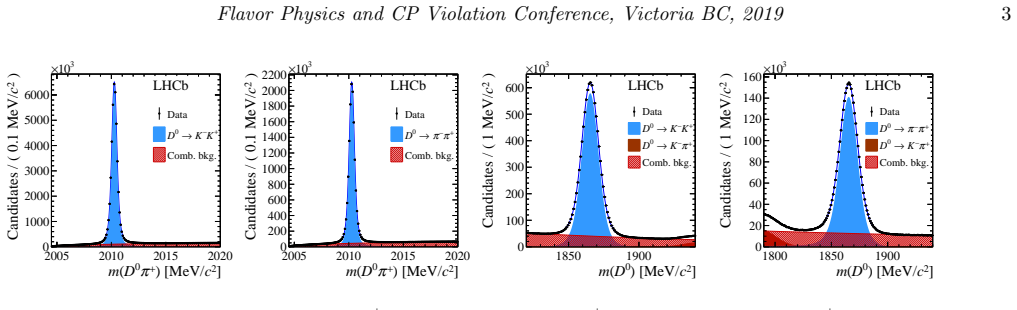


read the original abstract
In these proceedings, recent results on time-dependent and time-integrated measurements of $C\!P$ violation and of meson mixing in the charm sector are presented, including the first observation of $C\!P$ violation in the charm system.
Editorial analysis
A structured set of objections, weighed in public.
Referee Report
Summary. The manuscript presents recent LHCb results on time-dependent and time-integrated measurements of charm meson mixing parameters and CP violation, with the central claim being the first observation of CP violation in the charm system via time-integrated CP asymmetries in D0 -> K+K- and pi+pi- decays.
Significance. If the observation is robust, it constitutes a milestone result: the first evidence for CP violation in the up-type quark sector, enabling new tests of the CKM matrix and searches for beyond-Standard-Model contributions to charm decays.
major comments (1)
- [Systematic uncertainties and control-sample validation] The central claim of first observation of CP violation rests on the measured asymmetry exceeding residual detector effects (tracking, PID, trigger, production) and backgrounds after control-sample calibration. The manuscript must include explicit tables or figures (in the systematic-uncertainties section) quantifying the size of these residuals relative to the ~10^{-3} signal level; without this, the observation significance cannot be assessed.
minor comments (2)
- [Abstract] The abstract and introduction should explicitly state the observed significance (in sigma) and the final measured asymmetry value with statistical and systematic uncertainties.
- [Introduction and formalism] Notation for the CP asymmetry (A_CP) and mixing parameters (x, y) should be defined at first use and used consistently throughout.
Simulated Author's Rebuttal
We thank the referee for the careful review and the emphasis on ensuring the robustness of the CP-violation observation can be assessed from the presented material. We address the single major comment below.
read point-by-point responses
-
Referee: [Systematic uncertainties and control-sample validation] The central claim of first observation of CP violation rests on the measured asymmetry exceeding residual detector effects (tracking, PID, trigger, production) and backgrounds after control-sample calibration. The manuscript must include explicit tables or figures (in the systematic-uncertainties section) quantifying the size of these residuals relative to the ~10^{-3} signal level; without this, the observation significance cannot be assessed.
Authors: We agree that explicit quantification of residual detector asymmetries is required to substantiate the observation. The underlying LHCb analysis (LHCb-PAPER-2019-006) validates all relevant effects (tracking, PID, trigger, production asymmetry) with dedicated control samples and shows that the residual contributions after calibration are at the level of a few times 10^{-4} or smaller, well below the observed ~1.5 x 10^{-3} asymmetry. Because the present document is a short proceedings contribution with strict length limits, a full table cannot be added without removing other essential content. We will, however, insert a concise paragraph in the systematics discussion that states the size of the dominant residuals (with reference to the full paper) and notes that they do not affect the 5.3 sigma significance. This constitutes a partial revision. revision: partial
Circularity Check
No circularity: pure experimental measurement
full rationale
This LHCb proceedings paper reports time-dependent and time-integrated measurements of CP violation and mixing in charm decays, including the first observation of CPV. No derivation chain, ansatz, uniqueness theorem, or fitted parameter presented as a prediction exists. All results rest on data, detector calibrations with control samples, and background subtraction; the central claim is an empirical observation whose validity hinges on experimental control of systematics rather than any self-referential equation or self-citation reduction. The paper is self-contained against external benchmarks (real data) and exhibits none of the enumerated circularity patterns.
Axiom & Free-Parameter Ledger
Reference graph
Works this paper leans on
-
[1]
T. Aaltonen et al. [CDF Collaboration], Measure- ment of CP-violating asymmetries in D0 → π+π− and D0→ K+K − decays at CDF , Phys. Rev. D 85 (2012) 012009
work page 2012
-
[2]
M. Gersabeck, M. Alexander, S. Borghi, V. V. Glig- orov and C. Parkes, On the interplay of direct and indirectCP violation in the charm sector , J. Phys. G 39 (2012) 045005
work page 2012
-
[3]
R. Aaij et al. [LHCb Collaboration], Measurement of indirect CP asymmetries in D0 → K −K+ and D0 → π−π+ decays using semileptonic B decays, JHEP 1504 (2015) 043
work page 2015
-
[4]
R. Aaij et al. [LHCb Collaboration], Measurement of the CP violation parameter AΓ in D0→K+K − and D0 → π+π− decays, Phys. Rev. Lett. 118 (2017) 261803
work page 2017
-
[5]
Y. Grossman, A. L. Kagan and Y. Nir, New physics and CP violation in singly Cabibbo suppressed D de- cays, Phys. Rev. D 75 (2007) 036008
work page 2007
-
[6]
A. L. Kagan and M. D. Sokoloff, On indirect CP vio- lation and implications for D0-D 0 andB0 (s)-B 0 (s) mix- ing, Phys. Rev. D 80 (2009) 076008
work page 2009
-
[7]
Du, CP violation for neutral charmed meson decays to CP eigenstates, Eur
D.-S. Du, CP violation for neutral charmed meson decays to CP eigenstates, Eur. Phys. J. C 50 (2007) 579
work page 2007
-
[8]
N. L. Johnson Systems of frequency curves generated by methods of translation , Biometrika 36 (1949)
work page 1949
-
[9]
R. Aaij et al. [LHCb Collaboration], Measurement of CP asymmetry in D0 → K −K+ and D0 → π−π+ decays, JHEP 1407 (2014) 041
work page 2014
-
[10]
R. Aaij et al. [LHCb Collaboration], Measurement of the difference of time-integrated CP asymmetries in D0→ K −K+ and D0→ π−π+ decays, Phys. Rev. Lett. 116 (2016) 191601
work page 2016
-
[11]
M. Tanabashi et al. [Particle Data Group], The Re- view of Particle Physics (2018) , Phys. Rev. D 98 (2018) 030001
work page 2018
-
[12]
J. M. Link et al. [FOCUS Collaboration], Study of the D0→K+K −π+π− decay, Phys. Lett. B 610 (2005) 225
work page 2005
-
[13]
P. del Amo Sanchez et al. [BaBar Collaboration], Search for CP violation using T -odd correlations in D0→ K+K −π+π− decays, Phys. Rev. D 81 (2010) 111103
work page 2010
-
[14]
R. Aaij et al. [LHCb Collaboration], Search for CP violation using T -odd correlations in D0 → K+K −π+π− decays, JHEP 1410 (2014) 005
work page 2014
-
[15]
Opportunities in Flavour Physics at the HL-LHC and HE-LHC
A. Cerri et al., Opportunities in Flavour Physics at the HL-LHC and HE-LHC , arXiv:1812.07638 [hep-ph]
work page internal anchor Pith review Pith/arXiv arXiv
-
[16]
Y. Amhis et al. [HFLAV Collaboration], Averages of b-hadron,c-hadron, andτ-lepton properties as of sum- mer 2016, Eur. Phys. J. C 77 (2017) 895
work page 2016
-
[17]
A. Di Canto, J. Garra Tic´ o, T. Gershon, N. Jurik, M. Martinelli, T. Pilaˇ r, S. Stahl and D. Tonelli,Novel method for measuring charm-mixing parameters using multibody decays, Phys. Rev. D 99 (2019) 012007 ThuB1115
work page 2019
discussion (0)
Sign in with ORCID, Apple, or X to comment. Anyone can read and Pith papers without signing in.